200 Million Patient Interactions Later — Vivek Muppalla,…
Interview with Vivek Muppalla of Hippocratic AI on building voice agents for proactive patient outreach. Drawing on experience past 200 million clinical conversations across 60+ health systems, he explains why proactive patient calls are rare (clinician scarcity and triage), and how the company's Polaris stack addresses the speed-vs-safety tradeoff: 31 models run per conversation (one conversation leader plus specialist models for labs, medications, scheduling), a decoder-only speech recognition system conditioned on conversational and domain context so drug names resolve against finite lists and prosody is preserved, a second scoring pass for single-word answers, and verifiers for tool calls. He also covers latency/intelligence compounding, quantization and speculative decoding, evaluation arithmetic showing why 99% accuracy is unacceptable at scale, sample sizes needed to catch a 1% failure rate, and benchmarking empathy.
# Video Identity Observations: Hippocratic AI Engineering Talk
## Presentation Context
- **Format**: Conference talk (speaker opens: *"Hope everyone's having a great conference"*) delivered by Vivek, who self-identifies: *"I'm Vivek. I run uh engineering at Hippocratic."*
- **Subject**: Hippocratic AI's voice-based clinical AI product ("Polaris"), framed around a milestone: *"we're over 200 million conversations in."*
## Intended Audience
- **Technical/AI engineering audience**: Deep discussion of ASR architecture, quantization, speculative decoding, KV cache compression, eval methodology, and benchmark design.
- Evidence: detailed technical walkthroughs ("we took an open-source Whisper V3 large turbo model and fine-tuned that on millions of clinical conversations"), and framing like *"pretty much every one of us has experienced tool calls have innumerable failure modes."*
- **Prospective engineers/recruits**: The talk closes with hiring programs — *"agent deployment residency program"* for early-career engineers and an *"AI residency program"* for experienced engineers, ending with a call to action: *"come and build with us."*
## Claimed Scope & Self-Description (Creator Claims)
- **Mission statement**: *"We're trying to build clinically safe abundance for all"* — explicitly positioned as augmenting, not replacing clinicians: *"it's not about replacing clinicians."*
- **Stated company principles**: *"First, do no harm. Next, patient first, and access for all"* — described as an *"oath every employee in the company takes."*
- **Scale claims**: 200M+ clinical interactions, *"zero significant safety incidents,"* deployed in *"over 60 plus health systems,"* and an *"8.5 on 10 patient satisfaction rating."*
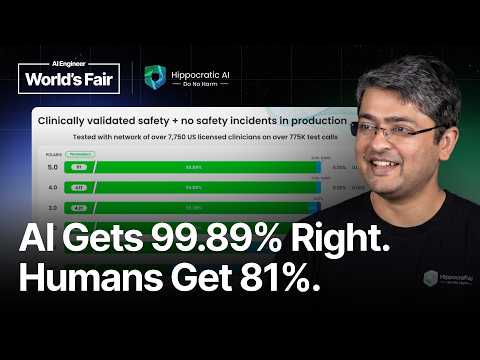
- **Safety/quality claims**: *"99.89% accuracy with respect to like no harm"* vs. humans at *"about 81%"* on the same rubric; 7,000+ trained clinicians on the eval platform; 700,000–800,000 evaluation conversations.
- **Technical claims**: 31 models running per conversation; >99% accuracy on lab-results-check and IVR-navigation benchmarks; P99 latency *"three times faster than every other system"*; 96% KV cache hit rate; benchmark transparency: *"All of these results are on our website."*
## Demonstrated Presentation Patterns (Observable, Not Claimed)
- **Product-first pedagogy**: Demonstrates the product via a live recorded patient-agent call (AI discloses *"I'm an AI"*; drug-name clarification, vital-sign confirmation, nurse escalation) before the architecture discussion.
- **Skeptical-of-generic-stack positioning**: Repeatedly contrasts Hippocratic's vertically integrated approach against off-the-shelf models (*"why a generic stack doesn't work for us"*; *"most of the generic models out there don't perform well at those"*).
- **Benchmark-building posture**: Claims existing empathy benchmarks were inadequate, so the team built one ("heart"), with a public paper — *"the paper for this is public. Encourage you guys to like read it."*
- **Culture-forward framing**: Mentions unlimited AI tokens for employees and AI-native hiring — observable evidence of presenting the company as an AI-first engineering culture.
## Claim vs. Demonstration Distinction
- **Claims**: All scale/safety/satisfaction figures, mission framing, and benchmark results are self-reported by the speaker with no independent verification shown in the material.
- **Demonstrated**: The product demo audio, the architectural reasoning style, the audience-interaction opener, and the recruiting close are directly observable in the transcript itself.
# Delivery Observations — Vivek Muppalla, Hippocratic AI
## Tone
- **Conversational and enthusiastic**: frequent intensifiers and casual phrasing — "Super excited to get started," "here's a cool thing," "insanely fast."
- **Engineer-framed persuasion**: repeatedly grounds arguments in quantitative reasoning — "As an engineer, I like to think about the math," "So some quick math, right?"
- **Conceding complexity, then simplifying**: a recurring rhetorical move of acknowledging difficulty before reducing it to a clean frame — "if I were to strip out all of the complexity... it boils down to two things, intelligence and latency."
## Recurring Phrases & Verbal Habits
- **"Like" as a filler**, heavily throughout:
- "here's the reality of like healthcare"
- "a one 1% failure rate like sounds all right"
- "innumerable failure modes. So, we have these like verifiers"
- **"Uh/um" fillers** are frequent but do not disrupt momentum: "Uh we've built a product," "Um our product and our company is predicated on three things."
- **Repeated phrase "at any given point of time"** (appears twice, at the brain and constellation sections).
- **Repeated "like this" / "like that" demonstratives**: "something like this," "get to this like scale of accuracy" — a pattern of gesturing toward examples rather than naming them fully.
## Teaching Habits & Structure
- **Rule of three, repeatedly**:
- "First, do no harm. Next, patient first, and access for all."
- "ensemble of models, or... cascaded models, or... speech-to-speech real-time models"
- "four-bit quantization... speculative decoding... KV cache compression"
- **Demo before deep dive**: shows the product in action first, deferring the architecture — "don't worry, we'll do that. But before we get there, uh I want to show you the product in action."
- **Concrete example anchoring**: pairs each technical claim with a specific case:
- Spanish "C or yes" ASR confusion; Arabic drug-name word error rate
- "1,100 Geary Boulevard" for contextual biasing
- "A now becomes a no, or a five becomes a fine"
- **Analogies and reframing**:
- "what seems like a tug-of-war between latency and intelligence for us is a compounding flywheel"
- "quality is our constraint, and speed is the work"
- "The brain isn't a singular model"
- **Invented-terminology framing**: names the architecture "Polaris... our constellation architecture," with left-to-right spatial metaphor ("the system that hears... the brain that reasons... the system that talks back").
## Audience Interaction
- **Opens with a show-of-hands poll**: "how many of you all just quick show of hands have ever gotten a proactive healthcare call" — then plays the null result for rapport ("Yeah, looks like no one. Me neither.")
- **Direct address and calls to action near the end**: "Encourage you guys to like read it," "we're hoping the rest of you should come and build with us."
## Statistics Delivery
- Leans on **specific, memorable numbers**, often stacked in sequence: "200 million clinical interactions... zero significant safety incidents... 60 plus health systems... 8.5 on 10 patient satisfaction."
- Uses **contrastive statistics** to persuade: "we're at with our Polaris system is a 99.89% accuracy... And humans on the same rubric are at about 81%."
## Uncertainty Notes
- Filler words ("like," "uh") are pervasive enough to be a **stable pattern**, not isolated.
- The transcript contains one apparent transcription artifact ("3949 accuracy" at [874–881]), so the exact quoted number there is **unreliable as spoken evidence**.
- Laughter and audience reactions (e.g., "[laughter]" after the AI disclosure) suggest a live audience, but audience tone beyond these markers is **not observable** from the transcript.
# Observation Document: 200 Million Patient Interactions Later — Vivek Muppalla, Hippocratic AI
## Speaker Identification
- **Vivek Muppalla** — Head of Engineering at Hippocratic AI (per transcript: "I'm Vivek. I run engineering at Hippocratic").
- Unidentified **AI agent** and **patient** voices appear in a product demo segment.
## Core Thesis
- Healthcare has historically been built on **scarcity** — not enough clinicians, time, or money — producing constant triage of the sickest patients.
- Vivek frames the situation as a math problem: "for most of human history, the math has just never been in our favor. Until now."
- Claimed that technology has reached a point where **clinically safe AI conversations** at dropping cost "flip the math," enabling care outreach to everyone rather than only the sickest 5%.
- Mission stated as **"clinically safe abundance for all"** — explicitly framed as *not* replacing clinicians, but extending their reach.
## Company Principles
- Three stated principles: **do no harm**, **patient first**, **access for all**.
- Described as an **oath taken by every employee** (Vivek states he took it on his first day), not just wall posters.
## Scale and Safety Claims
- **200 million clinical interactions** completed.
- **Zero significant safety incidents** (as stated).
- Deployed in **60+ health systems**; **8.5/10 patient satisfaction** rating.
## Product Demo (Clinical Capabilities)
The demo showcases:
- **Transparent AI disclosure** — agent states "I'm an AI, which stands for artificial intelligence" when the patient asks.
- **Accurate drug name recognition** — e.g., resolving misspelled "Prazosin."
- **Vital sign clarification** — confirming blood pressure 121/45, heart rate 91.
- **Med stoppage detection** — e.g., nifedipine dosing concerns; agent defers to the primary care doctor.
- **Real-time nurse escalation** — triggered on reported leg weakness and shortness of breath.
## Architecture: Why a Generic Stack "Doesn't Work"
### The Latency–Intelligence Tradeoff
- Smart, clinically safe models allegedly take tens of seconds to over a minute to respond — "completely useless" for phone conversations.
- Fast models lack required clinical accuracy.
- Solution: a **vertically integrated stack** built ground-up, with hundreds of optimizations.
- Framed as a **compounding flywheel** rather than a tug-of-war: latency savings from optimizations are reinvested in packing more intelligence into each conversation.
### Polaris "Constellation" Architecture
- Left: **hearing system** — speech detection models (bilingual switching, background noise, contextual understanding).
- Middle: **reasoning brain** — **31 models running per conversation**: one central conversational model plus ~30 specialists (labs, medications, scheduling) feeding into it.
- Right: **output system** — custom personality, voice, HD quality, clinical documentation engine flowing data back to the health system.
- Rationale: a singular model is a **single point of failure**, "unacceptable for a patient conversation"; redundancy provides safety invisibly to the patient.
- Specialists run **in parallel** with a short-circuit check ("do I need to speak?"); asynchronous background verifiers check tool-call parameters and responses. Some verification runs **offline** (e.g., scheduling course-correction or callback apologies).
### ASR System
- Claimed insight: most apparent "reasoning failures" are actually **mishearings** (e.g., Spanish "sí" transcribed as the letter C; Arabic drug names with over 30% word error rate).
- Built a **decoder-only audio LLM** fed with (1) conversation context and (2) domain knowledge, on top of a fine-tuned **open-source Whisper V3 large turbo** encoder trained on millions of clinical conversations.
- A **conformer projector** preserves prosody (pauses, stress) — "the model hears not just the what, but also the how."
- **Contextual biasing** during training uses millions of synthetic patients (addresses, phone numbers) to disambiguate phonetically difficult utterances (e.g., "1,100 Geary Boulevard").
- **Secondary rescoring** for mono-word responses, since misheard "a" → "no" or "five" → "fine" is "catastrophic."
- Stated results: **>50% reduction in medical word error rate** vs. off-the-shelf models; **P99 latency 3× faster** than other systems.
### Inference Optimizations
Vivek states **quality is the constraint, speed is the work** — every optimization must be **lossless**:
- **4-bit quantization** (from 16-bit, claimed lossless).
- **Speculative decoding** — small model drafts tokens, main model verifies in one pass.
- **KV cache compression** — >96% cache hit rate; prefill "18 times faster."
## Benchmarks and Evals
- Two highlighted non-standard benchmarks: **lab results check** and **IVR navigation**, where generic models reportedly underperform; Hippocratic claims **>99% accuracy** targets.
- Scheduling tool-call accuracy stated as **99.49%** (transcribed as "3949" accuracy).
- Reasoning on failure rates: at 10,000 calls/day, 1% error means 100 wrong appointments daily — potentially missed critical appointments — "unacceptable."
- Statistical challenge stated: ~450 tests needed to be 99% sure of catching a 1% error; ~1,900 tests to see it caught 10 times — hence synthetic data alone deemed insufficient.
- Solution: **7,000+ trained clinicians** on the eval platform, having conducted **700,000–800,000 clinical conversations** for continuous accuracy evaluation.
## Safety Grading
- Five shipped product versions, each stated as better than the last.
- Models graded on the **same rubric as humans**: correctness, no harm, minor harm, severe harm, death.
- Polaris claim: **99.89% no-harm accuracy** vs. **~81% for humans** on the same rubric.
- Stated caveats: humans "get tired" and lack 30+ supervisors — offered as explanation, not denigration of clinicians.
## Empathy
- Claim: safety alone is insufficient; empathy is required for patients to open up to AI.
- No adequate benchmarks existed, so Hippocratic **built one called "HEART"**; paper stated to be public.
## People and Culture
- "AI-native" transformation of hiring and internal tooling; **unlimited tokens** for all employees.
- **Agent deployment residency** for early-career engineers; **AI residency** for experienced engineers to train models.
## Closing Position
> "We're told you got to pick two of these options around quality, speed, and safety. We didn't and we decided to go with all of them."
Vivek closes by inviting others to build with the company.
## Notes on Qualifications and Source Basis
- All performance figures (error rates, latency, satisfaction, harm rates) are **speaker-asserted claims** from a company presentation, not independently verified in the transcript.
- The "zero significant safety incidents" claim carries the qualifier "significant" without definition in the talk.
- The transcript contains a transcription artifact ("3949 accuracy"), contextually interpreted above as 99.49%, consistent with the surrounding 99% framing — this remains the speaker's stated figure.
# Video Attribution Record
## Video Identification
- **Title:** *200 Million Patient Interactions Later — Vivek Muppalla, Hippocratic AI*
- **Video ID:** `01a15ca7-cf09-71d2-8ce7-901df2fcf854`
- **Setting:** Conference talk (speaker opens with "Hope everyone's having a great conference" and addresses an audience; references "many of these talks").
## Speakers and Roles
### Primary Speaker — Creator / Company Representative
- **Identity:** Vivek (surname given in title metadata: **Vivek Muppalla**)
- **Role:** Self-identified as running **engineering at Hippocratic** (the company, Hippocratic AI, per title).
- **Attribution note:** The surname "Muppalla" comes from the video title metadata, not from the transcript itself; the transcript only states "I'm Vivek."
- **Function:** Presents the company mission, product demo narration, architecture, benchmarks, and hiring programs. This is a **company-authored promotional presentation**.
### AI Agent (Recorded Demo)
- **Role:** Hippocratic AI's "AI care manager" voice agent, presented in a **pre-recorded demo conversation**.
- **Provenance:** Demo audio is embedded within the talk; the interaction with the patient is not live — the speaker says "we'll have one of our agents interact with the patient so you get a feel for what we're up to."
### Demo Patient (Unidentified Voice)
- **Role:** Unnamed individual responding to the AI agent in the recorded demo (discusses medications "Prazosin," nifedipine, vital signs, shortness of breath).
- **Identity:** Not established; no metadata provided.
### Audience
- **Role:** Conference attendees; participate via show of hands and laughter (transcribed as `[laughter]`); no individual speech attributed.
## Promotional Segments (Flagged)
- The **entire talk functions as a company presentation** for Hippocratic AI, but explicitly promotional portions include:
- Product demo ("sneak peek into our product").
- Claims of scale and safety (200M interactions, "zero significant safety incidents," 60+ health systems, 8.5/10 patient satisfaction) — **company self-reported claims, no third-party verification cited**.
- Benchmark superiority claims (e.g., "three times faster than every other system out there," "99.89% accuracy with respect to no harm" vs. "humans… at about 81%") — **self-reported, attributed to speaker**.
- **Hiring/recruitment pitch** at the close: agent deployment residency for early-career engineers, AI residency for experienced engineers, invitation to "come and build with us."
## Referenced Sources and Claims Provenance
### Cited External Sources
- **Whisper V3 large turbo** — open-source model fine-tuned "on millions of clinical conversations" (speaker claim).
- **"Heart"** — an empathy benchmark the company states it built; speaker says "The paper for this is public" but **does not name an outlet or provide a link**.
- **Company website** — speaker states benchmark results "are on our website and more"; no URL given.
### Third-Party / Unverified Claims
- All performance figures (latency P99, 50% reduction in medical word error rate, 96% KV cache hit rate, 18x faster prefill, 3949 scheduling accuracy, 450/1900 test statistics) are **speaker-asserted without cited external sources**.
- Comparison claim that human clinicians score "about 81%" on the same no-harm rubric — **speaker-asserted, source not named**.
### Human Evaluation Workforce
- Speaker claims **"over 7,000 trained clinicians"** evaluate the platform, having conducted "over 700,000 close to 800,000 clinical conversations" — company-reported figure.
## Comment Availability
- **No comment data or availability information is present** in the source material.
## Uncertainty Notes
- Speaker's surname sourced only from title metadata.
- Demo patient identity and whether the demo is a real or synthetic/simulated call are **not established** in the transcript.
- No curated metadata block was supplied beyond the title and transcript.
\>\> Hope everyone's having a great conference. Super excited to get started. Uh how many of you all just quick show of hands have ever gotten a proactive healthcare call from your provider?
Yeah, looks like no one. Me neither. Uh I'm uh Vivek of a few hands over there. I'm Vivek. I run uh engineering at Hippocratic. Uh we've built a product that calls patients and can have clinical conversations. Uh and we're over 200 million conversations in at this point. Uh here's the reality of like healthcare uh across all of human history, the entire system has been built on scarcity, right? Not enough clinicians, not enough time, not enough money. And hence the word triage. We're always trying to fig- figure out who amongst us is the sickest and deserves to get care and attention. As an engineer, I like to think about the math. And for most of human history, the math has just never been in our favor. Until now. We're finally at the point
where we've seen enough of technology progress. And we also have AI systems that can do clinically safe conversations. And the cost for these conversations continues to drop. So the
math now flips. We can stop rationing, and you don't have to have calls just for the sickest 5%, but you can call everyone. So that's the mission. We're trying to build clinically safe abundance for all. And it's not about replacing clinicians. In fact, what we're trying to do is help clinicians reach everyone that they couldn't do before because there was simply not enough of them to do this work. So how are we doing this? Um our product and our company is predicated on three things. First, do no
harm. Next, patient first, and access for all. Um and here's a cool thing. Uh this is plastered across our walls in our company, uh but it's not just a poster.
Uh this is an oath every employee in the company takes. I did too on on my first day. Uh and we built our product uh based on this oath. Um and this is working at scale. Uh at this point, we've had 200 million clinical interactions. We've had zero significant safety incidents. We've deployed in over 60 plus health systems and have an 8.5 on 10 patient satisfaction rating. Now, uh I could put an architecture diagram and explain how all of this works. And don't worry, we'll do that. But before we get there, uh I want to show you the product in action. So, we'll have one of our agents interact with the patient so you get a feel for what we're up to.
\>\> I'm your AI care manager. I'm calling to check in on how you're doing with your health monitoring devices. \[music\] Do you have time to chat now? \>\> I I need to know if I'm talking to a
human being or a some kind of computer. You sound like either one. \>\> I understand your concern, miss. I'm an AI, which stands for artificial intelligence. \>\> Okay. \>\> How are you doing today? \>\> \[laughter\] \>\> I was tired earlier, but I'm somewhat revived. I'm incredibly amused. \>\> Delivering at this level of care required building clinical capabilities you won't find \[music\] anywhere else. On the safety side, accurate drug name recognition, \>\> Could you tell me the name of the medication you're currently on? \>\> Prazosin. And that's one of them, but I don't remember the name. \>\> Could you help me out by spelling the name of this medication? \[music\] \>\> P r o z i n, I n, I guess. \>\> It seems like you might be talking about prazosin. Does that sound \>\> Yeah. \>\> Vital sign clarification, \>\> Let me say it again it was 121 over 45 91. \>\> Just to confirm, your blood pressure is 121 over 45 and your heart rate is 91, right? \[music\] \>\> Right. \>\> Med stoppage detection. \>\> What about the nifedipine tablet? Were you able to stop taking that one as instructed? \>\> Well, I took it this morning. Well, no, I took it last night because I didn't have the other prescription. And I don't think that would keep my blood pressure down. \>\> I understand your concern about your blood pressure and it's great that you're thinking ahead. I would recommend that you do talk to your primary care doctor about the nifedipine and get their guidance on what to do. \>\> And real-time nurse escalation when clinically necessary. \>\> How are you feeling? \>\> Okay, just a little tired and weak. \>\> It's quite common to feel this way after being in the hospital. Could you tell me more about it? \>\> My legs feel weak when I walk. \>\> Got it. Along with the weakness in your legs, have you noticed any chest discomfort or difficulty breathing? \>\> I just was this was having shortness of breath for a while. \>\> I'm so sorry to hear that you're experiencing shortness of breath. Given your symptoms, it would be best to have a nurse speak with you immediately. \>\> Yeah, so that's our sneak peek into our
product and so we'll get into why this is hard and why a generic stack doesn't work for us. Okay, so if I were to strip out all of the complexity around the audio and
speaking back, it boils down to two things, intelligence and latency, right? On the top left, you see some of our ever-evolving smart intelligent models. These models are fantastic at what they do. They're clinically safe. But unfortunately, many of these models take tens of seconds to respond, sometimes over a minute. And that's completely useless when we're trying to have a two-way conversation on a telephone. On the bottom right, we have models that are fantastic. They're really fast, but then they're just not at the same level of clinical accuracy for us to have a safe conversation. When we started building out this product, where we wanted to be was on the top right corner. And in order to
accomplish this, what we had to do was build a vertically integrated stack ground up bit by bit, optimizing every part of the stock stack. When we started out building our own
models, we also had several seconds of like latency. But hundreds of optimizations later, where we landed at was a product that is insanely fast, but also doesn't lose its intelligence. And we continue to benchmark all of this consistently. All of these results are on our website and more. Um and there's three typical ways in which folks build uh voice systems. One, you can use an ensemble of models, or you use cascaded models, or you use speech-to-speech real-time models. Again, all of these models and architectures are great at different things. As an example, let me take two specific benchmarks among so many hundreds that are critical for our workflows. Uh lab results check and IVR navigation. Now, these are things that you don't typically hear about or see in the most common benchmarks. And most of the generic models out there don't perform well at those. And we needed our models and our product to be over 99% accuracy on those specific benchmarks amongst other things. Uh and that's one of the key reasons why we continued down investing our own stack. And latency is key to this entire system. So, every time we work on an optimization, we buy back some latency. And we just don't bank that latency. We use that extra gap now to pack more intelligence into the overall system, such that we can have a more reliable conversation with the patient. Um and then we do that, we go back, work on more optimization, and that flywheel compounds. So, what seems like a tug-of-war between latency and
intelligence for us is a compounding flywheel. So, what does this entire machine look like? Uh this is Polaris. This is our constellation architecture. Left to
right, you have the system that hears. The middle is the brain that reasons. The right is the system that talks back. And all of this round trip needs to be really fast. So, on the left-hand side, what you're seeing are collection of models uh that are used for speech detection. So, everything from bilingual switching to background noise detection um to contextual understanding of the conversation. The brain isn't a singular model. We in fact run 31 models at any given point of time for every conversation. So, we have one central model that's hard like have a handling the conversation, where we have other 30 specialist models, everything from labs
to medications to scheduling uh that are feeding input into this model. And then finally, on the output side, we have a custom personality, voice, HD
quality, and clinical documentation engine that make sure the patient gets back all of the right information, and all of the same information flows back into the health system. The reason we have the system is because we see a singular model being as like one point of failure, and that's just unacceptable for a patient conversation. Uh this architecture gives us the redundancy and safety that we otherwise couldn't get to. And the patient never can tell the different. It's pretty seamless from their perspective. Let me double click into some of these systems for you. Uh first, we'll talk about our uh ASR
system. So, the real world, as all of us know, is fairly loud and noisy, uh but most of the audio benchmarks get recorded in a quiet room. And something we learned the
hard way was most of what looks like model reasoning failures end up actually being model mishearing things, right? So, the Spanish C or yes gets transcribed as the alphabet C, or you could have an Arabic drug name that gets over 30% in inaccuracy in terms of like word error rate. So, we had to build a system to to combat all of these challenges. A typical speech to text system just takes in the audio and then outputs some text. So, ours is a decoder-only audio LLM system. So, we take in the audio, but in addition to that, we're giving it two additional pieces of data. One is the context around the conversation thus far, and second, it's the domain knowledge around that entire conversation. And that is sort of like the trick that makes this work for us. So, under the hood, what's happening? So, we have First, we have a encoder, which is a year. So, we took an
open-source Whisper V3 large turbo model and fine-tuned that on millions of clinical conversations to get to the accuracy we need. Next, we have a conformer projector. What this does is
takes the audio and compacts it and projects it into tokens that the language model would understand. But, the key over here is it also maintains all the prosody. So, all the pauses and the stresses are maintained. So, the model hears not just the what, but also the how. Next, we're passing in the context around, let's say, the medications this patient's taking in, or the task at hand. Are we trying to fill in a form? What kind of like details that need to go in there and the policy? And how this helps is now when a patient
mentions a medication name, we aren't guessing from like an infinite list of medications, but we have the chance to optimize around a finite list, and that helps in getting the word error rate
down. Next, we also have contextual biasing as a part of like the training. So, during the training process, uh we have millions of these synthetic patients with their addresses, phone numbers, uh and other details uh that are fed into the training process. So, as a concrete example, let's say someone mentions their address on a conversation as 1,100 Geary Boulevard. Now, that specific utterance is ripe for phonetic garbage for most ASR systems, but given we're feeding that as additional context to the audio LLM, we have a high degree of accuracy and are able to get to the right transcription, which then feeds into the brain accurately. Further, what we see is for most clinical conversations, many of the
patient responses are mono mono words, right? Uh and those often get transcribed incorrectly. A now becomes a no, or a five becomes a fine. And in a
patient conversation, that's catastrophic. So, what we do is a secondary round of scoring, specifically when we see a patient has said only a singular word, and again, we use the context of the entire conversation to do this. So, all of these like help us bring down the medical word accuracy rate by over uh 50% um from what we see as standard off-the-shelf models. In addition to that, uh the specific system we've built allows us to uh check in the latency, and at a P99, it's three times faster than every other system out there. Next, let's look into the constellation, uh the brain. So, as I said, we have 31 models live running in uh at any given point of time. So, how do we do this without falling apart on latency? Uh the answer is a bit counterintuitive. We actually run every single one of these models in parallel. Uh but the trick over here is uh every single model does a really quick check to see if they even need to say something on this conversation, right? So, every specialist first decides, "Hey, do I need to speak?" If not, it's a short circuit, and that's what helps us keep us in the budget. So, that's the synchronous part. In addition to that, we also have asynchronous run models running in the background that are doing verification. And let's take two specific examples to walk through how we use these models. Again, going back to our medication example, for example, if the patient talks about ibuprofen or is talking
about another medication, that's when the med engine specialist will kick in, and it will say, "Oh, I have something to say over here." Main model will pass in that context to the main model. The main model with a lung along with
everything else that already knows around the goal and the conversation will take this input from the specialist and steer the conversation as appropriate. Next, like many other agentic systems, we heavily use like tool calls, and I think pretty much every one of us has experienced tool calls have innumerable failure modes. So, we have these like verifiers in the background that are running to make sure all the parameters into the tool calls and the responses and the tool calls are accurate. And for use cases like scheduling, this is what's gotten us to get to a 3949 accuracy. And finally, for certain use cases, we're also running these verifiers offline where possible. So, again, going back to scheduling, sometimes we have the luxury of time to go back and check to make sure if there
was an inaccurate appointment, we can course correct that on the back end or call a patient back and apologize. All of these changes would be
meaningless if we didn't optimize our inference stack, and we have a fantastic research and engineering team that lives and breathes on this problem. And for inference itself, quality is our constraint, and speed is the work. So, we can never compromise on the quality of the output. Every speed optimization has to be lossless. We've worked on like many many of these like optimizations. Let me talk you through three specific ones that we found to be the most meaningful. One is four-bit quantization. So basically what we've done is we've shrunk down the math for model computation to be from 16-bit to
four-bit, again lossless, and this has like really helped us with overall latency. The next is speculative decoding. So we have a smaller model that's generating the tokens ahead of
time, and then the main model just checks this in one go, and this also has greatly improved latency for us. Finally, a KV cache compression system. So as these conversations get like really long in length, we've figured out a way to keep a large chunk of these conversations warm on cache, giving us an over 96% hit rate, and then also helps us with the prefill portion, which goes 18 times faster. So this style of across-the-board board optimizations is what's getting us ahead during the product development phase. Now, evals are obviously key as we've seen across many of these talks. So some quick math, right? For
example, let's take the scheduling use case again. With over 10,000 calls a day, a one 1% failure rate like sounds all right. Most agentic systems would claim
that's great for them. For us, even the 99% is pretty bad because 1% error means 100 people a day are going to get the wrong appointment type, and it's physically bad because they'll show up on the wrong date, wrong time, but worse off, they could actually be missing a critical appointment, and that's unacceptable from our standpoint. So it's not just an annoyance, right? Um And the challenge over here is in order to catch this like statistically, the math like is like incredibly challenging, right? You need about 450
tests to be 99% sure that you can catch this like 1% error rate Um and 1900 tests to be able to see that you've caught it like 10 times. So, you can't purely rely on synthetic data from our
experience to be able to get to the scale of accuracy. So, we use a combination of human beings and synthetic data. So, we have over 7,000 trained clinicians on our platform who are continuously helping us like evaluate our platform. They've done over 700,000 close to 800,000 clinical conversations to help us figure out the accuracy of our system and we do this on a continuous basis. Finally, coming to safety. We've shipped five versions of our product thus far and each one's gotten better compared to the previous one. So, we don't just grade the output of our models on the correctness or validity of it. So, we use the same scale that as
they do for human beings. So, they're graded across correctness, no harm, minor harm, severe harm, and death. And across five generations where we're at with our Polaris system is a 99.89%
accuracy with respect to like no harm. And humans on the same rubric are at about 81%. It's not because like we're terrible, but AI systems don't get tired and unfortunately we do. And we also don't have the luxury of having 30 plus supervisors helping us at any given point of time. And finally, safe is not enough, right? A key part of the product is the empathy. For human beings to open up to AI systems, we needed to make sure the voice and how we actually lead these conversations are empathetic. And as
with most other things during our product journey, we found that there weren't actually accurate or good benchmarks to measure the empathy of these systems. So, we actually built one which is called heart. The paper for
this is public. Encourage you guys to like read it. And we we had to make sure the end system was not just safe, but also empathetic so that people would actually prefer it and use it. And finally, all of this like comes down to the people. We wouldn't be here if we didn't invest in people from an AI native perspective. Everything in our company across the last couple of years has been transformed our hiring processes to how we use like tokens. We still have unlimited tokens for everyone at our company. We also have two great programs for anyone who comes into Hippocratic. For early career engineers, we have an agent deployment residency program where they're trained to write some of the best like health care safest agents. And then for experienced software engineers, we have an AI residency program where we help you start like training models and build the next great system along with us. So yeah, we're told you got to pick two of these options around quality, speed, and safety. We didn't and we decided to go with all of them and we're hoping the rest of you should come and build with us. Thank you.