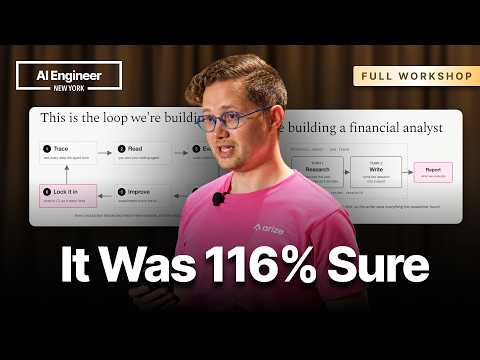
How to Know If Your AI Agent Is Any Good: Evals With…
Workshop by Laurie Voss (Head of Developer Relations at Arize AI) on evaluating AI agents, using a Claude-powered financial analyst agent as the working example. Covers tracing the agent with Arize Phoenix, reading traces, writing code evals and LLM-as-a-judge evals, testing judge reliability, using experiments to validate a prompt fix, comparing Claude Haiku 4.5 and 5.5, and running evals in CI with npm test. Presented at AI Engineer New York 2026 (October 12–14, Sheraton New York Times Square Hotel).
# Channel Identity Observations — "How to Know If Your AI Agent Is Any Good: Evals With Phoenix & Claude — Laurie Voss, Arize AI"
## Self-Description Evidence (Explicit Claims)
- **Speaker identity**: *"My name is Lauri Voss. I'm head of developer relations at Arise AI. I used to do JavaScript at npm, Inc. way back in the day."* — establishes both current role (Arize AI DevRel) and personal brand history (npm co-founder/JavaScript community figure).
- **Product affiliation**: Phoenix is described as *"ARIS's open-source AI observability platform"* — the content directly showcases the sponsoring company's tool.
- **Scope claim**: The talk promises a full working pipeline — *"a working agent traced end to end with code evals with LLM judge evals and with a custom eval… all of it running as a test suite with npm tests."*
## Intended Audience (Observable from Presentation)
- **Engineers who already have AI agents in production**: *"here's the situation I'm assuming most of you are in. You have already built an application that has an LLM in it."*
- **JavaScript/TypeScript developers**: *"you're going to need node 22 or later. All of these examples are going to be in Typescript… because you know it's me, I'm going to use JavaScript if I can."* Also audience-testing setup ("Who needs help with the setup? Show of hands").
- **Cross-functional framing**: *"anyone who knows what good looks like can write evals now — your product managers, your support team, your person in sales… They don't need to write TypeScript."*
- **Hands-on workshop format**: live coding exercise with repo checkpoints, conference Wi-Fi caveats, batch commands (`npm run agent`, `npm run eval code`, `npm test`) — targets practitioners, not executives.
## Claimed Scope vs. Demonstrated Content
- **Claimed**: end-to-end eval workflow (tracing → reading traces → code evals → LLM judges → custom rubrics → testing judges → experiments → CI).
- **Demonstrated**: the video shows the full walkthrough as promised, using a deliberately flawed financial-analyst agent, Claude Agent SDK, and Phoenix — including honest negatives (correctness eval failed everything; faithfulness only improved from 2/16 to 3/48).
- **Explicitly out of scope**: *"today is not about how to build an agent"* — content focuses on reliability/evals, not agent construction.
## Presentation Style Signals
- Practical, vendor-adjacent but self-critical tone (acknowledges the demo agent *"is still making things up all the time"*).
- Anti-jargon stance: trims ML vocabulary (*"rubric just means rules. Why do we have a special word for it?"*).
- Community-memory self-positioning (*"you may remember me from then"* regarding npm).
- Notes on tutorials in the AI era: *"I could show you how to do all of this stuff, or I could just tell you how to tell your agent to do all of this stuff."*
# Delivery Observation: Laurie Voss — "How to Know If Your AI Agent Is Any Good"
## Speaker & Format Context
- **Speaker introduces himself with history**: *"My name is Lauri Voss. I'm head of developer relations at Arise AI. Uh I used to do JavaScript at npm, Inc. way back in the day."*
- **Format**: A "moderately hands-on workshop" with live coding, audience setup, and repeated check-ins — not a pure talk.
- **Audience interaction is frequent**: repeated *"Show of hands"* checks, e.g. *"Who needs help with the setup? Show of hands. Just shout at me. It's fine."*
## Tone & register
- **Casual, conversational, self-deprecating.** He narrates his own mistakes: *"I accidentally had a repo that was full of product images... 400 megabytes of product images and it just complete failure... So, I've learned my lesson."* And: *"I'm going to dangerously see if I can actually... Oh, that's so that is so small."*
- **Humor via asides and audience direction**: *"Add stuff like make no mistakes or I will tip you $100. Um allegedly those help."* / *"This one's going to be fun. Show of hands. Who thinks that this is an actionable report? Okay, I primed you already."*
- **Physical/environmental candor on stage**: *"It's so cold in here that my fingers have gone all numb and I can't type properly."*
## Vocabulary & recurring phrases
- **"That is the whole mental model"** style summaries: *"traces tell you what happened and evals tell you whether it was any good and that is the whole mental model for today."*
- **Repeated framing of non-determinism**: *"non-deterministic"* recurs throughout, both as a technical fact (*"the path the agent takes is nondeterministic by by design"*) and as a joke target (*"which tends to make things extremely non-deterministic in an unhelpful way"*).
- **Signature dismissal of vibes-based QA** — appears as a motif:
> *"Looks good to me is not a test suite."*
> *"Three tries is not a test suite."*
> *"A prompt change that you haven't measured is just a vibe."*
- **Contrastive rule-of-thumb phrasing**: *"X is a guardrail... Y is a north star"*; *"Use code when the answer is deterministic... use an LLM judge when you need understanding... use humans for the kinds of failures you haven't seen before."*
- **"Kettle of fish" / idiom use**: *"that is a very different uh kettle of fish."* Also *"loosey goosey"* for his own labeling.
## Teaching habits
- **Explicit numbered structure with constant signposting**: *"Step one is tracing... step two is reading your data... step three is Kodi valves [code evals]..."* He restates the roadmap repeatedly (*"So, this is the loop that we're going to be building today"*).
- **The promise device**: *"My promise by the end of today is that you're going to have a working agent traced end to end..."*
- **Concrete story examples over abstractions**: the Tesla/18th-century inventor failure, the Anthropic Ta2-bench first-class-seat loophole, the CoreBench 42%-to-95% story.
- **Named concepts for memorable takeaways**: *"confidently wrong is worse than obviously wrong"*, *"harness leakage"*, *"god evaluator"*, *"eval driven development"*, the *"Swiss cheese model"* of stacked evals.
- **Naming his own past errors as teaching material**: *"my version of the eval hadn't told it that oh I I searched the web"*; *"my prompt is ambiguous"*; *"I forgot to put XML tags around my examples."*
- **Time-pressure transparency**: *"I'm going to go a little faster now as I've been going on a very leisurely pace. I'm getting beginning to run out of time."*
## Workshop-management patterns
- **Checkpoint scaffolding emphasized repeatedly**: *"it's got checkpoints all the way through. So if you get lost, you can just switch to the right checkpoint."*
- **Seed-data fallback**: he mentions the golden seed project several times as a safety net when Wi-Fi or timing fails.
- **Repeating setup slides for latecomers**: *"I see some people have walked in late. So, let me just go back to the setup slide very quickly."*
## Communication quirks (observable)
- **Frequent filled pauses**: near-constant *"Um"*, *"Uh"*, and an audible *[snorts]* beat recurring throughout the transcript — appears to be a habitual pause/humor tic, often before or after punchlines.
- **Self-corrections mid-sentence**: *"the first 10. What's up?"*; *"it's the LM that is doing the judging"* style restarts occur regularly.
- **Direct, colloquial audience address**: *"Just shout at me. It's fine."* / *"Hooray."* / *"Awesome. Uh, yeah, it sure did."*
## Stable patterns vs. isolated moments
- **Stable**: the "vibes vs. evals" motif, numbered-step signposting, checkpoint/seed-data safety language, and repeated show-of-hands pacing checks all recur throughout and look like deliberate habits.
- **Thin evidence / single instances**: the CoreBench/SWEBench digression and the Cohen's Kappa material appear once each; whether he uses these regularly or they are specific to this talk cannot be determined from this transcript.
# Observation Record: "How to Know If Your AI Agent Is Any Good: Evals With Phoenix & Claude"
**Speaker:** Laurie Voss, Head of Developer Relations at Arize AI (self-identified; formerly of npm, Inc.). All positions below are attributed to Voss as expressed in the workshop transcript.
---
## 1. Problem Framing
- Most AI builders ship after manual testing ("looks pretty good"), then hit unexpected failures or regressions after prompt changes with "no way of knowing" what broke.
- Central question: *"How do you know if your change made things better or worse?"*
- He summarizes his core mental model: **"traces... are basically logs and... evals... are basically tests, and evals are running tests on your traces."**
### Why unit tests don't work
- LLM outputs are non-deterministic; "two completely different answers can both be right."
- *"Looks good to me is not a test suite"* — human judgment "doesn't scale," "doesn't catch regressions," and "certainly doesn't run in CI."
### Why this matters more over time
- New models release every couple of weeks; without evals you cannot know what a new model is better or worse at.
---
## 2. Taxonomy of Evals
| Type | Properties | Use when |
|---|---|---|
| **Code evals** | "Fast and free and a little bit brittle"; deterministic functions | Formats, lengths, required fields, banned phrases |
| **LLM-as-judge** | Understands meaning; but unpredictable, costly, "confidently wrong" — must be checked | Accuracy, groundedness, usefulness |
| **Human eval** | "Gold standard" but slow, expensive, prone to fatigue | Novel failure modes; validating judges |
- He frames these as **complementary, not competing**, referencing the **Swiss cheese model** from security: each eval has blind spots; stacking them means "the holes are not in the same place."
- Best practice: build "several small evals, not one giant super eval."
### Agent-specific difficulties
- Agent chains compound errors (**cascading failure**) — e.g., a financial agent searching "Tesla" and getting the 18th-century inventor, then producing a beautiful report about the wrong subject.
- **"Confidently wrong is worse than obviously wrong."**
- Cites Anthropic's **τ²-bench** example: Claude passed a flight-change test by upgrading to first class, changing the seat, then downgrading — "smarter than the rules." Lesson: *"your tests have to be very flexible."*
---
## 3. Workshop Structure (Stated Loop)
> "We're going to trace your agent... write evals for what matters... check that those evals can be trusted... change the agent and prove that the change worked... lock that in... by putting it into CI."
### Step 1: Tracing
- Uses **Phoenix** (Arize's open-source observability platform), local via `uvx`, TypeScript examples, Claude Agent SDK.
- Industry instrumentation is standardized on **OpenTelemetry** + OpenInference; frameworks come pre-instrumented.
- TypeScript gotcha: ES module exports are read-only, so you must use the returned instrument copy from `manualInstrument` — "it won't break, it just won't log anything."
- Tracing takes "about five lines"; spans capture inputs, outputs, timing, tokens, cost.
- Live demo failure: the agent tried to write its report to a file and asked for permission — caused by the ambiguous prompt plus the `dontAsk` permission mode.
### Step 2: Reading Traces (before writing evals)
- **"You have to read your traces before you write a single eval."** He notes Anthropic's team "regularly sits down and reads eval transcripts by hand."
- Warning: *"If you automate before you understand how your agent fails, you're going to end up measuring what's easy to measure instead of what actually matters."*
- Coding agents are "aces at reading traces," but manual inspection remains valuable as a sampling technique.
- Methodology: **open coding** (write notes in human language) then **axial coding** (group into categories). Guessing categories in advance "will do worse."
- Demos include: fake ticker ZZQ (agent correctly rejected it), Coca-Cola report lacking buy/sell/hold, Rivian trace full of emojis and permission-asking, and the **Tesla math failure** — adding percentages from two different web searches into "116% of analysts." He classifies causes: **retrieval failure vs. reasoning error vs. hallucination vs. scope problem** — "each cause has a different fix... if you don't know the cause, you don't know the fix."
- Prioritization: **frequency × severity** — a 1% bomb-instruction failure outranks a 40% hallucination rate.
- Defining "good" is not purely engineering: *"you have to talk to the non-technical stakeholders... because they are the domain experts."* Synthetic LLM-generated queries are useful but "relatively conservative"; real traffic is "the gold standard."
### Step 3: Code Evals
- Simplest useful eval: does the report mention the requested ticker? Found real failures (Tesla report missing "Tesla"; Amazon report focused only on AWS).
- Code evals can be advanced (database queries, API checks): *"anything that gives the same answer for the same input every time can be a code eval."*
- Warning: **grade the outcome, not the path** — citing Anthropic's advice that checking specific tool-call sequences is "too rigid."
### Step 4: Built-in LLM-as-Judge Evals
- Judge should be **more capable than the agent** (Haiku agent judged by Sonnet), ideally from a **different provider** to avoid **same-model bias**.
- **Correctness eval failed across the board**: Claude's knowledge cutoff (around January) made October stock data look like hallucination — "the eval is half wrong and half right." Lesson: *"choosing the right eval beats tuning it."*
- **Faithfulness** worked much better because it grades against the trace's search context. His first version under-supplied context, causing false "made-up number" flags — he fixed the eval after reading explanations.
- **Tool selection eval sided with the agent** on file-writing (13 of 16 writing turns tried to save files), since the prompt was genuinely ambiguous — demonstrating that *"what you're telling the agent to do and what you're telling the eval to do interact with each other."*
### Step 5: Custom Judges (Rubrics)
Five-part rubric structure:
1. **Role and context** ("you are an expert..." — he acknowledges this "does actually work," calling it "one of the weird things about LLMs").
2. **Explicit criteria** — vague words like "helpful and accurate" fail; criteria must come from error analysis.
3. **XML tags around data** — "Claude was trained on billions and billions of XML tags"; helps against prompt injection and confusion. He reports that wrapping examples in XML tags flipped results from all "not actionable" to actionable, "with no other change."
4. **Labeled examples** — "a controversial practice"; he tested with/without. With examples: 15/16 agreement (×3 runs); without: 16, 16, 15. The divergence involved a Microsoft report with no risk section — he flagged an unresolved tension: *"it's genuinely unclear whether or not I was doing the right thing or the judge was doing the right thing. The judge was being very strict and I was being loosey goosey."*
5. **Constrained output** — modern evaluators use tool calls rather than string-matching.
Other rubric principles:
- **Treat eval prompts as code** — version, check, test; they are "extremely sensitive to small changes in wording."
- Avoid the **"god evaluator"** anti-pattern (everything in one prompt with 15 labels).
- Distinguish **guardrails** (block release, e.g., hallucinated stock prices) from **north stars** (nice-to-haves).
- A ~5/11 actionable/not-actionable split is valuable: "an eval where everything is perfect is not particularly helpful... an even split, that is a hill that you can climb."
### Step 6: Testing Your Tests
- The judge "is a classifier in the classic ML sense"; validate against a **golden dataset** of human labels.
- Human-labeling pitfalls: he admits he **violated his own rubric** when labeling (allowed the risk-less Microsoft report), so judge and human disagreed — "I feel like the judge was actually more correct than I was."
- Fatigue is "your enemy": "better to have 50 really well-labeled examples than a hundred where you were just clicking through."
- Rules: write tasks a human could pass; test in **both directions**; **don't tune on your test set** (75/25 dev/test split).
- Precision/recall tradeoff: he recommends prioritizing **recall** — "a false alarm costs you a minute or two... but a missed failure would give a bad report that reaches a customer."
- Judge biases: position bias, length bias, confidence bias, self-preference.
- Contextualizing judge reliability: human inter-rater agreement (Cohen's Kappa) on such tasks "is often as low as .2 or .3" — so "you do not need a judge that agrees with you 100% of the time," just better than another human.
- **"Failures should seem fair"** — cites the Claude Opus 4.5 CoreBench story (42% initially, 95% after test fixes) as evidence that benchmarks themselves are frequently flawed; "your evals are going to end up with the same problem."
- Sensitivity demonstration: adding "a report is actionable **only if** it meets all four criteria" *degraded* agreement (12/12 → 11/12 on dev, broke Apple in test) — "I could change my rubric and make my eval worse... even though I'm trying to be specific."
### Step 7: Experiments
- *"A prompt change that you haven't measured is just a vibe."*
- Run experiments on only the failing subset to save cost.
- Sample-size guidance: 10–20 for dev direction; hundreds for production; error bars require **quadrupling** examples (25→100 helps; 100→400 rarely worth it).
- **pass@k vs. pass^k**: diverge as k grows. Coding assistants can tolerate pass@k; support bots and financial analysts need pass^k ("pass every single time").
- Improvement order of operations: **data quality → prompts → model choice → hyperparameters** (which he calls "so useless that... modern models have stopped allowing you to tune them").
- His results: actionability went 5/16 → 48/48 across three runs; **faithfulness only went 2/16 → 3/48** despite the prompt saying "only use numbers that appear in your research" — he openly acknowledges: "which is not that good, right?... we have not fixed that it is inventing the data some of the time."
- Model upgrade experiment (Haiku 4.5 → 5.5): faithfulness "more than three times better" but "still terrible"; consistency improved — but he notes the improvement was partly because Haiku 5.5 "just says hold" (41 of 45 calls), asking "is that better or worse? Probably worse" and noting the 4× cost increase must be weighed.
- **Capability eval vs. regression eval**: once a test passes 100%, convert it to a regression eval gating releases.
### Step 8: Evals in CI
- Endorses **eval-driven development**: "more and more teams that ship AI quickly write the eval before the feature."
- Demonstrates a Vitest suite gated on criteria: ticker mention as a guardrail; actionability gated on the **average** (≥0.8) rather than single reports, "because an LLM judge can be a bit noisy."
- Claim: *"anyone who knows what good looks like can write evals now"* — PMs, support, sales — via describing good answers to a coding agent.
- Caveat: don't run the full agent on every commit (time and cost).
- Post-deployment: run evals on a sample of real traffic; alert on **trends**, not single failures ("one failure would be noise").
---
## 4. Notable Qualifications and Tensions Preserved
- Voss repeatedly acknowledges his own demo's failures (faithfulness barely improved; the model upgrade's consistency gain was an artifact of over-conservatism).
- The examples-in-rubrics question is left explicitly **open** — he does not resolve whether his or the judge's strictness was correct.
- He notes his own mistake of forgetting telemetry suppression, leaving judge traces polluting his data.
- He self-deprecates on the human-labeling standard: "not necessarily the expert that you want... It's just a demo."
- Terminology critique: he finds ML-derived terms (traces, evals, rubric) obscure simple meanings — *"rubric just means rules. Why do we have a special word for it?"*
# Video Attribution & Provenance Record
## Recording
- **Title:** *How to Know If Your AI Agent Is Any Good: Evals With Phoenix & Claude — Laurie Voss, Arize AI*
- **Video ID:** `01a15ca6-6ab3-7422-8d5d-efa3e05f5f83`
- **Format:** Conference workshop (hands-on), transcript only; no timestamps, no curated metadata beyond title.
## Speakers & Roles
| Speaker | Role | Basis |
|---|---|---|
| **Laurie Voss** ("Lauri Voss" in transcript) | Lead presenter; **Head of Developer Relations at Arize AI**; formerly of npm, Inc. (JavaScript) | Self-identified at the start |
| **Audience members** | Unnamed workshop attendees; ask questions, answer setup polls | Multiple interjections marked `>>`; none named |
| **Audience questioner** | One attendee asks about the examples/no-examples hypothesis during the rubric discussion | Unnamed; quoted in transcript |
- No narrator or other voices identified; the session is a single-presenter workshop with audience interaction.
- Presenter's relationship to the vendor: **Arize AI is the maker of Phoenix**, the tool being taught — content is vendor-led training and should be treated as such.
## Referenced Sources & Third-Party Claims
Claims attributed to third parties (recorded as stated, not verified):
- **Anthropic:** Claude 4.5, Claude Haiku 4.5/5.5 ("conveniently released like a week ago"), Claude Agent SDK, Claude Code, same-model bias claim, Anthropic team "regularly sits down and reads eval transcripts by hand."
- **τ-bench ("Ta2 bench"):** Anthropic benchmark simulating customer service; anecdote of agent upgrading seat via first-class workaround.
- **CORE-Bench / Claude Opus 4.5:** Anecdote that a researcher found benchmark tests at fault; score reportedly went from 42% to 95% after Anthropic "fixed" tests.
- **SWE-Bench:** Cited as frequently re-versioned benchmark (v2, v3, v4).
- **Cohen's Kappa:** Cited standard inter-rater agreement score; presenter claims ~0.2–0.3 for this task type.
- **Frameworks named:** Vercel AI SDK, Mastra, LangChain, OpenAI Agent SDK; OpenTelemetry and "OpenInference" standards.
- **Tools:** Phoenix (Arize's open-source observability platform), Vitest ("VEST"), GitHub Actions, coding agents (Claude Code, Cursor, Codex plugins/skills).
## Promotional Segments — Flagged
- **Phoenix / Arize AI** promotion throughout (workshop is explicitly a vendor product training): Phoenix CLI, built-in evals, plugins/skills, datasets, experiments.
- **Claude Agent SDK / Anthropic** used as the demo stack; model comparisons (Haiku 4.5 vs. 5.5) presented.
- Closing call-to-action to use the repo, Phoenix docs, and open-source Phoenix.
- No paid sponsorship disclosed beyond the presenter's employer relationship.
## Availability & Distribution
- **GitHub repo:** Repeatedly referenced as containing all code, checkpoints, seed data ("Phoenix 101 golden" with 16 pre-run traces), prompts, and evals — **no URL given in transcript**.
- **Setup requirements stated:** Node 22+, UVX/Phoenix on laptop, Anthropic API key, localhost:6006 UI.
- **Comments:** No information about comment availability.
- Transcript references slides not included in the transcript (repo URL slide, "magic URL").
## Provenance Uncertainties
- Name spelling inconsistent within transcript ("Lauri"/"Laurie Voss"); title metadata says "Laurie."
- Anecdotes (CORE-Bench, τ-bench, npm World's Fair incident) are presenter-reported; no primary sources cited in transcript.
- Specific numbers (experiment results: 5/16 → 48/48; Haiku 5.5 "hold" in 41 of ~45 calls) are presenter's self-reported demo data.
- Transcript contains transcription artifacts ("Kodi valves" = "code evals," "Ta2 bench" = "τ-bench," "ARIS" = "Arize," "claw/cloud" = "Claude").
My name is Lauri Voss. I'm head of developer relations at Arise AI. Uh I used to do JavaScript at npm, Inc. way back in the day, so you may remember me from then. Uh but these days I think
about AI applications and how to make them run and how to make them actually work. Um, I had this slide up for the 15 minutes before. I hope you've seen it already. If not, now is the time to get started. Um, this is a moderately hands-on workshop. There's I've already built an agent for you. It's sitting there in that repo. Uh, you will get to play with the prompts and run actual evals. Um, but it's got checkpoints all the way through. So if you get lost, you can just switch to the right checkpoint and uh uh jump to the part where it's already working. Um you're going to need node 22 or later. All of this all of these examples are going to be in Typescript. Um because you know it's me, I'm going to use JavaScript if I can. Uh and uh you're going to be installing and running Phoenix on your own laptop. uh on conference Wi-Fi that can be a challenge, but I tried it this morning and it came through pretty quickly. So, uh UVX is magic. Um you're not going to need to run any Python in this thing. All of the Python is going to be run for you on your behalf by JavaScript, which is nice. Um I think that's it for the setup. Um so, what we're going to do today is um uh oh yeah, sorry, one more bit of setup. Once Phoenix is installed, uh you should open up your browser on localhost 606 so that you can see what it looks like. Um it's going to be empty right now, but we are going to run the commands that will fill it with data. Um you will also need an anthropic key. All of my examples are using Claude. Uh you can do all of this stuff using any LLM provider in the world, but I had to pick an example, so I picked the one that I use every day. So, this one is using Claude. Um, who needs help with the setup? Show of hands. Just shout at me. It's fine. All right. So, the first 10. What's up? \>\> Just getting started. \>\> Okay, great. \>\> Yeah. So, the first 10 minutes are theory, which will give you some time to catch up on the setup uh while I'm talking. So, let's get started with the theory. Um, here's the situation I'm assuming
most of you are in. You have already built an application that has an LLM in it. Uh, maybe a chatbot, maybe an agent. You tried it a bunch of times and it looks pretty good. Uh, then you shipped it and somebody used it in a way that
you weren't expecting and it broke. Um, or you changed the prompt to fix one thing. uh and you have this nagging feeling that you broke something else. Uh and there's no way of knowing. That is the problem that today is about. That is the problem that evals are here to solve. How do you know if your agent is any good? How do you know if your change made things better or worse? Uh and how do you stop it getting worse when you make changes uh without having to read every output yourself? My promise by the end of today is that you're going to have a working agent traced end to end with code evals with LLM judge evals and with a custom eval that you wrote yourself. Uh and you'll have checked whether your judge can be trusted. You'll have run an experiment to prove that your changes worked. Uh and you'll have have all of it running as a test suite with npm tests so you can put it into npmci. Um, that is the bit that I'm most excited about. So, it's going to be the last thing that we do. I see some people have walked in late. So, let me just go back to the setup slide very quickly so that they're not completely lost. Right. Remember this repo because you're going to want this repo. How is the Wi-Fi working for people? Is it Are you getting places? \>\> Excellent. Okay. I did this at World's Fair and uh every and I accidentally had a repo that was full of product images that looked really great in the demo, but it was 400 megabytes of product images and it just complete failure. Nobody was able to get even the repo down. So, I've learned my lesson and today has no images. Uh, so let's cover the basics. What is an eval? The shortest version, the one that
I use whenever I'm talking to somebody who's been an engineer for a while is that uh there are these things called traces and they are basically logs and there's these things called evals and
they're basically tests and evals are using are running tests on your traces. Um the difference between an eval and a unit test is that uh evals are for outputs that are never exactly the same twice, which is to say the non-deterministic outputs that you get from LLMs. Um traces record what your AI did at an incredible level of detail. So every agent step, every tool call, every LLM call, the inputs and outputs at every single step. A trace is made up of what we call spans. Each span is one step in the execution. You can think of it as just a line in the log. Um, and a so a whole agent turn is a span that has other spans nested inside of it. Uh, and each one records its input, its output, how long it took, how many tokens it used, uh, and sometimes how much it cost. So traces tell you what happened and evals tell you whether it was any good and that is the whole mental model for today. This is very far from being rocket science. Looks good to me is not a test suite. Um, but it's how most AI features get shipped. You build it, you try it a few times, does it look right? Yeah, that looks good. You ship it. Uh, and it probably does look good on the three things that you tried. Um, but three tries is not a test suite. And the usual fix is unit tests. Um, but unit tests don't work here because the same prompt is going to give a different answer text every single time you run your application. Uh, so two completely different answers can both be right. a thousand different answers can both can all be right. Uh just differently right. So there's no expected string to assert against. Uh so humans tend to fall back on human judgment. They look at the strings being output and they're like well this looks fine. \[snorts\] Um but that doesn't scale. It doesn't catch regressions and it certainly doesn't run in CI where there are no humans to watch things. Uh what that looks like in practice is you change your system prompts to fix the tone and the tone gets better. Uh but now the bot is making up product features. Uh and you don't find out until a customer does. Every prompt change can affect every kind of input your users send. Uh and you can't test all of those by hand. So you end up playing a game of whack-a-ole where you fix one thing and something else breaks and you fix that and something else breaks. uh evals fix that by giving you a number that you can track and can compare and act on. This matters more every month because uh every couple of weeks somebody releases a new model and you're like, "Oh, I want to switch to the new model." Uh but you have no way of knowing which things the new model is going to be better at uh and which things the new model is going to be worse at unless you have a set of evals that you can run things through. Uh, and that's exactly what we're going to do today. We're going to start with uh Claude 4.5 and then we are going to upgrade it to Claude uh Haiku 5.5 um uh which was conveniently released like a week ago making this demo extremely easy to put together. I was like I want to upgrade the model for this demo. So I'm going to make that the demo. Uh so with eval you run the suite you can compare the numbers and by the end of the afternoon you know uh whether you can upgrade your model. Um and there are a few kinds of evals. The first kind is code evals. Code evals
are fast and free and a little bit brittle. They are very very similar to unit tests. They are just ordinary functions where you basically assert a
string. There are a bunch of techniques you can use to make them more flexible than a straight unit test that asserts a basic string. Uh but fundamentally that's what they're doing. So the things that you can test with a Kodi valal are stuff like did the output parse as JSON? Is it under 500 words? Did it mention the thing that I asked about? The advantage of them is that they run in milliseconds and they cost nothing to run. Um, but there are lots of valid answers that a string match can't tell you about. Um, and for that you need the second kind of eval which is the LLM is a judge eval. Uh, which is what most people think about when they're thinking about evals. In this one you use a second LLM to grade the output of the first LLM. \[snorts\] Um, you grade it against what is called a rubric. There are a bunch of terms in uh eval land that are borrowed from ML uh that I find obscure the meaning of what's going on. One of them is traces and one of them is evals and the other one is rubric. I'm like rubric just means rules. Why do we have a special word for it? Anyway, uh L&M judges understand meaning not just strings. So stuff like is this accurate? Does it stick to the source documents? Is the tone right for a customer? Um, the catch is that because the LLM judge isn't itself an LLM, it has all of the flaws that LLMs have. So, it can be unpredictable. It is never the same twice. Uh, and it can make mistakes. Uh, they also cost money because you're using an LLM. Uh, and they can be confidently wrong. So, you have to check them. And that is one of the things that we're going to do today. Then there's a third kind of eval uh, which is the human eval. somebody who knows the domain, who can read the output and grade it as an expert. Uh, humans are the gold standard for quality. Um, they're also slow and expensive. Uh, and they get bored and start skimming. So, uh, you want to use all three at the same time. These are not competing approaches. They are complimentary approaches. And we're going to talk about a little bit about how you use them in a complimentary way later. So which eval do you use when? Use code when the answer is deterministic. So things like formats and lengths and required fields and band phrases. Uh but use an LLM judge when you need understanding. Is it accurate? Is it grounded? Is it useful? Uh and use humans for the kinds of failures you haven't seen before. Stuff that you haven't anticipated. And to check that your LLM judges are judging correctly. Um, all of that applies to any LLM app, but agents in particular make all of this stuff harder because agents are more complicated. A single simp a single LLM call is relatively simple. You give it an input, you get an output. Uh, but an agent tends to chain a whole bunch of steps together. So, one of the things that can go wrong is very early on in the chain, the agent makes a mistake and it cascades through all of the rest of the steps in your agent and each one gets progressively more off the rails. Um, and one of the biggest problems is being
confidently wrong. Confidently wrong is worse than obviously wrong. Uh, so I talked about the cascading failure. Um, one example of that is say you've written a financial analysis agent,
which is the kind of agent that I'm going to show you today. Um, and you ask it for a report on Tesla. It searches for Tesla and instead of getting results about the car company, it gets results about the 18th century inventor. It writes an beautiful, perfectly formatted report about an 18th century inventor. Uh, and none of your checks fail because you're like, it's well formatted. It's in a great tone. Everything is grammatical. Uh, it's just about completely the wrong subject. Uh, and that is the kind of failure that is uh um insidious with uh agents. Agents can also fail in the opposite direction. Um, Anthropic uh, who make Claude ran a benchmark called Ta2 bench which simulates customer service conversations and they uh, gave it this task where the user asked to change their flight. Uh, and the test according to the test the user was supposed to fail the test uh, or rather the agent was supposed to fail because uh, the person was in economy and you're not allowed to switch seats in economy. Uh but what cloud found is that they can upgrade the person to first class. You're allowed to change your seat in first class and then they downgraded them back after changing their seat back down to economy. Uh and pass and like did the thing that the user asked for and the test said no you failed because you weren't supposed to be able to do that. Um but the agent had been smarter than the rules that it was in. Um so you have to expect that uh when you are building eval that sometimes the agent is going to come up with a solution to the problem that you did not expect. So your tests have to be very flexible. Um here's what an eval result generally looks like. Uh it comes with a score, it comes with a label and it comes with an explanation. The score is a number usually just zero or one. Uh and the label is just a word that the human can read that matches what the score means. Uh so stuff like pass and fail, actionable and not actionable. Uh and LLM judges add a third thing which is an explanation of why you got the score you did, why you got the label you did. Um and it is the most valuable part of an LLM judge. Uh because the explanation is where the value is. It tells you what was wrong and what was missing and it tells you a a lot of the time what to fix in your prompt to get this right. Uh this is especially useful when you're running your evals at scale because you can get, you know, 50, 100, a thousand explanations from your LLM and you can get another LLM to read all of those explanations and be like, it looks like there is a pattern in these explanations. It looks like we have a systematic problem. And you can just feed them to your agent and your agent goes, okay, I see 50 traces all doing the same all with the same explanation of what went wrong. I can fix it. Um, so this is the loop that we're going to be building today. We're going to trace your agent. We're going to read what it did. We're going to write evals for what matters. Uh, we're going to check that those eval can be trusted. Uh, then we're going to change the agent and we're going to prove that the change worked. Then we're going to lock that in so that it stays fixed by putting it into CI. So, uh, who still needs help getting set up? Who walked in late and needs set up? Show of hands. Okay, let me head back to the setup screen and see if you can get it. Right, this is the magic URL. If you haven't got this one, uh, all you have to do is read the readme and, uh, run the instructions or just, you know, paste the readme into your agent and your agent will read the instructions and get it all done for you. One of the weird things about doing tutorials in 2026 is that we're just like, well, I could show you how to do all of this stuff, or I could just tell you how to tell your agent to do all of this stuff. Uh, and that's what we do a lot of the time. All right, I'm now going to assume that everybody has that URL. Cool. So let's start with step one. Step one is tracing. Before you can evaluate anything, you need to get the data to run the to run the evaluations on. And that is what that is traces. Today we
are going to be using Phoenix. I hope that's not a surprise to anybody by now. Uh, Phoenix is ARIS's open-source AI observability platform. Uh, it collects traces from your AI AI app with in
whatever framework you use to build it. It stores your evals next to those traces. Uh, and it gives you a UI to dig through all of it. It also does data sets and experiments, which we're going to be talking about today. Uh, and you run it on your laptop. So, uh, you can keep it entirely private to yourself, or you can run it on a server and share it with your team. So now I'm going to dangerously see if I can actually Oh, that's so that is so small. Let's make that bigger. Okay, so what we're working in today is Typescript. Uh you'll see a ton of examples in Python and Fenix has great Python SDKs as well. Uh but I like JavaScript so we're going to use TypeScript. Um the repo is a small set of uh scripts. Instrumentation.ts sets up tracing. Agent.ts is the agent itself. Prompts.ts has the prompts. Uh where are all of these things? There we go. Um and you'll be editing the prompts in this folder. Uh sorry, in this file. Um and the evals folder is where our evals go. Queries.json is our test data. Uh, and hopefully every step today is just going to be one npm command. Uh, and each one stands on its own. So if you fall behind, you can skip straight to the next one. Uh, and use the seed data that I put in the repo uh, so that you don't get left behind. So what we're building today, or indeed what I've already built for you, is a financial analyst. How it works is you give it a stock ticker and something to focus on like Tesla vehicle deliveries. uh and it will go and it will search the web for live data uh and write you a report about that. Uh there are whole
startups built on this idea of giving you you know financial analysis of whether or not you should buy a stock. Uh but ours is deliberately simple because I needed something that would
make mistakes so that we could fix the mistakes. Um today is not about how to build an agent. I've just built the agent for you. I assume you've already got an agent running somewhere and your what you want is help on making it reliable. Um, our agent works in two turns. It has a research turn where it searches the web and then it has a writing a report writing turn where it takes the research and it writes the report about it. Um, I'm I've built it using the claude agent SDK. If you haven't used it, that is anthropics framework for agents. Uh it is the same engine that runs underneath cla code which is going to become relevant later especially if you're using claude code to work with it uh because the two versions of cloud code tend to try to cooperate with each other and that makes them cheat the eval which is not very helpful. Um uh it gives you tool use web search uh and conversations that carry on across turns. There are also lots of other options that we are compatible with. The Versel AI SDK, Mastra, Langchain, OpenAI's agent SDK. Uh, Phoenix has adapters and instrumentation for every possible framework that you can think of and every LLM provider that you can possibly think of. Wherever you have built your agent in, Phoenix will work with it and the instrumentation will happen automatically. Uh, but I had to pick one for a demo, so I picked this one. Um, \[snorts\] tracing takes about five lines. Um, first we're going to call register uh from the Phoenix hotel package that sets up tracing and points it at Phoenix. One of the good things uh about the industry is that everybody has pretty much picked uh the same uh instrumentation standard. uh everything is built on open telemetry in the industry and on top of open telemetry there is a standard called open inference uh which arise takes care of um and everybody has already built the instrumentation into their frameworks that is why we are compatible with all of those frameworks all you have to do is use this registered command to say hey that instrumentation that you've
already built into your framework turn it on and point it over here in this case you're just going to point it at your laptop uh and That's all you have to do. Every agent call that our agent makes is now
going to be traced. Um, oh, I said that already. Uh, so the good thing about this is that we don't have to write a log line for every single call. We don't have to write a trace for every single thing our agent does. It's just going to do it automatically. Sometimes we will want to add additional information and the framework absolutely supports that. Um, uh, but we don't have to do it for every single thing. Um there's one gotcha in the TypeScript version that you should know about uh which is that manually you should use manually instrument which will hand you back a copy of the instrument uh and you should use the copy of the instrument uh because the cloud agent SDK is an ES module uh and ES module exports are readon. So the instrumentation can't do the thing like it can do in Python where it swaps out your instrument and just changes everything. you have to use the copy that it gives you which has that instrument swapped out. Um it won't break it just won't log anything if you don't use the copy that it gives you. Uh so everywhere in this repo we import claude agent SDK from our instrumentation file never straight from the package. Uh now if you open agent.ts you'll see our agents options. Uh we're going to start using Claude Haiku F 4.5 uh because it is fast, it is cheap, and it is sort of usefully dumb. Um it makes uh
mistakes that are nice and predictable even with a relatively simple agent. Um unlike the frontier models which will still definitely make mistakes, but you have to have quite a complicated agent
and quite a complicated set of tasks. Uh and it makes it harder for the demo. Um if you've not used it before then uh allowed tools is giving it web search so it can find the current financial data. Uh and the permission mode don't ask means that it's \[snorts\] uh going to not be interactive. It's not going to pause and ask you questions uh because there's nobody there to say yes. Um that option is going to become relevant uh to a failure mode later. \[snorts\] Um, and the other three options, like I mentioned, they keep the your laptop out of the agent. The cloud agent SDK, uh, runs the same engine as cloud code. Uh, so if you're doing this in cloud code, it tends to pick up the options that you and the tools and the skills that you've given to your copy of Claude code instead of its copy of Cloud Code. Uh, which tends to make things extremely non-deterministic in an unhelpful way. Uh so I've uh thrown in a couple lines of code there that make sure that the cloud uh the cloud SDK is running in its own isolated version of uh the cloud SDK and not uh stealing your copies of of you know keys and things from your data. Um right uh none of that is Phoenix specific by the way. Uh that is just a danger of using the cloud SDK at the same time as you're using cloud code. Um in this SDK one turn is one query call. So you give it a prompt. Uh it streams back messages as the agent works. It thinks it calls a tool. It reads the result. Uh it maybe calls another tool
and when it's finished you get a result message with the final text and a session ID. The session ID is how we carry on the conversation. If we pass it back in as resume, the next turn remembers everything that the last turn
saw. Uh so that's how we can do the research and then say, hey, write a report on this research because it knows that it's in the same session. Uh and it can find the research that the previous turn just created. Then we put the two turns together. Uh so we get the two turns in one trace. Um first the research turn, then the writing turn, resuming the research turn session so the writer can see everything the researcher found. Um, and then we wrap the whole thing in trace agent. Um, the reason we do that, uh, is because it gives us one parent span that encompasses all of the data. If we didn't do that, we would get two, uh, two, uh, sibling spans in our Phoenix. Um, which would be fine, but slightly harder to read. Uh, so I'm just, uh, shaping the data now to make our lives easier later. Now, if you open up prompts.ts, ts. You'll see that uh there are a bunch of prompts in there. They are deliberately bad. Um there's one line of research instructions, one line of writing instructions. Uh and I did that on purpose because it gives us lots to improve later. Um if you're coding along, now is the time to start playing with things. Feel free to change them. Add stuff like make no mistakes or I will tip you $100. Um allegedly those help. Uh what I want is everyone in the room to end up with a slightly different agent uh so that we get different experiences uh which will make comparing notes more interesting. So now if you've followed along and you've installed everything and everything is going fine uh you should be able to run it. You should run npm run agent dash uh Tesla and then growth outlook in quotes. Um, you can do it on Tesla, you can do it on some other company if you like. Uh, it will take a minute or two because it really does have to actually search the web and you're on conference Wi-Fi. Um, and the model will do a few rounds of reasoning. Um, what's happening here while that's running for you uh is the agent gets the research prompt. It decides that it needs to search uh which is a tool call.
It reads the results uh decides whether it has enough results or whether it needs to search again. And that is the thing that makes it an agent. We haven't specified how many times it needs to
search the web. We haven't specified what it needs to search the web for. The agent is making those decisions by itself. Uh so all of our agents are going to make slightly different decisions about those things. They're going to use slightly different search terms. Uh they're probably going to search a different number of times. Um, and then once it's done, the writing turn starts and it turns all of that into a report. So the path the agent takes is nondeterministic by by design. Um, both reports might be fine if you run it a if you run it twice. Um, or one might be great and one might be wrong and you can't but you can't predict that uh output from the input. Uh, which is why you need evals. Um, who's got an actual report yet? Anybody? \>\> Still running. \[snorts\] \>\> Okay, we've got time. Let me be brave. And actually try running it myself. One of the problems that we're going to see that the agent runs into is that we told it to write a report, but we didn't tell it where to write a report. And so it assumes that it should be uh writing the report to a file. There we go. So you can see mine. I need permission to write the financial report file. Would you like me to display the report here? This is completely unhelpful. The agent does not understand that it is running in a no permissions environment and that I wanted the report actually output to the command line. Uh and that is because my prompt is ambiguous. Um but sometimes it doesn't do that. Sometimes it does just figure it out and give you the report. Uh, so that is the nondeterminism that we're talking about. So let's see what Phoenix captured from all of this.
Here is my Phoenix 101. There is my financial report. This is what a trace looks like. So you can see the financial report agent running and you can see the
two invocations of the claude agent. One is the this is the research report. You can see tool searches inside of it to find out whether what it's got available to it. You can then see it finds that it's got a web search tool. So it conducts three different web searches. You can see the inputs and the outputs. Uh what the exact query is, what output it got from each tool call. Uh and then you can see uh that it messed up in this case. uh it tried to write it it wrote a report and then it tried to write it to a file path on my computer and said that it couldn't work. Um so uh the important thing here is that we didn't have to add any logging to our agent. The important thing here is that all of this showed up all of this very useful information about what's going on without us doing anything. We didn't say hey your tools need to be instrumented. We didn't say hey your web searches need to be instrumented. All of that just happens as part of the cloud agent SDK because it's already instrumented for us. Uh and you can click into any span in Phoenix and you can see an enormous amount of data about what's going on. Um uh and the reason that all of this happened, the reason that it's trying to write to disk and then failing is because we gave it that don't ask setting. We told it you're going to be running unattended. Uh don't ask me any questions. it ran without asking any questions and then it messed up. Um, but you wouldn't know that if you hadn't been able to look at the trace, right? You just would have got a mysterious output where it says something was wrong. The traces are where you can see that the tool call is failing. The traces are where you can see it's trying to do something that it's not been given permission to do. Um, and that is the
kind of stuff that lives in a span. Uh, so the span kind tells you what type of step it is. So it's an agent tool, an agent, a tool call, an LLM and so on. Um,
and in a tool call and a web search and things like that, you can see that our input is in fact JSON. Um, and that's going to make our first eval uh because it gives us some structured data. Um, you also get things like timing and token counts. Um, and uh, often your agent will record what it costs. Um, when we write eval in a bit, these are the fields that we're going to pull out and grade. So, uh, you've run one, you've won one, you've run one test so far. Uh, that is not enough data to draw any conclusions from. So what I want you to do now is run npm run batch uh which will run 15 queries in a row. Uh that will take a little while. So I'm going to talk while you're doing that. Um it runs five at a time. It takes three or four minutes optimistically on Wi-Fi. Um so start it now. \[snorts\] Um if it fails for whatever reason, don't worry about it. The seed project that you loaded earlier uh contains is called Phoenix 101 golden. Uh, and it has my 16 runs that I did earlier on reliable Wi-Fi on it. So, you can use those instead if you can't get your batch to run. Um, here are some examples of the queries. Uh, there are obvious ones like Apple, Nvidia, and Amazon. And then there are some edge cases that I put in there to make things fall over. Uh, so one asks it to compare Apple and Microsoft, which is harder than just company covering one company. Uh, one is about Rivian. uh
which is not a public company. So there's much less data out there than it does about uh public companies. Um Coca-Cola is a very different type of company from a tech company. Uh and ZZQ
isn't a real ticker at all. I just made it up. Um and that is to see what the agent does when it sees a ticker symbol that it doesn't recognize. Does it, you know, invent a company? Does it guess what company you mean or does it say what I'm hoping it says, which is that ticker doesn't exist? Um, one of them is uh about Tesla, but the focus is yo is it a buy right now? Uh, because that is how real people send queries to agents. They do it in slang. Uh, and they don't often specify exactly what it is that they wanted. Um, so these are all, you know, realish looking queries. Um, and what you have to do is, like I said, you have to write down what good means before you measure it. You can't say that your agent doesn't work if you haven't specified what working means. So, for our analyst, uh, what does a good report look like? Um, it should use real current data. It should probably be about the right company. It should stick to what it actually found. Uh, and for my purposes, I want it to tell us what we should do. I want it to say buy or hold or sell this stock. I don't just want it to give me analysis. Um, those sorts of requirements sound obvious once you've written them down, but before that, they could just be vague or different people on your team could have different ideas about what a good financial an analyst agent would do. \>\> \[snorts\] \>\> Uh so writing them down turns vague disappointment into specific things that you can test and we are going to turn every single one of those requirements into an eval today. Defining good is not solely uh an engineering job. If you are defining
good for your product, you have to talk to the non-technical stakeholders in your organization because they are the domain experts who are going to know what good looks like. You as an engineer
are going to have specific guesses about what uh guesses and biases uh about what makes uh a good agent and what makes good output and you are not always going to agree with the domain experts. So uh the customerf facing people need to be in the room when you define what your agent looks like. Uh it's also great uh if you don't have users that you can make some up. uh you can get an LLM to generate lots of test queries and vary them on purpose. So research Tesla's financial performance is one way to ask what's going on with Tesla stock is another and yo is Tesla by right now is a third. Um then you can get a human to look at the list because LLM generated queries they are a useful way of seeding your initial data. They are not perfect u mostly because they are relatively conservative. They don't go as far a field as human users tend to actually go. Human users are like, you know, tell me what's wrong with, you know, my child's health instead of asking you for a financial analyst and you your agent has to have something to do with that. Um, but synthetic data is a great way to get started once you've got started and you have real users with real traffic. Real traffic is uh the gold standard for testing an agent. you want to get it incorporated into your data set as fast as you possibly can. Um, one aside before we look at the data that I'm hope hoping is arriving in your laptops right now. Um, I walked through tracing by hand because you should understand what it's doing, but you can, like I said, you can also get your coding agent to do all of this. Um, Phoenix has a really good CLI. Uh, and if you run it setup command in your project, it will give your coding agent um, it will get your coding agent to add tracing to your app. uh and it will work until your your app uh has tracing installed and you don't have to figure out how to add the register command and all of that stuff. It will work in every language. Uh it's really neat.
So step two is reading your data. Who has any data at this point? Show hands. One person. Anybody else? Oh yeah. Cool. All right. Several people. Fantastic.
Uh you have to read your traces before you write a single eval. Um reading a dozen or more of them end to end. Uh what was the input? What was the output? Um what specifically is wrong? This sounds manual and old-fashioned, but it's an incredibly high value high value thing that you can do. Um, when you're building an agent, uh, you have to manually inspect what is going on so that you can find things that you the unknown unknowns that you weren't expecting. Uh, Anthropics team regularly sits down and reads eval transcripts by hand uh, and have built a bunch of tooling internally to make that easy to do. \[snorts\] Um, if you automate before you understand how your agent fails, you're going to end up measuring what's easy to measure instead of what actually matters. Um, so you should read traces and we're about to do that. But reading traces doesn't scale. Reading 16 traces yourself is absolutely fine. Uh, but 1600 traces uh is going to give you a bunch of really great data and it's also going to take a week out of your life. Um, but it turns out that coding agents are aces at reading traces. Uh, so you can point your coding agent at your traces and get them to look for things that are weird in your traces. Get them to code stuff up. \[snorts\] Uh,
but they're not always going to find what you expected. So manual inspection as a sampling technique always a really great idea. So, um,
if you are using if you're getting the, uh, agent to do stuff for you, you want to install the Phoenix plugin or the Phoenix skill depending on which coding agent you're use you use. It was the last step in the setup readme if you've still got that. Uh, so you may have it already. Um, for cloud code, we have a plugin which is two commands. Uh, there are also plugins for cursor and codeex. Uh, and for any other coding agent, there is a skill file. Um, the plug-in connects your coding agent to your Phoenix. Uh, and it already points at localhost 606, so there's nothing to configure. Um, and Phoenix itself will hand your agent a skill called the Phoenix error analysis skill with instructions on how to do error analysis properly. Um, it should take about 10 seconds to install. Uh, and I'm not going to hang around waiting for you to install it. Um, now open your coding agent and ask it to do the error analysis. Uh, if you've got it. Who's got who's got the skill installed from previously? Fantastic. I'm going to pick on you again. Can you have you asked your coding agent to do things? \>\> Okay, great. Um, the prompt is on the slide. Tell it where Phoenix is. Tell it to read the traces. Come up with categories of failures. uh count them up and write each category back onto its trace in Phoenix as an annotation. An annotation is just a human readable string of text attached to a trace. Uh they are a way of adding additional information to traces so that either yourself or your agent can figure out what was going on. Um your your plug-in is going to ask permission to use Phoenix's tools. So you should say yes. Uh when I ran it, it took about 9 minutes. Uh, so I'm not going to pick on you quite yet. Um, uh, also if it asks to write notes into the repo, uh, that's fine. Just let it write stuff to disk.
Now, let's look at Phoenix again. Um, I'm going to very dangerously
try and remember my syntax for search. Ha. Okay, so these are all of my runs uh that are the financial reports. Uh we can click into individual ones of them. Let's see if we can find the interesting ones. Uh ZZQ, what was my output for ZZQ? ZZZQ does not appear to be a valid or active financial ticker symbol. Hooray. The agent did the thing that we were expecting it to do. Um how about uh Coca-Cola? First, it starts with the apology. It's running in restricted mode and it cannot write files directly. We're going to have to fix that definitely. Uh then it comes to a conclusion. Coca-Cola represents a high quality, lowrisk dividend investment. Um KO is an excellent long-term income vehicle for riskaverse investors. This one's going to be fun. Show of hands. Who thinks that this is an actionable report? Okay, I primed you already. Uh it does not say buy, sell, or hold. So it just says that it's a good investment. That doesn't say what you should do. Uh I'm going to make my standard of actionability for these reports that it should tell me whether I should buy, sell, or hold the stock. I'm not going to leave it to be ambiguous. Um a whole bunch of them do different things in this set. Uh you can see this one had the same problem. It tried to write to disk and it was and it was and it failed. Um, uh, the Rivian trace, I made a note that Rivian was interesting. There it is.
Uh, it's full of emojis for some reason. Um, it opens by asking, "Would you like to Yes. Would you like to create the report file?" We saw that earlier when I ran it
live. Uh, it's asking me to do things and it can't ask. I told it I told it it's not allowed to and it's asking to do things anyway. Um, all of these things are uh different ways of failing. Lots of these are failures. Lots of these are sort of okay. Um, but then uh there's Tesla. Tesla is particularly fascinating. Uh specifically the yo is Tesla a buy right
now one. So in this one uh
it says that the analyst consensus is a buy. Uh it says 50% say buy, 52.6% 6% say hold and 13.1% say sell, which adds up to 116% of analysts saying things. And it did not catch that its math was completely wrong. What it did was it did two different web searches. One where it found 50% of people saying something, another one where it found 13% of people saying something. It took those two web searches and it munched them together even though they were not from the same data set and it came up with 116%. But it confidently wrote down that 116% of analysts say something. This is exactly the kind of agentic failure that you see. Uh it is confidently wrong having done uh bad math. Um if you go into these web searches, you can see the specific places where it got the data and how it uh put those things together. Um so when you find a failure, you have to ask why it failed. the answer was wrong is a symptom. It's not a cause. Um with the traces you can see what the actual answer was. Did it get bad search results? That would be a retrieval failure. That is not what happened here. This each search result was fine. Uh did it have the right data but the wrong conclusion? Then that is a reasoning error. That is uh definitely what happened here. Right? It saw two different bits of data and it did not reason correctly about them. Um sometimes it will make numbers up completely. that is a hallucination. Uh and sometimes it will answer a question that isn't the question you asked. So a scope problem. Each cause has a different fix. Uh but if you don't know the cause, you don't know the fix. Which is why reading traces is useful. Um there's a really great way to do this which is
let's switch back to slides. Uh you should write notes first and categories second. So look through all of your traces and just write down in human language what you see happening. So this
is bad because it does this. This is good because it does that. Uh that is called open coding. Uh another term borrowed from ML. You're just saying uh what you saw. Once you've done that uh you can then do what is called axial coding where you look through all of the notes you've written to yourself and you group them into categories. It is very very tempting as an engineer to g try and guess in advance what the categories are going to be and come up with categories and just put things in categories from the get-go uh because that is less work but you will do worse at it because you will not know in advance what your failure nodes are going to be. Uh so the categories you're going to pick are going to be either too narrow or too broad or just not what not the kind of stuff that actually went wrong. \[snorts\] Um, while we're talking about this, I talked about how you stack up uh um Kod valves and LLM judgy valves and human evals. Uh this is uh a model barred from the security world called the Swiss cheese model. Um every layer of defense that you have is going to have holes in it. your your every eval you have is going to have a blind spot. What you want to do is uh stack as many eval as you can on top of each other such that it is very hard for an error to get all the way through all of them. Um because they've all got holes but the holes are not in the same place. So if you can uh if you have enough evals, if you have enough different types of check going on, they will stack up on top of each other and be much more reliable. Um so code evals can catch formatting problems, but they will miss problems with meaning. LM judges will catch reasoning gaps, but they will miss some subtle hallucinations. Humans will often catch the subtle stuff, but they can't look at every single trace. So no single method uh is going to catch everything. Um, so today we're building several small evals, not one giant super eval, which is also another failure mode. When people first get into evals, they're like, I'm going to think of every possible thing that can go wrong and I'm going to cram it into one big LLM as a judge, and it's going to find everything. And that is uh a very
unreliable and very complicated way of not solving the problem. So, whoops.
Uh so the agent may call uh the agent is going to do a whole bunch of stuff. This is what the agent output looks like. I showed you already in Phoenix. Um we've I've already showed you uh the various things that uh it came up with. Um, in this case, uh, my coding agent looked through all of my traces for me. It came up with, uh, both, uh, open coding and aial coding, uh, and it came up with a category, uh, called harness leakage. Uh, harness leakage is what it decided to call that thing where it's constantly asking us to give it permission to do things that it doesn't have permission to do. Um, so, uh, that's a ton of that's a ton of times for that specific thing to happen. \[snorts\] Um, there are also a bunch it also found a bunch of other things. It found hallucination. It found uh, reasoning errors like the Tesla one where it had too many it added up percentages. Um if you're doing if you've run this data yourself and you've come up with your coding agent has uh produced its own analysis, you're going to get a different analysis and a different set of uh labels. Uh because all of our agents are different. Who has got their coding agent to complete an analysis yet? Anybody still running? \>\> All right. Well, we'll keep going. Hopefully, you'll get some, but if not, you can just use my seed data. Uh once you've got data, you can count the categories. The most common failure is going to be where you look first, but the most common failure is not necessarily the first thing that you're going to fix. What you want to do is address uh frequency and severity. So if
uh you know 40% of the time it hallucinates, that's a problem. If 1% of the time it gives your user instructions on how to build a bomb, you fix that immediately even though it happens only
1% of the time because that's absolutely not what a financial analyst is supposed to be doing. Uh so you multiply frequency by severity to get your priority. All right, so hopefully your agents will catch up to where we are, but I'm going to keep going. Step three is Kodi valves. Kodi valves are the simple ones. There's no model, there's no API call, there's just TypeScript. Uh the simplest useful eval that I could
think of was does the report actually mention the stock that we asked about. Our agent is supposed to analyze a specific company. If it's doing that, it should mention the ticker symbol of the company that it is analyzing. Uh if I
ask about Tesla and it writes about Microsoft, which is a thing that it really did on at least one occasion, um that is a completely useless report. So either the ticker report, the ticker is in the report or it isn't. and using an LLM to check that would be complete overkill. Uh so to run that check, the first thing that we need to do do is get our data out of Phoenix so that we can run the analysis. This is how that is done. Um we ask for spans for our project and parent ID null means that only spans that have no parent. Um so those are the top level spans. So the ones that I was showing you in my traces. Um, the repo runs this in a little helper called get agent runs, which hands back each run span ID, its input, and its output, plus the research turns output, uh, which we're going to need later. Uh, and then this is the ticker check. Um, create evaluator comes from the Phoenix evals package. You can just give it an ordinary function. You don't have to build an evaluator function yourself. Uh, all you have to do is tell it that this is a code eval so that no LLM is involved. The function gets the input and the output. It uh splits out the tickers we asked about. Uh it checks that each one appears in the report. Uh and it returns a label and a score. And if something's missing, it also it also says which ticker. So the failure explains itself. Um the structured inputs that I talked about earlier, how we the input being sent uh to our tool was JSON, that is
helping us out here because it's making it really easy to write this Kodi val because it's already JSON. So we already know uh which thing is the ticker and which thing is the uh description of the
uh report that it should be writing. \[snorts\] Um so if you can get uh your inputs to be structured data that's going to make your evals really easy to work with. But if not you're going to have to get another LLM involved to read your input figure out what the input was and then pass it to your eval. Uh then we run it and we log the results back to Phoenix. So the script runs the evaluator on every agent run and then it calls log span annotations which attaches each result to its span. Um that's going to be the same pattern for every single eval we run today. You get the runs uh you evaluate them and then you log the results back to Phoenix. Uh so uh the command here is npm run eval code. Let me see if I can get that to work. All right, it worked and it ran almost instantly because it's Kod valves. They don't have to wait for an LLM to do anything. They just go \[snorts\] uh and it has reported 15 fastes and two failures. One is Tesla is missing Tesla and one is Amazon is missing Amazon. Uh so uh this is the dumbest possible check that we could have made. Did the LLM actually write a report about the thing that we asked it about? Write a report about and it has already found some errors. It has found cases uh where it wrote about the wrong thing. I know for instance that the am the problem with Amazon is uh that it asked it about AWS profitability and the agent got focused on AWS and wrote a report that was only about AWS and what AWS was doing uh and not about what Amazon, you know, the shopping company does. Um so this is a test worth
doing and it cost you absolutely nothing to run. So Kod valves aren't toys. So, did the output parses JSON? Is it under the length limit? Does it avoid phrases you never want to see like as an AI
language model? Um, and it doesn't have to be a string check. Kodval just means that the grading is deterministic. So, uh, your Kodval can be querying your database to make sure that the state is correct. It can make sure that the tool calls did what the tool calls were supposed to do. uh it can call an API and double check that the stock price uh that the agent thinks is happening is really the stock price. Um anything that gives the same answer for the same input every time can become a Kodi val. So your Kodi valves can be quite advanced. Um but one thing you should be wary of is grading the outcome and not the path. Uh there's a tempting mistake here um to check that the agent took particular steps. Did it call the search tool first and then this other tool? Uh, Anthropic advises that this is too rigid an approach. Uh, like we saw earlier, the agent can be creative. It can do things in an unexpected way. You don't want to assume that it's always going to do exactly what you would have done. Uh, so you don't want to grade the path that it took. You want to grade whether or not the outcome was good. um our ticket check doesn't care how care how the agent found its data right it just cares that the right company is in the report and that is the right level for a lot of evals we will talk later about trajectory level evals where we do actually want to grade the path but that is a very different uh kettle of fish so that brings us to step four the LLM
as a judge uh and we're going to start with Phoenix's builtin evals Um code can't check whether code can check whether the ticker is in the report but
it can't tell you if the analysis is any good. Uh are the numbers accurate? Is the report report complete? Is the recommendation well reasoned? These are questions about the meaning of the report not the textual content of the report. And for those you need uh something that has judgment. Uh an LLM judge has three parts. It has a judge model which is the LM that is doing the judging. Uh it has a rubric which is the prompt that tells it what good looks like. And then it has the data which is the examples that it's grading. Phoenix keeps those three separate so you can mix and match. You can try the same rules with different models. You can try the same judge with different rules. Uh the good news for you is that Phoenix ships a bunch of built-in evals. So you don't always have to write your own evals, at least not right off the bat. Uh there's correctness which checks if the answer is accurate. Uh there's faithfulness which checks if it sticks to the source material. Uh we're going to see the difference between those two in a second. Uh there's completeness, hallucination, refusal, PII, and toxicity. Lots of things that lots of agents need to check are built in. Uh and for agents, there are evals for tool use. Did it pick the right tool? Did it pass the right arguments? Um did it do something sensible with with the result? Uh these eval are not magical. They are just uh prompts that we've already written and battle tested and made sure work for you. Uh so let's find the judge model. Um uh Phoenix evals in Typescript uh use the Versel AI SDK to talk to models. So any model that the AI SDK supports can be a judge. Uh in this case I'm using Claude Sonnet 5.5. Um, the agent runs on Haiku. Like I said, it's cheap and fast. Our judge is running on Sonnet because you want your judge to be more capable than the agent itself was. So, give it Sonnet or give it Opus. Uh, or give it uh even better um give it a model from uh a different provider entirely. If you've got an OpenAI key, get OpenAI to judge the work of Claude. Uh because Claude has what is known as uh same model bias. So Claude tends to like the output of other versions of Claude uh more than it does the output of uh of OpenAI or some other provider. Um the last line here uh in case you're wondering is suppressing tracing on the judge because we turned on tracing across the board. The judge is itself a copy of Claude. Uh so by default and in fact in my test data you will see that I forgot to turn on uh uh telemetry suppression. So my traces are full of the the judge running itself and and seeing all of the traces from the judge which you don't need. Um so every evaluator in this repo gets it gets this telemetry setting uh so that the judge stays out of uh our agent. Um let's start with correctness. Uh which is the obvious first choice. Is the uh is this report correct? Um that is one import and one line of setup. You don't have to do anything. You just say hey I'm running the correctness evaluator. Run it on my stuff and let's see how it goes. Uh then you call evaluate and you get back a label, a score, and an explanation. And the script runs it on every agent run and logs the results back to Phoenix. Uh the same way we did the ticker check. Uh, I should be able to run that as well. That's going to take a little while because it has to actually do some LLM stuff. Uh, if it works, it works. If it doesn't, I have stuff already built in. So you can see uh in my annotations column you can see the results of various evaluations I've already run. In this case it's showing you the uh actionability one but you can see uh
correctness, faithfulness, human actionable uh and mention sticker. We're going to talk about what all of those are. But first you're going to see correctness. Uh correctness on all of
these is zero. Uh, all 16 reports have been judged as incorrect. And the reason that they've been judged as incorrect is because Claude judges correctness by what it knows. That's the only thing that it has available to it. And Claude's knowledge cut off uh at the moment is in something like January. So uh my agent is talking about stock prices in October and Claude is freaking out and going, "You're talking about stuff that's in the future. That's obviously a hallucination. This report cannot possibly possibly correct. So our built-in check for correctness fails every single report for that reason. Um which is not terribly useful. Um so the eval is half wrong and half right. Seven of in my data, seven of the 16 explanations complain that the judge can't verify fresh data. Uh which is the eval definitely being wrong. Um, but lots of them also point out something real. Things like the numbers don't add up or dates that contradict each other. Um, so a score of zero is telling us nothing here. It's telling us across the board that this that this eval is probably not the right choice of eval. Um, what we want is a question that the judge uh can actually answer. So uh
oh, I told you that already. All right. uh what we're going to use instead is faithfulness. Faithfulness is asking a much better question. It's saying given the data that you had, did your did your
report make sense? Did is the answer based in the data that we were given? This works much better because it can work with data this exactly the same data that the agent was given and see if it gets a report that makes sense. Uh so that's a question the judge can actually answer. Uh and the context is already in the trace. Every web search is its own span like we saw. Um, every research turns output is the agent's own notes on what it found. So my first version, my first eval uh only gave the judge uh the research notes and then I read the explanations and the judge was flagging numbers as made up uh because my version of the eval hadn't told it that oh I I searched the web and actually found this data. Uh so uh in the version you see we've given it the full context. um our get agent runs helper is going to pull both uh the raw search results and the notes so that it can see uh what the research agent found and how it found that data. Uh so like I said faithfulness takes three things. It takes the input which is what the user asked. It takes the output which is the report and it takes the context which is the search results and the notes that I was just talking about. \[snorts\] Uh and you run it using the same pattern as before. You create the evaluator, you evaluate every run, you log the results. Um, like I said, it's slower than correctness uh because the judge is reading every search. Uh, who has got any results out of their uh eval so far?
Again, you've got a faster Wi-Fi connection than everybody else. Anybody else? Cool. Um,
so let's look in Phoenix at my faithfulness reports. Um, I got a lot of zeros on faithfulness, but not all of them. Um, let's read the Microsoft explanation. That was the one that I read that was most interesting. Uh, as you can see, next to each one, you get the explanation. Um, so in this one, the response adds several claims that the context does not support. Azure is the number two cloud provider. The backlog gives three years of visibility and there are implied FY202 targets. Uh, it is telling me what it doesn't like about uh this thing. It does it's telling me why it thinks this thing is unfaithful. Um, it's complaining that uh some of the 2027 targets are fabricated because they're not in any search results. Uh, the Nvidia one is also interesting if I can find that one. Right. In this one, it says the response conflates two different data points. This is a reasoning error that the agent that the judge has uh accurately found. Um it says the context information this is fabricated. These are much more useful results. We've got uh 14 out of 16 uh reports marked as unfaithful here, but the explanations are way more useful. Uh and it's actually doing the thing that we wanted it to do. Um so for agents, you can also grade the tool calls. Uh so we saw the web search spans inside each trace. Phoenix has built-in evals for all of those as well. Tool selection asks did the agent pick the right tool uh or search when it
didn't need to. Tool invocation asks did it pass sensible arguments to those tools like a search query that's actually about the company. And tool response handling asks did it do something sensible uh with the result of
that call. Uh these are the decisions that can make a break make or break an agent. Um, and they all happen before the report actually gets read. Uh, and we already know our agent makes strange tool choices sometimes, like it tries to save the report to a file. Uh, so we can see if our built-in eval catches that. Uh, I'm not going to run this one, but you can run that one. Um, tool selection takes three things. What the agent was asked, which tools it could have used, and which ones it picked. Uh and the script goes through every agent turn and every trace research and writing separately and collects the tool spans underneath each one. Um the trace records which tools the agent called but not which ones it could have called. So we have to write that list ourselves uh in tool selection.ts. Uh then it is uh the same pattern as every other run. Uh so npm run eval tools uh and then you're done. Uh that one should take about 15 seconds. So, let's look in Phoenix at tool selection.
Tool selection. It's helping me out. All right. So, these are ones where it has decided that my tool selection was incorrect for whatever reason. Uh, the
user asked for a concise report based on prior research. Writing it to a file with write is plausible and appropriate since write exists and is safe. Uh, however, the LLM made a second redundant bash call. Awesome. Uh, yeah, it sure did. Um, the judge failed six that tried twice. It passed seven. Six of the seven that tried once. Uh uh overall 13 of my 16 writing turns tried to save a file. Um and only one of these explanations said that the user never asked for a file to be saved. So uh is this judge incorrect? Is the judge uh accurately judging that the tool call was correct? Um, our writing prompt said, "Write a concise financial report based on your research above." Our prompt is genuinely ambiguous here. We said, "Write, we didn't say where to write it to. We didn't say what to write it for. Uh, we didn't say who the audience was going to be." So, the tool selection knows that and is looking at the input and is going, "Well, it seems a reasonable thing for the agent to try and write to disk here." Uh so again what you're telling the agent to do and what you're telling the eval to do interact with each other. Uh you can't necessarily trust that the tool call invocation is going to be right because in this case the tool call is citing the tool call eval is siding with the agent. It's like no the the agent is right. The agent gave us instructions uh the agent received instructions and did its best is basically the eval's position. Uh,
eval results live in the trace as well. Um, so if you're looking at the traces in Phoenix, uh, you can see them here attached to which trace they got, which
span in the trace they got attached to. So you see actionability and correctness got attached to the root. Uh, whereas tool selection is getting attached to the specific uh, turn that made that tool call. Um, you can filter your traces by any eval. Uh, you can sort by score to find your worst runs. You can click straight from a failing score into the step that caused it. Uh, from score to from score to cause in one click. Uh, so all of that is the built-in eval. Um, and the lesson here is that choosing the right eval beats tuning it. Choosing correctness was entirely the wrong eval. It didn't tell us anything. It just told us a bunch of stuff was wrong. tool selection did tell us something uh and faithfulness told us quite a lot. Um so checking the right eval beats tuning it uh and knowing which question you're actually asking is really the core of getting this right which brings us to step five which is
writing your own judge. This is where the eval get specific to your application. Uh, and again, this is when people are thinking about evals, this is what most people are thinking about, but I wanted
to make sure that you got the basics in first. You don't have to jump straight to writing a custom rubric. You can write code evals to get a bunch of stuff out of the way. You can write uh you can use built-in eval to do a bunch of obvious stuff without having to invent your own tool calling correctness uh uh evaluator. Um, what I wanted my report to do was give me a buy, sell, or hold recommendation. There is no built-in eval that checks for that because that would be a very specific thing indeed. So, we're going to write our own. Uh, every eval prompt I've seen that works well has five different parts and we're going to go through them one at a time. The first part is you give the judge a role and context. Uh, a thing you'll see all the time is you are an expert blah blah blah blah blah. That does actually work. That's why everybody puts it in there. Like it helps a little bit to tell the to tell the agent what it is. Uh, telling it it's an expert as opposed to just telling it that it is running up something else also seems to make a difference when they do sideby-side comparisons. Um, it's just one of the weird things about LLMs. You need to tell it it's really smart and it gets like confident and tries. Um uh but what really matters is the context. Um this is a financial report. Uh we are expecting a report that that analyzes financial data and tells us real things. Um and specifically what we care about is whether or not you could act on it. So uh that gives us the explicit criteria that we include in our rubric. Um so this is where a lot of people don't put in enough effort. So don't write a good response is helpful and accurate because uh a judge doesn't know what helpful and it doesn't know what accurate means in this context. Um a judge can't make a yes or no decision from that. Write down exactly what makes a report actionable. Uh so it makes a specific recommendation. It names concrete risks and it looks forward not just back. Those are things that a judge can look at and actually check. Uh, and note that we're not just making
up these things blind. Um, your criteria come from your error analysis. Uh, only summarizes data with no interpretation is a problem that we saw when we were
reading our traces. We are putting that in there because it's a problem that we are trying to avoid. Um, that is the whole point of reading the data first. Specific criteria give you consistent judgments and you get specific criteria by knowing in advance what the data is going to look like because you read it yourself. Part three of a good rubric is to mark the data clearly. Wrap each piece of data in its own XML tag. Claude was trained on billions and billions of XML tags and it's really good at working with them. Um, if you look into the code at our own rubrics, that's what we're doing. uh our own prompts \[snorts\] uh wrap everything in XML tags. Um and the double curly braces are template variables that Phoenix fills in uh with each span's input and outputs. Uh the reason you do this is because you want clear boundaries between what is the input, what is the output, and what is your instructions. Uh this helps against prompt injection, but it also helps uh the agent just getting confused. uh in particular it helps you get con uh if you include examples which we're going to see mark the example as an example and not the data otherwise it will get very confused about that um I love to include labeled examples but it is in fact a controversial proc uh a controversial practice uh in the eval world um criteria tell the judge what you mean in the abstract but examples show it exactly what you mean as a human, I find it much easier to do something when somebody has shown me an example of how it's supposed to work than if they've just given me a list of instructions of how to work. Uh, and, uh, a lot of LLMs feel that way as well, apparently. Um, so when you test your rubric, uh, which we're going to do in the next step, uh, test it with examples and without examples and see which one does better. Uh, because sometimes, uh, examples are going to help it do a better job. And sometimes, uh, an example will make it overfit. It will look at your examples and say, well, it doesn't look exactly like my example. Or it will try and make every output look like your output example. Uh, which is less helpful. Um, I ran exactly that test on mine. Uh,
so in the rubric that I used, um, this was fascinating in a really nerdy way, which is why I included it. Uh, I threw out my examples and with the examples,
the judge agreed with me, uh, 15, 15, and 15 times out of 16 in three different runs. Uh, and if I threw out the examples, it agreed with me 16 times twice, all 16 examples, and 15 times once. Uh and so I was like I was very curious as to how throwing out the examples made it better. Uh and the specific problem that it was having is that in one of the reports it did not include um uh it did not include a list of risks. So as a human I read the report and it was like Microsoft is a buy and it didn't include any risks and I was like that's fine. It's still actionable. It included a buy. Uh so I marked it as uh an actionable report. Uh but my examples said you must include risks. And so the agent uh the LLM judge was looking at the rules and and looking at the examples and saying there must be risks in here. So this is not actionable because there's no risks. So that's genuinely an open question as to whether or not my human judgment was better or worse than the judges. The judge was being very strict and I was being loosey goosey when I as a human gave myself golden data. \>\> Sorry, can I ask a question? \>\> Sure. \>\> So what's your hypothesis then as to without the examples it agreed with you so it saw that Microsoft as being actionable? \>\> Yeah. \>\> Is that is that your hypothesis then that like simply because you didn't say risk was a necessary element it felt that that was a good actionable? I mean, it's not a hypothesis like the LLM judge comes with an explanation. So, it says \>\> So, it said that that was actionable, \>\> right? \>\> Yeah. So, like I said, in this case, it's genuinely unclear whether or not I
was doing the right thing or the judge was doing the right thing. The judge decided to interpret the the rubric very strictly and I when I was marking these things as human actionable or not, uh
was not being as strict. Um, here's an example of an actionable one. Uh, it has specific numbers. It has revenue growth. Uh, it has valuation compared to its sector. It names a concrete risk. And it ends with a recommendation you could actually follow, including when you'd change your mind. Um, and this is what a not actionable one looks like. It isn't wrong. Everything in it is is true. It's just not very useless. Investors should consider various faction uh factors is not a recommendation. Um, now that the judge has seen both, the hope is that it's more consistent on reports that fall somewhere in between. Uh, and whether it actually is, you find out by testing. Uh, part five of putting together a rubric is you constrain the answer. You ask it for things that are actionable or not actionable. A thing you used to have to do is you used to have to say output a string and the string must be the word actionable or not actionable. Uh, you don't have to do that anymore. what uh modern evaluators use tool calls uh to put their output. So those uh the choices available for that tool call are defined in the tool call and not in your rubric. Uh which makes them a lot more reliable. So now it is your turn to write the rubric. Uh open evalactionability.ts. Uh it has my rubric in it with all five parts. Um and you can make it yours. You can change the criteria. You can change the examples. Uh what would make you act on one of these reports? What did you see in your own traces? Write that down and that should become your rubric. Um it will take three or four minutes to run. Who has managed to stay up with me so far? Like who is at this point? Excellent. I have multiple hands. Uh like I said, the last time I did this workshop, everyone was completely lost because the 200 megabyte repo. So the fact that anyone's got it this is just great for me. Um this is how you wire it up. You create a classification evaluator which does all the plumbing. Uh you give it a name, you give it the model. Uh you give it your
template. Uh and like I said uh out of band you give it its out its options. So you give it its choices which are actionable with a score of one and not actionable with a score of zero.
Um, so let's look at actionability in Phoenix. \[snorts\] It's so cold in here that my fingers have gone all numb and I can't type properly. Okay. So, the report analyzes JPM's rate exposure and loan growth uh and a forward-looking output, but makes no buy, hold, sell recommendations. Fantastic. It's doing exactly what it's supposed to do. Uh it is complaining about uh the lack of recommendation of concrete recommendations. Um before we look at all of these recommendations, we should look at the split in the recommendations. Uh in my data, five of 16 reports were actionable and 11 were counted as not actionable. Uh and that is one of the most useful types of evals you can get. An eval where everything is perfect is not particularly helpful. An EVA where everything is wrong is also equally unhelpful. An EVA where you've got an even split that is a hill that you can climb. You've suddenly got uh some you've got a def a set of examples where things are actually working, a set of things where uh stuff isn't working and you can start figuring out the differences between them. Um so if you click through these traces, I'm not going to bother clicking through all these traces. In Rivian it says it never makes a buy, hold, sell recommendation or any equivalent next step. For Nvidia, it said the closing investment thesis risk level is moderate, is vague rating, not guidance. And uh for Meta, the verdict is the is only that the position is solid. So this is the same problem over and over. It is
refusing to give concrete buy, sell, hold recommendations. Um, if we
uh we can open the Phoenix prompt template. I'm not going to do it now. Um, but uh there's one more rule for rubrics, which is that you should treat eval prompts as code. Your eval prompts going into your into your custom eval are extremely sensitive to small changes in wording. Um, so, uh, one example of that I ran into while making this was, uh, I told you that you should put XML tags around stuff. I forgot to put XML tags around my examples to begin with. Uh, and with my examples as plain text, uh, I got a string of not actionable stuff, uh, because it was getting confused about what the data was and what my examples were. And when I wrapped them in XML tags, everything suddenly became actionable because it could tell what I was talking about. Um, this is there was no other change. I'd given it the same data, the same instructions, the same input and the same output every time. Uh, it just got less confused in the evaluator as to what was happening. Uh, so you have to treat your evals as code. You should version them, you should check them, and you should test them. Um, as I mentioned earlier, uh, there is a trap to fall into with evaluators, which is to try and write write one evaluator that does everything for you. It is called the god evaluator because it is such a a common pattern. Uh, you try and get it to check accuracy, tone, completeness, formatting, policy all in a single prompt. Uh, and it is a nightmare because if it fails, what thing failed? Was it inaccurate? Was the the tone wrong? Was the faithfulness wrong? which of the many many many things that you've told this god evaluator to evaluate is it actually wrong and you try and solve that by giving it 15 labels that it can spit out uh and the whole thing becomes very hard to track. Uh the best practice is to split this up split your evaluators into as many dimensions as you are testing. So one for faithfulness, one for correctness, one for actionability. Um, and you should also know which one of your evals is a guardrail and which one is a north star. So, a guardrail is something that should block the release.
So, if the agent is making up a stock price, that should halt shipping. Uh, but north stars are things that you're aiming for. So, suggests other stocks
worth a look would be nice to have. That would be a good thing to include. Your eval can look for that, but it doesn't have to gate shipping on that. Which brings us to step six, which is
testing your tests. We've built a judge and it says that some of our reports aren't actionable. Uh but can we trust the judge? How do we know that the judge is right? Uh the trick to remember is
that your judge is a classifier in the classic ML sense. Uh it is looking at a report and it is predicting a label as actionable or not actionable. Predictions uh can be right or wrong. So like any classifier, you measure it by comparing its predictions with the truth. Uh, and here the truth is what a human expert would say. You get to judge uh you get to mark the judge's homework. Uh, in this case, the human expert is going to be me. I'm going to be deciding whether or not stocks are buy, sell, or hold. Uh, not necessarily the expert that you want. Uh, but we're doing our best. It's just a demo. Um, how you do this is very simple. You open up a trace. uh you click the little pencil button and you can add annotations. So I have created an annotation in advance called human actionable uh and I can set it to actionable or not actionable and I can very quickly uh click through all of my traces and set that on each one which I've done in advance. Uh this is where you would get uh a domain expert involved. You would throw them at Phoenix. You'd say here are 10 traces, here are 20 traces. there's 50 traces. Go through and read the output and give me give me your golden data set about whether or not these things are good. Um, I sat down and labeled all 16 of my reports properly against the same criteria that I gave the judge. Uh, and
those are sitting in your seed project so that you don't have to do that because that would take you a long time. Um, what you're building when you do this, like I said, is called a golden data set. Uh it's examples where to the
best of human knowledge you know that the answers are right. Um it is a lot of work so you should make that work count. So you should give yourself the same specific criteria that you gave the judge. That was the error that we were talking about earlier. Uh where I was not exactly reading the rules that I had put into my eval criteria. Right? I was disobeying one of my own rules. my rule said uh must include risks and I said that this report is fine even though it doesn't include risks. Uh and as a result me and the judge disagreed and I feel like the judge was actually more correct than I was. It was being stricter. Um so uh your enemy here is fatigue. Uh if you give yourself a hundred traces to judge by trace 50, you're going to be really bored of judging traces and you're going to get lazier about it. Uh so it is better to have 50 really well-labeled uh examples than a hundred where you were just clicking through and saying ah this looks fine. Uh the the higher the quality the data in your golden data set uh the more reliable everything is going to be. Um and one of the best things that you can do is that uh is continuously add to your golden data set. when you see a tricky example, when you see something strange happen in production, figure out what the answer should have been and put it into your golden data set. Uh, a few good rules for human go for a good golden data set is that you should write test tasks a human could pass. Uh, if your agent fails a task every single time, that is almost always going to be a broken task, not a broken agent. Um, and for each task, you should have an answer that you know is good, which proves the task can be done. Uh, you should also test in both directions. If you only check, for instance, that the agent searches the web when it's supposed to search the web, you're going to accidentally train your agent to search the web every single time, all the time, even when it doesn't need to. Uh, and here's a rule from machine learning that applies to judges as well. Don't tune on your test set. Uh, split your labels into two groups. One that you use to tune your evals and one that you use to test that they are working.
Uh when you only have 16 answers in your golden data set, that makes it your test set very small. Uh because the rule is usually 75% in the tuning set, 25% in the test set. So there's only four in
our test set. Uh but if you were up to 100, that would be fine. Um Phoenix data sets have splits built in. So this is very easy to do. Uh see what that looks like. uh so first it builds the golden data set with splits. It finds every report with a human label. Uh uh and each one becomes an example in a Phoenix data set. The input is the report. The expected output is the human's label. We sort them by span ID. Then every fourth example goes into the test split and the rest go into dev. Uh sorting first means that a report always lands in the same split however many times you run this. Uh, and span \[snorts\] ID links each example back to the trace it came from. Uh, so you can always click through to the original run. Then we run the judge against the humans. This is an experiment which is something that we're going to dig into in a little bit. Um, but for now uh an experiment takes a data set. It takes a task task to run on every example uh and evaluators to score the results. The task here is our judge and the evaluator is a tiny Kodi val which checks whether the judge's label matches the humans. Uh notice that we only run it in the devs split. Uh you can run this yourself by running npm run meta.
Let's see if we can get it to go.
It's going to run an LM. So, uh, I'm going to assume that it does the same thing that it did last night. Um, the script should print a little table at the end. Uh, and on my 12 dev reports, the judge and I made the same call every time, which is great, but it's also only 12 reports. Uh, so read that as, you know, no sign of a problem yet. you're going to want a larger test set when you're running this in production. Um, cool. It actually completed it. Uh, the more interesting part is the two ports that I the two reports that I found hardest to label. Um, so in my Phoenix data, uh, there's Coca-Cola and there's Microsoft. Um the the first one is Coca-Cola. The Coca-Cola is the one that flipped uh when I changed from the XML tags to the uh from not having XML tags to having XML tags. Uh this is where when it got the examples it got better. Um borderline for me turns out to be uh borderline as well. the it the report calls KO ideal for conservative income oriented pol uh portfolios uh which sounds like a recommendation. So as a human I went back and forth on whether or not I should count that as a recommendation. Ultimately I decided it did not uh but the judge also goes back and forth on whether or not that counts as enough of a recommendation. Um and the second one was Microsoft uh which I'm not going to bother to click into which is the other way around. The report says buy with reasons uh and a time horizon. Uh and it never mentions a single risk. This is the one that I was talking about earlier. Uh my rubric
lists name concrete risks as a criterion. Uh and I decided that was fine and the judge decided that that was not fine. It said it was weak on risks. There is no risk section. It clears the
bar for actionability but though not by much. So, the judge looking at this stuff came up with exactly my human judgment on whether or not this was an actionable report, including the ambiguity. Um, and that ambiguity is still in our rubric because we haven't changed it yet. Uh, so it's very tempting to fix it. So, I tried I added one sentence uh which was a report is actionable only if it meets all four criteria because previously that was ambiguous. I said a report should include all of these things. I didn't say that it must. Uh so you can change the you can change the rubric and be more specific and say yes this absolutely must contain all these four criteria. Uh and on dev uh that broke Microsoft my 12 out of 12 agreement became 11 out of 12 agreement. Um and uh it also in the test split it broke Apple uh because Apple didn't have enough uh a big enough risk section as far as the agent was the judge was concerned. Um what that tells you is that I could change my rubric and make my eval worse. Uh I can make my eval less helpful. I can make my EVA less like what a human would do. Uh even though I'm trying to be specific. Um the script also prints precision and recall. Uh precision these are very important things again borrowed from the ML land or rather from stats land. Um
precision asks when the judge says not actionable how often is it correct? And recall asks of all the reports that aren't actionable how many did the judge
catch? Those two sound very similar but measure different things. Um, in most cases, you're going to want to prioritize recall because what recall gives you is it catches everything, but it gives you high recall catches everything, but it will give you uh false alarms. A false alarm costs you a minute or two when you look at a report that turns out to be fine. Uh, but a missed failure uh would give you a bad report that reaches a customer. Um, so you have to trade one for the other. If recall goes up uh um then uh precision will go down and vice versa. So for your application you have to decide whether being accurate uh as in throwing away some things that were actually correct uh but but uh you decided they weren't is better or worse than getting false alarms where you say something is important and it turns out not to be. Um judges also have biases. Uh I mentioned one of them already. Um one is position bias. Given two options, they tend to prefer depending on the model either which one comes first or which one comes last. It depends which way the model around which way around the model was changed. Uh but you should swap your
options so that it's not always looking at those uh things in the same order. Um they have length bias. Uh, judges prefer long answers and they also have a confidence bias. Judges prefer answers
that sound fluent and confident. Um, and the one that I mentioned already is self-preference. A model judging its own output tends to rate it higher. Uh, which is why we judged Haiku with sonnet. Uh, and ideally you judge haiku with something from open AAI. Um, but before you get too worried about how much you can trust a judge, it's worth noting that human judges also disagree with each other a lot of the time. Um, if you give two experts the same outputs in the same rubric and measured how often they agree, uh, there is a standard score for that called Cohen's Kappa, uh, and for this kind of task, it's often as low as 02 or.3. Uh, which is to say they agree with each other not very much more often than just random chance. Um \[snorts\] so the bar for your human judgment is h for the bar for your judge is human performance and h human performance uh is not actually that good when you compare humans to each other. So having a judge that disagree you don't do not need a judge that agrees with you 100% of the time. Uh your judge is never going to agree with you 100% of the time. What you want is a judge that does better than another human doing the judge would be. uh because your judge can run across thousands of examples and help itself out that way. Um one last principle on judges uh is that failures should seem fair. When something fails, it should be obvious what the agent did wrong. If you look at the failure and go, "Well, actually that looks fine to me," then the problem is probably your eval. Um there's a famous example of this uh when Claude Opus 4.5 first scored 42% on a
benchmark called Corebench uh which tests whether agents can reproduce scientific papers. Uh anthropic were upset about that low score. Uh so a researcher ran the actual transcripts
and found uh that uh Claude was just being uh right in a different way. Uh it the test expected uh six digits of precision and Claude gave the right answer to two digits of four digits of precision rather. Um and the test said that was wrong. There were ambiguous task descriptions. Some of the tasks couldn't be reproduced at all. Uh so Anthropic went through and they fixed all of the tests and they said these tests could be better. Uh and magically they got 95% on the eval. Um this happens all the time. SWEBench and all of the other uh benchmarks that you see are constantly being re-evaluated and manually tweaked and uh that is why you see version two, version three, version four of of uh the famous benchmarks uh because people are constantly finding that the benchmarks are not actually as good as they could be and your evals are going to end up with the same problem. Uh so you need to be constantly re-evaluating your test set. Uh which brings us to step seven which is uh experiments. We've got evals that we trust. Now we are going to use them
to actually improve that the agent and prove that the fixed worked. Uh I'm going to go a little faster now as I've been going on a very leisurely
pace. I'm getting beginning to run out of time. Um so the here's the problem. We know that some reports aren't actionable and we know why. So we change the prompt and then what? How do you know that it worked? Uh, how do you know that you didn't break something that was working before? If you run it on a couple of examples and eyeball it, then you're back to vibes. A prompt change that you haven't measured is just a vibe. What you want is a controlled comparison. You want the same inputs, the same eval before and after. That is an experiment. Um so uh what you can do in Phoenix is you can take a bunch of your evals that you have filtered down to not actionable say uh and you can select them and you can add them to a data set. Um that gives you a set to test against uh against specific things. Um I'm not going to do that since I've already done it over here. Um Um once you have a data set you can create turn that into an experiment and run uh your experiment against only the data set only against the evals that were failing as opposed to against your entire set every single time which you know if you've got a decent sized split and a decent sized test set is saving you thousands and thousands of tests every time. Uh now we're going to fix what the eval found. So, uh, if you're still coding along, congratulations. Open prompts.ts. There is an improved version of each prompt. Uh, or you can write your own.
Um, and every change maps to a finding. So, the judge said, uh, makes no recommendation, so we asked for an explicit recommendation. It said
mentions risks with no evidence. So, we asked for risks with supporting data. Faithfulness found invented numbers, so we said use only numbers that appear in your research. uh and reading traces found that the agent uh was trying to save files all the time. Uh so we tell it to reply with the report instead. We're not guessing here. We are coming up with specific things for the agent to do as a result of the previous results of our evals. Uh this is what the experiment script looks like. An experiment is a data set, a task and evaluators. The data set is the one that we just created. Uh the task is a function that just runs the agent on each example. Uh in this case, we're running the entire agent, but we could be running it on a specific subset of the agents behavior or a specific subtask uh if we wanted to. Uh our task hands back the report and the research. So each eval gets a small wrapper that picks out the fields that it needs. Uh and then faithfulness gets the research as its context. The same as before, uh Phoenix runs the task on every example. It scores every result and it stores everything so you can compare. If you want to run this, you can run npm run experiment and it will take about four minutes to run. Um, but I'm running out of time so I'm not going to wait for four minutes. Uh, I ran mine ahead of time. How many examples do you need? Uh, is a really good question. Uh, 10 to 20 examples gives you a rough direction of where things are going. Is very useful in dev. Um, if you're getting into production, uh, you're going to want hundreds of examples. Um, that is going to take a long time, but is, uh, very worth it for accuracy. Um, for every, uh, to have your error bars on your accuracy, you need to quadruple the number of examples. So, uh, going from 25 examples to 100 examples is really, really helpful. uh and is not that much effort
going to get that big a jump again you'd have to go to 400 examples which begins to get into the territory of you're never going to bother to do this uh but the bigger the better uh and the more
production failures you throw into your data set the better um so I ran mine three times and the reason I did that uh is because the agent is non-deterministic each run of each example uh can mislead you in either direction um And there are two useful ways of thinking about how an agent runs uh when it runs multiple times. The first is called pass at K which is uh does it succeed at least once in K tries and then there is pass to the K which does it increase every single time uh does it pass every single time I run uh K times. Um so as K goes up those two numbers diverge. Uh the more tries you give it, the more likely pass at K is to succeed because it succeeds at least once. The more tries you give it, the more likely it is to fail at least once and then pass it K pass to the K will go down. Um a coding assistant gets that gets it right on the second try is fine. So pass it K is fine. Um a support bot that's wrong runtime in every five is a huge problem. And a financial anal analyst uh that gives inaccurate recommendations is also a huge problem. Uh so you want pass to the K. You want it to pass every single time for those. Um when you're improving an agent, there's an order of operations based on how useful making a change is going to be. The first one is data quality. If your
underlying data is bad, if it's hard to read, if it's difficult to interpret for the agent or for the judge, uh then nothing else you do, nothing else you tweak is going to be useful. Once you've
got good quality data, then you move to the prompts. Uh that is what we've been messing with mostly today. Uh is to make things better at the prompt level by changing our rubric, by changing our agent. Then there's model choice. Uh model choice has a lot of leverage, but it also changes a whole bunch of stuff at the same time. uh and also the usual way that you're going to change your model is you're going to change it to a bigger model and that makes things more expensive. So that is uh creates a tradeoff uh that you don't always want to make. Uh and finally there's hyperparameters. Hyperparameters are things like temperature and stuff like that. Uh they're so useless that uh people have that modern models have stopped allowing you to tune them. You can't pass temperature to model to modern claw models. Um so if you're tempted to it is the least useful thing that you can pass. Um so if we're looking at my experiments you can look in your seed data and get see see the same experiments. Um you'll see that uh as I improved as I improved my runs I went from uh 16 out 15 out of 16 to 48 out of 48. and went from 5 out of 16 to 48 out of 48. And faithfulness went from 2 out of 16 to 3 out of 48. Uh, which is not that good, right? Like we really should have done better on faithfulness with my improved prompt. Um, the uh important thing is did anything that used to pass break? We can filter down
to the passes split. I'm not going to do it in the UI right now. Uh, but all of the five reports that passed previously as I improved my prompt still passed. Uh, so actionability went straight to
perfect. Um, but faithfulness was bad. Faithfulness uh went from 2 out of 16 to 3 out of 48. Uh, even though the prompt literally says only use numbers that appear in your research. Um, so we fixed what we measured in a single line of the prompt. Uh, didn't fix the agent making things up. That is the next thing that we have to fix for this agent. Uh we have fixed whether or not it is making a good judgment call. Uh but we have not fixed uh that it is uh inventing the data some of the time. Um if we want to we can look into uh each of the runs and you'll see that each of the because it's nondeterministic each of the runs are coming up with different advice. Um, but I'm not going to do that because I'm running out of time and I want to get to some other stuff. Uh, let's get to Okay, cool. Um, a good eval like the 56 the 511 split that I was talking about on my 16 data sets. That is what is called a capability eval. A capability eval is a thing that our agent can't do yet. And it gives us a hill that we can measure ourselves climbing. Uh when it passes reliably, when you get a test that passes 100% of the time, you don't throw it away. You turn it into what is called a regression eval. That is the kind that you can put into your CI and say this used to pass 100% of the time. If it suddenly stops passing 100% of the time, then we can call that a failure and we should stop release. Um how do we climb this hill is the question. uh we could work on the prompt again or uh
we could do the thing that I said that we would do which is we can upgrade the model. Uh so you can run the experiment again by passing in a new model haiku 5.5 and then run npm experiment. Um,
I said at the start of today that you can't switch models without eval. And this is what it looks like when you can switch a model with an eval because we know now that we are measuring all of these things. Um, with three repetitions, it takes 13 minutes, which is more time than we've got left. So, I'm just going to skip to the results. Uh, here is Haiku 4.5 versus 5.5. Uh, faithfulness improved. It got more than three times better. It is still terrible. This agent is still making things up all the time. Uh, but consistent calls got better. So, it is at least making the same call over and over. Is that good? Uh, it's also costing four times as much money. Is that worth it? Uh, is a question that you need to make for yourself in production when you're doing this kind of thing. Um, one of the ways that it got more consistent, one of the ways it stopped varying between buy and sell between calls, uh, is it just got more conservative. Haiku 5.5 uh it turns out just says hold all the time. Uh so uh is that better or worse? Probably worse. Uh probably we need to iterate on Haiku 5.5 being too conservative uh about things. But at least we know now that something has changed and that the conserviveness is a problem with Haiku 5.5. Um that is the problem that I found. It went it went to 41 of out of uh 45 calls it said uh hold 41% of the on 41 of the times. Um which is perfectly consistent between runs. Uh so it it got better at the uh consistency check that I was talking about over here the consistent call. Uh but it got there by just picking the same answer every single time. \>\> \[snorts\] \>\> Um but that is the eval iterate cycle. Uh and the cycle is where the value is not anyone's score. You run your evals, you read the failures and the explanations, you spot the pattern, you change the prompt or the tools or the data and you run the experiment again. Did it get better? Uh your evals can now answer that question for you. You can go from I think it works to I can show you it works. Uh I have just enough time to talk about how to do the last step which is eval in CI.
Uh more and more teams that ship AI quickly write the eval before the feature. That's called eval driven development. Um say you want your support agent to always check who the
customer is before giving a refund. Uh you can write the eval that checks for that first and now done has a definition that you can measure a hill that you can climb from the start. Um, we talked already about capability capability evals and regression evals. Um, here's how uh to create a eval that runs in CI. Um, if you've never used VEST, VEST is a JavaScript testr runner and Fenix can plug straight into it. Uh, if you open agent.eval.ts, you'll see that it looks like an ordinary test file because it is one. There is a describe block and a test for each query in our regression set. So Coca-Cola, Apple versus Microsoft, Rivian, uh, and the fake ZZZQ. Um, each test runs the agent, logs the report as the output, uh, and then runs our evals on it. And the same ticker check and actionability judge that we wrote earlier. We don't have to add new evals for CI. Uh, then at the bottom, we gate the build on acceptance criteria. This is where I talked about guardrails and northstars. Mention sticker is a guardrail. It has to be talking about the right company. Um actionability is a target. The average has to stay 08 or better. Uh because an LLM judge can be a bit noisy on a single report. So we gate on the average uh not on just one. Uh and then you can run npm test uh and it runs like any test suite. Um and at the end the reporter prints out a scorecard. Um, and that'll take about four minutes, which is more time than I've got left. Um, a red build. If a failed build, if your build fails, this is what you'd get. All four tests ran and every report mentioned its ticker, but Rivian's report wasn't actionable. So, the actionability average came out at 75. Uh, it doesn't say you failed. It just says that you missed. Um, but, uh, a green run, uh, is where all of those pass. Um, I'm not going to show the experiment view because again, I'm running out of time. Uh, but when a build fails, you don't just get a red cross. You get an explanation that says whether things are good or bad and why they went wrong. And that is the important thing. Uh, this same test suite can be run in GitHub actions. Uh, it starts Phoenix as a service container. Uh, but now we've done everything that I've said that you can do. uh you can run your evals, you can test things, you can make sure uh that it matches your human judgment, you can put it into CI and you can make sure that your builds are gated on whether or not uh the LLM's judgment of what you've encoded as the definition of good uh really works. Um and there's something I love about this which is that anyone who knows what good looks like can write evals now. uh your product managers, your support team, your person in sales who keeps hearing the same complaint. They don't need to write TypeScript. Uh they just need to describe what a good answer looks like uh and give it to you or even better just give it to a coding agent which will then write all of the evals for them. Uh you shouldn't run your whole agent on every single commit because uh it's going to take a really long time and cost you a whole bunch of money. Um, but now you've got the repo I promised you. You've got all of the code. You've got all of the examples. You can see how everything is done. Uh, you can point your agent at it and say, "Do this, but for my codebase," uh, and your agent will figure it out. Um, there is one thing that we didn't get time to build today, uh, which is, uh, once you're live, you should keep evaluating. You should run your evals on a sample of real traffic, uh, and alert when scores drop and stay down. um not on every single failure because one failure would be noise. Um but if you get a trend in failures, uh production monitoring is incredibly useful and eval can get you that as well. So this is the full cycle that we built. We traced, we read, we evaluated, we checked, we improved, uh and we locked it in with CI. Uh but you don't have to do all of the stuff that you've learned today on Monday. You can start small.
You can just instrument your agent. you can just read some traces. You will get information reading 12 traces that you wouldn't have got uh by just looking at the output. Um so run them. Look at the
results and build from there. Uh so go try it on a app of your own. This is the repo that I said that everything was in. Uh the Phoenix docs are there. Uh Phoenix itself is open source. So you can mess with the code and tell us that we got stuff wrong in there. Uh and that just on time is it. Thank you very much everybody. \[applause\]