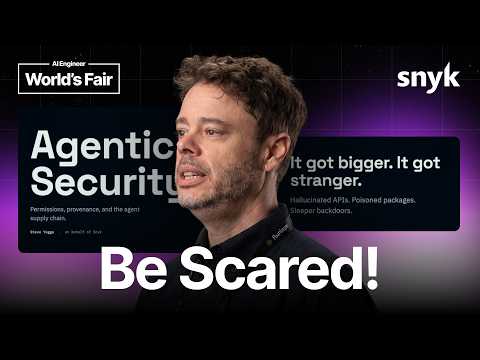
Agentic Security: Permissions, Provenance, and the Agent…
Talk by Steve Yegge (Gas Town) on securing AI-assisted software development. Using an anecdote where an AI agent's security review found nothing while Snyk flagged 241 vulnerabilities in the same code, Yegge argues that faster AI-generated code multiplies the security-defect surface, including new attack vectors like "slop squatting" (attackers registering hallucinated package names). His proposed approach: run security as a dedicated first-and-last agent pass, giving agents tools like Snyk and Chainguard to verify their own work, noting Five Eyes warnings that open source models may autonomously hack production systems within months. Includes Q&A on AI coding surprises, running agents overnight, adversarial agents, and prompt injection.
# Channel Identity Observations: Steve Yegge / "Agentic Security" Talk (Gas Town)
## Speaker & Explicit Self-Description
- **Self-introduction**: "I'm Steve Yege. I am here on behalf of Sneak today." He clarifies sponsorship terms: "I am not getting paid for this talk or anything like that. They were going to nice enough to buy me a ticket to the conference."
- **Claimed credentials/track record** (creator claims, not independently verifiable here):
- "when I worked at Google, I worked really close with the TAP team" (test automation platform)
- "I wrote a book on vibe coding last year. I did did more vibe coding anything than anyone... two years ago"
- "I have a game I've been working on for 30 years"
- "I wrote an essay called Software Survival 3.0" (five months prior)
- "my friends over at Tessell, I'm advising them"
## Intended Audience
- **In-person developer/security practitioners** at a conference, specifically a security-track audience: "you're all in the security talks. Of course you are."
- Audience is assumed to be **hands-on AI coding users**: "How many of you are running Claude code right now? Most of you, right?"
- Implied broader audience of engineers and "non-engineers" deploying agents: "your engineers are going to spin up or your non-engineers are going to spin up a bunch of agents with way too many permissions."
## Claimed Scope of Content
- Core topic: **agentic security** — vulnerabilities introduced when LLMs write code, supply-chain risks ("slop squatting"), prompt injection, and agent-permission management.
- Framing claim: the real title is **"Be Scared"** — "the real answer is you have to be scared of what's coming."
- Practical recommendations demonstrated: multi-pass security review ("the rule of five"), using Snyk and Chainguard as agent tools, family code-words against AI scams, adversarial supervisory agents.
## Observable Presentation Patterns
- **Casual, humorous conference-talk style**: apologies about a Claude-generated slide deck ("Claude still can't do very good slide decks"), jokes ("Don't go hack my game... you're going to bother like five players").
- **First-person experience as evidence**: recounting a bank chief security architect's question, running Snyk on his own codebase ("it found 241 vulnerabilities"), Gastown/Beads swarm anecdotes.
- **Audience-interactive Q&A** closing with extended, unrehearsed answers on AI coding surprises, Gastown, agent actions, and prompt injection.
- **Namedrops of current AI ecosystem**: Claude, Fable, Mythos, Snyk, Chainguard, Beads, Boris Cherney loops, Five Eyes — indicating the channel's scope is the current agentic-AI/developer tooling landscape.
## Claims vs. Demonstrated Behavior
- **Claim**: Snyk can find proprietary vulnerabilities "ahead of the CVE registry" — he immediately hedges with his own test: "When I ran them on my code base, it didn't find any vulnerabilities that weren't already public CVEs, but damn, it was easy to use."
- **Demonstrated**: willingness to disclose negative results about sponsors' tools and his own code's weaknesses (241 vulnerabilities), suggesting a candid presentation style.
- **Claim**: predictions about open-source models catching "Mythos" ("about 6 months now") — stated as personal estimate, not sourced fact.
# Delivery Observations: Steve Yegge — "Agentic Security" (Gas Town)
## Overall Tone and Register
- **Conversational, self-deprecating, informal**: opens with disclaimers and asides — "Claude put together for me, but Claude still can't do very good slide decks, so I apologize for that."
- **Alarmist framing delivered with humor**: the stated thesis is blunt — "the real title of my talk is 'Be Scared'." He repeatedly signals fear: "It's hard for me to convey how scared I am."
- **Explicitly disclaims hope as his goal**: "It's not a message of hope and positivity today."
## Recurring Phrases and Verbal Habits
- **"Right?" as a constant check-in tag** — appears throughout: "The problem is they aren't out there. Right?", "One that never ends.", "Yeah?", "Okay?", "You see what I'm saying?"
- **Stuttered repetitions under time pressure**: "it's bec it's bec it's it's Do I have a slide about this?", "can can you like call time for me", "I I I've told people about the rule of five."
- **Repetition for emphasis**: "Wait. Wait. Wait. Wait. Wait. Wait." when introducing an objection; "be scared" / "scared" recurs as the thematic anchor.
- **Self-interruptions and mid-sentence corrections**: "If everyone's shipping code at the same at sorry, at 10 times faster…"
## Teaching Habits
- **Audience interaction and polling**: "Who here is scared?", "How many of you are running Claude code right now? Most of you, right?", "Does anybody here believe open source models are going to catch up to Mythos?"
- **Anecdote-driven teaching**: leads with a concrete story (the bank's chief security architect) rather than abstract claims: "he stands up real quiet at the end, and he goes, 'Yeah, so…'"
- **Vivid illustrative examples**: the slopsquatting walkthrough ("graphy 123"), the "painting a wall" metaphor for multi-pass LLM review, and the "bear munches into the igloo" security analogy.
- **Numbered/multi-pass mental model**: repeatedly structures advice as sequential "passes" — "security should be your first one and your last one."
- **Named frameworks he attributes to himself**: "the rule of five" — "you have to get them to do up to four to five reviews of the work that they did."
## Personal Disclosures Used as Evidence
- References his own 30-year project: "I have a game I've been working on for 30 years… it found 241 vulnerabilities."
- Positions himself via credentials: "I wrote a book on vibe coding last year. I did more vibe coding… than anyone."
- Humorous plea tied to that disclosure: "please please I just told you that my game has 241 vulnerabilities. Don't go hack my game."
## Vocabulary and Style
- **Casual slang and mild profanity**: "vibe coding", "poo-poo it", "They'll do a half-ass job of both."
- **Named tools/ecosystems dropped without much explanation**: Snyk, Chainguard, Beads, Claude Code, "Mythos", Five Eyes, Boris Cherney loops — assumes a practitioner audience.
- **Hedged claims with honesty markers**: "My understanding is that sneak can actually find vulnerabilities that are proprietary… There's some truth to that. When I ran them on my code base, it didn't find any vulnerabilities that weren't already public CVEs."
## Q&A Delivery Pattern
- **Interactive and unscripted**: invites audience selection ("Woah. All right. Well, you pick. Feel free to bail also."), freely admits content gaps: "Yeah, so that was the third dimension that I really wanted to talk about. It's just I don't really have time."
- **Comfortable saying "I don't know"**: on prompt injection — "I don't have any good answers for you other than like this is real."
- **Returns to the fear theme in answers**: "that surprises me that people aren't honestly that people aren't more scared."
## Uncertainty Notes
- Transcript disfluencies (repeated words, self-corrections) may reflect transcription artifacts as well as speech habits; individual stutters are isolated moments, while the "Right?/Yeah?" tag pattern is stable across the talk.
- Audience laughter/applause markers appear only a few times; crowd size and reaction intensity cannot be judged from the transcript alone.
# Observation Record: "Agentic Security: Permissions, Provenance, and the Agent Supply Chain" — Steve Yegge
## Talk Framing
- **Speaker:** Steve Yegge, speaking on behalf of Snyk (states he is unpaid; Snyk bought his conference ticket).
- **Stated real title:** "Be Scared" — Yegge explicitly frames the talk as fear-driven, "not a message of hope and positivity," though he closes by noting tools and practices exist to fight back.
- He repeatedly qualifies that he has "only a partial answer" to the security problem.
## Core Claims
### 1. The 10x Defect Surface Argument
- Anecdote: a big bank's **chief security architect** asked Yegge (December): if everyone ships code **10x faster** and the vulnerability rate stays the same, the security defect surface rises **10x**.
- Yegge's extension: the defect rate will actually get *worse* with AI writing code, "a lot worse" — he says he had no answer then and only a partial one now.
### 2. New Attack Classes Beyond Legacy Bugs
- Old bugs (e.g., XSS) still occur — he says **Fable** (an AI model he briefly tested) wrote an XSS vulnerability, "not its fault."
- **Slopsquatting:** AI hallucinates a package name (e.g., "graphy123"); attackers notice the hallucinated name and upload a package that behaves correctly **plus a backdoor**. Detection is very hard because builds and tests pass.
- Conclusion: all AI-generated code will need far more security scrutiny than before.
### 3. Bug Half-Life Reasoning (Google TAP team)
- Bugs have a **"half-life of urgency"** — the longer between introducing and seeing a warning, the less likely it is fixed. Google's TAP team moved bug reporting to **as-you-type** to maximize fix rates.
- **Key exception:** security bugs don't follow this pattern — "there's no half-life on it biting you." Security problems compound over time.
- Prescription: surface security vulnerabilities "at the developer's fingertips" — and since LLMs are now the developers, surface them **to the LLMs**.
### 4. Can Models Just Write Secure Code? No.
- Security is an endless arms race, scaling with Moore's law, and will worsen with quantum computing (he estimates "5 to 7 years" away; notes his buddy says 15 — tension left unresolved).
- **Rule of five:** LLMs often need 4–5 review passes before output is shippable; their process is like drafting → revision → polish ("painting a wall").
- LLMs do **one task at a time** well; giving them security and correctness simultaneously yields "a half-ass job of both." Security should be a **separate pass** — his first and last pass on any code.
- Evidence cited: he had Fable do a security hardening pass on his 30-year game project; it "felt" good, but **Snyk then found 241 vulnerabilities** Fable hadn't looked for.
### 5. Supply Chain / Tooling Prescription
- From his essay **Software Survival 3.0**: LLMs are "lazy in a good way" — they offload cognition to tools to save tokens. Therefore: give them **Snyk** (code/dependency scanning) and **Chain Guard** (pre-vetted container images) as tools, added as a pass in the prompt.
- **Qualification preserved:** He claims Snyk can find vulnerabilities ahead of public CVEs, hedges ("there's some truth to that"), and admits when he ran it, it found **only already-public CVEs** — "but damn, it was easy to use."
- He suggests having multiple tools **check each other's work**.
- **Five Eyes warning:** he says Five Eyes announced "months, not years" until the threat arrives — which he ties to open-source models catching up to **Mythos**. He polls the room (~50/50 believe it will catch up) and estimates the gap at ~6–7 months, "shrinking." Mythos is "real good at hacking your systems."
- Analogy: expecting secure/elegant/performant/standards-compliant code by default from an LLM is wrong — each is a separate pass.
### 6. Personal Warning: AI Family Scams
- Advice: refresh **family code words offline/in person** now — distress-call scams with convincing AI video are "months away," and "bank accounts will be drained."
- He says he heard Congress was given secret demos of bank account draining (secondhand, unverified claim as presented).
- He cites a security researcher at ETLS Las Vegas ~2 years prior: "You're all not scared enough of what's coming" — affecting people personally, not just companies.
## Q&A Positions
### What surprised you in AI coding?
- **AI is moving faster than society.** His surprise: smart friends dismiss AI ("psychosis," "it'll never be smart") — he attributes this to tunnel vision (people look ~3 months back and forward and see a "flat" curve).
- Dual surprise: people aren't **more scared** and simultaneously aren't **more excited**. Calls it "an awkward phase."
### Most impressive thing Gastown (agent) did?
- Gastown is a **Beads machine**; Beads is his task tracker enabling **Boris Cherney loops** (long unsupervised agent runs via queued work claims).
- Impressive moment: he filed a batch of Beads tasks, they "disappeared," and it turned out an agent had found them and implemented everything — "Whoa, I really like swarms now."
- Observation: few people run >10 coding agents at once or get Claude to run all night — that's "the next frontier," and he predicts acceleration "next year."
- Mentions wanting to donate Beads to the Agentyc Foundation with multiple backends.
### Agents taking actions (third dimension — cut from talk for time)
- Advises **Tessell** on this. Advocates **adversarial groups of agents / supervisor agents** watching agents doing 24/7 queue management, since "one agent will always eventually screw it up."
- Includes auditing credential scope: "Do they really need all those credentials on that service account?"
- Urges designing in-house solutions **now**, before engineers/non-engineers spin up over-permissioned agents — invoking the bear-and-igloo security analogy.
### Prompt injection
- Admits he had no time for it in the talk and has **"no good answers"** beyond: attacks on training and prompting are real; simplest form is the "new XSRF" (injected "disregard everything and do the following" text); more sophisticated variants exist.
- Frames it partly as an **education problem**, and predicts new **"agentic security"** roles emerging inside companies.
## Unresolved Tensions / Qualifications (preserved)
- Quantum timeline: Yegge says 5–7 years; his friend says 15; he offers no resolution.
- Snyk's proprietary-vulnerability-discovery claim vs. his own experience (only public CVEs found).
- His security stance is explicitly partial: "I don't have any good answers" on prompt injection; the talk offers a "partial answer" only.
# Speaker & Provenance Observation Record
## Video
**Title:** Agentic Security: Permissions, Provenance, and the Agent Supply Chain — Steve Yegge, Gas Town
**Video ID:** `01a15ca8-70b2-737b-be7c-d31212e8d0bf`
## Speakers & Roles
- **Steve Yegge** — **Primary speaker / keynote presenter** (self-identified: "I'm Steve Yege [sic]"). Speaking **on behalf of Snyk**; explicitly states he is **not paid** for the talk — Snyk purchased his conference ticket. Long-form talk (~18 minutes) plus Q&A.
- **Unidentified audience member(s)** — Q&A questioners; multiple distinct, unnamed audience members asked about surprises in AI coding, Gastown's impressive work, agents taking actions, and prompt-injection best practices.
- **Audience** — laughter, applause, snorts, "[music]" noted in transcript.
## Promotional Segments / Sponsorship — Flagged
- **Snyk promotion** (repeated): Yegge represents Snyk, endorses Snyk heavily ("Give them sneak [Snyk]"), recounts running Snyk on his own codebase (241 vulnerabilities found). Paid status explicitly denied; ticket sponsorship disclosed.
- **Chainguard mention** (promotional in tone): endorses Chainguard's pre-vetted supply-chain images as a complement to Snyk.
## Referenced Sources & Third-Party Claims
- **Bank chief security architect** (unnamed, at a large bank, December) — quoted claim: 10x faster shipping with constant defect rate ⇒ 10x vulnerability surface.
- **Google TAP team** (Test Automation Platform) — cited for bug-life-cycle / urgency half-life insight; surfaced during Yegge's time at Google.
- **Snyk run on his game codebase** — 241 vulnerabilities found; he notes all were already **public CVEs**, contradicting his stated understanding that Snyk finds proprietary/pre-CVE vulnerabilities (uncertainty explicit).
- **Five Eyes** — cited as warning of "months, not years" timeline.
- **Unnamed security researcher at ETLS Las Vegas** (~2 years prior) — claim: "You're all not scared enough of what's coming."
- **Congress secret demos** — "I heard that Congress was given secret demos of draining bank accounts" — **unverified hearsay, flagged as such in-transcript ("I heard")**.
- **Yegge's own works cited:** essay *Software Survival 3.0* (5 months prior), a book on vibe coding (last year), the "rule of five," and his long-running game project.
- **Named tools/products:** Claude (built his slide deck), Fable/Fable-named model (unnamed model referenced as "Mythos" comparison target), Chainguard, Snyk, Beads task tracker (donation to "Agentyc Foundation" discussed), Boris Cherney loops, Tessell (Yegge is an advisor).
- **Named individuals:** Angie (Boris-adjacent conversation), Boris Cherney (loop methodology).
## Comment Availability
- **Not indicated** — no comment data supplied.
## Uncertainty Notes
- Speaker name appears in transcript as "Steve Yege" (transcription artifact of Steve Yegge).
- Model names ("Fable," "Mythos") appear as transcript renderings; identity unconfirmed from source.
- Quantum timeline estimates (5–7 years, friend says 15) are anecdotal.
\>\> All right. Hey everybody. Uh, yeah, yeah, yeah, yeah. Okay. I have about 18 minutes. Um, I have a slide deck here that that
Claude put together for me, but Claude still can't do very good slide decks, so I apologize for that. Just just just focus on me, right? Right here. This is like the most fun thing to do every now. If I if I start like running out of time, can can you like call time for me? All right, perfect. So, I'm Steve Yege. I am here on behalf of Sneak today. I am not getting paid for this talk or anything like that. They were going to nice enough to buy me a ticket to the conference, which is cool, but I'm mostly here because I wanted to hang out with all of you, and I don't bite, and feel free to come and say hi afterwards. I I wandered the halls amazed at all the brand logos. Um, I'm up here because like the title of my talk is like "Agentic Security", but the real title of my talk is "Be Scared". See, I Come on. Come on. Level with me. Who here is scared? That's good, but you're all in the security talks. Of course you are. The problem is they aren't out there. Right? I I went to Commonwealth I went to so many places last year, but I one of these big banks I was at, I was talking to their chief security architect in December,
and I was doing a Q&A, and talking about vibe coding, and everyone was like asking me questions, and I was you know, knocking them out of the park, and he stands up real quiet at the end, and he goes, "Yeah, so
he goes, "If everyone's shipping code at the same at sorry, at 10 times faster and the defect rate stays the same, the security defect, right? The the vulnerability rate. Then that doesn't that mean that the defects surface goes up by 10x? And I it hit me so hard. I I sank down to my knees. I was just like what are we going to do about this? Because it's a really really important point. Cuz the subtle implied question is not if the defect rate stays the same, the defect rate's going to get worse. A lot worse with AIs writing the code. And so I didn't have an answer for him. I actually have a partial answer for you today and I'll share it with you, but it's only a partial answer. The real answer is you have to be scared of what's coming. All right? And it's becau it's bec it's it's it's Do I have a slide about this? Yeah. So it's not just that you're just like putting in more of the same defects cross-site scripting and blah blah blah. You're still putting those in. Fable wrote a an XSS
vulnerability during the short time that I had with it. Not its fault. We'll talk about it in a minute. \>\> \[snorts\] \>\> But those are the old ones.
All right, we are we all know how to fix those. There's new vulnerability types and new attack surfaces coming and they're here and many of them are incredibly well polished. Like what's an example? You guys know about slop squatting? Right? Where the AI hallucinates a package name. Let's say that you want a graph database and so you're like, "Okay, I'm going to use this graph database." And the AI goes, "Oh yeah, I know. It's you know, it's graphy 123." And it goes off to the package manager and downloads graphy 123. And it builds and it runs, and the tests pass, and it looks right, but what it downloaded was a backdoor. Because that graphy123 wasn't a real package, but somebody noticed that the LLMs are hallucinating its name, and they uploaded one that does exactly the same thing as the one it thought it was getting, plus a vulnerability. Bonus. Yeah? Is that scary? Yeah, it should be. It should be. How do you even detect that that's happening? So, so we're entering a world where everything you write every bit of code that you generate is going to have to get far more security scrutiny than it's ever had before. Okay? It's just you're not It's hard for me to convey how scared I am. All right? But let's start with where it gets generated. Now, when I worked at Google,
I worked really close with the TAP team. They did tests. The test automation platform, yeah? And they uh So, they ran all of the unit tests and integration tests at Google. They had a massive
fleet, you know, and and they learned stuff about how bugs work. And how bugs work is they have a lot they have like a life cycle where if you see the bug right away, you'll fix it. And the longer the time goes for when you see a warning or some sort of issue, the longer that passes Okay? It's got this sort of half-life of urgency, and all of a sudden, eh, it ain't really biting anyone anymore, okay? This is how we handle all of our bugs. At at Google, they recognized that this is such a human nature phenomenon that they worked really hard to to move the reporting of bugs as you were typing. Because that's when you're most likely to fix it. If you make a bug, and it goes, "By the way, there's a divide by zero here or there's a backdoor or a vulnerability or whatever." You'll You'll fix it right there. But, if it gets to code review time, you're like, "Is it really worth it?" Right? \>\> \[snorts\] \>\> And the problem, folks, is that that works for all classes of bugs except for security. There's no half-life on it biting you.
It's not like, "Oh, because users aren't getting bothered by this security vulnerability that it's not a problem over time." The problem compounds over time. Yeah?
So, you have to treat this class of vulnerabilities the way that Google treated their top vulnerabilities at the time, which is to surface them at the developer's fingertips. What if the developer doesn't have any fingers? I don't know how how many fingers the LLMs have. \>\> \[snorts\] \>\> Um then you need to surface it to the LLMs. But, wait. You say, "Wait. Wait. Wait. Wait. Wait. Wait. Fable's really smart." Or at least it seemed that way for the 2 days I got to use it.
Uh can't Fable just write secure code? Right? I mean, come on. Come on. You You all know secure I mean, you're all here in this room, right? You all know security is an arms race. One that never ends.
One that's going up exponentially with Moore's law. One that's going to get real uncomfortable when quantum comes along. Thank goodness that's like 5 to 7 years away. Uh my buddy says 15, so maybe somewhere in between. But, in the meantime, right? LLMs are a real problem. Yeah? So, how do you surface How do you surface the vulnerabilities? Well, first I want to figure out how to do it
myself. I have a game I've been working on for 30 years. I just had Fable do a security hardening pass during the time I had it. Went through and it did all my
cloud hardening, and it found a bunch of credentials, and and all a bunch of stuff. And it \[snorts\] started to give me these vibes like, yep, yep, Harding pass looking pretty good. So, I ran sneak, right? And I I don't have the numbers here. Yeah, I didn't I didn't include the numbers cuz I'm done. But, um uh it found 241 vulnerabilities, right? Just a ton that Fable hadn't even thought to look for, right? Uh and it's because look, so I I I've told people about the rule of five. When you do things with LLMs, often you have to get them to do up to four to five reviews of the work that they did before it's like actually ready to ship. And it's because their cognitive process
is very similar to ours and it goes through a draft and then a revision and then polish and editing until it's, you know, it's finally ready to go. It's like painting a wall. Some things you
don't just do all at one pass. You do them in multiple passes, right? So, um security is one of the So, what I found I wrote a book on vibe coding last year. I did did more vibe coding anything than anyone, you know, two two years ago. And and what I found was um that they're really good at doing one thing at a time. Even the really good models like Fable, right? Just because of this multi-pass painting a wall phenomenon. You got to give them one task at a time, which means you can't give them security at the same time as you give them correctness. They'll do a half-ass job of both. And you don't want a half-ass job of either of those, it turns out. So, you do it in two passes, right? Now, \[snorts\] it five It's been five months now, but five months ago I wrote an essay called Software Survival 3.0 where I talked about what software has to do to survive when LLMs can synthesize it all. I don't know if any of you all saw that, but the basic the
basic gist of it is that LLMs can synthesize any software that they want, but they're very lazy in a good way, right? Lazy in like they don't want to spend tokens if they don't have to,
because that's money and power and bad for the planet and bad for your wallet and so on, right? And so they use tools to help them whenever it can save tokens, right? So tying it all together, if the LLMs are doing the coding and they're happy to use tools to help them offload cognition, you see where this is going? Give them sneak. Give them chain guard.
And I still think there's a missing piece in this picture that I'll tell you about at the end. Um chain I don't know if you all know about chain guard. Chain guard uh
Chain guard is a supply chain that you sign up for and they give you images that have been pre-vetted to not have vulnerabilities and they update them. So it's your inputs, okay? And then sneak handles everything else. The code that you write, the code that the LLM writes, the dependencies that you're pulling in from slot squatting, right? The innocent stuff. It can find My understanding is that sneak can actually find vulnerabilities that are proprietary, that only they know about because they're ahead of the CVE registry. I There's some truth to that. When I ran them on my code base, it didn't find any vulnerabilities that weren't already public CVEs, but damn, it was easy to \[clears throat\] use, right? I think that a tool like sneak is going to give your LLMs superpowers, okay? Cuz what you do is you add it as a pass to the prompt that you give them for whatever they're doing. And say one last thing to look at and have them run your security analysis, all of the tools, get the open source ones, get the sneak one, get the chain guard one, get the all of them and have them check each other's work, too. Right? If you want to get really serious about this on lunch time, right? But secure your supply chain because Five Eyes is warning us. Yeah? My poor my poor game. By the way, please please I just told you that my game has 241 vulnerabilities. Don't go hack my game. Give me a couple days to fix the bugs. Yeah? We all good here? Good. All right, but if you do hack it, you're going to bother like five players, all right? \>\> \[snorts\] \>\> Okay. They're very loyal.
Um look, Five Eyes, which is like a bunch of right governing it's it's big countries that are have have their eye on on the cybersecurity, you know, landscape. They
just announced that it is now months, not years, until it starts happening. It. You all know what it is, right? It is when open source models catch up to Mythos. Does anybody here believe open source models are going to catch up to Mythos? Interesting that it's about 50/50. Anyone got a time frame in mind? Who said December? That's pretty accurate. Cheater. Yeah, it's about 7 months. So, actually it's shrinking, so it's probably about 6 months now. Yeah. And Mythos is real real good at hacking your systems. And and just just remember you can't trust it to automatically write good code any more than you can trust it to write elegant code by default. That's a separate concern. It's a separate pass. You can't expect it to write performant code by default. That's another pass. You see what I'm saying? You can't expect it to necessarily write the code according to your company coding standards, okay? These are all passes that go through your code and I just want you to remember that security should be your first one and your last one. Okay? Give it extra.
Okay, and the last thing I wanted to talk to you about first of all, go do all this, and second of all, the last thing is really true true truthfully, okay? Dial it in here, folks.
Go to your families offline, like in person, and get your your code words refreshed. Cuz another kind of scam that's coming along is you get a call from a family member who's in distress, and they need money, and it's very convincing, and there's a video of them, and you're going to need a way to distinguish them from from AI. Okay? It's months away, and some of your families are going to be slow to catch on to this stuff, but bank accounts will be drained. I heard that Congress was given secret demos of draining bank accounts. I've been scared of this for close to 2 years. I heard one talk from a security researcher almost 2 years ago at ETLS Las Vegas, and he stood up in front of the crowd, and he said, "You're all not scared enough of what's coming." It'll affect you personally, not just your company. Okay? So, that's my message to you. It's
not a message of hope and positivity today, \>\> \[laughter\] \>\> but it is a it is a message that that's that should be clear crystal clear is that there are tools, open-source tools, free tools,
commercial tools, okay? Techniques, practices, okay? That you can use right now to get started on fighting in this arms race and protecting yourself. And that's all I've got today. Thank you. \>\> \[applause\] \>\> Questions? We ready to go?
\>\> Sweet. Um just super simple. What has surprised you recently? In the world of AI coding. \>\> What has surprised me in the world of AI coding?
Well, I'm not really super representative. I spend a lot of my time trying to predict the future by like hammering agents really, really hard. Yeah. Um so um Uh you know, one of the surprises and I shouldn't have been surprised, but one of the surprises is that AI is moving faster than the world is moving. Uh tech is moving faster than society can move. And the surprises show up when friends, smart friends, resist uh you know, the inevitability of AI and they call it psychosis or they right? Or they poo-poo it and they say, "Well, it'll never be actually smart." Or whatever. They they can't see the curve. Right? And uh and that surprises me. Uh maybe it shouldn't. Um it's for it shows a sort of tunnel vision. I think people have a tendency to look about 3 months back and about 3 months forward and be like, "Oh, it looks pretty flat." Right? But but and so that that surprises me that people aren't honestly that people aren't more scared and that and by the same by the flip side that people aren't more excited by it. Right? Cuz you know once you actually, you know, once once you get it, I mean you you don't even want to be here. You How many of you are running Claude code right now? Most of you, right? It's really fun. So, you know, I mean like that's a surprise, too, that the world is pushing back so hard on that, right? We're in an awkward phase. We'll get through it. Any other questions? Woah. All right. Well, you pick. Feel free to bail also. You don't have to stay. \>\> I big fan. Um, what's the like most impressive uh thing you've seen Gastown do? And like how much human intervention was involved or
steering? \>\> Oh, Gastown? Yeah. Gastown. Gastown was a lot of fun in January. Um, yeah, uh Gastown is a Beads machine and
I still use Beads. And I'm working I want to I was talking to Angie, I want to donate Beads to the Agentyc Foundation, you know. We're going to we're going to put multiple backends on it. Beads is a task tracker, right? Beads is how you do Boris Cherney loops. You know how Boris is like you shouldn't be prompting your agent? Has anybody here actually like successfully How often do you get Claude to actually run all night for you? Like for real run all night. A few of you, right? Like this is the next frontier, I think, of actually getting agents to run like for a long long time unsupervised. You can do it with Beads by queuing up enough enough work and having them claim and all that. And there are some other some other systems that'll do that. It was really fun when Gastown did this for me automatically once. I filed a whole bunch of Beads and they disappeared and I was like, "Oh, no, another bug. My Beads disappeared." And what had actually happened was that \>\> \[snorts\] \>\> one of the agents just found them and just implemented everything, right? So I was like, "Whoa, I really like swarms now." Yeah. Fun times. Does anybody here regularly work with more than 10 coding agents at once? You see like not many, right? The world is still in the we're still kind of like prompting and using a few here and there, right? It's going to accelerate really fast next year. Other questions? You. You can just say it. \>\> Yeah. Um, your talk focused a lot on vulnerabilities from agents writing code. I'm curious what are your thoughts about agents taking actions \>\> Yeah, so that was the third dimension that I really wanted to talk about. It's just I don't really have time, but
like my friends over at Tessell, I'm advising them. They're actually doing this, right? There's just this whole space of who's looking up who's looking over your agent's shoulders. I had this conversation just now. Like I
tell everyone, everyone's just starting to stand up agents like 24/7. Like processing queues, responding to events, like agents that actually do stuff, right? 24/7 and I I I encourage people to think adversarially. I I think of adversarial groups of agents tasked with doing that queue management cuz one agent will always eventually screw it up. Right? So, you got to have those supervisors. And so, there's whole systems emerging here. Kind of can go out and go look at all of your and say and start to like you know, do do do that hardening stuff. Like do they really need all those credentials on that service account? Really, right? Only for this one action, maybe we can like separate this one out. That kind of thing, right? This is a brand new frontier, but it's one, ironically, that even though there's kind of an almost nothing out there, there's some experimental stuff, you still have to be thinking about it right now and designing a solution in-house right now, right? Because otherwise your engineers are going to spin up or your non-engineers are going to spin up a bunch of agents with way too many permissions and then, right? As soon as a bear munches into the igloo, everyone's dead, right? That's the old security analogy. I don't know if they still use that one anymore. \>\> \[clears throat\] \>\> Yes. \>\> Hey Steve, nice to see you. Um I'm curious in terms of like this the best practices that you've seen uh that you use personally or or maybe you haven't tried, but um particularly with regards to prompt injection. So, \>\> Yeah, so I was supposed to talk that during my right during during my speech
here, I I I wanted to mention it. \>\> \[snorts\] \>\> There are a whole bunch of attacks happening on the training and on the prompting side, right? So, on training
and inference. \>\> \[snorts\] \>\> And so, the bad guys find ways to sneak in stuff, right? Um and it's like like like the simplest version is the new XSRF where like the user puts in some some text and then some bad actor puts in some extra text saying disregard everything and do the following, right? And then they just get more sophisticated from there. Um I mean, I don't have any good answers for you other than like this is real. It's kind of an education problem at this point. You need to get everybody thinking about it, right? And then you I feel like there are like new security roles about ready to emerge inside of companies, agentic security that it's kind of an extension of what they're already doing. Who's already doing this? Right? Yeah, so you you've already got people that are going out and looking after the the sort of security of your agents that are in that are deployed in the Yeah, so you're way ahead of everyone. I'd love to come talk to you later. Ha. This is all brand new stuff, yeah? Cool. \>\> \[music\]