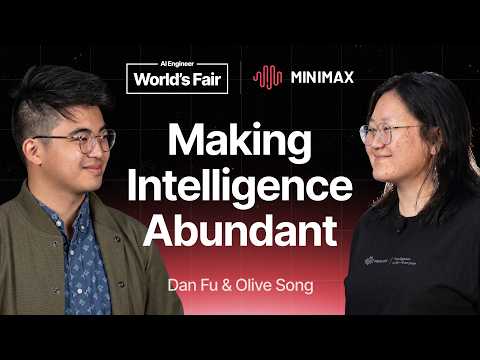
Agents at Scale: Inside MiniMax's Model and the…
Interview with Olive Song, who leads reinforcement learning at MiniMax, about the company's open weight models and the infrastructure serving them. Topics include the open source/open weights philosophy, agentic coding including a model that builds games, computer use trained with RL against environments like OS World, day-zero inference readiness, writing and tuning GPU kernels, parallel kernel benchmarks, optimizations such as KV cache handling and routing, multimodality training pitfalls (text and vision collapse unless trained together), and longer horizon tasks like replicating a twelve-hour run. She closes optimistic about open models closing capability gaps.
# Channel Presentation Observations
## Video Format and Framing
- This is a **moderated panel/fireside discussion** with two guests: Dan Fu (VP of Kernels, Together AI) and Olive Song (Research Lead of RL, MiniMax).
- The host frames the session explicitly: *"This is a discussion that I'm particularly excited about because the field is moving so fast and we have two people that kind of have this unique vantage point on the field."*
- The host notes prior channel activity: *"we gave an entire workshop on this on Monday"* — indicating the video sits within a larger event or series.
## Intended Audience
- The audience is addressed as **AI builders and developers**: *"everybody here there's a lot of builders here that can use it."*
- Questions are framed around practical utility for developers, e.g., asking what "unique capabilities" builders use the model for and "hidden gems."
- Implied technically sophisticated audience: discussion assumes familiarity with KV cache, sparse attention, MoE, quantization, RL post-training.
## Claimed Scope and Identity Evidence
- The host's organization appears to be an **inference/model-serving platform**: *"We have the lion's share of token usage for MiniMax M3"* and *"they launch an open source model and we're now distributing it."* The host's affiliation is Together AI-adjacent but never explicitly named in the transcript.
- Together AI's stated mission (via Dan): *"how do you make intelligence abundant? So how do you get more tokens to more people."*
- MiniMax's stated mission (via Olive): *"we want to have intelligence with everyone"* and open sourcing so *"everyone can use it."*
## Observable Presentation Patterns
- **Pro-open-source positioning**: the panel opens with "Why open source it?" and both guests identify as "big believers in open source"; the closing theme is open-weight models catching up to frontier labs.
- **Partnership showcase structure**: the discussion highlights the MiniMax–Together collaboration, including an origin anecdote (*"We had a car event in Las Vegas sometime last year"*).
- **Practitioner-depth technical content**: detailed discussion of day-zero inference optimization, agentic vs. chat workloads, benchmark design (parallel kernel bench, SVG bench, OS World), and multimodal training-from-scratch.
- **Forward-looking segment**: closing questions ask guests what will look outdated in three years, consistent with an industry-outlook style channel.
## Creator Claims vs. Demonstrated
- **Claimed (by guests/host)**: model capabilities of M3 (multimodal, 1M context, sparse attention), benchmark results (ICLR paper replication), token-usage leadership.
- **Demonstrated (by the material itself)**: the channel's access to senior technical practitioners (VP-level and research-lead guests), event-based production, and a builder-focused editorial angle.
No private motivations or channel-wide conclusions are inferred beyond what is stated.
# Delivery Observations: Agents at Scale Panel — Dan Fu and Olive Song
## Overall Format
- **Moderated three-way panel**: one unnamed moderator drives Q&A while Dan Fu (Together AI) and Olive Song (MiniMax) answer in alternating fashion.
- The moderator frames each question around a concrete context: *"I checked this morning. We have the lion's share of token usage for MiniMax M3."*
## Tone
- **Conversational and enthusiastic** throughout; the moderator opens with: *"This is a discussion that I'm particularly excited about"*
- **Dan's answers are casual and humorous**, e.g. *"I mean, you focus on a thousand and one things, yeah"* and *"If someone tells me you can't do the thousand first thing, yeah, like I don't know, try harder."*
- **Olive's tone is measured and technical**, with warm understatement: *"Um yeah, I think that is pretty cool."*
## Recurring Linguistic Habits
### Stutter-restarts and repetition (Dan)
- Very frequent word repetition: *"how do you make intelligence abundant? So how do you get more tokens to more people to do more useful things and and and and get get all these capabilities"*
- *"we we we have that list and then we start working on it"*
- *"and and and the and the and the ones that you find in JLM"*
- This appears to be a stable pattern across nearly all of Dan's turns.
### Filler and softeners (Olive)
- Recurring opener **"Mhm. Mhm."** before answers: *"Mhm. Mhm. Uh I would say it's the very important thing is the data"*
- Frequent hedging phrases: *"I would say,"* *"Um yeah,"* *"So, yeah."*
### Affirmation opener (Dan)
- Repeatedly begins with an echoed affirmation: *"Yeah, yeah, great question"*, *"Yeah, it's a it's a great question"* — appears at least twice; possibly a stable habit, though the sample is small.
## Vocabulary and Framing Patterns
- **Technical register**: KV cache, sparse attention, quantization, MOE, RL, long horizon, bench maxing — both panelists use domain vocabulary fluently.
- **Dan's abstract framing habit**: reframes concrete work into mission-level statements: *"how do you make intelligence abundant?"*
- **Olive's emphasis on environment/data**: repeatedly attributes success to setup: *"the key there is still the environments and the data and how you formulate the problem, how you formulate the rewards"* and *"it's the very important thing is the data and how we define the problems."* This is a repeated teaching-like pattern in her answers.
## Teaching Habits
- **Analogy and self-deprecating framing** (Dan): compares KV cache management to *"recreating a distributed file system... the type of thing that you should have done in your third year of undergrad or something like that, but most of us actually skipped that class, so now we're rediscovering it live in in industry."*
- **Concrete example anchoring** (Olive): grounds abstract training points in examples: *"For example, let's say the kernel one, right?"* and the website-development example for multimodality.
- **Moderator's bridge technique**: connects answers to prior context: *"I was just talking to Ingrid actually yesterday... And she said, oh, did you mean from last night?"*
## Communication Patterns
- **Moderator hands off explicitly between speakers**: *"Olive I want to throw it over to you"*, *"I want to come to you, Dan, for is KB cache."*
- **Laughter moment**: Olive jokes about her tenure: *"3 years ago I was still in... I actually didn't start this industry yet"* — an isolated moment, not a pattern.
- **Closing ritual**: brief, warm sign-off: *"Thank you guys. Thank you Dan. Thank you Olive... Have a great day."*
## Uncertainty Notes
- Speaker attribution for some lines (e.g., the "thousand and one things" follow-up *"And then get up a little later"*) is ambiguous in the transcript.
- The moderator's identity and some overlapping exchanges are not clearly delineated; observations above rely on the `>>` speaker markers as given.
- Transcript timestamps are bracket indices, not seconds; no time-based claims are made.
# Observation Document: Agents at Scale — MiniMax Model & Infrastructure Panel
## Speakers
- **Moderator** (unnamed host; Together AI-affiliated per context, e.g., references "we're distributing it," "we gave an entire workshop")
- **Dan Fu** — VP of Kernels, Together AI; leads inference/GPU optimization
- **Olive Song** — Research Lead of RL at MiniMax; responsible for final training and model shipping
---
## Open Sourcing MiniMax M3
- **Olive** on why open source:
- Believes the open-source community is "very strong and powerful."
- Aligns with MiniMax's mission: "intelligence with everyone."
- Developers contribute via feedback and PRs, strengthening the model.
- Open weights let partners like Dan optimize inference and "serve better for everyone."
- **Dan**: Together AI is "big believers in open source"; had followed MiniMax "from way older MiniMax models."
## Partnership Origin & Serving at Scale
- **Moderator** claim: Together has "the lion's share of token usage for MiniMax M3."
- **Dan** on the partnership:
- Originated at a Together event in Las Vegas ("a car event") where a MiniMax representative urged them to serve the next model.
- Together had served MiniMax 2.5 and 2.7; excitement about M3 usage led to collaboration on architecture and inference optimization.
- Framed Together's mission as making "intelligence abundant" — more tokens to more people.
## M3 Capabilities (Olive)
- M3 differs from M2 series by being **multimodal** — understands text, writes code, and understands video and images.
- Observed applications: multi-modal agents, **computer use** (navigating computers, using tools).
- **Hidden gem claim**: game development — "the model can help you develop real cool games."
## Post-Training for Benchmarked Domains
- Question raised by **Moderator**: SVG Bench, Kernel Bench, OS World.
- **Olive**: key factors are **data** and **problem definition**; for kernels, designing environments for reinforcement learning in complex environments so the model optimizes kernels itself and iteratively improves performance.
## Kernel Development & Parallel Kernel Bench (Dan)
- Both closed frontier and open models are getting better at writing kernels; Together uses models while developing kernels.
- **Parallel Kernel Bench**: contains **unsolved problems** derived from surveying inference-serving methods — many speedups lack good kernels.
- Stated intent re: benchmark overfitting:
> "If you overfit to it, that's great cuz we'll go take those kernels and use them to accelerate inference."
- **Moderator's** position: bench-maxing on "really useful benchmarks" is a "perfect world" if everything is in-distribution.
## Inference Stack: Day Zero and Beyond (Dan)
- Process: receive early model details (e.g., **MiniMax sparse attention**); each open model differs (attention, MoE choices, quantization), so they assess whether existing kernels work, need modification, or need to be written from scratch.
- Day zero priorities: **quality** and user experience; then a long optimization list (KV cache, attention kernels, quantization) executed over weeks — models "get faster between day zero and day seven and day 14."
- **Moderator anecdote**: asked whether M3 performance had improved over the last month; was told "did you mean from last night?"
## Agentic vs. Chat Workloads (Dan)
- Agentic multi-turn tool-calling workloads change the stack: KV cache, prompting, and which parts to optimize.
- Contrast: chat = few-thousand-token system prompt + logs; agentic coding = **whole codebase uploaded**, a very different optimization/routing/kernel challenge.
## Multimodal Training (Olive)
- M3 was trained **multimodal from scratch** — image and text data from step zero.
- Acknowledged that many labs see model collapse with such training; "we managed to solve that problem."
- Attention maps show text tokens attending to visual tokens — modalities "naturally understand each other"; benefits website development, where the model can see the rendered site and optimize during RL.
## Sparse Attention & Optimization Breadth (Dan)
- MiniMax sparse attention differs from DeepSeek and GLM variants, but lessons from prior optimizations transfer.
- Dan notes he has worked on this problem "going all the way back to my PhD" — seeing it trained at scale is validation.
- On prioritizing among many optimizations:
> "You focus on a thousand and one things... there's no stone that you leave unturned."
- Added jokingly: if told the thousand-and-first thing can't be done, "try harder," and "get up a little later."
## Training Long-Horizon Tasks (Olive)
- Example: M3 replicated a 12-hour run reproducing an ICLR paper (raised by Moderator).
- Challenges: long-horizon tasks, GPU/hardware constraints. Keys: **environments, data, problem formulation, reward formulation, and adapting the RL algorithm for efficiency**.
## Evaluation of Long Runs (Olive)
- Iterative submissions, each evaluated; validation tests distinguish genuine improvement from **hacking/reward hacking**.
- **Self-evolution** (since 2.7): using the model internally to speed development, building internal evaluations closely tied to their own work.
## KV Cache at Scale (Dan)
- Managing massive concurrent KV caches is "in some sense like recreating a distributed file system" or a very large database:
> "It's the type of thing you should have done in your third year of undergrad... most of us skipped that class, so now we're rediscovering it live in industry."
- Core problems: where to store, dedupe ("have you seen this before"), fetch, and transfer the cache.
## Three-Year Outlook
- **Dan** (referencing a recent Stanford lecture that we're very early):
- GPUs are heavily underutilized today (citing a "10% flop utilization" figure attributed to SpaceX); hopes future efficiency makes that look worse.
- Expects many more, better models.
- Hopes the recurring "closed labs are so far ahead" debate ends — open models like M3, GLM, and Kimi show "the open-source frontier really can catch up... not even that far behind."
- **Olive**:
- Notes a caveat: "3 years ago I was still in [school]" — hadn't started in the industry.
- Observes models were already accelerating development speed a year-plus ago, expects that acceleration to continue, enabling open-weight models to catch up with frontier labs — consistent with the mission of bringing the model to everyone.
---
## Preserved Qualifications & Tensions
- Dan's attribution of "10% flop utilization" is secondhand ("SpaceX said... or something like that") — hedged, not verified.
- Olive's three-year answer is explicitly limited by her shorter tenure in the field.
- Moderator's token-usage claim about Together serving M3 is the moderator's assertion, not independently supported within the transcript.
# Video Attribution Record
## Video Identification
- **Title:** Agents at Scale: Inside MiniMax's Model and the Infrastructure Behind It — Dan Fu and Olive Song
- **Video ID:** `01a15ca8-2e18-7113-b415-624dd1b2bc33`
- **Format:** Panel discussion / interview (no curated metadata supplied)
## Speakers and Roles
| Speaker | Role | Affiliation / Notes |
|---|---|---|
| **Dan Fu** | Guest — VP of Kernels, Together AI | Leads inference and GPU optimization; self-identified in transcript |
| **Olive Song** | Guest — Research Lead of RL, MiniMax | Responsible for final training and shipping of the model; self-identified in transcript |
| **Unnamed moderator** | Host / Interviewer | Drives the panel; introduces and questions both guests; affiliation not stated in transcript |
> Note: One apparent transcription artifact — Dan Fu refers to "at Anthropic we can do a lot better" during the closing section, despite identifying himself as VP of Kernels at Together AI. This attribution conflict is recorded as-is from the source.
## Referenced Sources and Claims
- **MiniMax M3 model** — described as multimodal (text, code, video, images), 1M context, sparse attention; open-sourced per Olive Song.
- **MiniMax M2 series / 2.5 / 2.7** — prior models referenced; 2.7 discussed re: self-evolution.
- **Benchmarks cited:** SVG bench, Kernel Bench, OS World (by moderator, attributed to blog/paper); **Parallel Kernel Bench** (recently released by Dan Fu's team, contains unsolved problems).
- **ICLR paper replication** — moderator cites blog post claim that M3 replicated a 12-hour run reproducing an ICLR paper.
- **Partnership origin** — Dan Fu describes meeting a MiniMax representative at a "car event in Las Vegas" (as transcribed); Together AI claims "the lion's share of token usage for MiniMax M3" (moderator citing his own check that morning).
- **Third-party references:** DeepSeek, JLM, GLM, Kimmy, Anthropic, OpenAI, SpaceX (re: FLOP utilization), Stanford lecture by Dan Fu, named individual "Ingrid" (Together AI, referenced by moderator).
- **Dan Fu's PhD** — mentioned re: prior work on sparse attention.
## Promotional Segments
- **Flagged:** Extended segment on the MiniMax–Together AI partnership, including host's claim that Together holds "the lion's share of token usage for MiniMax M3" and Dan Fu's praise of M3's progress — promotional in character.
- **Flagged:** Open-source advocacy framing by both guests (MiniMax mission "intelligence with everyone"; Together as "big believers in open source").
## Provenance and Availability Limits
- **Comments:** No information on comment availability supplied.
- **Curated metadata:** None supplied beyond title and transcript; timestamps absent; speaker labels derived from turn order and self-introductions, so some attributions may be uncertain where "\>\>" markers are ambiguous.
- **Uncertainty:** The moderator is unnamed; the "Anthropic" remark attributed to Dan Fu is unverified.
This is a discussion that I'm particularly excited about because the field is moving so fast and we have two people that that kind of have this unique vantage point on the field and
what I want to do is kind of ask questions to see if we can learn from that. So I want to start off with intros, talk a little bit about your role, what you're thinking about, what you're working on. Maybe Dan if you can go first. \>\> Uh hey everyone. I'm Dan. I'm the VP of Kernels Together AI. I lead inference, GPU optimization, trying to figure out how to use GPUs most effectively to serve AI models. \>\> Yeah. So one of the things that I wanted to dive in with Dan about is like you model drops, what are what is everything that goes on behind the scenes to serve it so that everybody here there's a lot of builders here that can use it. Olive I want to throw it over to you to talk about your role and what you're focusing on. \>\> Yeah. I'm Olive and I am the research lead of RL at MiniMax and I am responsible for the final training of the model and the shipping of the model. So basically everything before the inference, right? \>\> Okay. Awesome. Um so maybe I wanted to start off this panel is focusing on open
source. I wanted to start off with this is your strongest model yet, MiniMax M3. Why open source it? What's the kind of the the idea behind that as a company as
you're releasing these models? \>\> We do believe that the open source community as a whole is very strong and powerful. While we open source the model, everyone can use it. So it aligns with our mission that we want to have intelligence with everyone and also different developers can contribute to the model through feedbacks, through their own PRs and we can build the models even stronger. And also like for example, Dan you you will be able to optimize on our open weight model and make it inference faster and then serve better for everyone. \>\> Yeah. Yeah, we're we're big believers in open source that together and yeah, I think when we we've been you know, following you guys for for a while. I think from way old old older MiniMax models. So seeing M3 and seeing how far it's come is is really impressive and really great. \>\> So I wanted to kind of pick on this a little bit more. Can you explain so we've got the model creators themselves MiniMax. We've got experts on the inference side of things. How did this partnership come to be? So they launch an open source model and we're now distributing it. I I checked this morning. We have the lion's share of token usage for MiniMax M3. How does this partnership come to be and how do we serve a model like this at scale? \>\> Yeah, yeah, great question. So at together, I think one of the things that that we're really interested in is how do you make intelligence abundant? So how do you get more tokens to more people to do more useful things and and and get get all these capabilities into more people's hands. So we follow all the open models very closely. I I don't remember when exactly we we started part. Oh, actually I think I do know this. We had a car event in Las Vegas sometime last year. And with someone from MiniMax came and there he was like, guys, you really got to serve our next model. It's going to be really really great. So I think from there we we started talking. We were serving MiniMax 2.5 and I think 2.7 for for a while and then when leading up to the launch of of M3, we were we were quite excited about it. I think we we're seeing the the usage and what people were doing with it was it was really quite exciting and and so from there that's really where we partner. We start working on the model. The architecture, optimizing it, figuring out you know, what's the best way to serve inference on it and and all those great pieces. \>\> Yeah. I wanted to actually get into more on the model side of things. And so as
the creator of a model, as as somebody who's like post-training this thing, the model lands and all the builders that are here start using it. From your perspective, um what are the
kind of the unique capabilities that you love to see people use it for? And what are maybe some of the hidden gems that you haven't You thought, "Oh, people would love to build this." but you haven't seen a little bit. Could you shed more light on that? \>\> Mhm. Mhm. So, MiniMax M3, which was
different from the M2 series, was that it was actually multi-modal So, it not only understands text and it not only writes code, it also understands videos and images. So, we
did see a lot of applications on a gen tech multi-modal agents, which is very cool. Um and I would say there are a couple that we can highlight, right? For example, computer uses. The model can is able to navigate through a computer and then do some pretty good creations with the tools that they they can utilize. And also, um you can develop games with the model. Um it's very fun that I I don't I think that's one of the hidden gems is that we actually worked on um game development. So, the model can help you develop a real cool games. Um yeah. \>\> Yeah, one So, when the when the blog dropped and then the paper dropped, one of the things I noticed was that you guys highlighted SVG bench, you guys highlighted kernel bench, you also
touched on OS world. Can you talk more about Like, what does it take to post-train, especially for those particular domains? \>\> Mhm. Mhm. Uh I would say it's the very important thing is the data and
how we define the problems. Um it could be very different from different tasks. For example, let's say the kernel one, right? The It would be very important to design the environments of the data so that we can deliberately train reinforcement learning in those very complex environments and let the model to optimize the kernels themselves and iteratively improve the performance. \>\> And one one aspect that I wanted to talk to you about on the kernel development side of things, um where are you seeing open models when it comes to kernel development? You recently released a
benchmark specifically for this. So, I was wondering if you could talk on that a little bit as \>\> Yeah, yeah, it's a it's a great question. So, I think we're seeing all sorts of models of the closed frontier models and the open models get
increasingly better at writing kernels. So, we use models all the time when we are developing kernels and and and writing the optimization frameworks. I think the the interesting thing that we are starting to look at is this benchmark that that we recently released called um parallel kernel bench. So, it actually has a bunch of unsolved problems in it. So, we went around surveyed all the different ways they can
serve model inference. And one of the interesting things that we found is that there's a lot of things that we can think of that would actually speed models up that there don't exist good kernels for. So, one of the reasons that we put that
benchmark out was, you know, one thing that people worry about is like bench maxing or or overfitting to particular benchmarks. One of our intentions with this benchmark was that if you overfit to it, that's great cuz we'll go take those kernels and use them to to to accelerate the the the the inference and the development. \>\> Yeah, this is a really interesting point. A lot of people have problems with bench maxing, but the way I think about it is if researchers like you put all the really useful benchmarks out and we bench max on all of them and everything is in distribution, then that's a perfect world, right? That's a very useful model that we can then use. Um Okay, cool. So, I wanted to touch on the inference side of things now as well. So, like a new model drops like this, what does it take Could you take me like behind the scenes at the inference stack? And what does it take to go from
day zero launch and then optimizing it week over week, month over month? \>\> Yeah, yeah, great question. So, when we partner with someone like MiniMax, we will get some early model details. So, for M3, for example, there are things
like the minimax sparse attention and and some of those choices that were a little bit different from any model that's out there. And I think if you look at any of the open models now, they are all quite different from each other in different ways. So, there's different attention, different MOE choices, differences in quantization and and all these pieces. So, as soon as we get those details, we start writing kernels, benchmarking, figuring out is there existing kernels that work for it? Do we need to modify something? Do we need to write something from scratch? And then so day zero, we're trying to think about things like quality. So, when this model launches, is it going to have the quality that we all expect? Are we going to be able to provide the right the the right user experience? And then from there, as soon as it launches that day zero, we have a long list of things that we know, hey, we have to do this with the KV cache, we have to do this with the attention kernels, we have to do we're going to look at this part of the quantization, and things like that. So, we we we have that list and then we start working on it and start optimizing over the course of weeks so that when you use these models, they actually get faster between day zero and day seven and day 14 and etc. \>\> Yeah, I was just talking to Ingrid actually yesterday and I and I asked her, have we been improving the performance of M3? And I meant over the last month and she said, oh, did you mean from last night? And this is the pace at which these guys work. So, it's very real. One aspect that I wanted to touch on with this is we're seeing the workloads shift. We're going from kind of predominantly chat workloads where you have turns coming in now to agentic workloads where you've got this thing sitting inside a harness and you're doing hundreds and hundreds of multi-turn tool calls. \>\> Yeah. \>\> Does that change the way you build the inference stack? \>\> Yeah, it definitely does. So, these agentic turn-based workloads, they go into everything from informing your KV cash, your prompting, your pieces like this. So, it it informs what
part of the stack you want to go optimize because now I think when we're in the chat chat chat world, you have a system prompt of a few thousand, and then you just have the the chat logs. Now, with the coding base agentic
workflows, you'll upload your whole code base to the model, and that's a very different optimization and routing and kernel challenge than than just the the chat base workload. So, yeah, we're we we follow these work codes very closely. It's really interesting to see how they evolve and and how to adapt the inference stack and the inference engines to to really take to really serve them well. \>\> Not only do you have agentic workloads, but you've also got multimodal workloads in there. So, what I like to do often with these coding agents is get them to optimize a web app and then get it to use it and then do a feedback loop. So, one thing that I wanted to come to you all the four is Minimax M3 is multimodal, M2.7, all the ones before that were not multimodal. And like, can you talk a little bit about the optimizations and how you trained it for that aspect? And then also, I want to get into the architecture of it afterwards as well. \>\> Right. Definitely. So, what's different
from before was that it was trained multimodal from scratch. So, from step zero, we trained not only text data, we also trained image data. And it was normal for many other labs that the
model would collapse after training a little bit, and we managed to solve that problem. And what we found was actually that with this kind of training from scratch, if you look at the attention map, it actually the visual of the the text tokens would attend to the visual tokens. So, that they are naturally combined together, they naturally understand each other. So, for example, we are developing, for example, websites, right? It is better if we train with both modalities. Also, like, for example, it can look at the website, it can understand how it looks, and then better optimize for it. Like for example, during reinforcement learning. Um so yeah, I think that is pretty cool. \>\> So one one thing that kind of stuck out with this model for me was the fact that it introduced a lot of new things. The multi-modality, the increase of context to 1 million, um the fact that you have a sparse attention now. Um so if you go to the inference side, it's almost a a nightmare, isn't it? You get You get this new model and there's so many things that you could optimize to speed up inference. Um practically, what are the things that you focus on? There's like a thousand things that you could optimize, but where do you get the most bang for your buck? \>\> I mean, you focus on a thousand and one things, yeah. Like you just you just go and you keep you keep doing it. You find every edge that you can, um and and you go and and you push on it. Um so yeah, I think there there's there's no there's no stone that you leave unturned and you just uh keep keep going at it. If someone tells me you can't do the thousand first thing, yeah, like I don't know, try harder. \>\> Yeah. \>\> And then get up a little later. \>\> Yeah, like go ahead. \>\> No, I know. So the other thing that I wanted to ask is there's a whole kind of um zoo of open source models. As you're talking about speeding up inference, are there things that are there lessons that you can take from one model and apply it to MiniMax M3? Um or or do you have to like restart from scratch as you're thinking about the inference engine, the kernels, like how does that work? \>\> Right. Um yeah, so there there's definitely things that you learn from optimizing one model that you take to another. Um so I think sparse attentions are something that have become quite popular now. So the MiniMax sparse attention is a little bit different from the uh from the deep seek and the and and and those and the and the ones that you find in JLM. Um but the they're still similar lessons that you can take from that optimization process and that kernel writing process that you can then bring to to the new sparse attentions. And you know, we've been in in some form or or another I've been thinking about this problem for for many years. So going all the way back to my PhD. So it's it's it's great to see some validation that that folks can now train it at scale and people are using it and and it's and it's it's going pretty well. \>\> Yeah. \>\> Yeah, one of the interesting things especially about open source is you've got all these labs that are learning from each other kind of taking the wins from each other, right? So if if if one lab figures out that Minimax does this really well, then that gets becomes the golden standard. Um one of the things on model launch that I in the blog post that you guys go into is that this model was actually able to replicate a 12-hour run where it could
reproduce an ICLR paper. And so somebody who's training this model to do this thing, how do you actually go about that? Cuz that seems like a pretty ludicrous task. \>\> Right. So letting the model to do cool
stuff like replicating papers, optimizing kernel frameworks and stuff like that is always exciting for us researchers because it's like very related to our job. But training it can be very tricky because it's very long horizon and like the task itself would require GPUs. It has hardware constraints. So it's very interesting to train tasks like that and I would say the key there is still the environments and the data and how you formulate the problem, how you formulate the rewards, how you formulate the environment and how you change the reinforcement learning algorithm a little bit so that it's trained more efficiently so that you can see cool things emerging through the the iterations of RL runs. \>\> Mhm. Can you talk maybe if I keep pulling on this thread a little bit? How do you do evaluation over these longer longer scale runs? So if you're if you want the thing to do a 12-hour task, yes, it might or might not do it at the end, but are there like a intermediate things that you can also look at? \>\> Yes, we do. For these tasks, they are there are iterations, right? So, the model can submit several times, and we would evaluate each of them. Some of them some of the times the models would hack, and we do do like validation and test with for it to test if it's really improving on the performance or it's hacking. And also, we design our internal evaluations. So, for example, for the release of 2.7, we touched a bit on self-evolution, right? So, we're actively using the model to improve the speed of development internally, which like out of it out of it we can build our own evaluations that are closely related to our own work that we can evaluate the models on. \>\> Yeah. When So, when we start talking about these long horizon tasks that are 12 hours long, we gave an entire workshop on this on Monday, but what I wanted to come to you, Dan, for is KB cache. So, if let's say you you have concurrent requests that are 500 to a million thousand context length long, how do you deal with the KB cache that just keeps on growing, and how does the infrastructure deal with that? \>\> Yeah, so there there's a lot of different pieces that that you put there. Like in in some sense, it's like recreating a distributed file system. So, we we're in some sense building something like that or a very big database. It's it's pretty simple in theory. It's like the type of thing that you should have done in your third year of undergrad or something like that, but most of us actually skipped that class, so now we're rediscovering it live in in industry. But it's it's all about where do you store that cache? How do you know Have you have you seen this before? How do you fetch it? How do how do you send it from one place to another? So, yeah, it's it's a it's it's not that complicated, but you you do have to make sure that that you do a good job. \>\> Yeah, one thing I noticed you you gave a a um a lecture at Stanford recently and one thing that stood out was that if you fast forward like 2 3 years, 2 3 years is is is a long time in AI. And if you look back you said that we'll realize
that how um how early we are right now. \>\> Yeah. \>\> So, from your vantage point, where 3 years out, what do you think we'll look back on be like, "Why were we doing it this way?" \>\> Great question. Um uh some things that I
hope for, so I think we underutilize our GPUs a lot right now. Um you know, SpaceX said they would have like 10% flop utilization or something like that. I hope in 3 years, well, they they should already be embarrassed about it, but I hope in 3 years they're extra embarrassed by it. Um so, certainly training should be should be pretty um should be pretty good. I think at Anthropic we can do a lot better with the hardware that we're using uh that we have today, so I hope uh in a few years we'll we'll say uh we'll we'll have seen the light on on some of those pieces. Um and I think there'll be a lot more models, there'll be a lot better. Um I I hope finally by then we've put uh put to bed this question about the open models. You know, there's every few months there's someone like, "Oh, Anthropic OpenAI, they're so ahead, yada yada." Um but I think uh we're we're seeing with models like M3 and GLM and Kimmy and and all those models that um the open-source frontier really can catch up. Um and and it's it's not even that far behind, so so I think that that's quite exciting. \>\> Yeah. I I wanted to throw that same question over to you, Olive, but you mentioned that you it for for the M2 series and the M3 series, you're using this idea of self-evolution, where the model is building its own harness, and then it's training inside of that, and then you get the next checkpoint. Um if you look back 3 years uh out and then you say like, "What in RL or post-training um do you think uh made the biggest difference?" What do you think that is from this vantage point? \>\> Um great question. But, 3 years ago I was still in in \>\> \[laughter\] \>\> I actually didn't start this industry yet. \>\> Yeah. So I wouldn't have imagined what's happening right now today. So it's really exciting. But I can see how models that were developed are were already improving the speed of development maybe a year ago or even further than a year ago. So I could see how this speed is actually accelerating. How the development is accelerating. And that's how like open weight models can really catch up with frontier labs and Yeah, that's how we think we are more mission to bring this model to everyone so that everyone can use it. Yeah. \>\> Awesome. Thank you guys. Thank you Dan. Thank you Thank you Olive. Thank you guys so much. Have a great day. Very cool. Thanks so much. \>\> \[music\]