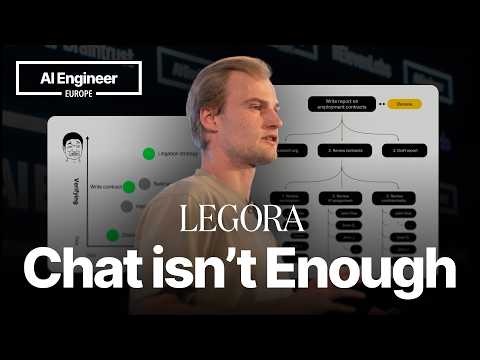
Agents need more than a chat - Jacob Lauritzen, CTO Legora
Conference talk from AI Engineer featuring Jacob Lauritzen, CTO at legal tech startup Legora, arguing that building effective AI agents requires more than chat-based interactions. The talk's specific technical content is not detailed in the supplied record.
# Video Identity Observations: "Agents need more than a chat - Jacob Lauritzen, CTO Legora"
## Explicit Self-Description Evidence
- **Speaker identity and role**: The speaker introduces himself: *"My name is Jacob. I'm the CTO of Legora."*
- **Company self-description**: *"We are a collaborative AI workspace for law firms, so we're a vertical AI company."*
- **Scale claims (creator-stated, unverified)**:
- *"We have more than 1,000 customers, more than 50 markets."*
- *"We've raised a bunch of money... maybe the fastest in history."*
- **Recruiting signal**: *"We are also hiring engineers in London... please talk to me after my talk."*
## Claimed Scope and Thesis
- The talk's framing: *"vertical AI and complex agents and why I think they need more than just the chat."*
- Stated goal alignment: *"our goal and the goal of most vertical AI companies is to make agents complete more and more complex work end-to-end."*
- Core argument advanced: *"humans and agents should collaborate in high bandwidth artifacts"* — chat is *"one-dimensional... a very low bandwidth interface."*
## Intended Audience (Observable)
- A **conference/talk audience**, indicated by the opening: *"How's everyone doing?... There's just me and two more people behind you and Friday beer."*
- **Technical/builder audience**: references to *Claude Code*, *reviewing big PRs on GitHub*, *RL environments*, *post-training*, *DAGs*, and *"verifier's rule"* suggest developers and AI practitioners.
- **Recruiting target**: engineers interested in joining a growth-stage startup.
## Observable Presentation Patterns
- **Demonstrated domain focus on legal AI**: multiple concrete legal examples (contract drafting, definitions checking, *"golden contracts,"* litigation strategy, EU termination clause law, tabular contract review), consistent with the claimed legal vertical.
- **Product demonstrations shown on slides** (described, not quoted): compaction/context-rot failure example, contract review tree/DAG, tabular review UI, document collaboration with highlights/comments/agent tagging — supporting the claimed "collaborative AI workspace" positioning.
- **Opinionated thought-leadership style**: explicit personal positions such as *"I don't think planning is going to stay around"* and *"we should not constrain them to human language."*
- **Informal, humorous delivery**: jokes about Americans and litigation (*"the Americans really love doing this all the time"*), YOLO mode, and *"hope that it doesn't delete your prod database."*
## Claim vs. Demonstration Distinction
| Type | Evidence |
|---|---|
| **Creator claim** | Customer count, market count, growth rate, funding ("maybe the fastest in history") |
| **Demonstrated** | Deep legal-domain workflow knowledge; product UI concepts (tabular review, document artifacts); agent UX frameworks (trust/control, skills, elicitation, guardrails) |
No private motivations beyond the explicit recruiting pitch were inferred; hiring interest and company growth are directly stated by the speaker.
# Delivery Observations — Jacob Lauritzen, "Agents need more than a chat"
## Tone & Register
- **Conversational and informal throughout**, with casual asides:
> "It's 5:00 p.m. on a Friday. There's just me and two more people behind you and Friday beer, so I'll try to be a little bit quick here."
- **Humor woven into technical points**, often deadpan:
> "if anyone's reviewed big PRs on GitHub, it really sucks. It's extremely painful."
> "you just YOLO mode it, let it rip, and hope that it doesn't delete your prod database."
> "I know we're in Europe now, but the Americans really love doing this all the time."
- Uses slang / internet-flavored vocabulary: **"AI pilled," "YOLO mode," "let it rip," "flash banging your guys' face."**
## Structure & Teaching Habits
- **Concrete scenario first**: opens with a relatable failure story of a long-running agent ("Clause three doesn't look right... Then you see this, compaction. That's when you know you can give up."), then introduces himself, then moves to frameworks.
- **Framework-driven explanation**: repeatedly organizes material into named concepts — **"verifier's rule," "control," "trust," "guardrails," "skills," "elicitation"** — each defined in plain terms:
> "Control is how effectively can a human instill their knowledge into the work that the agent is doing."
- **Definition-by-analogy and contrast**: contrasts legal vs. coding examples along the same easy-to-solve / hard-to-verify axis, and contrasts chat vs. high-bandwidth artifacts.
- **Extended co-worker analogy** for planning:
> "you could compare planning to working with a co-worker that... tells you about the approach, you align with them, and then you never ever hear from them again until they deliver the final document."
- **Recap-style transitions**: "Then there's control." / "Then we have skills." — a recurring signposting phrase introducing each section.
## Recurring Phrases & Verbal Patterns
- **Intensifier repetition** is a clear verbal habit:
> "Skills are really, really, really good. They are really good because..."
> "It's really inefficient. It takes a long time..."
- **Rhetorical "So" as a connector**, appearing many times: "So if you want to increase trust...", "So how do we increase control?", "So not chat."
- **Self-question-then-answer pattern**: "So what's a better interface? Well, I think humans and agents should collaborate in high bandwidth artifacts."
- **Hedging and disfluency markers**: frequent "um," "uh," "you know," "sort of," "basically," and one visible repair: "If I have very low control... Oh, sorry, low trust."
## Audience Awareness & Selling
- **Direct audience address**: "you guys," "I'm sure people have tried this in Claude Code," "probably all know this one."
- **Explicit recruiting pitch** mid-talk:
> "We are also hiring engineers in London... please talk to me after my talk."
- **Brand credibility slide**: cites customer count, markets, growth ("maybe the fastest in history").
## Closing Rhetoric
- Ends with a **symmetrical thesis restatement**:
> "I'm limited by language... but agents are not humans, and so we should not constrain them to human language."
## Uncertainty Notes
- Timestamps like [snorts] suggest one audible laugh/reaction moment; otherwise audience response is not observable in the transcript.
- Tone qualities (pace, pitch) beyond word choice cannot be assessed from text alone; observations above are based solely on the transcript.
# Observation: "Agents need more than a chat" — Jacob Lauritzen, CTO, Legora
## Speaker
- **Jacob Lauritzen**, CTO of **Legora**, a "collaborative AI workspace for law firms" (vertical AI company). Claims: 1,000+ customers, 50+ markets, fast growth ("maybe the fastest in history" — hedged as something he was "told"), hiring engineers in London.
## Core Thesis
- Vertical AI and complex agents "need more than just the chat." Chat is a **low-bandwidth, one-dimensional interface** that collapses a work tree into a linear thread.
- Goal of vertical AI companies: agents completing **more complex work end-to-end**.
## Motivating Failure Case
- Long-running agent researches, drafts contract, launches sub-agents, "compaction" occurs → **context rot**, agent forgets; follow-up fix requests produce uncontrolled changes beyond clause three.
## New Economics of Production
- Shift in last 6–12 months: **doing the work is cheap**; **planning and reviewing are the new bottleneck**.
- Side note: reviewing big GitHub PRs "really sucks"; he mocks (as "super AI pilled") having agents review their own work: "maybe it works, maybe it doesn't."
## Verifier's Rule
- Coined by "Jason" (no surname given): tasks that are solvable and **easy to verify** get solved by AI (originally about foundation models/RL; Jacob extends it to agents run in fix-loops).
- **Spectrum by task, not just industry:**
- Legal: checking definitions (easy to verify) vs. **writing a contract** (easy to solve, hard to verify — only truly verified in court by a judge) vs. **litigation strategy** (no objective truth; five lawyers give different answers; nearly impossible to verify).
- Coding: some parts easy; "building a successful consumer app, very difficult to verify."
## Two Levers for Agent-Human Collaboration
### Trust
- **Move tasks down the spectrum**: e.g., browser access + TDD makes feature implementation verifiable.
- **Proxy verification**: contracts compared against known-good "golden contracts."
- **Task decomposition**: leave risk profile, precedent selection, negotiation stance to humans; give agents formatting and definition-checking ("essentially linting").
- **Guardrails**: restrict what the agent can edit/read/search. Example: **Claude Code** — low trust = approval for every action ("extremely useless"); high trust = **YOLO mode**, "hope it doesn't delete your prod database."
- Relationship stated: low trust → review every trace; high trust → no review.
### Control
Models agent work as a **tree/DAG** (example: report on employment contracts — research org, review contracts on multiple dimensions, draft report). Ladder of control mechanisms:
1. **Root-level only**: very low control (the failure case).
2. **Planning**: align approach up front; better, but inefficient ("you have to do all the work to just know what to do"), can't anticipate contingencies (e.g., a special clause discovered mid-work). Analogy: a co-worker who aligns, disappears, then delivers the final document. Prediction: **"I don't think planning is going to stay around."**
3. **Skills**: encode human judgment into work nodes; enable **contingencies** and **progressive discovery** (e.g., special EU law on termination clauses). Limitation: "you don't have skills for everything."
4. **Elicitation**: agent asks the human when unsure. Recommended pattern: agent makes a decision, unblocks itself, writes to a **decision log** the human can later review/reverse.
## UX Conclusion
- Chat is wrong for large work trees (50 questions, no context, infinitely long).
- Humans and agents should collaborate in **high-bandwidth, persistent artifacts** that vary by vertical:
- **Documents**: highlight clause three and it only changes clause three; comments; tagging agents/collaborators; hand-offs to specialized agents.
- **Tabular review** (Legora feature, shipped "within last 2 weeks"): agent reviews all contracts and flags items; user quickly sees problems, instills judgment, then kicks off the rest of the agent.
- **Qualification**: chat boxes as *input* are great — flexible, language is the universal interface.
- Final point: **agents aren't humans** and shouldn't be constrained to human language (anecdote: he could only describe Legora's org chart verbally to a candidate; wishes he could have drawn an interactive one).
## Preserved Qualifications/Tensions
- "Maybe the fastest in history" — hedged, attributed to what he was told.
- Growth figures and product claims are the speaker's own, unverified in the transcript.
- Planning: presented as useful now but predicted to disappear — a stated tension, not resolved.
- Trust vs. control discussion includes a momentary self-correction ("low trust" vs. "low control").
# Speaker & Provenance Observation Record
**Video:** Agents need more than a chat - Jacob Lauritzen, CTO Legora
**Video ID:** `01a15ca9-ae18-707c-8238-97611243a847`
## Speakers
| Speaker | Role | Evidence |
|---|---|---|
| Jacob Lauritzen | **Creator / presenter** (sole speaker) | "My name is Jacob. I'm the CTO of Legora." Delivers the full talk; appears to be a recorded conference/presentation (speaker references "5:00 p.m. on a Friday," an audience, and a follow-up speaker: "two more people behind you"). |
- No guests, narrators, or other speakers appear in the transcript.
- An unnamed, off-transcript party is referenced: someone backstage telling the presenter to conclude ("I'm being told..."). No speaking role recorded.
- A **potential job candidate** is referenced in an anecdote ("talking to a potential candidate for Legal"); they do not speak in the transcript.
## Referenced Sources & Third-Party Claims
- **"Verifier's rule"** — attributed to a person named **Jason** ("a term that was coined by Jason"). No further identification of Jason is given in the transcript.
- **Claude Code** — referenced multiple times as an example product (permission prompts, "YOLO mode," planning behavior). Third-party product mention, not promotion.
- **GitHub PR review** — cited as an illustrative pain point.
- **Legal concepts** — contract verification, litigation strategy, EU employment law example (a "special EU law" on termination clauses). No specific statutes or documents named.
- Company facts stated by the speaker (unverified claims, self-reported): **1,000+ customers**, **50+ markets**, funding raised, growth rate ("maybe the fastest in history" — explicitly hedged).
## Promotional Segments
> "We have more than 1,000 customers, more than 50 markets. We've raised a bunch of money... we are also hiring engineers in London. So in case anyone's interested... please talk to me after my talk."
- **Flagged as promotional:** company growth statistics and the **hiring pitch for engineers in London** near the opening of the talk.
## Comment Availability
- **Not indicated** — no transcript or metadata information regarding comment availability. Uncertainty remains; this channel is unrecorded.
## Uncertainty Notes
- Event name, venue, and date are not stated in the transcript; only contextual cues (Friday 5 p.m., European location implied by "I know we're in Europe now").
- The identity of "Jason" (coiner of the verifier's rule) is not established beyond the first name.
\>\> How's everyone doing? Still good? Right. It's 5:00 p.m. on a Friday. There's just me and two more people behind you and Friday beer, so I'll try to be a little bit quick here.
I'm here to talk to you guys today about vertical AI and and complex agents and why I think they need more than just the chat. If you've ever worked with a long-running complex agent, you've probably tried something like this. Sorry that it's all white. I can see the flash banging your guys' face. Um you're told to research something, draft a contract, make no mistakes, and um it starts thinking, it starts reading, launches a bunch of sub-agents, does web search, writes files, launches more sub-agents, does more reading, writes more files, keeps going, takes forever, after 30 minutes, it gives you your contract. You take a look. Clause three doesn't look right. What Did you make a mistake here? Could you, you know, look at another document? You're absolutely right. Then you see this, compaction. That's when you know you can give up. It's going to forget everything. It's in the the the context rot state. Anyway, it continues, it keeps on going, and uh you get a new contract. Does it look Was it only clause three that was changed? Probably not. And so you end up in this state. Not the greatest experience. My name is Jacob. I'm the CTO of Legora. We are a collaborative AI workspace for law firms, so we're a vertical AI company. We have more than 1,000 customers, more than 50 markets. We've raised a bunch of money. Uh we're growing extremely fast. Um I'm being told maybe the fastest in history. Um we are also hiring engineers in London. So in case anyone's interested and wants to be on this growth journey, please talk to me after my talk. Um our goal and the goal of most vertical AI companies is to make agents complete more and more complex work end-to-end. That's sort of doing that has changed a lot in the past 6 to 12 months because there are new economics of production. So it used to be if you wanted to complete end-to-end work, that you would be focused on doing the work. Right? That would be sort of the main thing is actually just getting it done. But today things look a little bit different cuz
right now planning work and reviewing work is the new bottleneck. So doing the actual work is extremely cheap. It's very easy to do. But now you have to spend time planning, you have to get the non-functional
requirements, you have to get the specs, and you have to spend a lot of time reviewing the work. And if anyone's reviewed big PRs on GitHub, it really sucks. It's extremely painful. Um maybe if you're super AI pilled, you just get your AI agents to review their own work. No humans involved. Maybe it works, maybe it doesn't. And when we think about completing complex work, both the planning stage, the doing stage, and the reviewing stage, the verifier's rule is a good way to think about work. So verifier's rule is a a term that was coined by Jason, which states that if it's a task is solvable and it's easy to verify, then it's going to get solved by AI. He was primarily talking about foundational models, so sort of if you can make something very easy to verify, then you can do RL environment, you can post-train, it's going to solve it. I think it also goes for agents. You know, if you can make a task verifiable, you can just run an agent in a loop and tell it, "Hey, you did this wrong. Please fix it." and it'll eventually get there. Different industries are different places in this spectrum. Um it's a little bit more complex than just this because verticals have tasks that are different places on the spectrum. So if you take legal, we can check definitions in a contract, super easy to verify, super easy to get done. Writing a contract is very easy to solve, but actually extremely difficult to verify cuz if you think about it, when you write a contract, the only time you can actually verify if, you know, the language you used works is if it goes to court and a judge basically verifies it, tells you if it's good or not. So that's actually quite complex. Litigation strategy is also basically
impossible to verify. If you don't know what litigation is, it's when you sue someone or someone sues you. I know we're in Europe now, but the Americans really love doing this all the time. Um
but essentially, if you ask five lawyers, "What should be the right strategy for this litigation case?" they're going to give you different answers. And so there's no objective truth, which means it's basically impossible to verify and it's really difficult for AI to solve. Similarly on coding, some parts of it are easy, building a successful consumer app, very difficult to verify. So when we think about this, um we think about how to involve humans where it really matters and let agents do the work that we can let them do. There's two things that are important um to think about with agent-human collaboration. Control is the first one. Control is how effectively can a human instill their knowledge into the work that the agent is doing. So how effectively can I steer it? Control is a matter of how much do I need to review. So if I have very low control, I'm going to look at every single agent trace and see exactly what it did. If I have very Oh, sorry, low trust. If I have very high trust, I won't look at it at all. Depending on where the task falls in sort of the the chart, different things are important. How to increase trust. So if you want to increase trust, there's a few different things you can do. Firstly, you can bring a task down in the spectrum. So here is an example from coding. If you want to implement a feature, well, you can give it browser access, you can do test-driven development, and then suddenly it's actually a verifiable task and it's going to do much better. There are similar things you can do in finance and in legal, um you can do
something similar as well. We don't have Let's take the contract example in legal. You can't really verify it, but you can look for a proxy for verification. So for contracts, what you can do is you can take a look at
previous contracts. These are our golden contracts. We know they work well. Let's set up a test. Is it the new contract Is it similar to the old one? That's sort of a proxy for verification that's going to allow your agent to do much better job. You can also decompose tasks. So here's the example with writing a contract. I can turn that from one task into a bunch of other tasks, and I can leave picking a risk profile, picking the precedent documents, the negotiation stance, I can leave that to the human, but I can try to get other stuff done where it's easy to verify. So apply formatting, make it look like all my other contracts. Apply checking definition, which is essentially linting. Are all definitions used? Are all the definitions that are used to defined? This kind of stuff you can build, and then the agent can basically rip much better. You can also add guardrails. And guardrails is essentially a way to increase trust by limiting what the agent can do. So instead of being able to do all of this, you're just going to say you can only do these, you can only edit these three files, you can only read these from this directory, you can only search these websites. By limiting what it can do, you basically get more trust cuz you know they won't do all these weird things. An example of this, probably all know this one, Claude Code. If there's very low trust, it's going to basically tell you every single time it wants to do anything, which makes it extremely useless. Uh and on the high trust end of the spectrum, you just YOLO mode it, let it rip, and hope that it doesn't delete your prod database. Then there's control. So how do we increase control? Well, if you think about complex agent work, you can kind of think about it as a tree of work, as a DAG essentially. So here's
an example where I wanted to write a report on a bunch of employment contracts. So the agent's going to say, "Okay, let me research the organization first. Then I want to review the contracts and I'm
going to review for a few different things for each of the contracts. And then I'm going to draft a report at the end." This is extremely low control because essentially, I can only impose my judgment at the root level. So it's going to do all of this work and then it's going to get back to me and then I can try to talk to you again, and that's just basically the example I gave at the beginning. So very low control. Then there's planning. Planning essentially allows you to steer the agent up front and align on the approach. And so with planning here, it might say, "Okay, you should absolutely take these steps. These are correct. These are the clauses you should be looking for. This is what you want to review." So this is a good step. It gives you a bit more control. It's easier to impose what you want it to do. The problem is planning, you basically have to do all the work to just know what to do. I'm sure people have tried this in Claude Code. You basically have to go through the entire thing. It's really inefficient. It takes a long time and asks you a bunch of questions, and in the end, it's basically impossible for it to really know if you it has all the information it needs. Let's say for one of these contracts, there's a special clause. It wouldn't know that in the planning step. You can't really tell it what to do when it sees that because it hasn't done all the work. Essentially, you could compare planning to working with a co-worker that's uh comes up to you, tells you about the approach, you align with them, and then you never ever hear from them again until they deliver the final document. It's not a super nice way to collaborate. This is a good thing we have right now, but um I don't think planning is going to stay around. Then we have skills. Skills are really, really, really good. They are really good because the skills allow you to
encode human judgment into essentially the nodes of work the that happen here. So I can say whenever you review confidentiality, you should do it in this way. And the really good thing about this is
it allows for contingencies. So here at one of the termination reviewing termination clauses, there's a special EU law. But I have that in a skill, so that means whatever happens when it actually does the work, it knows how to handle that special case. You can't really do this with planning. There's also progressive discovery, which again is really awesome. Whatever happens, it it knows it'll pick it up. The problem is um you don't have skills for everything. The next step \[snorts\] is then uh to use elicitation, which means ask the user. Ask the the human. So you might have skills as well, but then instead of you giving all the info, it's going to come to you. It's going to say "Hey, here's the thing I don't know how to handle, and what do you want me to do?" This uh makes a lot of sense, first of all. Um what you don't want is you don't want the agent to be blocked. So ideally, if you implement this, what you do is you tell the agent "If you're unsure about something, make a decision, unblock yourself, but write this to a decision log." So then the human can review the decision log afterwards and reverse decisions if it needs to. Now the right UX for this, if you imagine this work, this tree, being 10 times bigger, 100 times bigger, um you don't want this in a chat. You don't want to open up a chat and then it's infinitely long. You have to answer 50 questions. You wouldn't know what to answer. You wouldn't really be able to do it because you don't have the right context. So not chat. Chat is one-dimensional. It's a very low bandwidth interface, and it tries to collapse this work tree into a single sort of linear thing. So what's a better interface? Well, I think humans and agents should collaborate in high bandwidth artifacts. I think they need to work in things that are maybe typically persistent, um and they will look different industry to industry, vertical to vertical, depending on what task you're solving. So an example from us is um a document. That's like a durable interface where it makes sense to collaborate. That's how you collaborate with your co-workers. You can highlight clause three and it will only change clause three. You can add comments. You can tag your agents. You can tag your collaborators. You can hand off parts of the document to special agents. Another example is our tabular review,
which is essentially I ask it to do um the contract review that I talked about, and it's going to say, "Okay, let me spin up a tabular review, which is like a known primitive that our users know."
And it looks like this, and then it's going to say, "I'm going to review all the contracts, and I'm going to just flag a few items for you that I want your take on." And then I can go in there and I can see very quickly where the problems are. So it's high control. I it's very effective for me to instill judgment. And I can also very quickly get an idea for what the agent has actually done. So reviewing is easy. And then once I've done that, I can just kick off the rest of the agent. Right now, what we're seeing a lot is the convergence of UI, basically um this is post-hoc and linear. Uh within last 2 weeks, shipping this new UI. Um to be clear, chat boxes as input is great. I think you get a lot it's extremely flexible, allows you to do a lot of stuff, but you don't want chat to be your main mode of collaboration with a complex agent. The good thing about this is language is essentially the universal interface. It's what people use to communicate. You can do everything with the voice. Um but agents aren't humans. Just a few minutes ago, I was um talking to a potential candidate for Legal and I was describing our org chart, and um I was limited because I can only use language. I wish that I could just draw up an org chart and they could interact with it and they could use it, but I can't because I'm a human. Uh I'm limited by language, but agents are not humans, and so we should not constrain them to human language. Thank you. \>\> \[music\]