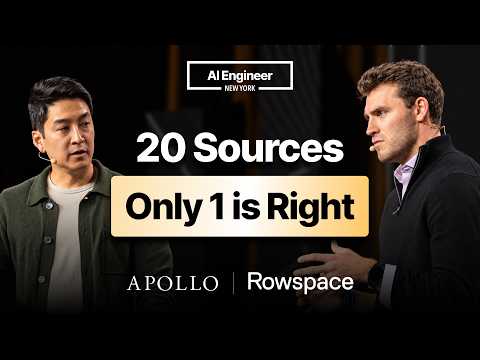
AI Agents Cut 3-Day Portfolio Builds to Minutes — Jack…
Jack McDonald (Principal at Apollo and COO of Redding Ridge, Apollo's structured credit and CLO manager) speaks with Rowspace co-founder Michael Manapat about practical AI use in finance. Topics include automating a weekly trade reconciliation previously handled by 2–3 people, building mock portfolios in minutes instead of days, why generic LLMs alone aren't enough when data comes from many conflicting sources, and the value of embedding engineers with the front office to build trust. Recorded at AI Engineer New York 2026.
# Video Identity Observations — "AI Agents Cut 3-Day Portfolio Builds to Minutes"
## Explicit Self-Description
**Presenter-identified affiliations:**
- **Michael Manapat**, introduced as *"a co-founder of Roam Space"* (transcribed variously as Roam Space / Rowspace / Rose Space), describing it as *"an H cloud form that uses AI to help financial services partners like Apollo deal with messy, fragmented data"* — *"We essentially use agents to do the work of data engineering."*
- **Jack McDonald**, introduced as *"principal at Apollo and COO of Reddington Ridge Capital,"* described as *"our structured credit and CLO manager that is captive to Apollo,"* managing *"about 50 billion in assets."*
**Product claims made on stage:**
- Portfolio construction that *"would typically take a PM… anywhere from two to three days in a manual Excel"* now completes *"in the matter of minutes."*
- A weekly trade reconciliation report *"created and now repeatable in the span of a minute."*
- Differentiation from general LLMs: *"it's all general information… none of your own actual data. So, it's great for research,"* versus Rowspace's approach of *"owning our own data."*
## Observable Presentation Patterns
**Intended audience — technical practitioners in AI × finance:**
- Moderator states: *"I think we have a bunch of engineers in the audience."*
- Closing advice is aimed at *"a lot of people in this room who either want to work on the technology side of AI and finance or perhaps finance side."*
- References to specific developer tooling eras — *"before Claude code became a thing, when cursor was still in the tap configuration era"* — signal a software-engineering-literate audience.
- Explicit recruiting close: *"shameless plug both Rose base and Apollo technology are hiring people who want to apply AI to finance."*
**Claimed scope — mission-critical (not experimental) AI:**
- Framing question: *"there's a pretty wide gap between when AI is nice to have and when AI can actually become mission critical."*
- Emphasis on operational stakes: *"your team are making trading decisions, performing management decisions. So, accuracy and quality are high."*
**Demonstrated format evidence:**
- Live fireside-chat/interview structure with moderator, audience Q&A references, and closing applause; customer (Apollo/Reddington Ridge) and vendor (Rowspace) appearing jointly as a case-study showcase.
## Creator Claims vs. Demonstrated Patterns
- **Claims (not independently verified):** efficiency metrics (3 days → minutes; weekly → 1 minute), "$50B in assets," "over 400 global investors," and the claim that Rowspace is *"ahead of our road map and expectations."*
- **Demonstrated:** the channel presents real enterprise AI deployments through practitioner dialogue, targets an engineering-leaning professional audience, and doubles as a recruiting surface.
# Delivery Observations — Jack McDonald & Michael Manapat
## Speaker Roles & Setup
- **Michael Manapat** (Rowspace co-founder) acts as the **interviewer/moderator**: asks structured, two-part questions with concrete framing.
- **Jack McDonald** (Apollo / Reddington Ridge COO) is the **primary speaker**, answering in long, explanatory turns.
---
## Jack McDonald's Delivery Patterns
### Recurring verbal fillers & softeners
- Heavy, consistent use of **"kind of"** and **"like"** as discourse markers:
> "all across **kind of** the structured credit ecosystem"
> "they **kind of** have like a very specific waterfall"
- Frequent **"call it"** as an approximating device:
> "**call it** anywhere from 200 to 400 single credit names"
> "**call it** 80 90% completion"
> "in **call it** the asset management investment banking... world"
- Repeated **"I think"** openers on nearly every substantive answer ("I think finance broadly...", "I think at its core...").
- Self-correcting, qualifier-heavy sentence structure: "what I'll say," "what I'll call middle back office support."
### Teaching habit: before/after contrast
McDonald's dominant explanatory structure is **manual past vs. automated present**, used in every concrete example:
- Portfolio builds: "would typically take a PM... **two to three days in a manual Excel**. Today... do it in the matter of minutes."
- Trade reconciliation: "it was **very manual**. We were going into... literally going into bank accounts... today... repeatable in the span of a minute."
### Quantification as persuasion
He anchors claims with specific numbers: "**50 billion** in assets," "**thousand name** loan pools," "**400 global investors**," "two to three days," "a minute."
### Metaphor habits
- **"Boots on the ground"** appears twice as his term for embedded vendor collaboration.
- Idiomatic, conversational phrasing: "**rinse and routine** type process," "**latest and greatest** information," "at **your fingertips**" (twice).
### Uncertainty surface
- One visible moment of lost thread: "And then **I'm blanking on the second part** of your question. Sorry." — an isolated, candid recovery, not a habit.
---
## Michael Manapat's Delivery Patterns
### Structured, two-part questions
He repeatedly signals multi-part framing explicitly:
> "This is a **two-part question**. I think a lot of people will ask us..."
> "And **what do you think is two-part question again**, so remember the second part."
This becomes a light running joke ("so remember the second part") after Jack forgets one.
### Vocabulary
Tech-industry idiom: "**AI pilled**" (used twice), "**AI native**," "**platform not point solutions**," "**cursor... tap configuration era**," "**golden source of truth**" (actually from Jack).
### Interviewer acknowledgments
Habitual validation between questions: "Awesome," "**I love those examples**," "Yeah, that that makes sense" — with occasional doubled words ("Glad glad glad to hear," "Yeah, yeah").
---
## Stable vs. Isolated
**Stable:** Jack's qualifier-heavy register, before/after structure, numeric anchoring, and "call it" approximations; Michael's two-part question format and affirming transitions.
**Isolated / thin evidence:** Jack's forgetful moment (once); the "AI pilled" joke (Michael only); the closing recruitment plug (once). Repetition is insufficient to call these habits.
# Observation Record — AI Agents Cut 3-Day Portfolio Builds to Minutes
**Video:** "AI Agents Cut 3-Day Portfolio Builds to Minutes — Jack McDonald, Apollo & Michael Manapat, Rowspace"
**Speakers identified in transcript:** Michael Manapat (co-founder, Rowspace/Rosebase) and Jack McDonald (Principal at Apollo; COO, Reddington Ridge Capital).
> **Note on naming:** The transcript inconsistently renders the company as "Roam Space," "Row Space," "Rowspace," "Rosebase," and "Rose Space." These appear to refer to the same entity; no attempt is made here to resolve the correct spelling.
---
## Speaker Introductions
**Michael Manapat (Rowspace)**
- Describes Rowspace as a cloud platform using AI to help financial services partners like Apollo handle "messy, fragmented data."
- Frames the product as agents doing "the work of data engineering" — directing and reconciling information across systems so portfolio managers and traders can decide "faster and more accurately."
**Jack McDonald (Apollo / Reddington Ridge)**
- Principal at Apollo; COO of Reddington Ridge Capital, described as Apollo's captive structured credit and CLO manager — a "separate, fully separate entity" managing **~$50 billion in assets**.
- At Apollo since 2020; prior roles in the financial institutions group and asset-backed group.
---
## The Data Problem at Apollo / Reddington Ridge (McDonald)
- Reddington receives **thousands of data points daily** across investments; manages roughly **thousand-name loan pools** across multiple businesses.
- CLO management is active and traded in the broadly syndicated loan market; fast access to information is described as "very, very important."
- Core goal: ensure data is "accurate, consistent, and in a format that we can utilize."
- Qualification on the data itself: the information is **private and fragmented across various documents** — unlike public equities or fixed income.
- Stated rationale for the Rowspace partnership: the team sits with Reddington's teams to learn the actual calculations, identify the "golden source of truth," and train the AI engines to repeat it.
---
## Concrete Before/After Examples (McDonald)
### 1. Portfolio construction
- CLOs are "very test specific" and rules-based, with a specific payment waterfall embedded in deep indenture documents and legal agreements.
- **Before:** PMs reviewed documents and built Excel-based mock portfolios of **200–400 single credit names**, taking **2–3 days** of manual work.
- **After:** With real-time data, the same task is done "in the matter of minutes."
- Stated division of labor: AI gets the portfolio to "**80–90% completion**"; PMs apply judgment to refine the final ~10% "to make it theirs."
- Data sources cited: document libraries, trade and compliance systems, real-time pricing.
### 2. Warehouse purchase activity / trade reconciliation
- The business uses bank financing and buys loans at any point; historically, a **weekly manual trade rec** required individuals to go "literally going into bank accounts" to check settlement statements, then email a recap to management.
- **After:** The same report is dropped into "Rosebud" (as rendered in transcript) for visualization, created and now **repeatable in about a minute**, fully automated.
- The team's role shifted to **daily QA**; previously the rec consumed "many hours of the week for two to three individuals."
---
## Why Not Just Use ChatGPT/Claude? — On Trust (McDonald, responding to Manapat)
- LLMs are "very beneficial" but work off **general information, not the firm's own data** — good for research, idea generation, or getting up to speed quickly.
- Reddington's AI approach centers on **owning its data** with a platform on top "that we know is to be true."
- Differentiator claimed for Rowspace: "boots on the ground" — the team sits with Reddington daily because **one data point may come from 20 sources, and only one is correct**.
- Trust mechanism stated: Rowspace spends time with portfolio management and finance teams to learn the correct calculations, override bad sources, and aggregate from the trade order management system, performance system, Bloomberg, and pricing indices.
- Contrast drawn with the rest of the company: fragmented systems requiring manual lift-and-shift of information.
---
## Apollo's AI Culture (McDonald)
- Claims Apollo "prided itself" as a leader and innovator in alternative asset management.
- Framing: "the AI world is here and we need to adapt and adopt it" rather than discredit or ignore it.
- Attributes the posture to a "very flat and open culture" open to change; goals stated as efficiency and freeing capacity for more thoughtful work.
- **Self-check note:** McDonald forgot the second half of Manapat's two-part question and acknowledged it ("I'm blanking on the second part"); the conversation moved on without it being answered.
---
## Where Finance Stands on AI Adoption (McDonald)
- Finance broadly — banks, large institutions — is **"very early"**, especially in asset management and institutional contexts.
- Complexity caveat: "we are extremely complicated and have a lot of complexity in everything that we do. So, it's not really straightforward."
- Current-model use cases (model creation, quick research aggregation) are characterized as **"lower value-add"** — though he notes this will evolve and may reduce junior support needs over time.
- Current Reddington focus: efficiency on routine tasks, freeing capacity for an "endless" project backlog.
---
## Commodity vs. Competitive Advantage (McDonald)
- **Position:** "If it's adapted and utilized properly, it will make you more competitive."
- Reasoning: in actively traded asset management, success "comes down to your process and the information at your fingertips" — process quality, available liquidity, pricing, and value at any given point.
- Distinction: this advantage exists today in actively traded markets but is **"evolving" in private markets**, where he claims Apollo has been "at the forefront."
- Risk framing: the last thing the firm wants is a decision "that was misinformed," propagating "down the chain to both the enterprise and to... our investor base."
---
## Personal Outlook — Next Few Months (McDonald)
- Goal 1: full confidence that information flowing to investors is accurate without hours of manual validation — noting a **base of over 400 global investors**.
- Goal 2: a more tech-enabled mindset. He states the team "has not lacked that to date, but it's kind of been an afterthought" — hoping technology thinking becomes the team's **primary** frame when tackling problems, specifically at Reddington Ridge.
---
## Advice for AI-in-Finance Practitioners (McDonald)
- These are "extremely complex organizations"; things that look "novel or strange... is probably actually there for a reason."
- Advice: **put boots on the ground** and sit with the front-office teams being built for — "time well spent."
- Credits Rowspace being "ahead of our road map and expectations" to Michael's team sitting with Reddington's team "pretty much every single day."
---
## Closing Remarks (Manapat)
- Notes "shameless plug": **both Rowspace and Apollo technology are hiring** people who want to apply AI to finance.
---
## Tensions and Qualifications Preserved
- McDonald frames AI as transformative, yet simultaneously calls current LLM use cases "lower value-add" and finance adoption "very early" — optimism and early-stage caution coexist without resolution.
- He explicitly declines to predict five-year outcomes (Manapat also declines, saying he "can't even predict if my team's going to use... cloud code next week").
- The "must rebuild the firm in an AI native way" / "platform not point solutions" characterization of Apollo comes from **Manapat's framing of prior conversations**, not from McDonald directly restating it in this transcript; McDonald's answer addresses culture generally and then loses the second part of the question.
# Video Attribution & Provenance Record
**Video ID:** `01a15ca6-6c39-73ab-a030-008005b29baa`
**Title:** AI Agents Cut 3-Day Portfolio Builds to Minutes — Jack McDonald, Apollo & Michael Manapat, Rowspace
## Speaker Roles
### Michael Manapat — **Co-founder, Rowspace** (creator-side interviewer)
- Self-identifies at the opening: *"I'm Michael Manapat. I'm a co-founder of Roam Space."*
- Describes Rowspace as an "H cloud form" [sic, likely "AI cloud platform"] using agents for data engineering in financial services.
- Acts as moderator/interviewer throughout; asks all questions.
### Jack McDonald — **Guest; Principal at Apollo, COO of Reddington Ridge Capital**
- Self-identifies: *"I'm Jack McDonald. I am a principal at Apollo and COO of Reddington Ridge Capital."*
- Describes Reddington Ridge as Apollo's captive **structured credit and CLO manager** managing **~$50 billion** in assets.
- At Apollo since **2020**; prior roles across financial institutions group and asset-backed group.
- Serves as the primary subject-matter respondent.
**Note:** Spelling varies in transcript ("Roam Space" / "Rose Space" / "Row Space" / "Rowspace"; "Reddington Ridge" / "Reading Ridge" / "Redding"). No curated metadata was supplied to disambiguate; "Rowspace" and "Reddington Ridge" (from title) are treated as canonical.
## Third-Party Claims & Referenced Sources
- **Products/tools referenced:** Claude, ChatGPT/LLMs generally, Cursor, Claude Code, Bloomberg (as a pricing source), Excel, Rowspace's product **"Rosebud"** (visualization/reporting, per transcript).
- **Business claims (speaker-attributed to McDonald):**
- Portfolio construction that took PMs **2–3 days** in manual Excel now takes **minutes** with Rowspace, reaching "80–90% completion" for human refinement.
- Weekly warehouse purchase/trade reconciliation, previously "many hours of the week for two to three individuals," now automated and repeatable "in the span of a minute," with team QA.
- Reddington Ridge manages "thousand name loan pools"; data "thousands and thousands of data points" daily.
- Apollo investor base: "over 400 global investors."
- **Data sources claimed for Rowspace integration:** trade order management system, performance system, Bloomberg/pricing indices, doc libraries, bank statements.
## Promotional Segments — FLAGGED
- **Closing recruitment plug (Manapat):** *"shameless plug both Rose base and Apollo technology are hiring people who want to apply AI to finance."*
- **Product promotion context:** The interview is conducted by a Rowspace co-founder about his own company's product with a customer (Apollo/Reddington Ridge). All product-efficacy claims originate from the customer guest; the interviewer's company is the vendor. Recorded as a provenance fact, not evaluated.
## Comment Availability
- No information about comments or audience Q&A availability is present in the transcript. A live audience is referenced ("I think we have a bunch of engineers in the audience") and applause appears at the end, but no comment channel is mentioned.
## Limitations
- No curated metadata supplied beyond the transcript and title.
- Transcript is auto-transcribed with inconsistent product/firm name spellings; treated as unverified.
- No timestamps available in the source.
\>\> It's great to be here. I'm Michael Manapat. I'm a co-founder of Roam Space. And Roam Space is an H cloud form that uses AI to help financial services
partners like Apollo deal with messy, fragmented data. We essentially use agents to do the work of data engineering, direct information, reconcile data from a cross variety of systems so that portfolio managers, traders, and so forth can make decisions faster and more accurately. I'm joined here with Jack McDonald who is chief operating officer of Reddington Ridge, one of Apollo's credit units. And maybe to kick it off, Jack, I'd love to hear a little bit about you and what your business does. \>\> Yeah, thank you, Michael. I'm Jack McDonald. I am a principal at Apollo and COO of Reddington Ridge Capital, which is our structured credit and CLO manager that is captive to Apollo. We're separate, fully separate entity, operating company that manages about 50 billion in assets. And all across kind of the structured credit ecosystem, primarily CLOs. I was been at Apollo since 2020, wear various different hats throughout the my time there across our financial institutions group, our asset-backed group, and now currently at Reddington. So, yeah, happy to be here. \>\> Awesome. So, something that we've noticed in talking to a huge number of financial
firms is that there's a pretty wide gap between when AI is nice to have and when AI can actually become mission critical to a business. And I think in Apollo's
case, we're seeing that AI can really be transformative in how the firm operates. I'd love to hear some examples from you on the kinds of work your part of the business was doing, what made it complex, and what you're seeing now with AI. \>\> Yeah. So, at Apollo and specifically Reading Ridge, you know, we manage many different fund entities, investments. We're getting uh thousands and thousands of data points on a like daily basis coming in across all of our investments. We manage probably, you know, thousand name loan pools and have credits across multiple different businesses that were assessing on a daily basis and investing in. Um CLO management is very active and it's traded in the broadly syndicated loan market. So, having all that information at your fingertips is very, very important. So, at Apollo, what we're doing is and at Reading specifically, is trying to enhance and ensure that all of our data and our data quality is accurate, consistent, and in a format that we can utilize, um and make us much more practical and thoughtful when we're making decisions in a much fast-paced environment. So, all of this information is privatized and is not very, what I'll say, widely in the marketplace like how public equities or public fixed income trades. It's very uh fragmented in various documents. So, we've looked to companies like Row Space to partner with to come in and actually sit with our teams, work with us, and understand the actual calculations and information that we're looking to, and what's actually the golden source of truth, and then continuing to enhance the AI engines to understand that and repeat that, and just make us that much more efficient. \>\> I think we have a bunch of engineers in the audience, and we've spoken a lot just you and I on fire drills that the
firm does. Like it used to take a team working a week, uh if not if not more. Uh can you make it concrete for us and maybe walk us through an example of something that was painful or
time-consuming, hard to do before that now you can do more easily with RoseAI space and and AI? \>\> Yeah, happy to. And I'll give kind of two examples that we that I like to look to. The first being is just on the portfolio construction side. So CLOs are very test specific. They have a bunch of they're very rules based. They have like a very specific waterfall of where money flows. So those all live in deep indenture documents and multiple different legal agreements that So sitting from like a portfolio manager's perspective in portfolio construction, they are reviewing those documents, building Excel based models, and building mock portfolios with call it anywhere from 200 to 400 single credit names to create a portfolio which would typically take a PM before kind of adopting RoseAI space anywhere from two to three days in a manual Excel. Today, we're able to kind of get the latest and greatest information that's real time, create a portfolio that would take somebody days to now do it in the matter of minutes. And then that allows these PMs to kind of build something to call it 80 90% completion and then kind of use their judgment and their thought to further refine that portfolio that last 10% to make it theirs. That's one of the most tangible examples. It's kind of pulling in various forms of data and you know, information from across multiple different things whether it's in doc libraries, you know, our trade and compliance systems, and real time pricing and stuff like that. The other one that I think I would look to is our kind of like warehouse purchase
activity. So how we run our our business operates with having a bunch of bank financing and we can go out and buy loans in in the fixed income market at any given point.
Historically, we would kind of do a trade wreck and trade activity on a weekly basis that would go around of here's your sale purchase activity from the week. Here's what we bought, here's what we sold, and it was very manual. We were going into various like literally going into bank accounts to understand uh statements, where things actually settled, and it was an individual team that was going and wrecking that out and then sending a reported email to uh the management team to say here's the recap. Um, today, what we're doing now is we've been able to take that exact same report, drop it into Rosebud from a visualization perspective. That report was then created and now repeatable in the span of a minute. And now all of that is automated, and then from our team's perspective, we are just QAing that and checking it each day to make sure that that looks right. And now it's a much more of a rinse and routine uh type process, which historically take many hours of the week for two to three individuals on our team to actually wreck that out. \>\> Yeah, I love those examples. So, you know, you aren't just reading the output of a chatbot to be informed. I think your team are making trading
decisions, performing management decisions. So, accuracy and quality are high. This is a two-part question. I think a lot of people will ask us or ask generally, "Why can't you just plug this stuff into
Claude and or ChatGPT and see what happens?" And for someone like you, how does your team get the confidence in a product like Rosebud or other AI tools to say, "We are going to make business decisions on this, make trades, build portfolios, all of that." How do you get to that level of of trust? \>\> Yeah, I would say Claude and the open AIs of the world and like the ChatGPTs, all the LLMs are uh very beneficial, but it's all general information that that's being worked off of and none of your own actual data. So, it's great for research or kind of building new ideas or getting up to speed on some type of uh product or investment quite quickly. Where Rose base is different and what we've kind of taken our approach to this the the AI build out at Redding has been around owning our own data and having some type of platform and technology that sits on top of that that we know is to be true. So the Rose base team which has been much different from what we've seen from other uh technology companies that we've worked with is they're boots on the ground. So like Michael sits with our team on a daily basis learning and understanding our information flow cuz for one piece of data that might come from 20 different sources and there's only one that's actually right. So the Rose base team is spending the time with our portfolio management team, with our finance teams to understand the calculations, understand what data is actually correct, and override other sources of information, and kind of aggregate that. So to that end, we're able to kind of have trust in the system and you know, appreciate that okay, we've had our team go in and validate that this information is correct and we can rely on it and it's coming from all of our whether it's our trade order management system, whether it's from our performance system, whether it's from Bloomberg or any pricing index that we're pulling in, and know that it's accurate. Whereas in a lot of other you know, call it systems throughout even our own company, it's very fragmented and we have to kind of lift one piece of information from over here and bring it back over here and kind of pull that together manually, whereas Rose base is now just automating that all for us.
\>\> Glad glad glad to hear \[laughter\] that. Need to talk about the firm at a higher level. Uh it seemed to me for a long time, even early last year before Claude code became a thing, when cursor was still in
the tap configuration era, that Apollo was among the most AI pilled of the firms we spoke to. And that was everything from the firms view on how to invest in an AI world, but operationally we've been talking to you a long time ago and you were in the we must rebuild the firm in an AI native way, must have a platform not point solutions. So I'm just curious, where did that come from and what is it about about Apollo's culture that made you so AI pilled even before things took off? \>\> Yeah. So Apollo has always prided itself in being kind of the leader of the alternative asset management space and the financial services industry broadly. We pride ourselves in being very innovative and being at the forefront of all things change and what that looks like. So I think from the onset and the way our management team approaches how we operate is always being up to skill and enhancing our team's capabilities and being able to be nimble and adopt to where the market's going. I think we appreciated that the AI world is here and we need to adapt and adopt it not, you know, discredit it or not utilize it. So we've been very forward and, you know, open-minded about adopting new technologies and bring those into our workflows and how we can be more efficient and free up capacity for people to be more thoughtful and think and, you know, replace manual processes. So I think at the core of its level we've always been a very innovative firm that's very flat and open culture to be open to those types of change. And then I'm blanking on the second part of your question. Sorry. \>\> Well, maybe we can keep on going. So I think one thing that we've been thinking about is software engineering that has completely changed as a discipline. Like the world is completely
different if you are a technology company like like Rose Space. And maybe arguably law and customer service are almost there. Uh, where do
you think finance is on the spectrum of AI is here, it's made a difference, or we haven't even, you know, gotten to the bottom of the of the first inning. And what do you think is two-part question again, so remember the second part. Uh, if we're early on, what what's necessary to really change the shape of finance with AI? \>\> Yeah, I think that's a great question. So, I think finance broadly, these banks and large organizations are massive. They have a lot of, you know, back-end what I'll call middle back office support, and I think there's a lot of room to grow and enhance there. I think probably as you appreciate now if working with us that we are extremely complicated and have a lot of complexity in everything that we do. So, it's not really straightforward. I think in finance broadly, especially in call it the asset management investment banking, the bank institution institutional world, I still think it's very early. I think there's some value for some of the like, you know, uh, model creation or getting up to speed on some company quite quickly and pulling and aggregating that type of research, but I think that's lower value-add at least of where we stand today, and that's going to evolve. I think like, you know, there's probably a need where there's less junior support over time for certain functions like that, but I think from where we are today and what we see from from at least my perspective at Reading, I think we're just trying to adopt this technology and make it, you know, as efficient as possible for, you know, routine tasks. That frees up capacity for, you know, other projects cuz we kind of have like endless things to do and enhance at our company, and that's just giving us a lot more flexibility to adopt that. \>\> Yeah, yeah. Uh, speaking of continuing on that note, I'm curious uh, there's a world in which AI just becomes something that helps speed up
tasks, uh, saves you on OpEx, things like that. And maybe in the same way, no given firm now has an advantage because they use Excel. Cuz everyone uses Excel,
and it's just a productivity tool. And there's also a world in which AI actually materially makes a competitive advantage or helps reify Apollo's lead in structuring and creative deals and so forth. Do you have a take on whether AI is going to be just a useful but a general commodity, or if it's going to be something that can actually structurally make a business more competitive in a durable way? \>\> I think if it's adapted and utilized properly, it will make you more competitive. I think at at its core, and especially around asset management and investing-type companies that are in the actively traded markets, like it comes down to your process and the information at your fingertips. So, knowing that you have a strong process in place to go out and execute, and knowing your available liquidity, or you know, where things are pricing and what the value is at any given point in is crucial. So, that just gives you, you know, more competitive edge. And I think like that exists today in the you know, actively traded markets, but in the private markets, it's evolving. Um which we've kind of been at the forefront of trying to to move on the broader Apollo machine. And I think having that will just turn into a competitive advantage over time, where firms will be able to get further ahead as they're, you know, having access to better information. They They know their teams know that it's accurate, and like stuff is not misaligned, cuz the last thing we want to do is, you know, do something or make a decision that was misinformed or had misinformation, and then that streamlines down the chain to both the enterprise and to the, you know, our investor base at the end of the day. \>\> Yeah. Yeah, that that makes sense. So, I wanted to ask you what Which was for what Apollo would be like in when we're talking five years observing all the change. I think that's unfair. I
can't even predict if my team's going to use code extra cloud code next week. So, I want to ask I want to ask you about five years in in the future. But I guess for you personally, what are you hoping to see in terms of your job, team, how
AI use in Apollo evolves, what conditions have to hold for the technology to actually be truly valuable? You know, what are you How are you thinking about things over the next you know next few months? \>\> Yeah, I think it comes back to some of the stuff I touched on before of just one having just you know, full confidence in any type of information that's flowing out at the end of the day to our investor base that's accurate, correct, and we don't have to spend hours manually checking that to make sure that that's validated and having the confidence that we're sharing, you know, no issues and or mistakes um cuz we do have just a wide investor base, you know, over 400 global investors. Um I would also say being much more tech enabled in mindset. I think our team has not lacked that to date, but it's kind of been an afterthought around the use of technology. And I think the more that we can develop and enhance these tools that make you know, routine tasks, you know, more efficient, it frees up capacity to add more thought or think more creatively around why does this process exist and how does it work today and how can we actually enhance that or should we change that or should we bring in a new type of technology and adopt that going forward? And our team has not lacked that today, but it's kind of been a secondary thought where I think ideally our workforce is positioned to think about that more on a go forward basis and that's kind of their primary thought as they're tackling different problems. Specifically this is specifically at Reading Ridge day-to-day and kind of scaling our organization. \>\> Uh I think we have time for one more. I think one of my learnings from working with you has just been how unimaginably complex and creative the work is and how it takes a lot of effort both human and AI to get things to work. A lot of people in this room who either want to work on the technology side of AI and finance or perhaps finance side. Is there anything that you would mention to them from an here's something that you should know or keep in mind when trying to apply AI to domains like yours? \>\> Yeah, I would say it it comes down to we are extremely complex organizations and it's not as straightforward and typically things might look a little bit novel or strange and out of place, but it's probably actually there for a reason or structured in a specific way. I'm sure as you guys have come in you appreciate that we're super nuanced and complicated. So, spending the time and really putting boots on the ground to sit with whatever team or front office professional that you're working to build a tool for or enhance is time well spent and I think the success and you know, where we are today with the Rose base product and kind of being ahead of our road map and expectations has been you know, due to
the fact that Michael and the team has spent ample time sitting on the ground with our team like pretty much every single day and you know, understanding our workflows which I think is crucial.
Awesome. Well, I guess the last thing I'll say is that shameless plug both Rose base and Apollo technology are hiring people who want to apply AI to finance. So, please reach out to either one of us if you are interested. All right, Jack thanks so much and great chatting with you. \>\> This is great. Thank you guys. \>\> \[applause\]