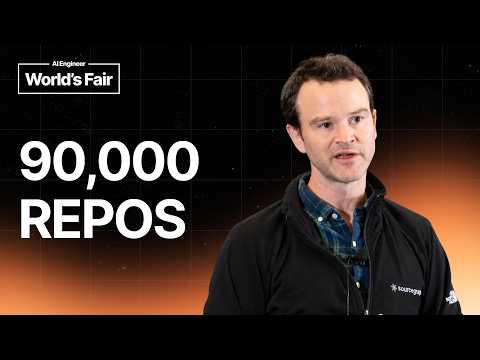
AI Coding Agents Are Breaking Big Codebases — Dan Adler,…
Dan Adler, CEO of Sourcegraph, argues that maintainers of large, long-lived enterprise codebases (in banking, automotive, aviation) face growing decay as AI coding agents generate code at scale — duplicated code, drifting standards, brittle dependencies, and new vulnerabilities. He contends that agents understand code by searching, so visibility at scale is infrastructure, and context — not model quality — is the bottleneck. He also presents Sourcegraph's Agentic Batch Changes for making and auditing changes across thousands of repositories from a single prompt. Recorded at the AI Engineer World's Fair 2026 in San Francisco.
# Channel Presentation Observations
## Explicit Self-Description
- **Speaker and role stated directly**: The speaker introduces himself as **"Dan Adler, CEO at SourceCraft"** (transcript opening; note the title and later transcript passages say **"Sourcegraph"**, suggesting a transcript mis-transcription of the company name). This is the creator's own claim about his position.
- **Company mission claim**: "This is what source graph is built around" — building tools "to give agents the ability to actually see and understand and evolve those large code bases."
- **Product claim**: "Just today we launched our new um our new agentic batch changes product into beta," described as a frontier agent for executing changes across "hundreds or thousands of repositories at once starting with a single prompt."
## Intended Audience
Evidence strongly indicates an audience of **engineers and technology leaders at large enterprises**, specifically those who own or manage massive codebases:
- Framing statistics aimed at large-company staff: "72% of software industry employment is in companies with more than 500 people."
- "Few of your peers work at startups at the hot companies you may hear about on social media."
- References to executive conversations: "Every day I talk to technology executives at these large companies and they are feeling this so viscerally."
- Direct audience address: "the same pain that I imagine many of you are feeling too."
- A secondary audience is addressed explicitly: "this session is also a call to dev tools companies out there, to the agent harness builders."
## Claimed Scope
- **Topic scope**: "the unglamorous but loadbearing work of owning a large complex codebase and why AI and agentic coding tools today make that job more difficult."
- **Company positioning scope**: Claimed gap in the market — "The infrastructure to see and understand a 50,000 repo codebase is not being built or sold by OpenAI, by anthropic, by cursor, by the rest of them."
## Observable Presentation Patterns
- **Conference-talk format**: Live audience address ("great to see you all here today," "Any questions?") with an in-person event promotion ("Code Cocktails and Cuttovers" in SF).
- **Problem-then-product structure**: Extended framing of enterprise codebase decay and AI-generated code risks, followed by a product launch announcement and a customer anecdote (Mercari user finding "80 other potential vulnerabilities").
- **Reliance on anecdotal customer quotes as evidence**: e.g., a bank tech leader quoted: > "Sure, Claude Code can uh make this change, but I have 90,000 repositories to make it in." These are presented as secondhand accounts, not independently verifiable in the material.
- **Industry-prediction framing**: "If you'll let me sort of take a moment and predict the future of our industry... There will be much much much more code."
## Claims vs. Demonstrated Patterns — Distinction
- **Creator claims**: company mission, product capabilities (self-heal, CI response, 100% coverage tracking/auditability), customer outcomes (Mercari anecdote), and industry trajectory. All are asserted by the speaker without independent verification within the material.
- **Demonstrated**: The channel (via this talk) demonstrates expertise-based, executive-level enterprise dev-tool marketing content delivered in a conference setting, addressing scale problems (thousands of repos, context-window limits, duplicated code, vulnerabilities) that are described rather than shown.
## Curation Notes / Uncertainties
- The transcript contains apparent transcription errors ("SourceCraft" vs. "Sourcegraph" in title; "gp gp gp" likely meaning "grep"), which should not be treated as factual channel identifiers beyond what the title states.
# Delivery Observation — Dan Adler, Sourcegraph (conference talk)
## Tone
- **Urgent, rallying, conversational.** The talk frames a problem as a looming threat: *"A title wave of code is coming for you"* [125], *"these code bases... are beginning to decay"* [179].
- **Warm and audience-facing** in the opening and close: *"Hey, welcome everybody... great to see you all here today"* [12], *"Bring your gnarliest codebased stories"* [707].
- Frequent **rhetorical engagement with the audience**: *"right?"* recurs constantly — e.g. *"The call is coming from inside the house, right?"* [247], *"what we're working on as a company... right?"* [497], *"and how you're dealing with... right?"* [707].
## Vocabulary and Recurring Phrases
- **"At the end of the day"** — used at least four times [224, 247, 530, 598], marking each major pivot: *"at the end of the day, the problem here is actually the volume of code"* [247].
- **"See and understand"** — the core repeated formulation: *"the infrastructure to see and understand a 50,000 repo codebase"* [317], *"agents the ability to actually see and understand and evolve those large code bases"* [520], *"go see and search and really deeply understand"* [474].
- **Massive/large codebase scale numbers as a motif**: "50,000 repo" [317, 485], "90,000 repositories" [407, 430], escalation ladder *"500 or 5,000 or 50,000 or half a million repo codebase"* [485].
- **"Infrastructure"** as a framing word: *"Visibility is infrastructure"* [553], *"this is an infrastructure problem"* [598].
- **Superlatives for emphasis**: *"so unbelievably good at... solving the small-scale problems"* [327], *"massive decades old super complex code bases"* [112], *"more much much much more code"* [507].
## Teaching Habits
- **Concrete real-world stakes up front**: a rapid-fire list of everyday systems — bank transactions, insurance reimbursement, Uber ETAs, warehouse scanners, *"your office air conditioner ticks on and on and on"* [80–101].
- **Named customer anecdotes with attribution**: *"I overheard a dev say, 'I don't know what this code does. AI wrote it for me.' This is a tech leader... at a top 10 car manufacturer"* [281]; the bank quote *"Sure, Claude Code can make this change, but I have 90,000 repositories to make it in"* [396–407]; the Merkari user patching *"80 other potential vulnerabilities"* [642].
- **Numbers as evidence throughout**: *"72% of software industry employment"* [47], *"hundreds and hundreds of independent microservices"* [631].
- **Direct address and call to action at the close**: *"If you're wondering what code is deployed right now... come talk to me"* [685–696], plus a named event, *"Code Cocktails and Cutovers"* [696].
## Communication Patterns
- **Flood/water metaphor sustained across the talk**: *"title wave of code is coming for you"* [125], *"this flood of AI generated code"* [136], *"putting sandbags down to keep this flood held back"* [157], returning to *"title wave of code"* at the close [707].
- **Rule-of-three and escalation lists**: *"It's not pretty. It's not new. It's not clean"* [35]; *"OpenAI, by anthropic, by cursor, by the rest of them"* [317]; *"to the agent harness builders, to people who are building the infrastructure"* [371].
- **Self-interruption and soft hedges** when transitioning to the pitch: *"Give this a second. If you'll let me sort of take a moment and predict the future"* [497]; *"So yeah, I'll stop here"* [664], *"Cool. Thank you. I'll stop there"* [717].
- **Filler words ("um," "uh")** appear frequently, especially in transitional moments.
## Confidence Notes
- The "at the end of the day," "see and understand," flood-metaphor, and "right?" patterns are well supported by multiple occurrences and look stable.
- The transcript contains transcription artifacts (*"gp gp gp gp"* likely "grep," *"title wave"* likely "tidal wave," *"codebased"* likely "codebase"); these are treated as transcript noise, not delivery evidence.
# Position Record: "AI Coding Agents Are Breaking Big Codebases" — Dan Adler, Sourcegraph
## Speaker
- **Dan Adler**, identified as CEO (introduces himself as "CEO at SourceCraft" — likely a transcript artifact; talk context is Sourcegraph) — sole substantive speaker.
## Central Thesis
- **Large codebases are the world's load-bearing infrastructure**, and AI coding agents make owning them **harder, not easier**, because the tools accelerating code creation also drive codebase decay.
- Quoted framing: **"The call is coming from inside the house"** — the problem is the *volume of code* generated by the very tools speeding developers up.
## Stated Claims and Reasoning
### 1. Software runs on large, old, unglamorous codebases
- **72% of software industry employment** is at companies with >500 people (stated statistic).
- Large enterprises manage **thousands of repositories and decades of history**; most engineers work in large, long-lived codebases, not startups.
- Examples cited: bank transaction rejection, insurance reimbursement rates, Amazon warehouse scanning, Uber ETAs, aircraft radar, paychecks, office HVAC.
### 2. AI-generated code is a "tidal wave" harming codebase health
Adler's stated failure modes from agent-written code:
- **Inconsistent coding standards** applied by different agents in different places.
- **Duplicated code proliferation** — existing libraries unknown to agents.
- **Brittle cross-service dependencies**.
- **Insidious hidden issues** from slight standard deviations.
- **New vulnerabilities uncovered by agents daily**, requiring constant oversight.
- Codebases too large to fit in a context window or grep in real time.
### 3. Current tooling is inadequate
- Code review agents and code-health tools are **"sandbags"** — local maxima, not solutions.
- Infrastructure to see/understand a **50,000-repo codebase** is "not being built or sold" by OpenAI, Anthropic, Cursor, "by the rest of them."
- Agent builders excel at **small-scale problems**, so the large-codebase decay "is going unnoticed."
- On agents and understanding: LLMs "just love to search"; agents "grep their way to codebase understanding," but **"you can't grep what you literally cannot see"** — understanding is a context/infrastructure problem. **"Visibility is infrastructure."**
### 4. Anecdotal executive testimony (as reported by Adler)
- **Top-10 car manufacturer tech leader**: overheard a dev say *"I don't know what this code does. AI wrote it for me"* — flagged as terrifying for vehicle autopilot code.
- **Top-10 US bank tech leader** (tens of trillions under custody/administration): *"Sure, Claude Code can make this change, but I have 90,000 repositories to make it in"* — regarding an npm supply-chain vulnerability.
- **Early-access user at Mercari**: used the new batch-changes product to patch a GitHub code-injection issue in two known repos, then explored the codebase and found **~80 other potential vulnerabilities**, patched deterministically.
### 5. Sourcegraph's positioning and product pitch
- Sourcegraph is "built around" solving this: **a code graph — search plus compiler-accurate output** — as the foundation for agent understanding.
- Product launched **into beta "today"**: **agentic batch changes** — a frontier agent executing changes across hundreds/thousands of repos from a single prompt; iteratively rolls out changes, **self-heals**, responds to CI status and PR comments, uses coding agents where judgment is needed and **deterministic scripts where it isn't**, with **tracking and auditability** for 100% coverage.
- Prediction: massive codebases are not going away; **there will be much more code**; tools giving agents the ability to see, understand, and evolve large codebases are "essential for the future."
### 6. Calls to action
- **Celebrate codebase owners** keeping the world's systems running.
- **Call to dev-tools companies / agent-harness builders**: build infrastructure for agents to see and understand massive-scale repositories.
- Invitation to Sourcegraph event ("Code Cocktails and Cutover") and to bring "gnarliest codebase stories."
## Qualifications and Tensions Preserved
- Adler **acknowledges countervailing trends** rather than denying them: models will get better, agents will absorb review/health tooling — but frames these as insufficient "sandbags."
- His dual role: he is both **diagnosing an industry problem** and **selling the solution** (Sourcegraph product pitch embedded in the diagnosis); the executive quotes are anecdotes he reports, not independently verified in the talk.
- Transcript-level inconsistency noted: self-introduction as "SourceCraft" vs. title/company Sourcegraph; recorded as spoken.
- The talk ends with an unrecorded Q&A ("Any questions?") — no audience positions captured.
# Video Attribution & Provenance Record
## Video Identification
- **Video ID:** `01a15ca6-f33e-7313-8642-afc454eeebc3`
- **Title:** *AI Coding Agents Are Breaking Big Codebases — Dan Adler, Sourcegraph*
## Speaker Roles
### Primary Speaker
- **Dan Adler** — self-identified as **CEO at SourceCraft** (spoken in transcript; note: title metadata says "Sourcegraph," transcript audio/transcription says "SourceCraft" — treat discrepancy as transcription variance, identity consistent)
- **Role:** Creator / presenter of a conference-style talk
- **Speaker type:** Single continuous speaker; no second speaker is identified. A trailing `>>` marker with music appears at the end, but no attributed person or content.
## Referenced Third Parties & Claims (as stated by speaker)
### Companies / Tools Referenced
- **OpenAI, Anthropic, Cursor** — claimed *not* to be building infrastructure for viewing/understanding 50,000-repo codebases (speaker's own claim)
- **Claude Code** — cited in an anecdotal quote
- **Amazon** — illustrative example of legacy software dependency
- **Mercury (Merukari)** — described as "a global shopping tool out of Japan"; cited as an **early access user** of the speaker's product
### Anecdotal Attributions (secondhand quotes, unverified)
- A dev at a **"top 10 car manufacturer"** (per speaker, overheard): *"I don't know what this code does. AI wrote it for me."*
- A tech leader at a **"top 10 US bank"** (per speaker): *"Sure, Claude Code can make this change, but I have 90,000 repositories to make it in."* — speaker says it concerned an npm supply chain vulnerability (not detailed)
- A Mercury early-access user: reported patching a GitHub code injection issue and finding **80 other potential vulnerabilities** (speaker's account, not independently verifiable)
### Statistical Claim
- **72% of software industry employment** is in companies with more than 500 people — no source cited in transcript
## Promotional Segments ⚠️
- **Product promotion:** Speaker describes his own company's offering — a **code graph / compiler-accurate analysis infrastructure** and a newly launched **"agentic batch changes" product in beta** (frontier agent for cross-repo changes)
- **Event promotion:** Announcement of an SF event tonight, **"Code Cocktails and Cutover(s)"**, with invitation to attend and speak with the presenter
- **Direct solicitation:** *"come talk to me"* regarding repo visibility/scan concerns — explicit sales call-to-action
## Availability & Metadata Limits
- No curated metadata beyond title was supplied beyond what is in `<source_material>`
- No comments section, links, or external references are available in the source
- No timestamps, slides, or citations provided in the transcript
- End of transcript includes an unresolved Q&A prompt ("Any questions?") followed only by music — **no audience Q&A content captured**
## Attribution Notes
- All quotes and statistics originate from a **single interested speaker** (company CEO) and are **secondhand or unsourced**; provenance beyond his account is unavailable
- Discrepancy between "SourceCraft" (transcript) and "Sourcegraph" (title) should be preserved as recorded
Hey, welcome everybody. I'm Dan Adler, CEO at SourceCraft. It is uh great to see you all here today. Thank you so much for coming out and joining us. Um, this is a talk today about the
unglamorous but loadbearing work of owning a large complex codebase and why AI and agentic coding tools today make that job more difficult and more important than ever before. Just to start, the software that runs the world is not pretty. It's not new. It's not clean. It's how everything
actually works. 72% of software industry employment is in companies with more than 500 people. These are the large enterprises of the world. These are the companies managing
thousands of repositories and decades of codebased history. Few of your peers work at startups at the hot companies you may hear about on social media. And even fewer of them are actually like ex soloreneurs making a living off of their um social feeds. Most of us work in large longived code bases. Those code bases are how your bank account will reject a transaction in real time if you hit your limit. They're how your insurance carrier calculates the reimbursement rate for a policy holder with dual coverage. It's how a chip and a warehouse scanner will actually allow Amazon to tell you when your socks arrive. It's how your Uber estimates an arrival time. It's how an airplane uses radar to uh adjust trajectories. How your paycheck gets issued. It's how your office air conditioner ticks on and on and on and on and on. These are the things that keep the world moving. We are all completely utterly dependent on massive decades old super complex code bases that have been built over many many years by thousands of engineers
and coding agents are writing more better code today faster than we have ever seen before. A title wave of code is coming for you. It's coming for your
code base and for all of your engineers on your team who are trying to just keep their heads above water. Every one of us has felt this pain, this flood of AI generated code that we now have to review and make sure is healthy for our codebase and we're exhausted by it. And look, there are now code review agents. I'm sure there's a lot of them around this room right now. There are tools designed to help you measure your code base's health and so on. And look, the new the major coding agents will start to pull this stuff in. The models will get better over time. We'll keep putting sandbags down to keep this flood held back, right? We're going to keep finding these local maxima to help ourselves sort of avoid this problem. But meanwhile, what's happening is that
these code bases, these massive ones that keep the world running are beginning to decay. millions of lines of code, tens of thousands of repositories, way too much to fit into a context
window or even just to clone and GP in real time. That's just not possible. And this is causing big problems. We're publishing new features, new patches at record speed. There are different coding standards being applied in different places by different agents across the codebase. There's duplicated code proliferating. You you already have a library that does this, but your agent doesn't know that. There's cross-ervice dependencies that are becoming more brittle. There are slight deviations in standards that are creating more insidious hidden issues across the codebase. And maybe more important than anything else here, there are new vulnerabilities being uncovered by agents every single day. They require constant constant oversight and upkeep of all of these massive legacy code bases that nobody wants to think about or deal with. The job of owning a codebase is harder today than it has ever been before.
And at the end of the day, the problem here is actually the volume of code. The call is coming from inside the house, right? The very tools that are speeding all of us up and letting us write more
code faster than ever are also the tools that are creating the conditions that will cause these massive code bases that run our world to begin to fail.
Every day I talk to technology executives at these large companies and they are feeling this so viscerally. The same pain that I imagine many of you are feeling too, right? I want to give my
devs the best tools possible. But just today, I overheard a dev say, "I don't know what this code does. AI wrote it for me." This is a tech leader and executive at a top 10 car manufacturer. When you're writing vehicle autopilot code and you have thousands of engineers in your org that you have to manage, you want to enable, this is terrifying. All right, here we go. So what I um deeply believe is that these codebase owners deserve better.
Today's agentic dev tools are not meeting the moment for this. The infrastructure to see and understand a 50,000 repo codebase is not being built
or sold by OpenAI, by anthropic, by cursor, by the rest of them. This is a hard and unique problem. Their agents are so unbelievably good at smalling at solving the small-cale problems that most developers deal with every day that they are their demand is growing faster than ever before. And this bigger problem of these code bases beginning to fall apart is going unnoticed. So this session this is a call first of all off to celebrate the people the owners of these code bases people around the world who are actually keeping them alive and keeping them running. most of our software engineer peers around the globe. So, thank you all so much for what you're doing. But this session is also a call to dev
tools companies out there, to the agent harness builders, to people who are building the infrastructure for these agents to help build the the infrastructure, the the ability to go see and understand these massive scale
repositories and give that to their agents.
This is a great quote that I heard from um a tech leader at uh one of the top 10 US banks. Tens of trillions of dollars in assets uh in custody or administration. Sure, Claude Code can uh make this
change, but I have 90,000 repositories to make it in. This is actually a specific quote about a specific supply chain vulnerability, an npm thing. won't get into it, but if you're a bank and you're seeing agents uncover and create these new vulnerabilities at an unprecedented pace and you're being told to go use cloud code to solve this, that's a problem. Good luck doing that in 90,000 repositories, mapping out how these code bases all come to together, what's actually living in production across your company, across your product offerings.
Because at the end of the day, right, what's really funny about all this is that, if we know anything about LLMs, is that they just love to search. It's like a new hire getting up to speed
on the codebase. It's how agents build models of the world. The repo architecture that you're plugging into your agents.md files, like, let's be real, that's barely moving the needle here. This agent is going to grap gp gp gp gp its way to codebase understanding. That's simply how it works. But understanding is a context problem.
You can't gp what you literally cannot see. This is tools and infrastructure that's needed. And the infrastructure to go see and search and really deeply
understand a 500 or 5,000 or 50,000 or half a million repo codebase is not being built by the agent builders today. And so that's where what we're solving, what we're working on as a company. This is what source graph is built around, right? Give this a second. If you'll let me sort of take a moment
and predict the future of our industry. These massive code bases are not going away. In fact, there will be more code. There will be much much much more code
out there in the future. And we believe very deeply that building tools to give agents the ability to actually see and understand and evolve those large code bases is essential for the future. And where this comes from at the end of the day is having a graph that code graph in mind. The foundational graph of
your codebase including search and then the actual compiler accurate output. Um, if you go and and do that analysis that is essential to give your agents
the ability to go and understand how to make changes effectively. Visibility is infrastructure. And we've actually built a lot on top of this, right? We're not stopping here.
Actually, just today we launched our new um our new agentic batch changes product into beta. This is a frontier agent uh and its job is to let the owner of a massive codebase actually execute code
changes across hundreds or thousands of repositories at once starting with a single prompt. This is a product that will iteratively roll out changes across that that codebase. Self-heal respond to CI status PR comments. Use coding agents where it makes sense, where judgment is needed. Use deterministic scripts where it's not. and provide tracking and auditability to be sure that you've covered 100% of the places where that patch is needed, where that change is needed. Because like I keep saying here, at the end of the day, this is an infrastructure problem. When you're putting code out there into the world, you need to make sure that it's actually going to keep your codebase healthy, that it's actually going to make be able to um adapt to the places where your codebase is beginning to fall apart.
Here's a great quote from an early access user um uh actually at Merkari, a global um shopping tool out of Japan. Incredible company, massive codebase, hundreds and hundreds of independent
microservices running in production. This user was using um this product to go actually patch a GitHub uh code injection issue where you have to set environment variables correctly. Um he ran this on two repos where he knew this issue existed and then said yeah go explore the rest of our codebase and found 80 other potential vulnerabilities across their codebase in other places. This is like bas this is like config files. This is basically just going and doing that scan patching them all in one go with a sort of deterministic script that can go make sure it's making that change consistently effectively across 100 of the places where that risk exists. That is what confidence is all about in the agent coding era. So yeah, I'll stop here. If you're
wondering right now about like how many repos in your codebase, how many forks are there out there, how many um copies of repos are there out there, how many repos have your in your developers brought into your um company and are now
being plugged in as a library or an API somewhere in your codebase that's live in production that you're not aware of. That's the sort of thing that we're here to help. Right? If you're wondering what code is deployed right now and how you can go scan it all and see it all and make sure it's all updated, come talk to me. And uh tonight we're actually hosting a event here in SF called Code Cocktails and Cuttovers. Come on out, join us. Um come find us. Bring your gnarliest codebased stories. This is where we want to uh talk and hear from all of you about what you're trying to deal with and how you're dealing with the title wave of code that's coming for you. Cool. Thank you. I'll stop there. Any questions? Thank you. \>\> \[music\]