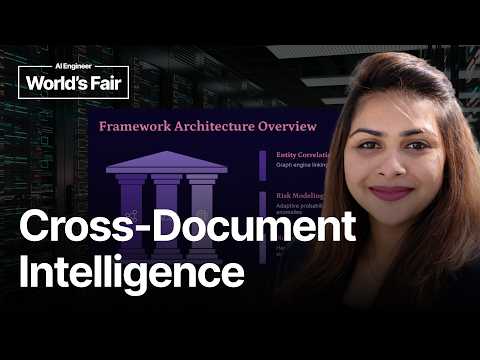
AI-Driven Multi-Document Correlation for Financial…
Conference session on AI-driven multi-document correlation for financial compliance. Traditional systems analyze documents in isolation, missing fraud patterns spanning enterprise systems. The talk presents a framework combining graph-based entity correlation, adaptive probabilistic risk modeling, and cross-jurisdictional normalization to detect compliance risks across payroll, tax, procurement, and financial records. Based on an evaluation of ~3 million anonymized records across four jurisdictions, it claims improved fraud detection accuracy, fewer false positives, and reduced manual audit effort, and offers guidance on building scalable AI solutions for predictive compliance. Speaker: Varsha Shah (Independent), a technical architect and researcher in enterprise AI, agentic systems, intelligent document processing, and AI-powered financial governance.
# Video Identity Observations
## Explicit Self-Description
- **Speaker identity stated directly:** The speaker introduces herself by name and role:
> "My name is Varsha Shah. I am an enterprise technical architect working at Tata Consultancy Services working for Microsoft."
- **Claimed focus areas:** She describes her professional focus as:
> "focused on artificial intelligence enterprise compliance, finance governance, and intelligent automation."
- **Research framing:** The talk is presented as "my research on AI-driven multi-document correlation for enterprise financial compliance and fraud detection."
## Presentation Context (Observable)
- **Conference setting:** The talk was delivered at an event the speaker names as the "AI Engineering World Fair" / "AI Engineering World Fest":
> "Thank you to the AI engineering world fair team for providing this wonderful opportunity."
- **Channel affiliation note:** Despite the title listing the speaker as "Independent," the speaker states affiliation with **Tata Consultancy Services** and **Microsoft** within the talk — a discrepancy between title metadata and transcript self-description.
## Intended Audience
- **Enterprise and practitioner audience:** The talk assumes listeners familiar with ERP systems, payroll, procurement, tax platforms, and audit workflows:
> "Successful implementation depends on… seamless integration with existing enterprise systems such as ERP, payroll, procurement, tax platforms."
- **Technical/research audience:** References to graph-based entity correlation, probabilistic risk modeling, F1 scores, and evaluation methodology indicate a technically literate audience.
- **Direct engagement offer:** The speaker invites follow-up, suggesting an audience of practitioners and builders:
> "Please feel free to reach out to me with your questions… or connect me on the LinkedIn… If you're building with such kind of amazing systems for compliances using the AI."
## Claimed Scope and Claims Made by the Creator
- **Claimed results (self-reported, not independently verifiable from this material):**
- Evaluation on "approximately 3 million financial records… over 5 years of period over the four different regulatory jurisdictions."
- "approximately 91% of precision," "87% recalls," F1 score "0.89."
- "76% reduction in false positive" and "reduces the manual audit efforts by approximately 40%."
- **Claimed positioning:** The framework shifts compliance "from reactive process into proactive intelligence capability" and toward "predictive governance."
## Demonstrated Presentation Patterns
- **Structured research-talk format:** Clear progression — problem framing, framework components, evaluation setup, results, comparison, deployment considerations, takeaways.
- **Consultative/enterprise tone:** Emphasis on operational value for "compliance teams" and enterprise deployment readiness rather than consumer-level content.
- **Promotional/networking close:** Ends with contact invitation, demonstrating a willingness to engage viewers as prospective collaborators.
## Claim vs. Demonstration Distinction
- **Creator claims:** Detection metrics, evaluation scale, and improvement figures are all asserted by the speaker; no external verification appears in this material.
- **Demonstrated:** Domain expertise in AI compliance architecture, structured technical communication, and conference-level research presentation style are observable directly from the transcript.
# Delivery Observation: Varsha Shah — AI-Driven Multi-Document Correlation for Financial Compliance
## Tone & Register
- **Formal, courteous academic-conference register** throughout, opening with acknowledgments: *"Thank you to the AI engineering world fair team for providing this wonderful opportunity to share my research."*
- **Polite closing** mirroring the opening: *"So, thank you once again to the AI Engineering World Fest team for this wonderful opportunity, and thank you all for your time and attention."*
- Generally steady and informative; no hostile or casual moments observed.
## Vocabulary & Terminology
- Dense, consistent **domain vocabulary**: *compliance, fraud detection, entity correlation, probabilistic risk modeling, cross-jurisdictional normalization, rule-based systems, false positive, precision/recall/F1*.
- Repeated conceptual pairing of **reactive vs. proactive/predictive**: *"transform enterprise compliance from reactive process into proactive intelligence capability"*; *"Instead of asking what went wrong, organizations can begin asking what is likely to go wrong next."*
## Recurring Phrases & Rhetorical Structures (stable patterns)
- **"Hidden risk/pattern" as a motif**: *"hidden fraud patterns"*, *"hidden risk through the cross-document correlation"*, *"reveal the hidden pattern and structural anomalies"*.
- **Rhetorical question as transition device** — used repeatedly between sections:
- *"So, if the problem is understanding relationships rather than individual documents, what kind of architecture can solve this?"*
- *"So, how effective was the framework in detecting hidden compliance risk?"*
- *"How do these improvements translate into operational value for the compliance teams?"*
- **"Let's begin / let's look at" framing phrases** to open sections: *"Let's begin by understanding the compliance gap"*, *"let's look at the proposed framework"*, *"Let me introduce you to the framework."*
- **Enumerated structure** for components and takeaways: *"The first component is the entity correlation engine"*, *"As I conclude, I would like to leave you with four key takeaways. First is… Second is… Third is… Finally…"*
- **Summarizing "In simple terms" resets** after technical explanations: *"In simple terms, this component answers one fundamental question, what is connected?"*; *"Simply put, this component answers the question that what is most likely to be genuine compliance risk."*; *"In simple terms, every completed audit helps make the next audit more efficient."*
## Teaching Habits
- **Component-by-component explanation**, each ending in a guiding question: *"this component answers to the question, 'How should the risk be interpreted within the appropriate regulatory context?'"*
- **Concrete examples to illustrate abstract points**: *"a payroll record may appear accurate to us. A vendor invoice may seem legitimate to us. A tax filing may be correctly submitted. But, when these records are connected…"*
- **Quantified claims** delivered with approximate hedging: *"approximately 91% of precision"*, *"87% um recalls"*, *"76% uh reduction in false positive"*, *"reduces the manual audit efforts by approximately 40%"*.
- **Verbal signposting of slide structure**: *"In the next few slides, I'll briefly explain you how each of these components contribute to the process."*
## Disfluencies & Fluency Patterns
- **Filler words ("uh", "um") cluster noticeably in the results/evaluation sections**, far more than in the opening: *"it's it's very important to uh briefly understand the evaluation of the environment"*, *"achieved 87% um recalls"*, *"investigators spend uh far less than reviewing the cases that they uh they're ultimately legitimate."*
- **Immediate self-corrections/restarts** appear throughout: *"The second component that is adaptive probabilistic risk model which is which evaluates"*, *"It the purpose of this is to connect"*, *"this continue, uh, continue learning, uh, capability"*.
- **Grammar slips** consistent with non-native English delivery: *"many sophisticated fraud patterns doesn't really appear"*, *"The reason is the most existing solution analyze the documents independently"*, *"What missing is the ability"*. *(These are observable delivery features, not judgments about the speaker.)*
## Isolated vs. Stable Patterns
- **Stable**: rhetorical-question transitions, "hidden risk" motif, enumerated takeaways, component framing, reactive→proactive narrative arc.
- **Isolated / less repeated**: the closing call-to-action offering contact channels (*"Please feel free to reach out to me… or connect me on the LinkedIn"*) occurs only once; insufficient repetition to establish it as a pattern.
- **Uncertainty note**: pace, gestures, and visual delivery cannot be assessed from the transcript alone; observations here cover verbal delivery only.
# Observation Document: AI-Driven Multi-Document Correlation for Financial Compliance
**Speaker:** Varsha Shah, self-identified as enterprise technical architect at Tata Consultancy Services, working for Microsoft; focus areas stated as AI enterprise compliance, finance governance, and intelligent automation.
## Problem Framing
- **Data volume vs. detection gap:** Organizations generate large volumes of financial data (payroll, tax, procurement, transactions), yet compliance teams still struggle with hidden fraud patterns and regulatory risk.
- **Stated root cause:** Most existing solutions analyze documents *independently*, while critical risks only become visible when information is connected across systems.
- **Fraud evolution claim:** "Modern fraud rarely appears as an obvious error within a single document" — it exploits subtle inconsistencies across systems, invisible under independent document review.
- **Limitation of current tools:** Traditional rule-based and document-level NLP systems validate individual records but are "not built to understand relationships across the documents."
## Proposed Framework (Three Components)
1. **Graph-based entity correlation engine**
- Connects entities across payroll, tax, procurement, and financial systems into a unified network (employees, vendors, accounts, transactions, regulatory files).
- Answers the question, in her words: "what is connected?"
2. **Adaptive probabilistic risk model**
- Combines multiple risk indicators — anomaly strength, source reliability, historic patterns — into confidence-based risk scores rather than single-rule alerts.
- Learns from audit outcomes to improve accuracy over time.
- Answers: "what is most likely to be genuine compliance risk?"
3. **Cross-jurisdictional normalization layer**
- Standardizes currencies, tax rules, reporting periods, and classification schemes so risk is interpreted consistently regardless of transaction origin.
- Answers: "How should the risk be interpreted within the appropriate regulatory context?"
## Evaluation and Reported Results
- **Dataset (as stated):** ~3 million financial records collected over 5 years across four regulatory jurisdictions.
- **Detection performance:**
- ~91% precision — "vast majority of the flagged cases were confirmed as genuine anomalies"
- 87% recall
- F1 score of 0.89
- Claimed consistency across all four jurisdictions at enterprise scale
- **Operational benefits claimed:**
- 76% reduction in false positives
- ~40% reduction in manual audit effort
- **Comparison to baselines:** Framework "consistently performs [above] the baseline across the key performance metrics" versus traditional rule-based approaches (statement slightly garbled in transcript but direction of claim is clear).
*Note: these figures are the speaker's reported results; no external validation or methodology detail was provided in the talk.*
## Continuous Learning and Proactive Compliance
- System improves via feedback from completed audits and investigator feedback: confirmed fraud strengthens future detection patterns; false positives refine risk scoring.
- Framed shift: from reactive compliance ("what went wrong") to predictive governance ("what is likely to go wrong next") — compliance as "an ongoing intelligence function rather than a periodic review process."
## Enterprise Deployment Considerations (as stated)
- Seamless integration with existing ERP, payroll, procurement, tax platforms
- Jurisdiction-specific configuration for local regulations
- Alignment with audit workflows so investigators focus on prioritized cases
- Scalability — evaluation showed processing of millions of records
## Key Takeaways (per speaker)
- The most significant compliance/fraud risks "exist between the documents, not within them."
- Combining the three components creates a more comprehensive, scalable approach.
- Results show improved detection accuracy, fewer false positives, and lower manual audit effort.
- Continuous learning enables movement toward predictive, intelligence-driven risk management, where AI "anticipates and prevents" risk rather than only detecting it.
# Speaker & Role Attribution Record
**Video:** AI-Driven Multi-Document Correlation for Financial Compliance - Varsha Shah, Independent
## Speakers
| Speaker | Role | Evidence |
|---|---|---|
| **Varsha Shah** | **Creator / Sole presenter** | Self-introduction: *"My name is Varsha Shah. I am an enterprise technical architect working at Tata Consultancy Services working for Microsoft."* |
### Role Details
- **Affiliations stated by speaker:** Tata Consultancy Services (enterprise technical architect), working for Microsoft.
- **Title metadata affiliation:** "Independent" (differs from self-stated employer — noted as a provenance discrepancy, no judgment).
- **Focus areas claimed:** AI enterprise compliance, finance governance, intelligent automation.
- **No other speakers, guests, narrators, or panelists appear in the transcript.**
## Event / Venue
- Presentation delivered at the **AI Engineering World Fair / World Fest** (speaker thanks *"the AI engineering world fair team"* and later *"the AI Engineering World Fest team"*).
## Referenced Sources & Claims
- **Evaluation dataset (speaker's own claim, unverified):** ~3 million financial records collected over 5 years across four regulatory jurisdictions.
- **Performance claims (speaker-reported):** ~91% precision, 87% recall, F1 of 0.89; 76% false-positive reduction; ~40% reduction in manual audit effort.
- **Baseline comparison:** Traditional rule-based approaches referenced as comparison baseline; no named external systems or datasets cited.
- **No third-party publications, named sources, or external citations appear in the transcript.**
## Promotional Segments
- **Closing promotional/outreach segment:** Speaker invites contact via an email "below" and LinkedIn connection for those building AI compliance systems:
> "Please feel free to reach out to me with your questions and your enthusiasm on this email below, or connect me on the LinkedIn."
## Availability Limits
- **Comments availability:** Not indicated in source material.
- **Referenced email/LinkedIn:** Mentioned but not provided in the transcript; actual contact details unavailable.
- **Slides/visuals:** Speaker refers to slides ("in the next few slides"), but visual content is not available in the transcript.
Hello everyone. Thank you to the AI engineering world fair team for providing this wonderful opportunity to share my research. It is truly an honor to be
speaking alongside so many talented researchers and practitioners. My name is Varsha Shah. I am an enterprise technical architect working at Tata Consultancy Services working for Microsoft. I'm focused on artificial intelligence enterprise compliance, finance governance, and intelligent automation. Today, I would like to share my research on AI-driven multi-document correlation for enterprise financial compliance and fraud detection. As organizations continue to digitalize their operations today, they generate a numerous amount of data for the financial system across payroll, tax, procurement, transaction system. Ironically, while we have more data than ever before, compliance teams continue to struggle with hidden fraud patterns, regulatory risk. The reason is the most existing solution analyze the documents independently. While many of the most critical risk only become visible when the information is connected across the multiple systems. In this presentation, I'll introduce you to a framework that combines the graph-based entity correlation, probabilistic risk modeling, and cross-jurisdictional normalization to uncover these hidden relationships and transform enterprise compliance from reactive process into proactive intelligence capability. The framework was evaluated using approximately 3 million financial records across four jurisdictional demonstrating both the strong detection performance and meaningful operations improvement. With that context, let's begin by looking at the compliance gap that organizations continue to face today. Let's begin by understanding the compliance gap that many organizations
continue to face. Enterprise compliance has become significantly more complex over the last decade. Organizations now operate across multiple countries, regulatory frameworks, and financial
system, each with own reporting standards and compliance requirements. At the same time, the volume of the enterprise has grown exponentially. Payroll records, tax filings, procurement transactions, and financial documents are generated every day, making manual reviews both time-consuming and increasingly impractical. Adding to this challenge, fraud has been evolved. Modern fraud rarely appears as an obvious error within a single document. Instead, it exploits subtle inconsistency across multiple system. Patterns that often remain invisible when the records are reviewed independently. This creates a fundamental limitation. Traditional rule-based and document-level NLP system are designed to validate individual records, but they are not built to understand relationship across the documents. And that's the gap this research aims to address. Moving beyond this isolated document analysis to uncover the hidden risk through the cross-document correlation. To better understand this limitation, let's look at why traditional document level analysis often fail to detect the most sophisticated fraud patterns. To understand why traditional approaches struggle, let's consider how most compliance system operates nowadays. They evaluate each document independently. A payroll register is validated against the payroll rules. The vendor invoices are checked against the procurement policies. A tax filing is reviewed under the tax regulations. If each document passes its individual validation, the transaction is generally considered compliant. The challenge is that many sophisticated fraud patterns doesn't really appear within a single document. They emerges only when the multiple documents are analyzed together. For example, a payroll record may appear accurate to us. A vendor invoice may seem legitimate to us. A tax filing may be correctly submitted. But, when these records are
connected, they're revealing the inconsistencies and indicate the fraud and compliance risk. The information already exists. What missing is the ability to understand the relationship
between these documents. That is why the research shifts the focus from document level validation to cross document intelligence, enabling the organizations to detect the risk that would otherwise remain hidden. So, if the problem is understanding relationships rather than individual documents, what kind of architecture can solve this? Let me introduce you to the framework. Now that we have established the problem, let's look at the proposed framework. Rather than relying on a single model or algorithm, the solution is built on three complementary components that work together to transform the raw enterprise data into the actionable compliance intelligence. The first component is the entity correlation engine. It the purpose of this is to connect the related information across the payroll, tax, procurement, financial systems, creating a unified view of enterprise activity rather than isolated records. Once these relationships are established, the second component that is adaptive probabilistic risk model which is which evaluates the connected data to determine which pattern represent meaningful compliance. Instead of generating alerts based on single rule, it it prioritizes the cases using the multiple risk signals here. The cross-jurisdictional normalization layer provides the regulatory context by standardizing the currency, tax structure, reporting standards, and compliance rules across the different jurisdictions. This ensures that the risk are evaluated consistently regardless of where the transaction
originated. So, individually, each component provides a value. Together, they enable the framework that move beyond the document validation and towards the
enterprise-wide compliance intelligence. In the next few slides, I'll briefly explain you how each of these components contribute to the process. So, let's begin with the foundation of the framework, the entity correlation engine, which makes the cross-document intelligence possible. So, the first component is graph-based entity correlation engine. The role is to connect the entities across the payroll, tax, procurement, financial system into unified network. Rather than analyzing the documents independently, it it identifies the relationship between the employee, vendors, account, transaction, regulatory files. And these connections reveal the hidden pattern and structural anomalies that are often invisible to the traditional document level analysis we were doing. In simple terms, this component answers one fundamental question, what is connected? It provides the relation relational fundamental for the rest of the framework. Once those relationships are established, the next step is determining which one actually represents the meaningful risk. Once relationships have been established, the next step is to determine which one actually represents meaningful risk. That's the role of the adaptive probabilistic risk model. Instead of relying on static rules, it combines the multiple risk indicators such as anomaly anomaly strength or the source reliability historic patterns has happened to calculate confidence best risk score. This helps prioritize the cases that require immediate attention while reducing the unnecessary investigations. The important advantage is its ability to learn from the audit outcomes, allowing the models to continuously improve its accuracy over
the time. Simply put, this component answers the question that what is most likely to be genuine compliance risk. Once we have identified the high-risk
cases, the final step is to ensure those risk are interpreted consistently across the different regulatory environments. The final component is cross-jurisdictional normalization layer. Global organizations operate across different countries, currencies, tax structure, and reporting standards. Without normalization, the same transaction can be interpreted differently depending on the jurisdiction. This layer harmonizes the financial data by standardizing the currencies, tax rules, the reporting periods, and the classification schemes as well. As a result, the risk are evaluated consistently regardless of where the where it has originated. In short, this component answers to the question, "How should the risk be interpreted within the appropriate regulatory context?" With all these components working together, the next step was the evaluated how the framework performs under real-world enterprise conditions. So, before discussing the result, let's um uh it's it's very important to uh briefly understand the evaluation of the environment. The framework was evaluated using the approximately 3 million of the financial records collected over 5 years of period over the four different regulatory jurisdictions. The objective was to assess how the framework perform under the real realistic uh enterprise condition and where uh large volume of interconnected financial data and varying regulatory uh requirement introduce the significant complexity here. Uh with that foundation established, let's look at how the framework perform. So, how effective was the framework in detecting hidden compliance risk? Let's
look at the results. So, here now uh look at the detection performances. The framework achieved approximately 91% of precision, meaning
the vast majority of the flat cases were confirmed as a genuine anomalies here. At um it also achieved 87% um recalls, demonstrating its ability to identify most true fraud cases while minimal uh minimizing the misdetections here. So, together, these results produce a F1 score that is 0.89, indicating a strong balance between the precision and recall here. More importantly, these results are achieved across four jurisdictions and large enterprise scale data, demonstrating that the framework performs consistently in the complex real-world uh environments. The next question is um equally important. How do these improvements translate into operational value for the compliance teams? Detection accuracy is one part of the story. The real value um comes from improving the efficiency of the compliance operations. Beyond detection accuracy, the framework delivers measurable operational benefits. One of the most significant outcome was a 76% uh reduction in false positive, meaning um investigators spend uh far less than reviewing the cases that they uh they're ultimately legitimate. So, in addition, the framework reduces the manual audit efforts by approximately 40% allowing compliance teams to be focused on the only high-risk cases instead of uh routing the document reviews. Ultimately, uh this translates into faster investigations, improved uh resource utilization, and uh greater confidence in compliance decisions. In other words, the uh the framework doesn't just detect
fraud more effectively, it helps compliance teams work more effectively. So, these operational improvements become even more meaningful when we
compare uh the uh the framework with the traditional rule-based approaches. This comparison highlights the advantage of moving beyond the traditional rule-based system. Uh conventional approaches are effective at validating the individual records, but they often struggle to detect the complex fraud patterns uh that spans multiple uh documents and systems. So, by incorporating entity uh correlation, probabilistic risk modeling, and regulatory normalization, the uh proposed framework consistently um performs the baseline across the key performance metrics. The key takeaway is simple. Connecting data across documents produces better detection, fewer false positive, and more actionable, uh, compliance intelligence than analyzing the documents is, um, in in isolations. One of the reason the framework continues to improve over the time is that, uh, doesn't rely on the static rules anymore. Instead, it continuously learn from the completed audit and investigate, uh, and the investigator feedbacks here. So, this framework is designed to continuously improve through the feedback. Every, uh, completed audit provides the valuable information. Uh, confirm the fraud case, strengthen the future detection pattern. While false positive helps refining the risk scoring and reduce the unnecessary alerts. This
create a continuous learning cycle where the system becomes more accurate with each audit and investigation. As fraud patterns evolve and business,
uh, environments changes, the framework adopts rather than relying on manual rule updates. In simple terms, every completed audit helps make the next audit more efficient. This continue, uh, continue learning, uh, capability enables a broader shift here. From reactive to compliance issue after they occur to identifying the risk before they become audit, uh, findings here. It's more of a proactive. Beyond improving detection accuracy, this framework changes how organization approach compliances. Traditionally, the compliance has been reactive. Issue were identified after audits, investigation, or regulatory reviews have happened. This framework enables more proactive approach through continuous, uh, monitoring, cross document correlation, adaptive learning. Instead of asking what went wrong, organizations can begin asking what is likely to go wrong next. That shifts from reactive validation to predictive governance, allowing the compliance teams to identify the risk earlier, prioritize the investigation more effectively, and make better informed decisions. Ultimately, the compliance becomes an ongoing intelligence functions rather than a periodic review process. While the framework is uh research driven, it has been designed with the enterprise deployment in mind. Successful implementation depends on uh four key consideration. First one is seamless integration with existing enterprise systems such as ERP, payroll, procurement, tax uh tax platforms. Second, the jurisdictional specific uh configuration to ensure the compliance with local regulations and reporting standards. Third one is um alignment with the audit framework
enabling the investigator to focus on prioritized risk code cases instead of manual document reviews. And finally, scalability. The evaluation demonstrate that the framework can effectively
process millions of financial records um making it suitable for the large enterprise environments. Uh so, together these uh consi- these considerations help bridge the gap between the research and the practical enterprise adoption. As I conclude, I would like to leave you with four key takeaways. First is many of today's most significant compliance and fraud risk exist between the documents, not within them. Detecting these risk require more beyond document level analysis and cross document intelligence. Second is combining the graph based entity correlation, probabilistic risk modeling, and cross jurisdictional normalization creates a more comprehensive and scalable approach to enterprise compliance. Third is the result demonstrated that this particular framework is not only improves the detection accuracy, but also reduces the false positive and significantly lowers the manual audit efforts, delivering the measurable operational value. Finally, by continuous learning from the audit outcomes, and the framework enables the organizations to move beyond reactive compliance toward predictive intelligence driven risk management here. I believe this represents an important step toward the future of enterprise financial govern- governance, where AI is not only helping the organizations to detect risk, but also anticipates and prevent this risk going forward. So, thank you once again to the AI Engineering World Fest team for this wonderful opportunity, and thank you all for your time and attention. Please feel free to reach out to me with your questions and your enthusiasm on this email below, or connect me on the LinkedIn. I'm happy to help you. If you're building with such kind of amazing systems for compliances using the AI wanted to transform them, and thank you all again. See you next time.