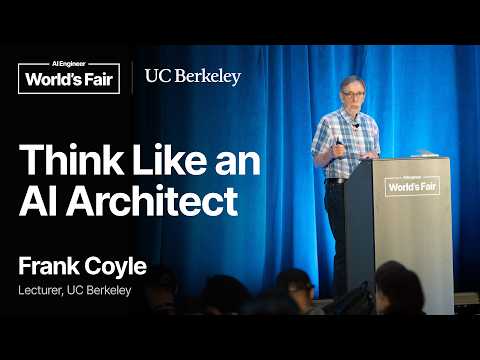
Anthropic's CCA Exam as a Field-Guide for Agentic…
Frank Coyle (UC Berkeley) treats Anthropic's Claude Certified Architect (CCA) exam — six production scenarios with four chosen at random — as a field guide for agentic engineering, walking each scenario backwards from its anti-pattern. Topics: branching on the model's stop reason (models return tool parameters rather than executing tools; stop reasons also reveal truncated outputs), context discipline including specialized subagents with narrow tool sets, isolating a critic agent from the reasoning behind claims to avoid convergence, forking subtask output into separate contexts with token-threshold compaction, and using batch mode to halve token cost when latency is acceptable. Description content beyond the topic summary (speaker social links, conference listings, transcript page link) is promotional/administrative and excluded; tags were not supplied, so the topic rests on the title and description.
# Observation Document: Channel Identity Evidence
## Video Presentation Overview
- **Format**: Live in-person/recorded talk with technical slides and code walkthroughs, delivered to an audience (applause at end).
- **Speaker self-identification**: Frank Coyle, "computer science guy," teaching computer science "for over 30 years," "now teaching at Berkeley."
- **Topic framing**: Anthropic's Claude Certified Architect (CCA) exam used as a "field-guide" for agentic engineering.
## Explicit Self-Description Claims
- **Creator claims about background**:
- "I've been teaching computer science for over 30 years, and I'm now teaching at Berkeley."
- **Creator claims about purpose**:
- "All my students, past and present, are having is AI, because computer science is no longer the magic pathway to a job. So, I've been trying to figure out ways to… help them get ready for this world of agentic AI."
- **Creator claims about external resources**:
- "If you want to reach out to me… I got a website co-supreme AI" (named after John Coltrane's *A Love Supreme*).
## Intended Audience (Observable)
- **CS students and early-career technologists worried about job prospects**: evidenced by the framing "computer science is no longer the magic pathway to a job" and "help them get ready for this world of agentic AI."
- **People considering agentic AI careers**: "if you're interested in a career in agentic AI, then certainly take a look at… what the exam is about."
- **Exam candidates / practitioners**: "whether you're going to take the exam or not… this is going to help you get ready for whatever the agentic world is going to throw at you."
## Claimed Scope of Content
- **Exam mechanics**: timed, proctored, scenario-based, $99 for individuals, "once every 6 months"; five domains with stated percentages (agentic architecture 27%, Claude code 20%, prompt engineering, tool design/MCP, context management/reliability); six production scenarios with four randomly chosen.
- **Pedagogical approach**: emphasizes **anti-patterns** — "understanding what you should not do is the key to leading you to what you should do."
- **Philosophy stated**: Sister Corita Kent quote — "Nothing is a mistake… There's only make" — framed as "experiment, experiment, experiment… you should make stuff."
## Demonstrated Presentation Patterns (Observable, Not Claimed)
- **Teaching style**: heavy use of analogies and historical CS references:
- Böhm and Jacopini (1966) on Turing completeness to contextualize "loops are the new thing."
- Multi-threaded programming / locks analogy for agent isolation.
- Carpenter-with-all-tools analogy: "maybe you want a professional carpenter… specialize, don't overload."
- Pizza/party analogy for agent groupthink.
- **Technical depth**: live code walkthrough of an agentic loop with stop reasons ("why did the LLM come back to us? That's our stop reason"), context forking, token-count thresholds (~150,000) and compaction.
- **Practical cost advice**: batch mode "for 50% fewer token cost… result… in at least 24 hours."
- **Candid uncertainty**: "Not quite sure how the implementation is of that, but there is compaction" — acknowledges limits of knowledge rather than overstating.
## Evidence Limitations
- No curated metadata was supplied; identity observations rest solely on title and transcript.
- No explicit channel-level mission statement appears; the channel's identity must be inferred from this single talk's demonstrated scope (agentic AI education, exam prep, practical engineering patterns).
# Delivery Observations — Frank Coyle, "Anthropic's CCA Exam as a Field-Guide for Agentic Engineering"
## Overall Tone & Register
- **Conversational, informal lecture style**: frequent filler ("uh," "um"), self-corrections, and asides — e.g., > "Okay, I'm getting rolling and uh welcome aboard. We just had a little technical issues, but uh we resolved them."
- **Humor and light self-deprecation**: > "I didn't think about the pizza analogy, but yes."
- **Folksy, memorable sign-offs**: > "Anyway, that's my story and I'm sticking to it and I'm about to zero time."
## Teaching Habits
### Pattern/Anti-Pattern Framing (most repeated structure)
Coyle consistently pairs a recommended practice with an explicit **anti-pattern**:
- > "there's also anti-patterns. And I think anti-patterns are a key to understanding what you should not do"
- Applied repeatedly per scenario: > "I'm going to jump to the anti-pattern. What you don't want is just to let the agent go…", > "The anti-pattern you have one agent and you load it up with tools", > "anti-pattern: Let every subtask dump its full output into the primary thread", > "anti-pattern: Always have interactive modes in a pipeline."
### Analogies to Everyday Life and CS History
- The **carpenter analogy**: > "you hire a carpenter to come to the house, and the guy shows up with uh plumbing tools, carpenter tools, electrical tools… maybe you want a a professional carpenter."
- The **pizza/party analogy** for agent group-think, extended playfully: > "Every agent gets its own slice."
- Historical grounding in computing: Böhm and Jacopini 1966, Fortran/COBOL language wars, design patterns movement, multi-threaded programming and locks.
### Quoting Authorities
Coyle opens and closes with quotations — Sister Corita Kent ("Nothing is a mistake… only make"), Edison ("10,000 ways that don't work"), and modern voices (Boris Cherney, Peter Steinberger on loops). The **Kent quote is bookended**, restated near the end: > "there's no exam, only make."
## Vocabulary & Recurring Phrases
- **"Loop"** as a central keyword: > "The loop is the new thing… Well, no, they're not."
- **"Stop reason"** repeated throughout scenario one.
- **"Context means tokens, tokens mean money"** — a distilled aphorism for context discipline.
- Repeated imperatives/short maxims: > "experiment, experiment, experiment", > "specialize, don't overload", > "Keep your agents independent."
- Colloquial connectives: "Okay?" used as a comprehension check constantly; "Bottom line here is…"; "Moving right along"; "Bingo."
## Structural Habits
- **Signposting scenarios numerically**: "So, number one customer support resolution agent… scenario two, code generation… Three, multi-agent research system."
- **Live-demo narration** of code with walk-through cadence: > "So here we have while loop… the first little block… the second block…"
- **Exam-pragmatic framing**: repeatedly ties concepts back to the test — > "that's going to help you with this exam."
## Uncertainty Notes
- Occasional transcript disfluency may be ASR artifacts (e.g., "Cloud Code" vs. "Claude Code"); I have not treated these as distinct speaker choices.
- Timing pressure is directly observable only near the end (> "I've only got a few few minutes left, few seconds left"); whether it compressed earlier sections is inferred, not observed.
# Observation Document — Frank Coyle on Anthropic's CCA Exam as Agentic Engineering Field Guide
## Speaker & Context
- **Speaker:** Frank Coyle, self-identified as teaching computer science for over 30 years, now at UC Berkeley.
- **Motivation stated:** Students past and present are struggling because "computer science is no longer the magic pathway to a job"; he seeks ways to prepare them for "agentic AI."
- **Central claim:** Anthropic's Claude Certified Architect (CCA) exam is a useful field guide because "Anthropic knows how people are using their system and what the issues are going to be."
## Guiding Philosophy
- Quotes **Sister Corita Kent**: "Nothing is a mistake. There's no win and no fail. There's only make."
- Advocates **experimentation**: read *and* do; make things.
- Quotes **Edison**: "I have not failed. I've only found 10,000 ways that don't work."
- Key framing: borrow the design-patterns movement's concept of **anti-patterns** — understanding what not to do is the path to what to do.
## Exam Facts (as stated)
- Released **March**, brand new.
- **Scenario-based, timed, proctored.**
- Available to companies in the Claude/Anthropic ecosystem; **individuals pay $99**, may take it **once every 6 months**.
- Multiple-choice, but grounded in "realistic constraints and realistic scenarios."
### Five Domains with weights
1. **Agentic architecture** — 27%
2. **Claude Code configuration/workflow** — 20%
3. **Prompt engineering** (structured output, JSON usage)
4. **Tool design / Model Context Protocol integration**
5. **Context management and reliability**
- Six **production scenarios** provided; the exam randomly selects four and centers all questions on them.
## On Loops
- Cites **Boris Cherney** ("doesn't write code; writes loops") and **Peter Steinberger** ("I don't code anymore. I just design loops that prompt your agents").
- Coyle's counterpoint: loops are **not new** — **Böhm and Jacopini (1966)** proved Turing completeness requires only sequence, if-then conditionals, and the loop.
- Claim: agentic power comes from adding the loop to previously sequential prompt flows.
## Scenario Walkthroughs & Anti-Patterns
### 1. Customer Support Resolution Agent
- Anti-pattern: letting the agent run and blindly using the response.
- Correct pattern: loop on the **stop reason** (a Claude Code concept).
- Explanation of mechanics: the LLM "can't do anything. It is just a probabilistic next word predictor" — it sets up tool parameters; **your code executes the tool**.
- Stop-reason checks enable **human-in-the-loop**: check confidence, escalate if needed.
- Also check for **token exhaustion** — responses based on partial generation require action.
### 2. Code Generation
- **Claude MD** files: Anthropic recommends a **three-level hierarchy** (project top level, project folder, directories) of rules controlling system response.
### 3. Multi-Agent Research System
- Questions raised: hub-and-spoke distribution, who orchestrates, how much information each agent gets.
- **Anti-pattern:** one overloaded agent with many tools (carpenter analogy — hire the specialist).
- Tie to functional programming: agents should **do one thing** with one or two tools.
- **Context discipline:** don't let sub-agent context spill into main context — "context means tokens, tokens mean money," and more context confuses the LLM. Even a million-token window shouldn't be filled.
- **Critic sub-agent example:** pass only claim and evidence, not the reasoning, to avoid **group think** among collaborating agents (pizza-party analogy — agents converge on one idea).
### 4. Developer Productivity
- **Anti-patterns:** subtasks dumping full output into the primary thread; unbounded context growth.
- **Context fork pattern:** fork agent into separate thread; return only the **summary** to the main context (e.g., "scan all logs for errors" → summary).
- **Compaction:** check token count; above a threshold (his example: 150,000 tokens), run Claude's compaction. Coyle qualifies: "Not quite sure how the implementation is of that."
- Side note: praises a book by **Sam Bagwell** (no connection, he emphasizes) whose company provides **custom context-compression logic** via an extensible base class.
### 5. Claude Code for Continuous Integration
- **Anti-pattern:** interactive modes in pipelines (Claude stops to ask permission).
- **Tip:** batch mode — **50% lower token cost** with results promised within **at least 24 hours**; run batches overnight/on vacation.
## Closing
- Returns to Corita Kent theme, adapted: "There's no exam, only make."
- Contact: "coyle at Berkeley"; website **co-supreme AI** (named, he notes, after John Coltrane's *A Love Supreme*).
## Qualifications & Unresolved Points (preserved)
- Coyle explicitly disclaims knowledge of compaction implementation details.
- He disclaims any connection to Sam Bagwell.
- Speaker identity relies solely on transcript self-identification; no independent verification.
# Speaker & Provenance Record — Video 01a15ca8-0163-7286-8fe9-a1034cbb6f11
## Speakers
| Speaker | Role | Evidence |
|---|---|---|
| **Frank Coyle** | **Creator / sole presenter** | Self-introduces: teaches computer science 30+ years, now at UC Berkeley. Delivers the entire talk. |
| **Audience** | Unidentified attendees | Applause at close; no speaking lines beyond implied presence. |
- **No guests, narrators, or other identified speaking roles** appear in the transcript.
- One moment suggests a possible audience interjection or aside — *"I didn't think about the pizza analogy, but yes"* — but no speaker identity is given.
## Promotional / Personal Segments (flagged)
- **Contact & self-promotion (closing):** Speaker invites outreach via email ("coil at Berkeley" [sic]) and promotes his personal website **co-supreme AI**, described as named after John Coltrane's *A Love Supreme*.
- **Third-party book mention:** Speaker shows/recommends a book handed out (apparently by street distributors), by **Sam Bagwell**, noting *"I have no connection"* — explicit disclaimer of affiliation. Cites "online page 32" claiming Bagwell's company provides custom logic for context compression and offers an extendable base class.
- **Anthropic / Claude Certified Architect exam** is the talk's subject matter; the speaker discusses it informatively (pricing: $99, retake every 6 months) with no stated sponsorship or affiliation.
## Referenced Sources & Third-Party Claims
- **Anthropic / Claude Certified Architect (CCA) exam** — released March (per speaker); scenario-based, timed, proctored; five domains with stated percentages (agentic architecture 27%, Claude code 20%, etc.); six production scenarios, four chosen randomly per exam.
- **Sister Corita Kent** — quoted: *"Nothing is a mistake. There's no win and no fail. There's only make."*
- **Thomas Edison** — quoted: *"I have not failed. I've only found 10,000 ways that don't work."*
- **Boris Cherney** — paraphrased claim: doesn't write code; his job is to write loops.
- **Peter Steinberger** (described as "master of Open Claw") — paraphrased: "I don't code anymore. I just design loops that prompt your agents."
- **Böhm and Jacopini, 1966** — cited theorem on Turing completeness requiring sequence, conditionals, and loops.
- **Anthropic recommendations** — hierarchical CLAUDE.md files (three levels); context compaction algorithms; batch mode at 50% token cost with ≥24-hour turnaround.
- **Design patterns movement** (early 1990s, object-oriented programming) referenced as historical framing.
## Uncertainty & Availability Limits
- Speaker states compaction implementation details are unclear to him: *"Not quite sure how the implementation is of that."*
- Speaker's book citation is informal ("online page 32"); exact title/publisher not stated.
- Transcript is single-speaker with no timestamps; possible transcription artifacts ("Cloud Code" for Claude Code, "coil at Berkeley").
- **Comment availability:** not indicated in supplied material.
- **No curated metadata** supplied; provenance facts derive solely from the transcript.
\>\> Okay, I'm getting rolling and uh welcome aboard. We just had a little technical issues, but uh we resolved them. So, my name is Frank Coyle. Uh I am a computer science guy. I've
been teaching computer science for over 30 years, and I'm now teaching at Berkeley. And one of the problems that uh all my students, past and present, are having is AI, because computer science is no longer the magic pathway to a job. So, I've been trying to figure out ways to uh help them come up with schemes to help them get ready for this world of agentic AI. And one of the things that sort of uh dropped into my uh plate was the something called the Claude Certified Architect exam, which I will be talking about today, and it has um a number of aspects to it. And I think if you're interested in a career in agentic AI, then certainly take a look at least what the exam is about, because I feel that um Anthropic knows how people are using their system and what the issues are going to be. So, before we jump into that, I want to give a little bit of my uh my philosophy. bop bop bop bop May have to do this manually, getting stuck. So, this is a quote from uh a woman named Sister Corita Kent. Nothing is a mistake. There's no win and
no fail. There's only make. Bottom line here is experiment, experiment, experiment. Not only should you read, but you should do. You should
make stuff. Now, what happens when you make stuff? A lot of times things don't work. Thomas Edison said, "I have not failed. I've only found 10,000 ways that don't work." And what I want to emphasize here is that what this shows us are something that in the design patterns movement, which came around in the early 1990s with object-oriented programming, we had patterns for objects. We now have patterns for agents, but there's also anti-patterns. And I think anti-patterns are a key to understanding what you should not do because understanding what you should not do is the key to leading you to what you should do. So, a little bit about the Claude Certified Exam, released in March, so it's brand new. It is uh it is based on scenarios. It is timed. It is proctored. It is available to companies in the Claude ecosystem, the Anthropic ecosystem, but individuals can pay $99 and take the exam once every once every 6 months. And it's not just multiple-choice questions. It is multiple-choice, but they're they are based on uh realistic constraints and realistic scenarios.
The five domains. There are five domains that are covered and they give you the percentages of each. So, agentic architecture, 27%. Claude code, how to configure the Claude
code system and workflow, 20%. How to doing prompt engineering, structuring your output, using JSON all over the place. Tool design. Model context protocol integration. These are topics that you should understand and know whether you're going to take the exam or not. This is going to help you get ready for whatever the agentic world is going to throw at you. And then there's going to be contact management and reliability. So these are the areas of of the kind of questions you're going to run into. Then there are and they they provide you with six production scenarios and your the exam will randomly choose four and all the questions will be centered around the four that they choose. And what I'm going to do is walk you through um the production scenarios and give you some anti-patterns to be aware of because there's a number of ways you can solve the problem but one of the big things is what not to do and that often can be the key to getting these questions right. So, number one customer support resolution agent. So we have agentic loops, control, something called
stop reason which is uh what Cloud Code has. Every time something happens, there's a stop reason and you need to take a look at that because that can give you a lot of information about what's going on.
Uh scenario two, code generation. Three, multi-agent research system which we'll look at. How do you How do you distribute your agents? Hub and spoke. Who's the orchestrator? How much information should they know? All these are important factors. Um scenario four, developer productivity with code. So how do you do subtask isolation? Keep your tasks in their little universes. And this hearkens back to what we learn in computer science from doing multi-threaded programming. When you have multiple threads operating and sharing memory, then you get into issues with synchronization. You You to put locks Keep the little threads independent. Keep your agents independent. Um and then some cloud code for continuous integration. And then we'll look at some patterns for structured data extraction. Okay, that's kind of where we're going to go. Now, here's something that I I I like to point out. Everybody's talking about loops, right? Every The loop is the new thing. Um uh Boris Cherney says he doesn't write code, but his job is to write loops. And Peter Steinberger master of Open Claw says, "I don't I don't uh I don't code anymore. I just design loops that prompt your agents." So, loops are the new big thing, right? Well, no, they're not. Okay? Um back in the day uh early days of computing, we had programming languages were exploding. We had Fortran, we had COBOL, and there were big fights. My program My programming language is better than yours. It can do more. No, it can't. We
can do this. Böhm and Jacopini, 1966 proved that if you want a language to be Turing complete, which means can compute
anything that computers are possibly able to compute, then you need only three things. The ability to to to write statements sequentially, okay? To have if-then conditionals, and the third piece is the loop. If you add the loop, you have Turing computability. And now we are seeing this being resurrected in the agentic world with the focus on loops, cuz up to now we've had sort of sequences. You have prompts, you have maybe if-then, but now we have a loop. And now this is what's giving us the power. This is where the agentic stuff is getting very exciting. Okay. I'm start with uh with scenario one, customer support resolution. So here we have a loop operating and the I'm going to jump to the anti-pattern. What you don't want is just to let the agent go and do something and get the response back and use it, okay? What you want to do is you want to loop with something called the stop reason. So I'm going to show you a little code here. So here we have while loop. It's a while true, it's a loop. We're looping right here, okay? So the first little block is where we call uh we call the model, okay? And we pass it the messages. The messages are essentially the sequence of prompts that exist in the context window, okay? And we are asking the and we have a we have a prompt and we have we have the context and we have a tool. And we're asking the LLM to do something with this tool and help us out. The problem is the LLM can't do anything. It is just a probabilistic next word predictor. It can't execute tools. So what it does though is it can figure out
if you point it to a tool, it can figure out how to set things up so that you or your code can execute it. So it's important to understand that the LLM is
not executing these tools. It can't do anything except talk back to you, very intelligently sometimes, but all it can do is talk back to you. So when it finishes this task and has a result which is basically here is I've I know what you want. I know what the tool can do. Here's how I It sets up the parameters that can then be or that then used to actually execute the tool. So, the second block you see why did the LLM come back to us? That's our stop reason. Tool use. Oh, okay. We've stopped because the LLM it wants to use the tool. So, let's just run the tool. So, that's what the second block is. Run tool, the response is what the LLM said, and it's basically the parameters that it has extracted from the data that you provided it. Okay? Then it executes that. Then it goes back. That then it continues. Continues means the LLM sees it and says, "Oh, successful run. So, okay." Come back down. We're not running a tool anymore. We're end the end of our loop. Bingo. Now, then we take the answer, and this is an opportunity for you to have a human in the loop potentially. You check the confidence. If it looks good, you keep it. If you don't, then you escalate to a human. So, now there's another reason why you need to make sure you check your stop reason. One of the stop reasons may be you have run out of tokens, and this response is based on partial when the LLM had to stop. And it's going to give you a response, but if you have run out of tokens, then you need to take action. Okay. Um Next scenario. Uh code generation with Claude. So, Claude code has this has this concept of
the Claude MD file, a markdown file, where you put all the things you wanted to know. What Anthropic recommends is you have three levels of Claude.
One that you have at the top level of your project, the other that you have in inside your sort of the project folder, and then within directories you can also specify. So, the idea is to have a hierarchical set of rules that that can then control how the system is going to respond. Okay. Moving right along, uh we have a multi-agent research system. So, here we're going to have uh the problem is how do I how do I get my agents to to go off and do stuff and bring the answers back in a reasonable way? The anti-pattern you have one agent and you load it up with tools, all right? So, I like to think about you you know, you hire somebody to come to your house, you hire a carpenter to come to the house, and the guy shows up with uh plumbing tools, carpenter tools, electrical tools. He says, "I can do anything." Well, maybe you don't want this guy, maybe you want a a professional carpenter. So, that's the kind of idea. And this kind of back takes us back to some of the the functional programming uh ideas that functions should be do one thing. And if you can get your agents to do one thing, you with maybe one or two tools available to it, then that's going to be a win, and that's going to help you with this exam. So, specialize, don't overload. The other part of this is don't let your agents context spill over into the main context because context means tokens, tokens mean money, and the more context you have, the more confused the LLM is going to be in giving you an answer. So, even though oh, a million token context window, I can put everything in there. No, no, don't put everything in there. Limit what's going to go in there because then you're going to get a much more accurate system.
So, here's a Here's an example of a specialized sub agents. You're giving it So, this would be the critic. So, let's
say you've run some stuff. Now, you want to get an agent to look at what's happened. What you want to do is just give it what it needs to solve that critic problem. I'm only giving it here the we're passing it the claim and the evidence. So, this is your claim is sort of how we're going to solve the problem. Here's Here's the evidence, but we're not giving it the the thought processes that went in to creating this claim. Why? When you When you get a bunch of agents together collaborating and talking to each other, there's a tendency to have group think. And all the agents seem to kind of devolve into one idea. I mean, it's it's like, you know, you're in a group, you know, you're at a party, and everybody wants pizza except you, but then people talk you into you you know, you don't want to be uh you don't want to spoil the party, so you'll go along. And it seems that agents kind of work in the same way. So, you're going to return Basically, you're going to give each agent only a slice. I didn't think about the pizza analogy, but yes. Every agent gets its own slice, and and it it should come through. Okay. Fourth scenario, developer productivity. So, the anti-pattern. Let every subtask dump its full output into the primary thread, crowding out the context. Again, this is what we're I was just talking about. This is bad. Let the context grow unbounded. Bad, right? For the reasons we just talked about. You want to isolate your subtask output, and you want to compact long sessions. I'm going to take a second to talk about that. So, here's
here's a an example of a pattern. Uh you want to have your agent uh look at the logs and create a summary
of where the problems are in the log. So, here's your task, scan all the logs for error. Context fork. So, you're forking the agent into a like a separate thread where whatever the agent does and thinks and adds tokens to does not come back and pollute the main uh the main context. Now, you see here what happens, then you take this summation, and then you add that summation without all the other stuff into the overriding context. Now, this last little block is kind of interesting, I think. Because you can check your token count, and you can determine how big the token count is. And if you can set some limit and you know, if if you have more than 150,000 tokens, then what you want to do is you can run a compact. So, Anthropic and Claude have these compaction algorithms that take this giant context and and compact it in some way, shape, or form. Not quite sure how the implementation is of that, but there is compaction. Now, a little side effect a little side channel I've been walking around when you walk outside, you see see these guys handing out these books. Okay? Anybody see these guys handing out these but take them. This is this is actually a pretty good little book. In fact, I was looking at it last night and one of the things it had in it was this is by this guy Sam Sam Bagwell. I have no connection I didn't even know Sam, but it there's a
online page 32. It says uh his company provides custom logic for compression of context. So, he's got an and you can write your own. He's got a
he's got he you can extend his base class and have your own compression of your data, whatever you think is important. So, I think that's kind of an interesting spin on this whole thing. Okay. Cloud code for uh uh continuous integration uh anti-pattern Always have interactive modes in a pipeline. Well, no no no cuz interactive modes mean uh Cloud will stop and ask you, "You want to do this? You want to do that? Can I have permission for that?" So, there are ways to set it up so that it'll just run straight through, okay? The other uh the other tip that I'll give you here is there's something called the uh the batch. So, you can take your prompts, you can take your work, and you can put them in a batch and for 50% fewer token cost you will get the result they promise in at at least 24 hours. So, if you're going to go take a nap, you're going to go on vacation, you're going to go out, take a a day off, run your stuff in batch mode, and you're going to have a a less to pay. Where am I here? All right, I've only got a few few minutes left, few seconds left, but I want to conclude with this. Remember, nothing is a mistake. There's no win, there's no fail, there's no exam, only make. You do it and you make it and you're going to succeed. If you want to reach out to me, reach out to me uh coil at Berkeley, look at my websites. I got a website co-supreme AI. I'm a big jazz fan and I named this website after John Coltrane, Love Supreme, if you know that song, great. Anyway, that's my story and I'm sticking to it and I'm about to zero time. Okay, \>\> \[applause\] \>\> thank you.