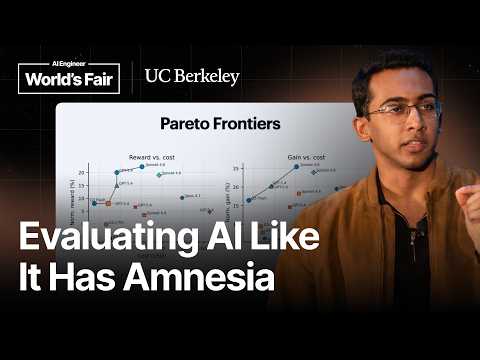
Beyond Static Intelligence: Evaluating Continual Learning —…
Talk by Parth Asawa (UC Berkeley) on evaluating continual learning in AI systems. He critiques standard single-task benchmarks that wipe memory between instances, arguing they cannot measure whether a system actually learns across tasks. His benchmark uses a "gain" metric — the difference between a stateful system and the same system reset after each instance — to separate learning from base capability. He outlines design requirements (headroom, shared latent structure across instances, and a learning signal) and presents Continual Learning Bench 1.0, spanning six domains including database exploration with concept drift via schema migration. Key findings: plain in-context learning outperformed more elaborate context management systems on reward, gain, and cost, and failure modes clustered around stability versus plasticity. The talk also covers limitations of current training stacks and future directions.
# Channel Identity Observations: Beyond Static Intelligence — Parth Asawa, UC Berkeley
## Explicit Self-Description (Creator Claims)
- **Speaker identity stated directly:** "my name is Parth Asawa. I'm a PhD student at UC Berkeley."
- **Affiliation and collaboration claims:** The speaker describes the benchmark as "a collaboration across Berkeley, Snorkel, Udub, Madison," with funding acknowledged from "Snorkel AI... through the open benchmarks grant program and the LOD institute via their LOD slingshots program."
- **Personal positioning:** "I'm personally quite excited about the parametric methods for continual learning" and "I do have an opinion and I'll share it at the end."
- **Broader framing:** "continual learning is just one example of my group's broader effort to challenge the way we do things in training today."
## Intended Audience
- **AI/ML researchers and conference attendees:** The talk opens with "We're all at these AI and machine learning conferences, but everyone is just talking about how smart these agents are" — indicating a researcher audience presumed familiar with benchmark leaderboards and model releases.
- **Technically fluent listeners:** Assumes familiarity with concepts like in-context learning, parametric weight updates, RLHF, "mid-training," "multi-teacher on-policy distillation," and catastrophic forgetting, without basic explanation.
- **Invitation to follow-up contact:** "Please feel free to email me or follow for updates" — suggests an audience expected to engage professionally with the speaker.
## Claimed Scope
- **Research scope:** Evaluating continual learning in language models; the talk introduces "Continual Learning Bench 1.0... the benchmark I'm talking about today," covering "six different domains of tasks" (spectrum monitoring, codebase adaptation, cohort studies/epidemiology, exploitable poker, database exploration, sales prediction).
- **Methodological scope:** Establishes three design criteria for continual learning benchmarks — **headroom**, **shared structure**, and a **learning mechanism** — plus metrics of **reward**, **gain** (stateful minus stateless reward), and **cost** on Pareto frontiers.
- **Field-critique scope:** "I'm going to make a case [that] we're actually not evaluating [continual learning] at all today."
- **Stated future roadmap:** More domain-specific and longer-horizon tasks, OSS models and parametric approaches, and better simulation of task environments including personalization.
## Observable Presentation Patterns (Demonstrated, Not Claimed)
- **Argument-driven structure:** The talk moves from critique of current evaluation ("we've kind of told the models, imagine that every time you do something, you completely forget your memory") → design criteria → concrete tasks → results → failure modes → opinion/outlook.
- **Opinionated research commentary:** Offers a "sunk cost fallacy" hypothesis about the field building continual learning on top of frozen-checkpoint training rather than designing it as a first-order requirement.
- **Transparency about limitations:** Acknowledges benchmark results may reflect medium-horizon tasks that "didn't push the frontiers of the in-context learning systems enough... that's one of the things on our roadmap."
- **Beyond-benchmark interests:** Closes with commentary on "open science, consolidation of power, safety, what the future of... academia or these third party institutions might look like," referencing additional writing "that I'd encourage people to check out."
- **Concrete examples used pedagogically:** Grounds abstract metrics in relatable scenarios, e.g., the database exploration task ("if you guys have ever worked in data engineering or know data engineers...") and an anecdote that poker was included "because my friends like to play poker."
## Key Claims vs. Demonstrated Distinctions
- **Claim:** The benchmark isolates learning ability from base model strength via the gain metric ("It isolates out what your benefit from actually learning was versus your base model's initial capability").
- **Demonstrated:** Detailed results are summarized narratively (vanilla in-context learning "tops the leaderboard") but no specific numbers or figures are read aloud in the transcript.
- **Claim of domain-expert validation:** "all of these task instances across domains we validate with domain experts" — presented as process, not evidenced within the talk itself.
# Delivery Observations: Parth Asawa — "Beyond Static Intelligence: Evaluating Continual Learning"
## Tone & Register
- **Conversational academic tone**: The talk blends conference-presentation structure with casual phrasing throughout.
- > "Hi everyone. Uh my name is Partasawa. I'm a PhD student at UC Berkeley."
- > "Let's get into it, right?"
- **Concession and hedging before claims**: The speaker frequently softens or pre-frames positions.
- > "though I do have an opinion and I'll share it at the end"
- > "I don't necessarily think this is what the end state of continual learning might look like... I would say that's fair"
## Recurring Rhetorical Habits
- **Repeated tag "right?"**: Used as a listener-engagement marker, appearing many times across the talk.
- > "charts and graphs that look something like this, right?"
- > "we extract a frozen checkpoint, right?"
- > "it'll look a little different, right?"
- **Repeated "Okay?" and "Okay." as section punctuation**:
- > "completely forget your memory. Okay?"
- > "they're not actually sufficient for continual learning. Okay, they don't consider sample efficiency"
- **"kind of" as a softener** (highly frequent):
- > "we've kind of told the models"
- > "You can kind of think of this as"
- > "there's a bit of a conundrum here"
- **Self-restarts and mid-word repetitions**, common in live delivery:
- > "the the red one and the black one"
- > "It it's actually really hard"
- > "is this learnable? Is this realistic?"
## Teaching Structure & Methods
- **Analogies to human experience** — a recurring explanatory device:
- > "imagine if your life was like that. You're restarting from scratch every single time you do anything."
- > "if I was an agent where my memory was being reset every single time, I wouldn't learn any of that"
- > "As a human, you reason through all this uncertainty and you're able to update your priors."
- **Enumerated design criteria** — explicit numbering to scaffold learning:
- > "The first one here is headroom... The second point that's going to talk about is shared structure... And the third criteria I'll talk about is a learning mechanism."
- **Signposting transitions**:
- > "Let's take a step back."
- > "Let's jump into an example of a concrete task to ground some of what we've been talking about."
- > "Before I finish, I want to offer a little bit of my broader thoughts"
- **Anticipating audience objections** — rhetorical question-and-answer:
- > "And the biggest question that I get when I talk about this with people is why can't I just chain existing benchmarks together?"
- > "And you might ask like why can't I just evaluate continual learning by looking at cumulative reward"
## Vocabulary & Framing Patterns
- **Shared technical vocabulary**: continual learning, catastrophic forgetting, headroom, shared latent structure, concept drift, stateful/stateless, Pareto frontiers, stability–plasticity trade-off.
- **Framing as field-level critique**, not just a paper pitch:
- > "we need to be measuring it the right way to optimize for the right objective as a field" (used twice, including the closing takeaway).
- **Concrete-example-first definitions**: definitions are given in plain language before formal terms ("Continual learning to me is sample efficient online learning that is stable over long horizons").
- **Quoting model failure verbatim** as evidence:
- > 'Quote, "These seem to be cohort definitions from a different study schema that doesn't apply here."'
## Isolated Moments (Not Stable Patterns)
- **Light personal aside** (single occurrence):
- > "exploitable poker, a strategic game playing task and because my friends like to play poker"
- **Time-pressure closing** (single occurrence):
- > "I would love to stick around, but I'm going to catch a flight, but I'm happy to take anything afterwards via email."
- **Transcription artifacts** ("Amy data sets" likely "AIME data sets," "RHF" likely "RLHF," "Parto/Pareto frontiers") appear to be transcript errors rather than speaker habits — noted as uncertainty, as the audio itself is unavailable.
## Uncertainty Notes
- Timestamps are coarse (transcript line markers, not exact video timestamps), so frequency claims ("right?", "kind of") are qualitative estimates from observed repetition, not counts.
- Filler-word and false-start density is well-evidenced; no claims are made about the speaker beyond directly observable delivery.
# Position Record: "Beyond Static Intelligence: Evaluating Continual Learning" — Parth Asawa, UC Berkeley
## Speaker
- **Parth Asawa**, self-identified PhD student at UC Berkeley (transcript introduction).
## Central Thesis
- Current AI/ML conferences focus on **how smart agents are**, not **how much they learn**.
- The field evaluates language models as **independent point capabilities** — each task is treated as if "every time you do something, you completely forget your memory."
- Continual learning "doesn't look like point capabilities. We need to measure it the right way to optimize for the right objective as a field."
- His stated case: not which method solves continual learning, but that **"we're actually not evaluating it at all today."**
## Definitions and Framing
- **Continual learning (his definition):** "sample efficient online learning that is stable over long horizons" — balancing retention without forgetting against updating from new information.
- Current LM paradigm: offline training in a "box," extracting a **frozen checkpoint** whose weights don't change post-deployment.
- Existing approaches he catalogs:
- **In-context learning** (simulated learning via context)
- **External memory stores** (notepads, key-value stores)
- **Parametric approaches** (online weight updates)
## Critique of Existing Evaluations
- Continual learning research is decades old (e.g., catastrophic forgetting), but existing evaluations — including sequential task training (A→B→C) and long-horizon factual recall tests — are **insufficient** because they:
- Don't treat **sample efficiency** as a first-order requirement
- Don't necessarily measure learning
- Won't work for **frontier models** pre-trained on vast internet distributions, where novel tasks with headroom are hard to construct
- **Why not chain existing benchmarks?** Benchmark instances are designed to be independent, with no shared structure — so improvement from earlier experience can't be meaningfully expected.
## Benchmark Design Criteria (Continual Learning Bench)
1. **Headroom** — task must require online adaptation; if offline training on the data suffices, it's not a valid continual learning task.
2. **Shared structure** — latent structure across tasks that agents can exploit to improve.
3. **Learning mechanism** — realistic learning signal: scalar reward, error messages, or textual feedback.
## Metrics
- **Reward:** per-instance metric, proxy for learning (efficiency, profit, prediction accuracy).
- **Cumulative reward alone is confounded** — it mixes continual learning ability with base model strength (illustrated via a diagram comparing a stateful system, its stateless variant, and a stronger stateless system).
- **Gain:** difference between stateful and stateless runs; each system runs the benchmark twice — once maintaining state, once reset per instance. Gain isolates learning benefit from initial capability.
- Reward, gain, and cost are measured on **Pareto frontiers**, not as a single metric — "we still care about the base model strength... the ability to learn and... the cost."
## Example Task: Database Exploration
- Natural-language questions answered via SQL queries over unfamiliar schemas; efficiency (fewer queries over time) measures learning.
- Adds **concept drift**: database migrations (dropped/renamed columns, format changes) test stability–plasticity trade-off — humans update priors while discarding stale knowledge; this "isn't native to a lot of language models."
## Benchmark Scope (v1.0)
- Six domains: **blind spectrum monitoring, codebase adaptation, cohort studies/epidemiology, exploitable poker, database exploration, sales prediction**.
- All task instances validated with **domain experts** for learnability, realism, and realistic drift.
## Results and Failure Modes
- **Vanilla in-context learning topped the leaderboard** on aggregate reward and on reward-vs-cost and gain-vs-cost Pareto frontiers, outperforming more expensive context-management systems.
- **Qualification preserved:** he doesn't think this is the end state — tasks were "medium horizon" and may not have pushed in-context systems far enough; extending horizons is on the roadmap.
- **Failure modes map onto the stability–plasticity trade-off:**
- **Stability failure (sales prediction):** after overprediction feedback, the model revised down; after underprediction feedback, it jumped back to overprediction rather than going to a middle value — it "forgot that it had the over prediction to begin with."
- **Plasticity failure (epidemiology, notepad system):** the model wrote that cohort definitions "seem to be from a different study schema that doesn't apply here" — when the schema *did* apply; it failed to update priors from new information.
## Broader Opinions (explicitly labeled as personal views)
- He is "personally quite excited about **parametric methods**" jointly optimizing architecture, data, and algorithms.
- **Sunk-cost-fallacy hypothesis:** continual learning research assumes methods must work atop frozen checkpoints, but "these models were never designed to be continual learners to begin with."
- First-principles alternative: continual learning could be "one phase of training... and everything after that is deployment" — a single phase of learning with ongoing weight updates.
- Broader research-governance views: opportunities to rethink open science, consolidation of power, safety, and the role of academia/third-party institutions; he has written more on this and encourages readers to check it out.
## Roadmap and Credits
- More domain-specific, longer-horizon tasks; more OSS models and parametric approaches; better simulation of non-deterministic environments, including personalization to user models ("I don't think we have models that are capable enough of simulating that right now... but I think we should").
- Collaboration across **Berkeley, Snorkel, UW (Udub), Madison**; supported by Snorkel AI's open benchmarks grant and the LOD institute's LOD slingshots program.
## Key Takeaway (as stated)
> "Continual learning doesn't look like point capabilities. We need to measure it the right way to optimize for the right objective as a field because that's a history of how machine learning has progressed."
# Speaker Attribution Record
## Video
- **Title:** Beyond Static Intelligence: Evaluating Continual Learning — Parth Asawa, UC Berkeley
- **Video ID:** `01a15ca7-fc48-7528-9bf7-4a423f9d73e3`
## Speakers and Roles
| Speaker | Role | Evidence |
|---|---|---|
| Parth Asawa (transcribed as "Partasawa") | **Creator / Sole presenter** | Self-introduction: "my name is Partasawa. I'm a PhD student at UC Berkeley." Delivers entire talk as first-person presentation of Continual Learning Bench 1.0. |
- **No other speakers** appear in the transcript (no guests, narrators, Q&A, or audience voices).
- Asawa indicates Q&A was unavailable: he had to leave to catch a flight and invited follow-up **via email only**.
## Referenced Sources and Third-Party Claims
- **Cited research literature (unnamed):** continual learning / catastrophic forgetting papers; graphs of sequential task training (task A → B → C); long-horizon factual recall evaluations for LLMs.
- **Named institutions/collaborators:** UC Berkeley, Snorkel AI, University of Washington ("Udub"), University of Wisconsin–Madison.
- **Acknowledged funding:** Snorkel AI "open benchmarks grant program"; "LOD institute" via "LOD slingshots program" (as spoken).
- **Benchmark described:** Continual Learning Bench 1.0 with six task domains (spectrum monitoring, codebase adaptation, epidemiology/cohort studies, exploitable poker, database exploration, sales prediction).
- **Personal claims flagged as opinion:** preference for parametric continual learning methods; "sunk cost fallacy" hypothesis about current training stacks — explicitly framed as the speaker's view.
- Mentions he has written elsewhere on open science / third-party AI research institutions — **writing not identified or supplied**.
## Promotional Segments
- **None identified.** Closing acknowledgments include funder mentions (Snorkel AI grant, LOD institute) — recorded as provenance, not flagged as promotion.
## Availability Limits
- No curated metadata supplied; no comment availability info.
- Presentation slides/charts and the named example failure transcripts (e.g., epidemiology notepad quote) are referenced but not included in the source material.
- Contact channel: email / follow for updates (addresses not provided in transcript).
Hi everyone. Uh my name is Partasawa. I'm a PhD student at UC Berkeley. We're all at these AI and machine learning conferences, but everyone is just
talking about how smart these agents are. We're not actually talking about learning ability or how much these agents learn. And so today I want to talk about that. You've seen the way we evaluate language models today. Every time there's a new model release, we see charts and graphs that look something like this, right? The way we evaluate these language models is we ask them to do one task and then completely independently we ask them to do another task and then another. And then we repeat this across a variety of different benchmarks, right? And so you've probably seen a variety of all of these. In the end, those benchmarks in aggregate when we take all of those independent evaluation scores give us leaderboards that look like this. Now, the challenge here is that if you look at the way we actually come to these single independent scores, what we've done is we've kind of told the models, imagine that every time you do something, you completely forget your memory. Okay? Like imagine if your life was like that. You're restarting from scratch every single time you do anything. That's the premise under which
we're evaluating language models today. I'm going to argue that it's not necessarily what it should look like. If you were to look at learning ability, you might see charts where across different instances, performance doesn't
look like a scattered line, but it looks like as a function of prior experience, models are actually able to improve their performance in contrast to what they've done in the past. Let's take a step back. What is continual learning? Continual learning to me is sample efficient online learning that is stable over long horizons. It's a challenging problem because you have to deal with both your ability to retain prior information without forgetting while simultaneously being able to update from new information and adjust your priors to new new data you're receiving over
time. In language models specifically, you know, the way we train language models is we take a bunch of data we want to train them on and we kind of put them in a box in some offline training
process and then maybe for a few weeks or something we train the model and then we extract a frozen checkpoint, right? And this frozen checkpoint is what's deployed to the world. The weights don't really change after that in today's paradigm. And continual learning is all about trying to change that, trying to enable mechanisms for models to learn over time. So in language models, people have looked to approaches like in
context learning. Put more information in the model's context and the model can simulate some amount of learning in context. People have looked towards external memory stores, right? You could externalize some of your memory to a
notepad that you then get to refer to every single time or a key value store or your choice of external memory. Or people look towards the parametric approaches. What would it actually look like if we had ways to update the model's weights online such that it could improve and learn from the new information? Now, today I'm not going to make a case for which one of these can solve continual learning, though I do have an opinion and I'll share it at the end. But what I am going to make a case for is that we're actually not evaluating it at all today. And the question that we need to ask ourselves is that if
continual learning doesn't look like point capabilities, we need to be measuring it the right way to optimize for the right objective as a field. So let's get into it, right? What does continual learning kind of look like
today when you read the literature? To be clear, continual learning by itself is not a new idea. Continual learning for neural networks has been around for decades, right? There have been famous problems in catastrophic forgetting that people have spent years trying to solve. But with language and you know an example of that is some of these sorts of papers where you'll see graphs like this where you train the models on a
particular task distribution task A then you train it on the task B distribution and then you train it on task C. And the objective you're looking for is the does the model's performance not degrade on prior tasks while it's still able to
learn the new tasks. And people have taken this similar methodology and applied it to language models too. Right? In some of the more recent papers we've seen, you're you're starting to see similar graphs of you train on one task and you train on the next. There's also a different class of evaluations for language models that look more like a factual recall sort of test where over these extremely long horizons, can models remember particular parts of the conversation and improve from that. The case I'm going to make though is that these sorts of evaluations aren't actually sufficient for continual learning. Okay, they don't consider
sample efficiency a first order requirement. They don't necessarily always measure learning. And perhaps most importantly, they won't work for frontier language models. And the reason being that frontier language models are
pre-trained on vast distributions of the entire internet or economically valuable tasks we care about. And so if you're expecting to see improvement on new tasks, it's it's actually really hard to come up with what those sorts of tasks should look like. So given all of that, what should a continual learning benchmark look like? The biggest question that I get when I
when I talk about this with people is why can't I just chain existing benchmarks together? Like we've we've seen all of these Amy data sets. Why can't I just take my AM problems and solve them in a sequence? And the
fundamental problem there is that benchmark instances are in traditional language model evaluation are designed to be independent. That means they don't have shared structure across tasks and as a result you can't meaningfully expect them to improve from earlier experience in future instances. And this is the fundamental problem that exists with any approach that tries to chain prior benchmarks together. In contrast, when we're designing continual learning benchmarks, we looked at three main design criteria as things that are kind of a fundamental
requirement for evaluating continual learning. The first one here is headroom. And this kind of goes to my last point. Frontier language models are trained on almost everything in the internet. If you want to evaluate
continual learning, you need some sort of task that actually requires online adaptation or learning from the language models. And that doesn't exist for a wide variety of the benchmarks where the models are just trained offline on that data. If the model can improve on your tasks by just training offline and not actually require any online learning, then it's not a good task for measuring continual learning. The second point that I'm going to talk about is shared structure. What this means is when going back to my point of pre prior language modeling benchmarks all being independent instances. If you want there to be an expectation of improvement in how you're evaluating continual learning, then there needs to exist some shared latent structure between the tasks. You can kind of think of this as some sort of shared latent in the environment that your models or agents are learning over time and they're seeking to exploit these these latent structures that exist in the environments to improve their performance on future tasks as a result of their prior information. And the third criteria that I'll talk about is a learning mechanism. And what this means is just there has to be some realistic
expectation that the models are able to learn as a result of their prior experience. This could look like scalar reward. It could look like error messages. It could look like textual feedback. The point being, there needs
to exist something in the environment that's giving agents signal to learn and improve on future tasks. Otherwise, it's not really a fair measure of continual learning. Let's talk a little bit more about the metrics before we get into examples. Obviously, there's a simple metric for a lot of tasks that we've seen recently, which is reward. And in our benchmark,
it's no different. Every task defines a per instance reward metric where reward serves as a proxy for learning. Higher reward is better. You could think of this as efficiency. You could think of this as profit. You could think of this
as how close you were to the actual predictions. There's some single unit of reward that operates on a per instance basis. And you might ask like why can't I just evaluate continual learning by looking at cumulative reward across these sequences of tasks we're constructing? And the answer is that total reward alone might confound \[clears throat\] continual learning ability with base model strength. Let's look at a diagram to kind of explain why this might work. Here we have two different continual learning systems. Okay, the the red one and the black one, the ones connected by the dotted lines. The gray system at the bottom is the black system except it wasn't allowed to maintain state across time. Okay, so that's what the black system looks like if its memory was wiped every single time. But if its memory wasn't wiped, if it had some mechanism of learning, then you can kind of see that it tends to improve over time. The challenge here is that if we looked at the cumulative reward metric alone, the red system would look like it was the best the best performing system on this task, right? It let's assume for a second that there is per room to do better and it hasn't saturated it. It has a higher cumulative reward, but you can kind of tell that in comparison to
uh to the black system, it doesn't necessarily improve over the stateless baseline. It's just a better system to begin with. And this is one of the confounds we run into when we're trying to measure cumulative reward. To deal
with this, we look at the gain metric in addition to reward. Gain refers to the difference between stateful reward and stateless reward. What that means practically in our benchmark is that for any system, we run it through the benchmark twice. Once in the normal way where it's allowed to maintain state across all of the instances in the benchmark. That might mean it's learning and updating its policy. It might mean that it's updating its notes. It might mean that it's just growing its context length, but it's allowed to maintain state. The second thing we run is a stateless baseline. What that means is we reset the system between every instance of a task so that the model isn't actually allowed to continually learn in any meaningful way. The difference between these two numbers then for any instance intuitively is kind of a question. It answers the question of how much did if we're looking at gain on task five, how much did my prior experience on the first four tasks actually lead to an improvement in my performance on the fifth task. It isolates out what your benefit of from actually learning was versus your base model's initial capability. To to be clear, I think reward, gain, and cost are all measured
on Parto Frontiers. There isn't one single metric that I think defines continual learning because we still care about the base model strength. We still care about the ability to learn and we still care about the cost we're
expending for these systems and so we try to measure everything on PTO Frontiers in this benchmark. Let's jump into an example of a concrete task to ground some of what we've been talking about here. I'm going to walk through the database exploration task which is hopefully a little approachable for uh which is hopefully approachable to understand. If you guys have ever worked in data engineering or know data engineers, you know that one of the
things they do is operate over these vast databases with large set many different sets of tables, schemas they're unfamiliar with and idiosyncrasies in the data. And if you're a human data engineer, you learn
those schemas over time. You learn how tables link together. You learn the idiosyncrasies in the data. But if I was an agent where my memory was being reset every single time, I wouldn't learn any of that, right? And so here what we can use as a measure for our ability to continually learn is the efficiency in the the task here is you're given a natural language question over the data and you have to answer it by performing some set of SQL queries right that gives you the answer from the from the databases but if you don't know anything about the databases it's going to take you a lot of SQL queries at the start and at the first questions you're going to be doing a lot of different exploration into figuring out what do the schemas look like what is the data format how do these link together but as you progress through the benchmark. If you're a continually learning system, maybe let's say by the 10th instance of a task, it'll look a little different, right? You'll you'll be able to know a lot more about the schemas, the idiosyncrasies of the data. You'll know how things link together, and it'll take you much less to actually answer the question. But there's a bit of a there's a bit of a conundrum here. We're going to add something a little more challenging to this task, too. In the real world, there's often concept drift in the things you're doing. In the database
example, let's say there's a migration of your database, right? Columns get dropped. There's new columns with different names added. The data format changes. As a human, you reason through all this uncertainty and you're able to update your priors. You know that
there's still some information from the past that may be relevant, but from your exploration, you learn what to forget and you learn what's actually relevant to maintain over time. You kind of have an innate ability to maintain the stability and plasticity trade-off in your mind. But this isn't native to a lot of language models. And so if we give it a task after the database migration, it might struggle to require it might struggle in its ability to detect and discard stale experience and simultaneously update from new experience. And so this n this notion of concept drifts is something we try to add a lot to our tasks to further test the limits of what memory and continual learning might look like in language model systems. In continual learning bench 1.0, know which is the benchmark I'm talking about today. We have tasks from six different domains of tasks. Okay, we have blind spectrum monitoring which is a signal processing task, codebase adaptation which is a software engineering efficiency, cohort studies and epidemiology task, exploitable poker, a strategic game playing task and because my friends like to play poker, and a database exploration task, the one I just showed you, and sales prediction, which is more of a data sciency prediction error style task. Across each
of these task domains, we construct sequences of individual task instances with defined reward metrics that agents or models are tasked with solving gradually over time. And all of these
task instances across domains we validate with domain experts to see is this learnable? Is this realistic? Is these the sorts of drifts you would expect and things you would expect to remember in an environment. Let's jump quickly into the results. In the first in initial release of the continual learning bench, we evaluated a lot of these context management systems to begin with and there's some parametric systems down the line too. If
we look at just aggregate reward for a second and ignore gain and cost, you'll kind of see that the incontext learning systems, this is vanilla in context learning where you just put the experience in the context and you don't do any of the fancy context management
that some of these other systems do. It tops the leaderboard and and it's not just on reward. It's actually also when we look at the Pareto frontiers, this kind of holds across reward uh versus cost and gain versus cost. I don't necessarily think this is what the end state of continual learning might look like. You could argue that these were medium horizon tasks and they didn't push the frontiers of the incontext learning systems enough and I I would say that's fair and that's one of the things on our road map to push those even further. But it was still surprising that these more expensive context management systems perform a lot poorly compared to just vanilla in context learning on these sets of tasks where you have to do real learning. These are real tasks that you might expect a normal person to do. I think it's also interesting to chat briefly about what some of the failure modes look like when we observed in this initial version of the benchmark. I'm going to argue that most failure modes in continual learning fall on one side of the stability plasticity trade-off. Okay. Okay. And stability is your ability to retain new information in a stable way and use that for future tasks. While plasticity is your ability to actually learn from new information.
We see usually that with most continual learning methods, any sort of failure mode comes from the inability to do one of these things. And I'll dive into examples from both. You don't have to read too much of the text here, but this
is our sales prediction task where the model's tasked with making some predictions or forecasting for sales over the course of I think five years. The model starts by getting feedback that it overpredicted for the last uh the last submission it set. And so what it does is that it then leads to it revises its prediction downwards to a lower prediction for the set of five years. And then it gets feedback that actually its underprediction was too
much of an underprediction. And so as a human might naturally do you would go for the middle. But that's not what the model does. The model kind of forgot that it had the over prediction to begin with at the start and it just re jumps
back right to the over prediction. This is kind of example of what stability failures look like where it's not retaining past information in improving its future experience. Plasticity is a bit of a different story. This is from our epidemiology task. And the only words I really want you guys to read this is a this is a system with with a notepad. Okay? It's a context management system that's given a notepad to externalize its memory to the highlighted text is is the important thing to read here. Quote, "These seem to be cohort definitions from a different study schema that doesn't apply here. the study schema did in fact apply here that the the model was unable to update
its priors and data from new information and meaningfully improve over time. It just didn't even recognize that this is something that's relevant to the task and use that to update its priors.
Before I finish, I want to offer a little bit of my broader thoughts on continual learning. I alluded to this before that I have some opinions on what methods for continual learning might actually look like. I'm personally quite excited about the parametric methods for continual learning that look at alternative architectures, data, and algorithms jointly to optimize what continual learning should look like. If you look at language models today, the
training stack used to look something simple like this, or maybe it never did, but I'm simplifying for for the sake of this pre-training, then we did supervised fine-tuning, and then we do RHF. But the stack kind of adapted over
the course of the last few years. Now it might look something more like this where you have mid-training, you have RL for different teacher models and you finish everything off with multi multi-teer on policy distillation. A lot of the work in continual learning today is how do we take these models that are already trained and then kind of that frozen checkpoint. How do we figure out methods for continual learning that work after the fact? But these models were never designed to be continual learners to begin with. And one of my hypotheses here at least is that we're operating in a bit of a sunk cost fallacy that because we've trained models the way we are today, we need
continual learning methods that work on top of that. If you were to think of designing what continual learning looks like as a first order principle and a first order requirement, it might look nothing like this. In the purest sense,
continual learning might just be one set, one phase of training for continual learning and everything after that is deployment. You're just the model is interacting in the environment. It's updating its weights. there's only one phase of learning and we don't necessarily have to assume that everything is built on top of the way we do language modeling today just because we've spent so much doing that there there are there are different ways to explore where if you think about continual learning as a first order requirement for your systems more broadly here for a second I think that continual learning is just one example of my group's broader effort to challenge the way we do things in training today I think that there are larger questions going on though and opportunities to challenge how we do AI research as a whole. There's a lot of questions around open science, consolidation of power, safety, what the future of things like academia or these third party institutions might look like. And I think that there's a huge opportunity for us to rethink a lot of that. And I've spent some time doing some more writing about that that I'd encourage people to check out. But the crux being there there are opportunities to reimagine what third party institutions for AI research look like and what the future of open science
should look like that I think we all need to spend more time getting involved in. To wrap up, uh, I want to thank a lot of my contributors on continual learning bench. This is a collaboration across Berkeley, Snorkel, Udub, Madison. Uh,
thanking the snorkel AI for their open their grant through the open benchmarks grant program and the LOD institute via their LOD slingshots program. Uh, in the road map, we have more domain specific and longer horizon tasks on the benchmark. We want to add more of the OSS models and the parametric approaches. We want to improve what simulation for task environments outside of easily verifiable deterministic
domains look like. What would continual learning where you're personalizing to a user model do? I don't think we have models that are capable enough of simulating that right now to figure it out, but I think we should. If there's one thing to take away,
continual learning doesn't look like point capabilities. We need to measure it the right way to optimize for the right objective as a field because that's a history of how machine learning has progressed. Thank you guys very much for listening. Please feel free to email me or follow for updates. I would love to stick around, but I'm going to catch a flight, but I'm happy to take anything afterwards via email. Thank you guys very much.