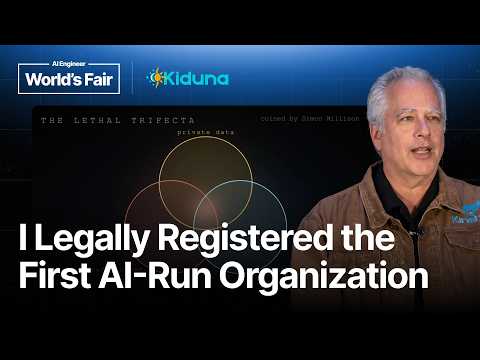
Beyond the Lethal Trifecta: Agentic Commerce on the Open…
Conference talk by David Levine (Kiduna Club) tracing his experience from LambdaMOO at Xerox PARC in 1993 to his proposal for agentic commerce on the open internet. He argues platforms and algorithms have ground down open communities over thirty years, and that Simon Willison's "lethal trifecta" (private data, untrusted content, and the ability to act) is what keeps enterprises from deploying agents openly. His proposed solution combines legal identity for agent organizations — illustrated by a DUNA (decentralized unincorporated nonprofit association) registration filed two hours before the talk — JWT-based agent identity resolving to a registered organization with an audit trail, and governance via decision markets in which members trade pass/fail tokens on policies instead of voting.
# Channel Identity Observations: "Beyond the Lethal Trifecta" — David Levine, Kiduna Club
## Observable Presentation
- **Conference talk format**: This is a recorded conference session, explicitly framed by the speaker as "the very last session of the entire conference," indicating the channel (or this upload) documents live event presentations.
- **Audience present is small and engaged**: The speaker counts attendees on camera — "2 4 6 8 10 12 14 16 18 20 21 people um got to experience this moment" — and takes questions at the end, showing an in-person, interactive audience.
- **Target audience: builders and technologists**: The speaker describes the first "Kaduna" as "very specifically for builders," offering "templates, all kinds of different agentic templates" (sales agents, social media agents, lawyer agents), signaling outreach to technical/entrepreneurial viewers.
- **Promotional close with calls-to-action**: The talk ends with direct contact and signup channels: "it's david@kaduna.club," "LinkedIn... {slash}motodave," and "if you go to kaduna.club, you can sign up for early access."
## Creator Self-Description and Claims
- **Affiliation and role**: The title identifies the speaker as **David Levine, Kiduna Club**; the transcript shows him presenting the "DUNA" (decentralized unincorporated nonprofit association) registration: "We have registered your DUNA with the Secretary of State's office and you have this organization number 628407."
- **Claimed scope**: Building an "agentic economy" on the open internet — "legal standing for an organization composed of intelligent agents" — with composable, permissionless, blockchain-verified agent organizations ("allies" and "kidunas").
- **Novelty/timeliness claims**: The speaker asserts the capability "did not exist until yesterday" and calls the moment "historic," describing the DUNA structure as "designed by Andreessen Horowitz for the blockchain" but "even better for autonomous agents."
- **Technical framing**: Addresses agent security ("the lethal trifecta," attributed to "Simon William Willison"), JWT-based identity tokens, and "decision markets" for governance.
## Demonstrated Patterns (vs. Claims)
- **Personal narrative style**: Opens with a long personal anecdote (1993 MOO/Xerox PARC story, "my old life ended"), demonstrating a storytelling presentation approach grounded in internet history.
- **Recruitment intent demonstrated, not just claimed**: The talk closes by explicitly inviting the audience to join ("Here's your invitation to join us... let's blow this whole thing up"), confirming the presentation functions as community building, not just education.
- **Evangelistic framing toward open internet**: Contrast drawn against "siloed platforms" and "extractive" algorithms, framing the channel's subject matter as an alternative to platform economics.
# Delivery Observations: David Levine — "Beyond the Lethal Trifecta"
## Tone
- **Conversational and energetic**: The speaker frames the talk as a finale and works to maintain momentum: *"this is the very last session of the entire conference. I hope you guys have had a great time and we're going to try and keep the energy high for the very end."*
- **Anecdotal, storytelling opening**: He anchors a technical topic in a personal memory: *"I want to go way back in time to November 1993 when I was at the wedding of a college roommate."*
- **Evangelistic, call-to-action close**: *"Build your agents, build your organizations… let's let's blow this whole thing up."*
## Vocabulary & Framing Devices
- **Coining and defining terms**: He explicitly introduces named concepts: *"the lethal trifecta,"* *"It stands for decentralized unincorporated nonprofit association,"* *"we call agents within the agentic economy allies… an agentic organization, which we call a kiduna."*
- **Attribution to others**: He credits named sources: *"Simon William Willison came up with this term, the lethal trifecta"*; *"this was designed by Andreessen Horowitz."*
- **Repeated structural contrast — "what it's not / what it is"**: *"So, what is it? That's what it's not. It's member governed."* This definitional pattern recurs, e.g., contrasting platforms vs. the open internet: *"you lose a ton of context."*
## Teaching Habits
- **Personal anecdote as analogy engine**: The 1993 MOO story (Pavel Curtis, LambdaMOO, *"lambda.park.xerox.com port 8888"*) is used to explain **composability** in accessible terms: *"they could create a motorcycle out of a scooter."*
- **Enumerated frameworks**: He presents the MOO's magic as four parts — *"The governance… The technology… The economics… and the culture."* Similarly, the ally-creation process is given as a repeated verb sequence: *"You inform it… you instruct it… you empower it… you set up in enact… and finally, alignment."*
- **Simple analogies for trust infrastructure**: JWT tokens are compared to the **domain name system** and to early protocol adoption: *"it's sort of like email at the beginning"* (SMTP, HTTP).
## Communication Patterns
- **Fillers and self-repair throughout**: Frequent *um/uh* and restarts: *"Um uh that's a beautiful blonde girl in my bed"*; *"who he is, who it is, she is."* Some transcript segments show stuttered repetition: *"you you you see all these websites."*
- **Direct address and audience inclusion**: *"there aren't very many people here… this is historic"*; counting attendees aloud (*"2 4 6 8 10 12 14 16 18 20 21 people"*); closing with *"You're all going to be famous someday."*
- **Recycled callback structure**: The talk opens with the scrap of paper from Matthew Pahr and closes by mirroring it: *"just like my friend Matthew Pahr gave me this little scrap of paper… I'm saying, 'Here's your invitation to join us.'"*
## Punctuation of Urgency
- **Dramatic timing claims**, stated twice: *"This was a problem literally until today"* and *"this whole capability did not exist until yesterday."* These are presentation claims rather than verifiable facts, but they are a clear rhetorical device.
## Uncertainty Notes
- The Q&A section is sparsely transcribed (audience questions largely absent), so observations about his interactive style rest mainly on his answers (*"Can you just stand up and yell a little loud?"*) — limited evidence.
- The stated attendee count and the West Virginia registration details come from the speaker's own delivery; no external verification is possible from this transcript.
# Observation Record: "Beyond the Lethal Trifecta: Agentic Commerce on the Open Internet" — David Levine, Kiduna Club
## Speaker
- **David Levine**, founder of Kiduna Club (self-identified; contact given as david@kaduna.club, LinkedIn /motodave). Single-speaker conference session, described as the final session of the conference.
## Narrative Framing: The MOO Origin Story
- Levine recounts joining a **LambdaMOO** text-based virtual world in **November 1993** after receiving a note ("lambda.park.xerox.com port 8888") from friend **Matthew Pahr** at a college roommate's wedding, then buying a 9600 baud modem at Egghead Software.
- He describes the MOO's appeal as a **real sense of community** in a text-only world that "didn't feel like text."
- Attributes the magic to **composability**: "it was all just nouns and verbs," users could change their player class to shared programs, e.g., "create a motorcycle out of a scooter."
- Notes the world ran on Pavel Curtis' Sparc 10 at Xerox PARC, and that Julian Dibbell wrote *My Tiny Life* about it.
- Claims MOO magic came from **four things composing together**: governance (architectural review board, wizards), technology, economics (funded by Xerox PARC), and culture — emphasizing culture as most important and often overlooked.
## Claim: Platforms Crushed the Open Internet (1995–2025)
- Levine asserts that over 30 years, communities on the early internet "got crushed by platforms" and algorithms.
- **Reasoning**: platforms and algorithms are "by their very nature extractive" — they remove value from communities, prioritize advertising/engagement (e.g., "dancing person" content, infinite scroll) over real connection.
- **Conclusion stated**: "There is no real economy of the internet anymore. It's just a bunch of siloed platforms."
## The Lethal Trifecta
- Context: In **January 2026**, Open Cloud "suddenly blew up," but the internet wasn't designed for agents and remained platform-oriented; malicious agents and miners exploited this via **prompt injections**.
- Characterizes agents as "incredibly naive" — easy to hijack by convincing an agent a new principal is its principal and having it exfiltrate private data.
- Attributes the term **"lethal trifecta"** to **Simon Willison** (transcript renders as "Simon William Willison"). The three elements:
1. Agent access to **private data** (bank info, logins, documents)
2. Exposure to **untrusted content** (agent can't tell a real job board from a trap)
3. Ability to **take actions** (fill forms, read emails, expose secrets)
- Levine states "there's really no way to solve this" — immediately followed by his proposed solution (a stated tension preserved as expressed).
## Enterprise Response (as described)
- Enterprises kept agents inside the perimeter (Slack, Salesforce, Notion), requiring APIs and MCP servers to integrate.
- **Claimed cost**: "you lose a ton of context"; heavy integration work for sales, finance, and research agents.
## The DUNA / Kiduna Solution
- Claims a new **West Virginia law** went into effect "yesterday," applicable globally; he FedExed documents and received registration from the Secretary of State — **organization number 628407** — granting legal standing to an organization composed of intelligent agents. He calls this historic and frames it as "this was a problem literally until today."
- **DUNA** = **Decentralized Unincorporated Nonprofit Association**. Properties claimed:
- **Composable** (agents on top of agents), **permissionless**, **accountable**, **registered**, safe and secure
- *Not*: no board of directors, no executives, no corporate shell
- **Constraint**: can be profitable but **cannot distribute profits to members** based on ownership — otherwise membership units would be securities (like LLC/C-corp stock)
- *Can*: member-governed, own assets/property ("your agents can... buy an apartment building and market it"), enter agreements, raise capital, earn profits, open bank accounts, hire and fire people
- Attributes DUNA's design to **Andreessen Horowitz** for blockchain/DAO projects; Levine claims it is "even better for autonomous agents than it is for blockchains."
- **Blockchain role**: verifying agentic identity — account resolution, money trails, and tracing responsibility if an agent is sued. He acknowledges the common critique ("blockchains are a solution looking for a problem") and claims agentic identity is that problem.
## Vocabulary and Agent Lifecycle
- **Ally** = agent in the agentic economy; **Kiduna** = an agentic organization ("DUNA + kinship").
- Agent creation steps as described:
1. **Inform** — load material into a vector database
2. **Infuse** — wisdom/knowledge (any LLM behind it)
3. **Instruct** — system prompt, character, stance
4. **Empower** — connect accounts (Slack, Telegram, Twitter, enterprise)
5. **Enact** — specific abilities, automation, long-term goals
6. **Align** — purpose so the ally works for you across contexts
- Organizations are "literally designed as software": discovering customers, sharing value, reinvesting revenue.
## Resolving the Lethal Trifecta
- Agents establish **identity, authority, and boundaries** within and between organizations via **cryptographic JWT tokens** — chosen because "the whole web runs on JWT tokens."
- Analogized to **DNS**: resolution up to a registered organization at the top (Secretary of State of West Virginia), resolvable to entities like Kaiser Permanente, Disney, Pepsi — "not some fentanyl dealer from North Korea."
- Each organization has an **audit trail on the blockchain** down to individual actions.
## Governance via Decision Markets
- Organizations balance **sustainability/growth** and **mission**.
- Uses **decision markets** (like prediction markets, e.g., Polymarket): members trade **pass and fail tokens on policies** rather than voting.
- **Stated reasoning**: LLMs are goal-oriented and want rewards; better decisions emerge when token value accrues to the winning side, rather than agents merely persuading each other. He adds "apparently, all this science says you reach much better decisions this way" (hedged attribution, no source named).
- Method: infuse agents with purpose, values, experiences, aspirations — "then let them argue."
## Call to Action
- Invitation paralleling the 1993 MOO scrap of paper: "Let's blow this whole thing up."
- Early access at **kaduna.club** in "just a few weeks"; first Kiduna is specifically **for builders**, with templates (sales agents, social media agents, lawyer agents); members can spin out their own organizations.
## Q&A Points (attributed to Levine's responses)
- **Umbrella organization**: the first DUNA is broad so anyone can register an agent under it without creating their own organization; JWT tokens can be posted on websites for interaction.
- **Adoption analogy**: like SMTP and HTTP adoption — parties eventually converge on standards; he argues a Secretary of State (a public office with standing) makes more sense as a registry than getting companies to agree.
- **Token flexibility**: different tokens for different purposes, different times-to-live, scoped access, a set of claims plus a blockchain address for lookup and validation before collaboration.
# Video Attribution Record
## Video
- **Title:** Beyond the Lethal Trifecta: Agentic Commerce on the Open Internet — David Levine, Kiduna Club
- **ID:** 01a15ca7-92b2-7342-ab95-8ee6ae7fc040
## Speakers and Roles
- **David Levine** — **Creator / Primary speaker**. Delivers the full session talk (final session of a conference), answers audience Q&A at the end, and promotes his organization.
- Identifies himself indirectly via contact info: email **david@kaduna.club**, LinkedIn **/motodave**.
- **Audience members (unnamed)** — Ask questions during Q&A (three brief exchanges); questions are largely inaudible/paraphrased in transcript.
- **Matthew Pahr** — **Referenced third party** (friend who gave the speaker the MOO invitation in November 1993); not a speaker.
- **Julian Dibbell** — **Referenced author** of *My Tiny Life*, cited as a book about the MOO; not a speaker.
- **Pavel Curtis** — **Referenced third party**; ran the MOO server at Xerox PARC; not a speaker.
- **Simon Willison** — **Referenced third party**; credited with coining the term "lethal trifecta"; not a speaker.
## Referenced Sources and Third-Party Claims
- **Simon Willison** — attribution of the term "the lethal trifecta" (prompt injection risk model).
- **Julian Dibbell's *My Tiny Life*** — cited book about the LambdaMOO community.
- **LambdaMOO** — lambda.park.xerox.com port 8888; run by Pavel Curtis on a "Spark 10" at Xerox PARC.
- **West Virginia Secretary of State** — speaker claims registration of a DUNA (organization number **628407**), effective "yesterday" relative to the talk; law described as new and "applicable globally" (speaker's claim).
- **Andreessen Horowitz** — credited by speaker with designing the DUNA structure for blockchain use.
- **Named companies/platforms** (contextual mentions): Facebook, LinkedIn, Slack, Salesforce, Notion, Telegram, Twitter/X, Open Cloud, Polymarket, Kaiser Permanente, Disney, Pepsi, Egghead Software.
- **Technical standards referenced:** JWT tokens, SMTP, HTTP, MCP servers, blockchain verification.
## Promotional Segments (Flagged)
- **Closing promotion:** Speaker invites audience to join via **kaduna.club** for early access, promotes templates ("sales agents... social media agents... lawyer agents"), and provides personal contact channels (email, LinkedIn).
- **Product/organization promotion throughout:** The talk promotes **DUNA/Kiduna Club** concept ("ally" agents, "Kiduna" organizations, decision markets) as the speaker's own framework.
## Provenance Notes
- Speaker's historical anecdotes (1993 wedding, LambdaMOO, West Virginia registration) are **unverified personal claims** recorded as stated.
- No curated metadata supplied; **comment availability unknown**.
- No narration; single-presenter conference session format.
\>\> Okay, well, this is the very last session of the entire conference. I hope you guys have had a great time and we're going to try and keep the energy high for the very end. So, we're going to
cover the lethal trifecta and most importantly how to get past it. So, for those of you who don't know, the lethal trifecta is what is keeping us from having true agentic commerce, a full economy on the open internet. So, the agentic economy starts right here, right now. And to really explain this, I want to go way back in time to November 1993 when I was at the wedding of a college roommate. And a friend of mine there gave me this little piece of paper and said, "You've got to join us on the MOO." And that paper said lambda.park.xerox.com port 8888. And this being the '90s, I walked down the block once I got home to Egghead Software, bought a 9600 baud modem, plugged it in, and my old life ended. Um
uh that's a beautiful blonde girl in my bed and I was sitting there on the MOO uh in the coat closet. And the reason was
you had a real sense of community. It was like the true virtual world where it was just text, but it didn't feel like text. And there was a reason for that, this concept of composability. So, someone would come up with a cool It was all just nouns and verbs. Someone would come up with a really cool program and everybody would then change their player class to that program so they could morph, they could create a motorcycle out of a scooter, they could do all kinds of things because it had coherence within the entire universe. And all of this was running on this guy Pavel Curtis' Spark 10 sitting somewhere in Xerox Park. It seemed like this infinite world, but it was just this little box. And this was big enough that there were books written about it like my friend Julian Dibell wrote My Tiny Life. The magic came from four things all composing together. The governance, how it was run, there was an architectural review board, wizards, etc. The technology was all right there. The economics, it was all funded by Xerox Park, and the culture was most important. A lot of people don't really think about or understand culture. So what happened between 1995
and 2025? Over the course of 30 years, all of these communities, all the things that in the early days of the internet people really loved just got crushed by
platforms. They got crushed by algorithms. Because platforms and algorithms are by their very nature extractive. They look for whatever value they can remove from whatever that community is. So if you have a group on Facebook or LinkedIn or wherever, what they're doing is saying, "Okay, this advertising message is more important or I can keep this person more engaged if I put in this dancing person and it just leads to the infinite scroll and not real connection. So there is no real economy of the internet anymore. It's just a bunch of siloed platforms.
Now, people suddenly thought, "Okay, I really have something." In January 2026, Open Cloud, which had been available for quite a few months, suddenly blew up.
And something weird happened because the internet wasn't really designed for all these agents running around. It was still designed for these closed platforms. So, other agents and miners took advantage of that. They did what we call prompt injections. An agent is incredibly naive. It takes It doesn't do much except take information in as a prompt. Now, normally that information is several pieces. There's a system prompt, there's context, there's words, but it's very easy to hijack by putting convincing this naive agent that your its principal and convincing it to take that private data and send it someplace else. So, this is what we call, well, Simon William Willison came up with this term, the lethal trifecta. So, you have your computer with your private data, your bank account information, your logins, um all kinds of spreadsheets, documents, memos, your notepad, and your agents have access to that. And then there's all this content out there on the internet, which is basically untrusted. I mean, you you you see all these websites it's searching, but it's very hard for an agent to know that that's a real job board versus someone has put something up to fool it. They really don't know. And then they can take actions. So, they fill out a form, an email comes in, that email they read and all of a sudden it tells them to expose some secret. So, there's really no way to solve this. Except, so what did enterprises do? They basically said, "Okay, we're keeping our agents within the enterprise. So, you have your your agents in Slack and your agents in Salesforce and your agents in Notion and your agents in all these different things. Then you have to do all this work with APIs and MCP servers to try and integrate all of these pieces, but you lose a ton of context. You don't there's no you basically have your sales agents and you have your finance agents and you have your research agents, but it just takes a huge amount of work to figure out how do we get this all together.
This was a problem literally until today. And this is the miracles of synchronicity, but there's a new law
in the state of West Virginia, but applicable globally, that went into effect yesterday. And about 2 hours before uh I'm here, I got I FedExed the documents and I got this reply from the Secretary of State saying, "We have registered your DUNA with the Secretary of State's office and you have this organization number 628407. So, now we have legal standing for an organization composed of intelligent agents. And again, there aren't very many people here. The end of the thing I'm going to take a picture because this is historic and it's um it's going to be
cool that we said 2 4 6 8 10 12 14 16 18 20 21 people um got to experience this moment. So,
what is a Duna? It's a true internet native agentic organization. It stands for decentralized unincorporated nonprofit association. And these organizations can build the agentic economy. They're composable which means well, we know what that means. You can build agents on top of other agents. Permissionless. It's not like Facebook or your bank where someone can tell you if you're banned or not banned. You can have an account or not banned. Anybody can connect. They're accountable. They're registered somewhere. They're safe and they're secure. So, the things that they're not, you don't need a board of directors, you don't need any executives. There's no corporate shell. One thing that's important you can be very profitable, but you can't
distribute profits to members. If you did that, then the membership units would be securities. It would be like selling membership units in an LLC or
selling membership units in a C corp or selling stock in a C corp. So, there are plenty of still ways to distribute there that value. You can't do it based on ownership. So, what is it? That's what it's not. It's member governed. You have full legal standing. You can own assets and property. So, your agents can go out and literally buy an apartment building and market it. You know, you can design agents in ways you were never able to do before. Can enter into agreements. You can raise capital. You can earn profits. You can open bank accounts, hire people, fire them. And very importantly, this is all blockchain verified. Now, this was designed by Andreessen Horowitz for the blockchain. And what was really interesting for DAOs, for crypto projects, but what I found was that this is even better for autonomous agents than it is for blockchains. A lot of people say blockchains are a solution looking for a problem. Well, they've finally found the problem, which is verifying agentic identity. Because you can't trick the blockchain. They you know, when an agent is associated with a particular account on the blockchain, you can resolve that account to a whole process that went from here to here, the money went from here to here. If someone sues an agent in court, you can trace it back to who is responsible for that agent. So, it just opens up a whole world of possibility in terms of the agentic economy.
So, here it is in a really simple way. We call agents within the agentic economy allies. So, you have an ally. And you also have an agentic
organization, which we call a kiduna. So, it's based on a duna, and then we added the kinship because these are all related. So, it's a kiduna. Now, your you create your ally very simply. You inform it, which means you put a bunch of material into the vector database. You infuse it with wisdom. So, it it knows all about what you want it to know about. Now, it still has you know, whatever LLM you want behind it, but what's really important about this is the the information that you give it if you're a scientist or a programmer or a psychotherapist or a lawyer,
you can give it all all information that you have. Then you instruct it. That's basically setting up the system prompt, giving it its character, its stance, knowing who he is, who it is, she is,
how they interact with the world. Then you empower it. You connect up all your accounts, your enterprise accounts, your uh Slack, your Telegram, your Twitter. Um then you set up in enact is giving it specific abilities and automation. So, you can do very deep agents, long-term goals that it works for extended periods of time. And finally, alignment. Really giving it a purpose so that your ally in different contexts works for you in the way that you want it to. Then your organizations get really cool cuz you're building software, but you're building your company, your organization literally as software. It's not Okay, I have software and then I have all these people and all the people have to sign paperwork. This is really designing the entire organization as software. So, it can discover new customers, share value. When you have profits, when you have revenue, you can reinvest it. It just all works in a completely new way. So, then the agentic economy is just connecting all these allies and organizations in all these new completely flexible ways. And this this whole capability did not exist until yesterday. And today we have the first actual uh agentic uh organizations. So, resolving the lethal trifecta. What
happens? The The lethal trifecta was private data going meeting untrusted content and then taking actions on that content, which
can then reveal your private data and cause all kinds of chaos. So, here these agents at a deep level establish identity, authority, and boundaries within an organization, between organizations. How do we do that? With cryptographic tokens. So, we just use JWT, extremely simple, the whole web runs on JWT tokens. And they just do that very quickly so that they know who where it all goes up. So, ultimately at the top level, what organization is registered? And this becomes a lot like the domain name system. So, all of a sudden, the Secretary of State of West Virginia is like, I can and saying, okay, you can resolve it to uh Kaiser Permanente or Disney or Pepsi. You know, not some fentanyl dealer from North Korea. However, you know, they can't fool each other because they're resolving these tokens that are ultimately registered with an authority. And you can you can look up by name and say, okay, organization ID. Well, if I go to that organization, it's got it'll have an audit trail on the blockchain all the way down to this action that was taken here. So, governance in the agentic economy is extremely important. Because every organization really is always focused on two different things, and both of those things are extremely important. One of that of those things is sustainability, growth, its own viability as an organization,
but it the other is what's its mission? And these organizations might have hundreds, thousands of people, eventually millions of people. And so,
we use a technology called decision markets, which is very much like prediction markets, like polymarket. Yet, instead so they trade pass and fail tokens on policies. Any member can propose a policy. What's really interesting is, instead of saying, um "Well, I'm persuaded. I'm going to vote for this." It's not votes. They actually trade pass and fail tokens. So, LLMs are always goal-oriented. They want rewards. They want to win. And you actually get better decisions if they're not just convincing each other, but ultimately they're they're you get more value. Your tokens are worth more if you side with the winning group. So, they sort of see them going back and forth and what the value of the tokens are. So, it's and apparently, all this science says you reach much better decisions this way. By infusing the agents with your purpose, with your values, with your experiences, with your aspirations, and then let them argue instead of, you know, someone convincing you of something. So, we're right now in this wonderful back small communities who are getting together for purposes, and we can now build this agentic economy together. Nobody can say how to do it. It's really up to us. Build your agents, build your organizations. So, now, just like my friend Matthew Pahr gave me this little scrap of paper
uh way back in November 1993 at my roommate Van's wedding, I'm saying, "Here's your invitation to join us." And um
you know, let's let's blow this whole thing up. Let's uh really make it work. So, it's david@kaduna.club. You can reach me. LinkedIn, um it's \{slash\} motodave. Um I probably haven't updated my LinkedIn in 5 or 6 years. But, um if you go to kaduna.club, you can sign up for early access. And in just a few weeks, you'll be the very very first people who will be building this first um uh this first Kaduna, as it's called, is for builders. It's very specifically for builders. We have templates, all kinds of different agentic templates um to say, you know, I'm going to build my sales agents, I'm going to build my uh social media agents, I'm going to build my lawyer agents. And we really want a whole bunch of different people in there contributing to this cuz then you can spin out your own organization for all kinds of purposes. Um I purposefully went through this fairly quickly so that I could take a couple questions if anyone if anyone has them. Yes. Can you just stand up and yell a little loud? Okay, I'm going to One more time. Mhm. Yes. So, the idea is the reason we I set up this first very broad um uh organization is because anybody can just register it. You can just say, my agent is part of an organization, and it'll trace to it. So, you don't have to set up your own organization. The first one is just a big umbrella organization. So, that kind of So, it's the idea of now in the open internet, anybody can just get a code. So, these are just JWT tokens. I can put it on my website. I can put it here. I can say if you want to interact with my agent on Slack or wherever, people will just at at a certain point we're going to have to get the message out, but it's sort of like email at the beginning. You know, people had to know that SMTP, like people were on all kinds of different mail systems. At some point they agreed, "Okay, we're going to use SMTP." Everyone was, you know, using different FTP servers and some people were using different ways to do file and everyone sort of agreed at some point on HTTP. So, my hope is that I mean, someone's got to do it and it makes more sense for a state, a secretary of state, which has standing in a public office to be that registry rather than trying to get all these different companies together and say, "Here's how to do it." Yes, it each um we're just at the end of this, so let's talk out out front, but basically the idea is you can create all kinds of different tokens for different purposes and you can set different times to live. You can say what it has access to. You can give it access to different things. The idea is just it's more the standard and you set a series of claims and it says it gives a blockchain address. It gives all the information you need so it can look up and validate before you say, "Okay, now we're starting to work together." Okay? So, thanks so much and uh if anyone appreciate it. I guess I'll let me do this uh picture. Um uh so we can see all the people. All right. You're all going to be famous someday. Thanks. \>\> \[music\]