Buy, Build, Deploy: Using M&A to Drive AI Transformation —…
Prathik Naidu, founding partner at Long Lake, explains an M&A-driven approach to AI transformation: acquiring established service businesses and applying AI from the inside. Topics include why deploying AI into real businesses is difficult, how trust and brand affect adoption, software versus service economics, how Long Lake selects acquisitions, and observed results across roughly 40 businesses in residential services, architecture, HR, and other sectors.
# Video Identity Observations
## Source Video
**Title:** *Buy, Build, Deploy: Using M&A to Drive AI Transformation — Prathik Naidu, Long Lake*
## Intended Audience
The speaker explicitly addresses an audience of **AI founders and practitioners selling into the enterprise**:
> "Let's say you're building an AI product and now you're trying to sell it into the enterprise... This all might sound very familiar to many of you."
Additional audience signals:
- References to shared career experience: *"Most of us have spent a lot of our time and careers building in this part [software economy]."*
- Recruiting-adjacent framing at the close: *"If you're excited about owning outcomes and partnering with incredible services businesses, feel free to reach out."*
## Claimed Scope
The video is a **thesis presentation** — the creator claims a specific investment strategy, not general commentary:
- **Self-description:** *"Long Lake is an applied AI holding company... we have raised 7 and 1/2 billion in capital from Elad Gil, General Catalyst, Alpha Wave, D1, and many others."*
- **Claimed scale:** *"We've today partnered with 40 businesses across a number of markets, residential services, architecture, HR, and many more... a team of 55 team members."*
- **Claimed deal announcement:** *"We recently just announced our partnership with Amex GBT. It's a 6.3 billion take private."*
- **Core thesis:** Acquire services businesses and deploy AI internally rather than selling AI as an outside vendor — *"the thesis of acquisition, deep partnership with incredible companies, and leveraging AI to scale these businesses... is exactly what we're excited about here at Long Lake."*
## Distinguishing Claims vs. Demonstrated Patterns
- **Creator claims (cannot be verified from the video):** capital raised, number of partner businesses, team size, Amex GBT deal, deal flow ("about 5,000 deals a year").
- **Observable presentation pattern:** the talk follows a persuasive conference-pitch structure — pain points for AI vendors → why ownership wins → market sizing ($70T services economy) → screening criteria → J-curve transformation playbook → call to action.
## Key Positioning Themes
- Repeated **"outside-in vs. ownership"** framing as the central contrast.
- Argument that **AI converts services economics toward software economics**: *"your labor cost no longer directly scales"* — described as removing an *"80% marginal tax on growth."*
- Screening criteria for targets: trusted customer relationships, human judgment in service, regulatory accountability — *"you have to own the outcome."*
# Delivery Observations — Prathik Naidu, Long Lake
## Overall Communication Style
- **Structured, enumeration-heavy delivery.** Nearly every section is organized as a numbered set of observations ("The first is that organizations are incredibly complex"; "The second reason I want to touch on..."; "The third reason that I want to highlight...").
- **Rhetorical question as a transition device.** Questions are used repeatedly to pivot between sections:
> "whose job is it to actually drive up that adoption?"
> "So, why not just go build that firm and build that business yourself with AI at its core from day one?"
> "So, if intelligence is getting cheap, what remains expensive?"
- **Comparison framing.** The talk is built on two contrasting positions, labeled explicitly: **"outside-in"** (selling to a business) vs. **"ownership"** (acquiring it).
## Recurring Phrases and Vocabulary
- **"Outside in" / "outside-in"** appears at least four times as the label for the vendor model ("these are the typical walls and challenges of deploying AI outside in"; "So, instead of being outside in and selling an AI agent...").
- **"Walls" of deployment** — a consistent metaphor for adoption friction ("this is typically the first wall"; "these walls of deployment reflect a pretty common challenge").
- **Ownership/outcome language** recurs: "own the outcomes," "You have to own the outcome," "owning the outcomes of a service end-to-end is far more valuable."
- **Superlatives attached to partnership vocabulary**: "incredible businesses," "incredible team," "incredible service," "incredible amount of alignment," "world-class services businesses" — "incredible" is the most frequent intensifier in the talk.
## Teaching Habits
- **Concrete numeric examples to make abstractions tangible:** the $1M contract → $5M EBITDA → "$50 million in enterprise value" chain; the "$100 of revenue... you keep about 80" vs. "$80 or so of delivery and overhead"; the "80% marginal tax on growth" framing.
- **Contrastive "not X, but Y" constructions** to sharpen the thesis:
> "It's not just about drafting a newsletter to a homeowner, but actually handling the end-to-end outcome of an urgent leak."
> "You sell the work itself, not just one specific tool."
- **Everyday-work scenarios as openers:** "Let's say you're building an AI product and now you're trying to sell it into the enterprise"; "If you are the leader of a health system and you're planning a new surgery building..."
- **Visual/verbal scaffolding:** references to on-screen artifacts throughout — "Look back at our chart here," "the visual of a J-curve," "your org chart might look something on the left."
## Audience Awareness
- Directly addresses shared audience experience: "very familiar experience to many of you," "This all might sound very familiar to many of you," "which I'm sure many of you have faced before."
- Closes with an open invitation: "feel free to reach out... feel free to chat more if there's any questions."
## Patterns vs. Isolated Moments
- **Stable:** enumeration discipline, rhetorical-question transitions, the outside-in vs. ownership binary, numeric worked examples, and the "incredible + noun" intensifier habit are consistent across the whole talk.
- **Thin / uncertain:** filled pauses ("you know," "uh") appear in the transcript but the transcript's bracketed markers don't reliably capture delivery pacing, so no claim about speaking tempo or hesitation density is made here. Similarly, a single segment of apparent repetition ("niche niche industries," "You You get to see") is likely transcription artifact and is not treated as a delivery pattern.
# Buy, Build, Deploy: Using M&A to Drive AI Transformation
**Speaker:** Prathik Naidu, Founding Partner, Long Lake
## Core Thesis
Acquiring established services businesses and deploying AI internally (ownership) is a superior strategy to selling AI into enterprises as an outside vendor — because the value created by AI deployments largely accrues to the business that owns the P&L.
---
## The Walls of Outside-In Enterprise AI Deployment
Naidu describes the typical AI vendor experience, noting deployment challenges are **"not the model"** — intelligence is improving exponentially. The difficulties are structural:
1. **Organizational complexity** — org charts look clean on paper, but real decisions are "entrenched in a web of team members" with decades of experience; vendors must embed into that web to build effective agents.
2. **Human judgment runs businesses** — vendors integrate with systems of record (CRMs, ticketing, SOPs, email), but businesses "run on human judgment": exceptions, edge cases, tacit knowledge, quick questions to experts.
3. **Value capture asymmetry** — a vendor might land a $1M/year contract producing ~$5M/year in EBITDA impact for the client; at a "roughly conservative 10x multiple," that's **~$50M in enterprise value for the client**, not the vendor who did the work.
> "As a vendor, you did all the work... But the largest impact actually shows up in the P&L of the business that you actually worked with."
---
## Alternative: Build an AI-Native Firm From Scratch
Naidu calls this **"a very valid strategy"** and says "many of these firms are going to be amazing." Qualifications he raises:
- You sell the work itself and **own the outcomes** (real advantages)
- **Challenges:** no starting customers, weak distribution, no brand reputation, hard to hire niche expertise
- **Example:** a health system planning a surgery building would choose a trusted 20-year firm over an AI architecture startup
---
## Why Ownership Works: Five Compounding Characteristics
1. **Access** — engineers sit with the people doing the work, learning tacit knowledge
2. **Data** — businesses are "live environments" with real tasks, edge cases, and ground-truth feedback to improve agents
3. **Incentive alignment** — "You only win when your team and your business wins"; no competing client goals
4. **Trust** — decades-old brand and customer relationships "baked in from the start"
5. **Scale** — existing customer base, expert team, and cash flow to compound growth
Naidu frames these as creating a **compounding flywheel**, not just independent benefits.
---
## Market Opportunity: The Services Economy
- Software market is large, but the **services economy is a "$70 trillion global market"** where owning end-to-end outcomes is "far more valuable."
- **Structural problem:** service business labor costs grow with revenue — "a huge, you know, 80% marginal tax on growth." Contrast: software keeps ~$80 of every $100 of incremental revenue; services keep ~$20.
- **Founders stop chasing growth** not from lack of ambition, but because of scaling costs.
- **AI thesis:** AI reduces cost *and* improves quality, creating operating leverage so "service economics... start to look a lot more like software."
---
## What Businesses Qualify: Mission-Critical Criteria
As intelligence gets cheaper, Naidu asks: **"what remains expensive?"** Long Lake's filter:
- Customer trust in end-to-end outcomes
- Genuine human judgment in the service
- Regulatory accountability
**Examples:** not drafting newsletters but handling an urgent leak; not extracting data but owning accountability for tax decisions; not booking flights but handling last-minute disruptions.
**Deal funnel:** ~5,000 deals seen per year with a "very tight filter."
---
## P&L Transformation: The J-Curve
1. **Invest** — platform, tech, workflow capture, team time
2. **Adopt** — usage grows; capacity unlocked (time savings)
3. **Put capacity to work** — incentive alignment, growth, NPS improvement
4. **Impact** — higher revenue per employee, better service quality
Claim: this is a **repeatable playbook**, not bespoke — faster deployment and time-to-impact with each new business, evidenced across Long Lake's 40+ partners.
---
## About Long Lake (Self-Reported)
- Applied AI holding company, founded ~3 years ago
- **$7.5B raised** from Elad Gil, General Catalyst, Alpha Wave, D1, and others
- **40 partnered businesses** (residential services, architecture, HR, and more)
- 55 team members (former founders, military, Palantir alumni)
- Recent **$6.3B take-private partnership with Amex GBT** (corporate travel)
- Modeled after prior holding companies, with the observation that "AI raises the ceiling for business transformation"
---
## Note on Source Basis
All figures, claims, and company details are as stated by Naidu in this promotional talk; no independent verification is available from the transcript, and the content represents his firm's thesis and self-description rather than settled fact.
# Video Attribution Record
## Speaker & Roles
| Speaker | Role | Basis |
|---|---|---|
| **Prathik Naidu** (also spelled "Pratik" in transcript) | **Speaker — self-identified founding partner at Long Lake** | Opening self-introduction: *"My name is Pratik Naidu. I'm a founding partner at Long Lake"* |
| Audience | Referenced, unnamed listeners | Speaker addresses "everyone," implies industry/developer audience |
- Single continuous speaker throughout; no interviews, guests, or narration by others.
- No curated metadata supplied beyond title; speaker identity rests entirely on the transcript self-introduction.
## Content Type
- **Promotional / first-person company presentation** — the talk functions as a pitch for Long Lake's thesis. Notable promotional passages to flag:
- Company overview: *"Long Lake is an applied AI holding company... raised 7 and 1/2 billion in capital from Elad Gil, General Catalyst, Alpha Wave, D1, and many others."*
- Scale claims: *"partnered with 40 businesses"*; *"55 team members"*
- Deal announcement: *"recently just announced our partnership with Amex GBT. It's a 6.3 billion take private."*
- Closing call to action: *"feel free to reach out"* / *"feel free to chat more if there's any questions"*
- All quantitative claims (funding, deal counts, EBITDA multiples, market sizes) originate from the speaker and are unaudited in this record.
## Referenced Sources & Third-Party Claims
- **Named investors**: Elad Gil, General Catalyst, Alpha Wave, D1.
- **Named partner/company**: Amex GBT ($6.3B take-private).
- **Named organizations (team background)**: Palantir; unspecified military background.
- **General third-party claims** (speaker's own framing, no citations):
- Global services economy characterized as a ~$70 trillion market.
- Software businesses retain ~80 of $100 revenue; services businesses ~20 (described as an "80% marginal tax on growth").
- "~$5M/yr EBITDA impact → ~$50M enterprise value at a 10x multiple" (illustrative example).
- "~5,000 deals a year" reviewed by Long Lake.
- **No cited documents, studies, datasets, or external works** are referenced.
## Comment / Q&A Availability
- The speaker invites questions at the close (*"feel free to chat more if there's any questions"*), but the transcript contains **no Q&A, comments, or post-talk audience interaction** — none are available in this source.
## Gaps & Uncertainty
- Speaker name spelling varies within the transcript ("Prathik" in title, "Pratik" in transcript); title spelling treated as the formal form, flagged here.
- All figures are self-reported by the speaker; no independent sourcing is present in the transcript.
\>\> Hey everyone. My name is Pratik Naidu. I'm a founding partner at Long Lake and today I'm excited to talk a little bit more about why acquiring businesses is a unique strategy to deploy AI into the
real world. So to start out very familiar experience to many of you. Let's say you're building an AI product and now you're trying to sell it into the enterprise. Well, where do you start? You found a pain. You built an agent for it and it works, but for one very narrow use case. It's a great starting point. But now you have to actually get it into production. And that might involve dealing with security review, internal coordination, integrations with 20-year-old systems. It's a lot of hard work and this is typically the first wall in order to deploy AI into an enterprise. But once you get past this, now you have to get the team to use it. So you typically will iterate on the product interface, go through trainings, get feedback from users. And there's a typical question that comes up, which is whose job is it to actually drive up that adoption? Is it yours as the AI vendor or is it the client that you're working with? And then let's say you actually go through all this and now you're trying to figure out how do I actually get revenue for the agent that I just deployed. You'll typically work through a few different questions. Do you sell tokens or seats, maybe a bit of both? How do you deal with price sensitivity from your client? And how do you actually then measure ROI? And the bigger picture question here is as an AI startup deploying into the enterprise, how do you capture the value that you create from your deployment? This all might sound very familiar to many of you. It certainly is to me and these walls of deployment reflect a pretty common challenge, which is you're building on the outside and that makes deploying AI really hard. And importantly, it's not the model. The models, as you know, are getting incredibly good. Intelligence is exponentially increasing. So, what makes this really hard? And I want to talk about a few different observations of why deploying AI into businesses is challenging. The first is that organizations are
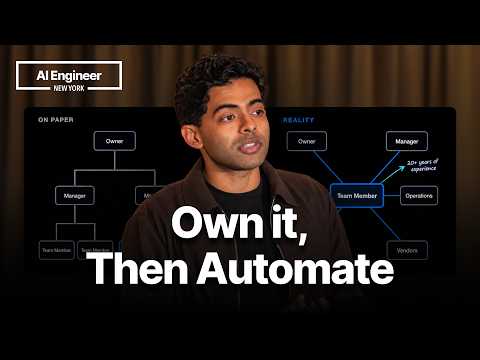
incredibly complex. On paper, your org chart might look something on the left. You know, you have your owner, you have teams, managers, and this is a standard team structure. But, the reality is
organizations are far more nuanced. There are decisions that are entrenched in a web of team members, often times folks with decades of experience. They're interacting with the sales team, the operations team. The owner often times leans on them. And so, building an agent as a third-party vendor is difficult because you actually need to embed into the organization. The second reason I want to touch on is you can't deliver the full value of your deployment if you don't understand the nuances of how a business actually runs. So, a vendor might integrate with your systems of record like a CRM or a ticketing system, or even, you know, document repositories where your SOPs, contracts, or, you know, old email threads live. And this is really valuable source of information, very useful. But, the reality is businesses, especially in complex domains, run on human judgment. It's the exceptions, the edge cases, the tacit knowledge, the, you know, quick questions that get asked to the expert that really matters. And that's really what governs a lot of how a company runs. And that's the operating reality. You need to work with the people doing the work to understand what great work actually looks like. The third reason that I want to highlight is that even if you are able to deliver end-to-end value, it's pretty hard to capture value as an AI vendor. So, let's say you land a seven-figure million-dollar contract, which is pretty impressive. But, how do you think about the enduring business value of that contract? A lot of big questions to answer. Will customers keep renewing? Can you maintain pricing as models improve and as alternatives get cheaper? But, let's say as part of that million-dollar-a-year revenue engagement, your client actually gets a lot of value from it. In fact, maybe $5 million a year in EBITDA impact. And so, what's interesting about this is that with an established business, you have years of operating history, enduring client relationships, and a proven business model with real economics. And so, you're adding earnings to a business with value that you can already reason about. And so, you know, using a, you know, roughly conservative 10x multiple, you can actually generate for your client $50 million in enterprise value, which is really interesting. And so, there's this question here, which is, you know, as a vendor, you did all the work. You've deployed your agents, you went through all the walls of integrating with the systems, working with the team. But, the largest impact actually shows up in the P&L of the business that you actually worked with. And so, these are the typical walls and challenges of deploying AI outside in. So, why not just go build that firm and build that business yourself with AI at its core from day one? This is a very valid strategy, actually. You can improve the whole workflow, not just a narrow slice. You sell the work itself, not just one specific tool. And importantly, you own the outcomes. So, the P&L and the value that you're generating is yours. And many of these firms are going to be amazing. We think this is a great strategy. But, I also want to call out some of the challenges that come up with this approach. The first is you don't start with any customers. It's hard to get distribution. You don't have any minimal you don't have any a brand reputation, so that makes it challenging to to grow. And it's hard to hire expertise especially in you know niche niche industries and important industries where clients might need multiple specialty offerings. So take an example here. If you are the leader of a health system and you're planning a new surgery building, do you hand that project to an AI architecture startup or the firm that you've been working with for 20 years who knows the standards, the nuances of how you actually design your buildings, and you can trust them to deliver the full scope of your project. It's a very different kind of execution model.
And so the important insight here is that the best firms have spent decades earning their customers, building brand and trust, and building an incredible
team to deliver great service to their clients. So instead of being outside in and selling an AI agent to a company or trying to build from scratch, what if you could partner far more closely with incredible businesses that already exist through acquisition? And I want to talk a little bit more about why ownership is such an interesting strategy here. Starting with on the engineering side, which is access. The ability to have your team sit down with the people who do work, understand what they do, build those relationships, understand the key people, the veterans, the folks that have the 20 years of experience is super important to really designing agents that not just solve one workflow or one use case, but really tackle the full automation and service delivery opportunity for the entire business. The second is data. Every business you can think of as really a live environment with real tasks, real edge cases, and real answers on whether or not an agent actually got something right versus not. And this is a huge opportunity to use that information, use that signal to actually improve your agents and models. But importantly, on the operational side, incentive alignment is huge. Ownership solves for this. You only win when your team and your business wins. And there's no separate revenue goals, no distractions from other clients. It creates an incredible amount of alignment that enables you to uncover and solve a lot of the blockers to ultimately get to faster deployment and faster shared goals. Outcomes really matter here. The other piece is trust, which we talked about. And, you know, importantly, rather than coming outside-in or building from scratch, ownership has that trust element baked in from the start. You know, you have the brand that took decades to build with all of the customer relationships. And and naturally plays into this idea of scale. Starting with a large base where you have those customers, you have an expert team that can deliver an incredible service, and the cash flow to continue to invest and compound in growth and new products is very powerful. And the important piece here is these five characteristics aren't just independent benefits. They actually create something far more powerful, which is a compounding advantage where a combination of your agents and your people continue to act in live operations. You can understand how work is done, create real-world data that leads to real outcomes, and that learning all compounds together. And this flywheel is really interesting, and it comes with all the elements of ownership to uh you know, power this flywheel from from day one. And so, what's interesting here is that ownership uh can compound rapidly over time. So, we talked about why ownership is is really interesting. But what markets are ripe for acquisition, especially in the AI era? I want to start with the software economy. This is a global software market. Most of us have spent a lot of our time and careers building in this part. And you know, it's a pretty big market. But what's interesting is that software is always sold tools to people doing the work. If you zoom out a little bit, this is a services economy. It's a 7 trillion 70 trillion global market. And the important insight here is that owning the outcomes of a service end-to-end is far more valuable. And that's what's exciting to us. It's a huge market opportunity. But there's an important observation here, which is under the hood, there's a challenge that services businesses typically face. Labor costs typically grow with revenue. So, uh for example, a community manager at an HOA management company can only run so many associations. An architect can only design so many hospitals or schools. So, if you want more clients, you have to hire more people. And this is the typical challenge of uh a business. And you know, if you compare it to a software company, if you add $100 of revenue in a typical software business, you keep about 80.
So, there's really low marginal cost of growth, which is why these businesses are incredible and you can scale very rapidly. On the contrary, a service business operates very differently.
For every $100 of incremental revenue, you typically have around $80 or so of delivery and overhead. You have to hire, train, manage your team. And so many founders who have built incredible services businesses have really stopped chasing growth, not because they lack ambition and not because there's no market opportunity. These are massive markets. But because the challenges of scaling, when you have to do a lot of the work for every $100, you're only keeping about 20. And so you can think of this as a pretty huge, you know, 80% marginal tax on growth, which makes it very challenging to both come outside in, start these businesses, and even scale them. What's very interesting here is that AI actually reduces the cost of service while also improving the quality of your service. So, look back at our chart here where revenue scales proportionally to labor costs, but when you deploy AI you can see here that you get actually operating leverage. So, your labor cost no longer directly scales with AI. You're still going to need to hire an incredible team of experts to deliver your service to your clients, but the service economics for these businesses start to look a lot more like software. And so, the thesis of acquisition, deep partnership with incredible companies, and leveraging AI to scale these businesses and improve the quality of service is exactly what we're excited about here at Long Lake. So, just quickly a little bit more about us. Long Lake is an applied AI holding company. We partner with incredible businesses, have raised 7 and 1/2 billion in capital from Elad Gil, General Catalyst, Alpha Wave, D1, and many others. We were started about 3 years ago. Our Our whole thesis is to acquire best-in-class services businesses, partner with them to transform their operations, help them grow faster, and ultimately deliver a better client experience.
We've today partnered with 40 businesses across a number of markets, residential services, architecture, HR, and many more. We're an amazing team of 55 team members
across technology, finance, and operations. We're growing. We have an eclectic mix of former founders, folks from the military, Palantir, a lot of familiar names here. And we recently just announced our partnership with Amex GBT. It's a 6.3 billion take private, bringing us into the corporate travel space, which we're incredibly excited about. You know, we're modeled after a lot of the holding companies that have come before us, but with a really interesting observation that AI raises the ceiling for business transformation. And this is the lever of excellence that we're excited to go and pursue. So, we talked about why We talked about services in particular. What services businesses though are actually attractive to own? And I want to start with an important observation, which is as models continue to get better, the price of intelligence is rapidly declining. And it's pretty incredible to see. I think this is only going to continue. So, if intelligence is getting cheap, what remains expensive? We really focus on mission-critical businesses, and it starts with a few key questions that we typically evaluate these companies on. The first is is there a customer base that trust these businesses with real end-to-end outcomes? The second is is there human judgment in the service that's actually being provided? And the third is that are there, you know, regulatory reasons that govern accountability when making these acquisition decisions? And I think the important piece here is you have to own the outcome, and that's the typical characteristic of a lot of these services businesses. So, to color this a bit more, it's not just about drafting a newsletter to a homeowner, but actually handling the end-to-end outcome of an urgent leak. It's not just about extracting data from documents, but actually taking accountability for a complicated tax decision. And, you know, it's not just about helping you book a flight, but handling the last-minute disruptions, which I'm sure many of you have faced before. Businesses like these are rare. You have
to fit all of these questions, and many more, and also have a team that's excited about that partnership. And to do this, you know, you have to see a lot of businesses.
Great investment decisions come with choice. So, you have to keep a big funnel, and then an incredibly tight filter. Our focus is on businesses that have incredible fundamentals from a business and market standpoint, but also have an awesome AI opportunity where we can actually go in and partner very closely with these businesses. We see about 5,000, you know, deals a year, but again, are very focused and diligent on what we actually focus on and who we partner with. Awesome. So, once you've found your business and you've partnered with a company, what does P&L transformation actually look like? And I think a very simple way to explain this is actually through the visual of a J-curve. So, you start with your investment in AI deployment. You have your platform, you build your tech, capture the workflows, commit a lot of team time to making this work. And it's a lot of hard work. You have to make it work within the business. Thinking back to, you know, some of the challenges of building outside-in, you have to partner very closely with their team, iterate, validate your product, potentially train new models, look at all the different unique workflows and data that exist within that business. But once you make it up this hill, you'll start to see folks actually using your product, which is incredibly exciting, and you start to actually unlock a lot of capacity. Time savings, usage is going through the roof. They're producing the same output, fewer hours. But this isn't the the the end of the journey. Importantly, we want to actually capture value and we want to generate real business impact with our partner companies. And so, you actually have to put that capacity to work. Think about incentive alignment, working very closely with our management teams and trusted partners to drive business outcomes, help with growth, improve customer and employee NPS. These are all part of the equation to actually driving impact within these businesses. And once you do all the those things, you get to real P&L impact. Higher revenue per employee,
but importantly, a far better service quality for our clients. And I think what's cool about this is that this isn't just a bespoke playbook that you run one-off for every single business.
If you have the platform and the playbook to do both the AI deployment and the business transformation, this can rapidly compound. You You get to see faster time to deploy agents and a faster time to P&L impact for all the new businesses that you partner with. And we see this at Long Lake across the 40 plus businesses that we've already partnered with today. Of course, it's not just about AI and business transformation. Under the hood, it takes a pretty unique team to actually own, operate, and and transform. So, you have to actually go and and buy these businesses, have an M&A team that can partner with world-class services businesses, work with them very closely to build that relationship, should build that excitement for the future. Then you actually have to go to do the work of building, and this is a lot of hard work. You have to fly out to Minneapolis, fly out to Portland, uh go to London, spend time with the team, and actually build and push the frontier of how agents get deployed. Again, not just for one narrow use case, but really for the entire operation. And then to actually do that deployment, you know, you need an amazing deployment and ops team to actually drive adoption, right? Think about that at that J-curve, right? Don't just stop at capacity and time savings. How do you actually ensure that the work you're doing is driving real business impact for the companies that you work with, and delivering a far better client experience uh for the service that you're providing? So, if you're excited about owning outcomes and partnering with uh incredible services businesses, feel free to reach out. Uh we're excited about this thesis. We think there's a lot of opportunity to go continue to build in the services economy, and uh feel free to chat more if there's any questions. Thank you.