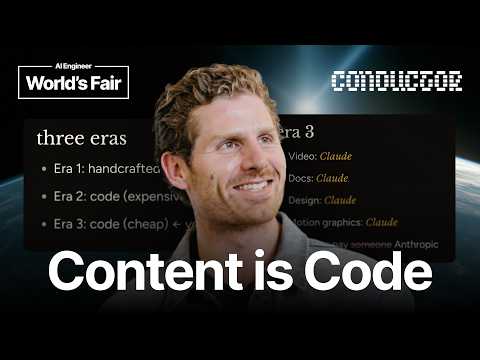
Content Is Code - Matt Palmer, Conductor
A talk by Matt Palmer (Conductor) arguing that code is the fastest medium for producing technical content, and that the key to great developer-focused content is the same as what makes a great developer experience. Speaker bio suggests the talk draws on his DevRel and developer education background in AI devtools.
# Channel Presentation Observations: "Content Is Code - Matt Palmer, Conductor"
## Creator Self-Description (Explicit Claims)
The speaker states his identity and role directly:
> "So, my name is Matt. I was previously a data engineer, then I led DevRel at Replit, and now I lead developer experience at Conductor."
- **Name:** Matt
- **Current role claim:** Leads **developer experience at Conductor**
- **Claimed background:** Data engineering, then DevRel lead at **Replit**
- **Closing sign-off:** "Again, I'm Matt with Conductor. Thanks for sticking around for my talk."
## Intended Audience
- **Developers, DevRel professionals, and content/technical communicators.** Evidence: the talk centers on "a typical DevRel motion" and frames content as "technical communication... communicating what a problem a product really solves."
- **Practitioners building product content assets** (documentation, changelogs, product tours, videos): "It might be documentation, it could be things like change logs, emails, product marketing, it could be video, which I create a lot of."
- **Conference/talk-format audience:** The presentation is delivered as a talk ("the idea I want to present to you today," "Thanks for sticking around for my talk").
## Claimed Scope of Content
- The talk claims a **thesis about industry trends**: "content is shifting left to code as the source of truth."
- It proposes a **three-era framework**: handcrafted content, expensive code ("Serp era"), and cheap code via AI.
- It makes **forward-looking predictions**: "I think 2027 is the year of the content engineer."
## Observable Presentation Patterns (Demonstrated, Not Claimed)
- **Practitioner demonstration:** He shows a working artifact: "In front of me, I have a product tour for Conductor that was built entirely with React and Remotion."
- **Honest self-assessment of work quality:** "It's not perfect. It's a little buggy and the flows aren't quite there yet, if I'm being honest."
- **Personal experience as evidence:** He describes his own tooling shift: "every ancillary asset is React or TypeScript... My background's in data engineering, I come from Python land."
- **Named tools/technologies:** React, Remotion, TypeScript, Claude, Anthropic, OpenAI, Python, CSS, HTML.
- **Casual, conversational delivery** with interjections ("That's wild. That's wild to say." / "Peace.") — consistent with an informal DevRel/video content style.
## Company Affiliation Signals
- The video title and metadata reference **Conductor**, and the speaker repeatedly anchors himself to the company ("I'm Matt with Conductor"), indicating this content is presented in connection with his role there, though the talk's thesis is framed as an industry-wide observation rather than a product pitch.
# Delivery Observation: Matt Palmer — "Content Is Code"
## Tone
- **Conversational and direct**, with a tech-talk cadence: casual connectors like "right?", "you know?", "um", and "So," at the start of sections.
- **Self-aware and mildly self-deprecating** in places:
> "I don't even really know how to write that good of TypeScript, you know?"
> "that is the most insane statement to hear myself say"
- **Confident assertion paired with contrarian framing** when challenging received wisdom:
> "You might think I'm going to say taste here. I'm not going to say taste because everybody says taste."
## Vocabulary & Recurring Phrases
- **"Right?"** as a recurring check-in tag, appearing across many sections ("Era one... So, in the handcrafted era, right?", "a website, right?", "code is communication... it's not just to build software, right?").
- **Repeated core catchphrases:**
- **"code is communication"** / **"content is code"** — stated multiple times, including near the close: "And so, code, again, is communication."
- **"wild"** as an emphasis word: "this was wild", "And that's wild. That's wild to say."
- **Repetition-driven emphasis**, e.g., the "AI rewards..." anaphora:
> "AI rewards conscientiousness. AI rewards organizational excellence. AI rewards structure."
## Teaching Habits
- **Numbered/frameworked structure**: organizes the talk into "three distinct eras" (handcrafted, expensive code, cheap code), then walks through each.
- **Definition-before-example pattern**: poses a rhetorical question, then answers it:
> "Now, what do I mean when I say content? Well, I'm talking mostly about technical communication."
Followed by a list of concrete examples (documentation, change logs, emails, product tours, video overlays).
- **Live demo reference**: "in front of me, I have a product tour for Conductor that was built entirely with React and Remotion" — showing an artifact rather than only describing it.
- **Honest hedging about his own work**:
> "Now, it's not perfect. It's a little buggy and the flows aren't quite there yet, if I'm being honest."
- **Rhetorical questions to advance the argument**: "if code is inexpensive, what is the expensive thing?", "How many organizations do this?"
## Communication Patterns
- **Parallel listing** for enumeration-heavy passages (types of content, structural practices: "Merging really clean PRs... Tagging PRs, PR descriptions, knowing what's a feature and what's a bug fix...").
- **Preview-and-callback structure**: opens with the thesis ("increasingly code is becoming the way that we communicate"), returns to it at the end ("a shift left movement for content, where content is moving to code").
- **Named-industry references** for concreteness: Anthropic, OpenAI, Claude, React, Remotion, TypeScript, Replit.
- **Rhetorical dismissal of common answers** ("everybody says taste") to set up his own claim ("Structure is expensive").
- **Personal-credentials aside** mid-talk for credibility: "my name is Matt. I was previously a data engineer, then I led DevRel at Replit, and now I lead developer experience at Conductor."
## Uncertainty Notes
- The **"right?"** tag and self-corrections ("sta- statement", "what a what problem") suggest spoken/improvised delivery, though repetition of exact phrasing across sections suggests the overall structure was prepared.
- Without audio, tone judgments (e.g., humor in "That's wild to say") are inferred from wording alone; actual delivery emphasis is unverified.
# Content Is Code — Matt Palmer, Conductor
## Speaker
**Matt Palmer** (self-identified in transcript): former data engineer, previously led DevRel at Replit, currently leads developer experience at Conductor.
## Central Thesis
> "Code is becoming the way that we communicate."
Palmer argues content — especially **technical communication** — is **"shifting left to code as the source of truth,"** enabled by AI making code cheap.
## What Counts as "Content"
Palmer defines content broadly as technical communication, not restricted to DevRel:
- Documentation and change logs
- Product marketing, emails, product update summaries
- Video, home page product tours (vs. static screenshots), video overlays
- Entire product surfaces and videos generated via code
He demonstrates a **Conductor product tour built entirely with React and Remotion**, recreating the product surface and walking through a sample user flow — while candidly qualifying: *"It's not perfect. It's a little buggy and the flows aren't quite there yet."*
## The Three Eras
### Era 1 — Handcrafted
- Everything manual; only levers are **time, money, and skill**
- Likely requires hiring experts or agencies (e.g., motion graphics)
### Era 2 — Expensive Code
- Code and cloud mature, but **engineering is the bottleneck** ("Serp era")
- Good websites required front-end engineers; low-code services "weren't any good"
- Content wasn't a priority for engineers, which Palmer says explains why frameworks like **Remotion didn't proliferate** — few "content engineers" existed
### Era 3 — Cheap Code (today, via AI)
- Paying Anthropic/OpenAI instead of humans; videos, docs, websites, motion graphics via Claude
- **Qualification:** not all AI output is good; quality requires engineering mindset and understanding of systems
## Code as Communication
- "The fastest way to build an asset today is through code" — prototypes, videos, websites, slides, images
- Personal observation: his favorite medium is **TypeScript**; every ancillary asset of this talk is React/TypeScript — which he calls "the most insane statement" by his standards of two or three years ago, coming from Python/data engineering
## What's Expensive Now: Structure, Not Taste
Palmer explicitly rejects the common answer:
> "You might think I'm going to say taste here. I'm not going to say taste because everybody says taste. **Structure is expensive.**"
Structure means:
- Structured codebase, consistent brand guidelines, design tokens
- Clean, tagged, well-described PRs; knowing features vs. bug fixes vs. reverts — noting **"I've worked at a number of organizations, none"** do this
- Accurate internal documentation ("even good agents can't solve problems without it")
He frames this as **conscientiousness** — meticulousness and care in matching outcomes to expectations — arguing success is now "less about software engineering skill" or being "the smartest person in the room."
> "AI rewards conscientiousness. AI rewards organizational excellence. AI rewards structure."
Structure is "the difference between AI purple gradient slop and something that looks professional and polished."
## Predictions
- **2026**: the year of the "creative technologist" (in DevRel)
- **2027**: "the year of the content engineer" — declarative, robust content pipelines producing walkthroughs, docs, screenshots, and product updates via code, React, and AI
- Best-communicating teams will instill **discipline and rigor** into software creation, then shift content left into code
# Speaker Attribution Record — "Content Is Code - Matt Palmer, Conductor"
## Speakers
- **Single speaker identified: Matt Palmer** — creator/presenter
- Self-identified role in transcript: previously a **data engineer**, former **DevRel lead at Replit**, current **head of developer experience at Conductor**
- Speaks in first person throughout; introduces himself mid-talk: *"my name is Matt"*
## Roles
| Speaker | Role |
|---|---|
| Matt Palmer | Creator / presenter (talk format) |
- No guests, narrators, or other speakers appear in the transcript.
## Referenced Sources & Third-Party Claims
- **Companies named:** Replit (former employer), Conductor (current employer), Anthropic, OpenAI
- **Products/frameworks named:** Claude (used for videos, documentation, websites, motion graphics per speaker), Remotion (React video framework), React, TypeScript, CSS, HTML, Python
- **Definitions cited:** dictionary definition of *conscientiousness* (no specific dictionary named)
## Promotional Segments
- **Flagged:** The on-screen **Conductor product tour** demo ("built entirely with React and Remotion") serves partly as a demonstration of the speaker's employer's product.
- **Closing identifier:** *"Again, I'm Matt with Conductor"* — company-affiliated sign-off.
## Provenance & Availability Notes
- Talk appears to be a recorded presentation (speaker references "this presentation," slides/assets created by him).
- Speaker acknowledges his demo product tour is **not perfect: "a little buggy and the flows aren't quite there yet."**
- **No curated metadata was supplied**; comment availability, publication date, and cited external links are unknown.
- Speaker makes forward-looking claims ("2026," "2027 is the year of the content engineer") presented as personal opinion, not sourced data.
So, if you've ever created content, you know it could be hard. And what's often most hard is choosing a medium for how you'd like to communicate. Do you write a blog post? Do you create a video? Do
you go out and speak at a conference? And even of these things, you're likely to select something that you're good at or you have experience doing. But the idea I want to present to you today is that increasingly code is becoming the way that we communicate. Now, this might seem obvious in 2026, but I want to point out that even a couple years ago, this was wild because the only people that were writing code to create content were professional software engineers. And often professional software engineers are spending their time doing mostly engineering and are not getting that deep on content. Now, what do I mean when I say content? Well, I'm talking mostly about technical communication. That could be documentation, it could be things like change logs, emails, product marketing, it could be video, which I create a lot of. Um, and it could be other things associated with a typical DevRel motion, but it's not restricted to DevRel, right? Content or technical communication is the act of communicating what a what problem a product really solves. And that can be done by anybody. That might mean really complete, accurate documentation that covers every part of the Deta X this framework. It could be change logs shipped timely um with robust assets that cover all areas of a product. This is something that's often overlooked. This is actually really hard because to have an accurate change log, you have to have an accurate diff of your product. Or you could just have someone that spends a lot of their time combing through PRs to try to figure out what was shipped. It could be things like timely product updates, emails, which kind of follow from a change log, right? If you understand what changed, you can then summarize that over time for your users. It could be something as simple as a home page product tour instead of a static screenshot. These are all ways that we're communicating products, we're communicating what this thing does or how it's changed via either written content free via code via distinct assets. It could also be something like video overlays, right? Something like adding a
bit of engaging material to the content that you create, but increasingly where I think this is headed is entire product surfaces and entire videos generated via
code. And in front of me, I have a product tour for Conductor that was built entirely with React and Remotion. So, basically, I recreated the product surface. I used a Remotion scene to recreate the product and do a full walk-through of a sample user flow. Now, it's not perfect. It's a little buggy and the flows aren't quite there yet, if I'm being honest, but I think we're moving towards a world where this is normal. So, my name is Matt. I was previously a data engineer, then I led DevRel at Replit, and now I lead developer experience at Conductor. And today I want to talk about how content is shifting left to code as the source of truth. And so, I think there are three distinct eras we can think about here. Era one, the handcrafted era of content. Era two, an era where code existed, but it was quite expensive. And era three, where code exists, but it's very cheap. And that's where we are today with AI. So, in the handcrafted era, right? Everything is manual. The only levers we really have are time and money and skill. And so, if I want something, I either need to create it myself, but there are only 24 hours in a day, so likely I'm going to go out and seek an expert, someone that does know how to create this thing. Maybe that's an agency or someone who creates these assets professionally. If I'm thinking
about like motion graphics, for example. Now, post era one, when we had expensive code, code and cloud are mature assets.
These are things that have existed for a while, and most professional software engineers know how to use. Engineering is now the bottleneck. This is like Serp era, everybody's paying a lot for engineers, and to get anything done, you really need professional software engineers. So, you'd better pay someone, maybe not an agency, but an engineer. And that included things like, you know, um robust documentation, or even just a website, right? You Back in the day, it's hard to imagine before AI, you wanted a website, a good website, you needed a front-end engineer, or like a low-code website service, but those weren't any good to begin with. So, you needed a professional engineer to have a really nice website. And what that meant was that content is really not the priority, right? Because if you're a professional engineer, you have better ways of spending your time. And I think this is reflected by um libraries like Remotion, frameworks like Remotion, um not proliferating the way that they are today. Because, really, who has the time and energy to put into these things? There aren't a ton of what I'd call content engineers. Now, in era three, most of these things, you're not paying a human, you're paying Anthropic, or OpenAI, or whoever, right? You can create videos with Claude. You can create documentation with Claude. You can design websites with Claude, and you can create motion graphics with Claude. Now, the problem is that not all of the all of these things are good, right? We'll talk about that later, but if you know what you're doing, if you have an engineering mindset, if you understand the systems, you can create high-quality assets with these systems. And I'm going to talk about how to do that in the rest of this presentation. So, today, code is cheap. And we talk about code as communication.
So, code is communication. The fastest way to build an asset today is through code. And it's not just to build software, right? It's really to build anything. If
I want a prototype a video, a website, slides, um I mean really any asset, any creative thing that I can think of, images, video, the fastest way to do that is going to be through code or code generation. And I was thinking about this presentation, I was thinking about how I was going to create all the assets for this presentation, and I realized that my favorite medium is actually TypeScript. Aside from recording myself talk or writing, every ancillary asset is React or TypeScript. And I just want to take a moment because that is the most insane statement to hear myself say if I was thinking about this two or three years ago, right? I don't even really know how to write that good of TypeScript, you know? My background's in data engineering, I come from Python land. Well, I better learn TypeScript, I better learn React because the best way for me to get these high-fidelity assets is React, TypeScript, CSS, um and HTML. And that's wild. That's wild to say. So, if code is inexpensive, what is the expensive thing? Now, you might think I'm going to say taste here. I'm not going to say taste because everybody says taste. Structure is expensive. This is maybe a bit of a contrarian sta- statement here because the hard thing is maintaining a very structured code base, maintaining brand guidelines and keeping those guidelines consistent, keeping design tokens in your project, separating even front-end code from back-end code from these design tokens. Merging really clean PRs, which like nobody does, right? Tagging PRs, PR descriptions, knowing what's a feature and what's a bug fix, knowing if you reverted a PR. How many organizations do this? I've worked at a number of organizations, none, right? And maintaining accurate internal documentation so that anybody can accomplish anything.
Even if you have really good agents, they're not going to know how to solve these problems if they don't have documentation or skills, right? And so, structure often is the difference between AI purple gradient
slop, right? And something that looks professional and polished. And I would even go a little bit further, and I would say that this is conscientiousness. And the dictionary definition for conscientiousness is the quality of being meticulous, careful, and guided by a strong sense of moral or professional duty. And so, it's less about comp- like software engineering skill today. It's less about the skill of being able to create this these assets, and more about the meticulousness and care given to making sure that an outcome matches your expectations. And that, you know, increasingly with each model generation is not predicated on being the smartest person in the room, or being this the person in the room with the most technical skill. So, what does AI reward? AI rewards conscientiousness. AI rewards organizational excellence. AI rewards structure. And ultimately, these are the things that go into good AI skills. There's a lot of like not very good AI skills out there. Um and most of them are just generated without any regard for what's in their contents or how they're structured. And so, all the assets that I showed you at the beginning of this video are a byproduct of design tokens, structured code, um structured assets. And they get exponentially harder to create when we lack those things.
And so, code, again, is communication. And we're seeing a shift left movement for content, where content is moving to code. And if code, right, is the
source of truth, if our code base is the source of truth, we have to have a structured source of truth in order to create content from code. In order to communicate, we need structure and conscientiousness around the way that we create code. And again, this only works with organizational excellence. And so, I think what we'll see in 2026 and the years beyond is that the highest performing the best communicating teams are the ones that are able to instill discipline and rigor into the process of creating software and then shift their content left towards the code through content engineering. And so, 2026, I think was the year of the creative technologist, at least in the DevRel space. This is the term that got thrown around a lot. I think 2027 is the year of the content engineer. And I'll close on that because I think what we're going to see next year are declarative and robust content pipelines capable of producing content walkthroughs, capable of producing documentation, screenshots, product updates, all of the things that were really manual can now be created through code, through React, and ultimately because of AI. Again, I'm Matt with Conductor. Thanks for sticking around for my talk. I'll catch you next time. Peace.