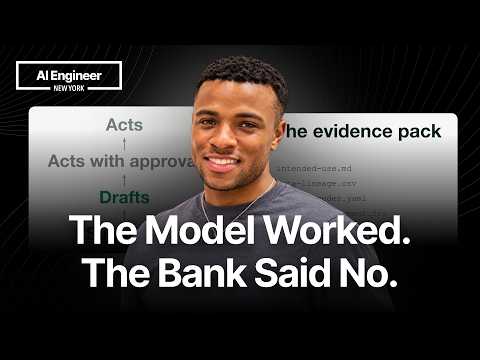
Deploying AI Inside a Bank Is Not an Engineering Problem —…
Using a hypothetical bank document-exception assistant as the example, Paden Gayle (Applied AI Engineers) explains why a working AI demo does not by itself establish a path to production in a regulated environment. The talk covers identifying who owns approval decisions (security, data owners, risk reviewers), locating those decision-makers in the first week of discovery, and defining the smallest useful system control owners can evaluate. Gayle describes a method for customers without complete specifications: shadow the work, draft a concrete workflow, and shrink it with control owners, granting autonomy only the least authority needed. A drafting assistant can gather evidence on errors, overrides, and recovery before being granted further permissions. He outlines an evidence pack covering intended use, data lineage, failure modes, results by segment, and accountable controls, noting that original inputs and outputs must be recorded since reruns cannot reconstruct what happened, and that aggregate performance can hide poorly supported document types requiring explicit restrictions. The talk closes with a first-week deployment checklist converting unresolved approval decisions into named owners and next steps. Presented as a planning aid for AI deployment in banking rather than a claim the example project shipped.
# Channel Presentation Observations — "Deploying AI Inside a Bank Is Not an Engineering Problem"
## Creator Self-Description (Explicit Claims)
- **Name and credentials stated twice** — opening and closing the video:
> "My name is Payeyton Gail." / "My name is Peyton Gail."
- **Career history presented as identity foundation:**
> "I started off at consulting at Accenture. Before moving over to Bloomberg as a software engineer where I worked on a trade infrastructure team and a data platform team. Then afterwards I would be at Google working on security and deployment."
- **Current role claim:**
> "Right now I am a founding FTE at a startup and writing the book on for deploy engineering with O'Reilly."
- **Closing identity restatement** reinforces specialization:
> "I am a founding for deployed engineer writing the book on FTE for O'Reilly... love to talk about FTE and everything related to it. If that's of interest, you can find me on LinkedIn or my website painting.com."
## Intended Audience (Observable)
The presentation addresses **technical practitioners deploying AI in regulated enterprise settings**, evidenced by:
- Direct address to builders: *"I can scope the work," "I rely on these three things — shadow, draft, and shrink."*
- Practical practitioner framing: *"here are some of the questions I would bring to a discovery call"* — including "who signs the relevant risk review and what have they signed before?"
- Audience pain point named explicitly:
> "The demo worked. The model was fine. However, it still did not ship."
## Claimed Scope / Thesis
- **Central thesis (stated in title and reiterated as closing takeaway):** deploying AI in banks is an organizational/discovery problem, not an engineering one.
- **Slogan-level takeaways offered:**
> "Discovery is the engineering. Draft the spec, then shrink it. Give the system only the authority it needs. Build the evidence pack in sprint one."
- **Scope claim:** the presenter claims a generalizable method — *"Carry that into each bank deployment. Honestly, any deployment."*
- Topic coverage observable in the talk: discovery, ownership mapping, scoping, autonomy ladders, evaluation/evidence packs, and a week-one readiness heuristic.
## Demonstrated Presentation Patterns
- **Slide-driven talk format** with references to slides ("the or chart," "read the ladder from bottom up," "four labels represent decisions").
- **Recurring hypothetical case study** — a document exception assistant used throughout as the worked example.
- **Personal anecdotes as authority evidence**, citing Bloomberg (cash-flow reconciliation, data platform) and Google (security/deployment) experience.
- **Single-presenter educational format** with a direct sign-off and contact information, consistent with conference-style talk distribution.
## Boundaries of Evidence
- This is one video; channel-wide conclusions are not drawn.
- The "founding FTE / O'Reilly book author" claims are creator statements, not independently verified here.
- Note: the transcript's spelling of the name varies ("Payeyton Gail," "Peyton Gail," "Peyton Gail") and the website ("painting.com") may be a transcription artifact — treat verbatim quotes cautiously.
# Delivery Observation Report
**Video:** *Deploying AI Inside a Bank Is Not an Engineering Problem — Paden Gayle, Applied AI Engineers*
---
## 1. Overall Tone
- **Direct, instructional, practitioner-to-practitioner.** The speaker speaks as someone sharing a working method, not theorizing: *"I want to now show you how to uncover those decisions in week one so you can design a system with a credible route into production."*
- **Calm and procedural.** Steps are enumerated deliberately: *"So, let's start with data… For the model risk… For third party risk… For audit…"*
- **Slightly conversational markers** appear ("okay," "right?"), e.g. *"Those are reasonable questions, right?"* — suggesting an audience-engagement habit.
## 2. Vocabulary and Signature Phrases
- **"Discovery is the engineering"** — used at least twice, clearly a thesis phrase:
> "And here discovery is the engineering."
> "what I want people to walk away with is that discovery is the engineering."
- **A recurring narrative hook:**
> "The demo worked. The model was fine. It still did not ship."
This exact framing appears early and again in the closing, functioning as a bookend.
- **Decision-and-ownership vocabulary dominates:** *owner, owns, decision, approval, reviewer, evidence, controls, boundary, credible path.* Examples: *"every data set has an owner,"* *"scope becomes a series of approval questions,"* *"a credible path of approval."*
- **Concrete artifact language:** *"evidence pack," "success criteria," "shadow, draft, and shrink," "the smallest useful version."*
## 3. Teaching Habits
- **Personal anecdote as grounding.** Bloomberg, Accenture, and Google experiences are repeatedly invoked as evidence, with one Bloomberg story (cash-flow system) told nearly verbatim twice:
> "For example, at Bloomberg, I worked on a system that handled cash flows. That work had to reconcile. That gave me a concrete place to start."
- **Rule-then-example-then-action structure.** Each principle is followed by imperative instructions: *"Find the person accountable for each source. Confirm the allowed use…"* / *"Sit with an analyst, watch which systems they open…"*
- **Enumerated checklists and ladders.** The "week one" five questions, the four-step autonomy ladder (*"Suggest… Draft… Acts with approval… Acts"*), the five evidence-pack files, and a scoring rubric (*"Four or five yeses… Three means… Zero to two means…"*).
- **Repeated hypothetical running example.** The "exception assistant" / document workflow is reused across multiple sections (*"going back to our lovely example, the hypothetical exception assistant"*), giving the talk a spiral structure.
- **Direct address and anticipated audience questions:**
> "given that you may start to ask yourself, okay, Peyton, what sort of question should I be asking?"
- **"By Friday" as a concrete time anchor:** *"By Friday, the people whose decisions the deployment depends on should know the project exists."*
## 4. Communication Patterns
- **Question cascades** as a rhetorical device — strings of questions model what the audience should ask: *"Who owns that action? What happens if it sends something wrong? And how do we stop it and recover it?"*
- **Contrast framing** between technical and organizational views: *"You can probably sketch that system in a few minutes. Now read the row underneath it…"*
- **Summary-and-handoff transitions:** *"So now let's grow our hypothetical system one step at a time," "That brings me to autonomy," "That brings us to our fourth promise."*
- **Named-outputs habit:** each section ends with a deliverable the listener can produce (a question list, a draft spec, an evidence pack, a score).
## 5. Stability Assessment
- **High confidence (repeated, verbatim-supported):** the "discovery is the engineering" thesis; the demo-worked-didn't-ship hook; ownership/decision vocabulary; imperative instruction style; hypothetical running example; personal-anecdote grounding.
- **Lower confidence (thin evidence):** the casual filler ("okay," "right?", "you know") appears often enough to note but the transcript contains transcription artifacts and near-duplicated passages (e.g., the repeated Bloomberg cash-flow lines), so some repetition may reflect the source text rather than deliberate delivery style. The duplicated Bloomberg passage in particular is ambiguous — it could be a rehearsal habit, an emphasis technique, or a transcript error.
## 6. Observable Limitations
- No metadata beyond title/transcript was available, so pacing, slide interaction, and nonverbal delivery could not be assessed.
# Positions & Reasoning Record
**Video:** Deploying AI Inside a Bank Is Not an Engineering Problem
**Speaker:** Paden Gayle (self-described: ex-Accenture consultant, ex-Bloomberg software engineer, ex-Google security/deployment, founding FTE at a startup, writing a book on deploy engineering with O'Reilly)
---
## Central Thesis
> "The demo worked. The model was fine. However, it still did not ship."
Gayle argues that AI deployment in a bank fails not for technical reasons but because unresolved organizational decisions — data ownership, risk review, audit, third-party dependencies — block production. His refrain: **"discovery is the engineering."**
---
## Claim-by-Claim Record
### 1. Failure scenario: the shipped demo that didn't ship
- **Position:** A system reviewing client documents and drafting exceptions can demo successfully and still fail to deploy because security, data owners, and risk raise questions ("which environment will host it?", "who agreed to this use of documents?", "who reviews a wrong exception?").
- **Reasoning:** Each question can change what may be built; a team invests in a design while decision-owners have never seen it.
### 2. Four decision areas to map in week one
Gayle says each deployment depends on four labels, each requiring a **person who can explain the decision, evidence they need, and a next step**:
- **Data:** who owns the source, grants access, approves the use; "being able to query a data set does not settle every question about how the application may use it."
- **Model risk:** who can say which review applies; ask what prior submissions looked like; who owns the system post-launch.
- **Third-party risk:** draw the actual dependency chain (model provider, host, your role in operating the service); find which relationships are already reviewed.
- **Audit:** what's needed to reconstruct a consequential action — input, configuration, reviewer view, approval. Records must be captured "from the beginning."
### 3. Every data set has an owner
- **Position:** Before designing retrieval, find the person accountable for each source; confirm allowed use and environment.
- **Evidence cited:** His Bloomberg data platform work building LLM infrastructure required knowing which data sets could be used and who could approve.
- **Qualification:** "If those answers change, your design changes with them." Also generalized beyond banks: "Honestly, any deployment."
### 4. Make dependencies visible via an ownership diagram
- **Position:** Sketch the top-row workflow (documents → model → analyst review) in minutes, then the ownership row underneath. Any unnamed owner (the "question mark") is a **dependency**.
- **Method:** Walk the diagram with a sponsor, name owners, confirm answers directly with those people, turn unnamed owners into specific tasks.
### 5. Discovery-call questions and Friday deliverables
- Questions include: where data lives and who approves reading; who stopped similar projects; which controls cover the workflow; who signs the risk review; what obligation the sponsor personally worries about.
- **Success output:** "It's either names, decisions, or next conversations."
- **Concrete step:** Close the loop — by Friday, "the people whose decisions the deployment depends on should know the project exists."
### 6. "Shadow, draft, shrink" scoping method
Used when the customer cannot write the spec:
- **Shadow:** follow the actual workflow (e.g., sit with an onboarding analyst, record the sequence — "that is the beginning of your specification").
- **Draft:** propose minimal lines (review documents / draft exceptions / analyst submits), make each specific (document access, model output form, checker and submitter).
- **Shrink:** first version = highlighted exception + draft form, analyst checks, edits, submits — "that is the boundary someone can correct."
- **Qualification:** "It is a proposal until we have an agreement." Proposed success criteria: less review time with no increase in mistakes — still needs measurement agreement.
### 7. Incremental growth through four scopes
1. Summarize a document the analyst already has (confirm access covers use).
2. Read from a second system (new data path needing approval).
3. Draft a customer-visible response (who checks content).
4. Send automatically (who owns the action; failure and recovery).
- **Reasoning:** Reviews depend on institution and use case; start with the increment creating value today — "build the smallest useful version or the MVP with a credible path of approval."
### 8. Autonomy ladder: start at lowest authority
Ladder read bottom-up: **Suggest → Draft → Acts with approval → Acts.**
- **Position:** "I start with the least authority that the problem [allows], then ask what task can be proven as evidence to give the system more."
- **Evidence cited:** Bloomberg cash-flow work: "every automated step needs a control and somebody owns a number."
- **Caveats:** Each rung changes error consequences, required controls, and reviewers to convince; "a model does not become more capable by itself."
### 9. Applied to the hypothetical exception assistant
- Original request (agent reads, decides, files automatically) lets the model's judgment become an operational action unchecked. Reframed: **model → human → submit.**
- **Important qualifications he volunteers:** "Human review does not guarantee approval and it does not determine a regulatory category on its own." Use must still be confirmed with reviewers.
### 10. Evaluation as evidence (from Google experience)
- **Position:** Answer concretely: what happens when the system breaks, who notices, who stops it, who's responsible, recovery time. Need intended use, threat model, failure modes, response plan.
- Per-failure: name detection path, fallback, and owner (e.g., invented exception → analyst rejects; unreadable extraction → stop and request clean file; missed exceptions → targeted offline cases, keeping affected work under manual review, with the noted limit that offline cases "do not detect every live miss").
- **Evidence pack (five files):** intended use; data lineage; failure modes; results by segment (lead with weakest result — "an average can hide a serious gap"); controls (reviews, thresholds, stopping rules, owners).
- **Preservation principle:** "Calling the model again later may produce a different answer. So we preserve what actually happened" — prompts, model version, configuration, output, reviewer action.
### 11. Friday checklist as planning heuristic
Five yes/no answers (data owner engaged; environment/admins named; sponsor can describe workflow "without saying AI"; smallest scope fits existing controls; risk signer known and what happened to the last signer).
- **His own qualification:** "This score does not predict approval, but it does tell us where to spend the next week."
- 4–5 yes → credible path to ship.
- 3 → unresolved decisions need owners and dates.
- 0–2 → resolve before committing, possibly shrinking or redefining scope.
---
## Takeaway Positions (as stated by Gayle)
> "Discovery is the engineering. Draft the spec, then shrink it. Give the system only the authority it needs. Build the evidence pack in sprint one."
**Closing move:** "So what do we do? We go find the people."
---
## Unresolved Tensions Preserved
- Success criteria are proposed but not agreed: measuring "less review time" against the current workflow is acknowledged as still open.
- Human review is necessary but explicitly not sufficient for regulatory approval — an unresolved dependency on institutional reviewers throughout.
- Discovery score indicates direction, not approval; approval remains outside the speaker's claims.
# Video Attribution Record
## Video Metadata
- **Title:** *Deploying AI Inside a Bank Is Not an Engineering Problem — Paden Gayle, Applied AI Engineers*
- **Video ID:** `01a15ca6-71b9-7600-a6a9-e9815bfc3e8b`
## Speakers & Roles
| Speaker | Role | Notes |
|---|---|---|
| **Paden Gayle** (transcript also renders the name as "Payeyton Gail" / "Peyton Gail") | **Creator / presenter / narrator** — sole speaker throughout | Introduced himself and closed the talk; the title identifies him as an Applied AI Engineer |
The speaker's stated professional background (self-reported in transcript):
- Started in **consulting at Accenture**
- **Software engineer at Bloomberg** (trade infrastructure team; data platform team)
- **Google**, working on security and deployment
- Currently a **founding FTE at a startup** (startup not named)
- Writing a **book for O'Reilly** on "deploy engineering" / "FTE" (transcript is inconsistent on the exact term used)
## Cited Personal Sources
Claims grounded in the speaker's own experience — no external sources, studies, or documents are cited:
- **Bloomberg data platform team:** stated basis for the claim that "every data set has an owner" and for LLM infrastructure work regarding dataset use approvals
- **Bloomberg cash-flow system:** used as an example of reconciliation work and automation controls
- **Google:** stated source of his approach to evaluating systems (break/failure response questions)
## Third-Party Claims
- None identified. All examples involving banks, data owners, risk reviewers, and the "exception assistant" are explicitly labeled by the speaker as **hypothetical**.
## Promotional Segments — FLAGGED
- **Book promotion:** repeated references to his forthcoming O'Reilly book on deploy engineering
- **Self-promotion (closing segment):** directs viewers to his **LinkedIn** and **website "painting.com"** (transcript spelling; likely a transcription artifact) for contact information
## Availability & Access Limits
- No curated metadata was supplied beyond title.
- No information about comments availability, slides, or linked resources appears in the transcript.
- Speaker identity, roles, and employer history derive solely from the transcript and title; name spelling is inconsistent and unverified.
## Provenance Summary
- **Single-voice presentation** — all claims attributable to Paden Gayle.
- Evidence base is the speaker's **personal professional experience** at three named companies plus hypothetical worked examples.
- No verifiable external citations; employers and book deal are self-reported and could not be corroborated from the supplied material.
Hello and welcome. Today we will be talking about deploying AI inside of a bank and how it is not an engineering problem. Before we get into that, I want to introduce myself. My name is Payeyton Gail. I worked across many different
fields. So I started off at consulting at Accenture. Before moving over to Bloomberg as a software engineer where I worked on a trade infrastructure team and a data platform team. Then afterwards I would be at Google working on security and deployment. And right now I am a founding FTE at a startup and writing the book on for deploy engineering with O'Reilly. In this example, the system reviews client documents and drafts exceptions for an analyst. The demo shows the intended workflow and everybody can see why it would be useful. Then security asks, okay, which environment will host it? The data owners ask who agreed to this use of documents and someone from risk asked who will review a wrong exception before it reaches the next system. Those are reasonable questions, right? Each question can change what we are allowed to build. The team has already invested a design while several people responsible for that design have never seen it. So in this case, the demo worked. The model was fine. However, it still did not ship. I want to now show you how to uncover those decisions in week one so you can design a system with a credible route into production. These four labels represent decisions your deployments depend on. For each one, I want a person who can explain the decision, the evidence they need, and the next step. So, let's start with data. Data, who owns the source, who can grant access, who can approve using this in the workflow. Those responsibilities may belong to different people, but being able to query a data set does not settle every question about how the application may use it. For the model
risk, find a person who can tell you which review applies to the intended use. Ask what a previous submission looked like. Learn who will own the system after launch and what evidence that owner will need to maintain it. For
third party risk, draw the actual dependency chain. Include the model provider, the host arrangements, and your role in the operating service. Find out which relationships have already been reviewed and which proposed changes require another decision. For audit, ask someone, right? For audit, ask what someone would need to reconstruct a consequential action. Which input was used? Which configuration produced the output? What did the reviewer see? And who approved the action? Those are the questions that affect the records you need to capture from from the beginning. Now imagine getting those answers after you built the whole entire system, a deployment boundary, a data path or action that may have to change. The useful move is to bring these people in and bring them into the design early. Their responsibilities help us identify the system we can actually operate. And here discovery is the engineering. So now we want to talk about what discovery is and who we need to really find out to understand what exactly we need to build. So you want to think every data set has an owner. The work I did at Bloomberg on the data platform team made this concrete for me. So building infrastructure for for an LLM meant understanding which data sets could be used and who could approve that use. The idea we want to get across is that every data set has an owner. My work at Bloomberg on the data platform team made this concrete for me. Building an infrastructure for an LLM meant understanding which data sets can be used and who could approve that use. Carry that into each bank deployment. Honestly, any deployment. So before designing retrieval, find the person accountable for each source. Confirm the allowed use and the environment where the processing can actually start to happen. If those answers change, your design changes with them. Imagine the key on this slide stands for a real permission with a real owner. We should be able to name that owner to know where exactly this key needs to come from. When starting to scope out an architecture, a lot of the questions you may have can be answered by looking at the or chart. Read the top row first. Documents go into the model and an analyst reviews the output. You can probably sketch that system in a few minutes. Now read the row underneath it. The documents have a data owner. The model service needs a platform owner. The analyst workflow needs someone who can confirm the relevant risk requirements. And the last name still has a question mark. That question mark is a dependency. We have designed a workflow without finding the person who can tell us whether its intended use is acceptable and what evidence will be required. So I would walk through this diagram with a sponsor or someone you trust and figure out, okay, who owns the documents? Have they heard about this use? Who can help us reach the appropriate reviewer? Then I would confirm the answers directly with those people. The real map will have more relationships than this. A technical component may depend on several approvals. Some decisions span the entire system. The point is to make those dependencies visible while the design is still easy to change. An unnamed owner becomes a specific task with a person responsible for resolving it. That is how discovery starts turning uncertainty into an implementation plan. And given that you may start to ask yourself, okay, Peyton, what sort of question should I be asking? So here are some of the questions I would bring to a discovery call. Where does the data live and who can approve reading it? Who has stopped it in a similar project before and why? Which existing controls could cover this workflow and who owns them? Where will this production run and who are the administrators for that environment? Who signs the relevant risk review and what have they signed before? What obligation is the sponsor personally worried about and who can explain it? Notice what I want to leave with. It's either names, decisions, or next conversations. If someone says security will be fine, ask will actually review the design and when you can meet them. Then close the loop. Send each owner a short description of the proposed use and confirm what they need from you. By Friday, the people whose decisions the deployment depends on should know the project exists. That gives scoping a much firmer starting point. And once all that is done and we
know who owns the decisions, I can scope the work. When the customer cannot write or give out the spec, I rely on these three things. Shadow, draft, and shrink.
For example, at Bloomberg, I worked on a system that handled cash flows. That work had to reconcile. That gave me a concrete place to start. So, it started with following. For example, at Bloomberg, I worked on a system that handled cash flows. The work had to reconcile and that gave me a concrete place to start. Follow the flow and the people responsible for it. I use that approach when a sponsor wants AI for onboarding. Sit with an analyst, watch which systems they open, where they make a judgment, and when they ask for permission, ask what happens when a document is missing. Write down the actual sequence. That is the beginning of your specification. Now, imagine we are building the document exception assistant. This is a hypothetical example, but I would still put these three lines in front of the sponsor. One, review the documents. Two, draft the exceptions. And three, analyst submits. Then I would make each line specific. Which documents can the analyst access? Is it access approved for this processing? What should the model produce? And that'll be a highlighted passage, a draft form or both. And who checks the draft? And also who submits it? For first version, suppose the output is a highlighted exception and a draft form. The analyst checks the source, edits the form and submits. That is the boundary someone can correct. I would also propose a success criteria. So either less review time with no increases and misconceptions. We still need to agree on how to measure that against the current workflow because that again right is the whole point. It is a proposal until we have an agreement. Take the draft to the sponsor and the control owners. They can cross out a document type. They can change the reviewer or they could just, you know, flat out reject the output. Each correction gives a decision we can build around. So once the workflow is complete, scope becomes a series of approval questions. So now let's grow our hypothetical system one step at a time. First, it summarizes a document that the analyst already has. We will still confirm whether that existing access covers its use. Next, it reads from a second system. Now, there's another data path and somebody needs to approve it. Next, after that, it drafts a response that a customer will see. Who checks the content and which will review the applies that we can use. Finally, it sends a response automatically. Who owns that action? What happens if it sends something wrong? And how do we stop it and recover it? Those are the four different engineering scopes. The applicable reviews depend on the institution and the use case. So I would confirm them with people who own those decisions. Then I ask which increment creates the useful value today. Could I draft inside the analyst's current workflow to solve enough of the problem? If so, start there. Confirm that the existing control really fits and build the smallest useful version or the MVP with a credible path of approval. That brings me to autonomy. I start with the least authority that the problem
solved then ask what task can be proven as evidence to give the system more. So when working on cash flows at Bloomberg I thought about automation a lot of the time. So every automated step needs a
control and somebody owns a number. I carry that discipline into AI. So find the consequential action name its owner decide what happens when the system is wrong. So for example in a hypothetical exception workflow the submission is that action. An analyst reviewing the draft needs the source evidence and visible uncertainty to make a real judgment. A review button only helps if the person can actually check the work. So when thinking about autonomy, I want you to read the ladder from bottom up. Suggest means the analyst receives a recommendation and chooses what to do with it. Draft means the system prepares something the analyst checks and submits. That is a highlighted step. Acts with approval means a person authorizes each action before it happens. Acts means the system operates within limits that have already been approved. Each step changes the consequences of an error. However, it also changes which controls must work and which reviewer needs to be convinced. I would start at the lowest step that creates value. Then collect evidence from there. Are the reviews overriding the drafts? Which failures keep recurring? Can people recover when something breaks? Use those observations to make the next authority decision. A model does not become more capable by itself. Answer how much authority this
particular workflow should give it. So now let's make that concrete with the same hypothetical exception assistant. Suppose the initial request is an agent that reads client documents, decides
which ones fall outside of policy, and files exceptions automatically. In that design, the model's judgment can become an operational action without an analyst checking each case. Now keep the model and change the action boundary. It highlights a likely exception, points to the relevant source, and prepares a draft form. The analyst checks the evidence, corrects the form, and chooses whether to submit. Follow that sequence on the slide. Model, human, submit. I'll take that design to the people we found during discovery. Can this use the analyst existing workflow? Does the approved data access cover the processing? Which controls apply? And what evidence do the reviewers need? Human review does not guarantee approval and it does not determine a regulatory category on its own. We still have to confirm the intended use and the required reviews. The useful question is whether this drafting version solves enough of the problems to ship first. If it does, we can collect evidence about errors, overrides, and recovery while operating within that boundary. The next decision about authority can draw on what happened in real use. That makes the evaluation part of the operating plan. And that brings us to our fourth promise. An evaluation the risk team can use for evidence, which really just means the ones they're responsible for managing. At Google, the question I needed answered was what happens when the system breaks, who notices, what stops, who takes responsibility, how long will it take to bring back up. For an AI deployment, I want the same concrete account, right? The intended use, a threat model, the failure modes, and a response plan. Show me the controls working when the model gets something wrong. Name the person who receives the alert and can stop the workflow. That gives a practical way to evaluate our example. So going back to our lovely example, the hypothetical exception assistant. If it invents an exception, the analyst checks the source passage and rejects the draft. If extraction produces unreadable text, stop and request a clean file. If it misses exceptions, targeted offline cases help expose that weakness. They do not detect every live miss. Keep affected work under manual review. For each failure, name the detection path, the fallback, and its owner. Put those decisions in an evidence pack. These five files make the review complete. Intended use, record users, boundaries and prohibited actions. Data lineage,
records, each example source and use approval, failure modes, records detection and fallback, results by segment, record coverage and errors controls, record reviews, thresholds,
stopping rules and owners. So with all of this, we generate the evidence with each evaluation run. alongside it preserve the input prompts model version configuration output reviewer action that lets us reconstruct the historical decision. Calling the model again later may produce a different answer. So we preserve what actually happened. A reviewer can then expect that supporting record. So now we can take a look to see like what exactly is being used to organize that result which is in the fourth file. For a hypothetical workflow, I would separate clean documents, scans, rare exceptions, and new document types. Measure the errors and control behaviors in each group, then lead with the weakest result. An average can hide a serious gap in one segment. If a group has a little evidence, say so and restrict that use until you have enough. This tells reviewers what the results support. And it also brings us back to our week one decisions. Now, just rounding everything up by Friday, I want
five answers. Is the data owner engaged and aware of this project? Are the production environment and its administrators named? Can the sponsor describe the workflow without saying AI?
Can the smallest useful scope fit existing controls confirmed with their owners? Do we know the risk signer and what happened to the person that signed last time? Use those answers as a planning heristic. Four or five yeses suggest a credible path to ship. Three means unresolved decisions need owners and dates. Zero to two means resolve this decisions before committing to delivery, including possibly shrinking scope or even redefining scope. This score does not predict approval, but it does tell us where to spend the next week. And here is what I would carry into these next conversations. So to wrap this up, what I want people to walk away with is that discovery is the engineering. Draft the spec, then shrink it. Give the system only the authority it needs. Build the evidence pack in sprint one. The demo worked. The model was fine. It still did not ship. So what do we do? We go find the people. Thank you for going through this presentation with me. My name is Peyton Gail. I am a founding for deployed engineer writing the book on FTE for O'Reilly. And yeah, love to talk about FTE and everything related to it. If that's of interest, you can find me on LinkedIn or my website painting.com has all of my information. Thank you again for watching today and yeah looking forward to