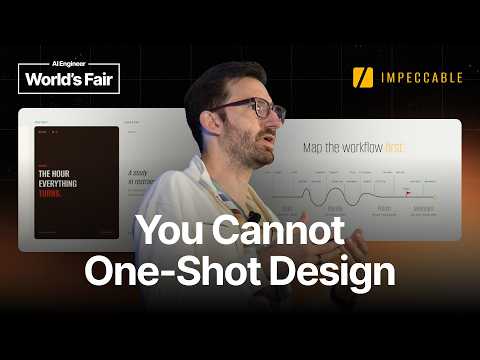
Design at the Speed of Adjectives — Paul Bakaus,…
Paul Bakaus presents "Design at the Speed of Adjectives," a talk on his design skill Impeccable, which works with AI coding harnesses like Claude Code, Copilot, Cursor, and Codex. He demonstrates running the same prompt on the same page with and without the skill, discusses how the "tells" of AI-generated design have shifted from purple gradients to a uniform "Claude beige" aesthetic, and argues that design cannot be achieved in one shot because it is context-rich and iterative. Instead of automating design decisions, Impeccable provides steering vocabulary (bolder, quieter, distill, polish, denser, harden) with project-specific meanings, maps injection points along the design workflow from shaping to hardening and design debt cleanup, and deliberately omits an automatic mode to keep humans in control of taste and intent.
# Video Identity Observation — "Design at the Speed of Adjectives"
## Video Overview
A conference-style talk by **Paul Bakaus** of **Renaissance Geek, Inc.**, presenting his design philosophy and tooling approach around **Impeccable**, a "design skill" for AI coding agents. The speaker explicitly frames the talk scope: *"this talk is really about… my approach to how to building this tool as opposed to the tool itself."*
## Explicit Self-Description
### Creator & Affiliation
- Speaker introduces himself: *"my name is Paul"* — attributed in the title to **Paul Bakaus, Renaissance Geek, Inc.**
- Claims substantial experience: *"I've built tools for more than 20 years. I guess I'm dating myself here."*
### Product Self-Description (Creator Claims)
- **Impeccable** is described as *"a design skill that turns your coding harness into a better designer and hopefully you into a better designer."*
- Cross-tool compatibility claim: *"It works across all harnesses, cloth code, github, copilot, cursor, codex, etc."*
- The speaker is the tool's creator/decision-maker — evidenced by *"a pull request standing out right now that I'm going to close because of that"* and *"I've been trying to build over the last couple months is a tool…"*
- Side project mention: a shader library, **"radiant shaders."**
### Explicit Scope Boundaries the Creator Sets
- The tool is **not** for automated one-shot design: *"It's never going to be a tool to oneshot design. That's not the intent."* and *"There is no auto and there will be no auto."*
- Explicit philosophy: *"I'm not trying to solve taste with my tools"*; *"taste… can be amplified… I call this amplified craft… I really do not think it can be lab grown."*
## Intended Audience
The talk is addressed to an audience that is:
- **Technically fluent in AI coding tools** — references to Claude Code, Cursor, Codex, Copilot, GPT, "pull requests," and agentic workflows are made without explanation.
- **Practitioners at the design/engineering intersection** — the core premise: *"the role of the engineer and the design are blurring… more people become design engineers than ever."*
- **Present live at an event** — *"Welcome everyone. Thanks for coming"* and *"I think I have time for a few questions"*; also a mid-conference slot: *"I'm going to try to save you from the midday slump"* and a nod to *"some of the next speakers."*
- Includes **existing users of the tool**: *"a lot of people install impeccable try it out uh and then they ask me…"* — implying an active user community the speaker engages with (also *"at least once a week somebody tweets at me"*).
## Claimed Channel Scope (Observable Evidence)
This video demonstrates a channel presence covering:
- **Tool-building methodology** — mapping workflows before building: *"whenever I build a tool, I actually map the workflow first… what is the actual workflow of the target user."*
- **Opinionated design philosophy / "hot takes"** — self-labeled: *"here's my first hot take of today's session. You cannot oneshot design"*; coined terms like **"claude beige"**, **"algorithmic unilo[s]"**, **"amplified craft"**, **"AI slop."**
- **Community-driven iteration on products** — *"I test them with the community and once it sticks… there are more people who are getting joy out of this."*
- **Live technical demonstration** — a before/after demo of Impeccable commands (*"make it bolder"*, "quieter," "distill," "harden," "polish," "overdrive") shown on screen.
## Claims vs. Demonstrated Patterns — Distinction
| Creator Claim | Demonstrated Evidence |
|---|---|
| Impeccable improves AI design output | Side-by-side comparison shown (*"same exact prompt without impeccable"*); effect judged subjectively by speaker — *"you be the judge"* |
| Adjectives steer agents precisely | Quoted internal skill text: *"show someone your work and say AI make this bolder… if they believe you you failed"* |
| Blurring design/engineering roles | Cited secondhand user feedback: *"impeccable gives me this shared language of design"* |
## Private Motivation Note
No private motivations beyond directly stated positions were inferred. The speaker's stated intent — finding *"the right level of control for design"* — is his own closing summary: *"this was about finding the right level of control for design."*
# Delivery Observations — Paul Bakaus, "Design at the Speed of Adjectives"
## Tone & Register
- **Conversational, informal talk style** with frequent filler words throughout: "Uh, let's get this going," "Um, okay," "So, you know, it's it's a it's a it's an okay website."
- **Light humor and self-deprecation**, especially at the opening: "I'm going to try to save you from the midday slump" and "I guess I'm dating myself here."
- **Opinionated but hedged**: strong claims are softened with qualifiers — "That's my opinion," "maybe not ever," "you be the judge."
## Recurring Phrases & Verbal Habits
- **"So" as a pivot word** — begins many new thoughts: "So this talk," "So, uh, this is something," "So sometimes I come up with these commands."
- **Repeated "uh/um" fillers and mid-word restarts**: "it's a design, it's a design skill"; "I've been trying to build over the last couple months is a tool."
- **"Right?" as a check-in with the audience**: "manipulating margins, paddings, whatever it is… or the design. Now that's fine… right?"
- **Self-corrections mid-sentence**, e.g., "sorry I think taste can be amplified" after misspeaking "taste cannot be amplified."
## Teaching & Argumentation Habits
- **Demo-first cold open**: shows a live before/after comparison before explaining the concept ("let's compare it to — this is exactly the same project… without impeccable").
- **Labels coined and repeated**: introduces named terms — "claude beige," "algorithmic unilo [sic, likely uni-slop]" — and reuses them.
- **"Hot takes" explicitly flagged**: "Now here's my first hot take of today's session. You cannot oneshot design."
- **Repeated core thesis**: the phrase "oneshot design" or "oneshotted" recurs at least four times, reinforcing the central argument.
- **Analogies to human practice**: "You can't go to a human design studio… go to a design director and say like you know what I want to design for my brand and a design director nods… That doesn't make any sense."
- **Attribution to others when borrowing ideas**: "an adjective is a light wart… such a German term and Matt Puk actually talked about this… this is uh stolen by one of his tweets."
- **Audience-interactive moments**: "but you be the judge of," "I don't know about you, but…"
## Structure & Communication Patterns
- **Announces scope explicitly**: "this talk is really about uh my approach to how to building this tool as opposed to the tool itself."
- **Walks through a workflow map**: "I actually map the workflow first… you start with initialization… crafting to iterating… harden and polish phase."
- **Concrete example verbs to anchor concepts**: "make this bolder, make this quieter, uh distill this… polish this, um make it denser or harden this."
- **Quotes his own product's instructions as evidence**: "show someone your work and say AI made this bolder — if they believe you, you failed."
## Uncertainty Notes
- Filler density and the "So" pivot habit are stable across the transcript; the German-term moment ("light wart") is a single occurrence, so no pattern can be claimed beyond it.
- Audience reactions are largely inaudible; tone observations about audience rapport (e.g., laughter) are not directly verifiable from this transcript.
# Observation Document: "Design at the Speed of Adjectives" — Paul Bakaus, Renaissance Geek, Inc.
## Speaker
- **Paul Bakaus** (self-identified: "my name is Paul"), building **Impeccable**, a design skill for coding harnesses.
## What Impeccable Is
- A **design skill** that turns your coding harness (Claude Code, GitHub Copilot, Cursor, Codex, etc.) into a better designer.
- Paul states the talk is about his **approach to building the tool**, not the tool itself.
## Demonstrations
- Showed a basic website, then ran "make the workflow section bolder" with Impeccable installed. He acknowledged **imperfections**: section numbers are "a very typical AI slop tail" that "GPT loves to do and Claude actually loves to do as well."
- Compared with the same prompt on **GPT-5.5 on extra high without Impeccable**: "there is a slight difference I would say, but you be the judge."
- Showed an event-horizon shader (from his "radiant shaders" library) built with the **"overdrive"** command — a command he wasn't sure about shipping ("half of a joke"), but the community loved it.
## Core Claims & Reasoning
### The role of engineer and designer is blurring
- "I've seen more people become design engineers than ever."
- The typical waterfall handoff (PM → design → critique → engineer) "is just not real anymore" and "is starting to collapse very quickly in small and large companies."
- Users report Impeccable gives a **shared language of design**.
### Two extremes and a missing middle
- **Direct manipulation** (Figma, Webflow, tweaking margins/paddings) is at "an elevation that's too low" for most work.
- **Fully agentic** ("please design this for me") yields **AI slop** — Paul claims slop is "a moving target": purple gradients are gone from most frontier models; now there's "claude beige" — instrument serif fonts, italics.
- Qualification: "It's not necessarily a bad design. It's just everything that comes out of [Claude] design looks that way."
- Result: **algorithmic uniformity** ("algorithmic unilo [uniformity]").
- The unexplored **middle ground**: inserting the human in the loop at the exact right time.
### Hot take: "You cannot one-shot design"
- Stated as his first hot take; "maybe we'll get there eventually. I just don't think it's possible at the current moment. Maybe not ever."
- Reasoning: effective design must be **context-rich** (informed by audience and goals) and **multi-shot** (iterated). "Design is messy, it's process."
- On a vibe-coded page: "nobody decided anything here… maybe competent but completely empty."
- Analogy: you can't brief a design director with nothing and expect results.
### Thesis: steering with adjectives and verbs
- A tool that gives "just the amount of control needed to steer your agent" with words like **bolder, quieter, distill, polish, denser, harden**.
- **Harden** = make the design work across the board (performance, responsiveness).
- Observed that a **designer vs. an engineer** attempting the same task with the same model/harness produce starkly different output based on language used — motivating compressing design language into a skill.
### Adjectives need meaning behind them
- "An adjective with nothing behind is just a nicer prompt."
- In Impeccable, **"bolder"** means "not gradients, not glass, not neon, but actually hierarchy, scale, decisive type" — things that don't break the design system and raise attention.
- Instruction embedded in the skill: *"Show someone your work and say 'AI made this bolder.' If they believe you, you failed"* — the agent often reflects and concludes it did bad work.
- "An adjective is a [Leitwort]" — referencing a German term and **Matt Puk** (via one of his tweets), who also makes excellent skills: words imbued with meaning and translated into your domain.
### Scope limitations (preserved qualifications)
- "I don't think you can solve any problems at that altitude" — there's still room for direct manipulation, exploratory work, and final polish.
- "I don't think right now AI is good enough to replace humans for the last 5, 10, maybe even 20% of the work to get it from good to great."
## Methodology
- Paul has built tools **20+ years**; he maps the target user's workflow first.
- Design workflow: **initialization → shaping → crafting → iterating (verbs/adjectives) → harden/polish → design-system reconciliation and cleanup** — he mapped injection points along this route.
## Rejected Directions
- **No automatic mode**: frequent requests to "let Impeccable do all the work by itself" are declined; "The point is to give you a way to steer… It's never going to be a tool to one-shot design." A pull request adding auto mode will be closed.
## Taste (contested position)
- Initial slip corrected in real time: "I think taste cannot be amplified — sorry, I think taste **can** be amplified."
- **Amplified craft**: tools can sharpen and bring out your taste.
- Taste **cannot be lab-grown**: it "is contextual. It's cultural. It's scars. And once everybody replicates the same thing… we don't think of it as taste anymore."
- Acknowledged this is "a hotly contested topic" and he is not trying to solve taste with his tools.
## Closing
- Summary: the talk was about "finding the right level of control for design." Q&A followed (not transcribed).
# Speaker Attribution Record
## Video Overview
- **Title:** Design at the Speed of Adjectives — Paul Bakaus, Renaissance Geek, Inc.
- **Format:** Conference/tech talk with live audience, closing with Q&A mention
## Speakers
### Primary (and only) Speaker
- **Name:** Paul (self-introduced: "my name is Paul")
- **Attributed identity per title metadata:** Paul Bakaus, Renaissance Geek, Inc.
- **Role:** **Creator / Presenter / Speaker** — delivers the full talk
- **Affiliation noted:** Author of "Impeccable," a design skill for coding harnesses; also maintains a shader library ("Radiant Shaders")
- **No guest, narrator, or other speakers appear.** Audience questions are referenced ("I think I have time for a few questions") but none are captured in the transcript.
## Promotional Segments ⚠️
- **Opening demo / cold open:** Promotes the speaker's own tool **Impeccable**, described as a design skill that "turns your coding harness into a better designer," explicitly encouraging the audience to try it ("you can try it out").
- **Overdrive command segment:** Demonstrates a feature of the speaker's own product, with reference to community testing.
- **Radiant Shaders mention:** Speaker showcases work from his own shader library.
## Referenced Sources & Third-Party Claims
- **"Pretty popular tweet" (unattributed):** "centering a diff with Opus" — cited as illustrating tool-selection problems.
- **Matt Puk** (per transcript spelling; "also makes some really excellent skills"): quoted tweet about adjectives as "light Worte"/"light words" — speaker calls it "stolen by one of his tweets."
- **Community/anecdotal claims:** Users telling the speaker that Impeccable "gives me this shared language of design"; weekly requests for an automatic mode; a pending pull request for automation the speaker says he will close.
- **Named tools/platforms (mentioned, not endorsed sources):** Claude Code, GitHub Copilot, Cursor, Codex, Figma, Webflow, GPT-5.5 ("GPD55 on extra high" per transcript), Claude/Opus models.
## Quotable Claims (Provenance)
> "Show someone your work and say 'AI made this bolder.' If they believe you, you failed." — quoted from the speaker's own Impeccable skill file (self-sourced).
> "I really do not think [taste] can be lab grown... taste by definition is contextual. It's cultural. It's scars." — speaker's own opinion, flagged by him as a hotly contested topic.
## Availability & Uncertainty
- **No curated metadata supplied** beyond the title; identity "Paul Bakaus" rests on the video title, not on in-transcript self-identification (he says only "Paul").
- **Comments availability:** Not indicated in source.
- **Q&A content:** Announced but not transcribed.
- Transcript contains minor ASR artifacts (e.g., "GPD55," "light wart(e)," "rabbit" for "raving"); flagged, not corrected.
Cool. Uh, let's get this going. Welcome everyone. Thanks for coming. Um, my name is Paul and, uh, I'm going to try to save you from the midday slump. So,
let's, uh, let's see if we can do that. Um, okay. So this talk, this cold open of this talk will make a lot more sense if you know uh what impeccable is. Uh but if you don't know what it is, it's a design, it's a design skill that turns your coding harness into a better designer and hopefully you into a better designer. Um and you can try it out. It works across all harnesses, cloth code, github, copilot, cursor, codex, etc. Um, and this talk is really about uh my approach to how to building this tool as opposed to the tool itself. Um, but let's get started with a pretty typical website. So, this is a intentionally very basic website and I want to give you that one as context to what I'm going to show you next. So, you know, it's it's a it's it's an okay website. It's not great. It's pretty bland. Um but it at least it has some color some something. Um so now here is um the command make it bolder make the workflow section bolder with impeccable. Um so this is with impeccable installed. So now there are it's not perfect. There are some problems with this. for example, the um the section numbers that you have there, that's a very typical AI slop tail uh that uh that GPT loves to do and I mean Claude actually loves to do as well and it sometimes creeps in. So I wouldn't say this is perfect by any means but I think it's I would say bolder than before. Um now a lot of people install impeccable try it out uh and then they ask me well I don't know like maybe it could be placebo maybe the model is good enough in itself right uh not sure if it actually works well let's compare it to this is exactly the same project GPD55 on extra high um same exact prompt without impeccable so there is a slight difference I would say but you be the judge of Um, so the before and after is pretty different and I'm going to talk about why that is and um and and what the approach is. So designing at the speed of adjectives and um to get the elephant out of the room, they are not just adjectives, they're also verbs. Uh but some of them are adjectives. First off, the role of the engineer and
the design are blurring. Um, I've seen more people become design engineers than ever. Designers are moving into code, engineers are moving into design and vice versa. Some of the best comments I
get from people who walk up to me and say like, well, impeccable gives me this shared language of design that everybody can communicate now in. But really, these worlds are all colliding in my opinion and the typical handoff is kind of broken. like the the waterfall process of I start with design, maybe I start with like the what on the PM side, then it goes into design and then there's like this handoff and this critique process and then ultimately the engineer builds it. That thing is just not real anymore. I don't know about you, but um I think that's starting to collapse very quickly in small and large companies. And when it comes to the actual work of design, I feel like there's right now kind of like two worlds that you can play in. Either it's direct manipulation sort of like in the pixel space, right? So you're in Figma and you're manipulating margins, paddings, whatever it is. Um or
you're in web flow or you're in some other tool where you directly manipulating the final output uh or the design. Now that's fine, but then you feel like you're getting behind because
everybody else is like agentic and going crazy with loops and loop maxing, right? And now you're going on the other extreme, which is simply telling your agent, please design this for me or please build this. But it feels like to me at least there's this there's this middle ground that we haven't explored enough like what is the exact level of control? How can we insert the human in the loop at the exact right time? Uh and so this this came to mind then it's pretty popular tweet a while ago. Um so centering a diff with opus. Yes. Uh not a great use of opus. Uh but you know it kind of speaks to that problem. It's like okay well when do we use which tool? When is which tool adequate to do what job? In my opinion right now for most work the direct manipulation of padding, margins, spacing and so on is actually at a elevation that's too low. And on the other hand um if you go fully agentic you get web pages like this now that you would you would get this in like 2022 I would say. So everybody here
can point out the typical AI slot patterns. Um but the purple gradients were actually way beyond that. there are no purple gradients anymore uh in most frontier models. Um now we just get this
and it's kind of wears a different suit as Claude would say. Um but uh but it really is slop as well. It's just a moving target. So now we have I call this claude beige. We have these instrument serif fonts. We have italics. And it's not necessarily a bad design. It's just everything that comes out of claw design looks that way. And when everything looks the same, you kind of get algorithmic unilo as I call it. Uh so also not great. Now here's my first hot take of today's session. You cannot oneshot design.
Um now many people want to and maybe we'll get there eventually. I just don't think it's possible at the current moment. Uh maybe not ever. Um, I think in order to build something that really
looks and feels great and is effective design, you need to have something that's context context rich which has been informed by what you're trying to do, what your audience is, what you're trying to build. And also it will have to be multi-shot. You will have to iterate on your design. Uh, and you I mean even if you're a soloreneur, but if you're not a soloreneur, you might have different people who have different opinions. Users have opinions. I mean design is messy. it's process and wishing it away and just saying like solve this problem for me agent will not unfortunately solve your problem. Um now the other problem is if you don't know the language of design or if your stakeholders don't know the language of design gets really frustrating really quickly too. So if you've ever designed something um you kind of know like this kind of experience um and then you know the inner feeling builds up of like and at some point you're like uh so really what you have to ask first is what's the emotional territory? What should this never feel like? What's what's the reference? What's the audience? These are all really important questions to figure out. Like you can't go to a human design studio even if it's the best design studio in the world. You go to design director and you say like you know what I want to design for my brand and a design dire not nods. It's like got it and then walks away. That doesn't make any sense. Like they obviously have to figure out what it is that you're trying to build and what you're trying to get out of it. Importantly on this example even sort of like the 2026 version of AI slop you know quickly vibe coded page nobody decided anything here like you just oneshotted this nobody decided anything on this page this was just I mean it's maybe competent but completely empty so my uh thesis that I make here and what I've been trying to build over the last couple months is a tool that gives
you just the amount of control needed to steer your agent in the right direction with adjectives and verbs. And these are the types of words I'm talking about. Talking about words like
make this bolder, make this quieter, uh distill this. So basically simplification, um polish this, um make it denser or harden this. Um harden for instance would mean uh make sure that this design works across the board. Maybe the performance is bad on certain devices. Maybe it's not responsive. Um, and so these are these are words that we use in the world of design. And I noticed when seeing two people attempt the exact same task and one is an engineer who's never really touched design at all and the other one is a designer um there's a stark difference even when they use the same model and same harness everything in the output that they're getting based on the language that they use. So, I've been trying to put that language basically compress it into a skill uh and into a system to be able to express yourselves better. And so, for example, you could have like a baseline um over here, but then you make it bolder and the agent actually knows what bolder in your context means. You make it quieter, it knows what it means. You distill and it knows what it means.
Um, but then bolder how what does bolder mean in the context of your project? That's a really important question because as you could tell at the beginning of the demo uh in the cold
open uh when you just ask GPT or claude whatever make this bolder it doesn't know anything about what you mean. Uh now it has its own sense of reference of like what boulder could mean but it will do whatever it wants right it will invent new colors it will invent new gradients. it will I mean it doesn't matter um what it actually means in impeccable not gradients not glass not neon but actually hierarchy scale decisive type so uh things that uh don't break your design system and adequately raise the attention that the user would put on it uh and this is an actual sentence from the the file that is loaded when you say bolder impeccable um show someone your work and say AI make this bolder made this bolder if they believe you you failed this is something that we actually instruct the agent to do for themselves and then the agent oftent times reflects and like I don't know think I did some bad work here an adjective is a light wart and a light wart such a German term and Matt Puk actually talked about this recently uh who also makes some really excellent skills. And so this is uh stolen by one of his tweets, but I really think uh um it makes a lot of sense. Um these are words that h that you basically imbue with meaning that you infuse with meaning and they mean something. They already mean something to the model, but then you translate this into the area that you're interested in and the right altitude really shifts. Um, now I don't think you can solve any problems at that altitude. That's super important too. Uh, there is still room for the very beginning. For instance, if you just want exploratory work and you just want to get something on the screen or you just want the last amount of polish. I don't think right now uh AI is good enough to replace humans for the last 5, 10, maybe even 20% of the work to get it from good to great. Uh but it does actually make it better. Now I've
built tools for more than 20 years. I guess I'm dating myself here. Uh but whenever I build a tool, I actually map the workflow first. I think about what is the actual workflow of the target
user that I'm trying to help. And the workflow of design is not linear. It's messy. Has many different stages. Uh there are different people involved. And so I kind of mapped every part of the process and thought about well what are the injection points along that route and how can we help along that route. And so you start with initialization with the shaping process of design uh you go over to uh crafting to iterating uh with all these verbs and adjectives and then to the actual harden and polish phase and finally you kind of bring it back to your design system. You do some tech debt cleanup design deck cleanup. Um, now here's one example of a command that I wasn't actually sure about shipping and it's called overdrive. Um, I basically built this uh built this command in Impeccable that uh tries to create something completely over the top and it was kind of like a a half of a joke maybe. Um, but people absolutely are rabbit about this about this thing. Um, and they love it. Um, and so this is just one example of I mean this is not oneshotted. Uh this is a um sort of realistic event horizon shader um that I've built for my shader library radiant shaders. But I did actually use the overdrive command for this to uh overdrive it even more uh and make it more ridiculous. So sometimes I come up with these uh commands I'm actually not sure about and I test them with the community and once it sticks uh I realize okay well there are more people who are getting joy out of this. Um oh here we go. Here we go. Okay. Um, an adjective with nothing behind is just a nicer prompt. So, you really have to tell the agent what you mean by the word that you're using. Uh, it it has so many different meanings uh within its training materials that you really have to tell it. Um, now here's another thing.
I've gotten so many requests for an automatic way of using Impeccable. So many. It's so frustrating. Like so at least once a week somebody tweets at me say like you
know what would be cool just let impeccable do all the work by itself. I don't have to decide on any command anymore. That's not the point. The point is to give you a way to steer what you want to end up with. It's never going to be a tool to oneshot design. That's not the intent. And I'll never I mean there's a pull request standing uh standing out right now that I'm going to close because of that. There is no auto and there will be no auto in my opinion and uh this is a bit awkward maybe for some of the next speakers but I think taste cannot be amplified uh sorry I think taste can be amplified I think I call this amplified craft uh and I think you can work with tools to sharpen your taste and bring out more of your taste I really do not think it can be lab ground lab grown I think it is uh taste by definition sort of is uh contextual It's cultural. It's scars. And once everybody replicates the same thing, it starts to become really muddy and we don't think of it as taste anymore. That's my opinion. And I know this is like a hotly contested topic. Uh, but I'm not trying to solve taste with my tools. Um, that's what I got. Uh, this was about finding the right level of control for design. Thank you very much. And, uh, I think I have time for a few questions if you have any. Thank you. \>\> \[music\]