Everyone Gets A Software Company — Benjamin Guo, Zo Computer
Benjamin Guo, cofounder of Zo Computer and former early Venmo team member and Stripe engineer, argues that users have lost ownership of their computers because software is rented through subscriptions ("technofeudalism"), where software companies pay cloud providers, which pay chip suppliers, while user data sits in silos. He presents Zo, a personal cloud server with built-in AI, demonstrated through two non-developer users: Charlotte, a private chef and life coach who runs websites, invoices, bookkeeping and scheduling from one place, and Anthia, a free diving instructor who replaced Squarespace and Calendly with a single server she owns. The talk closes with questions about cloud-based AI agents: whose cloud they run in and where intelligence accumulates.
# Observation Document: "Everyone Gets A Software Company — Benjamin Guo, Zo Computer"
## Video Format & Context
- This is a **live conference talk** (a "claw session" with multiple speakers), presented to an in-person technical audience with applause and a screen demo.
- Evidence: "Hello everybody... this is a kind of overview of all the speakers in today's claw session"; transcript ends with "[applause]."
## Explicit Self-Description (Creator Claims)
- The speaker identifies himself as **co-founder of Zo (Zo Computer)**: "I'm the co-founder of Zo. My name is Ben."
- He states the company's **mission** explicitly:
> "Our mission has always been to solve this by giving people a real home on the internet."
- He frames the product definition:
> "Zo is a personal server with AI built in... one place for all of your stuff and your AI and the stuff you host."
- He claims an agent-publishing future:
> "Anybody, a company or an individual should be able to publish agents and own them... And that is the future that we're building."
- He states the company is **based in Brooklyn/Bushwick**.
## Intended Audience
- **Dual audience** explicitly addressed:
- **General non-technical users**: "made to be simple enough for anyone, for people like Anthea, for my parents, for other people's parents."
- **Technical developers/agent enthusiasts in the room**: "it's also powerful enough for the audience in this room. It can be the home for your Open Claw or your Hermes... You can SSH in... control your Zo via API or MCP."
## Claimed Scope of the Channel/Product (as presented)
- Personal cloud / personal server with AI: hosting websites, APIs, files, automations, integrations, skill libraries, built-in browser.
- Evidence: "you can host anything, any arbitrary service, HTTP or TCP... tons of built-in integrations... a built-in browser."
- Positioning against **SaaS/techno-feudalism** framing: "we are still the peasants, we pay rent to the SaaS providers... because you don't own anything, you are a peasant."
## Observable Presentation Patterns (Demonstrated)
- **Live demonstration style**: builds a website during the talk ("I made the site just now while I was waiting to get started presenting").
- **Case-study testimonials**: named users Charlotte (private chef/life coach) and Anthea (free-diving instructor, "on track to make $100,000 on Zo"), plus secondhand anecdotes from LinkedIn/X about caterers, recruiters, and marketing agencies.
- **Promotional incentives**: "$100 in AI credits" giveaways via QR codes, and a beta sign-up for an agent-publishing platform.
- **Personal background credibility claims** (stated, not independently verifiable in-material): early Venmo team (2013), "the 80th engineer" at Stripe; co-founder Rob was "the first engineer" at Substack.
- **Opinionated framing**: recurring metaphors ("techno-feudalism," "intelligence feudalism," Matrix reference) and critique of competitors (Claude Tag, Squarespace, Calendly, "SaaS providers").
## Notable Distinguishers
- **Claims vs. demonstration**: Product features (SSH access, MCP control, hosting) are claimed and partially shown in a live demo; user success stories (Anthea's revenue, parents "coding up a storm") are creator-reported with no independent verification in the material.
- No private motivations are stated beyond the explicit mission quote; the ideological framing (ownership, anti-SaaS) is directly voiced by the speaker.
# Delivery Observations: "Everyone Gets A Software Company" — Benjamin Guo, Zo Computer
## Overall Tone
- **Casual, conversational founder pitch**: mixes informal filler with strong ideological framing. Recurring verbal tics: **"like," "kind of," "you know," "just," "so"**.
- > "It's what we call techno-feudalism. So, basically, feudalism was this like kind of shitty system back in the day"
- **Playful and theatrical**: opens with a giveaway, references his costume — > "I'm dressed up as a computer" — and jokes about his own product: > "It's like really dangerous for impulse purchasing. I like see something I'm like, let's buy it."
## Vocabulary & Framing Devices
- **Repeated central metaphor: feudalism/peasantry** (stable pattern, appears 4+ times):
- > "we are still the peasants, we pay rent to the SaaS providers"
- > "She is no longer a peasant"
- > "You are still a peasant again"
- > "this is intelligence feudalism"
- **Repeated rhetorical question "whose cloud is it?"**:
- > "the question again is like whose cloud is it?"
- > "Whose cloud is it? Whose Claud is it?"
- **Repeated tagline-style formula "It's your X / it's all yours"**: > "they're all yours," "it's your server," "You have your own thing."
- **Profanity used deliberately for emphasis**, not constantly: > "shitty system," "our lives are shitty," "shitify over time."
## Teaching / Presentation Habits
- **Before/after contrast structure**, used repeatedly (Charlotte, Anthea, the industry, agents):
- > "Anthia went from this, kind of being very confused... to this."
- > "It used to feel different, right? Today, the internet and our computers feels more like this."
- **Named case studies with concrete detail**: Charlotte the "LA-based private chef," Anthea the "free-diving instructor," a caterer, a recruiter.
- Quoted specifics: > "She texts her Zo, 'Give me a payment link.' And she closes the deal right then and there."
- **Audience interaction**: > "who like me misses the way that computers used to feel? Raise your hand, right?"
- **Live-demo-as-proof credibility move**: > "I made the site just now while I was waiting to get started presenting... I just made it just now."
- **Calls to action via QR code**, repeated three times ($100 credits, beta signup, speaker links).
## Communication Patterns
- **Pitch rhythm**: problem → structural diagnosis → product → case study → demo → future vision → CTA.
- **Audience-splitting appeal**: "simple enough for anyone... for my parents" vs. "powerful enough for the audience in this room."
- **Name-dropping for credibility**: Venmo, Stripe ("the 80th engineer"), Substack, Susan Kare's Finder icon story.
- **Slight product-name inconsistency** in delivery — "Zo," "Zoe," "Zoho" appear interchangeably in the transcript; likely transcription artifacts, so I can't confirm whether this is a real speaker error.
## Uncertainty Notes
- Timestamped **[snorts]** appear throughout the second half; whether these are the speaker or audience is not determinable from the transcript.
- The transcript is evidently auto-generated ("Zoho" for "Zo," "Claud tag" for what is likely a product name); exact word choices should be treated with caution.
# Observation Record: "Everyone Gets A Software Company — Benjamin Guo, Zo Computer"
## Speaker
- **Benjamin Guo** ("Ben"), co-founder of Zo (Zoho Computer), identified himself in the transcript. Career stated by him: early Venmo team (2013), 80th engineer at Stripe; co-founder Rob went on to be first engineer at Substack.
## Framing and Personal Anecdotes
- Ben states he loves computers and is "dressed up as a computer."
- Cites the **Mac Finder icon** designed by Susan Kare as depicting the human (white face) and machine (blue face) "in happy harmony" — offered as an aspiration for building AI tools: humans love tools and feel happy when "at one" with their machine.
- Claims he built a speakers-overview website "just now" on his Zo computer before presenting.
## Core Critique: "Techno-Feudalism"
- Ben argues the internet/computing used to feel better (early internet, first PC/website) and now feels like "swimming in the sea of applications."
- Claims prices are being raised "often because of AI features that we didn't ask for," and that regular people are reasonably "upset or confused or scared of AI" (notes vandalism of AI ads in NYC).
- **Structural diagnosis — techno-feudalism:** users are peasants paying rent to SaaS providers, who pay cloud providers, who pay "the kings" (he suggests "probably Nvidia these days").
- Claims product managers are incentivized to monetize attention, lock in data, and "sell it back to you," not to improve users' lives — "because you don't own anything, you are a peasant."
- Notes visible tension in his own rhetoric: he describes the old web (FTP files to a server, "always shipping to prod") as the better model, while acknowledging that for technical people, current life is "navigating between these different AIs and devices and SaaS services" — confusing.
## What Zo Is (per Ben)
- **Zo is a personal cloud / personal server with AI built in:** your own home in the cloud where you put your stuff and your AI; you can host services (websites, APIs, any HTTP or TCP service).
- His own personal cloud includes a Zo cloud computer with a Zo agent, Hermes, his websites/APIs, connectable to his laptop, Mac mini, and phone.
- Simple enough for non-technical users; powerful enough for developers: root access to a Linux VM, SSH, API and MCP control, bring-your-own API keys (chat with Claude Code, codex, Gemini, etc.).
- Features listed: file system/cloud storage ("use it as a Dropbox"), agentic work on files, scheduled automations, built-in integrations and skill library, built-in browser (he says he texts his Zo to buy things on Amazon — "really dangerous for impulse purchasing").
- Claims people report signing their parents up and parents are "coding up a storm"; a caterer, a recruiter, and a marketing agency use Zo (unsourced testimonials he relays).
## Case Studies (as presented by Ben)
- **Charlotte** — LA-based private chef/life coach: hosts multiple websites on Zo; Zo manages invoices, accounts, bookkeeping, scheduling, notes; he says it makes her feel "clear and calm."
- **Anthia (Anthea)** — early user, "totally non-technical," free-diving instructor:
- Claimed to be "on track to make $100,000" on Zo; canceled Squarespace, Calendly, and other SaaS subscriptions — "no longer a peasant."
- Workflow claims: Zo texts her with a prospect's number; she calls at the "moment of intent to buy"; texts Zo for a payment link and closes deals immediately. Claims retreats now hard to book due to demand.
- Hosts retreat website on custom domain, personal creative workspace (fairies, drawing, mushrooms); has a database "she doesn't really know what a database is"; hosting files and images via voice/text commands.
- *Qualification:* all claims are Ben's characterizations of user outcomes, not independently verified in the talk.
## Thesis on the Future and "Intelligence Feudalism"
- Aspires to an internet where every individual has a real home/presence, interacting directly with other people and companies' AIs "without middlemen."
- Predicts we will mostly interact with **agents**, which interact with "software 1.0" clouds (websites, APIs); many of those agents will themselves live in the cloud — raising the question: **"whose cloud is it?"**
- Critique of **Claude Tag** (newly released, per Ben): it is "a cloud agent," a company-level Claude with company context — ergonomically interesting, similar to Town and Victor — but "whose cloud is it?" As you improve your Claude Tag setup, "what really improves is Anthropic... the arrow is pointing the wrong way."
- Calls this **intelligence feudalism**: intelligence "bubbling up the wrong way"; the company is "still kind of a peasant."
- **Proposed future:** any company or individual should be able to **publish and own agents**, with end usage self-improving their own published agent. Zo has a "beta version" of this agent publishing platform (sign-up offered via QR code).
## Promotional Elements
- $100 in AI credits giveaway; QR codes for credits, speaker deep-research page, beta signup. He framed a real-world use claim ("I made this site just now") and demos building websites on the fly.
## Preserved Qualifications / Unresolved Tensions
- His non-technical-user framing ("she doesn't really know what a database is, but she has one") coexists with developer-grade claims (root access, SSH, MCP) — presented as dual positioning without reconciling them.
- Revenue claims ("$100,000 on track," "too much demand") are speaker assertions without shown evidence.
- He hedges predictions: "probably just be interacting mostly with agents," "what's probably actually going to happen," "Some of them will be local, but many of them will be in the cloud."
# Speaker Attribution & Provenance Record
## Video
- **Title:** Everyone Gets A Software Company — Benjamin Guo, Zo Computer
- **Video ID:** `01a15ca7-9248-7d2e-a007-1318e226aa70`
- **Format:** Live talk/demo at a conference ("claw session") with audience applause at the end.
## Speakers
### Primary (and only identified) speaker: **Ben** — Creator / Presenter
- Self-introduced as **"I'm Ben from Zo Computer"** and **"I'm the co-founder of Zo"** (product name alternately transcribed as "Zo," "Zoe," "Zoho" — same product).
- **Claimed background (per speaker, unverified):**
- Early **Venmo** team (2013); met co-founder **Rob** there
- **80th engineer at Stripe**
- Co-founder **Rob** went on to be first engineer at **Substack**
- Role: presents company mission, product demo, case studies, and future vision.
### Audience
- Present, addressed directly ("raise your hand"), applauds at end; no speaking lines.
## Promotional Segments (flagged)
- Opening promo: **$100 AI credits giveaway** announced via post on X (repeated multiple times via QR code).
- Promotion of **Zo product features** throughout (demo section).
- **Case-study testimonials**: Charlotte (LA private chef/life coach), Anthia/Anthea (free-diving instructor, "on track to make $100,000"), plus unnamed caterer, recruiter, and marketing agency users — all claims sourced solely from the speaker.
- Closing promo: sign-up for a **beta "agent publishing platform"** via QR code.
## Referenced Third-Party Sources & Claims
- **Susan Kare** (early Apple graphic designer) — cited as designer of the Mac Finder icon (speaker's attribution).
- **Claud Tag** (newly released, per speaker) — described as a "cloud agent" from Anthropic; speaker's critique ("intelligence feudalism") is his own opinion.
- **Town and Victor** — named as "similar instances" of cloud agents (no further provenance given).
- Named tools/services discussed: Venmo, Stripe, Substack, Squarespace, Calendly, Dropbox, Amazon, Claude Code, Codex, Gemini, Open Claw, Hermes, LinkedIn, X, Nvidia.
- Conceptual framing "techno-feudalism" — speaker's own framing, not attributed to a source.
## Availability & Uncertainty
- No curated metadata supplied; **no comment availability info**.
- Transcript is auto-generated (e.g., product name rendered as Zo/Zoe/Zoho; "[snorts]" artifacts); exact spellings of names (Anthia/Anthea, "Claud Tag" likely Claude Tag, "Town and Victor" possibly Tandem/Victor) are uncertain.
- All user testimonials and revenue figures are speaker-reported only.
\>\> Hello everybody. I'm Ben from Zoho Computer. I just posted on X from my Zoho. You know, I'll be giving away $100 in AI credits and I do all sorts of stuff with my Zoho. This is my computer. My Zoho is my computer. And before I get started, I made the site just now while I was waiting to get started presenting. This is a kind of overview of all the speakers in today's claw session. You can scan this QR code and check it out. I've got some useful links in here, but also I've got like some deep research on everybody presenting including their recent thoughts, links to their profiles and websites, blogs, etc. So, scan this. It's super useful. I just made it just now. This is my computer that you see right here, my Zoho computer. I'll be talking about it and this talk is about kind of Zoho and a lot of things. It's also about kind of personal agents, personal cloud agents in particular, which Zoho is one instance of and kind of the future and where I see all of this going. So, a little bit about me. I'm the co-founder of Zoho. My name is Ben. I started my career on the early Venmo team back in 2013 and um
I met my co-founder Rob at Venmo and I left Venmo to work at Stripe quite early. I was one of the first I was the 80th engineer and my co-founder Rob, he went on to build Substack. He was the first engineer there. And a final fact about me as you can see is that I really love computers. I'm dressed up as a computer. And I like to start with this like fun
fact about this finder icon. So, this icon was designed by Susan Kare, an early graphic designer at Apple Computer and many people don't know the story behind this icon, but it actually
represents the human, this white face, and the machine, this blue face, and they're kind of like in happy harmony. And I think that is what we should aspire to as we build AI tools for people. Like humans love tools, humans have always loved machines, and like when we feel at one with our machine, we feel like this. We feel happy. So, who like me misses the way that computers used to feel? Raise your hand, right? Like the early internet, like your first website, your first PC. Right? It used to feel different, right? Today,
the internet and our computers feels more like this. We are swimming in the sea of applications and sites and services and it's not great.
And on top of all of that, they're jacking up the prices on these things that we use, often because of AI features that we didn't ask for. And I think quite reasonably, consumers or I'll just call them regular people are upset or confused or scared of AI. So, Computer is based in Brooklyn, we're in Bushwick actually, kind of like the heart of hipsters in New York, and you know, there's a lot of this out there. I see a lot of this kind of vandalism over AI ads in the city. On top of all of that, this is what our industry looks like. But the deeper root of why this is bad is is a structural thing. It's what we call techno-feudalism. So, basically, feudalism was this like kind of shitty system back in the day, and though it no longer exists, it still
is alive and well in our digital lives. So, we are still the peasants, we pay rent to the SaaS providers who pay rent to the cloud providers who pay rent to the kings who are, you know, like
probably Nvidia these days. And because we are peasants, our lives are shitty. We are fragmented between all these different tools. There are various services that we use that lock us in and and shitify over time. Like that PM at that product that you use is not incentivized to make your life better. They're incentivized to improve their bottom line, to monetize your attention, to take your data, lock it in, and sell it back to you. And because you don't own anything, you are a peasant. So Zo, our mission has always been to solve this by giving people a real home on the internet. And we believe that most people in the world are kind of living in the Matrix, and we're trying to show people a better way. So Zo is alive and well. We've been out for about a year, and real people are using it. Real regular people like Charlotte, this LA-based private chef
and life coach. She hosts her websites, she has multiple websites now, on Zo. Zo manages her invoices and her accounts and bookkeeping and her scheduling and
her notes. And it's just like amazing system. It makes her feel like clear and calm and on top of the world, and it's fun. As you can see this text that she sent me.
So what is Zo? Zo is a personal cloud. We've never really had a personal cloud before, but it's quite simple. You have your own home in the cloud. You're not using other cloud services. You have
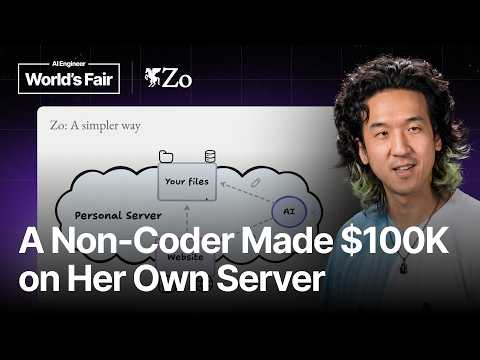
your own thing. You put your stuff in it. You put your AI in it. And because it is a place in the cloud, you can host stuff in it. You can host services like websites or APIs, and they're all yours. And I think for people in this room, if you're like interested in clouds and personal agents, like your personal cloud might look something more like this. You might have like a suite of local devices. Um and for me, I have like this like Zo computer, this like cloud computer as well, which has my Zo agent on it. It also has a Hermes on it, and it has my services. I have many websites and APIs and things that I've built, all hosted in the same place, and it can also talk to my laptop or my Mac mini, or I can use it on my phone. And that, collectively, is my personal cloud. So, Zoe is a personal server with AI built in. It's It's quite simple. And it hearkens back to a simpler time. So, back in the day, this is actually how we built and hosted websites. We just FTP'd our files onto a server, and that updated our website. You were just shipping to prod. You're like always doing it live. And that's actually, I think, how most people should build. I don't think it's necessary for a regular person like Charlotte to think about deployment. Unfortunately, for many of us in this room, this is probably what your life looks like, actually. You're kind of just navigating between these different AIs and devices and SaaS services, and it's very confusing. Zoe is meant to be a simpler way. It's one place for all of your stuff and your AI and the stuff you host, all of your personal stuff in the cloud. Here's another case study that I'd like to talk about. This is Anthia. She was one of our early users. She's totally non-technical. She's a free-diving instructor, and she's already on track to make $100,000 on Zoe. She used to use all of these different SaaS services to run her business and her life, like
Squarespace, like Calendly, etc. And now she's replaced all of that with Zoe. She's canceled all of those SaaS subscriptions. She is no longer a peasant.
Anthia went from this, kind of being very confused and having her data in all of these different SaaS silos, and not really being able to connect them very easily, to this. So, Anthea not only hosts her retreat website on Zo on a custom domain. She has many different websites now. She has her personal workspace that looks like this. She's really into fairies and like drawing and mushrooms and she's like expressing her whole self and her creativity online in this new way that we kind of really haven't had as regular people for a long time since like the '90s. And under the hood, like all of those sites are just the tip of the iceberg. So, when Anthea gets somebody who's interested in a retreat, Zo texts her with their number. Anthea now immediately calls them at that moment of intent to buy. She texts her Zo, "Give me a payment link." And she closes the deal right then and there. And that is how she is actually booking much more revenue than before with these retreats. Like her retreats are now like actually kind of hard to book because there's too much demand. And that's amazing. And under the hood, she has a database for all of her retreats. She doesn't really know what a database is, but she has one. She has all of her notes, all of her accounting, and it's all in one place. If she has like some images from a retreat and she wants to put those on her website, she just tells her Zo to do it and it's like right there. She can like host files directly from her personal server. And she is self-hosting everything. So, Zo is made to be simple enough for anyone, for people like Anthea, for my parents, for other people's parents. People are always telling me on like LinkedIn or X that like they sign up their parent for their parents to Zo and their parents are like five coding up a storm. It was awesome to see. I just got this message on LinkedIn the other day. Our caterer uses Zo um to kind of manage his staff at his restaurant. Our recruiter uses Zo as well. He's really into it and he's like kind of building a whole He's like rebuilding his his stack for his recruiting agency on Zo. Our marketing agency has become Zo-pilled. So, it's made for everybody. But it's also powerful enough for the audience in this room. It can be the home for your Open Claw or your Hermes. You can have a really nicely set up server to host your personal agent in if you use one of those tools. You can bring your codex or Gemini or etc. subscriptions and you can build and host anything. You have like root access to your own server to this very nicely set up Linux VM where like the networking is also like very well set up and you don't really have to worry about any of it. You can SSH in and you can control your Zo via API or MCP. So, very flexible. So, scan this QR code if you haven't yet uh to get $100 in AI credits. Um just try Zo. I I think you'll like it. And I'm going to do a little demo and then I'll have a little bit more to talk about after that. Um \>\> \[snorts\] \>\> So, really quick demo of Zo. You already saw it in the beginning, but Zo is this like nice kind of cloud workspace. I
made this website just now. I make all sorts of websites on the fly. Um you can chat with really any model as I mentioned. You can bring your own API key. You can even talk to Claude code in here. \>\> \[snorts\]
\>\> You've got this nice file system, built-in cloud storage because it's your server. You can just like use it as a Dropbox. Um and you know, you can obviously like work agentically in the chat with any of your files. You've got automations. So, you can kind of run tasks on a schedule with AI. \>\> \[snorts\] \>\> You've got tons of built-in integrations. You don't have to set any of this up. We have \[snorts\] lots of skills, a large skill library. There's a built-in browser, so you can log in to sites and let your Zo like buy things for you or do whatever. Actually, I always text my Zo these days to buy stuff on Amazon. It's like really dangerous for impulse purchasing. I like see something I'm like, let's buy it. \>\> \[snorts\] \>\> Um and as I mentioned, you can host stuff. So, you can really host anything, any arbitrary service, HTTP or TCP. And we also give you a really nice built-in personal website. This is my Zo space and this is all set up nicely and it's got like, you know, nice kind of like live coding features. Um and you just chat with it to edit it. And I've built all sorts of cool things inside of here. Um this for example is like my Calendly replacement. People can book time with me and it has just like this custom setup that I like. Um and my Zo can like review the people that are interested. I don't want anybody like booking time with me directly. Um and so that's kind of like what Zo is and I want to conclude by just talking a little bit about the future. So the reason we're building Zo is to build a future and better internet, one that looks more like this where everybody, \[snorts\] every individual has a real home, a presence on the internet. And \[snorts\]
companies already have this, but like we should interact directly with other people on the internet without middlemen. And we should also interact with like the various companies and their AIs. Um and it should be like more
direct. Another way to look at this is that like in the future we will probably just be interacting mostly with agents and the agents will kind of interact with the cloud, like these like software 1.0 things like websites and APIs. But \[snorts\] if you dig a little deeper into here, what's probably actually going to happen is that most of these agents that we interact with will also be in the cloud. Some of them will be local, but many of them will be in the cloud. And when those agents are in the cloud, the question again is like whose cloud is it? \>\> \[snorts\] \>\> So Claud tag is newly out and and Claud tag is actually, if you think about it, a cloud agent. It's this like cloud Claud. It's like a company level Claud that has like all the company's context and \[snorts\] anybody can interact with it. And you know, it's it's an interesting and very like ergonomic model. Town and Victor are also kind of similar instances of this. \>\> \[snorts\] \>\> But the problem with Claud tag is this. Whose cloud is it? Whose Claud is it? It's not really your company's Claud. And as you kind of improve your Claud tag setup, like what really improves is Anthropic, right? Like the the arrow is pointing the wrong way. And \[snorts\] this is intelligence feudalism. The intelligence now is bubbling up the wrong way. And you are still a peasant again, or your company is still kind of a peasant in a way. \>\> \[snorts\] \>\> And at Zoe believe really strongly in changing the way that things work and giving people and companies more \[snorts\] ownership over their cloud and over their intelligence. So, we believe that the future should actually look more \[snorts\] like this. Anybody, a company or an individual should be able to publish agents and own them and have end users and like have the end usage of their agent improve, like self-improve their own kind of published agent. And that is the future that we're building. We have \[snorts\] a kind of beta version of this. So, um I'm going to go back to to this Zoe space uh and scan this QR code finally if you want to talk to me, get AI credits, sign up for the beta of this kind of new agent publishing platform. \>\> \[snorts\] \>\> And uh yeah, also you can check out all of the speakers that are presenting on this Zoe space page. Um I'm Ben from Zoe computer. Thank you. \>\> \[applause\]