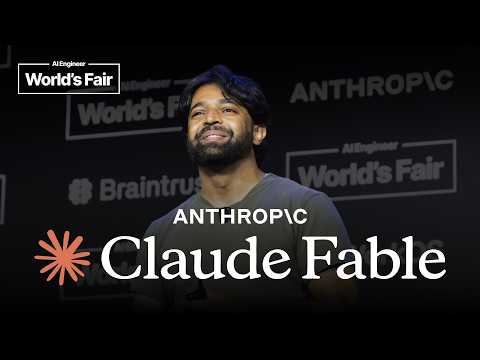
Field Guide to Fable — Thariq Shihipar, Anthropic
A talk by Thariq Shihipar (Anthropic, Claude Code team) on working with Anthropic's newest model, Fable. He introduces "capability overhang": models improve in spiky ways, and the tools given to them determine which capabilities become reachable. Topics include why Claude Code cut 80% of its system prompt because heavy instructions constrain a more imaginative model, the ask-user-question tool improving from barely functional under Opus 4 to generating embedded HTML questionnaires under Fable, building a full keynote deck in four hours, and an argument that teams should demand good, fast, and cheap results rather than picking two.
# Channel Identity Observations — Field Guide to Fable
## Video Overview
- **Event talk** at **AI Engineer** conference, delivered by **Thariq Shihipar**, introduced as a **"member of technical staff at Anthropic"** working on **Claude Code**: *"Hey everyone, I'm Tarik. I work at Anthropic on Claude Code."*
- Topic: a practical **"field guide"** to a new Anthropic model called **Fable**, covering model capabilities, prompting/workflow techniques, and mindset shifts for developers.
## Explicit Self-Description
- The speaker identifies himself as an Anthropic employee on the Claude Code team.
- He frames the talk as compressed written work: *"I've been working on this as a series of articles and blog post… let me do all of this at once at the talk, you know, speed run."* — suggesting the channel/creator also produces written technical content.
- He mentions a Claude Code team custom: *"we have a tradition on Claude Code where we take a selfie before a talk"* and an upcoming **fireside chat** with Kat Woo and Simon Wilson.
## Intended Audience
- **AI engineers and developers** working hands-on with Claude models — evidenced by the venue framing: *"if you're here, you know, at AI engineer."*
- Practitioners who prompt/build with LLM agents, e.g., guidance on system prompts, tools, interviews, and implementation notes for **Claude Code / Fable** workflows.
## Claimed Scope / Subject Matter
- **Anthropic model ecosystem**: Fable, Sonnet 3.5, Opus 4/4.5/4.8, Claude Code, Claude Tag.
- **Practical model-craft**: unhobbling models, "capability overhang," finding "unknown unknowns" in prompting, staying in the loop with agents.
- **Cultural/philosophical commentary on AI's impact on programming** — grief over hand-written code, "tradeoffs are not real," "building is easier, but generating value is still hard."
## Observable Presentation Patterns (Demonstrated, Not Claimed)
- **Insider perspective with internal examples**: cites internal decisions like *"we recently removed 80% of the system prompt for Claude Code"* and *"the ask you a question tool… something I worked on when I first got to Claude Code."*
- **Personal anecdote and emotional framing**: reflects on his former YC startup and sense of loss over hand-coding — *"how can you not laugh? Also, how can you not cry?"*
- **Teaching style**: structured four-part framework ("unhobbling Claude, finding your unknowns, dealing with the grief, and being unreasonable") with concrete prompt recipes (e.g., *"Can you do a blind spot pass…"*).
- **Self-demonstrated productivity claim**: *"I made this deck last night in about 4 hours with Fable."* (creator claim, not independently verifiable here).
## Confidence Notes
- All observations derive directly from the transcript; no curated metadata was supplied.
- Claims about Fable's capabilities and Anthropic culture are the **creator's claims**, distinguished above from demonstrated presentation behavior.
# Delivery Observation: Field Guide to Fable — Thariq Shihipar
## Overall Tone
- **Conversational and enthusiastic**: heavy use of filler words ("um," "uh," "you know," "like,") throughout, giving an informal, unscripted feel — e.g., > "Um we're rolling it out later today. Uh keep stay tuned for exact timeline."
- **Personal and emotive**: he frames product features through his own feelings: > "Fable is a model I'm just so so excited about" and > "It's a model that I just have a lot of like affection and excitement for."
## Vocabulary & Signature Phrases
- **Coining / branding terms for concepts**: "unhobbling Claude," "capability overhang," "blind spot pass," "being unreasonable."
- **Recurring metaphors as teaching devices**:
- **Gaming**: > "the the map is opening up, you know, like you were playing like an RPG and you've been on the tutorial."
- **Maps vs. territory**: > "the map is not the territory... the plan and prompt and spec that I have in my mind is the map, right? But the territory is the actual code base."
- **Biology vs. physics**: > "this is closer to a biology than a physics, right? It's still very empirical, very organic."
- **Recurring tag "right?"**: used constantly as a check-in with the audience (appears dozens of times, e.g., > "And that's sort of like the insight that led to Claude Code, right?").
## Teaching Habits
- **Explicit numbered structure announced upfront**: > "the four parts: unhobbling Claude, finding your unknowns, dealing with the grief, and being unreasonable."
- **Concrete, memorable examples** for abstract points — the Pokémon example: > "Why can't LLMs say which Pokémon end in AW?... Croconaw and Drednaw."
- **Framework-building**: the known/unknown matrix — > "known knowns... known unknowns... unknown knowns... unknowns unknowns."
- **Prescriptive tips framed as personal practice**: > "I like to do what I call a blind spot pass" — repeatedly anchoring advice in first-person workflow.
- **Recommendations to the audience**: > "I really, you know, encourage you to treat Fable like that" and suggesting a paper ("the biology of a large language model").
## Communication Patterns
- **Audience participation**: opens with the Claude Code selfie ritual — > "we have a tradition on Claude Code where we take a selfie before a talk."
- **Self-deprecating asides**: > "I tell it I have no visual taste."
- **Emotional narrative arc near the end**: shifts from tips to reflection on loss: > "how can you not laugh? Also, how can you not cry, all honestly?" and > "I just remember swimming in failure."
- **Closes with a memorable imperative**: > "go explore, make it real, and uh yeah, be less reasonable."
## Stable Patterns vs. Isolated Moments
- **Stable**: conversational fillers, "right?" check-ins, metaphor-driven explanation, first-person framing, numbered structure.
- **Isolated**: the personal grief reflection (startup history, love of hand-written code) and the closing resolution — emotionally distinctive but appear only in the final third; insufficient repetition to call them a general delivery pattern.
## Uncertainty Notes
- Timestamps in the transcript are bracketed line markers, not verified time positions; pacing, gestures, and vocal delivery cannot be observed from text alone.
# Field Guide to Fable — Observation Record
**Speaker:** Thariq Shihipar (transcribed as "Tarik Shaupar"), Member of Technical Staff, Anthropic, works on Claude Code
**Setting:** Talk at AI Engineer conference; Fable rollout announced "later today"
## Fable Rollout
- Fable is rolling out the day of the talk; exact timeline pending.
- Shihipar, Kat Woo, and Simon Wilson will hold a fireside chat at 12:30 with possible updates.
- He compares Fable to memorable Anthropic models: Sonnet 3.5 new, Opus 4, Opus 4.5 — "one of those Anthropic models where you're just going to remember it."
- Metaphor: **"the map is opening up"** — moving from an RPG tutorial into the open world: exciting but intimidating and confusing.
## Part 1: Unhobbling Claude
- **"Models are grown, not designed."** Anthropic doesn't set targets like "99% on SWE-bench"; they grow models organically with data, feedback, and compute, learning alongside them.
- What constrains models is **us** — the harness and prompting reflect our understanding of Claude. "Unhobbling" means understanding Claude better to unleash it.
### Capability overhang
- Pokémon example: normal chat models can't name Pokémon ending in "AW" (Croconaw, Drednaw), but Claude Code can — it fetches every Pokémon and writes a filter script. Claude "gets smarter in spiky ways."
- **Chat → Claude Code:** naive assumption was that coding would be solved by huge context windows (pasting the whole codebase); instead, giving the model "arms" (bash tool, environment access) let it build and search its own context — the insight behind Claude Code.
### Evolving best practices
- **Claude Tag:** recently rolled out; unlocked by Claude working proactively in multiplayer — Claude can "wake itself up" rather than waiting for prompts, which he says is unlocking a new wave of agents.
- **System prompt shrinkage:** they recently removed **80% of Claude Code's system prompt**. Trajectory: small prompt/few tools/many examples (3.5 era) → large prompt with examples and many tools → now smaller prompts because "the examples tend to constrain it, it's actually more imaginative than the examples we give it." Context, not constraints ("do not do this" is no longer necessary).
- **Ask-a-question tool:** barely usable with Opus 4 (required heavy tweaking); Opus 4.5 could conduct a 40-question spec interview; Opus 4.8 and Fable can build HTML reports with embedded questions.
- **Markdown/HTML evolution:** Markdown as output → plan mode (Markdown for you) → full HTML reports.
### Biology, not physics
- He emphasizes the field is "closer to biology than physics" — empirical and organic, rules not fully known, but with an intuition to build. Recommends Anthropic's paper "The Biology of a Large Language Model."
## Part 2: Finding Your Unknowns
- **"The map is not the territory"**: your plan/prompt/spec is the map; the codebase and real-world constraints are the territory. An **unknown** is anything in the territory not in the map — a decision point you haven't specified.
- Claim: Fable is the first model where he felt he must find his unknowns, because "it's going to traverse such a large area." Fable's bottleneck is his ability to match map and territory.
### Known/unknown matrix
- Known knowns (what you write in the prompt), known unknowns, unknown knowns (obvious things you'd never write down — "know it when you see it"), unknown unknowns.
### Techniques (using Fable to find unknowns)
- **Blind spot pass:** ask Claude to review a domain (e.g., an unfamiliar auth module), search git diffs/Slack, surface gotchas. He used this for color grading in video editing.
- **Brainstorms/prototypes:** for unknown knowns, especially design — e.g., "I have no visual taste; make me an HTML page with four widely different design decisions so I can react."
- **Interviews:** have Claude interview you; giving context on stage and priorities ("prioritize questions that would change the architecture") is extremely helpful.
- **References:** "One of the best ways to give Claude a map is to give it another map" — pass representative code or an HTML mock-up instead of a written spec.
- **Implementation notes:** ask Fable to log unknowns it encounters, so deviations are visible and explainable.
- **Quizzes:** have Fable quiz you afterward so you can represent the work in a PR or merge.
- Overarching claim: "the model knows more about almost everything than I do. I just need to get it out of it" and "staying in the loop" is one of the most important parts of working with Fable.
## Part 3: Dealing with the Grief
- First use of a "Mithril class model" (Fable) brought both gain and loss.
- Pre-LLM coding "feels like a foreign country": at his ~30-person YC startup, trade-offs were constant (fast app vs. prototype a feature; weeks of work). Returning to that codebase recently, weeks of work became hours.
- Emotional tension, preserved as stated: "how can you not laugh? Also, how can you not cry?" He loved hand-writing code and "rotating" the codebase in his mind, but also remembers late-night debugging, weeks of failure, "swimming in failure," most projects failing, most startups going bankrupt.
- Resolution: "the only way out is through" — "as much as I enjoyed those highs, I cannot go back."
## Part 4: Being Unreasonable
- He values that **Anthropic believes "tradeoffs are not real."** At his startup he was "reasonable" — listing priorities and choosing. Now: "What if you just did all of it? What if you forced reality to show you the tradeoff?"
- "Good, fast, cheap — now it's pick three."
- "The only way to prove that agents work is to do the best work of our lives faster than ever before."
- Example: he made this talk deck the previous night in ~4 hours with Fable, and liked it.
- Resolution for the year: be more productive, work less, spend more time with people he cares about.
- Qualification preserved: **"building is easier, but generating value is still hard"** — AI engineers focus too much on process/setups; value takes many swings and tries.
## Closing
> "Go explore, make it real, and be less reasonable. Thank you."
# Speaker Attribution Record — Field Guide to Fable
**Video ID:** 01a15ca8-d585-7970-857e-74ec4af301bf
**Event context:** AI Engineer conference (speaker references "at AI engineer")
## Speakers and Roles
### Primary Speaker
- **Thariq Shihipar** (transcribed as "Tarik Shaupar") — **Creator / featured speaker**
- Self-identified role: **Member of technical staff at Anthropic, working on Claude Code**
- Delivers the full talk; all technical claims, anecdotes, and opinions in the transcript are his.
### Secondary Voice
- **Unidentified stage announcer** — introduces the speaker ("Please welcome to the stage...").
- **Audience** — audible reactions (music cues, "Woo!"); no speaking role.
### Referenced Third Parties (non-speaking)
- **Kat Woo** and **Simon Wilson** — named as co-participants in a **fireside chat at 12:30** with possible Fable updates. No speaking content in this transcript.
- **Anthropic** — speaker's employer; described as believing "tradeoffs are not real" (speaker's characterization, not independent claim).
## Referenced Sources and Claims
- **Anthropic research paper:** *"the biology of a large language model"* — cited by speaker as one of his favorites; recommended to the audience. No link or citation details given.
- **"Viral tweet"** (unattributed, "a couple weeks ago") — claim that LLMs cannot identify Pokémon names ending in "AW"; speaker supplies answer (Croconaw, Drednaw). Source identity unknown.
- **SWE-bench** — mentioned as a benchmark example ("99% on SWE-bench"); hypothetical framing, no specific result claimed.
- **Model/product claims by speaker (Anthropic-affiliated, first-party):**
- Fable rolling out "later today"; exact timeline pending
- 80% of Claude Code system prompt recently removed
- Claude Tag enables proactive/multiplayer agent work
- Progression across Sonnet 3.5 new, Opus 4, Opus 4.5, Opus 4.8, Fable
- Speaker built the talk deck "last night in about 4 hours with Fable"
## Promotional Segments — Flagged
- **Product announcement:** Fable rollout ("we're rolling it out later today")
- **Event promotion:** Fireside chat plug at 12:30 with Kat Woo and Simon Wilson
- **Selfie ritual:** "a tradition on Claude Code where we take a selfie before a talk" — audience engagement bit
- **Company culture framing:** praise of Anthropic's "tradeoffs are not real" culture (first-party promotional characterization)
## Provenance / Availability Notes
- **Comment availability:** No metadata supplied; comment availability **unknown**.
- **Curated metadata:** None provided beyond title and transcript.
- **Uncertainty:** Speaker name spelled variably ("Thariq Shihipar" in title vs. "Tarik Shaupar" in transcript audio) — identity same, spelling unverified.
- Third-party verification channels (external sources, citations) were **not available** in the source material; all substantive claims are speaker/Anthropic first-party statements.
\>\> Please welcome to the stage member of technical staff at Anthropic, Tarik Shaupar. \>\> \[music\]
\>\> Hey everyone, I'm Tarik. I work at Anthropic on Claude Code. Before we get started, we have a tradition on Claude Code where we take a selfie before a talk. So, if you don't mind, if you strike a pose with me, I'll take a quick selfie at AI engineer. Okay, incredible. Well, uh yeah, to kick things off, like we said, Fable is back. Um we're rolling it out later today. Uh keep stay tuned for exact timeline. Me and Kat Woo and Simon Wilson will be doing a fireside chat at 12:30. We might have some updates for you then. Um but Fable is a model I'm just so so excited about. It's one of those Anthropic models where you just like you're just going to remember it, like Sonnet 3.5 new, Opus 4, Opus 4.5. It's a model that I just have a lot of like affection and excitement for. And the best way to describe Fable to me is like the the map is opening up, you know, like you were playing like an RPG and you've been on the tutorial. And now you get to the point where the like, you know, the open world starts, right? And there's so much that you can do and explore. Uh but there's also it's also a little bit intimidating and confusing, right? Cuz there's so much you can do. And so, what I wanted to do in this talk is give you guys a field guide to Fable, right? How do you work with this new class of models? So, I've got four parts to it. I've been working on this as a series of articles and blog post. Uh but, you know, when we announced Fable is coming out, I was like, "Okay, let me do uh all of this at once at the talk, uh you know, uh speed run." So, the four parts: unhobbling Claude, finding your unknowns, dealing with the grief, and being unreasonable. So, first, unhobbling Claude.
Um I think something we say really often is that the models are grown, not designed, right? We don't wake up and be like, "We need 99% on
SWE-bench," right? Like, the models are, you know, something we we grow carefully. We give it data and feedback and compute. Um but, ultimately, it's, you know, something that we it's a little bit organic, and we sort of figure out and learn with the model as we use it. And so, um that what that also means is that what contains them is us, right? The harness we put them in and the way we prompt them is basically like a function of our understanding of Claude, right? And by unhobbling it, I mean, how can we understand Claude better to unleash it? And we need to understand Fable more. So, I think one of my points is that, you know, uh we're still so early, and I think there's a lot more it understanding in Fable uh to unlock. And uh I I think I'll give you a quick example about how models get smarter, cuz it's a little bit unintuitive, right? Like, there I saw this viral tweet a couple weeks ago being like, you know, "Why can't LLMs say which Pokémon end in AW? There are a thousand Pokémon, right? And turns out there are two who whose names end in AW, Croconaw and Drednaw, right? And it turns out if you ask like a normal chat model, it can't answer it. Which is kind of confusing because like, you know, it definitely knows all the names of the Pokémon, right? But if you ask Claude Code, it can, right? Cuz what it does is that it fetches every Pokémon
and writes a script to filter for AW, right? And so, this is what I mean by like unhobbling Claude. We call this capability
overhang, right? Claude gets smarter in spiky ways. So, it doesn't just remember every Pokémon and reason through it, but if you give it the code execution tool, it can find the two Pokémon that end with AW, right? And so, this is I think part of the challenge with Fable is figuring out this capability overhang. What is now possible? And I think this is like a discovery that I'm excited to go on with you. Uh to make this a little bit clearer, I'm going to talk about a few different examples of how models have progressed in the past. Um one of the big examples obviously is like chat, you know, the chat models were had to be given context, right? Like maybe you paste in your code base and maybe naively you might have thought like, you know, the way we solve coding is by the context just gets really large and I can just paste in my entire code base, you know, it'll be a 100 million context window. But it turns out that instead, if you give it arms, like you give it the bash tool and ways to work with the environment, it can build and search its own context. And that's sort of like the insight that led to Claude Code, right? And so, again, spiky, like a new like innovation kind of, right? In how we think about and work with the model. And then recently we we rolled out Claude Tag. Uh and what sort of unlocked Claude Tag is its ability to work proactively in multiplayer. Uh Claude Code, you know, is something that you have to prompt for it to do work, right? And uh, this ability for Claude to wake itself up and do work is something that we think is unlocking the new wave of agents. But there's there's more here. So, for example, uh, we recently removed 80% of the system prompt for Claude code, right? And this is one of the ways in which models, you know, and what they need uh, changes over time. So, originally, like, you know, maybe back in 3 sign of 3.5 new, the best practices for a system prompt was a small system prompt, few tools, and lots of examples,
right? And then as the models get smarter, you can give it more information and more instructions, and they start following them. And so, it's a larger system prompt with lots of examples and many tools, right?
But most recently, we found this new class of models want fewer what want a smaller system prompt. The examples tend to constrain it cuz it's actually more imaginative than the examples we give it. And so, uh, and we tried to give it context and not just constraints. We're really trying to avoid being like, "Do not do this." Um, which was really necessary for the previous models. Um, and so, this is like, uh, a way that the system prompt is changing and and probably will continue to change. Uh, another feature I really like is the ask you a question tool. This is something I worked on when I first got to Claude code. And and it's uh, when Claude, you know, is is planning or wants to ask you a question, it can show you a multiple choice dialogue. Uh, for Opus 4, it could barely call it. I had to like really tweak the tool to make sure that it was uh, that it would work, right? And then, sometime at Opus 4.5, I was like, well, what if I asked it to like, you know, ask me 40 questions about the spec. It could start interviewing me, right? And so, its ability to ask questions jumped, right? And then, most recently with Opus 4.8 and Fable, I can now build a whole HTML report with the questions embedded inside of them. And uh it's just like a whole new way of interacting with uh with Claude, right? And and so this progression of like how Claude can get information from you has also changed. Um speaking of which, uh Markdown and
HTML is something I've also talked a lot about. Um you know, it turned Initially, Markdown was a a good output for the model. Um you know, it could show a little bit of rich information. And
then, you know, with plan mode, it started to be for you. Like you could understand what Claude was about to do. Um and now, you know, Claude can build you these in-depth HTML reports, right? So again, a way of this the model is getting smarter in a spiky way. I really like to emphasize that this is closer to a biology than a physics, right? It's still very empirical, very organic. Um we don't know all the rules, but there is some sort of science behind it, right? Like there is an intuition to build as well. And so I really, you know, encourage you to treat Fable like that. Uh one of my favorite papers uh that at Anthropic that we've written is on the biology of a large language model. Um all of our research papers are meant to be read by, you know, people with various degrees of technical expertise, but this is one of my favorite. So uh if you're looking to learn a little bit more, suggest you check it out. But so uh yeah, we talked about unhobbling Claude. But it turns out when you're working with Fable, you also need to unhobble yourself, right? And so one of the things that I think a lot about is that
the map is not the territory, right? When I'm working on a coding problem, the plan and prompt and spec that I have in my mind is the map, right? But the territory is the actual code base, the
real world, the constraints that Claude needs to navigate, right? And whenever Claude runs into something in the territory that's not in the map, I call that an unknown, right? Claude has to figure out what to do about it. It's a decision point that I haven't specified. And Fable is one of the first models where I felt that like I really have to figure out my unknowns because if not, it's going to traverse such a large area that like it's going to run into a lot of them. So, how do you figure out your unknowns? Um Yeah, it I Fable's bottleneck my ability by my ability to match the map and the territory to find my unknowns. So, a few um few ways to think about this. I like to think of it in a a matrix. So, like for any problem, I have a bunch of known knowns. This is usually like what I write in my prompt. What do I want, right? Then I have known unknowns. Things that like I know I haven't don't really know yet, but I just haven't figured out yet. I can um Uh yeah. Then I've got unknown knowns. Like what's so obvious that I just wouldn't write it down, you know, but I I'd know it when I see it, right? And then finally unknowns unknowns. What haven't I considered at all? What do I not know, right? Like what is something that if I knew could change how I prompt Claude? And and luckily, you can use Claude, you can use Fable to find your unknowns. So, I'm going to go over a few examples of how I do that with Fable. Um The first is I like to do what I call a blind spot pass. So, I like to say something like, "Hey, I'm working on a new auth provider that I know nothing about uh like in this code base. Can you do a blind spot pass to help me figure out my relevant unknown unknowns and help me prompt better, right?" And so, this like might have Claude go through the the auth module and figure out like, "Oh, you know, this is kind of like a hairy little uh dead end that comes up a lot." Maybe search in my Git diff or Slack. I might tell it where there's context, right? So, that I can learn about, you know, all the gotchas. And and you can use this very broadly, right? You can use it to teach you about new fields. I I recently did this for color grading when doing video editing. Um I think this is really powerful and and Sable is incredible at it. Um in
many ways, the model knows more about you know, almost everything than I do. I just need to get it out of it. Um then I like to do some brainstorms and
prototypes. Uh this helps me figure out my unknown knowns, right? Things like especially for design, it for me it's like know it when you see it, right? So, I might ask it to uh create a dashboard. Um and I tell it I have no visual taste. Uh make me an HTML page with four widely different design decisions so I can react to them, right? And then you know, you tweak this as you want, but like the idea is to sort of get an idea of like what are the things that you uh you know, you can't describe in words, right? And uh like work with the model to help figure that out. Uh then then interviews. So, once I have an idea of like, you know, this is what I want to do, uh there's probably still a lot of like uh unknowns here, right? Where I might not have considered something, I might not have specified it. And so, I'll ask Claude to interview me, right? And I'll give it a little bit more context. In any of these questions, like giving it a little bit more context about you and the work and the stage you're at, like, "Hey, yeah, prioritize questions that would change the architecture." is extremely helpful. Uh then references. One of the best ways to give Claude a map is to give it another map, right? So, instead of me writing out the spec, uh I can just say, "Hey, here's some code that represents what I want to be done, right? It could be in a different uh system or language. Uh but just read this code, understand it, and then use that to start your work, right? And uh again, this can be in a lot of different ways. If I'm making a a React component, I might have an HTML mock-up that is my map, right? That I pass in as a reference. I think this is a really, really powerful. Fable is really incredible at it. Uh something else I've like really appreciated is implementation notes. So, if uh while you're running Fable uh and it runs into an unknown,
ask it to log it, right? So that um you uh you can see where the deviations happened and then you can sort of figure out why as well, you know? It will usually give you some
context about what happened. And then finally, I'd like to get a Fable to quiz me about what happened uh just to make sure I understand what I'm doing and I can represent this work, you know, when I'm creating a PR or merging it. Um this is a really great way of like making sure that you're like really in the loop with Fable. And I think that's like one of the most important parts of Fable is like staying in the loop and making sure that you uh you get what you want. So, um those are some of my tips for working with Fable. Uh I also want to say that
the first time I used a Mithril class model, uh used Fable, I felt both a huge sense of like gain, but also a sense of loss.
And I I wanted to talk a little bit about that, you know? Um when I think about coding before LLMs, it feels like a foreign country, you know? Like I used to run a YC startup about 30 people and we were just constantly forced into trade-offs because of how hard code was, right? Like we could make the the app fast or we could try prototyping new feature and and this might take a month or this would take 2 months. And so we had to choose. It was just really, really hard. Um and now I went back to that code base a couple weeks ago and I thought about some of the things that I wanted to do. And uh it was just way easier. It was like the things that would have taken me weeks, I could do in hours, you know? And uh at some point it's like, yeah, like how can you not laugh? Also, how can you not cry, all honestly? Like, it's like one of these things where I really, really loved programming and writing code by hand. I love the feeling of like seeing the code base in my mind and like rotating it. But I also remember just, you know, like staying up late nights trying to debug, working on things for weeks without working, right? I just remember swimming in failure. I just remember that like the most of the projects I've ever worked on have failed. Most startups go bankrupt, you know? I think just overall programming and coding is extremely hard. And like as much as I enjoyed those highs, I I can cannot go back, right? And the way my reflection here is like the only way out is through, right? There's still a lot to learn with the gentle coding. There's a lot to learn with Fable. But I think if we try really hard and if we like stay in the loop, we on hobble it, we can get there, you know? And we can come out on the other side with just so much more. And so, the last bit I wanted to talk about is is
the so much more part, right? I call this being unreasonable. One of my favorite parts of Anthropic is that we believe that tradeoffs are not
real. Um, like I think that very often, I like in my previous company, I was very used to being reasonable. So I'd like write down this list of priorities and I'd be like, well, I guess we can prioritize this against this, right? And like, you know, that makes sense. So we'll this will be our priority this quarter. But what if you just did all of it, you know? What if you forced reality to show you the tradeoff, right? Um, this is one thing I really valued out of our culture in Anthropic. And that my reflection going forward is that I'm going to be a lot less reasonable. Um, I think one of this like the math of Claude and Fable really changes how you think about tradeoffs. And there are so many tradeoffs that you make implicitly in your head, right? Like good, fast, cheap. Now it's pick three, right? Um I think that like the best way to like do more ambitious work is to uh like reframe and make big make ourselves more ambitious. Because I think the only way to prove that agents work is to do the best work of our lives faster than ever before. Um you know, for example, I made this deck last night in about 4 hours with Fable. I feel like it's a it's a deck I really like and I I really enjoyed it, but I also um you know, I did it really fast. Uh and I think that if you're here, you know, at AI engineer, the world is kind of looking at you to prove that AI works, right? That it's not just like a fad or something, but that it can make us more productive and also save us time. And and that's my resolution for this year is to work be more productive, but work less and spend more time with people I really care about. Uh I think it's also worth calling out that building is easier, but generating value is still hard. And I think this is something that we run into, you know, as AI engineers sometimes where we think so much about the process of building and our our setups. Um but the the point is to generate value, right? And uh there it takes a lot of swings, it takes a lot of tries to find the valuable stuff. Uh but that really is the goal and that's like, you know, again, what the world is looking to us to prove that AI can really transform it. So, to to end, I just want to say like go explore, make it real, and uh yeah, be less reasonable. Thank you. \>\> \[music\] \>\> Woo!