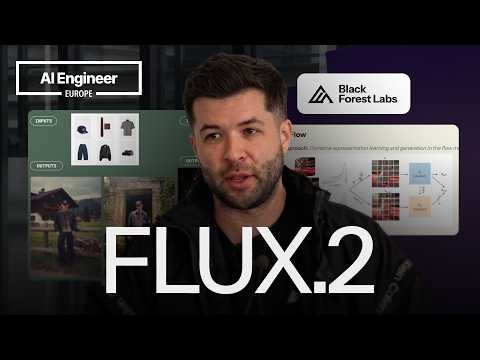
FLUX, Open Research, and the Future of Visual AI — Stephen…
Talk by Stephen Batifol of Black Forest Labs on FLUX and the company's research direction, tracing the progression from FLUX.1 through Kontext, FLUX.2, and FLUX.2 Klein toward visual intelligence beyond image generation. Covers BFL's work on self-supervised multimodal training, real-time generation and editing, and the path from generative media toward world models and robotics.
# Video Identity Observations — FLUX, Open Research, and the Future of Visual AI
## Speaker & Role
- Speaker introduces himself as **Stephen (Stefan) Batifol**, a **developer relations engineer at BFL (Black Forest Labs)**: > "I'm a developer relations engineer at BFL."
- The talk is delivered to a live conference audience ("Thank you all for coming today").
## Explicit Self-Description (Creator Claims About the Organization)
- **Company identity claim**: BFL is "the team behind Stable Diffusion, Latent Diffusion, and the Flux models."
- **Research credibility claim**: > "Our team has more than 200,000 academic citations."
- **Enterprise claim**: "We actually also work with enterprises and customers... some of our customers are Microsoft, Adobe, Canva, Mistral, and many more."
- **Stated operating principles**:
- > "Our first operating principle is to release state-of-the-art models... we want to raise the bar on quality with every release."
- > "We are a research company first. We publish things in the open. We publish paper. We really want to make sure that the field is moving forward with us."
- **Strategic direction claim**: > "Robotics and automation, this is where we're taking BFL... to train agents in those generative world to scale self-driving and automate every manufacturing."
## Claimed Scope of Work
- **Model releases cited**: Flux 1 (Aug 2024, open-source text-to-image), Flux Context (open-source editing), Flux 2 (Nov, multi-reference image generation/editing), Flux 2 Klein (Jan, sub-second generation/editing: "500 milliseconds for editing and 300 milliseconds for generation").
- **Open research**: The **Self Flow** paper, described as "a scalable approach to training multimodal generative models" using self-supervised learning, spanning image, video, audio, and action prediction.
- **Research-model disclaimer**: Speaker explicitly notes Self Flow demos are "research models, they're not meant to be released in production."
## Observable Presentation Patterns (Demonstrated, Not Claimed)
- **Audience addressed**: Technical/developer and AI-interested audience — assumes familiarity with diffusion models, encoders, flow matching; opens with hand-raising polls about awareness of BFL and Flux.
- **Educational explanatory style**: Walks through representation alignment, denoising, teacher/student training with plain analogies (e.g., the glass on the table, the chair).
- **Marketing-adjacent evidence**: Performance comparisons against competitors (e.g., "Kwen is like around like 15 seconds" vs. Klein's ~0.5s); qualitative claims like "impossible to basically tell they are AI-generated."
- **Transparency limits demonstrated**: When asked about training data, declines: > "this trade secret. I mean data is very sensitive as you can imagine. So, I can't really share this."
## Intended Audience (Inferred from Presentation Only)
- Developers, AI practitioners, and potential enterprise customers — evidenced by developer-relations framing, product use cases (e-commerce, storyboarding, product photography), and partner/customer name-drops.
# Delivery Observations — Stephen Batifol, Black Forest Labs (FLUX, Open Research, and the Future of Visual AI)
## Overall Tone
- **Conversational and informal**: despite a technical topic, the register is casual and audience-friendly.
- **Enthusiastic and promotional**: frequent positive intensifiers when presenting results.
- **Live-demo pragmatism**: acknowledges technical imperfections of research models openly rather than overclaiming production quality.
## Recurring Verbal Habits
### 1. Heavy use of "you know" as a discourse filler
Appears dozens of times throughout, functioning as a connector between claims and examples:
> "Flux 1 was the first breakthrough, you know, that was the model that was the big competitor"
> "We have the famous seagull here, you know, which has the VR headsets drinking a beer in a bar."
### 2. Repetition for emphasis ("really, really")
Doubling intensifiers is a stable pattern:
> "those use cases are really really important"
> "this is really, really good for us"
> "that was really good and really big actually"
### 3. Self-corrections mid-sentence
Frequently restarts or corrects phrasing, often announced with "sorry":
> "I'm Stefan Batyfull, sorry."
> "Flux 2 was uh as our base still our base our best model, sorry."
### 4. Hedged memory claims
Repeatedly flags uncertainty about specific numbers:
> "It was also the model that was really one of the fastest back then... if I remember correctly, was like 7 to 8 seconds."
> "I think the fastest it can do, if I remember correctly, it's 500 milliseconds"
> "DinoV2 and the other one that I can't remember."
This is a consistent honesty pattern rather than an isolated slip.
### 5. Rhetorical question-and-answer structure
Poses questions to the audience, then answers them himself:
> "So, how do we solve this? How can you teach, you know, a model representation directly without this external encoder?"
> "You may be like, 'Okay, that's cool from a research perspective. Why do we care?' The reason is robots."
Also opens with audience hand-raising:
> "First, who here knows about BFL? Raise your hand."
## Teaching / Explaining Habits
### Concrete physical analogies
Uses objects in the room to explain abstract training concepts:
> "they don't understand that my glass here should be actually on the stable. I shouldn't go through it."
> "Okay, you shouldn't go through the chair. My glass should stay on this table."
### Vivid informal descriptors instead of technical terms
> "a very Frankenstein setup, you know, nothing would really make sense."
> "weird way to do a push-up. Let's put it that way."
> "a face that's looking a bit odd. Let's put it that way."
The phrase **"Let's put it that way"** recurs as a polite hedge around negative comparisons.
### Left/right and baseline/comparison framing
Nearly every demo is structured as baseline vs. new method, explicitly narrated:
> "On the left, this is a baseline... Whereas on the right..."
This is the talk's dominant explanatory scaffold.
### Audience-directed anticipations
> "I don't know if you can see clearly, but in my opinion, they are like really amazing samples"
> "you can hear the difference hopefully"
## Vocabulary Patterns
- **Company-mission vocabulary**: "state-of-the-art" (repeated multiple times), "visual intelligence," "in the open," "moving the field forward."
- **Speed emphasis**: "real time," "real-time," "0.5 seconds," "less than a second" — latency is the recurring selling point.
- **Casual personification of models**: "she's chilling, uh taking a selfie in the streets of Freiburg," "the model is intelligent enough," "they got a bit tipsy."
## Spontaneous / Isolated Moments (not stable patterns)
- **Time-management aside** (single occurrence): "And I'm almost out of time. Oh, they added 5 minutes... So I can chill."
- **Demo mishaps acknowledged aloud**: "Oops. My bad. Yes, thank you." — appears during the bird video segment; not repeated enough to call a pattern, but consistent with the informal live-delivery style.
- **Firm refusal on data questions** in Q&A: "this trade secret... data is very sensitive as you can imagine. So, I can't really share this." — contrast with the open-research framing elsewhere in the talk.
## Uncertainty Notes
- Fillers ("uh," "um") are pervasive in the transcript, but some may reflect transcription artifacts; only clearly repeated phrases like "you know" and "really really" are claimed as stable patterns here.
- No curated metadata was supplied, so delivery context beyond the transcript (visuals, audience size, pacing) cannot be assessed.
# Observation Record — FLUX, Open Research, and the Future of Visual AI
**Speaker:** Stephen Batifol (transcript renders name as "Stefan Batyfull"), Developer Relations Engineer at Black Forest Labs (BFL)
## Company Background
- BFL is the team behind **Stable Diffusion, Latent Diffusion, and FLUX** models; claims **200,000+ academic citations**.
- Enterprise customers named: **Microsoft, Adobe, Canva, Mistral**, "and many more."
- Founded/start marked by **FLUX 1 release, August 2024**.
## Model Releases (Speaker's Claims)
### FLUX 1 (August 2024)
- First major release; text-to-image only; **runnable on a laptop**; "game-changer."
- Anatomy "really good" compared to bigger models.
- Was **most-liked model on Hugging Face** at the time — speaker explicitly notes "this is not true anymore."
### FLUX Context
- Claimed to be the **first open-source editing model in the world**, combining text-to-image and image editing.
- Very fast for its time: ~**7–8 seconds** vs. ~40–50 seconds for GPT image ("if I remember correctly" — speaker's own hedge).
- Use cases: character consistency, storyboarding (seagull VR example), input/output frames for video models.
### FLUX 2 (November)
- Described as BFL's **best model to date**; "steps toward visual intelligence."
- Speaker's opinion: samples "impossible to basically tell they are AI-generated."
- **Multi-reference**: up to **10 images simultaneously**; good at character, product, style consistency.
- Speaker claims it was **state-of-the-art in the open-source world** for text-to-image and editing.
### FLUX 2 Klein (January)
- Generates in ~**300 ms**, edits in ~**500 ms** (again hedged: "if I remember correctly").
- Comparisons cited vs. **Kwen**: on par or better quality at ~0.5 s latency vs. Kwen's ~15–20 s.
## Research Position: Self Flow
### Problem Framing
- Generative models trained via denoising **don't understand physical relationships** (e.g., a glass shouldn't pass through a table).
- Standard fix: **representation alignment** with external encoders (e.g., DINOv2), claimed **70× faster convergence**.
- Drawbacks of external encoders:
- **Scaling ceiling** — encoder limits generative model scaling.
- **Modality specialization** — need separate encoders per modality; "Frankenstein setup."
- **Objective misalignment** — segmentation vs. generation goals.
- Counterintuitive result: DINOv3 (technically better) gives **worse** generation performance than DINOv2; no clear rules why encoders work or don't.
### Self Flow (paper released ~1.5 months before talk)
- **Self-supervised**: no external encoder; combines representation learning and generation in one flow.
- Mechanism: two random noise levels; a **student** (high noise, denoises, minimizes both generation and representation loss) and a **teacher** (stable version, low noise).
- Claimed results: better than flow-matching baseline in **audio, images, video**; faster convergence; baseline plateaus while Self Flow keeps decreasing loss. Speaker speculates ("I'm pretty sure") baseline would plateau or worsen at 2M steps — **speculative, not shown**.
- Qualification: research models, **"not meant to be released in production."**
- Improves text rendering, anatomy, video stability (push-up, bird-flicker examples), joint video+audio generation ("Hello from the Black Forest"), and **action prediction for robotics** (can-picking demo).
## Stated Company Direction
- First operating principle: **release state-of-the-art models**; publish in the open to move the field forward.
- Future: real-time/interactive generation, **interactive visual engines for gaming/film**, **world models** for robotics, self-driving, and manufacturing automation.
## Q&A (Fragmentary, Questions Not Audible)
- **Training data**: "Can't really [share]. It's a trade secret… data is very sensitive… We're partnering with a lot of people though."
- On model state/memory: model learns representations internally; works via **context window / tokens**.
- On "long"-horizon (indefinite) memory: "That I'm not sure. I mean, there's always going to be a limit… maybe a sliding window." — **explicitly unresolved**.
## Unresolved Tensions
- Speaker mixes promotional claims ("impossible to tell AI-generated") with hedges ("in my opinion," "if I remember correctly") — recorded as expressed, not verified.
- Research demos contrasted against production readiness by the speaker himself.
# Speaker Attribution Record
## Video
**FLUX, Open Research, and the Future of Visual AI — Stephen Batifol, Black Forest Labs**
## Speakers
- **Stephen Batifol** (transcribed as "Stefan Batyfull") — **creator/presenter**, self-identified as **Developer Relations Engineer at Black Forest Labs (BFL)**. Sole named speaker throughout the talk and Q&A.
- **Unnamed audience members** — asked questions after the talk; only presenter's answers appear in transcript.
- **Audience** — applause noted.
No narrator, guest, or other identified speakers.
## Provenance and Referenced Sources
### Cited third parties / claims
- **Clem (Hugging Face)** — cited as having "gave us a shout-out" for Flux 1; Flux claimed to be "most liked on Hugging Face" at launch time (speaker notes this "is not true anymore").
- **Named customers**: Microsoft, Adobe, Canva, Mistral, "and many more" — per speaker's company claims.
- **External encoder models referenced**: **DinoV2, DinoV3** (claimed DinoV3 produced worse generation-alignment performance); a second encoder name the speaker explicitly could not recall.
- **Comparison models**: **Kwen (Qwen)** — latency comparisons cited; **GPT image** generation times referenced as context; **Stable Diffusion** cited as prior competitor and company heritage.
### Company/model claims (all from presenter, unverified)
- Team behind Stable Diffusion, Latent Diffusion, Flux models; "more than 200,000 academic citations."
- Release timeline: Flux 1 (August 2024), Flux Context, Flux 2 (November), Flux 2 Klein (January) — Klein claimed ~500ms editing / ~300ms generation.
- **Self Flow** research paper — claimed released openly ~"a month and a half ago"; research models explicitly **not production-ready** (speaker disclaimer).
- BFL headquartered in **Freiburg**, per speaker aside.
### Q&A — explicit limitations
- **Training data**: presenter declined to answer — **"this trade secret… data is very sensitive… I can't really share this."** Noted partnering with others for data.
- On long-horizon consistency: uncertain, "there's always going to be a limit… maybe like a sliding window."
## Promotional Segments
The entire talk is **company promotional content** delivered by a Developer Relations employee; notable promotional passages include the BFL intro (customers, citations), Flux 2 sample showcases, Klein speed comparisons, and the closing robotics/world-models vision ("that's why we're taking BFL").
## Unavailable Evidence Channels
- No curated metadata supplied beyond title.
- Comment availability: **unknown** (not stated in source).
- Training data sources, benchmarks, and dataset details: **withheld as trade secret** per speaker.
\>\> Thank you all for coming today. I really appreciate it. Thank you for coming to this talk which is Black Rice Labs Flux Open Research and the future of visual AI. I'm going to start quickly with a quick
intro of myself. I'm Stefan Batyfull, sorry. I'm a developer relations engineer at BFL. And I want to start with two questions. First, who here knows about BFL? Raise your hand. Okay, who here knows Flux? Okay, about the same people actually. But for the people that don't know BFL, I have a quick intro so you are not lost. But BFL at a glance, we are the team behind Stable Diffusion, Latent Diffusion, and the Flux models as well. Our team has more than 200,000 academic citations. And we don't only build models, we actually also work with enterprises and customers with them. So some of our customers are Microsoft, Adobe, Canva, Mistral, and many more. And the way we started is we started in August 2024 with Flux 1. Flux 1 was the first breakthrough, you know, that was the model that was the big competitor to Stable Diffusion back then and that was really the breakthrough where people were like, "Oh, this is a really cool model." We released it in open source in the first place. So really that was the one that was text-to-image only and you could run it on your laptop. That was a game-changer as well and the anatomy was really good in comparison to the other models and especially in comparison to other models that were way bigger. So this is where we really had a breakthrough and Clem from Hugging Face actually gave us a shout-out back then. This is fairly old but Flux was actually
the model that was the most liked on Hugging Face back then. This is not true anymore, uh but back then that was really the thing and that was really good and really big actually for a company that was, you know, coming out
of nowhere and just released this model. We then released Flux Context, which was the first open-source editing model in the world that was like the combination of text to image and image editing as well. This one Now, what I'm showing you here, what I'm showing you here, you know, it's obvious because now we have editing models everywhere, but back then that was a big breakthrough where you could do both text to image and image generation at the same time. If I have an example here, we have this input image and then you remove this snowflake from the face, you know, you can see have the character consistency, but you can also then move this person to be in Freiburg, which is where our headquarters is. You know, she's chilling, uh taking a selfie in the streets of Freiburg, and then you can, you know, do some local editing where you can change the background to be snowy, and then you also have snow on her face and everything. It was also the model that was really one of the fastest back then. You know, if you remember, this is the time where you had the first GPT image where it would take like 40, 50 seconds to generate or edit images. Whereas Context, if I remember correctly, was like 7 to 8 seconds. It was also really useful to tell stories. I've seen lot of use cases from our partners, from our customers where they would start with an input image and then create a storyboard like we see here. We have the famous seagull here, you know, which has the VR headsets drinking a beer in a bar. But then you can actually create other things. You can have a friend that is joining and that is then drinking with them. Now, you know, I guess they got a bit tipsy
and they're wearing hats in the bar. Then they're going outside. And then, you know, this is the story you could create and that was really useful actually for video model or for animation models. You know, you would
give those images as input frames or as end frames and then the video model could then create different content. In November, we released Flux 2, which is our steps towards what we call visual intelligence. Flux 2 was uh as our base still our base our best model, sorry. Um those are samples, which I don't know if you can see clearly, but in my opinion, they are like really amazing samples and it's impossible to basically tell they are AI-generated. If you look at the hands, if you look at the veins, if you look, you know, at the bracelets of the person on the left, there's personally no way that I would tell it's AI-generated. Same for the turtles you see on the right side, same for the dog or cat actually there's in the bath, that would be very very hard to get the sample like this. Um but those are AI-generated. And then you have more as well, so it's not only the people or animals, you know, you could do like some proper product photography. You can see it with a waffle here on the bottom right, or you can make some very cute images like this person, you know, on the left that is really driving the moped with some balloons. And this is what we released in November, but it's not only an image generation, it's also an image editing model at the same time. Um you can see on the left we have six images that we give to the model and my prompt was literally like create an outfit with those images and then the model is intelligent enough to actually, you know, make things that make sense. Like the jacket, you know, is worn properly, same for the tie. And on the right side, it's a bit more of a simple use case where you have the sofa and then you have to imagine, you know, maybe you are an e-commerce website or you're sofa maker and then you want to people to imagine, you know, what it looks like in your flat or what really it would look like if you had to buy it. And those use cases are really really important and those are like the main use cases we have currently for Flux 2.
But it also takes, yeah, up to 10 images simultaneously, so you can really edit a lot of images at the same time, and then you can create some magic things. It's very good at character, product, and
style consistency. And what I want to make clear is that BFL as a company and as a research lab, our first operating principle is to release state-of-the-art models. This is what we want to focus on. This is what we want to do as a company, you know, we want to raise the bar on quality with every release we do. So, we did it in the past, you know, with Flux 1 when it came out. We did it with context. Our Flux 2 was our best image model to date. It's the first one we released that was actually multi-reference as well. It was state-of-the-art in the open-source world. So, it was state-of-the-art for text to image and image editing. In January, we released Flux 2 Klein, which is a step towards like interactive editing and interactive image generation. It generates and edits images in less than a second. I'll talk a bit more about it later on during the talk. But I think the fastest it can do, if I remember correctly, it's 500 milliseconds for editing and 300 milliseconds for generation. So, basically real time. But this is not it. We also have more things that are coming, and this is where I want to talk about today. So, I mentioned it. We are a research company first. We publish things in the open. We publish paper. We really want to make sure that the field is moving forward with us, you know. This is our big focus as well. So, it's state-of-the-art model, publishing things in the open, and that's what we want to do. But I want to first take a
step back and tell you a bit, you know, about like how do you train models, and especially generate um models that are generating content, generating images, and everything. You you when
they generate things, when you train them, they actually don't understand what they're generating, you know, they don't understand that my glass here should be actually on the stable. I shouldn't go through it. Because you train them, you have images, and then you know, you add some random noise to those images, and then you just try to denoise them. That's what you do. That's what those models are doing. And when you denoise images, you never learn, you know, that my glass shouldn't go through here. You didn't never learn that, you know, you sit on the chair, you shouldn't go through it. So, what do you do? Is that you use you do what is called like representation alignment. So, you use an external model that actually knows about this, and that is an encoder that is like an image encoder that is teaching our model, "Hey, he is currently sitting on the chair. He shouldn't go through it." And those models are external, and they are really like trained to segment images, whereas our models are trained to generate images, or generate videos, or generate audio. And you try to align them to be on the same objective, so that our generative model actually learns, "Okay, you shouldn't go through the chair. My glass should stay on this table." And this is great, because it really improves the way generative models are working. We can see here on the right, you know, it is 70 times faster to actually converge and to reduce the loss when you use this external alignment. So, you're like, "Okay, this is great." But as usual, if something is working well, there are also counterparts to it. So, the first one is that you have a scaling ceiling. You imagine you're working with a model that is external, that has been trained at a checkpoint, you're not changing it anymore. What if you train a new model, and you have a generative model that you want to scale up? You're still like limited by this encoder that you have on the side, you know? You never actually scaling up
fully with that. Also, those are specialized in modalities. You have an encoder, for example, DinoV2 and the other one that I can't remember. It's specialized in
images only. What if you want your model to generate images, audio, video, and more? You would have to have encoders for all of those, and you can imagine then you would have like a very Frankenstein setup, you know, nothing would really make sense. And the objectives also misalign, so I've said it before. We want to generate content. We want to generate images or audio. The other one is here to segment things. So, like they have different objectives and you're trying to make them work together. And it works great, but it's also not perfect. Here, you see on the right side, we have DinoV2 and DinoV3. DinoV3 is a better model technically, per se, than DinoV2. But when you train your model, actually getting worse performances, you know, DinoV3 is here in right in red and green. And so, you're getting worse performances. So, you're like, "Okay, like this is supposed to be a better model. And yet, when I do train a model to generate things, then it gets worse." And there's also like not really any rules as to why, you know, certain encoders should work or otherwise shouldn't. So, how can we solve this? How can you teach, you know, a model representation directly without this external encoder? This is what we released about a month and a half ago now, which is a research paper. You can read it. It's called Self Flow. It's in the open. We released it to really make sure, you know, we're moving the field forward again and it's not only us benefiting from it. And it's basically a scalable approach to training multimodal generative models. So, they use self-supervised learning, so you don't need any other models, you know, to train it. And I'm going to try to go in tiny bit more details into it. But we combine representation learning and generation in the same flow. And you see here on the left, you have videos, images, or audio. You have different modalities. What do you do when you usually train a model? You add some noise, you add some random noise, you try to denoise it, and then you align it with the encoder, you know. How do we do it then? We actually add two different kind of noises that are both random and they're
both different. The first one we're adding is actually we're adding a lot of noise to the assets. So, this is the one you see at the top. And the other one we're adding like a low amount of noise. This is what you
see at the bottom. And the idea is that then we have two models that are actually working together. We have the student one, which is always getting the images with the most noises and is trying to denoise them. And then the teacher one, which is basically a more stable version of the students, is always getting the low um noises images. And then the student one is actually trying to learn two things at the same time. It's trying to minimize the loss for the generation and the loss in representation. And this is how then you actually work across different modalities. You know, this is then you only have one model, you don't have anything external, and if you actually scale up your model, then you're scaling up your student, you're scaling up your teacher. And you don't have to worry about the encoder that you have on the side anymore. And this is where we're working on. This is something, you know, we are currently using for different models that we're training. Um and this is, you know, where we believe the future is going to be and to get rid of those encoders that we have. We actually trained models. Uh so, those Disclaimer, those are research models, they're not meant to be released in production. Uh but we released actually one model on all those modalities. On the left, we're comparing flow matching, which is the usual way of training models, with ours. And you can see we are better in audio. So, this is what you see in the orange on the right side. And then, we also better in images. So, the dash lines is the baseline.
And then, we are like the full line where we can see we're also better at images. And also better at video. So, with this approach, without having the encoder and the external model that
you may struggle with, you actually get better at every modality that you're training your model on. It's also converging faster. You can see on the right, you know, the baseline is converging is actually hitting a plateau. Whereas, we are converging faster. And we're still, you know, decreasing the loss. And I'm pretty sure that if we were to go towards 2 million steps, you know, the baseline would really plateau and then wouldn't really get any better. Maybe actually get worse. Whereas, we would still go down in loss. And this is the difference between the two. If you used Flux in the past or if you used different models, you know, to generate, you may have noticed the text might not be perfect or, you know, things don't really make sense. This is what you see at the top. Where on the left it's like the future is Flux. But you can see, you know, you have like some letters that are missing or maybe you have two letters like on words, for example, you have two L's instead of one. Whereas, with this approach now, in the Cell Flow approach, you can see at the bottom everything makes sense. There is like they learn representation, you know, they learn that Flux then for the letters should be like one next to to the other. And the same on the mirror, same on the tree. And this is where we believe this is the future. But on top of this, we can see some comparisons here. On the left is the baseline. Where again, the letters are wrong. Um on the right, you can see that the letters are correct. Here is the same for the anatomy. Where you see on the left, you know, you have like a face that's looking a bit odd. Let's put it that way. And on the right, this is the one with Cell Flow. And again, this is not like a production model where, you know, you expect the face to be like
perfect, but you can see that the anatomy is way better than what you have on the left. What I want to show you as well some different generation if it loads. Yes,
thank you. Uh this is also possible This is also possible for video generation. So, this is the same model that has been trained on images. Now also can generate videos. On the left, you see the baseline. So, weird way to do a push-up. Let's put it that way. Whereas on the right, it's a perfect form. You know, the arms are correct. The hair as well is correct and nothing is wrong with it. And this is, you know, a way to actually fix all those artifacts that you may see usually in generations. The same here for the birds. Oops. My bad. Yes, thank you. Uh it's the same here for the birds where Thank you. Where you see on the left side, you have the baseline. There's a lot of flickering. There's a lot of like, you know, weird things happening because the model was using this encoder was trying to align things. Whereas on the right side, we sell flurry just does it perfectly and like the the bird, you know, is walking on the floor and there's no flickering or anything. But, it's not only about images or videos or audio. You train those jointly. So, you can also actually generate things jointly. We have here an example of a video and audio sample where the idea is that we have someone that is saying "Hello from the Black Forest." Uh I will just play them and you will hear the difference. Again, this is not a production-ready model. So, it's not like perfect, but you can hear the difference hopefully. Hello from the Black Forest forever. Hello from the Black Forest. Hello from the Black Forest forever. So, this one was the baseline where if you hear it correct if you try to pay attention to what he's saying, you hear like "Hello from the Black Forest." There's a bit of like, weird things at the end. Hello from the Black Forest for a first. Hello from the Black Forest. Whereas on the right side you can see, you know, the prompt is really just say hello from the Black Forest and then it ends here. And yeah, this is the same model that was trained on those images that we've seen before on video and on video and audio. Hello from the Black Forest for But this is cool and this is great. But what if you could also teach robots
on how to use this? This is also the same model. This one is trained on actions and not only on images, video, or audio. So it can also predict actions. And what I'm going to show you
now, it's a robot that is trying to pick up a can and make it closer to us. On the left, this is a baseline. Again, you see some like flickering. You see like the the arm is doing weird things. Whereas on the right for the same amount of steps, you can see how the robot is picking up the arm directly and like bringing it closer. And this is where we're going as well as a company. This is where we're really interested is like not only image generation or video, but it's also doing actions and doing more things toward physical AI. And there's more. It's also how do we make our models faster? Because this is really important for us. This is a demo of Klein, which is, you know, like near real-time editing. You see it on the right side. This is, you know, generated with Klein on Korea, where you see the edits and this is not a video model. This is those are images that are always editing in real-time. Not only they are faster, they also actually, at least on par or better than other models. And I'm almost out of time. Oh, they added 5 minutes. So I don't know if I'm Okay, cool. So I'm not out of time. So I can chill. Uh, so yes, here on the left we can see, you know, we have Klein uh that is 4B and 9B that is compared to the other open source models. So it's at least on par, while the latency, you know, it's like 0.5 seconds, while Kwen is like around like 15 seconds, you know? And if you are like on par and you're like way faster, then this is really, really good for us. Same for imagery image, you can see the editing. For Klein 9B, we are at like a tiny bit more than 0.5 seconds, whereas Kwen is still at around 15 seconds.
And then same for multi ref, you add it, but we're still at less than a second, whereas Kwen is more towards the 20 seconds. And this is what is really, really important for us because you really want to actually generate things
in real time. This is where we believe the world will to visual intelligence. This is where we're going as a company in the future. And why does it matter? As like I mentioned it, real-time generation, so you can imagine you render mock-ups as fast as you think. You know, you don't have to wait, you don't have to wait like 10 seconds, 20, a minute or two. You do things in real time and you can guide in real time. This is also where we're going. You can think, you know, interactive visual engines for gaming or films, where you really render a movie as you're prompted. On top of this, there's also world models. The idea of world models and behind it and why it matters for us, it's you train your models to understand and simulate geometry, relationship and like different interaction of the world. And you may be like, "Okay, that's cool from a research perspective. Why do we care?" The reason is robots. Uh that's why we care. That's why, you know, robotics and automation, this is where we're taking BFL, and that's why we also want to go towards world models, is to train agents in those generative world to scale self-driving and automate every manufacturing. And I think that is it. Thank you very much. \>\> \[applause\] \>\> Do we take Yeah, I think we can take questions. Yeah, I have something like Uh you mean the data? Can't really. Uh this trade secret. I mean data is very sensitive as you can imagine. So, I can't really share this. We're partnering with a lot of people though for it. Mhm. Well, this is what the model is learning. It's basically like those representation, you know, the model is learning that in itself as like the state and it has like some kind of memory. And this is uh the way we do it.
No, it's Yeah, it's the context window that you have, you know, you train and then you have the tokens and then they'll be like, "Oh, look, I've moved. Here is where I should be then next."
Uh define long. What do you call with long? Indefinitely. Uh that I'm not sure. I mean, there's always going to be a limit. Uh so, you may have, you know, like a sliding window. Um but this is the way we see it. Thank you. \>\> \[music\]