From Raw Documents to AI-Ready Data — Leo Platzer & Jeff…
Talk on taking an unstructured-document AI project from a stalled proof of concept to production. Using a legal-ops chatbot over 80,000 SharePoint files, it covers AI-assisted taxonomies and metadata tagging with evidence and confidence scores, sensitive-data detection, and quality checks for duplicates, conflicts, and freshness, plus scheduled data-slice refresh. The description states that stale or duplicated data can make up to 80% of retrieved context useless and that cleaning it roughly doubled recall in multi-hop RAG evaluations; these are the speakers' reported results, not independently verified here. The talk ends with generating a context file for coding agents using the SDK. Speakers are Leo Platzer and Jeff Koss of Deasy Labs (Collibra).
# Channel Identity Observations — "From Raw Documents to AI-Ready Data"
## Explicit Self-Description (Creator Claims)
- **Company/product affiliation stated directly**: Jeff introduces himself as "a staff customer engineer with DZ Labs," and Leo says he "was previously the CTO at DZ Labs which as Jeff has already mentioned was acquired last year by Calibbra." The presentation is branded "brought to you by Calibbra."
- **Positioning claim**: Jeff describes Calibbra as "more of a data governance tool for structured and AI um agents and models" and says "the gap that Calibbra had was we didn't have unstructured and that's really where uh DZ shines."
- **Offer explicitly stated**: "we have one-week PC's [POCs]. So, we're happy to prove our technology... you guys bring your business problem... bring some sample data."
## Claimed Scope
- **Focus area**: Unstructured document data curation for AI/RAG use cases — "So today we're talking about... how we can go from a stalled PC [PoC] to production with DZ data curation. So really focus on unstructured data."
- **Capabilities demonstrated/claimed**: file discovery from SharePoint, OCR/chunking/embedding, taxonomy and AI-suggested tagging, sensitivity scanning (PII/PHI), data quality (duplication, freshness, conflicting info), scheduled data slices for chatbot freshness, and an SDK for building "context repository" files for coding agents.
## Intended Audience
- **Enterprise data/AI practitioners**: personas in the demo scenario — head of data and AI, AI engineer, knowledge management lead, legal ops director, enterprise transformation lead — indicate a **business and technical enterprise audience** evaluating AI tooling.
- **Live conference setting**: this is a recorded conference talk — "Can everybody hear me?", "Our booth is way in the back by stage two. Please come by," and hat giveaways ("We have our hats that we're giving away at our booth").
- **RAG/chatbot builders specifically**: Leo's segment targets "your claw code for example or your codeex" and "multi-hop rag evaluation," addressing developers of agentic and RAG systems.
## Observable Presentation Patterns
- **Sales-oriented demo format**: walkthrough of a product UI (taxonomy builder, metadata generation, sensitivity scan, quality dashboard), a "demo scenario" company ("North River Manufacturing"), and closing call-to-action to visit the booth.
- **Quantified outcome claims** (presented as observed results, not independently verifiable): "they were able to go from four months of data prep work to down a days"; Leo claims "we pretty much double uh the recall um and overall improve our accuracy... task completion by between 10 and 15%."
- **Credential signaling**: Jeff cites personal background — "I used to work at both Informatica and data bricks" — to establish domain authority on data quality.
- **Casual, conference-booth tone**: informal asides ("my brother from another mother," "one more case of these hats"), consistent with a vendor session at a developer/data conference.
## Notes on Evidence Boundaries
- No curated metadata was supplied; all observations derive from the transcript and title alone.
- Claims of customer results (North River, "another telecommunications company... trying to curate 20,000 HTML files") are creator assertions; no external verification is available in the material.
# Delivery Observations — "From Raw Documents to AI-Ready Data"
## Speakers & Structure
- Two presenters, trading off: **Jeff** (most of the talk) and **Leo** (a conceptual/context segment in the middle).
- Structure follows a classic conference-demo arc: persona setup → problem → live/recorded demo → metrics → call to action.
## Tone
- Conversational, sales-engineering flavored, with frequent direct address to the audience:
> "Hey guys, let's get going. Can everybody hear me? All good. Perfect."
> "Appreciate you guys spending time with us."
- Heavy use of **"right?"** as a rhetorical check-in throughout:
> "seems pretty easy you can do that with 40 files but when they try to do it with many many different files with 80,000 plus files. Right now a sudden it's a little bit more challenging."
> "and everybody's talking about context, right?"
## Vocabulary & Recurring Phrases
- **"AI-ready data product"** — repeated product framing:
> "you can have very a lot of confidence in the the um AI ready data product that you guys are going to be building."
- **Numbers as narrative spine**: 40 files → 80,000 files; 339 → 20 files via filters; "four months of data prep work to down a days"; "double the recall… improve our accuracy… between 10 and 15%."
- **Named personas** as a teaching device: Sarah, Jim, Priya, Michael, Jackson — each given a role and a pain point ("He just needs to know which files do I need?").
- Repeated qualifiers: "small little pilot," "small little mini pilot," "tons and tons thousands and thousands of files."
- Occasional filler and self-correction: "um," "or sorry new files," "a a rack chatbot."
## Teaching Habits
- **Concrete scenario-first**: a fictional company (North River Manufacturing) anchors every feature back to a stakeholder need.
- **Narrating the demo while doing it**:
> "I just type in my tag name data document categorization give it a prompt and this prompt is what we're going to send to the LLM."
- **Anticipating objections with analogies**:
> "Think of your Slack messages. Today, a person says this, tomorrow a person says that, right? The truth changes over time."
- **Pulling in outside anecdotes** for credibility:
> "I was in uh in London at a Gartner conference uh a couple months ago and there was some folks from Finland…"
- Explaining domain concepts inline: "Taxonomy is a grouping of tags or a tagging tree."
- Leo favors a "so what?" framing — restating technical claims in impact terms:
> "you dduplicate your data, you reduce your search space, right? you clean it up, you have it fresh. What does it actually mean?"
## Communication Patterns
- **Handoffs with rapport**: "my brother from another mother, Leo"; matching branded hats mentioned twice.
- **Quantified before/after framing** as the persuasion pattern (40 → 80,000 files; recall doubling).
- Persistent **call to action** bookends: booth visits and hats at the start and end ("we only have one more case of these hats, so come on by").
## Uncertainty Notes
- The claimed evaluation results ("double the recall," "10 and 15%") are stated once without methodology detail beyond "multihop rag evaluation," so how representative they are cannot be assessed from the transcript.
- The rapport/joking tone is observable; no inference is made here about the speakers' actual working styles beyond this single session.
# Position Record: From Raw Documents to AI-Ready Data — Leo Platzer & Jeff Koss
## Speaker Identification
- **Jeff Koss** (transcribed as "Jeff CS"): Staff Customer Engineer at DZ Labs (identified via transcript self-introduction "My name is Jeff"; surname from curated title metadata).
- **Leo Platzer**: Former CTO of DZ Labs (self-identified in transcript).
## Background Claims
- **Jeff**: Calibra acquired DZ Labs "last summer." Calibra covers structured data governance for AI agents/models; DZ fills the unstructured-data gap Calibra had.
- **Jeff**: His background includes Informatica and Databricks.
## Core Positions & Claims
### Jeff — Scaling problem in document curation
- Demo scenario: **North River Manufacturing** (fictional/illustrative client), 40,000 employees, 20 countries, millions of SharePoint documents.
- Objective: a **legal ops AI chatbot** for supplier contracts, partnership agreements (termination clauses, expiring agreements, exclusivity terms).
- A 40-file pilot (parsing, chunking, OCR, embedding, vector DB + knowledge graph) worked well; scaling to **80,000+ files** surfaced challenges: file discovery, unknown sensitive-data location, untrusted data quality.
- Data quality for documents differs from structured dimensions (completeness, conformity, accuracy): it means **duplicate information, conflicting information, freshness**, plus context/metadata enrichment for chatbot relevance.
- He cites a separate telecommunications customer with **6–7 SMEs unable to keep up curating 20,000 HTML files** — evidence that manual curation is brittle.
### Jeff — Product capability claims (DZ)
- Taxonomy/tagging: manual, reusable library, or **AI autosuggested tags**; CSV import of valid values; conditional sub-tagging (e.g., only legal/contract files → contract type).
- Metadata generation shows **AI evidence** (where in the document the tag was found), supports thumbs up/down (few-shot learning), confidence scores.
- Filtering example: 339 files → 20 relevant files; quality dashboard for duplication/conflict; freshness date filters; data slices.
- Sensitivity scanning: **PII/PHI, pattern-based with context**, AI-based. Anecdote: at a Gartner conference in London, Finnish attendees asked about Finnish national ID detection; he doesn't speak Finnish, but the tool generated a Regex syntax plus Finnish associated words, reducing false positives. *(Stated as his personal account, not independently verified.)*
- Scheduled workflows auto-refresh data slices when SharePoint files change, keeping the vector DB fresh.
### Jeff — Outcome claims for North River
> "They were able to go from four months of data prep work down to days."
- Increased data utilization for AI, increased chatbot accuracy (via relevant files + injected metadata via SDK), reduced compliance risk by filtering sensitive data out of data stores.
- *(These are vendor-reported outcomes in a demo scenario; the "client" is a demonstration narrative.)*
### Leo — Why unstructured data quality matters (technical rationale)
- In vector search, duplicated or conflicting content fills **top-K results with irrelevant information**; "truth changes over time" (Slack analogy).
- In DZ, "duplicative" content is either **changed context** (kept) or **redundant** (removed from the knowledge base).
- Claimed evaluation result: if **30%** of a raw corpus is stale/duplicative, up to **80% of the context an agent uses** can be stale — "this has to be managed."
- On identical tasks (**multihop RAG evaluation**, not coding-agent tasks): **recall roughly doubled**, task completion/accuracy improved **10–15%**.
- Significance claim: duplication and freshness matter **independent of use case**, unlike relevancy which depends on intended use.
- Live SDK demo claim: contextualizes SharePoint folders and builds a folder-level index (context.md) so agents like Claude Code/Codex inspect folder context rather than individual files, reducing token cost.
### Jeff — Closing offers
- One-week PoCs: customers bring a business problem and sample data; DZ provides metadata generation, full sensitivity report, data quality report, and a use-case-specific taxonomy.
- Hats available at booth (mentioned twice).
## Qualifications & Caveats Preserved
- Jeff's background in structured data quality frames his framing of document quality — his own stated perspective, not an objective standard.
- Leo explicitly scopes the evaluation results to **RAG chatbot tasks**, excluding coding-agent tasks ("it's not... running an actual... cloud code task").
- "Up to 80%" stale context and "30% duplicative" are presented as illustrative evaluation figures without a cited methodology.
- Outcome metrics ("four months to days") refer to the demo scenario client; speaker is a vendor employee presenting the product.
# Speaker Attribution and Provenance Observation
**Video ID:** `01a15ca6-ee7d-714f-ace6-58a46a82263b`
**Title:** From Raw Documents to AI-Ready Data: Leo Platzer & Jeff Koss
**Source basis:** Transcript and title only. No curated metadata, comment data, or external references were supplied.
---
## 1. Speakers and Roles
### 1.1 Jeff Koss (presenter, opening and closing segments)
- **Stated role:** Staff customer engineer with DZ Labs.
- **Self-reported background:** Previously worked at Informatica and Databricks.
- **Identity note:** The transcript renders the self-introduction as "Jeff CS." The title lists "Jeff Koss." The transcript form is likely a transcription artifact, and the title is treated as the identifying source.
- **Segments:** Opening remarks, product demonstration (tagging, sensitivity scanning, quality dashboard, data slices, scheduled refresh), outcome summary, and closing call to action.
### 1.2 Leo Platzer (presenter, context segment and live demo)
- **Stated role:** Previously CTO at DZ Labs. The transcript states DZ Labs was acquired "last year" by Calibbra.
- **Current role:** Not stated in the transcript.
- **Segments:** Context and vector-space explanation, cited internal evaluation, and a live SDK demonstration of context-repository generation.
### 1.3 Named Individuals in the Demo Scenario (hypothetical personas)
These individuals are part of a presenter-described scenario. They are not confirmed as real people.
| Name | Stated Role in Scenario |
|---|---|
| Sarah | Head of data and AI; responsible for accuracy |
| Jim | AI engineer; needs relevant, non-sensitive files |
| Priya | Head of knowledge management; concerned with leakage and redaction |
| Michael | Director of legal ops; business user of the chatbot |
| Jackson | Enterprise transformation lead; sponsor of the flagship use case |
### 1.4 Organizations Referenced
- **DZ Labs:** The presenters' employer, referenced as the product provider.
- **Calibbra:** Described as the parent company after acquisition. The slide is described as reading "brought to you by Calibbra." The transcript describes it as a data governance tool for structured data and AI agents and models.
- **North River Manufacturing:** Described as the "demo scenario" company (about 40,000 employees, 20 countries). Presented as a scenario, not a confirmed customer.
- **Unnamed telecommunications company:** Described by Jeff as a separate engagement with six to seven SMEs curating 20,000 HTML files.
- **Informatica and Databricks:** Named as prior employers of Jeff.
- **Gartner:** Named as the conference where a Finnish-language demo interaction occurred.
---
## 2. Referenced Sources and Evidence Channels
### 2.1 Explicitly Referenced
- **Slide content:** Jeff refers to a slide showing the "brought to you by Calibbra" text. Leo refers to "a really good slide" on data freshness. Neither slide was supplied.
- **Internal evaluation (Leo):** A "multihop RAG evaluation" comparing outcomes with and without deduplication and freshness handling. No dataset, method description, or publication was provided.
- **Additional video (Jeff):** Jeff mentions "one more video." It is not included in the supplied material.
- **Live demo (Leo):** Described as live. The transcript describes the demo but not its output in full.
- **AI coding tools:** Claude Code and Codex are referenced as examples of agents that could consume a context file.
- **Finnish national ID patterns:** Jeff describes testing a Finnish national ID detection use case. The transcript states that some Finnish words were added to the pattern set by the system.
- **SharePoint:** Named as the source system for the demo data.
### 2.2 Data Points Presented Without Source
- **Ingested file count:** 339 files in the live demo, reduced to 20 through filters. The "14 files" figure appears later in a separate data slice.
- **Tag counts:** "68 different files" in a contracts/legal category.
- **Customer outcome claims for North River:** Four months of data preparation reduced to "a days," increased data utilization, increased chatbot accuracy, and reduced compliance risk. These are presented as scenario outcomes.
- **Evaluation results:** Recall "pretty much double," and task completion improved by 10–15%. Presented as results of the internal evaluation.
- **Context-staleness illustration:** Leo states that in a hypothetical corpus of 1,000 files, if 30% are stale or duplicative, up to 80% of the agent's retrieved context can be stale. The presenter frames this as "let's imagine" and it is treated as illustrative.
- **Confidence scores:** The system is described as showing per-file and per-chunk confidence scores.
---
## 3. Third-Party Claims and Attributed Statements
- **Legal and procurement questions:** Presented as the scenario's business questions (termination clauses, expiring agreements, exclusivity terms).
- **Customer experience claims:** The telecommunications company is described as "can't keep up" and "very brittle." Attributed to the presenter's account of that engagement.
- **Finnish attendees:** Described as having asked whether Finnish national IDs could be found. Their identity is not specified.
- **Analogy:** Leo describes Slack messages where "the truth changes over time." This is an illustrative analogy, not a sourced claim.
---
## 4. Promotional Segments (Flagged)
> **Promotional content is present throughout. The following segments are flagged explicitly.**
- **Opening sponsorship:** Slide reads "brought to you by Calibbra." Calibbra acquisition of DZ Labs is stated.
- **Booth promotion:** Booth location ("way in the back by stage two") and invitation to visit.
- **Giveaway:** Hats are given away at the booth, "first come, first serve." Closing reminder that "only one more case of these hats" remains.
- **Offer:** One-week proof-of-concept (PoC) offer. Attendees are invited to bring sample data for metadata generation, sensitivity reports, data quality reports, and taxonomy building.
- **Product demonstration:** The product walkthrough is presenter-led and self-described. Its claims are provider-originated.
- **Self-reported outcome claims:** Customer outcomes and evaluation results are provider-originated and unverified in the supplied material.
---
## 5. Availability Limits
- **Comments:** No comment data was supplied. Comment availability cannot be determined.
- **Slides:** Referenced but not supplied. Slide content is known only from verbal description.
- **Live demo output:** Described verbally. Screen content is not available beyond the narration.
- **Evaluation methodology:** Not provided. Results cannot be traced to a dataset, benchmark definition, or publication.
- **Customer identities:** North River and the telecommunications company are described in the transcript. No verification of their status as real customers is available.
- **Speaker identity:** Confirmed by title only. Transcript self-introduction for Jeff is inconsistent ("Jeff CS").
- **Missing transcript segments:** The transcript contains a mid-sentence gap in the Leo demo section and multiple disfluencies. Some content may be unrecoverable.
- **Current role of Leo Platzer:** Not stated.
All \>\> \[music\] \>\> right. Hey guys, let's get going. Can everybody hear me? All good. Perfect. All right. My name is Jeff CS. I'm a staff customer engineer with DZ Labs. Um, as you can
see from the slide, it says brought to you by Calibbra. Calibbra acquired DZ Labs last summer. Uh Calibbra is more of a data governance tool for structured and AI um agents and models. \[snorts\] So
the gap that Calibbra had was we didn't have unstructured and that's really where uh DZ shines. So today uh with me is Leo Platzer. \>\> Yeah. Hi everyone. Uh I'm Leo. I was previously the CTO at DZ Labs which as Jeff has already mentioned was acquired last year by Calibbra. \>\> And you can see we're both twins as well. We have our hats that we're giving away at our booth as well. So come by
and get them. First come, first serve. So today we're talking about um how we can go from a stalled PC to production with DZ data curation. So really focus
on unstructured data. So our demo scenario I typically talk about is a manufacturing uh company, North River Manufacturing. You can see
that you know there's 40 40,000 employees. They operate in 20 different countries. Uh really what they're trying to do is they have millions of documents in SharePoint. They've accumulated them over years and years and they need to figure out which ones are relevant for their chatbot. They're invested heavily in AI to improve operational efficiency. And their big objective this year is they want to build a legal ops AI chatbot. Now what they want to do is they want to help the legal and procurement teams answer questions around supplier contracts, partnership agreements, and it's going to be real time. So some of the questions they're trying to answer or what are the termination clauses for a specific supplier? Um which agreements expire this quarter, which agreements expire next quarter, and what partnerships have u exclusivity terms. So some of the folks in the teams that we've been working with um is Sarah.
She's a head of data and AI. So she's responsible for the accuracy. Um also there's Jim. He's the AI engineer. He just needs to know which files do I need? I have tons and tons thousands and
thousands of files in SharePoint. I need to find just the relevant ones with no sensitivity. Priya is the head of knowledge management. She wants to make sure that no sensitivity is leaked. um and make sure that if there if there is specific data that's uh classified that it gets redacted as well. Then there's Michael. He's a director of legal ops. He needs a chatbot to deliver accurate responses to his team. So he's from the business. And then finally there's Jackson. So Jackson's enterprise transformation uh lead and this is his flagship use case but also he has 15 other use cases that he needs to to deal with right so he wants to have a framework a repeatable successful process he doesn't just want to do it for one time he wants to do it for multiple different use cases so what they're able to do so far they were
able to take 40 around 40 different files pre-curated files and build a small little PC small little mini pilot where they can do uh parsing chunking
OCR embedding and then put it in a vector database and a knowledge graph and they got pretty good responses right seems pretty easy you can do that with 40 files but when they try to do it with many many different files with 80,000 plus files. Right now a sudden it's a little
bit more challenging. And so some of the challenges they had were I can't discover the files that I need. I don't know where the sensitive data is in my
on SharePoint. I can't trust the quality of the data. So my background um I used to work at both Informatica and data bricks. So for me data quality is
typically the six different dimensions of data quality. Completeness, conformity, accuracy. But when you deal with documents, it's a little bit different. It's I want to see is there duplicate information, conflicting
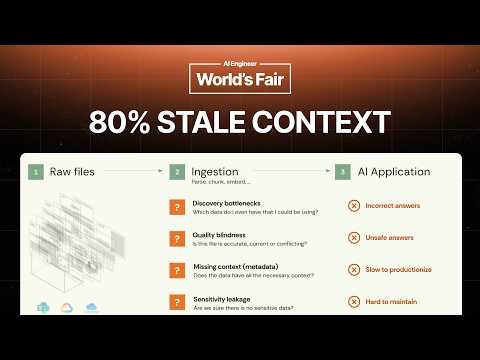
information, right? Leo's going to talk about he has a really good slide about showing why it's so important and also the freshness of the data and also everybody's talking about context, right? So what we want to do is when we tag the metadata, we want to use that in our chatbot in our vector database to make it more relevant, have better accuracy in the chatbot. So you can see some of the challenges that they had, right? They're getting incorrect answers. There's sensitive
information that's being leaked out in the chat bots. It takes a ton of time to go to production because they can't find the files. is spending too much time looking for the files instead of writing code and doing things that they they
really like to do, right? It's difficult to maintain. I'm working with another telecommunications company and they have six to seven different SME and they're trying to curate 20,000 HTML files and they can't keep up, right? So, it's very brittle, very difficult. And what we do is we provide the ability to automate this entire process. So over here now you can see they want to they want to try to access and leverage over 80,000 different files. So they went from 40 files to over 80,000 files. And really what they want to do is they want to find which files are relevant for their chatbot, which have high quality, which ones are up to date with knowledge. They don't want to use a a version where the contract is is old and expired, right? and they want to enrich their chatbot with the metadata that they've tagged and of course they don't want any sensitive data and so what we do over here is we provide the ability to do that right we can access the data um over here we can understand what the data is we can figure out which files are relevant do the OCR the chunking and things like that so let me show you a little a brief demo So over here you see in SharePoint much
like what North River has they have a whole SharePoint site full of different you know there's call transcripts there's PDFs there's excel there's word documents and I they don't know which
ones are relevant which ones are focused around legal now over here when we look at DZ we've already opened up the application right here and I can see you know I've already ingested 339 files and now I can see both the uh page page level or chunk level as well as a file level. I can see all the information right here. And then over here, this is what we call a texonomy. Taxonomy is a grouping of tags or a tagging tree. So I've ingested the 339 files. And now I can either manually create a userdefined tag. I can leverage tags that are reusable for my tag library or I can leverage AI to autosuggest what tags I should even have. Right? I can leverage AI to say you these are the tags are relevant. So here I just type in my tag name data document categorization give it a prompt and this prompt is what we're going to send to the LLM to determine is this file how should we tag this file now if I know what I'm looking for I can put in the classification values it's optional and again if I can leverage AI to autosuggest all these tags for me now also the other thing to point out if I have my uh my taxonomy here, my valid values um already. I can upload them through a CSV. And so once once we do this now, I can see I started to build this this tagging tree. Now the other thing I can do is I can have conditions on my tagging tree. So remember I said I only want legal and contracts. That's what they're looking for. Now what I can do is I can have have um subtagging. So only legal and contract files. I want to pull out more data around the contract type. Is it a supplier contract? Is it part of an NDA? Right? Is it materials and and time contract? And now what we can do when we add this, you can see we have different branches in our tagging tree. And I could have um unconditional tags
as well. I can have any number of different tags. Now, what we're doing is we're going to generate the metadata. So, I choose what files I want. I can choose what tags I want. I can say generate metadata. And we'll run this.
And you'll see the results over here. So now I can see the document category. I can hover my mouse. There's engineering documents. There's my contracts and legal, right? I have 68 different files. And if I click on any of those, it automatically filters for me. Now I can also see the evidence. Why did AI tag this? Where in the document did it find evidence that it's a legal contract? Right? And I can also do thumbs up and thumbs down. So there's fshot learning as well. So I can give it an example if I want to. Now you can notice I also have filters. So I have two different filters. I quickly went from 339 files down to 20 files.
So, we also have the ability to scan for sensitivity as well. So, whether it's PII, PHI, um could be anything. I was in uh in
London at a Gartner conference uh a couple months ago and there was some folks from Finland that came up and they wanted to know, you know, can we find Finnish national ID? I don't speak Finnish. So, I put it in there. I did this demo and not only can we do AI based, we can do patternbased with context and it ended up figuring out the the reax um syntax for me, but it also added some Finnish words which I thought were probably associated with Finnish national ID. So, it's going to be less false positives as well. All right, let me keep going here. So the other thing we can do is we can do quality. So again for us we have a dashboard in here for quality where we can go through and see what are the
different groupings for um for duplication for conflicting information. Um and then we'll we'll leverage AI to auto suggest which ones to keep. Now the
other thing we can do too is again for freshness we can say I only want files within x number of days or within a specific date range and then the last thing we can do for data quality is you know here's the the pieces of metadata that I absolutely have to have and then what we'll do is we'll figure out you know of the 339 files maybe you really need 200 files and then from there you can create a data slice and then we can also give it context as uh over here. So I'll go through one more video and we also have a live demo for you that Leo is going to be doing in a second. So in this case now what I can do is I can I can leverage a a data slice. So my data slice could be filtered based on the specific criteria
that I want. So in this case I have 14 files. These are only the files that are relevant for legal. And now what I'm doing is I'm copying my use case description. What I can do is I can say
here's what I'm trying to build and I can either do a flat uh tonomy or multiple layer levels in my tagging tree and then over there when I run it it's going to autosuggest these tags for me. There's human in the loop so I can choose which ones I like, which ones I want, which ones are relevant. But again, it's all done for me based on what I'm trying to do. We gave it context and based on the content of the files themselves. And then over here it even builds out the classification values for me. And then if we want when we run when we generate the metadata we're the job now we can see over here's all the sensitive information right here's all the different information that we have over here. And then again I can see the evidence at the file level and the chunk level. I can see the confidence score. So coming back from from AI what the model return I don't have to guess you know it's 100% confident 95% confidence. Here's why. So you can have very a lot of confidence in the the um AI ready data product that you guys are going to be building. All right. And now finally what we can do uh for
delivery and maintenance. So you know one other thing that that's really important is with our data slice technology we have workflows where you can put on a set schedule so it's auto refreshed. So we want to make sure that
your chatbot never gets stale. So if there's new records or sorry new files that get added to SharePoint or deleted, we'll automatically pick those up and add those on a set schedule to my um uh to my data slice or my AI ready data product and then our SDK will pick that up in the chatbot and then when we load the Victor database, you'll always have the most freshest uh metadata.
So what's it mean for North River? So basically they were able to go from four months of data prep work to down a days. They were able to increase their data utilization for AI. They increase their
chatbot accuracy because they not only were able to figure out which files to use but also the metadata from the files. They were able to inject that and leverage that through our SDK in their chatbot. Right? And then the other thing they did was they reduced their compliance risk. they knew where all the sensitive data is and they made sure that they were not part of they were all filtered out in their u data stores. Okay, so I'm going to turn it over to my brother from another mother, Leo, and he's going to talk about um context. Yeah. Hi everyone. Um I just wanted to
basically like give this so what right technically okay you dduplicate your data, you reduce your search space, right? you clean it up, you have it fresh. What does it actually mean?
Right? So, if we were looking at the vector space, right, when you ask a question, it comes in and you have duplicated data with the same information or potentially even a different version of the document with conflicting information now, right? Think of your Slack messages. Today, a person says this, tomorrow a person says that, right? The truth changes over time. If it ch if it stays however in your knowledge base in your search space your top K will always be full of pretty much irrelevant information right so in DZ for example something which is considered duplicative is either another piece of context like your database has changed and I can actually use it or it is simply redundant and we will remove it from the knowledge base. The second piece is like same as same reason as before. If your information is old, right? If you suddenly are working with data from before the 2000s, if you're working with information which was only relevant last week is not relevant this week, in the future some of the use case when agents actually get into production for let's call it the most high stakes use cases that has detrimental effects. And we have done um a lot of evaluation around what is the effect of making sure that your unstructured data quality is maintained, is consistent and is always handled deterministically in the same way, right? And what we're essentially seeing is that if your raw corpus, okay, let's imagine you have a thousand files and
30% of your files are stale or duplicative, it can happen that up to 80% of your actual context your agent uses to answer a question is filled up
with stale information. which means like it actually uses 80% of completely redundant useless information and knowledge and this has to be managed. Um what we have seen is that by running on the exact same tasks. So this is a rack chatbot. It's not um running an actual like let's say cloud code task or codeex on a coding task. It was simply like multihop rag evaluation. And what we saw is that if we look at
recall one like I mean we pretty much double uh the recall um and overall improve our accuracy. So like task completion by between 10 and 15%.
And why is this so significant? This is so significant because this has nothing to do with the use case you're working with. This is true independent of what you're actually using the data for. Right? Because if you actually know what you want to use your data for, you can apply relevancy and all not other data quality dimensions, right? But duplication and freshness is true no matter what. And yesterday, right, there is a lot of context topic, a lot of context flags around here. Um, I wanted to give a very very quick demo on how you would use the
DZ SDK to prepare a context repository. And I'm going to run this live. So what this is doing is essentially it's going to fetch all of the metadata we have
about a given SharePoint site and we will then contextualize each folder within that SharePoint site as well as create an index over all folders so that your claw code for example or your codeex does not even have to look at the individual files to figure out what to look for but simply looks at the context MD file. So what you're seeing here is essentially really by using DZY you can curate context files where you are directly aware what exactly is within each folder right what is its purpose right when do you want to use it so for example this is one to one the mirror of what I actually have in SharePoint but now instead of actually looking at these 23 files figure out whether I even should look at this folder. I know exactly what document types I have, what it is about, what are the key topics, when to use this folder, and what are example questions. So this is how this is all the kinds of use cases today, right? How you can use the easy for use cases like your rack chatbot or use the easy to actually improve the performance and reduce, for example, the token cost for your agents. Um, but yeah, basically I'll move over to Jeff again to summarize this whole presentation. \>\> Thanks, Leo. All right, so guys, um, we're almost out of time. Our booth is way in the back by stage two. Please come by, bring any different use cases that you guys have. Um, we're happy to have discussions, do live demos, um, talk about what your challenges are around unstructured documents. um over here. Um before we leave, just want to let you guys know we have oneweek PC's. So, we're happy to prove our technology.
Uh again, you know, you guys bring your your business problem. Um you're trying to solve with AI, bring some sample data, a bunch of different files, and then what we can do is we can get generate metadata for each different files. Um we could get a full sensitivity report on your on your data, data quality report as well. and then we'll show you how we can build a full tonomy based on your specific use cases, your specific files. So with that, everybody, appreciate you guys spending time with us. And lastly, we only have one more case of these hats, so come on by and grab them. So we'll be out in the back. Thanks, guys. Appreciate you.