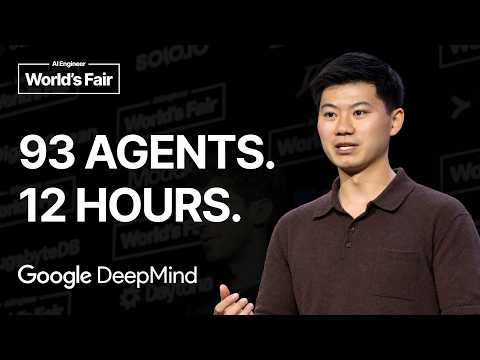
Get Out of the Model's Way — Kevin Hou, Google Antigravity
Talk by Kevin Hou, engineering lead on Google's Antigravity (Google DeepMind's agentic coding product), on building products that improve as models improve — summarized by the 'give Messi the ball and get out of the way' principle. Covers the evolution of coding tools from autocomplete (2022) to agents (2024), agent managers (2025), and agent teams (2026), including lessons like removing chat from Windsurf and splitting the agent manager from the IDE. Introduces Antigravity 2.0's three building blocks: dynamic subagents led by Gemini 3.5 Flash via /teamwork, sidecars (a plugin protocol for webhooks, cron jobs, and messages), and generative UI rendered on the fly. Demonstrations include an OS kernel built from scratch that runs Doom (cited as 93 subagents, 12 hours, 2 billion tokens, under $1,000) and DeepMind researchers automating ~90% of eval analysis with 100 parallel hypothesis agents. Timestamps and a corrected transcript are available via the linked talk page.
# Channel Presentation Observations: Kevin How, "Get Out of the Model's Way"
## Source Context
- **Video ID:** `01a15ca7-251b-772b-a6dd-8232423e36e7`
- **Title:** *Get Out of the Model's Way — Kevin Hou, Google Antigravity*
- **Curated metadata:** None supplied. The channel name is not present in the source material.
- **Format:** A recorded conference talk, not a channel-style episode.
---
## Explicit Self-Description
These are statements the speaker makes about himself or the product.
### About the speaker
- Introduces himself as Kevin and says he leads part of the engineering team on Antigravity:
> "My name is Kevin How and I lead part of the engineering team on anti-gravity."
- Describes his track record:
> "this is actually my fifth time speaking at AIG. Um and I've been building developers tools since 2022."
- Refers to a public following:
> "for those of you that follow me on X or hear me just yap generally for the last four years"
### About the product
- Describes Antigravity as:
> "Google's agent coding product for technical and non-technical users."
- Positions itself as:
> "unapologetically agent first."
### About the team's stance
- States a guiding principle:
> "scaling with intelligence. This means that as the model gets better, so should your product."
---
## Intended Audience
The audience is inferred from direct address and assumed knowledge. These are observations of the text, not claims about who watches the channel.
### Direct address
- Opens to the room: *"Hello everyone."*
- Asks an interactive question: *"are there any World Cup fans out there?"*
- Frames the talk for builders:
> "if you're building a product around an agent, you should consider what are the primitives that are in my product"
- Addresses a product-owner audience:
> "as a builder or you as a product owner, you might be surprised at what the models can do."
### Assumed knowledge
The talk uses terms without defining them, which suggests a technically fluent audience:
- MCPs, custom tools, permission systems, skills, hooks, artifacts
- Jupyter notebooks, evals, rollouts, judges, async pools
- Monorepo, TPU, sub-agents, sidecars
### Contextual signals
- References to "AIG" and thanks to "Swix and Ben for having me" suggest a conference setting. This is a textual inference only.
- Closing invites direct contact:
> "you can find me on Twitter. Uh you can DM me for feedback."
> "I'll be at the anti-gravity booth if you want to talk further."
---
## Claimed Scope
### What the speaker says the talk is about
The speaker explicitly narrows the scope away from product features:
> "I don't want to spend today telling you about the product. I want to tell you a little bit more about the behind the scenes, some of the principles that went into it and notably some of the things that led to its roadmap."
### Core claims made
- **Three primitives** for the "2026 era" of agent teams:
1. Dynamic sub-agents
2. Sidecars (a plug-in protocol)
3. Generative UI
- **Historical framing** of eras:
- 2022: autocomplete and chat sidebars, described as "deterministic"
- 2024: agents, with MCPs, custom tools, and permission systems
- 2025: the agent manager and parallel agents
- **Prediction about direction:**
> "our prediction is that this idea of agent orchestration... is the future. And we're willing to bet on that future."
### Quantitative claims (creator-reported)
- OS kernel build: "93 sub aents over the course of 12 hours, made 15,000 requests, two billion tokens, and it was under $1,000"
- Gemini Flash speed: "almost 900 tokens a second. This is 10x faster than a lot of the other frontier model experiences."
These figures are the speaker's own and are not independently verified in the material.
---
## Demonstrated Presentation Patterns
These patterns are observable within this single video.
### Structure and style
- **Mixed format:** anecdote, historical timeline, live-style product demo descriptions, and an internal workflow case study.
- **Conversational delivery:** includes asides and interruptions such as *"Are the slides up? Oh, they are. Great."*
- **Recurring metaphor:** the "get out of the model's way" theme, anchored in an opening sports analogy:
> "It's called Give Messi the ball and get the heck out of the way."
### Candor about past decisions
The speaker discusses unpopular product changes:
> "a lot of users were yelling at our team because we took away something that was very dear to them the chat sidebar"
He also hedges claims:
> "We aren't right 100% of the time"
### Product promotion
The talk includes announcements and product direction:
> "we were really excited to announce agent teams in public preview inside of anti-gravity."
The material shows the promotional content. It does not establish the speaker's motives beyond what he states.
---
## Observation Limits
- **Single source:** These observations come from one talk. They do not describe a channel-wide pattern.
- **No metadata:** Without curated channel data, the channel's identity, publishing history, and other content cannot be confirmed.
- **Affiliation is stated:** The title and speaker describe a Google product team. The material does not show anything beyond that affiliation.
# Delivery Observation — Kevin Hou, "Get Out of the Model's Way"
## Overall Tone
- **Energetic, conversational, and audience-aware.** Opens with a crowd prompt: *"So, are there any World Cup fans out there? Woo!"*
- **Confident product-evangelist register.** Assertive framing without hedging on vision: *"We have and always will be unapologetically agent first."*
- Occasional informal self-awareness: *"hear me just yap generally for the last four years."*
## Signature Metaphors and Recurring Phrases
- **Sports/team metaphors dominate the framing.** The central analogy: *"Give Messi the ball and get the heck out of the way"* — later echoed in the closing: *"let the model cook."*
- **"Scaling with intelligence"** is the explicit thesis phrase, introduced mid-talk and repeated verbatim at least three times (*"Scaling with intelligence really is not easy"*; *"Again, we are scaling with intelligence"*).
- **Pop-culture analogies for technical concepts:**
- Agent teams as *"kind of like the Avengers, right?"*
- Steve Jobs iPhone keyboard quote invoked for generative UI: *"not fixed in plastic."*
- **Catchphrase-adjacent repetitions:** *"faster, better, and cheaper"*; *"the list goes on and on and on."*
## Teaching Habits
- **Year-by-year historical scaffolding.** Builds the argument chronologically: 2022 (autocomplete/chat), 2024 (agents, MCP), 2025 (agent manager), 2026 (agent teams) — a timeline-based teaching structure.
- **Past-removal anecdotes as lessons ("battle scars").** Recurring framing word: *"battle scars"* and *"today's battle"* — uses prior controversial decisions (removing chat, terminal access) to pre-frame the current controversial one.
- **Concrete numbers to make claims tangible:** *"93 sub agents over the course of 12 hours, made 15,000 requests, two billion tokens, and it was under $1,000."*
- **Analogy-first explanations for abstractions:** debugger/IDE analogy for the agent manager split: *"You don't always need a debugger, but it definitely is helpful to have it."*
- **Rhetorical question → answer pattern:** *"do you force the new era of primitives or is it something that comes to you...? The answer is kind of both, right?"*
- **Enumerates threes consistently** — three primitives (sub agents, sidecars, generative UI), three examples, signaled explicitly: *"the third and final primitive."*
## Communication Patterns
- **Live-stage adaptation visible:** mid-talk logistics chatter (*"We might want to get the slide. Are the slides up? Oh, they are."*) and a closing callback joke: *"I'm going to keep using the slide until we've actually conquered the TPU crunch."*
- **Direct audience address ("you")** in the takeaway section: *"you as a builder or you as a product owner, you might be surprised at what the models can do."*
- **Community continuity cues:** references prior appearances (*"my fifth time speaking at AIG"*) and prior talks (*"if you remember my last talk"*), and thanks hosts by name (*"Thank you Swix and Ben"*).
- **Inclusive conversational fillers:** frequent *"right?"* and *"um"* throughout, indicating an unscripted, talk-track style rather than read delivery.
## Stable vs. Isolated
- **Stable-looking:** the Messi/"get out of the way" metaphor bookends the talk; "scaling with intelligence" recurs with consistent meaning; the three-part enumeration structure is sustained; numbered evidence is used in both demo examples.
- **Isolated (low repetition):** the World Cup opener, the Avengers line, and the Jobs quote each appear once — treating them as habitual devices would be overstating the evidence from a single talk.
# Get Out of the Model's Way — Kevin Hou, Google Antigravity
**Speaker identification:** All claims below are attributed to **Kevin Hou**, who self-identifies as a lead on part of the Antigravity engineering team at Google. No other speakers present substantive claims.
---
## Core Thesis
- **"Scaling with intelligence"** — Hou identifies this as the single most important lesson from four years building developer tools:
> "As the model gets better, so should your product. And the frontier edge of whatever model you are serving should be apparent inside of your users's product experience."
- Opening analogy: coaching Argentina in the 89th minute with Messi — the play is "give Messi the ball and get the heck out of the way." LLMs "aren't just role players anymore. They can be your star player if you build the right product around them."
## What Antigravity Is (per Hou)
- Described as **Google's agent coding product** for technical and non-technical users, launched November 2025.
- Claims the team has "and always will be unapologetically agent first."
- Product timeline as stated:
- Original **Antigravity IDE** with an "agent manager" concept for orchestrating many agents.
- Extracted the agent into a standalone **Antigravity CLI**.
- **Antigravity 2.0** launched at Google IO, **decoupling the IDE from the agent manager** into two separate applications. Features listed: sub agents, work trees, scheduled tasks, voice mode, new models.
- He frames the product pitch as secondary: "I don't want to spend today telling you about the product" — the talk focuses on principles and roadmap instead.
## Historical Pattern of Primitives (Hou's framing)
- **2022:** autocomplete and chat sidebars — deterministic systems (embeddings, rules, files, syntax tree parsing) "because that's all that the model could really handle."
- **2024:** agents arrive; new primitives: MCPs, custom tools, permission systems.
- **2025:** agent managers, parallel agent handling; primitives: skills, hooks, artifacts.
- **2026 (his prediction):** agent teams / orchestration era — sub agents, sidecars, generative UI.
## "Battle Scars" — Removing Familiar Features
Hou acknowledges difficulty and includes qualifications:
- **Terminal access for AI:** recalls fears of catastrophic codebase deletion, but argues that as models improved and permission-system primitives matured, "users ended up building faster... and they did so safely."
- **Removing chat from Windsurf:** quotes a representative tweet of user backlash ("the yelling that I got"), concedes it was "something that was familiar and rather difficult to swallow," but argues agentic research and execution became the new paradigm.
- **Explicit qualification:** "We aren't right 100% of the time," and leading users down a "**potentially**... better path" — he flags "potentially" himself as a big keyword.
## Agent Orchestration Bet
- Analogy: the IDE is to the agent manager **what the debugger was to the IDE** — helpful when you need to go a layer deeper, but not always needed.
- Prediction: agent orchestration ("agent teams," "swarms," "software factories") is "the future. And we're willing to bet on that future."
## Model–Product Flywheel Claims
- States the privilege of being inside Google DeepMind is a direct relationship between product and model.
- Claims Gemini has "now learned a thing or two about how to manage a team of agents" from the Antigravity product, while qualifying: "There's still a lot of headroom" for multi-agent systems to get better at collaboration and task decomposition.
- **Gemini 3.5 Flash** (launched April, per Hou): described as "really good at leading teams," faster and cheaper, "pushing the Pareto curve" of intelligence vs. speed/cost.
## Agent Teams (public preview, activated via `/teamwork`)
As described by Hou:
- User specifies a task; the agent can ask clarifying questions until requirements are clear.
- A **lead agent** manages "a team of arbitrary size" — likened to the Avengers: frontend, backend, infra, QA, design specialists.
- **Sub agents are dynamically generated**, operate independently, and can select different models than the main agent.
- **Example projects claimed:** a browser-based raw photo editor; a messaging app — each using "hundreds of sub agents" over "almost half a day."
- **Hero run — OS kernel:** built a complete OS kernel from scratch and played Doom on it (demoed by colleague Verun at Google IO). Stats given: **93 sub agents, 12 hours, 15,000 requests, 2 billion tokens, under $1,000**. Hou qualifies it: "Obviously, we're not going to spend thousands and thousands of dollars to build an OS kernel every day, though it is possible."
## Internal Eval Automation Example
- Side-by-side eval comparison workflow (control vs. experiment rollouts) that traditionally required "Jupyter notebook elbow grease."
- Claim: researchers automated **90%** of the workflow via natural language, with the agent:
1. Computing the delta using skills and knowledge of Google's monorepo.
2. Spawning a research specialist proposing ~100 hypotheses.
3. Spinning up one sub agent per hypothesis to investigate in parallel.
4. Producing a report plus **generative UI** (dropdowns, filters, segmentation).
- Overall claim: "What used to be a very manual process now takes minutes."
## The Three 2026 Primitives
### 1. Dynamic Sub Agents
- "Basically no two sub agents are the same" — the main agent configures, prompts, and seeds them on the fly.
- Can run in parallel in different secure environments (sandboxes, remote execution) with infinitely many specialized roles.
### 2. Sidecars
- A **new plug-in protocol**: "a long-lived utility... responsible for listening" — letting the model set its own triggers (SMS, webhooks, cron jobs, GitHub PRs).
- Antigravity's scheduled tasks/cron feature is claimed to be built on this primitive internally.
- Spec to be released "later this summer."
### 3. Generative UI
- **Hypothesis stated (not asserted as fact):** "human written specialized UIs are kind of dead."
- Claims Gemini Flash on Antigravity runs at "almost 900 tokens a second" — "10x faster than a lot of the other frontier model experiences."
- UI is rendered inline in the conversation rather than via templates or HTML files; extends to charts, graphs, tables, and playable Doom.
- **Steve Jobs analogy:** quoting Jobs on removing the iPhone keyboard ("fixed in plastic... the same for every application"), Hou argues Antigravity similarly skipped "heavy infrastructure and mechanical UIs" for a product "not fixed in plastic."
## Closing Advice to Builders
- "If you're building a product around an agent, you should consider what are the primitives that are in my product and how might they scale with the model's intelligence."
- Shipping features is now easy; the challenge is **deciding which features** will scale with the next model release, "which will inevitably be faster, better, and cheaper."
---
## Unresolved Tensions and Qualifications (preserved)
- Hou concedes the team is "not right 100% of the time" and acknowledges real user backlash over removed features.
- The "human-written UIs are dead" claim is framed as a **hypothesis**, not a conclusion.
- Multi-agent systems are described as still having "a lot of headroom" for improvement despite the product bet.
- The OS kernel demo's cost is acknowledged as atypical ("mildly affordable" only in his framing; not an everyday expenditure).
# Speaker Attribution and Provenance Observation
**Video ID:** `01a15ca7-251b-772b-a6dd-8232423e36e7`
**Title (as supplied):** Get Out of the Model's Way — Kevin Hou, Google Antigravity
---
## 1. Speakers and Roles
### 1.1 Primary Speaker
- **Name as spoken:** "Kevin," later self-identified as **Kevin How**
- **Name as titled:** Kevin Hou
- **Identity discrepancy:** The spoken name ("Kevin How") differs from the supplied title ("Kevin Hou"). The record does not resolve which spelling is correct.
- **Stated role:** Leads part of the engineering team on Antigravity
- **Stated affiliation:** Google (Antigravity is described as "Google's agent coding product"; the speaker references being "inside of Google DeepMind")
- **Stated background:**
- Has been building developer tools since 2022
- Describes this as their fifth speaking appearance at the conference (referred to in the transcript as "AIG")
- Says they worked on autocomplete and chat sidebars in 2022
- **Speaking role:** Conference presenter delivering a talk
### 1.2 Referenced Individuals
| Name | Role as stated in transcript | Context |
|---|---|---|
| **Verun** | Colleague | Demoed the OS kernel project at Google I/O |
| **Swix and Ben** | Hosts | Thanked by the speaker for having them present |
| **Steve Jobs** | Quoted figure (not a speaker in this video) | Quoted regarding the iPhone keyboard removal |
### 1.3 Audience Interaction
- The speaker asks the audience whether there are "World Cup fans" and receives a response ("Woo!"). The audience response is not attributed to any named individual.
---
## 2. Referenced Sources and Artifacts
The speaker refers to the following sources. None are reproduced or verified in the transcript.
- **Antigravity product releases**
- Antigravity IDE (launched "last year" per speaker)
- Antigravity CLI (described as "extracted" from the agent)
- Antigravity 2.0 (launched at Google I/O, "last month")
- **Google I/O**
- Used as the venue for the Antigravity 2.0 launch
- Used as the venue for the OS kernel demo
- **Gemini 3.5 Flash**
- Described as launched "back in April"
- **Speaker's prior talk**
- Referenced as "my last talk," which discussed a "research product flywheel"
- **A tweet about removing chat from Windsurf**
- Shown on a slide; content is not reproduced in the transcript
- The speaker describes it as representative of user complaints
- **"Son of Anton"**
- Referenced as a source of fear about AI deleting codebases
- The transcript does not elaborate on what this refers to
- **Steve Jobs iPhone keynote remarks**
- Paraphrased and quoted in part
- The speaker attributes the remark to "the late Steve Jobs when unveiling the iPhone"
- **Internal Google tooling**
- An internal version of Antigravity used by researchers and engineers
- Google's monorepo codebase
- **Forthcoming specification**
- A sidecar plug-in protocol spec, to be released "later this summer"
---
## 3. Third-Party and Attributed Claims
These are claims the speaker presents, not independently verified facts.
- **OS kernel project statistics** (as stated by the speaker):
- 93 sub-agents
- Approximately 12 hours of runtime
- 15,000 requests
- 2 billion tokens
- Under $1,000 in cost
- The speaker states that a complete OS kernel was built and "played Doom on it"
- **Gemini 3.5 Flash speed** (as stated): "almost 900 tokens a second," described as "10x faster" than other frontier model experiences. No comparison source is cited.
- **Other project outputs** (as stated): a photo editor and a messaging app, each built with "hundreds of sub-agents" and "almost half a day to run."
- **Industry workflow claim** (as stated): researchers "were able to automate 90% of this workflow."
- **Internal eval workflow claim** (as stated): the agent proposed "a hundred different hypotheses" for eval deltas.
- **Prediction** (as stated): agent orchestration ("agent teams," "swarms," "software factories") "is the future."
- **Internal Google claim**: "the privilege of being inside of Google DeepMind" gives the team a model-product relationship.
---
## 4. Promotional Segments
> **Flagged as promotional.** The following segments promote Antigravity or Google products.
- **Product introduction:** The opening section describes Antigravity as "unapologetically agent first" and presents the 2.0 release.
- **Feature showcase:** The speaker lists product features including sub-agents, worktrees, scheduled tasks, and voice mode, then states "I don't want to spend today telling you about the product."
- **Agent teams launch:** The speaker announces agent teams "in public preview inside of anti-gravity" and gives an instruction to use the `/teamwork` slash command.
- **Gemini 3.5 Flash promotion:** The speaker describes Flash as "faster and cheaper" and "really good at leading teams."
- **Call to action:**
- Find the speaker on Twitter
- Send DMs for feedback
- Visit the Antigravity booth
- Speak with team members at the booth
---
## 5. Availability and Limits
### 5.1 Metadata Availability
- **Supplied metadata:** Title and video ID only.
- **Not supplied:** Speaker bios, timestamps, chapter markers, description text, cited source lists, comment data, or upload date.
### 5.2 Evidence Channels Unavailable
- **Slides:** The speaker references slides, screenshots, and a tweet, but no slide images or captions are supplied. Some referenced visuals (the Windsurf tweet, the 2.0 screenshot, the OS kernel demo) cannot be verified from the transcript.
- **Live demos:** The Doom demo, photo editor, messaging app, and generative UI examples are described verbally only.
- **Comments:** No comment data is available for this video.
- **Named sources:** No citations, links, or URLs are provided for any statistic or claim.
### 5.3 Transcript Notes
- The transcript contains apparent transcription artifacts: "Gemini 3.5 FL yeah" (likely "Flash"), "sub aents" (likely "sub-agents"), "anti-gravity" and "anti-gravity" versus "Antigravity," and "Swix and Ben" (names as spoken).
- The speaker says "AIG" for the conference name; the transcript does not otherwise name the event.
---
## 6. Self-Check Summary
- [x] Speaker identity and role stated explicitly in the transcript
- [x] Name discrepancy (Kevin How vs. Kevin Hou) flagged, not resolved
- [x] Referenced sources inventoried
- [x] Third-party and speaker-stated claims recorded as claims, not verified
- [x] Promotional segments flagged
- [x] Unavailable evidence channels listed
- [x] No quality evaluation of content recorded
All right. Hello everyone. Um, my name is Kevin. I'm going to be talking about anti-gravity. So, are there any World Cup fans out there? Woo!
Imagine you are coaching Argentina and you're in the 89th minute and you have Messi on your team. What play are you running? It's called Give Messi the ball and get the heck out of the way. LLMs aren't just role players anymore. They can be your star player if you build the right product around them. And to let your star player cook, you have to get out of the model's way. We might want to get the slide. Are the slides up? Oh, they are. Great. Um, so Anti-gravity is Google's agent coding
product for technical and non-technical users. Uh we launched back in November of 2025 and have been accelerating devs both within Google and externally ever
since. My name is Kevin How and I lead part of the engineering team on anti-gravity. So let's talk a little bit more about what anti-gravity is. We have and always will be unapologetically agent first. So, we debuted the anti-gravity IDE last year with a brand new agent manager concept and it was a platform to manage and orchestrate many agents. Since then, we've actually extracted our agent and launched our own anti-gravity CLI. And last month at Google IO, we had the pleasure of launching anti-gravity 2.0. In the theme of getting the model out of the way, we actually decoupled the IDE from the agent manager. So, now you have two separate applications. Um, and now you can use the agent manager in a standalone app. And since pictures are worth a thousand words, here's a screenshot of anti-gravity 2.0 in action. As you can
see, not only is it your own dedicated mission control for your agents and projects, you have sub agents, you have all the new models, you have work trees, scheduled tasks, voice mode. There are
so many things to unpack with the product. But I don't want to spend today telling you about the product. I want to tell you a little bit more about the behind the scenes, some of the principles that went into it and notably some of the things that led to its roadmap. So, as some of you for the longtime AIG fans, uh this is actually my fifth time speaking at AIG. Um and I've been
building developers tools since 2022. And the one thing that has stood above all other lessons that I've tal talked about is the idea of scaling with intelligence. This means that as the
model gets better, so should your product. And the frontier edge of whatever model you are serving should be apparent inside of your users's product experience. So let's get into more concrete examples of what this means.
So for those of you that follow me on X or hear me just yap generally for the last four years, you'll know that I've been working on a number of these sort of transformations year over year over year. In 2022, I was working on
autocomplete and chat sidebars. This was based on embeddings, rules, files, a syntax tree parsing, basically everything inside of that app is deterministic because that's all that the model could really handle. And in 2024, when agents came onto the scene, it completely changed how developers were going to do work. With it came new primitives like MCPs, custom tools, and permission systems. And with 2025, we introduced anti-gravity's agent manager with many other products following suit in that similar form factor with users managing many agents at once in parallel. And this led to things like skills, hooks, artifacts, and a couple other primitives. Um, and that sort of defined the 2025 era. So, let's talk a little bit about 2026 and what those primitives might be. Before we answer this question, I want to take you back to some of these battle scars that are a little bit closer to home. Scaling with intelligence really is not easy. It's really hard to take away something that users love and are familiar with to lead them down
potentially, and that's a big keyword, a better path. We aren't right 100% of the time, but there are two that jump to mind when I was putting together the slides for this talk. The first one is
giving AI a terminal. We all remember fears about son of Anton deleting your entire codebase and doing catastrophic things to both, you know, your startup, your company, etc., etc. But as models got better and people invested in primitives such as permission systems, users ended up building faster, they ended up shipping more, and they did so safely. So, we were able to overcome this. And as models got smarter, they were able to make better decisions about what they should and should not run in your terminal. The second instance is um this tweet
which is very representative of sort of the yelling that I got uh when we removed chat from windsurf. So a lot of users were yelling at our team because we took away something that was very dear to them the chat sidebar and
replaced it with only an agent. Now at the time this is something that was familiar and rather difficult to swallow. But when we look back, models have advanced. Multistep research, agentic research and execution became the new paradigm. And here we are today using and loving all these agentic products. And so now I bring you to today's battle. What is going on today? So we decoupled the agent manager from the IDE. And with anti-gravity 2.0, we split them into separate applications. We believe that the IDE is to the agent manager what the debugger was to the
IDE. You don't always need a debugger, but it definitely is helpful to have it if you need to go a layer beneath and go one step deeper into that abstraction stack. And our prediction is that this
idea of agent orchestration, you can call it agent teams, you can call it swarms, you could call it software factories, is the future. And we're willing to bet on that future.
So here are the primitives for what we're calling the agent teams 2026 era. These are things like sub aents, generative UI, and sidecars. And we'll
talk more concretely about what those things are and some examples of how they manifest inside of the product. But it's really important to first understand the why. What brought about these changes and what model changes, what model properties actually led to the development of these new things? And as a product team, do you force the new era of primitives or is it something that comes to you by using the model and experiencing the model? The answer is kind of both, right? And the privilege of being inside of Google DeepMind is that we do have that relationship
between the product and the model. So you remember the crux of anti-gravity 1.0 is to manage agents in parallel, to put the human in the driver's seat. And if you remember my last talk, I talked a
lot more about this research product flywheel. And now, as promised, because of the anti-gravity product, Gemini has now learned a thing or two about how to manage a team of agents. There's still a lot of headroom to make multi- aent systems better, more collaborative, better at deconstructing tasks into smaller tasks. But we've got a really good head start with Gemini. and all the basics have been imbued to the model so that we can build a product like anti-gravity 2.0. Gemini 3.5 FL yeah Gemini 3.5 flash was launched back in April and this brought
to market a lot of those capabilities that we had been working on in the background with anti-gravity and flash now isn't just good at executing tasks. It's actually really good at leading teams. It's faster and cheaper, pushing
the paro curve of what is intelligent versus the speed and the cost at which you run those things. And putting this all together, we were really excited to announce agent teams in public preview
inside of anti-gravity. All you have to do is simply type the slash command/teamwork and you'll see a new mode where you can enter and unleash a swarm of agents onto the task at hand.
So we'll talk a little bit about how this works. You as a user will specify your task. The more specific you are, the better. Though the nature of these agentic communication styles is that if it needs something more, it can actually ask you for more until everything is basically clear. You'll work with that lead agent and it will manage a team of arbitrary size to get that work done. And what I like to say, it's kind of like the Avengers, right? It'll take a bunch of specialized roles. It may front-end engineers, backend engineers, infrastructure specialists, QA, design,
the list goes on and on and on. And there are infinite possibilities for what each of those sub aents could take on. Each sub aent is dynamically generated and can operate independently. Um, and it can even actually select a
different model from what the main agent is using. And this is done so by that main agent. Again, we are scaling with intelligence. And one of the coolest aspects of this is that it can use generative UI. With a
model that is as fast as Flash, things can happen nearly instantaneously. If you ask, hey, what is the status of my task? show me a canban of what's going on. Or maybe, you know, you prefer
something a little bit more like uh the the Chrome debugger tool. It can show you a timeline like that. And all these things are generated on the fly because it's able to generate UI on demand. So, some of the projects that the system has implemented, um we've built a photo editor. You can actually edit raw photos directly inside of your browser. Um we've also built a messaging app that
might look a little bit familiar to those in the room. Um, and each of these took hundreds of sub aents uh, and took almost half a day to run. But to really put it through its paces, one of the
hero runs that we did was actually building an entire OS kernel. This is something that, uh, we got to show off at Google IO, but we built a complete OS kernel from scratch and actually played
Doom on it. And my colleague Verun was able to demo this at Google IO. We were super proud of this particular milestone because it really demonstrated that if you throw more intelligence, you throw more sub aents um at this sort of
problem, a model like Gemini 3.5 Flash could do this in a way that was not only very very powerful, but also scalable and you know, mildly affordable. Obviously, we're not going to spend thousands and thousands of dollars to build an OS kernel every day, though it is possible. And some of the stats out of this, it took 93 sub aents over the course of 12 hours, made 15,000
requests, two billion tokens, and it was under $1,000, which was one of the really cool aspects of this project. And so, as you can see with this particular example, sub agent primitives are one of
the defining parts about building a 2026 era of agent teams. So, agent teams are just that first example. And I want to show you another example that our team uses internally that sort of
demonstrates some of these new primitives. Um the second one is about automating research tasks. So we work inside of Gemini. We help sort of make Gemini better at coding related tasks, agentic
related tasks. And this is where the real magic starts happening with the product. We have an internal version of anti-gravity that researchers, engineers, nontechnical folks can use. And when they understand the primitives that anti-gravity offers, it becomes a very very powerful way to automate your own workflows. So we'll take the example of sideby-side eval. So this is a very common workflow not only at DeepMind but just generally in the industry. You essentially will take multiple rollouts 1 2 3 4 etc. Um and you want to compare them. So you'll take a set of tasks, you'll do some rollouts, you'll get some results and they'll essentially be in two different tables. Now you'll look at the control, you'll look at the experiment, and then you'll have to figure out not only what the difference was, but perhaps what are the reasons for those differences and how can we actually iterate from there and make a better version of for the next experiment. Now, traditionally, this was a lot of Jupyter notebook elbow grease essentially. But when you start working with the new primitives in 2026, you end up with a lot cleaner of a workflow. So researchers were able to automate 90% of this workflow by simply asking the agent about the eval in question using
natural language. Then the agent that is now primed with skills and an understanding of Google's massive monor repo codebase is able to crunch the numbers and get back to you with a delta. Now what's really cool here is
instead of just taking that delta then handing it back to the user, it went the extra step. It spun up for a research agent specialist that proposes a hundred different hypotheses over why those deltas might occur. And then it uses sub aents to then spit up one sub aent for each hypothesis and basically drills into that particular case in parallel mapping back to a single response and then telling the researcher, hey here are some areas that I found. Now uh here's a report that you can review. And what's really cool is that it doesn't stop at just the report. It actually puts together a generative UI for you to
look through, interact, select dropdowns, filter, segment, slice, and actually interact richly with that data. And internally, we care a lot about this
sort of workflow. Improving the model, improving the product, and understanding the ways that users find success and failure internally at Google. So, what used to be a very manual process now takes minutes. So, what used to be handineering, you'd have to build your own async pool of agents, you'd have to set up your judges, uh you'd have to tape together data pipelines, all of this now starts becoming grounded in these new primitives that we've established earlier in the slideshow. You have a sub aent graph that is completely dynamic. The generative UI comes in at the end to richly convey the findings in a way that the user best understands or maybe caters to their learning style. And all of these things can be regenerated and redone on the fly. All the user had to do was load up a skills file and ask away. So with teamwork and this eval example, we start arriving at these 2026 primitives that I keep talking about. And these model characteristics really change the way that we have to think about the product and how we have to
develop the product. So the three examples that we've talked about, first we have the dynamic sub agent. And to provide a little bit more color here, basically no two sub aents are the same.
The main agent is the one that is orchestrating this entirely on its own. It's configuring and prompting and seeding these sub aents on the fly. They can operate in parallel. They can operate in different types of secure environments be it a sandbox be it a remote execution system and they can all take on infinitely an infinite number of specialized roles. So the scaling story here is quite obvious and from the last two examples you can probably tell as the model gets smarter your team will become more specialized it will become more collaborative and ultimately that means it'll be capable of getting more complex work done for you. And now the second is this new concept and we've alluded to it slightly in the past, but it's called sidecars. This is a new plug-in protocol that we're bringing to anti-gravity. A sidecar process is essentially it is a sidecar process. The
naming sort of reflects what's going on under the hood, but it's a longived utility and it's responsible for listening. It allows the model to listen to the outside world and set up its own triggers for things that might happen.
For example, this could be SMS messages. This could be web hooks, cron jobs, hooking it up to GitHub PRs, the the list goes on and on. But this is a generic plug-in primitive. Anti-gravity already uses sidecars for things that are timebased. This is where the the scheduled task cron concept comes from. Um, but under the hood, this is all this new sidecar primitive. So, we'll be releasing the spec for this so that you all can build on top of this new primitive um later this summer. But there are some really, really cool ways that people internally have been using this sort of concept. And the third and final primitive is generative UI. So we hypothesize that human written specialized UIs are kind of dead. Gemini Flash on anti-gravity clocks in at almost 900 tokens a second. This is
10x faster than a lot of the other frontier model experiences. And in a matter of seconds, you're able to go from whatever you thinking inside of your head into a prompt into a use case that is designed and embedded inside of
your conversation view perfectly. And rather than rely on templates or even HTML files, anti-gravity can render your generated UI in line. So you can do things like this and play Doom. But this also extends to things like bar charts, graphs, um, tables, anything that you would want to interact with and maybe inspect a little bit further than just a markdown file or just a conversation. And generative UI in many ways reminds me of the quote that the late Steve Jobs said when unveiling the iPhone. He justifies the removal of the keyboard
and says they all have these keyboards. They are there whether you need them or not. And they all have these control buttons that are fixed in plastic and are the same for every application. In
an analogous way, we built our product to dynamically scale with the needs of the agent. We skipped the heavy infrastructure and mechanical UIs in favor of sidecars and generative UI. And that creates a product experience that is not fixed in plastic. So, sub aents, sidecar triggers, and generative UI are the latest primitives that are powering anti-gravity. We've
tried our best to stay out of the way and let the model cook. And if you're building a product around an agent, you should consider what are the primitives that are in my product and how might they scale with the model's
intelligence. We all are familiar with shipping features is now quite easy with all of these new tools. And it's about deciding what features to actually add um so that the model so that your product can scale with the next release of the next model which will inevitably be faster, better, and cheaper. And so with the right primitives, you as a builder or you as a product owner, you might be surprised at what the models can do. And in classic fashion, I'm going to keep using the slide until we've actually conquered the TPU crunch. So you can find me on Twitter. Uh you can DM me for feedback. We're always looking for new ideas on how to build the latest and greatest. Thank you for watching. Thank you Swix and Ben for having me. It's always a joy to be here. And I'll be at the anti-gravity booth if you want to talk further. If you want to get to know the product a bit more, some team members will be there. So, thank you so much for your time. Excited to meet you all. Yeah. Heat.