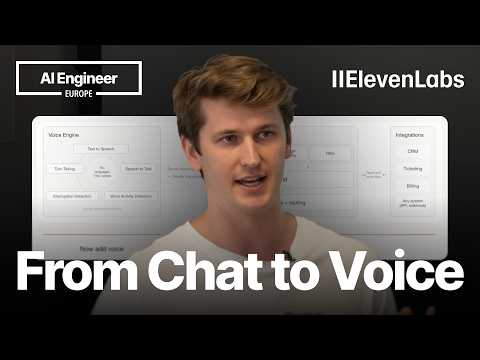
Give Your Chat Agent a Voice — Luke Harries, Head of…
Talk by Luke Harries of ElevenLabs arguing that the next upgrade for chat agents is a voice layer rather than better prompts or RAG. Covers why voice extends chat agents to phone lines, calls, screen readers, and ambient interfaces, and how the ElevenLabs Voice Engine wraps an existing chat agent with a few lines of code—handling turn-taking, speech-to-text, text-to-speech, and emotion-aware interruption detection—without altering underlying agent logic. Includes a live demo converting a chat support agent to voice, overviews of the client and server SDKs, Shadcn-based UI components, tool calling through the wrapper, and predictions for AI agents, plus Q&A.
# Video Identity Observations
## Presenter & Explicit Self-Description
- The speaker introduces himself as **Luke Harries, Head of Growth at ElevenLabs** (per video title).
- He explicitly positions the company: ElevenLabs **"first started... building the best text to speech models in the world"** and was then **"pulled into this big solution of how do you now build these agents."**
- Claims customer scope: **"powering customers like Revolut's customer support."**
## Intended Audience
- **Developers who have already built chat agents**: > "You've spent a ton of time building these complex chat agents. But to actually add voice to that is then remarkably simple."
- Explicit in-room framing: > "Probably a bunch of us in this room have either built the same system or pitched the same slide."
- Developer-experience emphasis: > "really importantly for the folks in this room, we've really cared about what does the developer experience of this look like?"
## Claimed Scope of Content
- Announces a **product preview**: > "I'm giving you an early preview of a new product which will be coming out in a couple of weeks... this is voice engine."
- Technical components claimed: **speech-to-text ("Scribe")**, **text-to-speech ("V3")**, **emotion/context-aware turn-taking**, **"thousands of different voices and languages"**.
- Claims simplicity: **server SDK**, **client SDK ("basically three lines")**, **UI components "based on the Shaan CN and Vercel style"**, and a **skill enabling conversion "in about one prompt"**.
## Observable Presentation Patterns (Demonstrated, Not Claimed)
- **Live product demo**: The speaker demonstrates a working chat support agent ("Hello, how are you? Perfect. It replies... all running locally") and shows generated wrapper code.
- **Trend-analysis framing**: Opens with commentary on 2025 chat agents, citing a viral tweet (Linear, PostHog, "SEO") and **gov.uk's chat agent approach**.
- **Recruiting posture**: Closes with an explicit call — > "We're also looking for some design partners... we'd love to chat."
- **Q&A segment**: Handles a tool-calling question, describing client-side vs. server-side tools and DOM manipulation.
## Claims vs. Demonstration Distinction
- **Claimed but not shown**: accuracy rankings ("Scribe, which is the most accurate model"), Revolut partnership, out-of-box telephony/CCaaS.
- **Demonstrated**: local chat agent responding, wrapper code on screen, SDK code walkthrough.
- **Predictive claim** (creator opinion, flagged as such): > "chat agents will either die... or start adding voice."
# Delivery Observations — Luke Harries, "Give Your Chat Agent a Voice"
## Overall Tone & Register
- **Conversational, developer-to-developer**: casual vocabulary and asides throughout — "Chat's cool, but it doesn't feel like you're building the future though."
- **Pitch-like enthusiasm**: frequent intensifiers — "really excited," "really cool," "super simple," "remarkably simple," "really beautiful well thought out UI components."
- **Self-aware humor**: "Probably a bunch of us in this room have either built the same system or pitched the same slide."
## Recurring Vocabulary & Phrases
- **"Really" as a habitual intensifier** (stable pattern): "really excited," "really agree," "really think," "really cared about," "really useful paradigm," "really simple and easy."
- **Simplicity framing**: repeatedly emphasizes ease of adoption — "super simple. It's basically three lines," "pretty much out the box," "literally in about one prompt," "very easy, very quick to prompt."
- **"Basically" as a filler/hedge**: "we basically have this," "it's basically three lines," "we've basically taken this voice engine bit," "It basically has all the best in class stuff."
- **"Kind of" and "like" as verbal tics**: "start like correcting you," "kind of got pulled into," "kind of proxy all the stuff," "this is like a really useful paradigm."
## Teaching / Presentation Habits
- **Concrete audience-relevant examples**: references PostHog, Linear, and gov.uk in the opening; later "let's say you were PostHog."
- **Problem → solution structure**: establishes customer pushback via role-played quote — "Well, hold on. I've already got my agent... Why would I need to completely replace and rebuild?" — before introducing the product.
- **Live demo with narration**: "I'll give you a quick demo now," walks through interactions ("Hello, how are you?" — "Perfect. It replies."), then shows code: "So you can see here we've got the voice engine. You attach it with each new new session."
- **Summarizing recap**: explicit "So to summarize the two different things we now have for developers..."
- **Closes with a call to action**: "We're also looking for some design partners... we'd love to chat."
## Uncertainty Notes
- Filler-word frequency ("um," "uh") appears throughout but the transcript is a demo-style talk; exact frequency can't be reliably measured from timestamps alone.
- Audience reactions beyond bracketed "[applause]" are not observable, so pacing/pause dynamics are inferred only from transcript breaks.
# Position Record: "Give Your Chat Agent a Voice" — Luke Harries, Head of Growth, ElevenLabs
## Speaker
- **Luke Harries** (identified via title metadata), Head of Growth at ElevenLabs.
## Central Thesis
- **2025 was "the year of the chat agents"** — Harries claims SaaS companies either "died" or "became AI first by adding a chat agent."
- He cites a **viral tweet** about Linear, PostHog, and SEO tools converting home screens to chat interfaces as evidence of a trend he "really agrees with," calling chat a declarative, quick-start default — even noting **gov.uk** adopting chat agents.
- **Qualification:** "Chat's cool, but it doesn't feel like you're building the future."
## Why Voice (Stated Reasoning)
Harries argues voice is the natural next medium because it is:
- **Quicker and more interactive** than chat.
- **More accessible** for people who struggle with keyboards or have dyslexia.
- **Omni-channel** — unlocks new interaction paradigms:
- An agent could join a Zoom call and correct wrong stats (PostHog example).
- Customer support can add a phone line.
> "What we really need to do is upgrade all these chat agents into voice agents."
## ElevenLabs' Evolution (As Described)
- ElevenLabs initially aimed to "build the best text to speech models in the world," then was "pulled into" the broader agent-solution problem.
- They power customers like **Revolut's customer support**.
- Typical architecture: a **voice engine** (TTS, turn-taking, STT) plus **agent orchestration** (LLMs, RAG, tool calling, integrations).
- **Customer tension noted:** many customers had already built agent orchestration and asked why they should rebuild — motivating the new product.
## Product Announcement: "Voice Engine" (Early Preview)
Described as wrapping the voice engine into a **first-class primitive** that wraps any existing agent:
- **Scribe** STT — claimed "most accurate model"; **V3** TTS.
- **Advanced turn-taking** — emotion/context aware, detects pauses, handles "semantic baddies" *(transcript as spoken)*.
- Thousands of voices and languages.
### Developer Experience Claims
- **Server SDK**: create client, create voice engine, attach a wrapper to an existing chat agent; each session proxies to the existing agent.
- **Client SDK**: ~three lines to add a widget to a site; telephony and "C SAS" *(transcript as spoken)* come "pretty much out the box."
- **UI components** based on "Shaan CN" *(transcript as spoken)* and Vercel style; a coding agent can convert a chat agent to a voice agent in "about one prompt."
- Ships with a **skill** that analyzes the codebase, identifies the chat agent, and handles deployment/wrapping.
- Live demo of a generic chat support agent run locally ("Hello, how are you?").
## Broader Suggestion
- Harries proposes the community move toward **"higher abstraction bundles"** instead of pure STT/TTS components.
## Summary of Two Options for Developers
1. **Voice Engine** — wrap existing chat agents via SDK.
2. **Full agents platform** for conversational AI, out of the box.
## Closing Prediction & Call to Action
- **Prediction:** "Chat agents will either die or start adding voice."
- Seeking **design partners** for early access.
## Q&A: Tool Calling
- Harries states the existing **chat agent handles the majority of tool calling** on the back end, so the wrapper avoids tool-calling issues.
- ElevenLabs supports **client-side and server-side tools**; e.g., exposing tools on the frontend to manipulate the DOM.
- **Forward-looking (tentative):** "We're going to add in a way where you can proxy some of these tool calls to the wrapped agent" — not yet shipped.
## Notes on Record Quality
- All claims are Harries's own promotional assertions (e.g., "most accurate model," "one prompt conversion") and are recorded as expressed, not verified.
- Product described as unreleased at talk time ("coming out in a couple of weeks") — status may have changed.
# Speaker Attribution & Provenance Record
**Video:** Give Your Chat Agent a Voice — Luke Harries, Head of Growth, ElevenLabs
**Video ID:** `01a15ca9-75a0-7ef6-a323-e98a6569bbb5`
## Speakers & Roles
| Speaker | Role | Evidence |
|---|---|---|
| **Luke Harries** | **Presenter / creator-side keynote speaker**, identified as **Head of Growth, ElevenLabs** | Title attribution; first-person statements: *"when we first started 11 labs"*, *"what we found is when we were starting working with these customers"* |
| **Unnamed audience member(s)** | **Q&A questioner(s)** | Asks *"how do you handle tool calling?"* after the talk |
| **Audience** | **Non-speaking role** — applause noted twice in transcript | `[applause]` stage directions |
No narrator, host, or additional guests are present.
## Promotional Segments (Flagged)
- **Entire talk is promotional** in nature: speaker represents ElevenLabs and is announcing a product.
- **Explicit product announcement / early preview:** an unreleased "voice engine" product, described as *"a new product which will be coming out in a couple of weeks."*
- **Direct solicitation of business:** *"We're also looking for some design partners. So if you want to be some of the first people to do this, we'd love to chat."*
- **Product feature promotion:** claims about Scribe ("the most accurate model"), V3 text-to-speech, "advanced turn-taking," server/client SDKs, UI components, and an upcoming "skill" for code conversion.
## Referenced Sources & Third-Party Claims
- **Viral tweet referenced, not quoted verbatim:** speaker cites a tweet about Linear, PostHog, and SEO companies making chat interfaces their home screens. No link or author provided.
- **gov.uk chat agents:** cited as an example of government adopting chat interfaces. No specific source given.
- **Named customers/claims:** ElevenLabs is *"powering customers like Revolut's customer support"* — third-party claim from the speaker, unverified in the source.
- **Third-party technologies referenced:** shadcn/cn and Vercel (UI style), Zoom (call scenario), coding agents.
- **Speaker opinions/predictions (first-party, not sourced claims):** "2025 was the year of the chat agents"; prediction that chat agents will either die or add voice.
## Provenance & Availability Notes
- **Transcript is speech-only**; no curated metadata block was supplied (no description, chapters, links, or citations).
- **No timestamps** present in the transcript; Q&A boundaries marked only by `[applause]` stage directions.
- **Comment availability:** not indicated — no metadata supplied.
- **Demo shown in-talk** (live chat agent and generated code) is described verbally only; visual evidence unavailable from transcript.
- **Unreleased product:** details reflect a pre-launch preview; final product claims may change.
\>\> And so really excited to talk to you about giving your chat agent a voice. Um and 2025 was the year of the chat agents. And I
think you either like died a SAS or you became AI first by adding a chat agent to your app. And so lots of you probably saw this tweet which went viral where it
was linear post hog SEO where they all went and added their home screen is now the chat interface. And I actually really agree with this. It's like that's the default way that you want to now be interacting with AI. You can use the tool calling, you can use the rag. It's just very declarative. It's a great quick start. You even have the government doing the same. This is the gov.uk um approach into chat agents. Chat's cool, but it doesn't feel like you're building the future though. And I really think voice is this natural medium. It's way quicker, it's way more interactive. It's also much more accessible to lots of people who struggle with keyboards or dyslexia, voice is a much more natural medium. And it's also omni channel. As soon as you add voice, you unlock all these different type of interaction paradigms. So let's say you were post hog, well now your agent can actually join a zoom call and start like correcting you if you're saying wrong stats. Or if you're customer support, you can now add a phone line. And so what we really need to do is upgrade all these chat agents into voice agents. And oh.
There's a there's some transitions. Um and what we found when we're building with companies is we first started 11 labs, we were like, "Okay, let's just build the best text to speech models in
the world." And then we kind of got pulled into this big solution of how do you now build these agents? And we're working powering customers like Revolut's customer support. And all of them kind of end up looking like this where you have this voice engine where you do the text to speech, the turn taking, the speech to text. You then have this agent orchestration where you combine your LLMs, your rag, your different tool calling, your all your integrations. Probably a bunch of us in this room have either built the same system or pitched the same slide. But what we found is when we were starting working with these customers, loads of them went, "Yes, we're starting from scratch. That's great. Let's use this out of the box one." Um but for lots of them, they'd actually already built this. And they were like, "Well, hold on. I've already got my agent. I spent loads of time doing the evals, the transcriptions. Why would I need to completely replace and rebuild with what I have?" And so that's why we're I'm giving you an early preview of a new product which will be coming out in a couple of weeks where we've basically taken this voice engine bit and wrapped it up into its
own first class primitive, which makes it really easy for you to add and wrap any existing agent. And so this is voice engine. We combine the best
models, so speech to text with scribe, which is the most accurate model, as well as the text to speech models like V3. It's got this really advanced turn taking, which is emotion context aware. It can tell when you're pausing. The it does the semantic bad as well. As well as all the different thousands of different voices and languages. And really importantly for the folks in this room, we've really cared about what does the developer experience of this look like? And what's really cool about this is you've spent a ton of time building these complex chat agents.
Um but to actually add voice to that is then remarkably simple. And so this is what the server SDK looks like. We basically have this uh you create your client, you then create
your voice engine. And then you add this little wrapper to your existing chat agent where you basically attach it. And then each time there's a new session started, it will kick off this loop and just kind of proxy all the stuff to your to your existing chat agent. Additionally, with the server SDK, we also then have the client SDK. And so this is like super simple. It's basically three lines you can then add and you have a widget in your site. Uh one of the cool things you actually get for free as well is once you've started adding these client SDKs, you can then also add like telephony and C SAS. And all of this is like pretty much out the box once you've wrapped it. Um and finally we have a bunch of really beautiful
well thought out UI components all based on the Shaan CN and Vercel style. So you can actually just point your coding agent and give it a go. Uh what's cool is you can literally in
about one prompt actually convert an existing chat agent to a voice agent. So I'll give you a quick demo now. Um So this is like your generic chat support agent where we can go, "Hello, how are you?" Perfect. It replies. Uh so that works pretty well. And this is the code all running locally. And and where when we release this, it will come with a skill which basically has all the best in class stuff. And then it's literally one prompt which will then go analyze your code base, work out your chat agent, how to actually deploy it, work out how to wrap it. Um so it should be really cool and quick to do. I'll just show you some of the code that it ends up writing. So you can see here we've got the voice engine. You attach it with each new new session, it then starts proxying it. So it should be really simple and easy to add to your existing agents. All right. We can let it work in the background. Um Cool. So that's a that's an early glimpse of voice engine. I also think this is just
like a really useful paradigm which one of the community should do where we start kind of moving to this higher abstraction bundles instead of just the pure text to speech speech to text. So to summarize the two different things we
now have for developers building these different voice engines um or voice agents, you've either got voice engine, which is fantastic. You spend all your time building these excellent chat agents. You can just do this little wrapper with a nice SDK. Or if you want to use a full agents platform for conversational, we've got that out of the box. It's very easy, very quick to prompt. Uh ends with a um uh a prediction. I think these chat agents will either die chat agents or start adding voice. Um I'm excited to
work with lots of people in the room. We're also looking for some design partners. So if you want to be some of the first people to do this, we'd love to chat. But thanks so much. \>\> \[applause\]
\>\> Cool. Yeah. I have how do you handle tool calling? Yeah. The cool thing about this is um your chat agent actually normally does
the majority of tool calling. So it's actually already built out on the back end here. And so you can have this wrapper without needing to deal with any of the issues of tool calling. We also um at 11 labs have the concept of either client side uh tools and server side tools. So you can do some pretty cool stuff where you then like expose the tools on the very front end to like manipulate the DOM. And we're going to add in a way where you can proxy some of these tool calls to the wrapped agent. But most folks will already have all the tool calling already handled with the chat agents. Cool. Nice. Thanks so much. Thank you. \>\> \[applause\] \>\> Cool.