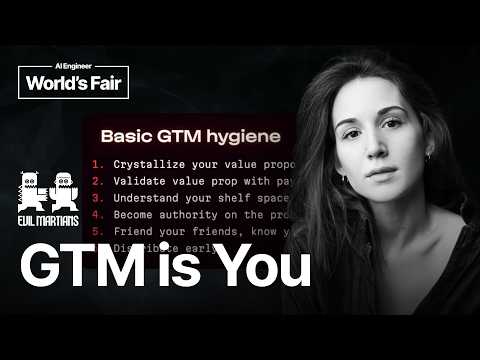
GTM Is You - Victoria Melnikova, Evil Martians
Talk by Victoria Melnikova (Evil Martians) analyzing interviews with developer tool founders (including Sam Lambert, David Cramer, Paul Copplestone, Ivan Burazin, Zeno Rocha, and Jason Bosco) conducted in San Francisco to derive go-to-market tactics for developer tools and AI startups, with a focus on building a personal brand.
# Video Identity Observations — "GTM Is You - Victoria Melnikova, Evil Martians"
## Explicit Self-Description (Creator Claims)
- **Role and affiliation:** The presenter states directly: *"I'm Victoria Melnikova, and I run new business at Evil Martians. We're a consultancy for developer tools."*
- **Channel reach claim:** She claims the consultancy operates a blog *"that has half a million technical readers every year."*
- **Adjacent media property:** She states she runs *"a podcast about the business of developer tools called Dev Propulsion Labs."*
- **Methodology claim:** The channel/consultancy claims a proprietary framework: *"At Evil Martians, we developed product market fit compass... We analyzed 37 successful devtools and derived a graph."*
## Observable Presentation Evidence
### Intended Audience
- **Developer-tool founders and early-stage startups**, evidenced by: *"I work with about 50 startups every year, and I know just how much founders hate this part of the job"* and *"We work with early stage developer tools startups."*
- Specifically **technical founders averse to marketing**: *"technical founders really hate marketing. So, distribution is something that we need to fix."*
- The closing invitation is audience-targeted: *"DM me to talk about your go-to-market."*
### Claimed Scope
- **Go-to-market strategy for developer tools "in 2026"**: *"today, I want to talk to you about what works as go-to-market for developer tools in 2026. I say that go to market is you."*
- **Business-of-devtools expertise**: *"My job is to figure out the business of developer tools."*
### Demonstrated Content Patterns
- **Expert interview clips from named founders** are woven through the talk: Sam Lambert (PlanetScale CEO), David Cramer (Sentry), Zen Rocha, and unnamed Typesense and Supabase-related speakers.
- **Structured, educational framework delivery:** six enumerated GTM hygiene steps (value proposition, shelf space, channels/authority, ecosystem, foes, early distribution).
- **Opinionated thesis framing** with a competitive-advantage hook: *"the most underrated competitive advantage in startups in 2026... it's you."*
- **Narrative opening** using a scene-setting anecdote (a San Francisco evening at the PlanetScale office) before pivoting to the core argument.
- **Advisory/consultative call to action** consistent with a consultancy's business model: *"DM me to talk about your go-to-market."*
### Tone and Positioning
- Direct, conversational, second-person address: *"I invite you to think about your failures as opportunities"* and *"I would like to invite you to think about you."*
- Takes a stance against AI-generated marketing noise: *"AI made our inboxes and feeds unpairable... it's really hard to tell the real deal,"* while framing AI as an amplifier, not a replacement, of personal brand.
## Notes on Source Limits
- No curated metadata was supplied; identity observations rest solely on the title and transcript.
- Audience size and framework claims (readership figures, 37 devtools analyzed) are **creator claims**, not independently verifiable from this material.
# Delivery Observation: "GTM Is You" — Victoria Melnikova
## Overall Tone
- **Conversational and energetic**, blending storytelling with structured teaching. She opens with a cinematic scene rather than a thesis: *"Picture this. It's a warm summer night in San Francisco."*
- The tone mixes **informality** (*"you get the idea"*, *"boba time"*) with **business vocabulary** (*"product signal"*, *"cross-pollinate"*, *"founder-led sales"*, *"mind share"*).
## Structure & Teaching Habits
- **Numbered, list-based instruction**: *"I will walk you through five simple six simple steps"* — a visible self-correction mid-count.
- **Explicit agenda-setting**: *"And today, I want to talk to you about what works as go-to-market for developer tools in 2026."*
- **Evidence-citing habit**: *"And I actually have evidence to back that up."* followed by the "37 successful devtools" analysis. This recurs with founder quotes (Sam Lambert, David Cramer, Zen Rocha) used as proof points.
## Recurring Phrases
- **Direct invitations to the audience** (stable pattern, appears ~4 times):
- *"I invite you to..."*
- *"So, what I invite you to do is..."*
- *"I would like to invite you to think about you."*
- *"I suggest you think about your own personal traits"*
- **"Really" as an intensifier** (very frequent): *"really hate this part"*, *"really, really hard"*, *"really resonates"*, *"really really comes through"*.
- **"Need to" framing** for imperatives: *"we need to crystallize"*, *"we need to validate"*, *"we need to distribute early"*.
## Storytelling & Quotation
- **Opens and anchors on an anecdote**: the Sam Lambert story, framed with narrative detail (*"He's in a great mood... he has a drink in hand"*) and callback: *"That conversation has been rattling in my head for days."*
- **Frequent embedded third-party quotes**, introduced with attribution markers: *"And David Cramer, founder of Sentry, put it even more bluntly."* / *"Here's what Zen Rocha says about that."*
## Rhetorical Patterns
- **Rhetorical questions**: *"Why, you ask me?"*; *"Don't you ever get tired of it?"*
- **Antithesis / triadic contrast**: *"It's not your model, it's not your team, it's not your funding, it's you."*
- **Repeated "you" emphasis** matching the title: *"it has to be you"*, *"GTM is you"*, *"be unapologetically you"*, *"think about you."*
## Verbal Disfluencies
- Noticeable fillers and restarts, concentrated in the instructional mid-section: *"uh"*, *"um"*, *"the the painful problem"*, *"a lot to a lot to tackle there"*, *"five simple six simple steps"*. These appear **less in the polished opening**, suggesting the intro was more rehearsed.
## Closing Habits
- **Returns to the invitation formula**: *"I would like to invite you to think about you."*
- Ends with a **direct CTA**: *"DM me to talk about your go-to-market. Thank you."*
## Uncertainty Note
- Delivery features like pacing, gestures, or visual aids are **not observable** from the transcript; observations here are limited to spoken-language evidence. Disfluency frequency estimates are impressionistic from the text.
# GTM Is You — Position Record
**Speaker:** Victoria Melnikova (Evil Martians, runs new business); quoted: Sam Lambert, David Cramer, Zen Rocha, and unnamed founders (per transcript cues).
## Central Thesis
- **"Go-to-market is you"** — the founder's personal brand is the most underrated competitive advantage in startups in 2026; "it's not your model, it's not your team, it's not your funding, it's you."
- Supporting context: **building software has never been easier, so the bottleneck has moved to distribution.**
## Key Evidence & Claims
### Sam Lambert anecdote
- Sam Lambert (PlanetScale CEO) reportedly said he loves Twitter and gets many customers from his own account; when asked whether he tires of it since "you can't delegate it," he replied: "I would never give it up. It's my literal favorite thing to do."
- Melnikova: technical founders hate this part of the job, yet it "has to be you."
### Product Market Fit Compass (Evil Martians framework)
- A mathematical formula from analyzing **37 successful devtools**, graphed on two axes: **product signal** and **revenue**.
- Signal > revenue → work on distribution.
- Revenue > signal → work on product.
- Equal → "go forward full speed."
- Finding: **nine out of 10** early-stage devtool clients have signal stronger than revenue, largely because technical founders hate marketing.
### AI-driven noise
- AI made inboxes/feeds "unpairable" [sic — overwhelmed]; generated slop makes it hard to cut through noise — hence personal brand matters more.
## Recommendations: Six Steps of GTM Hygiene
1. **Crystallize value proposition** — validate with *paying* customers.
2. Understand **shelf space** in a developer's life.
3. Use that to pick **channels** and become the authority on the problem.
4. Understand the **ecosystem** — "friend our friends," know foes to differentiate.
5. **Distribute early**, even pre-product readiness (founders hate this).
### SF-Lessons (from founder interviews)
- **Come to San Francisco:** meet clients/friends in person; VCs are there; staying after YC allegedly helps fundraise "twice as much, twice as fast."
- David Cramer (Sentry): "SF is unfair. Just do it… it's a network game."
- **Banners/billboards:** signaling + subconscious mind share. Typesense founder (unattributed by name): billboards served as a **credibility proxy** since, unfunded, they lacked funding milestones to signal trajectory.
- **Events:** small formats (paddle, poker, breakfasts, meetups, launch parties) through user conferences; earlier-stage startups increasingly host user conferences; Supabase cited as example; one founder describes abandoning a "no conference policy" after internal consensus built.
- **Crazy marketing:** banners over subs, branded coffee, named ice cream — fun shows; **failure attracts** people if there's an elegant recovery.
- Quoted founder: walked away from **$300K ARR** to start from scratch — "Absolutely. Should have done it sooner," then qualified: "maybe 2 months before would have been better," with interviewer noting "sooner would be too early."
### Personal Brand
- Be **unapologetically you**; quirks can become your genius zone and personal-brand pillar.
- Pendulum swinging toward the **artisanal**; people prefer crafted experiences despite AI.
- **AI can amplify your signal but not replace you.**
- **Founder-led sales** builds trust — people want a real human behind the product.
- Zen Rocha: tries not to overthink personal brand; "just try to be myself… as organic as possible."
- Closing claim: personal brand is the **moat**; hard for AI to replace even as AI improves through 2030.
## Qualifications & Tensions
- SF argument is framed as applying "of course" mainly to **fundraising** — acknowledged scope limit.
- The "should have done it sooner" claim is immediately softened by both speakers (timing caveat).
- Cramer's "SF is unfair" is presented as contrarian against "internet memes" — disagreement with remote-first views preserved, not resolved.
- Evidence base is Melnikova's own framework and anecdote; presented as evidence, not independently verified.
# Speaker & Role Attribution — "GTM Is You – Victoria Melnikova, Evil Martians"
## Primary Speaker
- **Victoria Melnikova** — **Creator / presenter**. Self-identified: "I'm Victoria Melnikova, and I run new business at Evil Martians." Delivers the main narrative and framework throughout.
## Quoted Third Parties (in anecdotes and clips)
- **Sam Lambert** — quoted as **CEO of PlanetScale**; anecdote about acquiring customers via his personal Twitter account. (Paraphrased/quoted dialogue, not a live guest segment.)
- **David Cramer** — quoted as **founder of Sentry**; clip commentary on San Francisco networking.
- **Zen Rocha** — quoted on personal brand authenticity (clip segment, no title given in transcript).
- **Unnamed TypeSense speaker(s)** — quoted regarding billboards as a credibility proxy ("we're not a VC-backed company"); role inferred only from the speaker's own words, name not stated in transcript.
- **Unnamed interview clip participants** — a dialogue about walking away from $300,000 ARR; speakers unidentified in transcript.
## Narration Structure
- First-person narrative talk by the creator, interleaved with **pre-recorded interview clips** (marked by `>>` in transcript) from founder conversations. Clip speakers are only identified where the creator names them (Cramer, Rocha); others remain **unidentified**.
## Promotional Segments
- **Creator's own organizations** are promoted: Evil Martians (consultancy, blog with "half a million technical readers"), the **Dev Propulsion Labs** podcast, and the **Product Market Fit Compass** framework.
- Closing call-to-action: **"DM me to talk about your go-to-market"** — an explicit promotional/solicitation segment.
## Referenced Sources & Claims
- **Product Market Fit Compass**: creator states Evil Martians "analyzed 37 successful devtools" to derive it — an internal, unverifiable claim.
- Statistic: "nine out of 10 times, product signal is stronger than revenue" among their early-stage clients — internal claim, no external source.
- Anecdote: "if after YC you stay in SF, you fundraise twice as much, twice as fast" — attributed to general "notion," no named source.
- Third-party claims embedded in clips (Cramer on SF, TypeSense speaker on billboards, dialogue on ARR) are quoted without cited evidence.
## Availability Limits
- **No curated metadata was supplied**; attribution is derived solely from the transcript.
- Names of several clip speakers and the clip sources (which podcast/event) are **not stated** — uncertainty remains.
- **Comment availability: unknown** (no metadata provided).
Picture this. It's a warm summer night in San Francisco. We are at the new PlanetScale office downtown, right off Market Street.
Sam Lambert, the CEO, is there. He's in a great mood. New office, room full of cool people, he has a drink in hand, you get the idea. I'm talking to Sam about how PlanetScale gets customers. And Sam says something I wasn't expecting. He says, "I just love Twitter. You would be shocked if I told you how many customers we get from my own account. I work with about 50 startups every year, and I know just how much founders hate this part of the job. So, I asked, "Don't you ever get tired of it? You can't delegate it, you know." It has to be you. Sam smiles and says, "I would never give it up. It's my literal favorite thing to do." That conversation has been rattling in my head for days. I think Sam just mentioned the most underrated competitive advantage in startups in 2026. It's not your model, it's not your team, it's not your funding, it's you. Quick context on why I'm telling you this. I'm Victoria Melnikova, and I run new business at Evil Martians. We're a consultancy for developer tools. We have a blog that has half a million technical readers every year, and I run a podcast about the business of developer tools called Dev Propulsion
Labs. My job is to figure out the business of developer tools. Building software has never been easier, which means that the bottleneck has moved. Now, the bottleneck is the
distribution. And today, I want to talk to you about what works as go-to-market for developer tools in 2026. I say that go to market is you. Well, your personal brand. And I actually have evidence to back that up. At Evil Martians, we developed product market fit compass. It's this framework that tells us exactly what needs to be done for a devtool company to achieve product market fit. It's a mathematical formula. We analyzed 37 successful devtools and derived a graph. Basically, it consists of two axes, product signal and revenue. If product signal is stronger than revenue, we need to work on distribution. If revenue is stronger than the signal, we need to work on the product. If signal and revenue are the same, we just go forward full speed. We work with early stage developer tools startups, and nine out of 10 times, product signal is actually stronger than revenue. Why, you ask me? Well, technical founders really hate marketing. So, distribution is something that we need to fix. And the truth is, in 2026, distribution is really, really hard. AI made our inboxes and feeds unpairable. There is so much annoying outreach and generated slop that it's really hard to tell the real deal. And it's really hard to cut through the noise. So, what I invite you to do is I
want you to revisit some of the conversations I had with successful devtool founders here in NASSCOM and learn from them. And we'll begin with
just basic go to market hygiene. Uh I will walk you through five simple six simple steps uh that will create foundation for our go to market motion. First, we need to crystallize our value proposition. We really need to understand the the painful problem that we're solving, and we need to validate that value with paying customers. It's very important that those customers are willing to pay. Then we need to understand where in the life of a developer we live. So, we need to understand the shelf space. Once we understand that shelf space, we understand what channels to use to distribute our product, and we can become the authority on the problem. Then we need to get a good sense of the ecosystem. We need to friend our friends and cross-pollinate. And we need to know our foes, so we can distinguish ourselves from them. Finally, this is something that technical founders really hate to do, but this is really something super important. We need to distribute early, sometimes even before the product is ready. The first big lesson that we can take away from SF-based devtool founders is come to San Francisco. \>\> \[gasps\] \>\> San Francisco is great because here you can meet your clients and friends in person. And there is this whole notion that if after YC you stay in SF, you fundraise twice as much, twice as fast. This applies to fundraising, of course. All the VCs are here, so if you're in the fundraising game, you have to be here as well.
\>\> Uh I try and talk to folks that are newer in the industry or they're building things and try and chat with them, and and this is a place to make that really easy. So, I think SF is
going to stay strong for that. It's very hard to unseat those. \>\> And David Cramer, founder of Sentry, put it even more bluntly. \>\> I think there's like a network thing. If you can get to SF, despite what people would like to tell you, SF is unfair. Just do it. Who cares? Who cares about what the internet memes say? Like SF is like it's like a network game, right? Like especially if you want to like do the founding thing or or the venture thing, like it is so unfair if you have access to SF. \>\> Once you're in SF, you have to get loud. You have to advertise. SF is big on the banners. You can see them on the Muni buses. You can see them on buildings. There are banners on the highways. Banners in SF do two things. It's signaling. You are sending a strong message to the world that you exist. Potentially, you even invented a new category, and you want to be loud about that. Um and of course, you want to earn mind share. What this means is that they memorize you on a subconscious level. \>\> And also, it helped establish Type Sense as a brand that, you know, because we're not a BC back company, we don't have funding milestones to share to say to say, "Okay, hey, we're we're on a good trajectory." So, we needed to find a proxy for that, and billboards are expensive. So, we realized, "Okay, this is this could be one way as an our own credibility mechanism to say that, 'Hey, we're not And and it And that's the feedback we also got now that the billboards have been, you know, around for a couple of months, and that's the feedback we've been, you know, getting is that, 'Oh, I didn't realize you were this big that you could do, you know, hundreds of billboards in SF.' So, \>\> Once you're in SF, of course, you have
to do events. And there are different ways to do this, and probably this is like a huge separate topic, but basically, you can organize events, you can come to events. When it comes to
organizing events, you can do small events, and you can choose whatever format you want. You can play paddle, poker, uh do breakfast, do dinners, do lunches, do boba time. Uh you can do technical meetups. You can do launch parties. You can do user conferences. There is really really like a lot to a lot to tackle there. And now it's becoming more common for earlier stage startups to host their own user conferences. Uh you can learn from the industry's best. Like folks like Superbase are doing their Superbase Select second year in a row. \>\> I think everyone eventually aspires to have their own user conference. And for us we have discussed it for many years and we kind of internally have a no conference policy. Like as in we don't attend many conferences. We just put our heads down and do work. And then this year, for whatever reason, it wasn't me who chose it. The momentum built and someone decided that now was the year. And I guess there was enough consensus built that we should do this. \>\> And do crazy things. Fly a banner over a sub. Do a crazy marketing campaign. Open a cafe. Um brand your coffee. Name an ice cream. I love a sub because founders here are just doing crazy things and they work. And I think that whenever you have fun with your marketing, it really really comes through and shows. This one is special because failing actually attracts people to your brand. Um everyone wants to be perfect, but perfect is boring and people just love a good fail story, especially if there is like an elegant recovery from it.
I invite you to think about your failures as opportunities. \>\> starting from scratch, you know, because you walked away from
ARR of what? 3 \>\> We had 300,000, yeah. \>\> That's a solid ARR, you know. \>\> Especially pre-AI, not terrible, yeah. \>\> Yeah, it sounds great. You walked away from that. You started from scratch. Now looking back at it, are you happy about that move? \>\> Absolutely. Should have done it sooner. Yeah, it's always like, you should have done that sooner. \>\> I mean, sooner would be too early. \>\> I guess, maybe. Maybe 2 months before would have been better. \>\> Finally, um I want to invite you to be unapologetically you. Uh everyone has unique quirks, and if you think about it, your unique quirks can become your genius zone. Something that comes naturally to you, something that you're really passionate about. This could really become a pillar for your personal brand. Uh the good news is the pendulum is kind of running back to the artisanal. People love craft, people love beautiful designs, people love beautiful text. It really resonates with the audience. So, despite all the AI automation that's available to us, I think people still prefer a beautiful crafted experiences. So, for us technical folks, that's that's a good chance to execute. And the way I see AI is it cannot really replace you, but it can amplify your signal, right?
So, whatever you bring forward, AI can amplify, whether that's text, videos, whatever it is. I suggest you think about
your own personal traits and ways in which AI can amplify that on your personal level and on a brand level, on a team brand level. People want to buy personally from you. Founder-led sales is one of the main motions, especially for early-stage startups, for a reason. That's how trust is built. People want to see a real human behind the product. Here's what Zen Rocha says about that. \>\> I feel like I I try not to overthink my personal brand as much, or like have like, "Oh, here's my food strategy, you know? I just try to be myself because that's how I feel like people are are drawn to folks that are they try not to impersonate or or or be someone else. So, I just try to be as organic as possible. \>\> Your personal brand is the moat. Founders that learn to leverage their personal brand will stand out. In 2026, in 2030, as AI gets better, we'll only have an ability to amplify that even more, but it's going to be very hard for AI to replace our unique brands. I would like to invite you to think about you. What are some quirks and genius zones that you have? What are some things that come naturally and organically to you? What are some things that interest you? And think about how is that could become pillars for growing your personal brand and therefore your company's brand. I wish you the best of luck winning your share of the pie and DM me to talk about your go-to-market. Thank you.