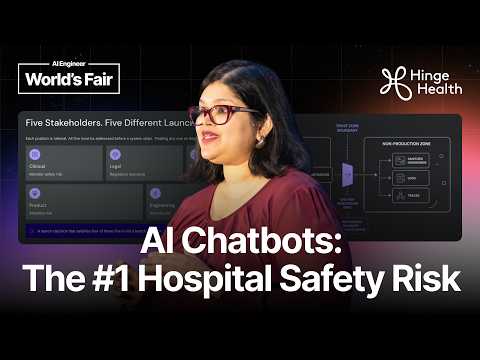
Guardrails First: Engineering Member-Facing Health AI —…
Talk by Rashi Agrawal (Hinge Health) on engineering safety architecture for member-facing healthcare AI. She frames the problem with the sodium bromide chatbot poisoning case, an independent Mount Sinai safety test of a consumer health AI that under-triaged life-threatening emergencies about half the time, and ECRI naming chatbot misuse the top health technology hazard of 2026, noting roughly 40 million people already self-triage with AI. Her core argument: most healthcare AI safety failures are architectural decisions made before any model output. Topics covered include stripping PHI at the pipeline boundary on ingestion; keeping deterministic, must-never-be-wrong logic (911/988 routing, intent routing, identity verification) in a code layer above the model rather than in prompts; why not to treat prompts as security boundaries; safety as a continuous layer of judges scoring live traffic, with the discipline of verifying the judge when a score drops; and a launch checklist covering five stakeholders, five risks, and five decision rules.
# Observable Presentation Evidence — "Guardrails First: Engineering Member-Facing Health AI — Rashi Agrawal, Hinge Health"
## Speaker & Platform Signals
- **Practitioner talk format**: The video is a conference-style presentation, opening with a handoff reference — *"[snorts] Chetana gave us a great overview… Today I'm here to talk more from a practitioner's view"* — indicating the video is one session within a larger event.
- **Named speaker with stated role**: The speaker self-identifies: *"I'm Rashi Agrawal. I lead AI and ML at Hinge Health."*
## Explicit Self-Description / Claimed Scope
- The talk explicitly frames its scope: *"I will be talking about guardrails that are needed to build member-facing health care AI"* — positioning the content around safety architecture for production health AI, not research or general LLM topics.
- The speaker claims the material reflects real practice: a **five-rule decisioning framework** described as *"the framework I actually use for making these decisions when stakeholders disagree."*
- Closing self-positioning: *"We are not building a generic low-stakes chatbot. We are building a system that has to be worthy of someone's health."*
## Intended Audience (Demonstrated)
- **AI/ML engineers and technical leaders** in regulated industries, evidenced by:
- Direct engineering framing: *"Most AI safety failures in health care are not model failures. They are architectural decisions."*
- Assumes familiarity with concepts like prompt injection, evals, multi-agent architectures, LLM authority hierarchy (*"Root, system, developer, user, guideline"*).
- **Product, legal, compliance, and clinical stakeholders** are addressed through the stakeholder-disagreement scenario (clinical, legal, compliance, product, engineering each seeing different risks).
- Audience is presumed to work with **distributed teams and HIPAA-regulated data**: *"We all work with the teams which are geographically distributed."*
## Demonstrated Content Patterns
- **Regulatory grounding**: Repeated references to HIPAA, FDA's good machine learning practice, and state law (*"state laws like Texas, Triaga"*) presented as design inputs, not afterthoughts.
- **Architecture-first philosophy** as a recurring motif: *"Don't policy what you can architect. Don't prompt what you can code. Don't gate what you can monitor."*
- **Use of real-world incident citations** to motivate the topic (chatbot bromide poisoning case, Mount Sinai triage study, ECRI's 2026 hazard ranking) — though the talk itself does not name its publication sources beyond these descriptions.
- **Actionable frameworks over theory**: Layered architecture (PHI protection → deterministic code layer → continuous evaluation) plus a five-rule launch decisioning rubric.
- **External engagement CTA**: *"Let's continue the conversation on LinkedIn"* — observable channel-presentation behavior suggesting audience follow-up off-platform.
## Distinguishing Claims from Demonstration
| Creator claim | Observable evidence |
|---|---|
| Speaker leads AI/ML at Hinge Health | Stated directly in intro |
| Framework is what she "actually uses" | Self-reported; no independent corroboration in material |
| 40M people use frontier models for triage; ECRI ranked AI chatbot misuse #1 hazard of 2026 | Cited as context; sources not named in transcript |
| Architecture described (PHI stripping at ingestion, deterministic escalation to 911/988, live judges) | Described as Hinge Health practice; not shown in demo, only narrated |
**No curated metadata was supplied**, so all identity evidence derives from title and transcript. No private motivations were inferred beyond direct statements.
# Delivery Observations — Rashi Agrawal, "Guardrails First: Engineering Member-Facing Health AI"
## Overall Tone & Register
- **Practitioner-to-practitioner tone**: Direct, declarative, engineering-focused. She opens by framing the talk explicitly: *"Today I'm here to talk more from a practitioner's view of you know how we are building health care AI within Hinge Health."*
- **Confident, normative delivery**: Heavy use of prescriptive imperatives — *"You cannot slap on HIPAA on top of, you know, an underlying system"* and *"Don't ask, 'How often does this happen?' Ask, 'What's the worst version of this?'"*
- **Conversational softeners interspersed**: Fillers like *"you know," "believe it or not," "we all know," "Last but not least"* keep the register informal despite technical content.
## Structural Teaching Habits
- **Numbered frameworks, announced in advance**: She signals structure upfront — *"It starts with three non-negotiable foundations"* — and later *"The next slide is the framework I actually use... Five rules."* Each rule is labeled explicitly: *"Rule one. Worst case always wins... Rule two, Severity is not capacity..."*
- **Roadmapping the talk**: *"That's the first part of what I want to talk about today. The second half is what happens when the architecture is not enough."*
- **Layered metaphor**: Consistent "layer" vocabulary — *"Let's start with layer one... Let's move to the layer two... layer three."*
- **Summary slide callback**: *"Here's the whole talk in one slide. If you screenshot one thing, this would be it."*
## Recurring Linguistic Patterns
- **Contrastive formula: "not X, but Y"** (highly repeated):
- *"They are architectural decisions that were made before even a single token was generated"* (vs. model failures)
- *"safety is a continuous evaluation layer, not a one-time gate"*
- *"Monitoring is not a last resort. It is the first resort"*
- *"Fast follows are committed debt, not an optional backlog"*
- *"Fast follows are debt, not backlog"*
- *"revealed risk tolerance, not stated risk tolerance"*
- **Parallel "Don't X what you can Y" construction** in the closing takeaway: *"Don't policy what you can architect. Don't prompt what you can code. Don't gate what you can monitor."*
- **Repetition for emphasis**: *"always, always design for human in the loop"*; *"must must again take a deterministic route"*; *"is not this is not really a frontier problem."*
- **"The rule is very simple" / aphoristic statements**: *"A model is not a guardrail. A model with a system prompt is also not a guardrail."*; *"What can never be wrong cannot be left to probability."*
## Use of Concrete Examples & Case Framing
- **Anecdotal case studies to open**: Two detailed failure stories — *"Poisoned by a chatbot"* and the Mount Sinai triage study — narrated in short, punchy sentences: *"3 weeks in the hospital. For what? For following diet advice?"*
- **Rhetorical questions as pivots**: *"So the question comes, how do you ship AI to somebody who's already trusted you with their health?"* and *"So, what do you do? Do you hold the launch and fix, or do you actually ship?"*
- **Side-by-side scenario teaching**: The judge-verification example uses paired scenarios — *"In scenario A... In scenario B"* — to isolate a single variable (whether the judge or agent is wrong).
- **Quantified specifics**: *"Bromide levels 200 times the safe limit," "under-triaging life-threatening emergency 50% of the times," "400 mg for most adults," "score has been steady at 4.9."*
## Vocabulary & Domain Terminology
- Consistent technical vocabulary: **PHI, HIPAA, prompt injection, golden data set, evals, judges, traces, drift, fast follows, irreversible decisions**.
- Consistent audience vocabulary: **member** (not "user" or "patient") — e.g., *"member-facing," "member feedback," "member trust is why."*
- Vivid architectural metaphors: *"The picture to hold in your head is a stack. Code on top, model below"*; *"even a single pipe is all that it takes."*
## Verbal Fillers & Disfluencies
- Frequent **"you know"** throughout: *"you know how we are building health care AI," "you know, the regulatory bar is much, much higher," "you know, as you keep scaling your consumers."*
- Occasional false starts and self-corrections: *"There are two spectrums to it. One is safety bugs and polish, the other side is polish bugs"* (apparent garbled phrasing); *"you you get the point"*; *"If the If the If it ships broken."*
- Audible **[snorts]** appear repeatedly in the transcript, suggesting a physical tic or breath pattern during pauses (uncertain — may be a transcription artifact of breathing/laughing).
## Isolated Moments vs. Stable Patterns
- **Stable**: contrastive framing, numbered lists, imperative phrasing, "member" vocabulary, aphoristic rules — all recur across the full talk.
- **Isolated**: the dramatic rhetorical question *"For what? For following diet advice?"* appears once; the caffeine example is a single extended illustration; the final LinkedIn call-to-action appears only at the close.
- **Uncertainty note**: Timestamps for disfluencies come from the transcript's own markers; whether the [snorts] represent audience sounds or the speaker cannot be determined from text alone.
# Position Record: Guardrails First: Engineering Member-Facing Health AI — Rashi Agrawal, Hinge Health
## Speaker
- **Rashi Agrawal**, who leads AI and ML at Hinge Health, delivers the entire talk from a practitioner's perspective on building member-facing healthcare AI.
## Framing: The Production Baseline
- **Claim**: 40 million people use frontier models for triaging healthcare issues.
- **Failure cases cited by Agrawal**:
- A 60-year-old man followed AI diet advice to substitute salt with sodium bromide for 3 months, resulting in ER admission with paranoia and hallucinations, bromide levels 200x the safe limit, and 3 weeks in the hospital.
- A Mount Sinai independent safety test found a consumer health AI under-triaging life-threatening emergencies (diabetic ketoacidosis, respiratory failure) 50% of the time, advising a doctor visit "in a day or two" when the correct answer was immediate ER care.
- ECRI named AI chatbot misuse the **number one health technology hazard of 2026**.
- **Position**: "This is not a frontier problem. This is the production baseline that we're working with right now."
## Three Non-Negotiable Foundations
1. **"The constraint is the architecture"** — Most AI safety failures in healthcare are not model failures but architectural decisions made before any token was generated.
2. **Deterministic rules belong above the model, not inside it** — "What can never be wrong cannot be left to probability."
3. **Safety is a continuous evaluation layer, not a one-time gate** — "Launch of your product is where the real risk starts, not where it ends."
## Layer 1: PHI Protection
- **Position**: PHI protection requires both policy (what to protect) and architecture (ensuring it happens).
- PHI should be stripped **at the pipeline boundary at ingestion**, before reaching the data lake — not reactively redacted from logs.
- Production and non-production must be **completely separate, with no pipes between** — "even a single pipe is all that it takes" for member data to leak.
- Access depends on **role and geographic region**; engineers outside regulated regions cannot reach raw PHI at all.
- Regulatory frameworks (HIPAA, FDA's good machine learning practice, state laws like Texas) are **"grounding inputs" to design, not afterthoughts** — "You start with it and let the architecture grow around it."
- Closing claim: architecture-level protection means relying on "a system that's incapable of certain failures," not trusting policy compliance.
## Layer 2: Code Above the Model
- **Position**: "A model is not a guardrail. A model with a system prompt is also not a guardrail. Code that runs above the model is closer."
- Reasoning: model labs themselves publish an authority hierarchy (root, system, developer, user) where "every layer above user is one prompt injection away from being overridden" — "If the labs themselves don't trust the prompt as a security boundary, neither should you."
- **Code layer responsibilities** (irreversible decisions):
- **Emergency escalation**: self-harm, suicidal ideation, acute emergencies route to 911/988; "the model should not even see this turn."
- **Intent routing**: high-stakes classification (clinical vs. tech support vs. education) takes deterministic routes; a clinical question routed to generic tech support is "unrecoverable."
- **Identity verification**: authentication is a security boundary; prompts are not.
- Pattern: "Code runs first. Code makes the irreversible decisions. The model handles what's left."
## Layer 3: Continuous Evaluation
- **Position**: Evals as a pre-launch checklist are "necessary but hardly enough"; production safety relies on judges continuously scoring **live traffic**, not saved golden datasets.
- **Three signal sources**:
- **Automated judges** across many dimensions (clinical accuracy, safety, escalation, relevance, drift, refusal), always refreshing.
- **Member feedback** (thumbs up/down) — "the only one that comes straight from the person you're serving it to"; catches tone problems judges miss.
- **Sample traces** — random samples across capabilities, with 100% sampling on high-stakes cases.
- **Claim**: The bottleneck is not compute or capability but "having enough people to read the signal and act on it."
- **Position on persistent failures**: Some failures can't be "prompted away"; each fix round "buys you less and less" and the rate never hits zero — so "monitoring is not a last resort. It is the first resort, which is always on." New production failures become new judges.
## Decisioning Framework: When Architecture Isn't Enough
**Scenario presented**: One open issue 5 days before launch; five stakeholders see different risks — Clinical (member safety, hold), Legal (regulatory exposure), Compliance (audit risk), Product (adoption risk), Engineering (velocity risk).
**Five rules** (Agrawal's stated framework):
1. **Worst case always wins** — severity set by worst plausible outcome, not average; a bug harming 0.1% of users is more severe than one annoying 100%.
2. **Severity is not capacity** — severity comes from harm, not ownership or fix difficulty; options are fix, delay, or accept with explicit sign-off; "never quietly downgrade a bug."
3. **Asymmetric default** — for safety bugs, when unsure, hold and fix; for polish bugs, when unsure, ship.
4. **Revealed risk tolerance, not stated** — calibrate to what the org already accepts in production, not stated standards; a behavior live in the existing product without complaints "cannot be called a launch blocker just for a new thing."
5. **Humans are the constraint** — "Judges scale. Pattern interpretation doesn't." Fast follows are **committed debt, not optional backlog**.
## Production Discipline: Verify the Judge
- **Position**: In a non-deterministic system the judge is also non-deterministic — "Before you trust the score, verify the scorer."
- Example: a clinical accuracy judge dropping from 4.9 to 4.5 should prompt first a check of the judge, not the agent.
- Side-by-side caffeine example:
- **Scenario A**: agent gives FDA-standard 400 mg guidance with pregnancy/medication caveats; judge wrongly flags as hallucination → **fix the judge**.
- **Scenario B**: agent says 1,000 mg/day is fine; judge correctly flags → **fix the agent**.
- Claim: "Fixing a judge prompt is not cheating. Judges are software, too."
## Closing Synthesis
- Architecture pattern: **"Don't policy what you can architect. Don't prompt what you can code. Don't gate what you can monitor."**
- Decisioning pattern: score by worst case, default to the safer mistake, calibrate to the org, design for human-in-the-loop.
- **Qualification acknowledged**: Building guardrails first is slower than bolting them on later — "that's the design, not limitation."
- Closing position: "We are not building a generic low-stakes chatbot... The architecture is how, the decisioning is when, and member trust is why."
# Speaker & Provenance Observation — Video `01a15ca7-d038-70b1-ae65-26139ea616b1`
## Video
**Title:** *Guardrails First: Engineering Member-Facing Health AI — Rashi Agrawal, Hinge Health*
## Speakers & Roles
- **Rashi Agrawal — Creator / Primary speaker**
- Self-identified in transcript: *"I'm Rashi Agrawal. I lead AI and ML at Hinge Health."*
- Delivers the entire talk; sole substantive speaker throughout.
- **Chetana — Referenced prior speaker (not present in this transcript)**
- Mentioned: *"Chetana gave us a great overview of... what a bridge does."* Role and affiliation not stated.
- **Audience — Implied, non-speaking**
- Talk addressed to a live audience ("good morning"); no audience speech recorded.
- No guests, narrators, or other identified voices appear.
## Roles Claimed/Implied for the Speaker
- **Head of AI/ML at Hinge Health** (self-stated).
- Speaks from a **practitioner's perspective** on building member-facing healthcare AI.
## Referenced Sources & Third-Party Claims
Rashi Agrawal cites the following (no bibliographic details given; claims recorded as stated, not verified):
- **"40 million people"** using frontier models for health triage — source not named.
- **Case report:** 60-year-old man harmed after following chatbot advice to substitute sodium bromide for salt — source not named; described as a headline from "the past one year or so."
- **Mount Sinai independent safety test** — claimed finding: a consumer health AI under-triaged life-threatening emergencies ~50% of the time (DKA, respiratory failure).
- **ECRI** (patient safety group) — claimed to have named **AI chatbot misuse the #1 health technology hazard of 2026**.
- **Regulatory/framework references:** HIPAA, FDA's Good Machine Learning Practice, state laws (Texas mentioned; "Triaga" as transcribed — likely transcription artifact), model labs' published authority hierarchy (root/system/developer/user/guideline).
## Promotional Segments
- **Closing promotion:** *"Let's continue the conversation on LinkedIn."* — explicit call-to-action flagged as promotional.
- No product marketing, sponsorship, or third-party promotion otherwise detected. Hinge Health's own practices are described, but as talk subject matter rather than flagged ad segments.
## Availability & Evidence Limits
- **Curated metadata:** None supplied beyond title and transcript; no speaker bio, event name, or date established externally.
- **Comments availability:** Not indicated.
- **Transcript artifacts:** Repeated `[snorts]` markers; "Triaga" possibly a mistranscription of a state law name — uncertainty remains explicit.
- **Timestamps:** Absent from transcript; none invented.
\>\> Hello and good morning. Chetana gave us a great overview of you know what a bridge does. Today I'm here to talk more from a practitioner's view of you know how we are building health care AI within Hinge
Health. So hi, I'm Rashi Agrawal. I lead AI and ML at Hinge Health and today I will be talking about guardrails that are needed to build member-facing health care AI. I want to talk a little bit about the state of health care AI right now. We do have a lot of frontier models which are running and believe it or not, 40 million people actually use these models for triaging their health care issues. But there is a caveat and these are some of the headlines that have been happening in the past few in the past one year or so. Poisoned by a chatbot. Let's start with this one person. A 60-year-old healthy man asked a popular AI assistant how to cut salt from his
diet. The LLM told him to swap it with bromine sodium bromide. He did it for 3 months. He landed in the ER with paranoia and
hallucinations. Bromide levels 200 times the safe limit. 3 weeks in the hospital. For what? For following diet advice?
Let's look at another pattern. The first independent safety test of a consumer health AI out of Mount Sinai found that this health AI is under
triaging life-threatening emergency 50% of the times. Diabetic ketoacidosis, respiratory failure. And it told the people to go see a doctor in a day or two. The right answer was ER right now. And this is in French. In February, ECRI the patient safety group that hospitals trust to rank their top risks named AI chatbot misuse as the number one health technology hazard of 2026. Number one on the list that they publish every year. So this is not this is not really a frontier problem. This is the production baseline that we're working with right now. So the question comes, how do you ship AI to somebody who's already trusted you with their health? The next 20 minutes are all about that.
It starts with three non-negotiable foundations. One, the constraint is the architecture. Most AI safety failures in health care are not model failures.
They are architectural decisions that were made before even a single token was generated. Two, deterministic rules belong above the model, not inside it. What can never be wrong cannot be left to probability. And three, safety is a continuous evaluation layer, not a one-time gate. Launch of your product is where the real risk starts, not where it ends. That's the first part of what I want to talk about today. The second half is what happens when the architecture is not enough and a human has to make a decision of what ships versus what holds. \>\> \[snorts\] \>\> Let's start with layer one. Protecting PHI takes both policy and architecture. Policy tells you what to protect and
architecture makes sure that it actually happens. The first thing that changes when you start shipping member facing health AI is where PHI lives.
Most teams treat PHI as a runtime problem. Something to redact when a log gets written to a dashboard. That's the reactive version. The architecture version strips PHI at the pipeline boundary. At ingestion before it ever reaches the data lake. By the time the data is stored, the PHI is gone. So, a developer opens a dashboard there's nothing to redact. The PHI was never there. The rest of the architecture works in a similar way. Production and non-production stay completely separate. No pipes in between because even a single pipe is all that it takes for member data to leak into a dev environment. And HIPAA laws are very stringent, especially in health care. You know, the regulatory bar is much, much higher. So, you have to be very careful about the architecture that you're designing. Another big thing access depends on two things. Your role and your geographic region. We all work with the teams which are geographically distributed, but not everybody has access to PHI. That is a certification, a policy that is applied to specific regions only. An engineer outside the regulated region cannot reach raw PHI at all. And the compliance rules, HIPAA, FDA's good machine learning practice, state laws like Texas, Triaga, they are not afterthoughts. They are the grounding input in how you actually design your systems. You cannot slap on HIPAA on top of, you know, an underlying system or an architecture. You start with it and let the architecture grow around it. When PHI is protected at the architecture level, you're not just trusting that the policies will get followed. You're actually relying on a system that's incapable of certain failures.
Let's move to the layer two. Probabilistic systems are great at generation. We all know that. However, they are unreliable for things that cannot can never be wrong. So, the
rule is very simple. Must not fail behavior belongs above your prompt, above the model. And what does above the prompt actually mean? It means that there is a code layer that runs first on every turn before the model even runs. The code layer is what makes your irreversible decisions. The decision of, you know, whether this is an emergency escalation, should they be routed to 911, should a clinician step into the loop. All of those are irreversible decisions which need to lie at a deterministic code level layer. The model handles the long tail of your conversations and interactions with your members. The picture to hold in your head is a stack. Code on top, model below. Every turn goes through the code layer first. Most turns do reach the model, but the model never gets a vote on high stake calls. Here's how you can think about it in a different way. A model is not a guardrail. A model with a system prompt is also not a guardrail. Code that runs above the model is closer. Even the labs that be build these frontier models publish the authority hierarchy. Root, system, developer, user,
guideline. Every layer above user is one prompt injection away from being overridden. If the labs themselves don't trust the
prompt as a security boundary, neither should you. \>\> \[snorts\] \>\> So, what does live in this code layer? Let's examine it a little bit. Let's take three examples.
First, very very relevant to health care, which is emergency escalation. If a member mentions self-harm, suicidal ideation, or an acute medical emergency,
the system must route to 911 or 988. The model should not even see this turn. Code runs first, decides, and routes, and makes a decision right away. Another example, intent routing. Which capability in your underlying multi-agentic system, multi-agentic architecture handles a conversation turn? Is it clinical? Is it tech support? Is it education from the millions of, you know, credited articles? Is it exercise recommendation? The model can help to classify, but high-stakes path must must again take a deterministic route at the top itself. You You don't want like a clinical question quietly being routed to your generic tech support agent. That's unrecoverable. Third, identity verification. Anything that touches member data has to check that the right member is at the other end. That's an authentication check. And authentication is a security bound boundary. Prompts are not. The underlying pattern across all three, code runs first. Code makes the irreversible decisions. The model handles what's left. Last but not least, layer three. As we all know, safety is not a gate you
pass once. It is a continuous layer that runs the whole time. Most teams treat evals as a pre-launch checklist. You run your tests, you ship, you move
on. That's necessary, of course, but that's hardly enough. What actually holds up in production is judges that continuously keep scoring real conversations as they happen. Not a saved golden data set. Live traffic. Scored on a lot of dimensions all the time. These signals come from three sources, and each one catches something different. First, automated judges. 30, 40, name it, you know, as as much as you can scale. Automated judges with multiple dimensions, always refreshing. Clinical accuracy, safety, escalation, relevance, drift, refusal, etc., etc. I can keep going on. But you you get the point. These are the automated judges that are always going to catch regressions and any even sensitive drops in quality. Second, your gold mine of information. That's going to be member feedback. Thumbs up, thumbs down on each and every single message. That's the truth signal. That's your member communicating with you. And it's the only one that comes straight from the person that you're serving it to. It catches tone problems and things that judges miss. \>\> \[snorts\] \>\> Third, sample traces. Random samples spread across capabilities with high-stake cases checked every single time. 100% sampling on those. Ultimately, people need to read these signals. People are going to catch what no single metric is going to catch. And here's the part that nobody really warns you about. The bottleneck is not the compute, the models, the capability. It's actually having enough people to read the signal and act on it. One more thing about layer three. Some failures, you can't just prompt away. You ship the fix, it comes back under new conditions. New prompts, new tools, the model shifts. You ship the fix again. Each round buys you less and less. The rate never hits zero. At this point, monitoring is not a last resort. It is the first resort, which is always on. A new failure that you see in production simply means you now have a new judge. Your underlying architecture and your system needs to be able to keep scaling with new judges, new monitoring as you keep scaling your, you know, consumers. And \[snorts\] that's the point. Monitoring is how you know that the architecture is still holding. \>\> \[snorts\] \>\> But monitoring also tells you when the architecture is not enough. And when the architecture is not enough, a human has to decide. And this is the second part of my talk where I want to focus on the decisioning frameworks. \>\> \[snorts\] \>\> Let's take an example. You're about to
ship, you know, uh consumer AI again in the healthcare space, and you have a feature, a specific capability that you're about to launch. And there is one issue left on the board
5 days before your launch. And you have multiple different stakeholders. Five stakeholders look at the same issue. Each one sees a different risk. And they don't agree what to do about it. Clinical sees member safety risk. They want to hold the launch. Legal sees regulatory exposure. Compliance sees audit risk. Product sees adoption risk. The If the If it ships broken, the feature won't land. And engineering sees velocity risk. They can't fix it without slipping the date they want to ship. Five rational people, five different risks, and five very different fixes. So, what do you do? Do you hold the launch and fix, or do you actually ship? The next slide is the framework I
actually use for making these decisions. Five rules. This is how I think about decisions when stakeholders disagree. Rule one.
Worst case always wins. Severity is set by the worst possible plausible outcome, not the average. And this is extremely relevant in health care. A bug that lightly annoys 100% of users is way less severe than one that could cause serious harm in 0.1% of cases. This is non-negotiable. The worst case matters more than the average case, always. So, when you're triaging, don't ask, "How often does this happen?" Ask, "What's the worst version of this?" That sets the severity. Rule two. Severity is not capacity. This one keeps politics out of it. As we all know, as we ship features, there's always a little bit of contention between timelines, features, deliverables. But, a bug's severity comes from the harm that it causes. Not who owns it, not whether your team has the capacity to fix it, not how hard the fix is. You have three options in front of you at this point. Fix, delay the launch, or accept the risk with explicit sign-off. Those are the three. You never quietly downgrade a bug just because you can't get to it. Rule three, asymmetric default. When you don't know what to do, always pick the safer mistake. And there are two spectrums to it. One is safety bugs and polish, the other side is polish bugs. For safety bugs, the math is one-sided. Shipping a real safety bug is much worse than delaying for a false alarm. So, for safety bugs, when you're not sure, always hold and fix. On the other side, for polish bugs, the math runs the other way. Delaying a launch costs more than shipping a small flaw. So, when you're not sure, ship in case of polish bugs. Ultimately, the framework doesn't decide for you. It just tells you which way to lean. Rule four, revealed risk tolerance, not stated risk tolerance. Your launch bar is what your org already accepts in production, not what it says it will accept. If a behavior has been live in your existing product for weeks, months, without escalation, without member complaints, without leadership concern, you cannot you cannot call it a launch blocker just for a new thing. Your stated risk tolerance might be no bugs in production, but your revealed risk tolerance is what's actually shipping today. Calibrate to the revealed one. That's the floor. Rule five, humans are the constraint. Judges scale. Pattern interpretation doesn't. Always, always design for human in the loop. Judges code traces automatically. Dashboards refresh every few hours. None of that is hard anymore. But what's hard is having enough people to read the signal and act on it. One more piece around this. Fast follows are committed debt, not an optional backlog. If you didn't ship it at launch, it's not a wish list item. It's already committed. The five rules tell you how to decide. But they all assume one thing. That your underlying signal is true. So here's the discipline that needs to come first. In a non-deterministic system, the judge
is also non-deterministic. Before you trust the score, verify the scorer. And here's what it looks like in practice.
Say you're watching a clinical accuracy judge in production. The score has been steady for at 4.9 for weeks. Today, it drops to 4.5. And tomorrow, it stays at 4.5. The immediate instinct is, let's start changing the prompts. The agent is broken. Let's fix the agent. That's reactive. And it's risky. You fix one thing and you break another. Worse, you're changing the agent based on a signal that might not be true. And the discipline needs to be different. First, ask whether the judge is right. We can solidify that with a with a concrete example. Uh let's take it side by side. In scenario A, same question, member asks about caffeine. The agent gives FDA standard guidance. 400 mg for most adults, less if pregnant or on certain medications. The judge flags it as a hallucination. Because the agent mentioned pregnancy and medications without checking. But that's just clinical context. The judge is over calling in this case. Fix the judge in this scenario. For the same question, scenario B, the agent says 1,000 mg a day is fine. That's well above the safety limits. The judge correctly flags it. And the agent is wrong. In this case, fix the agent. The rule is always ask, is the judge right before changing the agent's response? Fixing a judge prompt is not cheating. Judges are software, too. And they need to continuously evolve. This is what production discipline looks like when the system is not deterministic. Here's the whole talk in one slide. If you screenshot one thing, this would be it. Six takeaways, three from architecture, three from decisioning.
On the architecture side, the pattern is very simple. Don't X what you can Y. Don't policy what you can architect. Don't prompt what you can code.
Don't gate what you can monitor. On the decisioning side, the pattern is how humans decide when the system cannot. Score by the worst case and default to the safer mistake. Calibrate to your org. And always design for the human in the loop. Fast follows are debt, not backlog. Yes, building guardrails first is slower than bolting them on later. But that's the design, not limitation. We are not building a generic low-stakes chatbot. We are building a system that has to be worthy of someone's health. The architecture is how, the decisioning is when, and member trust is why. Thank you. Let's continue the conversation on LinkedIn. Thank you.