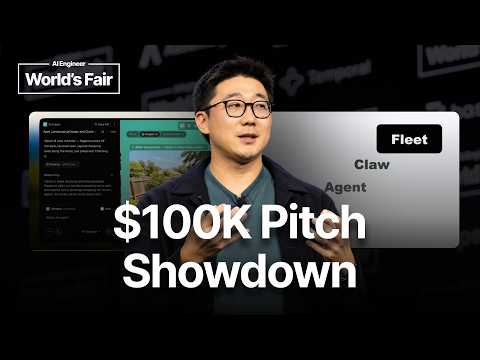
Hiring Employable Agents + Startup Battlefield Finals —…
Howie Liu (founder of Airtable and HyperAgent) traces the progression of agent product form factors — from raw completions to chatbots, agents, always-on agents, and agents that orchestrate other agents. He demonstrates a landscaping business run end to end on HyperAgent, featuring a triage agent, a surveyor agent, human approval steps, and agents that learn from feedback. The talk also discusses what it takes to hire an agent the way you would hire an employee. The second half is a Startup Battlefield segment in which three finalists (Kamad, Comment IO, and Built by Foundry) pitch to judges Howie Liu, Theo (T3 Chat), and Joshua (HeyGen) for $100,000 in prizes; Comment IO wins, Built by Foundry places second, and Kamad places third. Recorded at the AI Engineer World's Fair 2026 in San Francisco.
# Video Observation Report
## Context and Setting
This video captures a **live conference keynote and startup competition segment** at an event repeatedly referred to as **"AIE"** ("Hello, AIE", "our biggest AI engineer event ever", "hyperagent.com/aiie"). The speaker is introduced as Howie Liu, described as "the founder and CEO of airtable" and associated with **HyperAgent**, "a product within airtable."
## Intended Audience
- **AI engineers and technical builders attending a conference.** The speaker addresses the room directly: *"many of you are sitting in this room are really just kind of overseeing a fleet of agents"* and *"there are really really creative people many of whom are in this room."*
- **Startup founders and product builders**, evidenced by the embedded Startup Battlefield competition: *"from 500 founders we... pre-selected 20. They competed today in the startup battlefield."*
- **Practitioners across industries, not only software**, per the speaker's framing: *"ingenuity of agent builders is not contained to just AI companies or software companies... it doesn't have to be a pure software business."*
## Claimed Scope and Self-Description
- The speaker self-describes as *"a product thinker at heart"* and frames the talk as a high-level, non-technical overview: *"this is not about the technical deep dive but how do we think about these from a product building standpoint."*
- He claims a deliberate **horizontal platform philosophy**: Airtable is *"almost laughably horizontal platform"*, initially rejected by investors (*"you can't possibly go out with a horizontal platform approach"*) but now applied to agents via HyperAgent.
- The talk presents a **form-factor taxonomy**: completions → chatbot → agent → "claw" (always-on agents with heartbeat mechanisms) → multi-agent orchestration, with the Anthropic definition of agents cited: *"a model that recurses upon itself."*
- Product claims include that HyperAgent *"works with a fully capable sandbox VM"* where agents can *"write code... manipulate files... use things like ffmpeg."*
- A direct **call to action** is made: *"hyperagent.com/aiie and you get $1,000 of inference credit."*
## Observable Presentation Patterns
- **Promotion embedded in narrative**: the keynote transitions from worldview to product demo to competition sponsorship ($100,000 in prizes: *"50k to the winners um 30k to runner up to 20k to second runner up"*).
- **Customer story as proof point**: a landscaping business running *"virtually end-to-end"* on agents is presented as *"a very realistic use case based on some of our actual customer usage."*
- **Authority references**: the speaker cites Anthropic's agent definition, Sarah Guo's post on where value accrues, and Jensen Huang's "somebody using AI" framing.
- **Event-host voice**: the second half features a host referencing his own London keynote (*"work agents are eating the rest of work"*) and noting his team's dependence on Airtable (*"AIE runs on air table"*).
## Boundary Notes
- This is a single event recording; channel-wide conclusions should not be drawn from it.
- Customer outcomes (e.g., the landscaping case) are creator claims demonstrated via demo, not independently verified.
- No curated metadata was supplied beyond the title and transcript.
# Delivery Observations — Howie Liu (HyperAgent keynote + startup battlefield)
## Tone & Register
- **Enthusiastic, high-energy keynote register.** Opens with audience engagement: *"All right. Hello. Um, who's excited about the end of this event?"*
- **Self-deprecating/casual asides punctuate the structure**: *"I've never been introduced with so much base. I am very very pumped in this moment."*
- **Consistent stakes-raising language** near the close: framework adoption is framed as existential — *"table stakes for survival for every company in every industry."*
## Vocabulary & Word Choice
- **Heavy repetition of intensifiers**, especially *really* and *very* (often doubled): *"really really intelligent orchestration," "very very intimately familiar," "a really really important kind of next form factor leap."*
- **"Form factor" is a signature term**, used at least eight times as an organizing concept: *"product form factor thinker at heart," "the next form factor of AI."*
- **Corporate/team framing via "fleet"**: *"a fully fleet of agents native company," "overseeing a fleet of agents."*
- **Agent-as-employee metaphor** runs through the talk: *"hiring employable agents," "agents to get unblocked by humans that still own policies and decisions," "just like a great manager."*
- Minor transcript-artifact quirks: "air tableable," "claw" for Claude/openclaw, "instruct GBT" for InstructGPT — deliverable-level artifacts, not verified spoken habits.
## Teaching Habits
- **Spectrum/ladder explanations.** Introduces a progression, then walks each rung: completions → chatbot → agent → "claw" → orchestration, each introduced with *"The next level I call..."*
- **Concrete anchoring after abstraction.** Explicit signpost: *"So all this is kind of abstract. I want to make it very very tangible"* — then a full landscaping-business walkthrough.
- **Named-definition behavior.** Pauses to pin down overloaded terms: *"my definition of agent really is the same as the anthropic definition, which is distinct from workflows."*
- **Reference-dropping as credibility scaffolding**: Sarah Guo (*"a great post uh a few weeks ago"*), Gary, Jensen (*"it's not going to be AI taking your job"*), Anthropic's agent definition.
- **Analogy-driven teaching**: SimCity (*"zooming out to see the entire Sim City landscape"*), developer-tool history (Copilot → Cursor → agentic devs) mapped onto general agent work.
## Structural / Communication Patterns
- **Rhetorical setup with "right?"** as a constant checking device: *"that's a spectrum, right?... it would just kind of complete your thought, right?"* — extremely frequent, likely the most repeated token in the talk.
- **Signposted structure**: *"So who am I," "So let's walk through what this looks like," "And so, you know, I I compare this to..."*
- **Contrast framing** ("not just X, but Y") recurs: *"not just an AI native company, but... a fully fleet of agents native company"; "not just the opportunity to boil the ocean but... table stakes for survival."*
- **Product placement is soft-sold**, delivered as an invitation rather than a pitch: *"we'd love to see you try Hyper Agent... you get $1,000 of inference credit."*
## Panel/Q&A Behavior (Startup Battlefield segment)
- **Judging style is framing-first.** He names the *shape* of a business before critiquing: *"I love the shape of this business because it's like the inverse of what we just heard... they went super vertically deep... you guys are going super broad."*
- **Questions are forward-looking and competitive**, not financial: *"what do you do to keep up with the changing competitive landscape... as models progress?"*
- Occasionally interjects positivity before questions: *"it checks all the boxes on like the classic... ideal vertical agent business."*
## Stable Patterns vs. Isolated Moments
- **Stable (repeated across the talk):** "right?" tic, "really/very" intensifier stacking, "form factor" framing, spectrum/ladder teaching, contrast constructions, agent-as-employee metaphor.
- **Thin evidence (single occurrence, treat cautiously):** the SimCity analogy; the "boil the ocean" idiom; the closing Jensen quote — each appears once, so recurrence as a habit is unconfirmed.
- **Isolated context-dependent moments:** the playful improv during technical snafus (*"Pretend like we're a non multimodal model. We just we only accept text."*) reflects the live-event format rather than a signature pattern.
# Position Record: "Hiring Employable Agents + Startup Battlefield Finals"
## Speaker Identification
The transcript does not label most speakers; attribution below relies on contextual evidence in the transcript (introductions, self-identification) and should be treated as speaker-by-context, not verified metadata.
- **Howie Liu** — introduced as "chief executive officer at Hyper Agent" (also self-identifies as founder/CEO of Airtable); delivers the keynote.
- **Unidentified host/emcee** — runs the Startup Battlefield segment.
- **Theodore (Theo)** — apparently a judge; self-references as a creator ("with me, for Vercel") and is asked to present an award.
- **Spirro Anakos, Dom, and Nick Nakos** — self-identified founders of "Kamad" (transcript variously renders it *Kamad*, *Commod*, *Kimode*, *Commodities*).
- **Max Windbomb and team** — "Common.io" (also rendered *Comet*, *comment.io*, *Common*), a multiplayer markdown editor.
- **Weston Belgettes** — self-identified founder/CEO of "Built by Foundry."
- **Joshua** — judge, asks a question (initially directed at the wrong team).
---
## Keynote Positions — Howie Liu
### Self-characterization
- Describes himself as "a product thinker at heart" — interested in **product form factors** more than technical depth, despite enjoying architecture and algorithms.
### Form-factor spectrum of AI
Liu presents a staged progression of AI product form factors, each enabled by smarter models:
1. **Completions** — token continuation; "arguably powerful but more narrowly applicable" until InstructGPT.
2. **Chatbots** — enabled by InstructGPT-style conversational tuning; ChatGPT as the breakout product.
3. **Agents** — adopts Anthropic's definition, **distinct from workflows**: "a model that recurses upon itself" with an open-ended set of tools, reasoning steps, and decisions — "not prescripted to a linear workflow."
4. **"Claws"** (term borrowed from OpenClaw's popularity) — long-running, **always-on agents** with a "heartbeat mechanism" that wake themselves up; explicitly contrasted with earlier agents that were "still mostly reactive" and completed within ~20 minutes to an hour.
5. **Agent orchestration** — agent-to-agent interaction, citing Claude Code workflows "fanning out" massively parallel agent work; framed as "the next leap."
### Stated reasoning
- Prior long-running experiments (Baby AGI, AutoGPT) "would all inevitably... end up drifting off to something not super useful"; current models are "smart enough" to sustain coherence on longer, open-ended problems, enabling task decomposition and handoffs.
- Orchestration is characterized as "managing each agent's task or context window" plus coordination.
### Hyper Agent demo — landscaping use case
- Presents a "realistic use case based on some of our actual customer usage": a **landscaping business** running end-to-end (prospecting → quoting → pitch → work management) on agents.
- **Claim about user base:** "the prototypical users for Hyper Agent are not who you would think they are" — including "traditionally offline businesses," not just AI/software companies.
- **Position:** "ingenuity of agent builders is not contained to just AI companies or software companies"; every industry can disrupt itself.
- Prefers the term **"fully fleet of agents native company"** over "AI native" — employing whole fleets with "governed behavior and... the right context and the right tools."
- Describes a multi-agent flow: **triager agent** (lead quality/scope) → **surveyor agent** (analyzes imagery/video via a "fully capable sandbox VM," including using ffmpeg to extract screenshots) → human approval gate.
### On human-in-the-loop
- Endorses Sarah Guo's recent post (which he says he "firmly agrees with"): the ultimate deployment blocker remains a human element — humans "own policies and decisions" and "gate... critical high impact actions" (e.g., sending a binding quote).
### On learning agents
- Asserts agents "should not be static... They really need to learn with every interaction" — accumulating memories, skill updates, and feedback in real time rather than waiting for fine-tuning runs.
- Endorses Gary's "GBrain" framing of a "sticky context layer that learns with every interaction" as a "universal principle."
### On the human role shifting
- Compares coding workflow evolution: manual coding → "augmented coding" (GitHub Copilot, "really just a completions form factor") → Cursor Composer 1.0 chat-style agent → **overseeing a fleet of agents**.
- Anecdotal claim: frontier agentic developers feel "going to sleep without setting off your agents... feels like you're taking this huge loss."
- UX prescription: an **orchestration control plane** — "zooming out to see the entire Sim City landscape" at macro level, not micro-managing each task.
- **Strong claim:** this shift is "not just the opportunity to boil the ocean but... table stakes for survival for every company in every industry."
- Closes with Jensen Huang's framing: "it's not going to be AI taking your job, it's going to be somebody using AI."
### Founding 500 / competition rationale (Q&A)
- Frames the competition as "betting on the most frontier part of that economy" — "the most agentically leveraged companies" defining a new playbook.
- **Claim:** leverage from agent-native companies is "far more than even being... an early software leveraged or internet leveraged company"; predicts "explosive growth far higher than any other sector."
---
## Startup Battlefield — Team Positions
**Format noted by host:** $100,000 in prizes from Hyper Agent ($50k winner, $30k runner-up, $20k second runner-up); judging emphasizes impressiveness of technology use and founder interest — "not so much a VC pitch."
### Commod (Commodities trade agents) — Spirro Anakos, Dom, Nick Nakos
- **Claim:** "$17 trillion in physical commodities move every year"; "hundreds of billions are lost annually due to fraud, fragmentation, and... complexity."
- **Product:** "agentic execution layer"; proprietary **CFC state machine** ("patent filed") governs specialized agents for KYC, document forensics, deal structuring, settlement signaling. Agents "advance only by clearing every deny condition"; "it never touches the funds."
- **Response to moat question (models absorbing the product):** commodities is "a private industry with a lot of sensitive information"; they pull from "real databases," have partner and founder domain expertise; models "can learn more for sure on the open internet, but... they have to learn upon and train upon certain data."
- **Unit economics claim:** ~100 customers to reach scale; individual deals can be "$200 million or north of that"; some partners "transact nine to 12 billion dollars a month"; monetizes per deal.
- **Additional claims:** end-to-end solution; wedge is traders and banks (banks "pulled out of physical commodities trading years ago after the fraud"); audit trails "unlock a tremendous amount of liquidity."
- **Roadmap answer:** "becoming the bank."
### Judge pushback (Theo) on Commod
- Calls it "the ideal vertical agent business" per YC-style criteria (money available, domain-specific moat) — but asks what they'll do "to keep up with the changing competitive landscape" as models progress.
- **His own position:** "the only thing that's actually defensible is being the most creative in your category"; endorses aggressive shipping ("we ship and then 10 companies go extinct the next day") and winning "ultimately... on distribution."
### Common.io — Max Windbomb and team
- **Product:** "multiplayer markdown editor... focused on making the best documents for the modern work, which is people and agents"; open, pluggable, familiar UX.
- **Problem framing:** collaboration software "was built for people, not for agents"; Google Docs has "a really terrible format" and no real-time agent collaboration, which they call "critical for all kinds of real work."
- **Team credentials claim:** collaboration work on Microsoft Word; Texio, "the first AI native writing software six years before ChatGPT"; Fortune 500 AI-writing rollouts.
### Judge feedback (Howie Liu) on Common.io
- Calls it "the inverse" of Commod: broad and "arguably maybe a little thinner but by intention."
- **His reasoning:** the agent economy will be so large (token spend) that even "1 to 2%" of tokens touched "could be a very valuable" business despite low per-usage margins.
### Team responses
- All writing software today is "horrible for agents"; real-time collaboration is missing everywhere.
- Anecdotal market signal: many conference attendees said they rolled their own visual markdown editor and "gave up, I just rendered an HTML document" — "it's a hard problem."
### Built by Foundry — Weston Belgettes
- **Product:** replaces agencies; AI agents build product businesses for content creators end-to-end; "over half a million people use products our agents built" (claimed).
- **Thesis:** "The cost of building software is approaching zero. What's left is trust and taste and no one has more of it than creators."
- Founder's background claim: two years at TikTok meeting "hundreds of creators" stuck with brand deals, affiliate links, "$20 PDFs."
- References Theo (T3 Chat) and Gary (GStack, GBrain) as creator-solves-cold-start-with-distribution examples — Theo interjects it "sucked. It doesn't work... It works great for our users."
### Judge pushback (Theo) on Foundry — substantive disagreement
- **Saturation problem:** with any brand, "there is a saturation point where it stops being useful" to his audience; his own best move was "going from having four sponsors to 80" — variety is where the value is.
- Concedes creators have more taste, distribution, and audience knowledge than most founders/companies — but says Foundry "doesn't provide the solution to that other problem."
- **His alternative model:** a tool for *businesses* to study creators ("watch my streams... find the problems I have, and then show me how your product solves them"). Speaks "as the YouTuber who has started the second most companies": creator-founded companies "doesn't work. It just burns you out and it burns your audience out too."
- **Founder's rebuttal:** tech (and comedians) are unusually hard niches; claims a homesteading creator ("Brandon," 2M followers) successfully monetizes a freeze-dryer-settings subscription; claims "zero creators across our entire company history have ever left... because they always are profitable." Theo concedes: "You're very convincing."
---
## Outcomes (as announced)
- **Second runner-up:** Commod (Kimode) — presented by Theo on the team's behalf.
- **Runner-up:** Foundry.
- **Grand prize:** Common.io / comment.io.
---
## Unresolved tensions preserved
- Theo's judge positions are internally critical on both sides: he validates Commod's vertical-agent fit while questioning its model-evolution resilience, and validates creator advantages while rejecting the creator-as-founder model Foundry is built on.
- Theo's own T3 Chat creator-business experiment is described by him as both a failure ("it sucked. It doesn't work") and a user success ("works great for our users") — left unreconciled in the transcript.
- The winning product (Common.io) is described by Liu himself as "maybe a little thinner" by intention; the tension between vertical depth and broad token-capture was presented, not resolved.
- Minor transcript inconsistencies (Kamad/Commod/Kimode; Common/Comet/comment.io) are rendering artifacts and cannot be resolved from the transcript alone.
# Video Attribution & Provenance Record
**Video:** *Hiring Employable Agents + Startup Battlefield Finals — Howie Liu, HyperAgent*
**Video ID:** 01a15ca6-9f6b-7453-ac3e-b2613cc039d1
---
## 1. Speaker & Role Inventory
### Primary Speaker
- **Howie Liu** — identified in-transcript as **"chief executive officer at Hyper Agent"** and self-identified as **"founder and CEO of Airtable"** (Hyper Agent described as "a product within Airtable"). Delivers the main talk, *"Hiring Employable Agents"*, and later participates as a competition judge.
### Hosts / Moderators (unnamed in transcript)
- **Host/MC #1** — opens the event, conducts the on-stage interview with Howie Liu, moderates the Startup Battlefield, introduces judges and teams. Name not stated.
- **Host/MC #2** — co-moderates; mentions running "my London keynote" and that "AIE runs on Airtable." Name not stated (context suggests an AIE/AI Engineer event organizer, but identity is not explicit).
- **Announcer (opening)** — introduces Howie Liu ("chief executive officer... at Hyper Agent, Howy Lou"). Name not stated.
### Startup Battlefield Judges
- **Howie Liu** (see above)
- **Theo** — referenced by name ("our dear judges... Howie, Theo, and Joshua"). Also identified by context as a creator affiliated with **T3 Chat** ("Theo, you did this with T3 Chat" — Theo confirms with self-deprecating humor). Affiliation given in-passing only.
- **Joshua** — named as a judge; affiliation not stated. Associated with "Pan" in an ambiguous line ("Thank you from Pan").
- **Judging affiliation note:** Transcript says "thank you from Pan" immediately after introducing judges — organizational link is **uncertain**.
### Competing Teams (finalists)
1. **Commod / "Kamad"** (also heard as "Kimode" — spelling inconsistent in transcript)
- **Spirro Anakos** — self-identified founder
- **Dom** and **Nick Nakos** — self-identified co-founders
- Mentions a first customer "out of the UAE... U trading company based in Dubai" (present in audience, unnamed)
2. **Common.io / "Comet"** (transcript spelling varies: Common.io, comment.io, Comet, Kamad)
- **Max Windbomb** — named by host as team lead; also described by Weston as co-founder of a prior company
- **Unnamed co-founder** — states he started his career "bringing collaboration features into Microsoft Word" and worked with Max at "Texio"
3. **Built by Foundry**
- **Weston Belgettes** — self-identified "founder and CEO of Built by Foundry"; states he "worked at TikTok for two years"
### Referenced Third Parties (spoken of, not speakers)
- **Gary** — referenced twice by Howie Liu (a prior talk at the same event; associated in the transcript with "GStack" and "GBrain" via Weston's remarks). Did not speak in this video.
- **Sarah Guo** — cited by Howie Liu as author of a post "a few weeks ago" about where value accrues in the AI landscape.
- **Jensen** — quoted indirectly by Howie Liu ("as Jensen put it... somebody using AI who takes your job").
- **Anthropic** — cited as the source of Howie Liu's agent definition; mentioned as a potential model/tool provider.
- **OpenClaw** — credited with popularizing the "claw"/always-on agent concept and the "heartbeat mechanism."
- **Sage** — name of an agent in the landscaping demo ("Here we have Sage who has come back to the real human owner").
---
## 2. Referenced Sources & Third-Party Claims (as stated in transcript)
| Source/Claim | Speaker | Nature |
|---|---|---|
| Sarah Guo's recent post on AI value accrual | Howie Liu | External cited source |
| Anthropic's agent definition (agents vs. workflows) | Howie Liu | External cited source |
| Jensen's remark on AI and jobs | Howie Liu | Paraphrased quote |
| OpenClaw's heartbeat mechanism | Howie Liu | Product reference |
| GLM 5.2, Opus 4.8 "Fable 5", "GBD 5.5" (transcript spelling uncertain) | Howie Liu | Model offerings on Hyper Agent credits |
| Claude Code "workflows" capability | Howie Liu | Personal usage claim |
| YC "RFS for vertical agents" | Judge (Theo, per context) | External framework reference |
| InstructGPT, ChatGPT, GitHub Copilot, Cursor Composer 1.0, BabyAGI, AutoGPT | Howie Liu | Historical product references |
| Microsoft Word, Texio, TikTok | Common.io team / Weston | Personal employment history claims |
| Commod's "patent filed" CFC state machine | Commod founders | Unverified company claim |
| Customer transacting "hundreds of millions" annually (Dubai) | Commod founders | Unverified company claim |
| Foundry claim: "over half a million people use products our agents built" | Weston Belgettes | Unverified company claim |
| Theo's claim of "80 sponsors" / "second most companies started by a YouTuber" | Theo | Self-reported claims |
---
## 3. Promotional Segments (flagged)
- **Hyper Agent call-to-action (Howie Liu, end of talk):** explicit promotion — `hyperagent.com/aiie` offering **$1,000 of inference credit**.
- **Founding 500 / Startup Battlefield:** Howie Liu describes Hyper Agent's **$100,000 prize competition** ($50k winner, $30k runner-up, $20k second runner-up); prizes provided by "the Hyper Agent team."
- **Hype video credit:** host states the hype video was "created by Hyperframes and Hijen" (transcript spelling uncertain).
- **In-competition promotion:** Commod, Common.io, and Foundry pitch their own products; Common.io founder closes with "Check us out. It's free. comment.io."
- **Event recap video** for the "World's Fair" / AIE event plays during judge deliberation (self-promotional for the event).
---
## 4. Content Ambiguities & Uncertainty Notes
- Transcript spelling is inconsistent for several proper nouns: **HyperAgent/Hyper Agent/Hyper Asian**, **Commod/Kamad/Kimode/Comet/Common.io/comment.io**, **Howie/Howy Liu**, **Texio**, **Hyperframes/Hyper fans**, **Pan**. Identities should be verified against external metadata.
- Judge **Joshua's** affiliation is not stated; the "Pan" remark is ambiguous.
- Host identities are never named.
- A technical snafu is noted: judges could not see Common.io's video ("Pretend like we're a non multimodal model"), and Foundry's video also had monitor issues ("Commodities can't see the video on the confidence monitor").
- Some model names spoken at the end of the talk (e.g., "Opus 4.8 Fable 5," "GBD 5.5") may be transcription artifacts; record as uncertain.
---
## 5. Availability / Access Limits
- No comment availability information is present in the transcript.
- No curated metadata beyond the transcript was supplied.
- Prize checks/results: **Commod** = second runner-up, **Foundry** = runner-up, **Common.io** = grand prize winner (announced on stage).
Please join me in welcoming the chief executive officer \[music\] at Hyper Agent, Howy Lou.
All right. Hello. Um, who's excited about the end of this event? This this has been an amazing few days. Amazing talks. Amazing uh Gary talk right there. And by the way, I've never been introduced with so much base. I am very very pumped in this moment. Um, so I consider myself a product thinker at heart. meaning you know as much as I like to spend time on the technical side
of building and you know I I love to think about architecture and algorithms and so on you know really I'm a product form factor thinker at heart and you know what I want to end today off with
is a brief and kind of highle overview of how I see the world going with agents as it relates to product form factors so I'm calling this hiring employable agents and it's really a reflection on as these models have gotten better and better and we've heard from some really really great speakers about you know the latest uh frontier models whether GLM 5.2 to uh or others and how to coax the most um performance out of them and really this is not about the technical deep dive but how do we think about these from a product building standpoint so who am I the founder and CEO of air tableable and also know hyper agent which is a product within air tableable and as many of you already know air tableable is basically a almost laughably horizontal platform uh when we in fact set out to build the company almost 12 years ago we got you know basically this negative feedback from virtually every investor we talked to early on which was you know you can't possibly go out with a horizontal platform approach and try to build something that is everything for everyone like any type of app that people want to build you know you can't solve all of those use cases and you know I think we ended up doing a pretty good job of solving for many of them at least and solving for a large builder community and we're basically applying a very very similar philosophy to agents now and I'm going to break down how we're doing it so um when I zoom out and
think about the progression of models and therefore the product form factors they enable. I really see it as this spectrum, right? So, we went from basically completions, which is, you
know, you give a model, one of these LLMs, a, you know, string of tokens and it just, you know, continues emitting more tokens until it gets to a stop token. And more or less it would just kind of complete your thought, right? Or complete um the pattern. And you know, until instruct GBT happened and enabled a chat form factor, it was like arguably powerful but more narrowly applicable. Once we got to a higher level of model intelligence and then also the kind of innovation of instruct GBT and kind of tuning these models to actually have more of a conversational back and forth behavior with users, then we enabled the chatbot, right? And of course we all know chatbt was an awesome breakout product. We're now all very very intimately familiar with that form factor of AI. The next level I call an
agent, right? And you know I think agent has been very overloaded. Um, we've probably talked about that a ton over the past few days, but my definition of agent really is the same as the anthropic definition, which is distinct
from workflows. And an agent is really a model that recurses upon itself, right? And has, you know, the the open-ended set of tools that it could call, of reasoning steps it can make, of decisions it can make. So, it's not prescripted to a linear workflow, but it can kind of make an open-ended set of choices. Um, still you know I like to think of agents as being a little bit distinct from the next level of agents which I'm using the term claw here because openclaw obviously has has popularized uh this concept but you know there's a market shift that I see from agents that were still mostly reactive um you know to user input. So you would have an agent go and perform a task. It might spend 20 minutes maybe up to an hour to perform the task and then it completes. claws um as I call them are really you know about agents that go and perform work for much longer right they can even have a mechanism like the heartbeat mechanism within openclaw um and now in other products like hyper agent that enable them to wake up on their own and almost like um exhibit this always on behavior I mean underneath the hood what's happening is you know each wake up basically results in many different turns so the agent loops upon itself it's performing tool calls each tool call response then invokes the the LLM again until it reaches a stopping point, but then that stopping point gets reinvoked or or kind of restarted with a heartbeat mechanism where you can wake up the agent again and again, right? And so this idea of this always on agent that's actually constantly moving towards its goal and kind of figure out creatively how to unblock itself where maybe prior agents would get stuck. I think that's a really really important kind of next form factor uh leap that we're seeing. And
then finally, as you think about models that are now capable of, you know, really, really intelligent orchestration of complex tasks, right? Um, so I've personally been using the workflows capability in uh cloud code quite a bit,
uh, where it can fan out a lot of work to a massively parallel set of, uh, of agents. Um but this concept of you know this agent that can go and orchestrate with other agents right an agentto agent interaction um to perform even more advanced tasks uh right longer running jobs is I think the next leap yet all of this is enabled because the models are getting smarter and smarter to the point where they can achieve coherence even on longer and more open-ended scoped problems right u if you recall back to the days of um uh baby AGI and autogbt those were really kind of fun cool science experiments, but ultimately, you know, as much as they were really interesting to watch and, you know, see them work for hours and hours on a problem, they would all inevitably, you know, kind of end up drifting off to something not super useful, right? It would go off into a rabbit hole and kind of get stuck. And I think now the models are actually smart enough to enable not only longer running jobs but actually enable us to start applying these kind of organizational principles to break down problems into differently scoped tasks that different agents can hand off to each other. All of which is about managing each agent's task uh or context window and ability to coordinate work with each other. So all this is kind of abstract. I want to make it very very
tangible and show you how we've applied some of that design thinking of building a horizontal product and distilling a lot of the complexity of agents like we did for building a database or a
database powered app with air table for agents in hyper agent. So this is a um a very realistic use case based on some of our actual customer usage. One of the interesting things we found from launching Hyper Agent is, you know, the the uh prototypical users for Hyper Agent are not who you would think they are, right? I mean, we definitely get our fair share of like the super AI forward, you know, kind of pure software companies, like AI companies themselves, but we also get really interesting other companies that are, you know, sometimes like traditionally offline businesses. And in this case, we're depicting a very realistic scenario, which is um a customer uh that is in a landscaping business and actually uses agents to run virtually endtoend every part of their business, which is finding clients to propose landscaping projects to like physically going and like redoing their garden or their backyard and end to end managing everything from the prospecting to building a quote and a pitch to managing the work itself. And I think this is a huge huge um interesting um insight that you know I've just kind of stumbled on from working on hyper agent which is ingenuity of agent builders is not contained to just AI companies or software companies. Um and I was really inspired by Gary's talk just a second ago. I think that the uh the motive behind that applies to every industry, every sector and there are really really creative people many of whom are in this room who can go out and disrupt your own industry whatever it be. You know, it doesn't have to be a pure software business. Um, but I think all it takes is the ability to imagine what work could look like when you do go and become fully not just an AI native company, but I like to use the term, you know, a fully fleet of agents native company where you're actually going above and beyond and not just thinking about small kind of narrow steps to automate with AI, but actually how to employ a whole fleet of agents that have governed behavior and have the right context and the right tools to be able to do really useful and very end-to-end autonomous work. So let's walk through what this looks like. Um this is a realistic example of you know in this business this uh this landscaper wants to go and pitch clients right? So you know they get all these inbound uh submissions of clients who are interested. Somebody submits this inquiry saying hey here's my current backyard. You know it's a little messy. Here's my info like can you give me a quote and show me a proposal of what you could do? This basically gets routed into a um in into one agent that is the triager agent, right? And so this agent is basically taking in this intake and saying, "Hey, like what is the um the scope of the project, you know, like is this something we want to take on and is this a quality lead? Is this a legit person?" And so it does some research, but ultimately it hands off then the work to another agent, a surveyor agent to actually go and then look at the um the physical landscape of this person's backyard and come up with a proposal of what a rellandscape version of that could look like. So here um the surveyor agent is going and looking at the original imagery uh or even video that the um submitter gave them. Um, hyper agent uh in our case uh works with a fully um capable sandbox VM. So every agent in fact every thread with an agent is able to fully write code. It can manipulate files. It can actually use things like ffmpeg to like you know clip out individual screenshots from a video file and then analyze those um and actually go through and like find all the relevant information to create a fairly high quality um and hightouch uh proposal that would have been unfathomable for a small business like this before. Right? If you think about like a really high-end interior designer or maybe like a very high-end landscaper, maybe they could do a very bespoke proposal like this for like a $5 million plus uh client, you know, if they're working for a big hotel or something. But it would have been unheard of to do something this hightouch and actually mock up real imagery and a real client pitch deck for, you know, just a small backyard landscaping proposal. But this person has done it because they've they've figured out how to use agents in an extremely capable and autonomous way to do the job that otherwise would have been undoable by humans. And so what happens next is you know the
surveyor agent it it went and created this proposal and pitch and now the intervention has to go back to the human like there is a step where humans still need to unblock the agents right Sarah Guo put out a great post uh a few weeks
ago about you know just describing like where the value is going to acrue in this AI landscape as things evolve and models get smarter and I firmly agree with her take which was you know the ultimate blocker to still be able to deploy useful agents there's still a human element to that you know as As much as models are getting smarter, the ability for agents to get unblocked by humans that still own policies and decisions and really importantly just kind of gate, you know, really critical um high impact actions like in this case actually making a pitch to a customer that has a binding quote um or perhaps like agreeing to do the work that becomes something that the human then intervenes at just like a great manager who's getting upwards uh reports or you know upwards work updates from their team to then unblock. So here we have Sage who has come back to uh the real human uh owner of this business and saying hey here's a lead I already surveyed the the project here's a beautiful pitch deck and a proposal and have come up with a realistic quote based on all the factors I've already surveyed in this uh particular project to give to uh to you to now approve sending to the client and see if they accept it right and you can see like even the u the proposal itself is this really beautiful kind of interactive uh web page that again would have been unfathomable for a business like this to be able to send to every single client even for small tasks uh or jobs like a $10,000 landscaping proposal, right? Um you know, better yet, as you interact
with these agents, you know, as as Gary talked about with GBrain and and just kind of like creating this very um sticky context layer that learns with every interaction. I completely agree. I think that is a you know kind of a
universal principle and kind of a form factor for useful agents going forward is agents should not be static. They should not just be you know either static LLM calls or static even agents that just have a prompt and you know some static skills. They really need to learn with every interaction right and you can't wait for the next you know kind of fine-tuning run of your own models where you have you know a bunch of collected data or rubrics to to retrain the model. It should learn in real time, right? It should accumulate the memories and skill updates and just take user feedback and actually learn from real world performance to constantly adjust and get better just like humans do. And so in this case you can see you know within Slack or you know in our case within uh either Slack or email or other um invocation methods you can basically go back and forth with the agent just like a real human and say hey like you know remember to take this into account next time you kind of you know here's something differently uh formatted or a different way to think about the proposal or you missed kind of um this additional cost lever in this particular project. So, you know, remember that for next time. And I think it's critical that in this next generation of agents, agents need to remember these things, right? Um they should feel fluid and and um evolving just like humans are in order for them to fully realize the potential that the latest frontier model capabilities enable them to to actually go and do in terms of autonomy. Um, and then finally, I think what ends up happening at the end of all of this is with all of these agents that are each individually capable and even interacting with each other, I think the job of the human becomes increasingly
about unblocking agents to be able to do work effectively. And so, you know, I I compare this to the development workflows that uh have evolved from, you know, originally before any um, you
know, kind of AI enabled coding, obviously, we just sat in front of a computer. We as humans are pretty single threaded, right? You'd start at one code file, you think about a problem, you'd kind of bang out some code, maybe take a break, come back to it to then we had um augmented coding with the first generation of GitHub copilot and similar tools where I mean I think of that as really just a completions form factor on coding. You type some code, it can autocomplete a few extra lines to then we had things like cursor composer 1.0 0 like the original uh experience not the the composer model um but the chat experience where you could talk to this agent it would do more complex changes and that was even more leverage right but we're now moving to this point where you know the best frontier agentic developers I know and many of you are sitting in this room are are really just kind of overseeing a fleet of agents right like in fact going to sleep without setting off your agents to perform useful work overnight feels like you're you're taking this huge loss like your your team is not working because you're not unblocking Um, and so the UX of how you oversee these agents, whether it's in development workflows or general purpose work like this landscaping example needs to shift as well. And so the way we've thought about that is you need to see this kind of orchestration control plane where you can see at a glance what all of your agents are working on, what they're blocked on, who's handing off work to each other. And your job becomes almost like, you know, zooming out to see the entire Sim City landscape and orchestrating across everything going on at a macro level between your different agents rather than going and having to play micro and zoom into each individual project or each individual task. Um and so I think this is a really really exciting moment as we have shifted from you know not just completions and kind of the slight augmentation of existing human uh work but really a radical now leap into humans as orchestrators of agents that also can orchestrate themselves. and finding the right way for us to interact with those agents as they become more and more capable is going to become not just the opportunity to boil the ocean but in my opinion table stakes for survival for every company in every industry this is going to be the way to get ahead and thrive in your industry and if you don't you know as Jensen put it you know it's not going to be AI taking your job it's going to be you know somebody using AI who takes your job or takes your business so really really excited both for the opportunity and for everyone in this room to be part of this um transformation and this really kind of bold leap into the next form factor of AI. Um all that being said, we'd love to see you try Hyper Agent. So hyperagent.com/aiie and you get $1,000 of inference credit. Um you know that can be spent on all of
our different model offerings including uh you know the latest uh Opus 4.8 Fable 5. You can use it on GLM 5.2 uh on GBD 5.5 etc. and we'd love to see what you do with uh with agents on Hyper Agent or elsewhere. Thank you all for being here. How are we again? \>\> Thank you for joining us. \>\> Thank you. Um so for the close of our events uh a few months ago I saw that
hyper agent was launching this startup competition and at AIE we've always wanted to feature some kind of battlefield for like a competition and a contest for people uh and we didn't
really have any sort of mechanism by which to judge or to fund it or anything like that and hyper agent came along and they had this uh 500 founders \>\> right what was the inspiration for that \>\> you know I think um as I think about the multiple layers of disruption stacking you know we we're going as I said from you know just humans doing the same work they were augmented a little bit by AI to now humans overseeing fleets of agents doing work that wasn't before possible like this landscaper running his business in a fundamentally different way to now this entirely new economy of agent native companies being built and so you know really the founding 500 is about betting on the most frontier part of that economy as possible right it's the most agentically leveraged companies that are not only outd disrupting their space but kind of defining an entirely new playbook for how companies in this new era will be run. And I think the leverage we're already seeing from some of these uh these companies that are running in this way like Gary said like it's profound. I mean it's far more than even being like an early software leveraged or internet leveraged company. So really really you know kind of big believer that this subset of the economy is going to have explosive growth far higher than any other sector and it's going to cut across not just you know the tech industry, software industry but every industry. \>\> Yeah. uh in my London keynote I always often talk about how uh work agents are eating the rest of work and being accessible to nontechnical teams. In fact, my team is right there back now because AIE runs on air table uh and they're so excited to meet you and so excited to to work with hyper agents. Um so from 500 founders we you guys pre-selected 20. They competed today in the startup battlefield. Uh three have emerged as finalists. Let's introduce them. Um, so I don't know if I'm
supposed to to click this. Uh, but uh first of all, I'm just going to go and introduce uh our dear judges. I think uh we're going to have Howie, Theo, and Joshua. Um, thank you from Pan. Um, and
uh we I think we'll we'll we'll sort of have them judging there. Uh, but also we're going to uh go into the format and the background as well. Uh so basically what we're going to do uh we um the Hyper Asian team has kindly put up $100,000 in prizes and basically what this is is a competition for whoever is going to be the most impressive uh winners. So uh 50k to the winners um 30k to runner up to 20k to second runner up. Uh we're going to have a hype video that is uh thankfully um created by hyperframes and hijen. uh we have founder pitches and Q&A with the judges and then we'll also get to the next uh uh pitch as well. So just three quick pitches back toback. Um and basically we decided that we really wanted some kind of judging in terms of like what is impressive and usage of this technology and like why it matters. Um it's not an investment pitch so much as like you know it's not like a VC pitch so much as like well why should you care? Why is this an interesting use of technology and and why um you know why are you like an interesting founder that people should know? Um and so I'm very excited to announce like the winning teams. Uh so I think first of all we're going to introduce um come on Spiro come on stage. All right. Thank you.
Um I think you guys are going to take over and present. Yeah. \>\> All right. Do you have your clickers or you got you got your you're gonna kick it off? Okay.
\>\> Hey everyone, I'm Spirro Anakos, one of the founders of Kamad. This is Dom and I'm Nick Nakos. We are the founders of Kamad. Kamad has agentified physical commodity trade. From the rice you eat to the gold chain you're wearing to the chip in your smartphone to the gas you're putting in your car to every single copper pipe running through our data centers. Physical commodities power the world. But the global trade system is broken. Trillions move annually. Yet hundreds of billions are lost annually due to fraud, fragmentation, and the sheer complexity of coordinating global trade. Kamad has taken that complexity and transformed it into an agentic execution layer. Our proprietary CFC state machine governs specialized agents that verify, execute, and settle trades entirely. And then, you know, people ask, why is this so complicated? And if you think about it, it's like, well, it's every country in the world, every resource, all of their different currencies, and all of their different banking laws. So, of course, it's inevitably going to be a disaster, right? But with AI, it's finally solvable. \>\> So, we're very excited to have you here. We also have our our first customer in the crowd out of the UAE U trading company based in Dubai and he moves several hundreds of millions of volume in in trade every single year and uh he's proved the product. So, we're excited to be here today and thank you for the opportunity. Talk to the judge. \>\> 17 trillion dollars in physical commodities move every year. The world runs on them. Yet it still moves on paper, email, and a handshake. No one knows who is real or if the documents are. The result, billions lost. Commod plugs into the stack you already run. Gmail, Slack, Stripe, Salesforce, WhatsApp, and more. A deal begins. Agents screen both sides. KYC identity sanctions in seconds. Forensics catch document fraud instantly. A private deal room spins up. Shipping and logistics partners link in with live pricing. Then an agent swarm structures the deal in parallel. Compliance, legal, currency, banking, shipping, settlement, weeks of work in minutes. The swarm obeys one protocol, the CFC. Our patent filed state machine. Agents advance only by clearing every deny condition. It cannot move until the evidence is real. Settlement eligible. It never touches the funds. It emits the signal. Your bank moves the money 30 days closed in minutes. Commodities can't see the video on the confidence monitor. \>\> What happens now? \[laughter\] \>\> I don't know. \>\> Is it on me? \>\> Yes. Um I I I realized that we didn't get you a mic. So uh are you're still miked up at the end of miked up? \>\> Oh, you're all miked up. Okay, great.
Um, so I think we have a little bit of a Q&A session. \>\> Yeah. \>\> So, are we supposed to ask questions or what? \>\> Exactly. \>\> My team agreed to this, not me.
\>\> Wait, why are you guys playing this? \>\> Joshua, you want to go? \>\> Uh, sure. I I'm very interested in the um the second project, common.io. And you know, certainly we need a share space for agent to \[music\] collaborate together. Just curious, have you thought about having that format to be HTML versus a markdown file or how \[music\] you've been thinking about it? \>\> Sorry. \>\> All right. Sure. \>\> Yeah. Don't \>\> Yeah. I was just saying that you know um \[music\] um the second project common.io is about \>\> That's the next one. Yeah. \>\> Oh, the next one. \>\> We're talking about the first one. \>\> Uh so I'll ask a question. This is one of those types of products that's really hard to build because it requires so much domain specific knowledge as well as like the building out of all of these pieces to collect the information needed for the product. A lot of the concern I have with modern startups is the thing that they're building is eventually going to be a feature of a sufficiently intelligent model. Do you see a future where the models get capable enough and the tools they're given by Anthropic and OpenAI could compete with you guys if they were to get smart enough and build in the right directions? So in commodities trade, it's very specific as to what data is being pulled. And what we've done with our orchestration layer is set the gates for each agent. So they're pulling from real databases and have that context themselves. Whereas you're talking about gold, oil, grain, whatever it may be,
there's certain procedures that only industry experts really know and have the documents and the information to pull that in. Which is why we've partnered with Connor and a few other partners to bring in all that data. uh
and I have domain experience as well to know what's real, what's not and to train the agents based upon that. So to your question, could that happen? They can learn more for sure on the open internet, but this is a private industry with a lot of sensitive information and they have to learn upon and train upon certain data in order to progress and become experts in that domain. \>\> So it sounds like relatively bespoke in the sense that like every company's a bit different. You need to get everything for them. How many customers would it take for this to become a billion dollar company or to hit like I don't know 100 mil ARR like how many customers you think it would take to get there? \>\> It's about 100 uh 100 customers total \>\> huge. \>\> It's also important to mention as well like the tickets in this industry are massive on on deal sizes. It's not like a stripe for example processing microtransactions. One transaction might be you know $200 million or north of that. and one partner such as a refinery, many of them transact nine to 12 billion dollars a month. So getting in at that level, charging per deal on that changes the whole landscape of what we're able to earn and what we're able to be valued at. \>\> I just want to add one more piece as well. Our solution is end to end. So you know the solution serves the entire supply chain, but the wedge ultimately into the industry is the traders and the banks. Banks pulled out of physical commodities trading years ago after the fraud became so rampant. So this unlocks a tremendous amount of liquidity as well by the audit trails and the immutability that we give uh into the commodity and the trade itself. So there's a lot to love about this business. I think like in many ways it's like check checks all
the boxes on like the classic like here is the ideal vertical agent business to build. Like if you look at the the YC kind of like RFS for vertical agents like this is like the perfect application in the right the right kind
of sector. like there's lots of money up for grabs and there's a lot of like domain specific stuff that you have to do that creates I think a good defensible moat. Um I think my perspective is more like you know what do you do to keep up with the changing competitive landscape and just you know as models progress how do you need to evolve your product to stay competitive right so it's less about is this a relevant and great business today and more about what changes over the next two three years or even like next year that impacts you in a way that you know it doesn't necessarily mean like enthropic opening eye eats your lunch but what do you need to do to stay you know kind of at the frontier and be a better product. Yeah, I think like the only thing that's actually defensible is being the most creative in your category regardless of which product you're creating, right? Like truly nothing's defensible other than being the most creative. Like anybody these days has a product, but we actually do like the anthropic eat your lunch model. Like we like the ship extinction model where we ship and then 10 companies go extinct the next day. So um yeah, it's aggressive shipping and product superiority, but then ultimately we're going to win on distribution. \>\> What are you most excited about on your upcoming road map if you can share? becoming the bank. \>\> Yeah, \>\> it's exciting. \>\> Thank you so much. \>\> Awesome. \>\> Awesome. \>\> Give better off. Come on. Uh we're going to invite the next team on now. Uh if you want to come back here. \>\> Thank you. Appreciate it. \>\> Thanks. \>\> Um and up next we have Max Windbomb and the team from Common.io.
\>\> Come on, Max. Oh, you're going to play the video. All right. All right, we'll play the video.
That was the music. Oh, sorry. Heat. Heat. \>\> \[music\] \>\> All right, welcome in. Come on, guys. Oh, thank you. Um, if you could uh so we have a little bit of a technical snafu where the judges couldn't see the video. \>\> Okay. \>\> Uh, we have to describe a little bit just to just to prompt things off \>\> before \>\> you if you sort of before you get into the whole pitch. Yeah. \>\> Okay. \>\> Pretend like we're a non multimodal model. We just we only accept text. \>\> So, uh, yeah, text comment.io is a uh it's um multiplayer markdown editor. It's uh focused on making the best documents um for the modern work which is uh people and agents. But what you would have seen on the video is a familiar document editor interface, but people and agents are popping in. They're notifying each other. Everyone can call anyone in. Um and that's that's basically the gist. \>\> Awesome. \>\> All right. So, um, it's Friday afternoon, ready to go home, packing up your laptop, and all of a sudden you're hearing dings around the office, servers down, big outage. So, you put down your bag, you head into the conference room, and you're pulling out your laptop. There's one question on your mind. What is going on, Claude? And you're entering that in. You're waiting a few minutes. Give me some ideas. It's culminating or whatever. And then it gives you some ideas and the first thing you do is you tell everyone else in the room the ideas so they can put it into their clouds and then someone else has a different idea and then they let you know and then you put it into your cloud and then you real how did we get here? How is this the job? There has to be a better way and there is. It's agents and the who are doing the work and people who own the problem sharing context in real time. But how? Think of the productivity software that you all use the collaboration software. Can you just like drop your coding agents into them and have them working with each other? No, you can't because they were built for people, not for agents. And that's why we're making Comet. It is the multiplayer markdown editor. It is we're laser focused on making it the best document platform for modern work for people and for agents. It's open. It's pluggable. That's key for enterprises. It's key for it's key for developers. and it's wrapped in a user experience that is super familiar. I started my career in productivity bringing collaboration features into Microsoft Word. Max and I worked together um at Texio, the first AI native writing software six years before chat. We were deploying companywide rollouts of AI writing software to the Fortune 500. We've been doing this a long time. \>\> The market for comment is expanding with agents. As more and more people use agents, more people are going to need the ability for agents to share context in a product that is built for agents but designed for people working together even in the highest stake circumstances. \>\> Awesome. I love the shape of this business because it's like the inverse
of what we just heard from the um the commod guys, right? Like they went super vertically deep. they're trying to extract a lot of value out of a very deep um you know domain and you guys are going super broad and arguably maybe a
little thinner but by intention right and I don't say that as a as a detriment at all like I think you know one way to think about the landscape here is like the agent economy is going to be so large there's just so much money flowing through agents like literally the token spend right and if you can be a product that like even a one to you know 2% uh amount of those tokens touches like you could be a very valuable even if like the per uh per or per usage um you know kind of uh metric uh you know kind of margin extraction or revenue is is relatively low you can be a very cheap very fast very um broad product and still gain a lot of scale right so I think it's a really really interesting shape of product um what have you found is like the most surprising learnings from like a product design or product affordances standpoint to make this product better for agents than like the human design equivalents right like why not just have agents collaborate on a Google doc right or even try to use like GitHub as the uh uh you know kind of repo not just for code but for markdown. \>\> All writing software today is horrible for agents to use. Software like Google Docs has a really terrible format. It has an MCP. You can send a document there. You can have your agent read a document from there, but you can't have them collaborate in real time. And that's critical for all kinds of real work that needs to happen. And as more agents join the workforce, they need to be in there with your documents. And as we've talked to our users, people who love working in documents, who rely on documents for their day-to-day, need to bring their agents because they're starting to use agents, too. It's not just developers anymore. \>\> Okay. I think \>\> I'll mention it. \>\> Oh, final closing words. I was just going to say the other thing I'll mention is that I've been super surprised about um talking to people at this conference when we've talked to them is how many people have said I've rolled my own like visual markdown editor that other people can look at so people can look and then you're like ah but I gave up I just rendered an HTML document instead like it's a hard problem and you need dedicated like focus on making it great and that's kind of what we're doing. \[snorts\] \>\> Awesome. All right, nice job guys. Thank you so much. \[applause\] Uh next for and last team to compete.
We're going to play the video by Foundry.
Content creators don't have time to build a business, \[music\] so they have to hire an agency. It's expensive, slow, and risky. Built by \[music\] Foundry replaces the agency and lets creators launch their own products faster and cheaper. Our AI agents build the business end to end. The creator launches it. We keep growing the revenue. Type in any creator's handle and our \[music\] agents become their biggest fans, watching their videos, reading their comments, and finding a painkiller their audience would actually pay for. We've done this creators of every size and over half a million people use products our agents built. The cost of building software is approaching zero. What's left is trust and taste and no one has more of it than creators. We're building the agentic product team that is going to turn every creator into a founder. \>\> Woo! Foundry team, come on up. \>\> Thank you. Thanks, Max. \>\> Hello, AIE. I am Weston Belgettes. I'm the founder and CEO of Built by Foundry. We're going to turn every content creator into a founder of their very own company. And I have great news today. I think we found the formula for a winning business. You take your unique expertise and turn it into a product and you solve cold start with your built-in distribution. Theo, you you did this with T3 Chat. \>\> Yeah, it sucked. It doesn't work. \[laughter\] It works great for our our our users, but uh Gary did it with with G uh GStack and GBrain. And uh what what we find is that if we help uh creators to take a step back and solve a real pain point that their users have, so we're not just making another Patreon for that, paywalling this content. We're helping them solve a real pain point behind that. And that's what our agents are experts in is finding the pain point within the users's problems. And our companies have uh built over uh many different niches and uh different sizes of shape and shapes of creators. And really what we're building is we want to give the power back to the content creator. They're stuck in these I worked at Tik Tok for two years and and I met with hundreds of creators who are stuck just doing brand deals or affiliate links or selling $20 PDFs in their link in bio and they are one step away from building their own business. They just need someone to help them and that's what our agents do. At Built by Foundry, we deploy teams of agents to build recurring revenue businesses for content creators so that they can focus on posting and posting and posting and we can keep growing their revenue. I have a lot of thoughts on this one. \>\> Okay. \>\> So, the problem I find as a creator, even with the brands I work with, is that there is a saturation point where
it stops being useful to talk about a given product with my audience. Like with me, for Versel, for example, there was quickly a point where everybody in my audience either was a Verscel user and doesn't want me to show it to them anymore or they won't be a Verscell user
and they don't want me to talk about it anymore. It is very easy to hit the saturation point and the best solution is to have a much broader set of things to show your audience. One of the best things I ever did for myself. The single moment that has had the most positive impact on myself, my career, my businesses, and my income has been going from having four sponsors to 80. Because now there's a wider variety of things to bring my audience. And even if 80% of them aren't relevant to them, the 20% that is is now conversion I'm getting that I wouldn't have otherwise. The variety of what I bring to my audience is where I find the most value by far. And every creator I've worked with ultimately has come to a similar conclusion. That said, you're touching on really important pieces here. Creators do have more taste than most founders. Creators do have better distribution than most companies. Creators know their audience better than most businesses. And you've built a machine that identifies that, but it doesn't provide the solution to that other problem, which is you have to bring variety to your audience. Where I could see this working really well is as a tool that businesses use when they identify a creator is overlapping with the archetype of customer they're looking for to help that business build better things for Theo. And I've told this to so many businesses that want to work with me. Watch my streams, watch my videos, find the problems I have, and then show me how your product solves them. That's a way better pitch than going to try and start your own company as a YouTuber. As the YouTuber who has started the second most companies, as far as I'm aware, it doesn't work. It just burns you out and it burns your audience out too. The best thing you can do is work with companies to teach them what your audience wants and for them to come to you with money to show it to those audience or those audience members. \>\> I understand and I will say your niche as a tech creator is one that is very challenging because there's a lot of options. Um and what we have found is that for all of our creators, I'll just few examples. Um, one one creator's name is Brandon and he does homesteading content and he always loses track of uh the best settings on his freeze dryer, which sounds ridiculous to us, but to his 2 million followers, that's a real pain point. And now they pay him a recurring revenue monthly or monthly or yearly subscription to solve that specific painoint. So, I think unfortunately Theo, you've picked a bad niche. I'm sorry, but um if you want to pivot to homesteading or gardening, m maybe uh we could we could work together. But I I'd say primarily whatever the user's niche is, apart from tech and maybe com comedians, we've been able to take a step back. Our agents find a painoint that they're willing to pay for and zero creators across our entire company history have ever left our our company because they always are profitable. \>\> You're very convincing. \[laughter\] Okay. Excellent. Then give it up. \>\> Yeah. Thank you. \[applause\]
Um, so we're going to have a little bit of a deliberation moment. Uh, the judge is going to go backstage for a couple minutes. In the meantime, sorry. Okay. In the meantime, we've, uh, prepared this little video recapping the World's Fair. So, take your time, judges. This is our biggest AI engineer. \[music\] event ever. We're constantly adding \[music\] new techniques for you to draw. \>\> \[music\]
\>\> Thank you so much. All right. Um, I think we're inviting everyone back on stage. Give it up for the start of Battlefield.
Um, congrats, guys. Yes. Okay. So, uh, we have some prizes that we're going to hand out. I think, um, the folks back there are doing some checks. Um, in second runnerup face, we have Kimode. Uh, Theo, I think you're presenting. Uh, yes. \>\> Okay, we'll take some pictures as well for the team. \>\> All right. U, next, and I guess this also reveals the order. Uh, we have Foundry as runner up. Great \[cheering\] pitch, Max. Great pitch. \[applause\] \>\> All right, congrats. \>\> Awesome. All right, no secrets now for the grand prize. Comment.io. Welcome. Great video as well. \>\> Congratulations. Well deserved. \>\> Do you want to also do the group photo? I think we're doing \>\> all of us. \>\> Um, \>\> yes. Okay. \>\> All right. \>\> What it mean just them? \>\> They're the founders. We're just here to com everyone. \>\> Oh, fine. We'll sneak it in. \>\> Get them. Come on in. \>\> Yes. \>\> All right. \>\> Thank you so much. \>\> You all had some building with hyper agent and \>\> Yeah, of course. Yeah. \>\> Um, \[music\] any last words that you wanted to comment on? I think you guys uh brief a little bit. Yeah. \>\> Yeah. I just want to thank uh sorry about the thank everyone here at AIE. We got amazing feedback um through the whole um time and uh Hyper Agent um for inviting us to this and Hyper fans for helping us with the video and uh overall like \>\> so much. \[snorts\] \>\> Check us out. It's free. \>\> comment.io I know.