How a Remote Company Builds AI Fluency — Em Shreve,…
Em Shreve, head of AI enablement at Automattic (the company behind WordPress.com and Tumblr), explains how a fully remote company of over 1,400 people in 82 countries builds AI fluency. Her thesis: giving people AI tools isn't enough — they need real time to learn. She describes two-week, in-person programs combining workshops and real project work for engineers, cross-functional teams, and non-technical groups like finance and leadership; a curriculum covering skills, MCPs, hooks, and autonomous agents that must change constantly; an internal MCP server; and how graduates become multipliers through guides, local meetups, AI ride-alongs, and an always-on help channel. She also covers what they measure and projects built during the program, including one by a support teammate rather than an engineer. Recorded at AI Engineer World's Fair 2026 in San Francisco.
# Video Identity Observations
## Source Context
- **Title:** *How a Remote Company Builds AI Fluency — Em Shreve, Automattic*
- **Format evidence:** A conference talk. The speaker opens with audience-facing logistics — *"Hi everybody. Can you hear me?"* — and closes with *"I will be available for questions at our booth which is uh the automatic booth right over on the other side near that stage and the swag pickup."* This indicates a recorded in-person presentation rather than a hosted channel video.
## Speaker Self-Description (explicit claims)
- **Identity:** *"my name is M. Shrieve and I work at Automatic"*
- **Company description:** *"we are the company behind WordPress.com and Tumblr and a number of other properties"* and *"a fully distributed company uh with over 1,400 uh people in 82 countries"*
- **Talk scope:** *"I'm here today to talk about our approach to uh AI enablement and upskilling our organization"*
## Intended Audience
- **Conference attendees interested in enterprise AI adoption / L&D.** Evidence: the talk assumes organizational context — *"your education program,"* curriculum design, metrics tracking — and invites follow-up at a booth.
- **Practitioners and leaders, not hobbyists.** The content discusses cohort design (*"seven of these cohorts of groups of about 45 people"*), measurement (*"72 hours after uh 30 days after and 90 days after"*), and internal infrastructure (*"internal uh MCP server called context automatic"*).
## Claimed Scope
- **A single organization's internal AI upskilling program**, not general AI education. Claims cover:
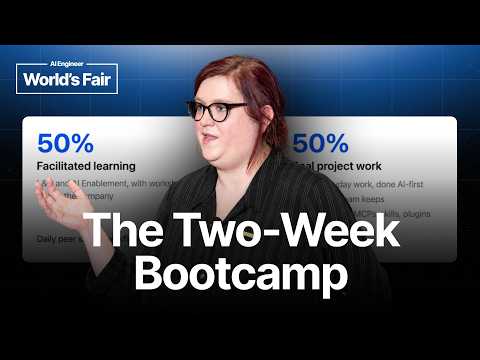
- Program structure: *"two week um enablement programs"* with *"50% facilitated learning"* and *"50% real project work"*
- Scale targets: *"aiming to get around 600 people through these programs by the end of the year... about 2/3 of our engineers"*
- Multiplier strategy: *"guides program"* (champions), *"local AI gettogethers"* (*"about 10 of those so far"*), *"AI ride alongs"*, and an *"always on uh help Slack channel"*
- Built outputs: *"agentic analytics system"* for WooCommerce, a *"Zenesk connector"*, an *"agent skills directory"*, *"guided admin support"*
## Observable Presentation Patterns
- **Tool-agnostic stance claimed:** *"we don't prescribe a single tool so folks are able to use codecs or claude or uh any other number of tools open code"* — positioning the program as vendor-neutral.
- **Core thesis stated twice** (opening and close): *"you can't just throw a bunch of tools at them and expect their way of working to change. You need to to make space and give an environment for learning."*
- **Metrics-driven narrative:** tracked outcomes include *"intentionality"*, *"flow"*, and *"sharing"*.
## Boundaries
- This is one talk by one representative; no channel-wide conclusions can be drawn from it.
- All program metrics and outcomes are creator-reported claims; no independent verification is present in the material.
# Delivery Observation — Em Shreve, Automattic
## Overall Register
Conversational, informal conference delivery. Sentences often trail into fillers and hedges ("um," "uh," "like," "kind of"), giving the talk a spoken, unscripted feel rather than a rehearsed keynote cadence.
- Opens by checking the room: *"Can you hear me?"*
- Frequent verbal softeners: *"kind of the art of what's possible," "like little events," "just kind of be available."*
## Recurring Vocabulary
Several terms repeat across the talk, forming a consistent lexicon:
- **"Reach" / "extending"** — the multiplier theme: *"extend our reach to the folks that we can't get to yet," "continue spreading the knowledge," "extending these abilities."*
- **"Cohorts" / "programs"** — *"seven of these cohorts," "earlier cohorts," "one of our programs."*
- **"Real"** — *"real time to learn," "real project work," "real work that they want to get done."*
- **"We" framing** — nearly every claim is team-based: *"we've ran three flavors," "we've tackled this in a few different ways."* First-person singular is rare and mostly limited to introduction and closing.
## Teaching / Explanation Habits
- **Concrete numbers as anchors**: *"1,400 people in 82 countries," "45 people," "around 600 people... about 2/3 of our engineers," "about 10 of those so far."*
- **Signposting structure aloud**: *"And we'll look a bit at what that curriculum looks like shortly," "some of the cool things that I'll highlight shortly," "so our engineering curriculum starts the first few days."*
- **Enumerated lists in speech**: *"one of these is... a number of folks... we've been building... and then finally another one."*
- **Contrast framing** for the core argument: *"you don't just get good quality learning... out of just handing people the tools. you need to give them real time to learn."* Repeated at the close: *"you can't just throw a bunch of tools at them and expect their way of working to change."*
- **Peer-similarity reasoning**: *"seeing someone in your similar role... is a lot more easy to grasp than just you know talking about the concepts."*
## Pattern of Attribution
Projects and ideas are consistently credited to program participants rather than to the speaker:
> "the whole skills directory actually came out out as a project from one of these cohorts as well"
> "this actually came not from an engineer, but one of our support folks"
## Closing Style
Ends with a single distilled takeaway plus a logistical invitation: *"give people real time to actually experiment and learn"* — followed by a booth/swag-pickup call to action and *"yeah, thank you."*
## Isolated Moments (uncertain as patterns)
- A brief audible reaction — *"[snorts]"* before describing an earlier cohort — suggests spontaneous warmth, but it occurs only once.
- One self-correction mid-sentence: *"context a C"* / *"context automatic"* naming inconsistencies likely reflect a system with a casual short name; repetition is too inconsistent to confirm a stable naming convention.
- Grammatical irregularities (*"we've ran," "we also have began"*) appear multiple times, but may be transcription artifacts rather than stable speech habits.
## Summary of Confidence
The **team-first pronoun use, participant attribution, numeric anchoring, and "real time to learn" thesis** are each supported by multiple direct quotations and appear stable across the talk. Everything listed under isolated moments rests on single occurrences and should not be treated as established patterns.
# Observation Record — "How a Remote Company Builds AI Fluency — Em Shreve, Automattic"
## Speaker Identification
- **Speaker:** Em Shreve (self-identified in transcript: "my name is M. Shrieve and I work at Automatic"). No other speakers are identified; the transcript contains only this one presentation.
## Company Context (as stated by speaker)
- Automattic is the company behind **WordPress.com** and **Tumblr**, described as a **fully distributed company** with **over 1,400 people in 82 countries**.
- The talk covers Automattic's approach to **AI enablement and upskilling**.
## Core Thesis
> "You don't just get good quality learning or work out of just handing people the tools. You need to give them real time to learn and experiment."
- Restated as the closing takeaway: you cannot "throw a bunch of tools" at people and expect their way of working to change; you must "make space and give an environment for learning" and make that "the star" of the education program.
## Program Structure: Two-Week In-Person Enablement Cohorts
Stated composition of each cohort:
- **50% facilitated learning** — run by the learning & development team and AI enablement team, with internal workshop hosts.
- **50% real project work** — participants bring real work, a tool/dashboard for their day-to-day, or create new skills/MCPs to work faster after the program.
- **Peer sharing** of workflows "to show the art of what's possible," plus **project demos at the end of each day**.
### Three program "flavors"
- **Engineers** (main track) — more in-depth, applied AI.
- **Cross-functional** — product, engineering, and design together.
- **Non-technical teams** — finance, executive leadership team, and other functions.
### Engineering curriculum arc
1. Basics: skills creation, using MCPs, spec-driven development, foundations of responsible and mindful AI use.
2. Deeper topics: creating MCPs, the hook system of "codecs and claude" (transcript as spoken), extending the harness, autonomous agents, background routines.
3. Applied topics: applied WordPress AI, features in WordPress core, building a personal assistant.
### Curriculum maintenance caveat (speaker's own qualification)
> "You cannot just write this curriculum once."
- Because AI changes "day to day, week to week" and "the top model might be different depending on the latest release," the curriculum must be **constantly updated** to avoid teaching "six months out of date."
## Internal Infrastructure
- **"Context Automatic"** (referred to later as "context a C" / "context aid C" in the transcript): an internal MCP server enabling rapid addition of tooling sets, including custom **governance and observability layers**.
- **No prescribed single tool:** participants may use "codecs or claude or… open code etc."; the skills directory was built to work across all of them.
- Cohort projects compound capabilities, allowing the company to "do more as a company because of that."
## Multiplier Strategy
- Each graduate is intended to be a **"multiplier"** extending reach to people the central team can't reach.
### Programs stated:
- **Guides program** (analogous to other companies' "champions programs") — identified top practitioners spread knowledge.
- **Local AI get-togethers** — regional events run by program alumni (~**10 so far**).
- **AI ride-alongs** — small workshops showing how someone in a similar role works with a tool; speaker claims seeing a peer is "a lot more easy to grasp than just talking about the concepts."
- **Shared skills and MCP infrastructure** — encouraging building on each other's work.
- **Always-on help Slack channel** — staffed by alumni for newcomers.
## Scale and Metrics (as claimed by speaker)
- **7 cohorts** run this year, each of about **45 people**.
- Target: **~600 people by end of year**, described as "about 2/3 of our engineers" plus other functions.
- Tracked dimensions: **intentionality** (thoughtful application vs. chatbot-only use), **flow** (workflow integration, "not just using it for AI's sake"), and **sharing**.
- Individual lift metrics: skills, custom commands, MCP comfort, context management.
- Survey cadence: **72 hours, 30 days, 90 days** post-program. Speaker observed people "continue growing within those 90 days," gaining confidence after more time to experiment.
## Cohort-Built Projects Cited
- **Agentic analytics system** for WooCommerce — asking questions about a store and getting answers.
- **Zendesk connector** on Context Automatic — adopted by various teams company-wide; other providers added for observability or where native MCPs lacked.
- **Agent skills directory** — tool-agnostic; emerged as a cohort project.
- **Guided admin support tool** — built with Claude Code to highlight screen areas during help sessions; notably built by a **support employee, not an engineer**, who "felt a bit more comfortable after going through one of our programs."
## Closing Offer
- Speaker invited questions at the Automattic booth and mentioned discussing how WordPress.com and WooCommerce are "embracing AI" via official connections and MCPs.
## Notes on Fidelity
- Transcript is auto-generated; some tool names are phonetic renderings (e.g., "codecs" likely = Codex, "context a C" = Context Automattic). Recorded here as spoken/transcribed without correction beyond flagging.
- All figures (7 cohorts, 45 people, 600 target, 2/3 of engineers, 10 get-togethers) are **speaker claims**, not independently verified.
- No contradictions between positions were expressed; the one explicit qualification preserved is the curriculum-obsolescence caveat above.
# Speaker Attribution & Provenance Record
## Video Identification
- **Title:** How a Remote Company Builds AI Fluency — Em Shreve, Automattic
- **Video ID:** `01a15ca6-df0e-7012-9fdb-970a6310ca47`
## Speakers & Roles
| Speaker | Role | Evidence |
|---|---|---|
| **Em Shreve** (transcript renders as "M. Shrieve") | Company representative / presenter, Automattic | Self-introduction: *"my name is M. Shrieve and I work at Automatic"* |
| Unidentified voices (`>>` markers) | Non-speech cues (music, audio markers) at start/end; no identifiable second speaker with content | Transcript opens/closes with `>> [music]` |
- No guest, narrator, interviewer, or additional named speaker appears in the transcript.
- **Speaking context:** Conference talk (presenter references an audience, a booth near the stage, and swag pickup).
## Self-Described Affiliation & Facts (as stated by speaker)
- Works at **Automattic**, described as the company behind WordPress.com, Tumblr, WooCommerce, and other properties.
- Fully distributed company: **1,400+ people in 82 countries** (speaker's claim).
## Referenced Sources & Claims
All claims originate from the speaker; no external citations or attributed third-party sources appear in the transcript.
- **Internal claims (speaker's own org):**
- Two-week in-person AI enablement programs (50% facilitated learning, 50% real project work).
- Internal MCP server called **"Context A8C" / "context automatic"** (transcript spelling varies).
- Program stats: 7 cohorts run this year, ~45 people each, targeting ~600 people (~2/3 of engineers) by year end.
- ~10 local AI get-togethers held; "guides" (champions) program, "AI ride-alongs," always-on help Slack channel.
- Survey cadence: 72 hours, 30 days, 90 days post-program.
- Cohort-built projects: agentic WooCommerce analytics system, Zendesk connector, agent skills directory, guided admin support tool (built by a support, not engineering, staff member).
- Tools mentioned as unprescribed options: Codex ("codecs" in transcript), Claude, Open Code.
- **No third-party sources, studies, or external data citations are present.**
## Promotional Segments
- **Closing booth invitation:** Speaker directs attendees to the **Automattic booth** for questions and to hear more about *"how WordPress.com and WooCommerce are embracing AI"* — a promotional/brand segment within the talk.
## Availability & Access Notes
- Transcript only; no curated metadata supplied beyond the title.
- Q&A availability is in-person at the booth only; no comment availability or linked resources indicated in the transcript.
- **Transcription quality caveats:** name rendered as "M. Shrieve" (title says "Em Shreve"); "Automatic"/"A8C" spellings vary; possible ASR errors ("codecs" likely = Codex, "claude" = Claude Code, "Zenesk" = Zendesk, "gettogethers" = get-togethers).
All \>\> \[music\]
\>\> right. Hi everybody. Can you hear me? All right. So, uh, my name is M. Shrieve and I work at Automatic. Um, and if you're not aware of what Automatic is, we are the company behind WordPress.com and Tumblr and a number of other properties. Um, and we're a fully distributed company uh with over 1,400 uh people in 82 countries. Um, and I'm here today to talk about our approach to uh, AI enablement and upskilling our organization um, to use all of these uh, new tools and ways of working. Um, so our bet is
that you don't just get good quality learning or work out of just handing people the tools. you need to give them real time to learn and uh experiment. Um
so what we've been doing is running these two week um enablement programs where we bring people in in person for a twoe immersive experience.
And uh the way that we do that is um through 50% facilitated learning um through our uh learning and
development team and our AI enablement team. We pull together workshop hosts from within the company to run workshops and hands-on um activities. Uh
and we'll look a bit at what that curriculum looks like shortly. Um and then 50% real project work. So, we have folks bring in um real work that they want to get done or a tool or dashboard that would help them and their day-to-day work. Um or these can also be creating new skills or MCPs to enable them to work faster outside of the program. And another large part of this is uh encouraging peer sharing. um so sharing their own workflows to show um kind of the art of what's possible. And uh as they work throughout the two weeks, we also do a number of uh project demos at the end of each day. So we've uh we've ran three flavors of this. um our main set being for
engineers where we go uh a lot more in depth um getting into applied AI. We've also um experimented with crossf
functional programs um with product engineering and design getting together in a room and discussing kind of the future of of how we all work together um with with these new tools. And then we've also extended into non-technical teams and run workshops with our finance group, our executive leadership team um and other functions as well. So our engineering curriculum starts the first few days uh covering the basics
skills and how to create them. um learning how to use MCPS and specdriven development um as well as kind of the foundations of
how to use AI responsibly and how to um apply it in a way that's mindful. Um and then we start getting into deeper topics. Uh creating MCPs um for new functionality, getting into the hook system of codecs and claude and being able to extend the harness that way. Um up to uh autonomous agents and running routines and such in the background. Um and then we end on some different applied topics. Um so again automatic is behind WordPress.com. So uh we normally run a workshop on applied WordPress AI um and some of the cool features that are in WordPress core uh around AI as well as uh being able to create your own personal assistant. So we really try to walk people um from the foundations up into uh the ability to start creating these new things for themselves. And one thing that we found out is you cannot just write this curriculum once. As we're all aware, AI is constantly
changing from day to day, week to week. The top model might be different uh depending on the latest release. Um so we're constantly needing to update the
curriculum and stay current to make sure when we running these programs, we're teaching the right thing and we're not teaching six months out of date. Um, another interesting part I wanted to highlight here is we have our own uh internal uh MCP server called context automatic. And this allows us um to
rapidly add new tooling sets for MCPs that might not exist or that we want to build our own um like governance and observability layers on. Um, and one of
the cool things that, uh, I'll highlight shortly is, uh, some of the projects coming out of these cohorts is extending these abilities. So, as people go through the capabilities, um, compound and we're able to do more as a company uh, because of that. Another main focus of our program is that these aren't just a number of people that we're sending through. We're also wanting each person we send through um
to be a multiplier uh within the company and extend our reach to the folks that we can't get to yet. Um, so so far this
year we've ran seven of these cohorts of groups of about 45 people. Um, and we're aiming to get around 600 people
through these programs by the end of the year. Um, which is about 2/3 of our engineers as well as uh some of those other focus areas that I highlighted at the beginning. And we would like to equip all these people with uh ways of sharing their knowledge out and again extending our reach. So we've tackled this in a few different ways. Um we are beginning a guides program or um I think other companies call this like their champions program. And what we want to
do is extend our team's reach into other areas and have these um like top practitioners that we've identified within the company be able to
help us out and uh continue spreading the knowledge. Um because we're distributed, we also have began these local AI gettogethers. So people that have gone through the program um are able to then run these like little events within their regions and um run workshops and we'll help support that as well. Um and we've done about 10 of those so far in various different areas of the world. Um and it's been been exciting to see like what some of these people that have gone through the program have have gone on to do and teach. Uh we also um organize these things called AI ride alongs and these are little workshops
that we run um basically showing how you work, how you use a different tool. Um because what we found is seeing someone
in your similar role or um in in a similar job to you, being able to see how they use it uh is a lot more um easy to grasp than just you know talking about the concepts. Um and then we're also attempting to build a shared skill and MCP infrastructure. So again that context
aid C um system that I mentioned but also uh encouraging people to create and share skills and build uh on top of each
other's work so that we're all kind of building um towards the same kind of platform. And then we have an always on
uh help Slack channel where we also ask people that have gone through this program to help out um and just kind of be available for anyone newer uh to
working this way to have a place to come and ask questions at any point of the day. So, I'm going to share a few of the the
metrics that we've been tracking and um improvement we've seen throughout the program. Um, one of these is intentionality and
um just applying to applying AI to your work in a more thoughtful way. Maybe these people came in at the beginning just using it as a chatbot or um you know not fully using an agentic workflow. Um so having people be a bit more intentional at how and when they apply AI. Um flow which is like how well they're able to integrate AI into their workflows. um if people feel as if um they're able to use it in a way that makes sense for them and not just using it for AI's sake. Um and then the the sharing part again is very important to us so that we can continue um reaching other people in the company and um kind of making everyone uh a a teacher and an expert on these topics. Um we also track uh individual lift on various metrics such as um skills and custom commands um how comfortable they feel using and applying MCPS and uh other topics like context management um and what we've seen uh from doing various surveys uh after the program. So we'll do one 72 hours after uh 30 days after and 90 days after. People will continue growing within
those 90 days and um being able to apply things more and like they've had more time to experiment and try things. Um so we're still seeing
people like gain confidence and experience uh even once they've gone through the program. Um so I wanted to highlight just a few of the things that folks have built um just within the two weeks of the program. Um one of these is uh an
agentic analytics system. So uh we have WordPress has a uh e-commerce platform plugin called Woo Commerce and some of
the people that went through our program um created a a gentic system for asking questions about your store and getting back answers. Um a number of folks that go through uh build on top of context a C. Um so one of our earlier cohorts \[snorts\] um they wanted to be able to use uh some of
these tools for support um and built a Zenesk connector um which now we've had adopted through various teams throughout the company. Um we've built other
providers in there that uh might not have a native MCP or again because we wanted to add additional observability there.
Um we've been building out our own agent skills directory. Uh we don't prescribe a single tool so folks are able to use codecs or claude or uh any other number
of tools open code etc. Um so we wanted to build our skills directory in a way that can be used across all of those. Um and the whole skills directory actually came out out as a project from one of these cohorts as well. Um and then finally another one I wanted to highlight here is uh guided admin
support. So, um, during a help session, say you want to show someone exactly where something is, uh, within the dashboard, um, they built a tool using,
uh, cloud code that allowed them to be able to, um, guide and lead a session, highlight different parts of the screen. Um, and this actually came not from an engineer, but one of our support folks um that felt a bit more comfortable after going through one of our programs. And that is the end of my presentation. But the one takeaway that I wanted people to take from this is uh give people real time to actually experiment and learn.
um you can't just throw a bunch of tools at them and expect their way of working to change. You need to to make space and give an environment for learning um and
and make that like the star of whatever your education program is. And uh I will be available for questions at our booth which is uh the automatic booth right over on the other side near that stage and the swag pickup. Um, so I'll be there for a little bit after this talk if you want to talk about anything I talked about here. Um, or you'd like to hear more about how uh how WordPress.com and Woo Commerce are uh embracing AI um with our official connections and MCPs. Um, so please stop by the booth. Um, and yeah, thank you. \>\> \[music\]