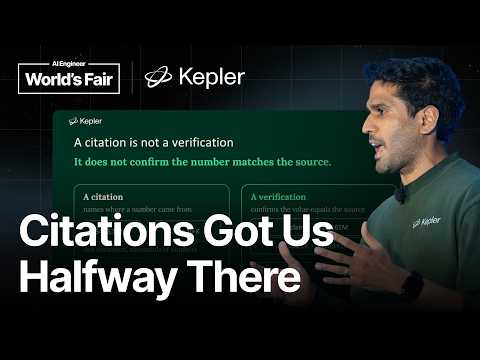
How Kepler Built Verifiable AI for Financial Services —…
Talk by Vinoo Ganesh, CEO of Kepler, on building verifiable AI for financial services. He argues that language models, as probability machines, are unreliable at the deterministic work finance depends on, so Kepler treats the model as one part of a larger system wrapped in a deterministic substrate. The talk covers three tenets: atomic provenance (every number tied to a verifiable source), scope determinism (models handle nondeterministic tasks while actual figures like revenue from a 10K filing are pulled deterministically with reconciliation), and reviewing each extracted number like a pull request to catch entities and prevent invented figures. Framed around the idea that in finance a number is worthless without traceable origins. Timestamps included.
# Video Identity Observations — "How Kepler Built Verifiable AI for Financial Services — Vinoo Ganesh"
## Speaker & Self-Description Claims
- **Speaker identity claim (explicit):** "My name is Venu Ganesh and I'm the CEO and co-founder of Kepler."
- **Company scope claim (explicit):** The talk is framed as "how we built verifiable AI for financial services" — Kepler is presented as a company building a platform for numerically verifiable AI work product in finance.
- **Authority/credibility claims (explicit, unverifiable):**
- Career background at Palantir ("led the compute platform as well as a lot of our USG engagements"), founding/selling an alt data startup, and "head of business engineering at Citadel."
- "This whole talk is a distilled version of a case study Anthropic did on Kepler... we're the only company they've ever done a case study of."
- **Growth/hiring claim (explicit):** "We're growing pretty quickly. Obligatory come join us if these problems are interesting to you."
## Claimed Scope of the Channel/Product
- **Core product claim:** A platform built on three tenets — **atomic provenance**, **scope determinism**, and **derivation chains** — enabling "numerically accurate" outputs such as consolidated financial statements and DCFs "with every number tied back to its individual source."
- **Ambition claim beyond finance:** "We're picking numbers here because finance cares about numbers. But you can imagine a world where every court case... runs through the same process" and "we're starting in finance now. We'll be in a lot of different dimensions pretty quickly."
## Intended Audience (Observed)
- **Financial services professionals**, specifically:
- Analysts and portfolio managers ("if you're a portfolio manager at Citadel...").
- Buy-side and Wall Street firms ("real meaningful adoption across Wall Street").
- **Technical/industry conference attendees** familiar with LLMs, RAG, token usage ("there's a club here for people that consumed a billion plus tokens"), and data infrastructure (Snowflake Summit, Databricks Summit references).
- **Potential recruits** (closing hiring pitch) and possibly **customers** (Q&A discusses "what are our customers most excited about").
## Observable Presentation Patterns
- **Founder-led technical/marketing talk format:** Combines thought-leadership framing ("AI has made a writing problem a reading problem") with product explanation and demo-free architecture walkthrough.
- **Positioning against incumbents:** References Bloomberg, FactSet, CapIQ, "Deloopa" (likely Daloopa), and "Tegus" as read-only or contractor-dependent systems the Kepler approach claims to improve on.
- **Contrarian framing as a rhetorical device:** "Evals are not verifiable," "you cannot use AI to produce verifiable work product in finance without augmenting it with a deterministic substrate," critiques of "token maxing."
- **Audience-interaction evidence:** Live Q&A at the end ("Yeah, go ahead. Yes, your question is about provenance..."), indicating a conference/stage setting rather than a produced video.
## Claims vs. Demonstrated Patterns
- **Creator claims (not independently demonstrated in this material):** 94% extraction accuracy of a trained model, the Anthropic case study, customer enthusiasm, product capabilities (statement consolidation "in seconds").
- **Demonstrated in the material itself:** The speaker's ability to articulate a detailed verification architecture (model never writes or manipulates numbers; deterministic checks; provenance ledger), and audience engagement via questions and applause.
## Notes & Caveats
- Speaker name is stated as "Venu Ganesh" in the transcript; the title uses "Vinoo Ganesh" — a transcription or naming discrepancy, not resolvable from the material.
- No curated metadata was provided; all observations derive from the title and transcript alone.
- Claims about competitors (e.g., "CapIQ's, the Deloopa's that are all using contractors") are the speaker's characterizations, not verified facts.
# Delivery Observation: Vinoo Ganesh — "How Kepler Built Verifiable AI for Financial Services"
## Overall Tone & Register
- **Conversational, punchy, and assertive.** The speaker frames claims bluntly and pre-announces escalation: *"And now I'm going to say something even more aggressive."*
- **Self-aware humor woven into technical content**, often at the expense of industry trends: *"there's a club here for people that consumed a billion plus tokens. They're walking around with gold cards. It's kind of funny, actually."*
- **Direct audience address** ("Hey everyone, thank you for being here") and rhetorical challenges to the room: *"Who here would trade off of something that's 94% accurate?"*
## Recurring Phrases & Signature Vocabulary
- **"Deterministic" / "non-deterministic" / "probabilistic"** — the conceptual spine of the talk, repeated across nearly every section (*"These are probability machines"*, *"it can't be the one responsible for doing the mathematical adjustments. Because it's a probability machine"*).
- **"Token maxing"** — used repeatedly as a foil for what the industry is doing wrong (*"How do I token max? How do I get AI to do more?"*).
- **"Work product"** — the recurring goal-state term (*"AI is going to start doing some very powerful things in terms of producing work product"*).
- **"Provenance"** — introduced, defined, and reused (*"Provenance as a whole just means writing down exactly where you got the information"*).
## Teaching Habits & Structure
- **Numbered framework delivery.** The core architecture is presented as three explicitly named tenets: *"The first is atomic provenance… the second is scope determinism, and the third is derivation chains."*
- **Plain-language redefinition after dense statements.** He flags jargon and immediately simplifies: *"That was a lot of buzzwords. A verification just means I can prove deterministically this number is right."*
- **Analogy-heavy argumentation.** Cross-domain parallels are a consistent move:
- Software: *"Software, we run CICD. We do unit tests. We do integration tests. We have code reviews."*
- Medicine: *"When a doctor writes a prescription, a pharmacist fills that prescription."*
- Aviation: *"We have a pilot and a co-pilot."*
- E-commerce security: *"we're almost like pre-SSL in the e-commerce ecosystem."*
- **Contrast framing.** Many points are built on paired oppositions: citation vs. verification, writing problem vs. reading problem, producing vs. verifying.
## Rhetorical & Delivery Patterns
- **Provocative contrarian claims delivered casually:**
- *"the reason that people buy products like Bloomberg and FactSet is to displace culpability."*
- *"the honest answer. You don't. [use AI verifiably]"*
- **Hedged intensifiers.** Frequent softening qualifiers around big claims: *"kind of"*, *"like"*, *"pretty"* — e.g., *"which is kind of cool"*, *"pretty impactful"*, *"It's kind of funny, actually."* This softening coexists with aggressive content, giving a casual-confident register.
- **Fillers and restarts visible in the transcript** (*"uh"*, mid-sentence rewording: *"What was the net What was the net margin"*), suggesting an extemporaneous, unscripted delivery style.
- **Personal credentialing up front**, then pivoting to the audience's takeaway: a short bio section (Palantir, Citadel) followed by *"my only goal with this whole talk is to convince you…"*.
- **Reflexive framing of the whole talk as argument** — he explicitly names contentions: *"the second contention of this whole talk is that you cannot use AI to produce verifiable work product in finance without augmenting it with a deterministic substrate."*
## Q&A Delivery
- **Restates questions before answering** (*"Yes, your question is about provenance…"*, *"Yeah, so the question is um what are our customers most excited about?"*).
- **Answers are structured and enumerated** in Q&A as in the talk: *"At its core, the number comes from three different things."*
- **Humor persists into Q&A**: *"The portfolio managers don't want the AI portfolio manager. Like they want the AI analyst."*
## Stable Patterns vs. Isolated Moments
- **Stable (repeated across the talk):** deterministic/probabilistic vocabulary, analogy-based teaching, contrast framing, casual qualifiers, contrarian framing of industry practices.
- **Isolated:** the recruiting pitch (*"Obligatory come join us"*) and specific anecdotes (94% accuracy model, Snowflake/Databricks cost-optimization history) appear once and are not recurring devices.
- **Note on uncertainty:** pause-based audience engagement (the "Who here would trade off of something that's 94% accurate?" question) appears only once in the transcript; whether silence or response followed is not observable from the text, so reaction effects cannot be characterized.
# Position Extraction: "How Kepler Built Verifiable AI for Financial Services" — Vinoo Ganesh (CEO & Co-founder, Kepler)
## Speaker
- **Vinoo Ganesh** — self-identified CEO and co-founder of Kepler; prior roles: Palantir (compute platform lead, USG engagements), founder of a sold alt-data startup, head of business engineering at Citadel, startup advisor. (Note: transcript audio renders his name as "Venu Ganesh" once at the start; title metadata says "Vinoo Ganesh.")
## Core Claims & Reasoning
### 1. The problem: AI turned a writing problem into a reading problem
- **Claim:** AI has made producing content nearly free, but verifying it remains unsolved.
- **Reasoning:** Historically, edge/alpha came from *producing* analysis (e.g., Citadel hiring hundreds of analysts). Now models read everything, so "you have the most real version of alpha decay that you possibly can. There is no edge if everyone can look at Tegus and get all the same information."
- **Qualification:** He says AI is "nearly free... but like, thank you VCs, heavily subsidized" — a caveat that cost is subsidized, not zero.
### 2. Evals are not verification
- **Claim:** "You cannot take a non-deterministic LLM and eval your way to something deterministic. These are probability machines."
- Terms like "trust" and "verifiability" have been "largely abused."
### 3. Finance lacks a verification layer
- **Reasoning by analogy:** Software has CI/CD, unit tests, code reviews; prescriptions have pharmacists; aviation has pilot/copilot; EMTs have primary/secondary. Finance has "maybe an overworked VP as a verification layer."
### 4. Controversial claim: Bloomberg/FactSet purchases displace culpability
- **Claim:** People buy these tools partly so that "if it's wrong, everyone on Wall Street has the same incorrect information."
- He frames this as both "interesting" and "kind of a scary proposition," and notes these tools are **read-only** — the analyst still produces the work product, which he calls the biggest wall to meaningful AI adoption.
### 5. Citations are only half the battle
- **Claim:** LLM citations are "an after-the-fact audit," not verification. Unvetted sources (Seeking Alpha, Reddit, Substacks) are data points, not vetted sources.
- **Definition offered:** Verification = "a deterministic, repeatable, numerically verifiable mechanism... I can prove deterministically this number is right."
### 6. Verification is not ground truth; it's firm-relative
- **Claim:** In finance, two desks with identical data and verification mechanisms can hold opposite positions (e.g., two Citadel TMT desks).
- Verification means the output "respects the nouns and verbs or the rules of your organization."
### 7. Second contention: AI alone can't produce verifiable work product
- **Claim:** "You cannot use AI to produce verifiable work product in finance without augmenting it with a deterministic substrate."
- **Reasoning:** AI is great at non-deterministic tasks (e.g., figuring out *how* to do EBITDA adjustments) but shouldn't perform the math itself. Model AI "like that PM" with deterministic tools, grounding, and risk thresholds.
## Kepler's Three Tenets
### a) Atomic provenance
- Model never writes or manipulates numbers; it writes a *reference* and hands off to databases/systems. Wrong numbers that fail deterministic checks are stripped out.
- He cites Kepler's fine-tuned extraction model at **94% accuracy** and asks rhetorically who would trade off that — "a wrong number is still wrong if you're in that unfortunate 6%."
- Explicitly rejects multi-model cross-checking ("OpenAI check ChatGPT check Anthropic") as probabilistic systems evaluating each other.
### b) Scope determinism
- "The model decides what to compute. It never does the computation itself."
- Deterministic code parses filings/XBRL and persists results outside the model's understanding. Also cheaper.
### c) Derivation chains
- For ratios/multiples (gross margin, enterprise value) that differ by firm, a replayable, rewindable chain of events records how each number was produced — analogous to an analyst's risk-reward decision process.
## Results & Implications Claimed
- System knows which data points it may and may never produce (e.g., no extraction from prose/raw tables).
- Financial statement consolidation "in seconds with every number tied back to its individual source" — displacing contractor-based approaches (CapIQ, "Deloopa" [LSEG/Loops? — as spoken]).
- Claimed generalization beyond finance: legal (Harvey, Legora — deterministic entity extraction to avoid hallucinated citations), drug discovery (NIH formulations).
- **Analogy:** Current moment is "pre-SSL in e-commerce" — trillions in TAM but zero trust before security existed.
## Predictions & Positions
- AI producing verifiable work product is "inevitable. Whether it's Kepler or whether it's anyone else."
- **Against "token maxing":** rewards for token consumption are "kind of hilarious" — "in what time in history has an employee been rewarded for your company to pay another vendor?"
- Predicts a **cost-optimization wave** like the post-Snowflake/Databricks ROI era: "sometimes you don't need a multi-billion parameter model when one CPU cycle will just work."
- "Citations got us like 50% of the way there"; the work product itself is the proof (analogous to commit/PR/code-review history).
- **Last mile is personalization:** hopes by "2027" someone presents on verifiable ontologies proxying investment processes.
## Q&A Positions
### Q: Where does a number in the provenance ledger come from?
- **A (Ganesh):** Three sources: (1) extracted filing information, (2) mathematical calculation producing a derivative (e.g., ratio), (3) internal documents combined with external data. Any model-instructed IO operation joins the provenance chain.
### Q: What are customers most excited about?
- **A (Ganesh):** Not the "AI portfolio manager" — PMs don't want that; they want the **AI analyst**. Most valued: automating repeatable painful tasks (listening to earnings calls, opening 15 tabs of 8-Ks/10-Ks to build V0 financial models). "Some of these folks make 6-700k a year to do this."
## Preserved Qualifications / Tensions
- Self-acknowledged aggressive claims: "Now I'm going to say something even more aggressive" (the culpability-displacement claim).
- Scope determinism was "a super controversial idea like a year ago, and VCs were like, 'This is crazy.'"
- Promotion of his own case study ("we're the only company they've ever done a case study of" — Anthropic) coexists with the claim the talk is inevitable/industry-wide, not just about Kepler.
- Aspirational framing ("hopefully one of us will be on stage" in 2027) kept as hope, not fact.
# Speaker Attribution & Provenance Record
## Video
**Title:** How Kepler Built Verifiable AI for Financial Services — Vinoo Ganesh
**Video ID:** `01a15ca8-3159-7954-84ce-befb5278d4c2`
## Speakers & Roles
- **Vinoo Ganesh** — **Creator / Primary speaker (solo presenter)**
- Self-identified: "My name is Venu [sic] Ganesh and I'm the CEO and co-founder of Kepler."
- Delivers the full talk; answers audience Q&A.
- **Audience members** — **Other (unidentified questioners)**
- Two spoken questions relayed/restated by the speaker: one on provenance ledger sources, one on customer excitement.
- **Susanna** — **Mentioned, not a speaker**
- "we're both from Kepler" — identified as a Kepler colleague present; no speaking lines.
- **Moderator/host voice** — implied by "Yeah, go ahead" framing but not separately identified in transcript.
## Presenter's Stated Background (self-reported)
- Former Palantir (led compute platform, USG engagements)
- Built and sold an alt-data startup
- Former head of business engineering at Citadel
- Startup advisor
## Promotional Segments (flagged)
- **Anthropic case study pitch:** Talk is a "distilled version of a case study Anthropic did on Kepler"; QR code shown; claims "we're the only company they've ever done a case study of."
- **Hiring pitch:** "Obligatory come join us if these problems are interesting to you."
- Repeated claims of Kepler platform capabilities (94% extraction accuracy "it's in the article", consolidation of financial statements, DCF generation).
## Referenced Sources & Third-Party Claims
- **Anthropic case study on Kepler** (referenced, external document)
- **Companies/tools mentioned:** Palantir, Citadel, Bloomberg, FactSet, CapIQ, Deloopa ("CapIQ's, the Deloopa's"), Tegus, Seeking Alpha, Reddit, TechCrunch, Snowflake Summit, Databricks Summit, Harvey, Legora, NIH white papers, Claude/ChatGPT, OpenAI, Anthropic, xAI, GLM 52, Opus 48, Hugging Face, Polarys (implied by "another Polarys thing")
- **Regulatory bodies cited:** SEC, OCC
- **Filing types cited:** 10-K, 10-Q, 8-K, earnings call transcripts, XBRL
## Provenance / Availability Notes
- Claims of a 94% accuracy figure are attributed by the speaker to the Anthropic article ("it's in the article") — **not independently verifiable from transcript**.
- Speaker's aside "[snorts]" noted; audience applause and music noted in transcript.
- No curated metadata supplied; no comment availability information present in source.
- Q&A questions are paraphrased by the speaker, not transcribed verbatim from questioners.
\>\> Hey everyone, thank you for being here. My name is Venu Ganesh and I'm the CEO and co-founder of Kepler. Today, I'm going to talk to you about how we built verifiable AI for financial services.
First, a little about me. My career has been working in fairly difficult places to work in terms of numerical accuracy and verifiability. Began my career at Palantir where I led the compute platform as well as a lot of our USG engagements. Built and sold a alt data startup. Then was head of business engineering at Citadel. I have some Citadel colleagues here in the audience as well. I've advised a bunch of startups and been lucky that all of them have reached pretty positive outcomes. So this whole talk is a distilled version of a case study Anthropic did on Kepler. If you scan that QR code, we're the only company they've ever done a case study of, which is kind of cool. And so this is a distilled version of that. That has a lot more information about how we were able to do what we do, why it's been pretty impactful in financial services, and really where we go from here. So my only goal with this whole talk is to convince you that AI is going to start doing some very powerful things in terms of producing work product. So everything that I tell you is inevitable. Whether it's Kepler or whether it's anyone else, we are already on this journey and this trajectory. So we all better be ready. So I first want to observe every talk that we've seen in the financial services space so far has been about
producing more. Like how do I token max? How do I get AI to do more? Very little of it is about how to actually make AI trustworthy or produce trustworthy
products. And what's interesting is even terms like trust and verify-ability have actually been largely abused. Evals are not verifiable. You cannot take a non-deterministic LLM and eval your way to something deterministic. These are probability machines. And the kind of underlying reason for this is that AI has made a writing problem a reading problem. We can produce insane amounts of content, whether that's code, whether it's marketing, whether it's like a DCF in record time. But we can't easily verify this. And that's because for years the hardest part about this whole process was actually producing the work. Edge and alpha came from people like Citadel being able to hire hundreds of analysts who could scour the internet and understand where any source of alpha could exist. So it really came from this idea of being able to consume content. The problem is when a model reads everything, you have the most real version of alpha decay that you possibly can. There is no edge if everyone can look at Tegus and get all the same information.
So the hard part now is trusting what actually got produced by the model. And this is kind of funny. This is not necessarily a finance problem. Every system that exists has some form
of this. Software, we run CICD. We do unit tests. We do integration tests. We have code reviews. When a doctor writes a prescription, a pharmacist fills that prescription. So if it says 10,000 milligrams of a medication, someone catches that. We have a pilot and a co-pilot. We have an EMT that's a primary EMT and a secondary. In finance, we have maybe an overworked VP as a verification layer, but that concept doesn't really exist. And now I'm going to say something even more aggressive. Uh the reason that people buy products like Bloomberg and FactSet is to displace culpability. When you buy a tool like that, you know that information free. It exists in SEC filings. But, you believe that because a bunch of contractors or folks overseas vetted this data and stuck it in a central instance, at least if it's wrong, everyone on Wall Street has the same incorrect information. And that's interesting in certain ways. It's also kind of a scary proposition. And that's because every one of these tools is read-only. You as an analyst look at Bloomberg, you look at FactSet, you consume information, and you produce the work product. And that's where the biggest gap and biggest wall to real meaningful adoption across Wall Street has actually
been. And so, why does this actually matter? We can't use AI properly in this ecosystem. There is a reason that analysts are still working till 4:00
a.m., and there's a reason folks in investment banks are actually dying because of the hours they're putting in. Because AI can produce a very confident answer, but when it comes to producing any kind of meaningful work product, we're totally lacking. Not only that, we have the SEC, we have the OCC, we have a number of these regulatory agencies who exist to make sure that you are not insider trading, or you're not producing a trading decision that can't be justified or backed by some set of primitives or some set of information that you can reliably say, "I made this decision because of these sources of information." And so, in this ecosystem, the biggest challenge is how do I get AI to jump from producing the search technologies that it's doing right now to producing work product. That can mean a fairness opinion, it can mean a DCF, it can mean an investment memo, it can mean looking at every SIM that your firm had 5 years ago and figuring out why your IRR number wasn't what it should have been, or anything else. And so, the whole industry has solved this by citing things. When you search the internet with Claude or ChatGPT, it gives you a list of sources that pulled information from. What's ironic is you can't easily curate those sources. So, if you find my random Substack that says Palantir is going to be $3,000 a share, and you trade off of that, please go do that because it'll be very helpful for me. But, that's not a real vetted source. Seeking Alpha and some of these blogs or Reddit posts, they're data points, but they're not real vetted sources. So, showing where you got the information from is only half the battle. And that's where we're limited right now. The citation is effectively an after-the-fact audit. Now, a verification is a deterministic, repeatable, numerically verifiable mechanism that we can use to produce validity that a number is right. That was a lot of buzzwords. A verification just means I can prove deterministically this number is right. So, when I extract a revenue number from a 10-K, I can deterministically prove that is the correct number from that 10-K. So, these are two sides of kind of the same game. One is showing where you got the sources from, and one is verifying that the information that you pulled out is actually correct. This becomes challenging. It becomes challenging because verification is not a outcome. It lives in the path or the set of steps that are required for you to produce information that is valid for your individual firm. Finance is one of the rare industries where two people can be have the same information, and one can be long a stock, and one can be short that stock with the exact same data. And so, the idea of verification is not actually ground truth. It is verifying that you got an output that respects the nouns and verbs or the rules of your organization. If a desk at Citadel, like a TMT desk at Citadel, believes that a particular stock is going to go up into the right, another TMT desk at Citadel may have the exact opposite belief, and they may have the same verification mechanisms that produce vastly different outcomes. And so, this really comes on to something simple. What are the sources that we trust? What are the transformations that we apply on those sources to produce information that we care about? And how do we make sure that's codified in a way that makes logical sense? And so, the whole point of this is simple. This came from a 10K is not the the validation as a whole. Your job now is to figure out as an individual, how do I use AI in a verifiable way? And here's the honest answer. You don't. AI is great at doing non-deterministic tasks. It can solve problems in a way
that's novel. It can figure out exactly how to do EBITDA adjustments, but it can't be the one responsible for doing the mathematical adjustments. Because it's a probability machine. It is great at next token prediction.
So, the second contention of this whole talk is that you cannot use AI to produce verifiable work product in finance without augmenting it with a deterministic substrate. Which effectively means, if you're a portfolio manager at Citadel, you have access to a number of deterministic tools that you use to make your trading decisions. We need to model AI like that PM. It needs to exist in grounding, needs to exist with a certain risk threshold and verifiability. So, here's how we did it. Here's what Anthropic was excited about. We have three tenants that we use to ensure that numerical accuracy is a tenant of the Kepler platform, and that allows us to produce pretty powerful, pretty verifiably reliable information.
The first is atomic provenance, and I'll talk through all of these. The second is scope determinism, and the third is derivation chains, uh which we'll all talk about. But the core premise is this. There are
certain things humans should never do. And I will tell you right now, I don't believe a human should sit there and look at a PDF 10K, 10Q, 8K, or earnings call transcript and on one screen take that number and put it into an Excel model on the other screen. Humans were not built for that. That's not like there's a reason we don't have databases just written in our heads. And so, let's break this down for how you can actually use AI to produce work product. Let's talk about provenance. Provenance as a whole just means writing down exactly where you got the information. Now, uh have a lot of respect for everyone else who got here on stage, but we did a model we trained a model that was really good at extracting information. It outperformed foundation models, it's 94% great. It's in the article. Who here would trade off of something that's 94% accurate? Right. So, fine-tuning your way on probabilistic solutions still is it's really cool and like TechCrunch will be really excited about it, but like no one else really cares about it. And that's because a wrong number is still wrong if you're in that unfortunate 6%. So, with atomic provenance, what we do is the model writes effectively a reference to the number. It cannot write the number or manipulate the number in any way. It doesn't even understand what that number is. We have tools that are really good at understanding numbers. They're databases. They are systems that can codify information and read them and write them with appropriate fidelity. So, that's the first piece of how we do things. Anytime a model makes a decision, it makes the decision to figure out exactly where it got the number from and hand off to something that can write that number. We then run it through a deterministic check where any kind of a wrong number, if we can't verify it independently, we strip it out. That number will never make it to someone if it doesn't follow the deterministic check, the Providence ledger, and most importantly, uh the whole cycle kind of repeating at least a couple of times. So, this is not me saying, "Have 10 models and each individual have OpenAI check chat check Anthropic and have Anthropic check XAI." These are not probabilistic systems evaluating each other's work. There's a core canonical process of extracting a number, persisting it, and making sure that process actually occurred properly. And this is when I say atomic traditional atomicity in like database land. Second, scope determinism.
This is This was a super controversial idea like a year ago, and VCs were like, "This is crazy." Now, this half of this talk has been This session has been about this. Um
the model is really good at reasoning and planning. Intelligence is commoditized. GLM 52 shows it. You can download it off of Hugging Face right now. You have something as powerful as Opus 48. Now, what the model cannot do is math. And why would it? Why would I run 1 + 1 through a multi-billion parameter model instead of one CPU cycle? Unless you're companies that are giving bonuses on people token maxing, which is another Polarys thing. \>\> \[snorts\] \>\> Um and so, what the model does is the model decides what to compute. It never does the computation itself. And so, from the Kepler platform perspective, what we do is we split the deterministic pieces of the model, which are none, from the non-deterministic pieces of the model, which are all of them. And we give the model the right tooling and technology to calculate the deterministic pieces. Now, let's get really concrete. A model can read something like, "Okay, I need to understand what net margin is. I know the right pieces of information to go to to get that data, but I can't be the entity that's actually running the code behind the scenes to pull that number out of a PDF or parsing the XBRL behind the scenes to pull that information out. That is code." Now, the deterministic pieces of the platform pull that information out and persist it outside of anything the model understands. And with those two together, we can actually produce a numerically accurate answer to the question of like, what was the net What was the net margin of this stock or this company last quarter? This also is a lot cheaper because again, I don't need the model to do a bunch of stuff it shouldn't be doing. Now, the last piece here is how do we actually do reconciliation? When someone asks about a ratio like a gross margin or anything else that doesn't exist in a filing, therefore, I can't just go look up what the gross
margin is or what the set of EBITDA adjustments were. The other thing that's really complicated is everyone calculates these ratios and these multiples differently. Everyone does enterprise value
calculations differently. Things that are considered recurring or non-recurring may be unique. So, not only do we have to codify that in the processes that are run, but we need some kind of a chain of events to figure out what went into producing an individual number and what went into producing an outcome. This is not any different than the chain of events that an analyst does on a desk at a hedge fund to make a risk-reward or a trading decision. It's just done by the model in a way that can be replayed and rewound. And so, that leads us to something fairly simple here. Uh we have a system that knows which data points it's allowed to produce, meaning from structured filings, from numerical data, from any other ecosystem, it knows what it's allowed to produce, and it knows what it's never allowed to produce. So, if it's pulling things out of prose, raw tables, or anything else, it doesn't do that extraction. What this allows us to do is this allows us to do things like
consolidate financial statements in seconds with every number tied back to its individual source. Which means not picking any companies, but the CapIQ's, the Deloopa's that are all
using contractors for this, we don't need to do that anymore. We can actually create a financial model in a numerically accurate way that allows you to build work product. We can build a DCF in the format that you actually want. In knowledge, the model will not hallucinate that a row exists that shouldn't exist. Now, the really crazy thing and why I say this is inevitable is everything that I'm telling you generally generalizes past finance. We're picking numbers here because finance cares about numbers. But you can imagine a world where every court case, if you're a Harvey or a Legora, runs through the same process. A pre-processing step that understands that we can extract entities like case A versus case B and store that deterministically so we don't hallucinate citations. Or every drug discovery formulation that exists in NIH white papers such that we never miss a compound or anything else. And so, the kind of uh interesting dimension that we're entering is we're an ecosystem right now where we're almost like pre-SSL in the e-commerce ecosystem. Where like what's the TAM of e-commerce? Trillions, but how many people were comfortable putting their credit card number on the internet before there was security?
Zero. So, we're in the last step. AI can now produce verifiable work product across a number of industries. Meaning the rag platforms of the past are really, really
helpful and really cool in codifying workflows, but there's a reason that the foundational labs are going after every one of these. There's a reason that Claude for science is not a deterministic system, but still a rag-based system. And so, the piece that should be really exciting about this whole thing is there is a piece of this that no one has built yet in a variety of disciplines and a variety of industries. We're really good at consuming tokens. In fact, there's a club here for people that consumed a billion plus tokens. They're walking around with gold cards. It's kind of funny, actually. But, like, that's kind of hilarious, right? Like, in what time in history has an employee been rewarded for your company to pay another vendor for how much money you're spending? And so, token maxing, I think, is now being thought of as not the right approach here to actually solve your problems. So, the natural thing will become a rush to the bottom, which is an optimization problem, which we've seen over and over again. If you rewind time, I actually sat on this stage 4 years ago, maybe not this particular room, talking about like Snowflake Summit and Databricks Summit, where the idea was all of a sudden people wanted ROI on top of like to understand the ROI of their Snowflake investment or their Databricks investment. And we started doing cost optimization. We started figuring out how to make sure every dollar of capital we put into Snowflake and into Databricks went to actually producing a pipeline that people were using. That same trend is about to start. And we're figuring out right now, how do we use the right tool for the right job? And sometimes you don't need a multi-billion parameter model when one CPU cycle will just work. So, kind of wrapping this up, AI has made producing work completely, I say nearly free, but like, thank you VCs, heavily subsidized. The reading problem is still very open. And you verifying a data point is not enough anymore. The system has to be able to track or track its own provenance and actually ensure that the numbers that you're pulling represent your own unique company philosophies. Citations got us like 50% of the way there, but the next half of the verifiability and provability is going to be how we start using this in real like valuable, verifiable work. And the interesting thing here is the work product itself is the proof. In code, we have I mean unit tests, we have every single pull request and every commit and every code review on that pull request stored in perpetuity. There are companies here trying to mine that information to create a representation of your on your ontology right now on a company specific basis. We need that same ecosystem in finance. So, let's just say this, all these problems are solved at this point. The last remaining mile is going to be that personalization. So, the second version of this in 2027 hopefully one of us will be on stage talking about how we're now able to build verifiable ontologies that actually proxy our investment processes instead of saying how do I not spend a trillion tokens to solve this individual problem. Um so, we're also I mean Susanna, we're both from Kepler. We're growing pretty quickly. Obligatory come join us if these problems are interesting to you. And yeah, I think we're starting in finance now. We'll be in a lot of different dimensions pretty quickly. Um so, thank you so much and happy to answer any questions. \>\> \[applause\] \>\> Yeah, go ahead. Yes, your question is about provenance and from the provenance ledger, where does the number actually come from? At its core, the number comes from three different things. It comes from extracted information from the filings. It comes from either a mathematical calculation that we do to derivative
production, so like a ratio or something else. Or it comes from your internal documents or other internal pieces of information that operate in conjunction with that external data to produce that individual
data point. So, anytime the model effectively is responsible for telling some entity to do an IO operation, that's part of the provenance chain. Yeah. What are your customers most excited about in your product? \>\> Yeah, so the question is um what are our customers most excited about? It's funny. Uh everyone wants AI like the dream is the AI portfolio manager. The portfolio managers don't want the AI portfolio manager. Like they want the AI analyst. And so the thing they're most excited about is a way of rapidly producing, rapidly doing kind of the repeatable painful tasks that their analysts are doing. Things like uh analyst actually sits there and listens to an earnings call transcript. If we didn't have to have an analyst do that, it would be amazing. Or an analyst sits there with like 15 tabs and they're opening every 8-K and 10-K over the last, you know, whatever years to create the V0 of a financial model. So they're most excited about getting their analyst time back. That's the honest answer. And these are expensive analysts. Like these Some of these folks make 6-700k a year to do this. Cool. I'm happy to answer any more questions outside as actually Yeah, outside as well if you want to defer it time. Yeah, the gentleman in the back. \>\> \[music\]