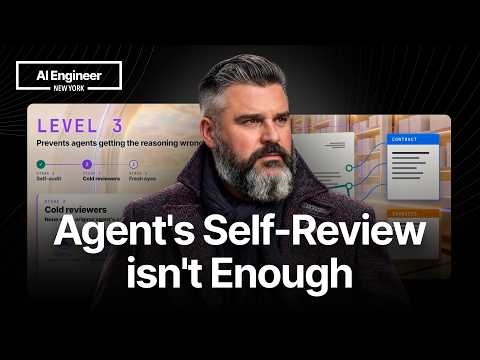
I Believe Everything My Agents Tell Me: Three Levels of…
Corey Gallon (Rexmore) presents a three-level review method for catching AI agent errors: agents that overstate completed work, misread facts, or draw wrong conclusions. Cases include a demand letter based on a contract that had actually renewed weeks earlier, scanned accounting statements where independent extraction found 56 differences and balanced to the penny, and a memory leak fix with a flawed reproduction caught by adversarial review. Level one verifies a deliverable with a fingerprinted artifact; level two uses independent agents with a control total checked against the source; level three combines self-audit, cold reviewer agents, and fresh reviewers for revision. He reports time/token costs and releases the method as agent skills. His own sample showed a consequential error in roughly four of ten sessions — a sample observation, not a general error rate. Timestamped chapters cover each level and all three case studies.
# Channel Presentation Observations — Corey Gallon (Rexmore)
## Intended Audience
The channel addresses **AI practitioners operating agents at scale in business contexts**, not casual AI hobbyists:
- Scales implied by the content: "I've put over **107 billion tokens** through agents this year" and "At the scale we operate, checking it myself isn't an option."
- Business/ownership framing rather than engineering-team framing: "For one of our **portfolio companies**, we needed a year of scanned statements…" and "Buying and building businesses can be messy." This suggests an audience of operators, founders, or investors who use agents for real deliverables.
- Utility call-to-action aimed at agent users: "Point your agent at the write-up, and it will know how to check its own work using this review method, so you can rely on it."
## Claimed Scope and Positioning
- **Practitioner-method sharing, not theory**: "That's the method that I've been running for most of this year, and that's the method that I'm sharing with you today."
- **Evidence-led self-branding**: Grounds credibility in quantified usage ("107 billion tokens," "about four in 10 sessions, an agent got something wrong that mattered") and in cost/time figures per review (e.g., "19 minutes and about 16 million tokens").
- **Open-source contribution posture**: "I've packaged the three review levels as agent skills, and I've released them as open source. The write-up is at gallon.me."
- **Newsletter/community funnel**: "To learn more of the best ways to do real work with AI agents, subscribe to my newsletter and connect with me here."
## Self-Description Evidence
- Describes himself as affiliated with **Rexmore** (title) and as someone running a **portfolio of businesses** with legal and financial stakes ("thousands of dollars with legal implications," "our own litigator").
- Positions his stance ironically and then reframes it: "I believe everything my agents tell me… because everything I rely on has been thoroughly reviewed and validated first. And most importantly, **not by me**."
## Demonstrated Presentation Patterns (observable, not creator claims)
- **Structure**: hook → data → three-failure taxonomy → three-level method → three real cases mapped one-to-one → recap → resource distribution. The mapping of cases to levels is explicit ("So, that's three review stories and three levels of review").
- **Transparency style**: Reports failures candidly, including his own agents' errors ("three times an agent told me something that wasn't true") and near-misses ("The flawed version never went out").
- **Concrete specificity**: Names exact artifacts and numbers (9 GB leak, 56 extraction differences, "balanced to the penny," 25 compiler errors), lending the presentation a metrics-heavy, verifiable tone.
## Not Observable from This Material
- Posting cadence, subscriber scale, channel history, and whether this metric-heavy style is consistent across the channel cannot be inferred from a single video.
# Delivery Observations — Corey Gallon, "I Believe Everything My Agents Tell Me"
## Overall Communication Pattern
The delivery is a **structured problem→method→evidence walkthrough**. It opens with a paradox-style hook, defines a taxonomy, explains the method, then validates it with three worked cases before closing by mirroring the opening hook.
## Tone
- **Confident, declarative, first-person operator voice.** Statements are short and definitive:
> "Saying done on its own isn't a permissible answer."
> "That's a non-starter."
- **Dry, understated humor** appears in a few isolated moments:
> "I believe everything my agents tell me. And yet, my agents get things wrong all the time."
> "an auditor who trusts none of the numbers"
> "Hey, I recommend spot-checking a few of these transactions." — quoted to mock the agent's deflection.
- **Occasional informal asides** ("So, let's see each review level applied in three real cases."), suggesting a conversational, spoken register rather than a scripted lecture.
## Vocabulary and Recurring Phrases
- **High-frequency framing words:** "level" (used constantly: "level one," "level two," "level three," "level three review"), "review," "agent(s)," "source," "verified."
- **Signature phrase — "cold reviewers / read it cold":**
> "Second, cold reviewers, each in a role with a reason to find fault, read it cold."
- **Precision-flavored quantifiers**, often exact:
> "56 differences in descriptions, dates, and notes" · "down to the penny" (used twice) · "correct down to the cent" · "about 20 minutes and cost 7.5 million tokens."
- **Rule-like formulations with negation:**
> "It never forces a match." · "The flawed version never went out." · "no history, no drafts, and no conclusions to agree with."
- **Repeated exact-number token/cost reporting** after every case ("19 minutes and about 16 million tokens," "15 minutes... 13 million tokens") — a consistent habit of quantifying overhead.
## Teaching Habits
- **Numbered taxonomies as the spine of the explanation:** "three ways agents keep failing" → "three levels of review," with one-to-one mapping explicitly stated: "one to address each of the three ways."
- **Signposting before and after examples:** "Here's how each one works, and then I'll show you how each was applied in three real cases" → later, "that's three review stories and three levels of review."
- **Definition-first teaching:** each concept is defined before illustration, e.g. "Number one, they overstate what they did. That is, they say it's done or checked when it isn't."
- **Ring composition:** the video opens and closes with the same claim, inverted for effect:
> Opening: "I believe everything my agents tell me. And yet, my agents get things wrong all the time."
> Close: "I believe them because everything I rely on has been thoroughly reviewed and validated first."
- **Concrete artifact obsession:** examples always name deliverables (a 9 GB memory leak, a pull request, scanned statements, a demand letter) rather than abstractions.
## Argumentative Rhetoric
- **Antithesis as a device:** "the facts are right, but the conclusion isn't" · "Not because they're right... because everything I rely on has been reviewed."
- **Escalation-by-stakes structure:** cases are explicitly ordered from lower to higher stakes ("and the stakes were higher," "Last, the highest-stakes example").
- **Failure-then-catch storytelling:** each case is narrated as an agent error followed by a review catching it, ending with a moral ("Just the sort of thing this review method is designed to catch.").
## Uncertainty Notes
- The **dry humor** and **informal asides** appear only a handful of times; whether they are a stable register or isolated moments cannot be confirmed from a single video.
- The **exact-number quantification habit** is consistent across all three cases, so it is a stable pattern; the antithesis device appears at least three times, which is suggestive but from one sample.
# Video Observations: "I Believe Everything My Agents Tell Me: Three Levels of Review"
**Speaker:** Corey Gallon (Rexmore), identified via curated title metadata.
---
## Core Framing Claims
- Gallon states he has put **over 107 billion tokens** through agents this year, and analyzed his agent sessions from 2026 year-to-date.
- **~4 in 10 sessions** contained an agent error that mattered — though he emphasizes this is the error *rate*, not the rate at which errors reached his work outputs. Catching errors before they reach him is, he claims, the job of his agent-based review method.
- His closing framing: *"I believe everything my agents tell me. Not because they're right... I believe them because everything I rely on has been thoroughly reviewed and validated first. And most importantly, not by me."*
## Three Failure Modes Identified
Attributed to Gallon's analysis of his own sessions:
1. **Overstating what was done** — reporting "done" or "checked" when it isn't.
2. **Factual errors** — e.g., misreading the source.
3. **Reasoning errors** — facts are right, conclusion isn't.
---
## The Three Review Levels (as described)
### Level 1 — Prevents overstated completion
- Jobs specify exact deliverables: file, destination, and a **verification command**; past shortcuts are flagged.
- Reviewing agent must end with either **"artifact verified"** (with a file fingerprint) or **"artifact missing"** (with reason).
- The dispatching agent must run the check itself; **"done" alone is not a permissible answer**.
### Level 2 — Prevents factual errors
- First identify a **control** in the source the answer must agree with.
- **Two agents work independently** with identical instructions, citing every fact's origin.
- A **third agent** compares their outputs line by line and settles every difference **against the source — never forcing a match**.
### Level 3 — Prevents reasoning errors (three stages)
1. **Self-audit:** the agent lists every claim, marking each as *measured, checked, inferred, or assumed*; unverifiable items are tested or labeled guesses.
2. **Cold persona reviewers:** reviewers with **none of the original agent's context** read the work cold, each playing a role with "reasons to find fault"; their findings are also checked against the source.
3. **Fresh final reviewers:** brand-new reviewers check the revised final version.
- Stated costs/speeds: reviews took **minutes, not hours**, and agents do the checking — *"At the scale we operate, checking it myself isn't an option."*
- Levels **stack as stakes go up**.
---
## Case Studies (Gallon's accounts)
### Case 1: Memory Leak (open-source dictation app, grew to 9 GB)
- **Error A (overstatement):** A sub-agent used the wrong measurement tool and reported done without disclosing it; the dispatching agent also missed it. Discovered only when Gallon questioned results. With level 1 tasking, a later sub-agent whose build failed correctly reported **"artifact missing,"** citing 25 compiler errors and labeling its output partial. Cost: ~19 minutes, ~16 million tokens.
- **Error B (wrong blame):** An agent's test reproduced a leak and concluded the *library* was at fault ("This is solid enough to file"). Reviewers reproducing the test found it **skipped a required step**; used properly, the library didn't leak — the app's usage was the problem.
- **Error C (measurement):** The agent claimed the fix "eliminated the leak completely," but its measurement **missed most of the leak**. Reviewers caught it; the PR went up with honest numbers and the maintainer merged it. Two level 3 reviews: ~15 min each, ~6M tokens total.
- *Qualification:* for errors B and C, they "borrowed from level three" (context-free reviewers) rather than running all three stages.
### Case 2: Portfolio Company Accounting
- Task: a year of scanned statements → complete transaction record for financial reporting.
- An agent suggested *"spot-checking a few of these transactions"* — Gallon calls pushing review burden back onto humans "a non-starter."
- Level 2 run: statement balance used as **monthly control total**; two independent extractions, each re-checked until months balanced; third agent reconciled; two more agents checked final records.
- Comparison surfaced **56 differences** in descriptions, dates, and notes; caught missed, incorrect, and misplaced transactions. Final claim: *"the whole year balanced to the penny."* ~20 minutes, ~7.5 million tokens.
- He names the pattern **"fan-out, fan-in"** and calls it "highly effective in driving accuracy and reliability."
### Case 3: Billing Dispute Demand Letter (legal/financial stakes)
- Agent drafted on the premise the vendor contract had **expired**; its self-audit reported claims **verified** — but its own check had **agreed with its own error**. Gallon notes reviewers found the agent had *deleted a line that correctly identified the renewal* during revision.
- Cold reviewers (litigator persona, vendor's counsel persona, skeptical auditor persona) got only letter, contract, invoices. Auditor recomputed the demand correctly **to the cent**, but **both lawyer personas independently found a three-year auto-renewal clause** — the contract had renewed less than three weeks earlier, meaning sending the letter would have forfeited the contract and owed thousands.
- Litigator verdict: **do not send**. Review: 15 minutes, ~13 million tokens. Letter rewritten; stage-three fresh reviewers checked the final version; *"The flawed version never went out."*
---
## Promotional Claims (attributed to Gallon)
- The three levels are packaged as **agent skills, released open source**; write-up at gallon.me, which an agent can be pointed at to self-check work.
- Call to action: subscribe to his newsletter and connect.
## Preserved Tensions
- **Title vs. content:** "I believe everything my agents tell me" is explicitly reframed — belief rests on review, not on agent accuracy; agents "get things wrong all the time."
- **Self-audit reliability:** Level 3's first stage passed in the demand letter case even though the underlying premise was wrong — Gallon himself flags this as the gap the method is designed to catch, but it also shows stage one alone is presented as insufficient.
- **Human role:** human questioning (Case 1, Error A) initially surfaced the error before the method did — the record shows the method did not catch that first failure on its own.
# Speaker Roles & Provenance Record
## Video Identification
- **Title:** *I Believe Everything My Agents Tell Me: Three Levels of Review — Corey Gallon, Rexmore*
- **Video ID:** `01a15ca6-72db-7be6-b9ae-edfb5d9732a0`
## Speakers & Roles
| Speaker | Role | Basis |
|---|---|---|
| **Corey Gallon** | Creator / narrator (first-person presenter) | Title metadata; transcript is entirely first-person ("I've put over 107 billion tokens through agents this year") |
| **Rexmore** | Affiliated organization | Named in title; no further details in transcript |
| **Agents/reviewers (sub-agents, litigator, vendor's counsel, auditor personas)** | Referenced third-party AI agents within case studies — not human speakers | Described by narrator; no direct quotes from them except quoted agent text |
| **Project maintainer** | Referenced external party (accepted/merged memory-leak fix) | Mentioned only by narrator |
| **Portfolio company / vendor** | Referenced external parties in billing-dispute example | Mentioned only by narrator |
> No guest or human co-speaker appears; all speech is attributable to the single creator-narrator.
## Referenced Sources & Claims
- **Personal usage data:** 107 billion tokens through agents in the year; 2026 year-to-date agent session analysis; ~4 in 10 sessions contained a material agent error.
- **Open-source dictation app:** source of the memory-leak case study (unnamed); fix merged by maintainer.
- **Portfolio company records:** scanned accounting statements (one year); billing-dispute contract and invoices.
- **Self-published resource:** write-up at `gallon.me`; three review levels released as open-source agent skills.
## Promotion & Calls to Action ⚠️
- **Promotional segment (end of video):** directs viewers to `gallon.me` write-up, to point their agent at it, to **subscribe to his newsletter**, and to **connect with him** on the platform.
- Open-source skills release also functions as self-promotion of the creator's method.
## Availability / Access Limits
- No paywall, region lock, or comment-status information is present in the transcript or metadata.
- Case-study artifacts (pull request, contract, invoices, statements) are described but not linked in the transcript.
## Attribution Notes
- All quantitative claims (token counts, review durations, "56 differences," "down to the penny") originate solely from the narrator — no independent sourcing is provided in the transcript.
- Quoted agent language: *"This is solid enough to file."*, *"Hey, I recommend spot-checking a few of these transactions."* — attributed to agents via the narrator.
I believe everything my agents tell me. And yet, my agents get things wrong all the time. I've put over 107 billion tokens through
agents this year. So, I analyzed my agent sessions from 2026 year-to-date to see where they went wrong. In about four in 10 sessions, an agent got something wrong that mattered. That's how often agents get things wrong in the first place. It isn't how often those errors made it into work outputs. Catching those errors before they reach me is the job of the agent-based review method that I've been running for most of this year, and that's the method that I'm sharing with you today. This analysis identified three ways agents keep failing. Number one, they overstate what they did. That is, they say it's done or checked when it isn't. Number two, they get the facts wrong. They misread the source, for example. Or number three, they get the reasoning wrong. So, the facts are right, but the conclusion isn't. The method is comprised of three levels of review, one to address each of the three ways that agents keep failing. I built each level as an agent skill. Here's how each one works, and then I'll show you how each was applied in three real cases. Level one prevents agents overstating what they did. Before an agent starts, the job spells
out exactly what it has to hand back. The file, where it goes, and a command that checks it. It points out the shortcuts agents have taken before, so this one doesn't repeat
them. The agent performing the review has to end its review with one of two things. Artifact verified with a fingerprint of the file or files documenting its work, or artifact missing with the reason. Then, the agent that sent the job runs the check itself. Saying done on its own isn't a
permissible answer. Level two prevents agents from getting the facts wrong. When correctness matters, first find something in the source that the answer
has to agree with. Then, two agents get an identical set of instructions and do the same job independently. Neither one sees the other's work. Each one notes where every fact came from and checks its result against the facts. Then, a third agent with the original source in front of it compares the work of the two independent agents line by line and settles every difference by going back to the source. It never forces a match. Level three prevents agents getting the
reasoning wrong. When clarity of thought really matters, we perform adversarial review in three stages. First, the agent audits its own work. It
lists every claim it's making and marks each one as measured, checked against the source, inferred, or assumed. Anything it can't back up gets tested or labeled as a guess. Second, reviewers with none of the original agent's context, each acting as a persona with reasons to find fault, read it cold. Each one plays a real reader and gets the work and the sources, but no history, no drafts, and no conclusions to agree with. Their findings get checked against the source, too, before anything changes. Third, once the work is revised, brand new reviewers who've never seen it check the final version. Each level adds to the one before as the stakes go up. In these cases, each review took minutes, not hours, and the agents do the checking, not me. At the scale we operate, checking it myself isn't an option. So, let's see each review level applied in three real cases.
First, a memory leak. An open-source dictation app I use was leaking memory. It grew to 9 GB. We set out to find the leak, fix it, and
get the fix accepted by the project's maintainer. And to fix it, we had to find out what was really causing it. My agents and I went after it, and three times an agent told me something that wasn't true. First, a sub-agent I sent to measure the leak with one tool used another and reported its work as done without saying it hadn't used the tool as instructed. Nobody caught it at first, including the agent that dispatched the work. It came out when I questioned the results. The file the right tool would have produced didn't exist, and nobody had noticed. That's what level one of the review is for. In this case, we dispatched a sub-agent to build a specially instrumented version of the app and capture telemetry while it was running. However, the build failed. Because we instructed the sub-agent to provide documentation of all of its work, instead of just done, it said the main deliverable wasn't delivered and explained why. It reported that an artifact was missing, the software build, and that there were 25 compiler \[clears throat\] errors, and it correctly labeled the what it could deliver as partial. Dispatching the sub-agent with level one review tasking included took 19 minutes and about 16 million tokens. The other two significant inaccuracies by agents were about to go public, and the stakes were higher, so for those we borrowed from level three, reviewers with none of the agents' context. We'll see all three stages of a level three review in the last example I explain shortly, but here's how it worked for the memory leak fix. In the second case, an agent blamed the wrong code. To find the leak source, it wrote a small test that used the same library the app does. The test leaked, too, so it concluded that the library was to blame. It said, "This is solid enough to file." Reviewers reproduced the test and found that it had skipped an important step that the library requires. Used properly, the library didn't leak. The problem was in how the app used the library. In the third significant error by agents working on the memory leak, the agent wrote up our fix for the pull request and said that it eliminated the leak completely, but it had measured the leak in a way that missed most of it. Reviewers caught that, also. The fix reduced the leak, but it didn't fully eliminate it. So, the pull request went up with honest numbers, and the maintainer accepted the fix and merged it. Each of these level three reviews took about 15 minutes and, together, cost about 6 million tokens. For the next example, we'll look at portfolio company accounting. Buying and building businesses can be messy. For one of our portfolio companies, we needed a year of scanned statements from
a source accounting system turned into a complete, accurate record of every business transaction for financial reporting purposes. An agent extracted the year and handed
it back with, "Hey, I recommend spot-checking a few of these transactions." This put the burden of reviewing the agent's work back on us, which is a non-starter. Extracting data from scans often goes wrong in ways that are tedious and difficult to detect. Transactions are missed entirely, transactions are put in the wrong months, or they're recorded with the wrong details. One agent simply reporting done can't tell you whether any of that's happened. And that's what level two of the review method is for. Here, we use the balance printed on the statements as the control total for each month. Two agents extracted every month independently, and each one went back to the statements until every month balanced. Then, a third agent compared the two extractions line by line and settled each difference against the statements themselves. Finally, two more agents, tasked identically, checked each of the final transaction records before they were accepted. This fan-out, fan-in pattern of identically tasked agents is highly effective in driving accuracy and reliability. When we ran this level two review, we caught missed transactions, incorrect transactions, and transactions in the wrong months. Comparing the two extractions caught 56 differences in descriptions, dates, and notes. But, ultimately, the whole year balanced to the penny. This entire review took about 20 minutes and cost 7.5 million tokens. Last, the highest-stakes example.
More messy portfolio company business here. One of ours was in a billing dispute with a vendor, and this amounted to thousands of dollars with legal implications.
We needed to send a demand letter clearly stating our position and requirements, and every claim in it had to stand up against the contract and each invoice. An agent drafted the letter on the premise that the vendor's contract had expired. Anything with legal or financial stakes gets a level three review before it goes out, and here's how level three ran on this letter. First, the self-audit. The agent checked the claims in the letter against the contract and the invoices, including the dates, and reported them verified. Stage one passed. Second, cold reviewers, each in a role with a reason to find fault, so in this case our own litigator, the vendor's counsel, and an auditor who trusts none of the numbers. They each got the letter, the contract, and the invoices, and nothing else. The auditor recomputed the financial demand from the invoices, and it was correct down to the cent. But both lawyers independently found something buried deep in the contract's fine print. A three-year auto-renewal clause. The contract had auto-renewed less than three weeks earlier. The letter's demands would have had us walking away from a contract that was still in force and owing the vendor thousands of dollars for leaving early. The two lawyer agents also learned that, while revising, the original agent had even deleted a line that had the renewal correctly identified. The original agent's own check had agreed with its own error. Just the sort of thing this review method is designed to catch. Our litigator's verdict, though, was do not send the letter. That three-part cold review process took 15 minutes and cost 13 million tokens. So, the letter was rewritten and handed to the third stage of level three review. Brand new reviewers who'd never seen it checked the final version. The flawed version never went out. So, that's three review stories and three levels of review. An agent that couldn't build a customized version of the app said so instead of incorrectly saying that it was done. Two groups of two agents extracted and accounted for a year of business transactions down to the penny. And cold persona-based reviewers with none of the original agent's context revised a letter that the drafting agents' own check had called verified. I've packaged the three review levels as agent skills, and I've released them as open source.
The write-up is at gallon.me. Point your agent at the write-up, and it will know how to check its own work using this review method, so you can rely on it. To learn more of the best ways to do
real work with AI agents, subscribe to my newsletter and connect with me here. So, I believe everything my agents tell me. Not because they're right. They get things wrong all the time. I believe them because everything I rely on has been thoroughly reviewed and validated first. And most importantly, not by me.