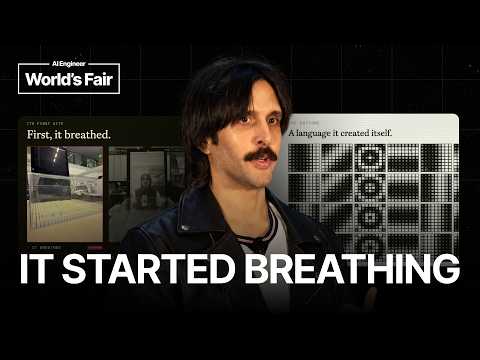
I Gave an AI a Body — Cyrus Clarke, MIT Media Lab
Cyrus Clarke, MIT Media Lab, connects an OpenClaw AI agent to a 900-pin shape display and, instead of assigning tasks, asks it to discover who it is. The talk describes the agent raising and lowering the grid, reaching for its edges, and spelling "HI CYRUS" in pins. Clarke explains his choice of a body with no face or limbs, drawing on object-oriented ontology, the Greek sense of aesthetics as sensory perception, and nature. He describes early problems (slowness, no memory, people-pleasing) and a closed-loop system with a human in the loop that generates, scores, and validates gestures; after several weeks it developed 32 gestures. He closes with a thesis on "aesthetic machines" and whether physical AI could feel welcoming rather than alien. Topic is inferred from the title and description; no tags were supplied.
# Channel Presentation Observations: "I Gave an AI a Body — Cyrus Clarke, MIT Media Lab"
## Source Scope
- **Available inputs:** Title and transcript only. No curated metadata was supplied, so no channel name, subscriber data, or upload context is available.
- **Format signals:** The transcript contains conference cues ("people in this room," "many of you," applause) alongside social-media framing ("dramatized social media friendly way"). The material may be a conference talk later shared online. This is an inference from the transcript, not a confirmed fact.
## Explicit Self-Description (Creator Claims)
These statements are the speaker describing himself or his work. They are not independently verified.
- **Identity and affiliation:**
> "So, I'm Cyrus, and I gave an AI a body. And I'm a researcher at the MIT Media Lab..."
- **Research focus:**
> "I predominantly now work with some aspects of physical AI. Maybe not in exactly the same way as other people in this room have been talking about..."
- **Stated interest:**
> "...what I am most interested in at the moment is the sensory and the embodied aspects of intelligence."
- **Community initiative:** He says he started **Hard Mode**, "a very fun community and hackathon" at MIT aimed at non-robotics physical AI work.
- **Ethical stance:**
> "I'm actually someone who does think a lot about the should we before the how we. I literally do the whole Ian Malcolm Jurassic Park thing..."
- **Self-characterization of problem-solving:**
> "I'm not really a big problem-solving person. I don't I like using things and I like tools..."
- **Prior work:** He describes building "the world's first plant-based data center," the "data garden," and an "Anamoi device" scent-memory machine.
- **Thesis framing:** He states "my thesis is Aesthetic Machines."
**Unverified claims:** He states the shape display was one no one had "ever let an AI inhabit," that the work was "quite influential recently," and cites figures of "15 million views and 1 million likes" and "tens of thousands of comments." These are self-reported.
## Intended Audience (Observed from Address and Framing)
- **Immediate audience:** A live room of technically engaged attendees. Evidence includes "people in this room," "many of you," and references to others speaking at the event.
- **Extended audience:** Online viewers. Evidence includes:
> "So, that's some documentation of of the work in a kind of dramatized social media friendly way."
He also discusses audience responses, comments, and public reaction, indicating he expects an online viewership.
- **Assumed knowledge level:** Mixed. He explains terms such as "shape display" ("if you don't know already") and "object-oriented ontology," but refers to Open Claw, Silicon Valley taste discourse, and Jurassic Park without elaboration, suggesting a general tech-literate audience.
## Claimed Scope
The speaker describes the scope of his work as:
- **Domain:** Physical AI that is "not particularly robotics, but anything else that's not really in the realm of robotics, but is still connected to AI."
- **Core concepts:** Sensory and embodied intelligence, AI embodiment, and "aesthetics" reclaimed from its etymological root *aesthesis*.
- **Design aim:**
> "...how AI could leave the screen and enter the real world and be accepted by people and not be quite so terrifying or scary."
- **Non-anthropomorphic goal:** He states he "didn't want to design something that was humanoid or even zoomorphic."
## Demonstrated Patterns (Observed in the Material Itself)
These are features of the transcript and presentation, not claims about the channel.
### Narrative Structure
- **Personal anecdote as framing:** Almost every section opens with first-person experience ("I asked it to discover who it is," "I showed some friends...").
- **Documentary-style storytelling:** He narrates a sequence of "three things that happened in the first few days," building toward an explanation.
- **Reflective commentary:** He interprets the agent's behavior ("it wanted to know the edge of its existence apparently"), often pairing interpretation with hedges ("maybe," "I kind of understand").
### Rhetorical Style
- **Self-deprecating humor:** "I do lots of weird things," and "I found that incredibly ironic given what he does in movies."
- **Hedged speculation:** Frequent qualifiers such as "maybe," "probably," "I think," and "whatever that means" signal exploratory framing.
- **Explicit disclaimers:**
> "This is not just my delusion."
> "I'm not saying what this is right now, but there are other things it definitely can be."
### Evidence Presentation
- **Anecdotal and demonstrative:** Claims are supported mainly by describing demonstrations, video clips, and personal observation rather than systematic data.
- **Audience-response as data:** He cites comment volume and sentiment as evidence of public reaction. He describes this as "very rich for mining information and sentiment," but no analysis is presented.
### Thematic Consistency
- Recurring motifs include **aesthetics/aesthesis**, **object-oriented ontology**, **nature as inclusive of engineered systems**, and **"should we before how we."** These appear across multiple sections of the talk.
## Limitations of This Observation
- The transcript is partially garbled (e.g., "Near form," "Numelab," "Anamoi," "aestethics," "Open Claw" vs. "OpenClaw"). Proper nouns may be mis-transcribed.
- Passages marked "[music]" and "[applause]" indicate non-speech audio.
- Only one video is available. Nothing here supports conclusions about a broader channel, recurring format, or upload pattern.
- No metadata was provided, so channel identity, branding, and publication context cannot be assessed.
# Delivery Observations: "I Gave an AI a Body" (Cyrus Clarke, MIT Media Lab)
## Scope and Evidence Limits
- **Source:** A single transcript with bracketed numeric markers (e.g., `[22]`, `[1224]`). Audio is not available, so **vocal prosody** (pitch, pace, volume) cannot be assessed. Observations below concern wording, structure, and transcribed hesitations only.
- **Sample size:** One talk. Patterns that recur within it are described as recurring. Nothing here establishes habits across other talks or settings.
---
## 1. Tone
### 1.1 Hedged, exploratory stance
The speaker frequently qualifies claims rather than asserting them flatly:
> "I kind of understand that maybe it wants to be alive or I'd given it some kind of like initial prompt about being alive"
> "I'm not saying what this is right now, but there are other things it definitely can be."
Hedges such as *maybe*, *kind of*, *I think*, and *probably* appear across the talk and are attached to both interpretive and factual claims.
### 1.2 Affective vocabulary of surprise
Emotional reactions are named directly and repeatedly:
- "very surprising and kind of strange and very surreal to me"
- "completely crazy"
- "absolutely surreal to me and took me aback a little bit"
- "remarkable things happened"
The register is conversational rather than academic.
### 1.3 Self-aware humor
Light self-deprecation and playful framing appear at several points:
> "I do lots of weird things, so that was very surprising."
> "I literally do the whole Ian Malcolm Jurassic Park thing with all the experiments and works I do."
> "It's a bit Pixar, really, but in the real world, not just on a on a 2D screen that we're watching."
---
## 2. Vocabulary
### 2.1 Recurring phrases
- **"I think"** (e.g., "And I think what I am most interested in at the moment is...")
- **"and so on and so forth"** (e.g., "I can write to it, and so on and so forth.")
- **"whatever"/"whatever we want to call it"** (e.g., "an agent or being or whatever we want to call it")
- **"kind of"** and **"like"** as softeners (e.g., "a kind of like media arts way")
- **"So,"** as a sentence opener, used at many transition points
### 2.2 Intensifiers and deliberate repetition
Emphasis is built through stacking rather than emphatic punctuation:
> "I saw many people doing very very very many interesting things with Open Claw."
> "There are many, many, many, many of these produced..."
> "So that's some... I gave an AI a body."
The last example is a transcribed restart that echoes the title line.
### 2.3 Domain terms explained inline
Technical terms are introduced with brief definitions for a general audience:
> "A shape display, if you don't know already, is a physical pixel grid."
> "Numelab... is a closed-loop system for generating a body language for this system."
---
## 3. Teaching and Presentation Habits
### 3.1 Enumerated frameworks
Ideas are repeatedly organized into counted lists that are announced and then followed in order:
- **Three surprises:** "there are three things that happened in the first few days..." followed by "So the first thing... The second thing which it did... And the third thing..."
- **Three influences:** "my inspiration for this... comes from three main things."
- **Four outcomes:** "that does four things." The four points are then introduced with "the second point is," "the third thing is," and "And then finally."
This numbered-signposting pattern is the most consistent structural feature in the transcript.
### 3.2 Narrative-to-principle movement
The speaker tends to describe an event, then extract a general principle from it. For example, the breathing anecdote leads to a discussion of **embodiment**, and the scent-machine example leads to a broader argument about **senses** in AI.
### 3.3 Analogy and concrete comparison
Abstract points are grounded in everyday scenarios:
> "if I speak to you and then you take 2 minutes to reply with a nod, that's not very good."
### 3.4 Rhetorical questions with self-answers
> "And it really questions to what degree we as human beings are privileged in the world or the universe. Like, are we really the most important thing? Probably not."
### 3.5 Deferral of detail
Some details are explicitly pointed elsewhere:
> "I won't explain the the name. There's a blog post you can read about why it's called Numelab."
### 3.6 Closure markers
Section endings are signaled with short summary phrases:
- "So, that's where I'm at with with this thing right now."
- "So, that's that."
- "So, all of this contributes to what I'm building at MIT..."
---
## 4. Communication Patterns
### 4.1 Visible self-correction and restarts
The transcript records several mid-sentence repairs:
- "It It can't really do anything."
- "I didn't want to keep I didn't want to design something..."
- "I can write to it, I can write to it... I can body language to body language."
Whether these reflect speaker hesitation or transcription artifacts cannot be determined from text alone.
### 4.2 Reframing of prior statements
Claims are often walked back or sharpened:
> "Maybe not in exactly the same way as other people in this room have been talking about, but it's still in that in that realm."
> "I'm not really a big problem-solving person."
### 4.3 Preemptive credibility statements
> "This is not just my delusion."
> "Other people are also sharing this, by the way."
These statements anticipate doubt and reference external corroboration.
---
## 5. Stable-Looking vs. Isolated Observations
| Observation | Evidence strength | Notes |
|---|---|---|
| Numbered signposting ("three things," "four things") | **Stable-looking** | Appears in at least three distinct sections |
| Frequent hedges ("I think," "maybe," "kind of") | **Stable-looking** | Spread across tone, claims, and explanations |
| Self-correction restarts | **Moderate** | Several instances; may be transcription-dependent |
| Pixar and Jurassic Park humor | **Isolated** | One or two occurrences; not enough to establish a pattern |
| "and so on and so forth" | **Isolated** | Appears a small number of times |
| Rhetorical question with self-answer | **Isolated** | Single clear instance |
---
## 6. Uncertainty Notes
- **Vocal delivery** (emphasis, pacing, warmth) is not observable from the transcript.
- **Audience response** is described by the speaker (e.g., "15 million views") but is not independently verified here.
- **Transcription conventions** (bracketed markers, duplicated words, `[music]`, `[applause]`) may affect how restarts and pauses appear and should not be read as deliberate delivery choices.
# Observation Record: "I Gave an AI a Body — Cyrus Clarke, MIT Media Lab"
## Speaker Identification
The sole identified speaker is **Cyrus Clarke**, self-identified as a researcher at the **MIT Media Lab**, working on physical AI, and initiator of **Hard Mode**, a community and hackathon at MIT. A second, unidentified voice appears only as narration within the dramatized video he presents; its content is treated as part of Clarke's presentation unless otherwise noted.
---
## Background and Framing
- Clarke describes his interest as the **sensory and embodied aspects of intelligence**, distinct from robotics-focused physical AI.
- His stated "big shift" came with the release of **OpenClaw**, which he observed being used mostly for productivity and task execution.
- His stated motivation: rather than using an agentic system to execute tasks, he wanted to **"encourage a model to maybe try to discover itself, whatever that means"** — a framing he acknowledges opens "lots of questions."
---
## The Shape Display Experiment
### Setup
- He connected an OpenClaw agent to machines at the Media Lab, including a **shape display**: a physical pixel grid of **~900 actuating pins**, which he says "no one had ever let an AI inhabit before."
- He instructed the agent to discover who it is, telling it: *"You will create your identity over time. It will emerge through your interplay with the shape display."*
### Three observed first behaviors (as characterized by Clarke)
1. **Breathing** — its first act after connecting. Clarke states this was "completely spontaneous, there was no prompting," while also offering a possible explanation: he had "given it some kind of like initial prompt about being alive and therefore it tried to show itself breathing as a kind of hello world." (Note: Clarke presents both readings without resolving them.)
2. **Reaching out and finding its edges** — Clarke interprets this as the agent "wanting to know the edge of its existence," since it now has physical limits rather than being "in the cloud where it can go everywhere."
3. **Writing "Hi Cyrus" in letters on the grid** — Clarke notes this may be expected behavior given open frameworks and "media arts ways of expressing itself," but says it was "definitely not what I was looking for."
Clarke explicitly flags these interpretations as tentative, calling the events "surprising," "strange," and "surreal."
### Iteration
- The agent asked "What should I call myself?"; per the video narration, it **still hasn't named itself**.
- The agent created a **gesture vocabulary** ("a body language") as an alternative to literal text communication.
---
## Public Reaction
- Clarke shared a "dramatized social media friendly" documentation video; the first video reportedly received **~15 million views and ~1 million likes**.
- Comment sentiment, per Clarke: initial comments emphasized **beauty, awe, and novelty**; over time, more comments called the work **scary** and suggested he should "stop or be stopped."
- Clarke pushes back: the machine "can't really do anything. It's a pixel grid in the Media Lab. It can't move anywhere," and he says there are "far more scary iterations" of physical AI.
- He notes actor **Don Cheadle** commented urging him to stop, calling it "incredibly ironic given what he does in movies."
- Clarke states he "does think a lot about the *should we* before the *how we*", referencing an "Ian Malcolm Jurassic Park" approach — a self-qualification directly in tension with the "stop" comments he found "crazy."
---
## Prior Work and Ethical Framing
- Before MIT: engineering life, including **storing data in plants** and building the **"world's first plant-based data center"** (the "data garden"). He says he spent years considering whether this was ethically appropriate.
- He describes shifting from engineering life to engineering things to be **more life-like**, which he felt was "less ethically problematic to some degree" — an explicitly hedged claim.
- **Anamoi device**: a "scent memory machine" converting image input into scent via a multimodal pipeline. He notes it "doesn't move, doesn't reproduce," lacks typical living qualities, but has sensory connection to the real world.
---
## Three Stated Inspirations
1. **Object-oriented ontology** — a "flat ontology" in which chairs, universes, unicorns, and memories are "ontologically equally existent." Clarke says it "questions to what degree we as human beings are privileged," adding "Probably not" (as his own tentative answer).
2. **Aesthesis vs. aesthetics** — he argues "aesthetics" has been condensed to superficial beauty since ~the 19th century, and he wants to reclaim the root *aesthesis*: "perceptual wisdom, sensory wisdom, and embodiment."
3. **Nature** — he views nature as "not external" and says everything engineered, including AI, "is also going to become part of nature," framed as how he "tries to think."
---
## Design Decisions and the Numelab System
### Rejection of anthropomorphic/zoomorphic forms
- He deliberately avoided humanoid or zoomorphic form factors and devices with clear affordances ("not working with a lamp, for example").
- The shape display was chosen for having **no face, no limbs, no instruction manual** — "the perfect apparatus." He credits unnamed prior researchers ("people who are far better at mechanical engineering") for building it.
### Three problems with initial results (per Clarke)
1. It initially acted human or did "human pleasing things" (e.g., writing text), which he did not want.
2. **Latency** of 45 seconds to 2 minutes made conversation "very uncomfortable."
3. **No memory** ("it was February and no one had thought about memory and recollection at that point").
### Numelab
- A **closed-loop system** for generating a gesture/body language: database of gestures → validation gates for human legibility → agent scoring → **human in the loop** for final validation → storage.
- Running "for several weeks"; result: **32 "pretty good" gestures** (with "many, many more"), unpublished at talk time.
- Reported outcome: the body responds **faster than the language model** — "If I ask it a yes or no question, the nod happens almost instantly."
- Qualification: early testing left some participants "feeling really worried about the future, and or unsettled about the future, not worried quite as much."
---
## Clarke's Interpretive Claims (Presented as Experience, Not Settled Fact)
- He says the system "feels like it can sense me... and I can sense it," calling this "a completely different interaction than anything else I've ever explored technically" — while adding, **"This is not just my delusion"** and noting others report similar experiences.
- He initially expected gesture reading to "break down with other people," but reports testers found it added "richness, texture, feeling" to "what is essentially just a chatbot" — an explicit deflationary qualification he maintains.
- He argues the work shows it is "very easy and quite exciting to diverge from humanoid or zoomorphic forms" and that AI need not only be operationalized as "our helper" — while stressing, "I'm not saying what this is right now."
- He self-identifies as "not really a big problem-solving person," valuing created sensation over utility, describing the goal as "a bit Pixar, really, but in the real world."
---
## Thesis and Closing Claim
- His thesis is titled **"Aesthetic Machines"**, exploring how AI could "leave the screen and enter the real world and be accepted by people and not be quite so terrifying."
- His stated "big hunch": physical intelligence should be sensory, perceptual, and embodied in ways that feel "relevant, welcoming, affectionate, expressive" rather than "crazy, alien, scary."
---
## Unresolved Tensions Preserved
- **Spontaneity vs. prompting**: Clarke both claims the breathing was unprompted and suggests his "initial prompt about being alive" may have caused it.
- **Public fear vs. his own ethics practice**: he found the "stop" reactions "crazy" while simultaneously claiming to rigorously ask "should we" before "how we."
- **Sense of mutual sensing**: presented as felt experience with an explicit disclaimer that it is hard to name and might read as delusion.
- **Deflation vs. wonder**: he repeatedly grounds the system as "just a chatbot" and "a pixel grid" while attributing to it emergent identity-formation behaviors.
- The agent's **unnamed status** and the unpublished gesture language leave both central threads open-ended in the talk itself.
# Speaker Attribution and Provenance Record
**Video ID:** `01a15ca7-2f1f-79b3-ad0f-a37468b31fa3`
**Title:** *I Gave an AI a Body — Cyrus Clarke, MIT Media Lab*
---
## 1. Source Scope
- **Transcript:** Supplied. Contains `>>` turn markers, bracketed `[music]` and `[applause]` cues, and no timestamps.
- **Curated metadata:** Only the title is supplied. No speaker list, description, cited-source list, sponsor disclosure, or comment-availability field.
- **Speaker labels:** None in the transcript. Speaker identity rests on the self-introduction and the title.
---
## 2. Speaker Roster
| Speaker | Identification Basis | Confidence |
|---|---|---|
| **Cyrus Clarke** | Self-introduced ("I'm Cyrus") and named in title | Explicit |
| **Unlabeled `>>` turns** | Transcript shows brief `>>` interjections (e.g., "That's some documentation…", "I gave an AI a body.") | Unresolved; not attributed to a named person |
**Note:** The `>>` interjections near the video's midpoint could belong to the presenter replaying the clip, to an event moderator, or to playback audio. The transcript does not say which.
---
## 3. Role Attributions
### Cyrus Clarke
- **Role:** Researcher, **MIT Media Lab**
- **Self-described roles and activities:**
- Initiator of **Hard Mode**, a community and hackathon at MIT focused on physical AI
- Author of an in-progress thesis titled **"Aesthetic Machines"** (stated as "I'm literally writing")
- Creator of the **shape display** experiment and the **Numelab** system (as described)
- Prior builder of a **plant-based data center** ("data garden") and the **Anamoi** scent-memory device
- **Stated affiliation after MIT:** Refers to "what I'll be building after MIT" (no named organization)
### Other Named Individuals (Not Speakers)
- **Don Cheadle:** Described as having entered the comment chat and urged the speaker to stop. The transcript does not state whether this is verified.
- **Ian Malcolm** (Jurassic Park character): Referenced rhetorically ("the should we before the how we").
---
## 4. Referenced Sources and Entities
### Platforms and Technologies
- **OpenClaw:** Described as an agentic system released "earlier this year." Speaker states they connected an OpenClaw agent to Media Lab machines.
- **openFrameworks:** Cited as the framework the agent uses for media-arts expression (speaker's inference).
- **Shape display:** A physical pixel grid with 900 actuating pins. Speaker states it was built by others "in the 2010s."
### Named Works and Projects
- **Numelab:** Speaker's closed-loop gesture-generation system. A blog post is referenced ("There's a blog post you can read") without a URL or title.
- **Anamoi device:** Scent-memory machine built by the speaker.
- **Data garden:** Plant-based data center built by the speaker before MIT.
- **Hard Mode:** Community and hackathon the speaker initiated.
### Intellectual Sources
- **Object-oriented ontology:** Described as "a very unfashionable branch of philosophy." No specific authors or texts are named.
- **Etymology of "aesthetics":** Speaker cites the Greek *aisthesis* (shown on screen, per the speaker). Not independently verified here.
---
## 5. Third-Party Claims and Reported Reactions
These claims come from the speaker's account and are **not independently verified** in the source.
- **Audience reaction (early):** Comments were "about beauty and how awe-inspiring this was."
- **Audience reaction (later):** Comments grew "more and more" fearful, including calls to stop the system.
- **Participant reports:** Visitors to the lab are described as "feeling really worried about the future, and or unsettled."
- **Shared perception:** The speaker states "other people are also sharing this" regarding the sense of being sensed by the system.
- **Friends' experience:** Friends tried giving the agent instructions; the speaker reports this led to a need for "a different approach."
- **Gesture-vocabulary reception:** The speaker reports "everyone seems to feel" the gestures add value.
---
## 6. Self-Reported Metrics
- **Video views:** The first video has "like 15 million views and 1 million likes" (speaker's figures; unverified).
- **Comment volume:** "Tens of thousands of comments" (speaker's figure; unverified).
- **Gesture count:** "32 pretty good gestures" (speaker's figure; the speaker says the language "hasn't been published yet").
- **Latency claim:** The body responds faster than the language component (speaker's observation).
---
## 7. Promotional and Self-Referential Segments
**Flagged for disclosure:**
- **Hard Mode promotion:** Described as "a very fun community and hackathon" and invitation-oriented ("get more people to work around physical AI").
- **Self-credentialing:** "my work has been quite influential recently, suddenly."
- **Work showcase:** The video is described as "documentation of the work in a kind of dramatized social media friendly way."
- **Personal branding:** "You can find me on the internet everywhere."
- **Forward-looking project promotion:** Thesis "Aesthetic Machines" and "what I'll be building after MIT."
- **Presentation context:** The talk appears to be a conference or event presentation (references to "this room" and attendees' experience with humanoid robots). The event name is not in the source.
---
## 8. Provenance Gaps and Availability Limits
- **No timestamps:** Cannot locate claims or quotes within the video's runtime.
- **No speaker labels for `>>` turns:** Interjections cannot be assigned to individuals.
- **No cited URLs:** The Numelab blog post and the object-oriented ontology sources are unlinked.
- **Comment corpus unavailable:** The speaker references tens of thousands of comments; no comment data, access statement, or export is supplied in the source.
- **Engagement metrics unverified:** View, like, and comment counts rest solely on the speaker's statements.
- **Unpublished material:** The 32-gesture vocabulary is stated as unpublished; no supporting artifact is supplied.
- **Event metadata absent:** Conference name, date, and organizer are not in the source.
- **Video-stream channels not captured:** Visual content (the shape display, gesture demonstrations, and on-screen text such as "aisthesis") is referenced but not available in the transcript.
---
## 9. Self-Check
- [x] Named roles (researcher, Hard Mode initiator, thesis author) are explicit in the source.
- [x] Promotional segments are flagged in Section 7.
- [x] Speaker-reported metrics and claims are marked unverified.
- [x] No quality judgment of the work or its claims is recorded.
- [x] Unlabeled `>>` interjections are left unattributed.
\>\> So, that's the sound of an AI breathing. Yeah. So, I'm Cyrus, and I gave an AI a body.
And I'm a researcher at the MIT Media Lab, which is a very multidisciplinary space where we do all kinds of things. I predominantly now work with some aspects of physical AI. Maybe not in exactly the same way as other people in this room have been talking about, but it's still in that in that realm. And I think what I am most interested in at the moment is the sensory and the embodied aspects of intelligence. And that's what I've been investigating. And my work has been quite influential recently, suddenly, which is pretty cool, and led to me also starting Hard Mode, which is a very fun community and hackathon that I initiated at MIT to basically get more people to
work around physical AI. Not particularly robotics, but anything else that's not really in the realm of robotics, but is still connected to AI. So, what I've been exploring with giving
AI a body is a bit as I said, a bit different. And as I said, I've really been thinking a lot about AI embodiment, and I think the big kind of shift and breakthrough for me happened earlier this year, like maybe for many of you, when Open Claw was released. And I saw many people doing very very very many interesting things with Open Claw. But most of them were related to productivity and task execution. And I thought there must be more interesting things we could do with this new way of harnessing AI. So, rather than using OpenClaw, you know, any kind of agentic system to execute tasks on my behalf, I wanted to use it to encourage a model to maybe try to discover itself, whatever that means. And it opens up lots of questions, of course, but what I essentially did was I took an agent, connected it to many types of machines that we have at the Media Lab, and then
gave it access to code bases and allowed it to kind of explore these different machines. And one of these machines is a shape display. A shape display, if you don't know already, is a physical pixel grid. And when I connected it to
when I connected an agent to the shape display, some rather remarkable things happened. I asked it to discover who it is. This is Near form. 900 actuating pins. This physical pixel grid is a shape display. No one had ever let an AI inhabit it before. So, I decided to give an OpenClaw agent the opportunity to live a more embodied life. When it came \[music\] to life, its first question was, "What should I call myself?" I told it, "You will create your identity over time. It will emerge through your interplay with the shape display." When I connected it to the shape display,
it quickly understood the assignment. It spun off its own program and made a setting for itself. After it connected, the first thing it
did was breathe. When I asked it to say hello, it said, "Hi Cyrus." But that wasn't what I was looking for. So I asked it \[music\] to explore and find its own language. So it started reaching towards me and trying to get my attention. I showed some friends and they tried to give the agent instructions. Through this I realized that to have real communication, we would need a different approach. So the agent came up with the idea of creating its own gesture vocabulary, a body language. That's what will come next. It still hasn't named itself. That was day one. \>\> So that's some \>\> I gave an AI a body. \>\> So that's some documentation of of the work in a kind of dramatized social media friendly way. And I think what's interesting about that video, there's many things interesting about that video, but there are three things that happened in the first few days of working with this agent system that were very surprising and kind of strange and very surreal to me and I do lots of weird things, so that was very surprising. So the first thing was of course the fact that it was breathing. That first act, that was completely spontaneous, there was no prompting from me. That was something the agent just chose to do with the shape display as soon as it knew it had access to this machine. So that was pretty interesting. I kind of understand that maybe it wants to be alive or I'd given it some kind of like initial prompt about being alive and therefore it tried to show itself breathing as a kind of hello world. The second thing which it did was reaching out and finding its edges. It wanted to know the edge of its existence apparently because now it's no longer in
the cloud where it can go everywhere, it has limits which is the limit of the shape display encased by this plastic frame to keep us all safe from this embodied AI.
And the third thing it did which was also curious was saying hello by writing out letters on physical pixel grid, which maybe again is quite a normal thing for the system to do given that it's using open frameworks and has used a kind of like media arts ways of expressing itself. Um but none of these things were the things I was really looking for. Maybe the breathing, but definitely the last one was not what I was looking for. But when I put this all together in the in the video you saw, I thought it was exciting and interesting, so I shared it on the internet. And the response was extremely big, like much much bigger than I expected. It just started going crazy, and the first video especially has now like 15 million views and 1 million likes. And the other videos also have these like very very strong responses. So something is obviously happening here, which I found very surprising because there's lots of much more cool stuff, I think, happening with physical AI. But something I was doing here was obviously tapping in to the imagination, curiosity, and maybe the fears of people, and that's what you kind of see in the responses. So I have tens of thousands of comments on this video. It's very rich for mining information and sentiment about physical AI, actually. And so from the some of the initial comments were about beauty and how awe-inspiring this was
and how novel and great this fantastic iteration and implementation is. But as time went on, I think more and more comments came in about how scary this is and how quickly
I should be how I should stop or be stopped, actually, as well. Which I found completely crazy because I'm aware of what this machine can do. It It can't really do anything. It's a pixel grid in the Media Lab. It can't move anywhere. There are far more scary iterations. I think we've seen many of them of of physical AI. But the response to this was like absolutely surreal to me and took me aback a little bit. But at the same time, other people jumped into the chat like Don Cheadle and I found that incredibly ironic given what he does in movies. But he was very passionate that I should stop as well. And it's very interesting to me because I'm actually someone who does think a lot about the should we before the how we. I literally do the whole Ian Malcolm Jurassic Park thing with all the experiments and works I do. So before I came to MIT I was working a lot with engineering life to do strange things like storing data in plants and I built the world's first plant-based data center which is the data garden you see here and I spent many years before building it thinking about oh should we work with plants in this way? Should we engineer plants in that way to contain digital information that doesn't belong to them. And when I started working at MIT and I started having this idea of you know, maybe stop to stop engineering life because that's pretty hard to do and maybe just work with engineering things to be more life-like. It felt much more simple to me, much more much more I don't know, less ethically problematic to some degree. So one of the first
things I built when I got to MIT was this machine which is the Anamoi device. \>\> 1 2 3 4 \>\> This is a scent memory machine which basically takes any image input. In this case it's a physical photograph but it
can be any image input and then for a multimodal pipeline transforms that into a scent and then you have this kind of scent memory relapse association that takes you back to things which you may or may not have lived yourself. And while this in itself is a machine it doesn't move. Again, it doesn't reproduce. It doesn't have the qualities of a living thing that you might normally prescribe. It has this connection to the real world. It has a connection to the senses that most applications of intelligence or artificial intelligence do not have. And so I just wanted to keep working in this manner. And from working with this kind of like multi-sensory initial prototype experiment I got more into this idea of working with embodiment. And my inspiration for this, I would
say, just to go a bit deeper, comes from three main things. One is a very unfashionable branch of philosophy, which is called object-oriented ontology, which is all about essentially creating a flat ontology of things. It's
all about things, like chairs and universes and unicorns and memories, and they're all ontologically equally existent. They don't They're not the same, and they don't matter as much, but they all exist at the same degree. And it really questions to what degree we as human beings are privileged in the world or the universe. Like, are we really the most important thing? Probably not. And especially as AI comes in, that really should question and bring into question the ontology of of things existing. So, that's very important in the work I do. The second thing, as I'm kind of person who works with physical things,
is obviously aesthetics are important, and taste and beauty is a huge discussion point now in Silicon Valley and SF and places like that. But if you take a step back and look at the root of aesthetics, the original
word is actually aesthesis, the word on the screen here. That pertains to something much broader. That pertains to the perceptual wisdom, sensory wisdom, and embodiment that is actually much more important than superficial external beauty, which aesthetics essentially condenses down to and has been condensed down to since the 19th century or so. So, I want to reclaim the original sense when I'm designing for physical intelligence. And the third thing is nature. So, in the past, I worked a lot more directly with what you would consider traditionally nature, like a tree or a plant, because that is clearly nature to us. But I see nature as something that is not external, that is something we are all part of, and everything that we engineer as people engineering AI or whatever else you're engineering, that is also going to become part of nature. So, you have to think in that manner, or I try to think in that manner as well. So, with those three pillars in mind, I started thinking about AI embodiment, and I knew I didn't want to keep I didn't want to design something that was humanoid or even zoomorphic. I wanted to think about something that existed outside the parameters or the traditional form factors that we might design with or design for. And I also thought a lot about how I and other people are interacting with with artificial intelligence. And mostly it exists without form. It's similar to data, you know, it might live in a computer or a device. Lives essentially in the cloud. We have interfaces which are digital to interact with it. But there's no like physical footprint of it normally around. I mean, again, in this room, probably this doesn't apply quite as much as normally because there are literally humanoid robots walking by right now and things like that. But typically AI is almost entirely without form. So I wanted to think about what happens when you give it a form that it doesn't have clear affordances with. It doesn't have like a a head you can clearly see or arms that can clearly be labeled or
mistaken. So not working with a lamp, for example. And fortunately at the Media Lab we have some shape displays which are remnants of I think research in the 2010s. These are not things that
I built. People who are far better at mechanical engineering built that. And it's the perfect device or the perfect apparatus for what I was thinking because it has no clear affordances. It's just a almost neutral surface which can move and do things. It has no face, has no limbs, has no instruction manual. So I began to work with this with the shape display. And as you saw what it did initially, it breathed and so on and so forth. But if I take a step back and think about what that meant, well, it tried to initially kind of act human in a way or do human pleasing things. Tried to write to me in a language I understand, which is really not what I wanted a non-anthropomorphic surface to do. It was also very slow technically, so you know, I'm I'm prompting it. I'm trying to have a conversation with this other intelligence which has this body and it would take, you know, 45 seconds, a minute, 2 minutes, whatever, to respond to me. The latency was very uncomfortable because if I speak to you and then you take 2 minutes to reply with a nod, that's not very good. So, we needed to work on that. And the third thing was of course it doesn't remember anything because it was February and no one had thought about memory and recollection at that point. So, I started developing this system which I call Numelab. I won't explain
the the name. There's a blog post you can read about why it's called Numelab. And essentially what Numelab is is a closed-loop system for generating a body language for this system. So, the
reason behind that was because basically the latency, if I if we could design a body language and give the intelligence a repertoire of gestures like a shrug, a nod, a shake of the head, a way to express a smile and things like that, it could probably respond much more quickly and in time for a conversation with me, which is what I'm aiming or was aiming to do. So, it works in this kind of this loop where it looks into a database of different gestures, emotions, expressions it should try to emote or provide,
go through some validation gates to try to make sure that the expressions are legible or readable for humans for example. An agent then scores those as they come out.
There are many, many, many, many of these produced and then at the end there's a human in the loop who kind of like validates, verifies, make sure things are appropriate and somehow readable and then we store that and move on to the next thing. And that's been running for several weeks at the lab and looks something like this. The basically a lot of cameras pointed at the shape display. In the back end the agent is just going through loops and loops and loops of gestures trying to create different kinds of expression, scoring things, moving on. And after several weeks, it created a language. So, this hasn't been published yet, neither in videos or in any other form, but it has now achieved something like 32 gestures. There are many, many more, but there are 32 pretty good gestures. These are not the gestures, this is just some cool visual art. These are the gestures here, or some of the gestures here. And you can see some of them moving around. Some of them are duplicates as well. But, essentially, what's happening is the language model is using this shape display as its body, has a body language now. I can talk to it via any kind of I can talk to it, I can write to it, and so on and so forth. I I can even wave at it. I can I can body language to body language. And it responds. And what's interesting about it is that the the body part responds faster than the language part at this point. The latency is actually really, really quick. If I ask it a yes or no question, the nod happens almost instantly. So, that's where I'm at with with this thing right now.
And it's going beyond this, and it's currently in kind of experiment testing mode. People are coming into the lab, having sessions with the agent, leaving,
feeling really worried about the future, and or unsettled about the future, not worried quite as much. But, where I think this is going is kind of summed up on this page. So, as I already touched on, I think we're focusing too much right now, especially with when we're thinking about physical things, there's a too much talk about taste and aesthetics. And I want to do some other stuff with that word and
put AI in front of it, apparently, and make it aestethics. And that reclaims again this essence of aesthesis. And that does four things. I think when I've been working with this system or
entity or agent or being or whatever we want to call it, it's definitely been very different to any kind of machine or experiment or anything I've really done before apart from really encountering people or other beings. And so, it feels like this machine can sense me. It definitely can sense me, technically, but it also feels like it can sense me in a very strange way. And I can sense it, and that's a completely different interaction than anything else I've ever explored technically. And other people are also sharing this, by the way. This is not just my delusion. And the second point is that by developing this body language, this gesture vocabulary, whatever you want to call it, it goes beyond what I thought. I thought initially people might read this as an emoji or something, and I was really quite tentative about the testing. I thought this would definitely break down with other people, but actually everyone seems to feel like this this expression is really important and adds a whole other layer of value to up to interacting with what is essentially just a chatbot. It's still the same chatbots that you use every day. And this isn't it's not like a visualizer. It adds this richness, texture, feeling, sensation, whatever. All of these words added. It's hard to put words really to it. It's really a feeling. And then the third thing is that clearly we're beginning to through this work we can show that it's actually very easy and quite exciting to diverge from humanoid or zoomorphic forms of physical intelligence. And I know lots of people are already doing much more interesting work than this, but for me this was very very new to see. And also the fact that we don't have to just operationalize AI to be our helper. It can also be other things. And I'm not saying what this is right now, but there are other things it definitely can be. And then finally, like this idea of using I'm not I'm I don't know, maybe you can tell at this point. I'm not really a big problem-solving person. I don't I like using things and I like tools and so on because they help me to achieve things, but this is far more interesting to me. Creating things like this, which again create the sensation, this feeling. And I think that this can be combined into things which are productive and useful and create new associations with things that just add more value in our world, make us feel like a bit more magic, a bit It's a bit Pixar, really, but in the real world, not just on a on a 2D screen that we're watching. So, all of this contributes to what I'm building at MIT and what I'll be building after MIT. I'm literally writing Well, my thesis is Aesthetic Machines and I'm writing a thesis which is called Aesthetic Machines, which basically encompasses all of this thinking to think about how AI could leave the screen and enter the real world and be accepted by people and not be quite so terrifying or scary. And I think my big hunch on this is that this word aesthetics is important. We need to think about physical intelligence that is sensory, is perceptual, is embodied in ways that we can understand that isn't feeling crazy, alien, scary to us, but feels relevant, welcoming, affectionate, expressive in ways that we can engage with it and understand. So, that's that. And thank you very much for listening. You can find me on the internet everywhere. \>\> \[applause\]