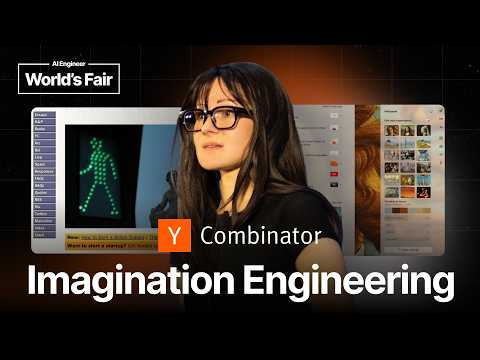
Imagination Engineering: "Live in the future and then build…
Talk by Eve Bouffard (Head of Design, Y Combinator) on "Imagination Engineering"—the idea that as AI models grow more capable, the bottleneck shifts from technical execution to conceiving bold ideas. She shares experiments including "Thinking in Public" (aggregating stream-of-consciousness notes into a personal AI-generated website), building software on demand such as a "Shape of Minds" visualizer mapping historical geniuses and a custom emoji picker, and using AI for rapid learning via summarized reports on complex topics. She frames the current era as analogous to the Library of Alexandria, urging consolidation and creation of knowledge.
# Channel Identity Observations: "Imagination Engineering" Talk
## Explicit Self-Description Statements
- **Role claim**: The speaker states, *“I work at YC. I lead design at YC”* — this is a direct self-description of professional identity.
- **Motivation claim for working at YC**: *“One of the big reasons why I work at YC is many probably know about this wonderful mind, Paul Graham.”*
- **Personal background detail**: *“Some of them are in French because I grew up speaking French up until I was 21”* (referring to books listed on the generated website).
- **Self-characterization**: *“My brain has many, many thoughts. It's actually like sometimes overflowing with thoughts.”*
- **Stated personal value**: *“I love to make people smile… a great way for me to make people smile is to use a lot of emojis.”
## Claimed Scope of the Talk
- The talk frames a new concept the speaker coined: *“The reason I called this talk imagination engineering is because I've been thinking about how incredibly capable the recent models are… I think that the new bottleneck will be to come up with like crazy ideas.”*
- Central thesis presented: *“What about thinking in public?”* — positioned as an extension of “building in public,” inspired by Paul Graham’s essays.
- The speaker describes the session as an experiment share: *“I thought today I could share with you a really weird experiment that I started a week ago.”*
## Intended Audience (Observable Evidence)
- A **live, in-person audience**: *“Thanks so much for coming. I'm actually really surprised that the room is so full.”*
- Audience is presumed **technically fluent and AI-tool-aware**: references to “Fable 5,” “Opus 4.8,” “cloud code compatible,” “Conductor Cloud,” and “agents” are used without explanation.
- Audience is invited into dialogue: *“If you have questions, I am happy to take it. All of this is an experiment, and I would love to learn from you guys on how you're experimenting with models.”*
## Demonstrated Presentation Patterns (Observable, Not Claimed)
- **Live demonstration style**: The speaker shows an actual website live — *“evebufar.com”* — and narrates its features in real time (custom backgrounds, dark mode, language translation).
- **Rapid tool-building showcase**: Multiple self-built tools are demonstrated, including “Shape of Minds” (*“I created this really fun tool”*), a Slack emoji picker, and an emoji search tool — all built with AI models.
- **On-the-fly, time-constrained creation**: *“This was generated about 20 minutes ago, right before”* — indicating comfort presenting unreviewed material.
- **Enthusiasm and wonder framing**: *“I kind of felt like it was AGI. And I'm excited to share with you the result and to share the wonder and the awe that I feel towards technology currently.”*
- **Quote-driven inspiration**: Recurring citations of Paul Graham (*“Live in the future and then build what's missing”*) and Steve Jobs (*“Computers are the bicycle of their minds”*), plus a paraphrased Gary quote (*“It's a rocket ship for the minds”*).
## Claimed vs. Demonstrated Distinction
- **Claimed**: Speaker positions themselves as a design leader at YC running a “thinking in public” experiment.
- **Demonstrated**: The material itself shows a pattern of quick AI-assisted prototyping, personal tooling built for own workflows (emoji pickers, timers, reports), and meta-experimentation with AI summarizing one’s own thought streams (*“It made… a MD file that is my tone and what makes me unique as a person”*).
## Notes on Limits
- No curated metadata was supplied; observations derive solely from the transcript.
- No channel-wide conclusions (e.g., channel topic or upload cadence) can be drawn from this single talk.
# Delivery Observations: "Imagination Engineering" Talk
## Tone & Overall Register
- **Enthusiastic and conversational**: The speaker uses casual, energetic language throughout, e.g., > "Hi everyone. Thanks so much for coming. I'm actually really surprised that the room is so full."
- **Self-aware informality**: The speaker acknowledges the oddity of the topic: > "imagination engineering is like a really weird term."
- **Warm and affirming toward others**: Frequent positive descriptors for colleagues: > "the privilege to work with wonderful, wonderful minds" and > "the partners there are incredible."
## Vocabulary & Recurring Words
- **Intensity adjectives repeated heavily**, especially "phenomenal," "wonderful," "beautiful," "magical":
- > "it came up with something that is quite magical and phenomenal"
- > "he's a phenomenal thinker and phenomenal brain"
- > "the most beautiful fertile minds in history"
- **"Picked up on"** as a recurring phrase when describing what the AI extracted (appears at least six times):
- > "it picked up on the fact that I love art"
- > "It picked up on the projects that I've been working on"
- > "it picked up on this"
- **"Stream of consciousness"** repeated as a core concept:
- > "sharing his stream of consciousness"
- > "Whatever like whatever stream of consciousness you have, you should just ask an agent to do it for you."
## Teaching / Presentation Habits
- **Live demo-driven structure**: The talk is organized around showing artifacts rather than slides: > "So I can show you an experiment I can show you actually what it looks like."
- **Framing concepts with existing quotes**, then extending them:
- Paul Graham: > "live in the future and then we'll build what's missing"
- Juxtaposing Jobs and a colleague: > "computers are the bicycle of their minds" vs. > "it's like a rocket ship for the minds."
- **Introducing a memorable conceptual pairing**: > "we hear very often about like building in public... But what about thinking in public?"
- **Transparent about improvisation and time pressure**:
- > "I'm going to discover them with you because I haven't had time to read them before uh presenting here cuz this was generated about 20 minutes ago"
- > "I knew that I had a a deadline to hit and so I made a timer for myself"
- **Prescriptive takeaways delivered as direct advice**:
- > "you should just ask a a model to prepare like a little like report for you on this topic"
- > "I feel like it's a great prompt for everyone here."
## Communication Patterns
- **Heavy use of filler and self-repair**: frequent "um," "uh," "like," and restarts, e.g., > "Uh evebufar. com" and > "I love paper sheeters. Paper, if you know, it's a a new design tool."
- **Live self-narration of on-screen actions**: > "I can hide this," > "I can like do dark mode for the reader," > "whoops, it picked up on this."
- **Time-checking and audience-aware pacing**: > "they're only I have 5 minutes left. What can I share?" and > "I don't want to overload you with a lot of things."
- **Open, experimental framing at the close**: > "All of this is an experiment, and I would love to learn from you guys on how you're experimenting with models."
## Uncertainty Notes
- **"Picked up on" and the intensity adjectives ("phenomenal," "wonderful")** are well-supported recurring patterns.
- **Personal disclosure habit** (e.g., > "I love to make people smile," > "my brain has many, many thoughts") appears a few times, but not enough repetition to call it a stable pattern.
- Single-occurrence habits (e.g., the timer anecdote) are **isolated moments**, not established delivery patterns.
# Observation Document: "Imagination Engineering"
## Talk Overview
- **Speaker**: Self-identified as a YC employee who leads design at YC ("Eve" — inferred from her named Slack channel "Eve Thoughts"; the transcript gives her name only via the channel name "evebufar.com"). Works with YC partners and engineers.
- **Thesis**: With increasingly capable models (she references "Fable 5" launching the same day), the new bottleneck is **coming up with crazy ideas** — "imagination engineering." She frames the valuable skill as "how to stretch our mind and how to invent things that don't think are possible right now."
## Key Claims and Positions
### 1. AI capability shifts the bottleneck to imagination
- She argues it "will be really easy to one-shot absolutely everything and anything very soon," so idea generation becomes the scarce resource.
- Supporting analogy: we are in a moment like the **Library of Alexandria** — a period for consolidating and creating knowledge for the species. (She generated the Library of Alexandria image with ChatGPT.)
### 2. "Thinking in public"
- Inspired by **Paul Graham (PG)**, whom she calls "arguably one of the most intricate minds in our generation"; she attributes YC's success partly to PG's essays — "his essays are still echoing to this day."
- PG's mode is described as **thinking in public**, contrasted with the common "building in public."
- Her experiment: created a **"Eve Thoughts"** Slack channel at YC, modeled on **Lewis's** "Lewis Thoughts" channel at Conductor (a former YC colleague), brain-dumping her stream of consciousness for a week, visible to trusted YC colleagues.
### 3. The website experiment (evebufar.com)
- Built by asking **Opus 4.8** (two days prior; she notes she "wished it was Fable") to aggregate her week of Slack thoughts.
- Claims it "encapsulated" her: her love of art, admired quotes, YC projects, media, tools, life-changing books (some in French — she spoke French until age 21).
- Features she demonstrated: customizable backgrounds, dark mode, font/typeface/width controls, language translation, applying **Paper "sheeters"** (a new design tool she loves, "cloud code compatible") to backgrounds showing famous art.
- Her prediction: **"the future of design will be just a lot of sliders."**
- She also had it generate a **voice.md** distilled from her online writing (including tweets) describing her tone — "it's kind of crazy to read it" — plus an auto-updating design-language file and personal invocable "skills."
- She said seeing the result "kind of felt like it was AGI" — an expressed feeling, offered with wonder rather than as a settled claim.
### 4. Notable quotations she endorses
- PG: **"Live in the future and then build what's missing"** — her favorite quote, framed as "a great prompt for everyone here."
- Steve Jobs: "computers are the bicycle of the mind"; she reports **Gary** saying that with Fable-era models it is now "a rocket ship for the minds" — "no longer a bicycle."
### 5. "Shape of Minds" tool
- Built that morning (started 10:00 a.m. at a coffee shop in the Marina) with Opus 4.8, because Fable wasn't yet available.
- Purpose: find commonalities across dimensions (thinking, obsessions, quirks, origins, routines, prolific output, love, worldview, religion, habits, knowledge) among "the most beautiful brains in history."
- Observations surfaced by the tool (presented tentatively, some read live for the first time): many liked to argue; **many were childless** ("not sure what this means"); **naps were very popular**; **they barely ate** ("an interesting one"); notable number of Germans.
- Design language deliberately celebrated the **Fable 5 campaign**, with butterflies extracted and turned into individual components.
- Also generated an agent-readable **glossary MD** ("a lot more efficient than having the agent look at this page").
### 6. Small personal tools and practices
- A **random Slack emoji / iOS emoji picker** tool — built because finding the right emoji was inefficient and she loves making people smile.
- **On-demand learning reports**: asking a model to prepare short reports (e.g., "10 principles of good design," Renaissance patronage) digestible during commutes.
- Excitement about **Cloud Workspaces / Conductor Cloud**: "spin off a bunch of agents on the go."
- A **self-imposed timer** (started 10:10 a.m.) to hold herself to the deadline, and a repo-change backlog page showing site evolution.
- Her general maxim: **"software on demand"** — "whatever stream of consciousness you have, you should just ask an agent to do it for you."
## Qualifications and Unresolved Tensions
- Several tool findings were presented as tentative or unexamined: she read the Shape of Minds highlights live, admitting "I haven't had time to read them before presenting here."
- The childless observation is flagged by her own uncertainty ("not sure what this means").
- She frames everything as **an experiment** and closes by inviting the audience to share how they are experimenting with models — no settled conclusions offered.
- Model names in the transcript ("Fable," "Opus 4.8," "Fable 5") are recorded as spoken; speaker identification of "Gary" and "Lewis" relies solely on her first-name references.
# Speaker Attribution Record
**Video:** Imagination Engineering: "Live in the future and then build what's missing."
**Video ID:** `01a15ca8-a2bb-76fc-8a37-1b041e8e6a11`
## Speakers
- **Single identified speaker (presenter/creator)** — introduces herself contextually as **"Eve"**, who **leads design at Y Combinator (YC)**. She delivers the entire talk as a live presentation to an audience.
- No guest speakers, narrators, or additional identified voices appear in the transcript. The transcript ends with a `>> [music]` marker.
## Referenced Third Parties (quoted or attributed, not speaking)
- **Lewis** — former YC colleague, now at **Conductor**; credited with the "Lewis Thoughts" Slack channel that inspired the experiment.
- **Paul Graham (PG)** — YC founder; quoted: *"live in the future and then we'll build what's missing"* (described as her favorite quote).
- **Steve Jobs** — quoted/paraphrased: *"computers are the bicycle of their minds."*
- **Gary** — attributed the line that current models are like *"a rocket ship for the minds"* (vs. a bicycle); said to have made the speaker laugh on Sunday.
## Referenced Tools, Models, and Products
- **Opus 4.8** — used to build the website and the "Shape of Minds" tool.
- **Fable / Fable 5** — referenced repeatedly; a model launch/campaign ("Fable 5 coming back") tied to the event; used for highlights extraction and butterfly design components.
- **ChatGPT** — used to create the Library of Alexandria image.
- **Claude** — credited with generating a completion checklist and a "voice" markdown file.
- **Conductor / Conductor Cloud / Cloud Workspaces** — mentioned re: spinning up agents on the go.
- **Paper** — a design tool the speaker says she loves, including its "sheeters" (**note:** delivered in a promotional tone — she offers to show the product website and praises it).
- **Slack** — platform for "Eve Thoughts" / "Lewis Thoughts" channels.
## Promotional Segments Flagged
- **Paper design tool** — extended praise of the product and its cloud-code-compatible "sheeters," with an offer to demo its website: promotional in character.
- **Fable 5 campaign** — the talk's design language is explicitly stated to be "in celebration of the Fable 5 campaign"; event context appears tied to this launch.
## Referenced Projects / Sites
- **evebufar.com** — website aggregating one week of "Eve Thoughts."
- **"Shape of Minds"** — tool comparing historical thinkers across dimensions (built morning of the talk).
- Personal utilities: Slack emoji search tool, learning-report generator, website backlog/change log, voice/tone MD files.
## Unverified / Uncertain Claims
- Speaker's name ("Eve") is inferred from channel/site names ("Eve Thoughts," evebufar.com), not an explicit self-introduction.
- Model names (Opus 4.8, Fable 5) are recorded as spoken; internal consistency is not verifiable.
## Comments Availability
- No metadata supplied; **comment availability unknown**.
\>\> Hi everyone. Thanks so much for coming. I'm actually really surprised that the room is so full cuz imagination engineering is like a really weird term. I'm really surprised that you showed up
to learn more about it. Um the reason I called this talk imagination engineering is because I've been thinking about in how incredibly capable the recent models are, especially today with Fable 5 coming back. And I think that the new bottleneck will be to come up with like crazy ideas because it's going to be really easy to one-shot absolutely everything and anything very soon. And so I think that the thing that we can reflect on that will be the most valuable for the world right now is how to stretch our mind and how to invent things that don't think are possible right now. And the reason I took this um that I created with ChatGPT this image, it's the Library of Alexandria, which was
like the center of knowledge uh many thousand years ago. And I feel like we're in a very similar period in our in the human history right now where we
should be thinking about how to consolidate all the knowledge and how to create more knowledge for our species. Um and so I thought I thought today I could share with you a really weird experiment that I started uh a week ago. And I was one of the or if you don't know, I work at YC. I lead design at YC and I have
the privilege to work with wonderful, wonderful minds. The partners there are incredible. The engineers that I get to work with are phenomenal. And um there's a wonderful person that I
used to work with at YC and he's now at Conductor. Um his name is Lewis and he created a Slack channel in the Conductor Slack called Lewis Thoughts. And ever since then, he's been sharing his stream of consciousness of everything that hits his mind. And it is a way for everyone on the Conductor team to see what's going on in his mind as he's thinking about features and how to make the product better. And I was heavily inspired by his approach, and I did the same for the YC Slack, and I created Eve Thoughts. And for a week have been brain dumping everything that has crossed my mind. And 2 days ago, I asked Opus 4.8, I wish it was Fable, but it was Opus 4.8 on Saturday to make a website that encapsulate all the thoughts that I had in the last week. And it came up with something that is quite magical and phenomenal, and I kind of felt like um it was AGI. And I'm excited to share with you the result and to share the wonder and the awe that I feel towards technology currently. Um maybe to take a take a step back before
I show you the website is I work at YC, and one of the big reasons why I work at YC is many probably know about this wonderful mind, Paul Graham. He's arguably one of the
most intricate minds in our generation, and it's one of the reasons why I work at YC. And um what I think is truly phenomenal about PG is that not only he's a phenomenal thinker and phenomenal brain, but he also shares his brain and how his mind works with the world. And one of the main reasons why YC has been so successful is because his essays are still echoing to this day, and people are applying to YC because of his essays. And um I've been thinking, you know, we we hear very often about like building in public, you know, building open source or like sharing how you build things. But what about thinking in public? And it's basically what PG is doing, thinking in public. And this is the experiment that I wanted to run with Eve's thoughts, the Slack channel on the YC channel. The YC Slack. It was what if I thought in public and I allowed a few people that I highly trust at YC to have access to my stream of consciousness. And it does feel a little bit sci-fi. Um but at the same time it's sort of an experiment that I really wanted to see the light of. Um and see where it goes. So I can show you an experiment I can show you actually what it looks like. Uh evebufar. com And so this was
an iteration uh no it was actually like an aggregation of all the thoughts that I've been dumping in this Eve Slack channel for a week. And it picked up on the fact that I love art. And so it allows me to
customize the background here. Um it picked up on some of the quotes that I truly admire. It picked up on the projects that I've been working on at YC. Picked up on some of the media that I've been doing. It picked up on the tools that I use on a daily basis. It picked up on all the books that have changed my life. Some of them are in French because I grew up speaking French up until I was 21. Um the books that I want to read, some quotes. One One my favorite quote of all time is PG quote that says live in the future and then we'll build what's missing. I feel like it's a great prompt for everyone here. How can we live in the future and build and then build what's missing? Um another So there's this famous quote by Steve Jobs like computers are the bicycle of their minds and Gary always says that with Fable and these insanely capable models it's like a rocket mind like a rocket ship for the minds. It's no longer a bicycle. Um which I loved he made me laugh like on Sunday when he said that. Um and it also picked up on like a train of thought. Um, and like many, many thoughts cuz my brain has many, many thoughts. It's actually like sometimes overflowing with thoughts. So, I was able to capture everything as I was brain dumping in the Slack channel. Um, I can also share a little bit more about the fun things that it came up with. Like for example, um, it loves it knows that I love paper sheeters. Paper, if you know,
it's a a new design tool. Um, I can show you the website if you want. I love their product. And I specifically love their sheeters.
I think I can do it here. Specifically love their sheeters. They're all cloud code compatible and you can use them for all your creative projects. And so, uh, whoops, it picked up on this. And it allows me to apply sheeters to my background. I can hide this. And you can you get to see the most beautiful pieces of art in human history with some very fun sheeters. Just kind of fun. You can do it this here. And then you can even like customize all these things. And I think the future of design will be just a lot of sliders. Um, and I can revert. And it also allowed me to uh, I can like do dark mode for the reader. Um, it allows me to customize absolutely everything about the font and typeface and the width, everything. Oh, if you speak foreign languages, it also converted or translated everything that is on the website depending on whatever language you want. But I think going back to the how to think in public and how to build in public, I wanted to experiment with, okay, what if I made sort of a dashboard of what this website consists of. And so, what is the stack of this website? And also some of the an early version of a design system to keep everything consistent. Um, I also experimented with toolkit to allow to hold myself accountable to make sure that everything about this um this project as a webpage is uh complete. And so, Claude made this really lovely list of all the things that I should be that I should hit including like an open graph picture and things like that. Um, but yeah, there's so many things that I want to show here. So, I asked it to create a voice on MD which um it picked up on all the writings that it could find on the internet that was written by me including my tweets and everything and then it made it distilled it into an MD file that is my tone and what makes me unique as a person. And it's kind of crazy to read it. And I asked it to do the same for my for the design language of this website. And whenever I make a a change to the design of this website or create a new uh component, it automatically updates it. Um, and I can also show I created a few skills for myself that I can in invoke at any given point. Um but the real real fun project that I wanted to show today was we're in in imagination engineering and so, thinking about how the most
beautiful fertile minds in history were thinking and what is the commonality between all of these beautiful minds. And so, this morning started at 10:00 a.m. at my favorite coffee shop in the marina
uh with Opus 4.8 because Fable was not out at this point. I created this really fun tool. I call it Shape of Minds and it's a way for us to find commonality across different dimensions of the most beautiful brains in the history of humanity. Um and I can show you a little bit. It is uh highly responsive. You can just hover over all of these beautiful minds and it tells you what makes this person unique or in the dimension of thinking for example, how is Bach unique? And it's all like you can see them the spikiest minds uh based on this different dimension. So, I wanted to explore their thinking, their obsessions, their quirks, their origins, you know, it's interesting cuz here for example, there are a lot of Germans in these uh in these great minds. Um their routine, prolific output, workaholic, unsurprisingly I guess. For love, interests, worldview, religion, habits, knowledge. And because I didn't want to bore you too much with all of this overload of information, I asked Fable to come up with the highlights, the most interesting things that it picked up on uh when it came to the commonality or spikiness of some of these minds across the different dimensions. And there are really interesting things and I'm going to discover them with you because I haven't had time to read them before uh presenting here cuz this was generated about 20 minutes ago, right before. Um so let's see. I guess people these people like to to argue. Um a lot of them were childless. Uh not sure what this means. Um oh yeah, naps naps were very popular among the best minds. Um they barely ate. This is an interesting one. Um and yeah, anyway, all of this is public so if you want to uh look at the highlights, it's um it's quite soul nourishing and mind nourishing to look at this. Um and I also created a design so if you had not um picked up on this, the entire design language of this tool that I built this morning was in celebration of the Fable 5 campaign that came back. Um and so I asked uh Fable to extract all the butterflies from this and then turn them into individual components that I can use for the design language of this project. Um what else can I share? Um oh, this is a MD of it's a glossary of all the information that is displayed on this project. Super easily readable by the agents and it's a lot more efficient than having the agent look at this page, obviously. And funny enough, I made this page this morning when I started working on this project and I knew that I had a a deadline to hit and so I made a timer for myself uh when I started 10:10 a.m. so that I knew exactly how much time I had to work on this project to accomplish the task that I needed to accomplish. Um and yeah, it's all like software on demand. Whatever like whatever stream of consciousness you have, you should just ask an agent to do it for you. Um like all of this is AI. I have generated this picture which I kind of thought was cool. You can probably recognize some of these cool faces like Da Vinci, Salvador Dali, Marie Curie, Nikola Tesla, Einstein. Um and yeah, they're only I have 5 minutes left. What can I share? Um I can share
I can share so I love to make people smile. I love to make people smile when I can. And um a great way for me to make people smile is to use a lot of emojis
um especially in the company Slack. And um it was always a pain to find the emoji that I wanted to use to make people smile in the Slack. It was like very inefficient for me to find that. So I created this tool for myself where I can just like search for a random fun stupid Slack emoji as a reaction um for my Slack and same thing for these here. They're kind of fun. I specifically like this one. And this is like the regular iOS emoji picker, which I kind of always struggle with. I never find the thing that I'm looking for and so I just built it for myself and you can like by a click just copy. Another fun thing that I built is I always, you know, we're all
students of life and we're all trying to learn as much as possible and with these these new models we can \>\> and \>\> learn at a pace that was never possible before. And so whenever you have a
stream of consciousness about something that you'd like to work on you should just ask it. You should you should just get ask a a model to prepare like a little like report for you on this topic and that's what I started doing a few few days ago. All these things are things that I would have that I love to would love to deepen my understanding of and would still make it very efficient. And so I just explored a few concepts like the 10 principles of good design and um like Renaissance patronage is also something that I'm fascinated by right now. And so it just cooked up like a short very short report for me that I can digest as I'm on my way to work or I'm coming back from an event or something like that. That's why I'm so excited about Cloud Workspaces as well is because it's going to be very possible very soon with Conductor Cloud to be able to spin off a bunch of agents on the go as I'm like traveling from one place to another. But yeah, feel like I can I can stop there. I don't want to
overload you with a lot of things, but another interesting thing that I created is like this the backlog of all the changes on this website as I was making the final tweaks to the shape of mine
a few minutes ago, 25 minutes ago. And you can see like the evolution of that repo over time. Um But yeah. I guess I can I can end early, and if you have questions, I am happy to take it. Uh to take questions. All of this is an experiment, and I would love to learn from you guys on how you're experimenting with models. Um Yeah. \>\> \[music\]