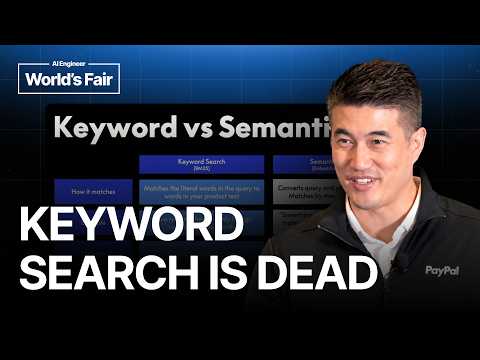
Keyword Search Is Dying. Is Your Catalog Ready for AI…
Nixon Dinh, director of product for agentic commerce at PayPal, explains how shopping is shifting from keyword search toward AI agents: a progression from the search era to the intent era and delegation era, and why catalogs built for keyword SEO aren't readable by agents. He covers keyword vs semantic search (and why hybrid wins) and shares PayPal's experiments enriching merchant product data — enrichment improved agent recommendations (with thin catalogs gaining the most), but over-enriching with unstructured boilerplate diluted the signal and caused agent hallucinations.
# Channel Presentation Observations
## Source
- **Video:** "Keyword Search Is Dying. Is Your Catalog Ready for AI Agents? — PayPal"
- **Format evidence:** A conference-style talk ending with *"please visit our booth at P11"* — indicating this was recorded at a trade show or industry event, not a typical YouTube-style video.
## Intended Audience
- **Merchants and e-commerce business leaders**, not consumers or developers. Evidence:
- *"helping merchants navigate this shift uh towards agent-driven commerce"*
- *"what does this actually mean for businesses and merchants?"*
- Practical framing such as *"assess your catalog and then figure out the right strategy"* and *"how do you as a business be visible where the consumers interact?"*
- **Secondary audience:** prospective PayPal clients — the talk doubles as a product introduction, closing with a referral to *"PayPal's Agent Commerce Services... at our booth."*
## Claimed Scope
- **Topic scope:** the intersection of agentic AI, product catalogs, and commerce — specifically *"the catalog piece and it being agentic ready."*
- **Positioning claims made by the speaker:**
- Self-described role: *"I'm Nixon Den. I'm the director of product for Agentic Commerce at PayPal"* and *"I lead a lot of our efforts on how AI agents are reshaping shopping and payments."*
- Framework claim: commerce is moving through three eras — the **search era**, the **intent era**, and the **delegation era**.
- Market-size claims cited (e.g., *"1.1 trillion dollars... in US retail to be agentic,"* *"3 to 5 trillion globally"*), plus third-party projections attributed to *"Bay & Co."*
- **Experimental evidence presented as channel-owned:** *"we ran some experiments. We enriched some of our merchant product data"* with findings that enrichment improved recommendations but **over-enrichment caused hallucination** — *"more text isn't better."*
## Self-Description vs. Demonstrated Presentation
- **Explicit self-description:** PayPal positioning itself as a thought leader and service provider for agentic commerce: *"that's also where as PayPal we're building towards."*
- **Demonstrated presentation style:** executive/analyst briefing tone — market statistics, era-based frameworks, keyword-vs-semantic search explainers, and a case example (the "men's shoe model 8543" enrichment before/after) rather than entertainment or personal content.
- **Thought-leadership stance claim:** *"AI will reward content quality and not brands."*
## Notes
- The transcript contains apparent transcription artifacts (e.g., "693%" likely meaning 69%, "intent error" likely "intent era," "Bay & Co."); these are treated as transcription noise, not channel claims.
- No claims about the broader channel (upload cadence, content mix, subscriber relationship) can be inferred from this single talk.
# Delivery Observation Report
**Video:** *Keyword Search Is Dying. Is Your Catalog Ready for AI Agents? — PayPal*
**Speaker (as introduced in transcript):** "I'm Nixon Den… director of product for Aenticcommerce at PayPal"
---
## 1. Overall Delivery Style
- **Conversational, heavily hedged speech.** The transcript is dense with fillers and softeners, suggesting an unscripted, talk-through-it delivery:
> "Hi everyone. Um, welcome. I I'm Nixon Den."
- **Frequent self-corrections and restarts mid-sentence:**
> "what we have seen is that there are over two billion users um projected to use like AI to start their shopping journey"
> "we, you know, when we first uh when we think about consumer shopping"
- **Uncertainty note:** the transcript appears to contain speech-to-text artifacts (e.g., "intent error" for "intent era," "693%" for a percentage, "COVID moves to AI agents" likely for a garbled term), so exact-word claims should be treated with caution.
---
## 2. Recurring Vocabulary and Phrases
| Feature | Evidence |
|---|---|
| **Filler "um/uh"** | Appears in nearly every sentence: "Um, and you know, most of my career has been on commerce and payments." |
| **Filler "like"** | "towards like agent-driven commerce," "it's very like SEO based," "like we see AI as the next evolution" |
| **"you know" softener** | "And you know, when we first uh…," "um, you know, if you…" |
| **Intensifier "really"** | "what that really means," "why this matters now… really underscore," "how you enrich… really really matters" |
| **Era-based framing vocabulary** | "the search era," "this phase called the intent error [era]," "this delegation era" — a deliberate three-period naming scheme used to structure the whole talk |
| **"level set"** | "we just kind of level set a little bit"; "I think very good to level set with everyone" |
---
## 3. Teaching Habits
- **Contrast-pair / trade-off framing.** Nearly every concept is taught as a benefit-plus-drawback:
> "The good part about this, it's very precise, it's fast, it's predictable. But the downside is it misses intent."
> "Semantic search is just it's smart but it's very fuzzy."
- **Concede-then-pivot move.** Acknowledges the concern, then reframes positively:
> "all change it can seem like a threat to a business. Um but on the flip side of that can also be seen as a big opportunity."
- **Concrete anchor examples.** Abstract ideas are grounded in shopper scenarios:
> "I might say something like, you know, my daughter's starting school in September in fifth grade and I need uh to to shop back to school."
> The detailed "men's shoe model 8543" enrichment walkthrough (thin description → cushioned, breathable, mesh, review-enriched).
- **Rhetorical question as transition device:**
> "So what do you do when you don't know? You run experiments."
- **Data-led persuasion.** Cites figures repeatedly: Bay & Co.'s "15 to 25% of all commerce… by 2030," "$1.1 trillion," "3 to 5 trillion globally," "39% of US shoppers," "four times higher conversion."
- **Direct audience inclusion:**
> "And I'm sure many of you have probably defaulted to that pattern today."
---
## 4. Structural Communication Patterns
- **Explicit signposted summaries at section ends:**
> "So to sum it up keyword search is quite precise."
> "just generally speaking a sum of our learnings was…"
- **Tricolon-style closing takeaways:**
> "enrichment works assess your catalog structure and more text isn't better."
- **Aphoristic closers designed for recall:**
> "AI will reward content quality and not brands."
- **Promotional handoff at the end:** "please visit our booth at P11."
---
## 5. Stable Patterns vs. Isolated Moments
**Stable (recurs throughout):**
- Filler-heavy, conversational tone
- Era-based framing vocabulary as the talk's backbone
- Contrast-pair teaching (precise vs. fuzzy, threat vs. opportunity)
- Signposted wrap-ups and data citation
**Isolated (single occurrence; low confidence as habits):**
- The rhetorical-question pivot ("what do you do when you don't know? You run experiments") appears once.
- The booth promotion appears only in the closing seconds.
**Uncertainty statement:** This is a single video with a noisy transcript; repetition counts are approximate and some quoted strings may reflect transcription errors rather than the speaker's exact words.
# Video Position Record: "Keyword Search Is Dying. Is Your Catalog Ready for AI Agents?" (PayPal)
**Speaker:** Nixon Den, identified in the transcript as Director of Product for Agentic Commerce at PayPal. No other speakers appear. The title is the only other metadata.
**Source basis:** All positions below come from the transcript. Statistics are recorded as the speaker attributed them. Where the transcript appears garbled, the likely intended wording is noted but not substituted.
---
## 1. Framing: Commerce Eras
The speaker describes three consumer-behavior phases, each with a different interaction model.
- **Search era:** Keyword-driven navigation with SEO optimization. The speaker says this "put the burden on the shopper to really find what they needed," and that "for many businesses this worked."
- **Intent era:** Shoppers express needs in natural language (e.g., a back-to-school example). The speaker says "the brands are coming to you instead of you having to go find them."
- **Delegation era:** Speaker's stated expectation: "customers need to start trusting the recommendations," after which they will "start delegating more and more actions to their agents."
> "Although we talk about this delegation era and we think it sounds like it's so far into the future, you might be asking like why this matters now."
**Status:** Forward-looking. Introduced with "what we believe will happen next," so it is a stated expectation, not an established fact.
---
## 2. Market Claims Cited
The speaker presents these as supporting why the shift matters. Each is attributed to a named source or to "the industry," and none is independently verified in the video.
| Claim (as stated) | Attributed source | Speaker's framing |
|---|---|---|
| 15–25% of all commerce executed by agents by 2030 | "a study at Bay & Co." (likely Bain & Company) | "not meaningful now... a very marginal shift that businesses can't ignore" |
| Agents predicted to outnumber humans online within a decade | Not specified | Presented as structural change |
| $1.1T of US retail commerce to be agentic; $3–5T globally | "As a industry we expect" | Basis for PayPal's stated bullishness |
| Over 2 billion users projected to use AI to start shopping | Not specified | Presented as expectation |
| Referral traffic from AI engines up "over 693%" | Partner/customer reports | Transcript figure is unclear; may be a transcription error |
| 39% of US shoppers already use AI for shopping | "consumer studies" (the speaker's own team, per "we did consumer studies") | Stated as current fact |
| Up to 4x higher order-completion conversion when the shopper first interacts with an agent | Not specified | Attributed to richer product data |
**Caveat:** The speaker describes PayPal as "bullish" on the opportunity and is presenting PayPal's Agent Commerce Services. The speaker does not state any further reason for the framing.
---
## 3. Core Problem Claims
### 3.1 Catalogs Were Not Built for Agents
- Merchants syndicate catalogs to Google, Meta, and similar platforms. "The spec wasn't built for agents."
- Catalogs are "not as readable for agents" and "really just built for humans search."
### 3.2 Model Opacity and Non-Determinism
- Agents "use different varying models," which use different ranking and recommendation algorithms.
- The speaker says the models are "still for the most part a black box."
- "Vector database retrieval is also not always deterministic."
- **Stated consequence:** "In the old SEO world, there was a clear strategy. In this new world, the strategies are still remain largely unclear."
### 3.3 Response to Uncertainty
> "What do you do when you don't know? You run experiments."
---
## 4. Keyword vs. Semantic Search
The speaker's characterization:
- **Keyword search:** Precise, fast, predictable, but "misses intent." Example: a search for "footwear for jogging" may miss running shoes because the words don't match.
- **Semantic search:** Matches by meaning via vector representations. Broadens results, but "if you inject too much meaning it can lose focus and hallucinate."
- **Stated conclusion:** "The real answer isn't an either or. It's combining both, which is exactly what our hybrid approach does."
**Note:** The speaker presents the hybrid approach as PayPal's, and describes it as "where we're headed next." It is not described in technical detail.
---
## 5. Enrichment Approach and Experiment
### 5.1 Enrichment Dimensions Tested
The speaker lists these patterns without detailing each one:
- Filling attributes
- Description depth
- Buyer context and trust signals
- Product identity
**Stated principle:** "Enrichment isn't one size fits all." The right approach depends on the starting catalog (e.g., thin vs. spec-heavy).
### 5.2 Worked Example
A men's blue running shoe is enriched from a minimal title and description to a title ("men's lightweight running shoe"), expanded description (cushioning, breathability), added attributes (true-to-size, mesh material), and review data. The speaker says the enriched version matches "running," "training," and "mesh," among other terms.
### 5.3 Thesis and Findings
- **Thesis:** "Does enrichment help boost recommendations?"
- **Answer, with caveat:** "At its core yes it does." The speaker adds: "while this was only one set of experiments."
- **Baseline:** The unenriched baseline "just completely underperformed" in head-to-head comparison.
- **Who benefits most:** "Merchants with the thinnest catalogs tend to gain the most," and merchants with weak product data have "the most room to improve."
- **Overenrichment:** "When we overenriched the agent tended to hallucinate more and it underperformed."
- **Unstructured data:** Adding unstructured text "can actually dilute the signal." Examples of irrelevant content: "welcome to our store," "we're family-owned business."
**Qualification from the speaker:** "We don't have a concrete recommendation for every business but a good place to start is just assess your catalog and then figure out the right strategy for that."
---
## 6. Summary Conclusions (as stated)
- **Enrichment helps keyword search.**
- **Semantic retrieval requires a different data structure.**
- **Balance matters:** Enrichment has diminishing or negative returns when overdone.
- **"More text isn't better."**
- **"Structured quality content... is the one thing that wins out."**
- **"AI will reward content quality and not brands."**
- **Trust signals:** Content quality "does optimize for other trust signals as well."
---
## 7. Unresolved Tensions and Qualifications
These points appear in the transcript and are not reconciled by the speaker.
- **Title vs. body:** The title says "Keyword Search Is Dying," but the speaker argues enrichment "helps keyword search" and describes keyword search as precise and still relevant. Hybrid is presented as the answer, not replacement of keyword search.
- **Structure vs. text:** The speaker says "more text isn't better" and that schema "is not what actually" drives results, yet also recommends "structured quality content" and says "how you enrich what you structure into the data really really matters."
- **Content vs. brand:** "AI will reward content quality and not brands," followed immediately by "it does optimize for other trust signals as well." The speaker does not explain how trust signals relate to brand.
- **Strength of evidence:** The speaker calls the experiment "only one set of experiments" and acknowledges no universal recommendation, while also stating conclusions in general terms ("enrichment works").
- **Timeline:** The delegation era is described as possibly "so far into the future," but the speaker also argues it matters now.
---
## 8. Transcription Notes
- "intent error" appears to be "intent era."
- "COVID moves to AI agents" appears to be "catalog moves to AI agents."
- "Bay & Co." appears to be Bain & Company.
- "693%" is unclear and should be verified against the original source before citation.
- "Aentic" in the speaker introduction is likely "agentic."
# Speaker Attribution and Provenance Record
## Video Identity
- **Video ID:** `01a15ca6-f3ed-76ae-b37d-9196b49786ff`
- **Title:** *Keyword Search Is Dying. Is Your Catalog Ready for AI Agents? — PayPal*
- **Curated metadata supplied:** Title only. No speaker list, description, cited-source list, or comment data was provided.
---
## Speakers and Roles
### Primary Speaker: Nixon Den
- **Self-identified role:** Director of product for "Aentic commerce" at PayPal (transcribed as "Aenticcommerce"; likely "Agentic Commerce")
- **Stated scope:** Leads PayPal efforts on how AI agents reshape shopping and payments
- **Speaking role:** Presenter. The speaker opens the session, presents the material, and closes with a call to action.
- **Identity basis:** Self-introduction in the transcript only. No independent verification was available.
> "I'm Nixon Den. I'm the director of product for Aenticcommerce at PayPal."
### Other Speakers
- None identified. The transcript contains a single continuous speaking voice.
---
## Promotional Content (Flagged)
- **Closing promotion:** The speaker directs viewers to PayPal's **Agent Commerce Services** and invites them to visit "our booth at P11."
- **Self-referential product framing:** The speaker states PayPal's direction in commercial terms, such as "as PayPal we're building towards" building trust for delegation of commerce tasks to agents.
- **Company-positioned statements:** Opening and mid-presentation remarks describe PayPal as "bullish" on the opportunity. These are stated by the presenter in a vendor role.
- **Vendor-run experiments:** The experiments and their framing are presented by PayPal. The results are PayPal's own claims.
---
## Referenced Sources and Third-Party Claims
| Claim (as stated) | Attributed Source (as stated) | Provenance Notes |
|---|---|---|
| 15–25% of all commerce executed by agents by 2030 | "a study at Bay & Co." (likely Bain & Company; transcribed as written) | Named source, but no study title, date, or link given. |
| Agents predicted to outnumber humans online within a decade | Unnamed prediction ("agents are predicted") | No source named. |
| $1.1 trillion of US retail commerce to be agentic | "As a industry we expect" | Attributed to an unnamed industry expectation. |
| $3–5 trillion of commerce globally to be agentic | "As a industry we expect" | Same as above; no source named. |
| Over two billion users projected to use AI to start shopping | "what we've seen" / "projected" | No source named. |
| Over 693% referral traffic from AI engines | Customers and partners ("what they've reported") | Transcribed as "over 693%"; exact figure and reporting basis unclear. Unnamed. |
| 39% of US shoppers already use AI for shopping | "our consumer studies" | Attributed to the speaker's organization. Study design and sample not described. |
| Up to 4× higher order-completion conversion when an agent is engaged first | "what we have found" | Attributed to the speaker's organization. No methodology described. |
| Enrichment improves recommendations; thin catalogs gain most | PayPal's merchant product-data experiment | Vendor-run, single experiment set. Sample size, dataset, and metrics not specified. |
| Overenrichment increases agent hallucination | PayPal's experiment observations | Described as observed in "some cases." |
### Speaker's Own Illustrative Material
- **Product example:** "Men's shoe model 8543" with before-and-after enrichment fields. The speaker presents this as an example of enrichment in action. It is illustrative, not a documented dataset.
- **Conceptual explanation:** Keyword vs. semantic search, and the search, intent, and delegation "eras." These are the speaker's framing, with no cited source.
---
## Provenance Gaps
- **Unnamed sources:** Most quantitative claims lack a named report, date, or methodology.
- **Vendor-generated data:** The consumer studies and merchant experiments originate from the speaker's organization.
- **Ambiguous figures:** The "693%" and "$1.1 trillion" figures are transcribed without units or context clarification.
- **Transcription artifacts:** "Bay & Co." and "Aenticcommerce" appear as transcribed and may not match published names.
- **Speaker-stated limits:** The speaker acknowledges that the experiment is "only one set of experiments" and that PayPal lacks "a concrete recommendation for every business."
---
## Comment Availability
- **Status:** Unknown. No comment data was supplied with the record.
---
## Unavailable Evidence Channels
- Slide content (referenced as "this slide" but not present in the transcript)
- Speaker and audience visuals
- Experiment data, methodology, or appendices
- Cited study documents (Bain, consumer studies)
- Q&A or audience interaction (none present in transcript)
Hi everyone. Um, welcome. I I'm Nixon Den. I'm the director of product for Aenticcommerce at PayPal. And what that really means is I lead a lot of our efforts on how AI agents are reshaping shopping and payments. Um, and you know, most of my career has been on commerce and payments. And right now, I'm really excited about helping merchants navigate this shift uh towards like agent-driven commerce. And specifically, what we're going to talk about today is um the catalog piece and it being agentic ready and sharing some of our learnings on this on this journey. So I think it's very important we just kind of level set a little bit when we look at the evolution of commerce. We've seen it transform from you install brick and mortar transactions to the advent of
e-commerce where this started off quite linear. Um a user would simply search and buy from e-commerce sites and then through like internet 2.0 O we've seen
that transform further into more complex uh channels that involve email, SMS and like now social commerce for us like we see AI as the next evolution in that journey and with any evolution we know two things to be true. The first like all change it can seem like a threat to a business. Um but on the flip side of that can also be seen as a big opportunity. And the second thing that we know is that whenever we have seen consumer behavior change because of a new technology, commerce tends to evolve alongside with it. And so we are starting to see that now with Aentic where not only is the new this is a new channel that's enabling uh merchants to engage with customers in a very deeply personalized way, but also how customers are searching and finding products is changing. And uh now is really the time that merchants are starting to look to invest on how to to change with with their customers and and uh succeed in the agentic era. So
earlier I touched on how the consumer behavior is starting to change. Um but I just want to dive deeper a little bit on this. So we, you know, when we first uh
when we think about consumer shopping, that behavior up to today has been now what we're calling the search era. Um it goes through a phase where like it's keywords, you're navigating a catalog, there's SEO strategies, and this is what most businesses have optimized towards over the last decade. And while for many businesses this worked, this model put the burden on the shopper to really find what they needed. Um, now what we're seeing is that we're moving into this phase called the intent error. So instead of typing keywords
like I want school supplies, um, I might say something like, you know, my daughter's starting school in September in fifth grade and I need uh to to shop back to school. And that's a very
completely different interaction. Um, so you're now expressing your needs in your own words and AI is now asked to meet you where you are. And so the brands are coming to you instead of you having to go find them. And that's a very very different interaction model. Um, and most businesses now are starting to find that they need to set themselves up for this interaction model. Um so
what we believe will happen next is after we go through the intent error what will have to happen is customers need to start trusting the recommendations that they're getting from the from the agents and once that
trust starts to build we do start to believe that they will start delegating more and more actions to their agents and that's also where as PayPal we're building towards is um continue to build on that trust and moving to a world where humans start to delegate more and more of their task in commerce and shopping to their agents. So although we talk about this delegation era and we think it sounds like it's so far into the future, you might be asking like why this matters now. And so we have couple pretty big
data points that we want to share to really underscore why this matters. The first is uh through a study at Bay & Co. um they project that by 2030 15 to 25%
of all commerce will be executed by an agent and furthermore within a decade agents are predicted to outnumber humans online and so these numbers don't just indicate that this is like not meaningful now it is a very marginal shift that businesses can't ignore and that this is a very structural transformation happening entire entire e-commerce ecosystem So
to go further I think it's very good to understand why PayPal feels like we are bullish on this opportunity. Um as a industry we expect uh to be some
very tangible opportunities coming forward. We expect 1.1 trillion dollars of uh commerce to happen uh in US retail to be agentic and then we expect that to be 3 to 5 trillion globally and what we've have seen is that there are over two billion users um projected to use like AI to start their shopping journey over the next few years. And so when we think through this, what does this actually mean for businesses and merchants? When we talk to our customers and what
we talk to our partners, what we've seen is six they what they've reported is that over 693% uh referral traffic from AI engines. And when we did consumer studies, we
found that 39% of US shoppers are already using AI for shopping today. Um, and I'm sure many of you have probably defaulted to that pattern today. And what we have found also is that when you do start and interact with an agent first, businesses have tend to see up to four times higher conversion on a completion of an order because now they can get more rich and in-depth data on a product. And so with that all happening and the traffic
moving, we want to break this down further onto like what this really means ac deeper for merchants. In the search era, this was very like
SEO based and you might optimize for like a sum dress. In the intent era, you have to think through how do I be discoverable for where an agent is representing my my business. And then in the delegation era, we need to think through uh how I can convert that demand safely and trusted in a trusted way. And so the challenge becomes to think through is like as COVID moves to AI agents, how do you as a business be visible where the consumers interact?
The issue with this is that cataloges weren't really built for agents. Um most merchants today maybe advertise on Google. Um they have a catalog they syndicate to there or maybe to Meta or
Facebook or other advertising platforms. But the spec wasn't built for agents. And so agents now um you know if you it's not optimized for agents to discover products. Um it's not as readable for agents as well. And they're really just built for humans search. And then to compound that even more,
the models that agents use are still for the most part a black box. Agents can use different varying models to make their decisions. Um, different models
use different ranking and recommendations and and and uh algorithms to to determine their recommendation. Uh, vector database retrieval is also not always deterministic. And because of all of this, how do you decide as a business what model do you do to you optimize for? In the old SEO world, there was a clear strategy. In this new world, the strategies are still remain largely unclear. And so what do you do when you don't know? You run experiments. And so we we
ran some experiments. We enriched uh some of our merchant product data. And we ran experiments to see how agents uh uh searched uh and and recommended products.
And before I get into the experiments that we ran, um I think very good to level set with everyone how like the differences between keyword and semantic search and it it trickles through to the
themes I talked through earlier with keyword search being you know very matching the the search that the user is entering in. So, in a classic search, it might match literal words. Um, for
example, I'm searching for blue running shoes, and you only get results that contain those words. The good part about this, it's very precise, it's fast, it's predictable. But the downside is it misses intent. And so, if you ever search footwear for jogging, it may not even return those shoes. Uh, and that's only simply because the words don't match. Whereas with semantic search, it matches based off meaning. Um, what it does is it converts the query into vectors that create uh meanings of intent. And so you might type something, oh, I'm searching for something comfortable for marathon training. And you might find your running shoes even though none of those words exist in the search query. Um so the good part about the that is it broadens and how it can search but the downside is if you inject too much meaning it can lose focus and hallucinate. So there is a balance of how much you want to enrich and how much you want to inject into your enrichment. So to sum it up keyword search is quite precise. It's it's very literal. Semantic search is just it's smart but it's very fuzzy. And realistically, the real answer isn't an either or. It's it's combining both, which is exactly what our hybrid approach does. Um, and that's kind of where we're headed next. So, now that we understand what semantic
search is, it's important to highlight that there is no singular way to really enrich product data for semantic search. I think it's really important for you as a business to understand the kind kind
of catalog data you already have. um do you have a thin catalog? Do you have a catalog of products that are more spec heavy? Depending on where your business is today, you should think through what you might want to enrich. And so for the experiment though, we thought through different patterns of enrichment. Um and I won't go through all of them in detail, but things around like filling attributes, making sure there's description depth, um make sure there's buyer context and trust signals, and even some product identity. I think the main take away from this slide is that enrichment isn't one sizefits-all. The right approach really depends on the catalog you're starting with and that's the framing we'll build on next. And so here's just an example of
enrichment in action for us. Um example on we're starting with we have men's uh men's shoe model 8543 that's blue and then the description will be I
have blue running shoes. um available multiple sizes. there's an attribute that's blue keyword matches maybe blue running or shoe and then um the semant for semantic there's you know very little context for that when you enrich there now we might have the title as a men's lightweight running shoe um the description is now more enriched like it's cushion it's breathable uh there are further attributes we've pumped into that as well so there's like true to size it's it's the the material is mesh um we also put in some reviews here as well so enrich that with some review data and now what the search sees is um it matches running, it matches training, it matches meshes. There's a lot more that it matches. So with semantic there's a lot of rich meaning that's put there uh to kind of enhance the search. And so here the the some of the examples we use was attribute filling or bio context or even uh the trust signals around the reviews as well. And so ultimately at the end of the experiment um you know our thesis was generally speaking does enrichment help
boost uh recommendations and at its core yes it does. Um what we saw was an unenriched baseline
like when it went headto-head um it just completely underperformed. We found that merchants with the thinnest cataloges tend to gain the most. Uh merchants with weak product data also had the most room to improve. Um but I think what we needed to also understand is that it's all about content quality that drives the results and it's not the schema that
actually and actually piling on you unstructured data can actually dilute the signal as well. And so what do we mean by like unstructured data? like we just don't want to stuff the the context
of anything any words we want. We don't want to put any boilerplate messaging around um potential like you know welcome to our store. We're familyowned business. Those things are irrelevant to an agent at times. And so how you enrich what you structure into the data really really matters as well. And so
just generally speaking a sum up of our learnings was enrichment helps keyword search. Semantic retrieval requires a very different set of data structures.
But there is a balance to how much you want to enrich uh to improve semantic retrieval. And while this was only one set of experiments, we did find that enriching just yeah head-to-head always improved recommendations. Um what we had found in some cases when we overenriched the agent tended to hallucinate more and it underperformed. Um and we don't have a concrete recommendation for every business but a good place to start is just assess your catalog and then figure out the right strategy for that. Um and so just to wrap up you know
enrichment works assess your catalog structure and more text isn't better. um structured quality content, structured quality content is the one thing that wins out and AI will reward content quality and not brands. Um but it does optimize for other trust signals as well. So thank you everyone. Uh if you want to learn more about PayPal's Agent Commerce Services, please visit our booth at P11.