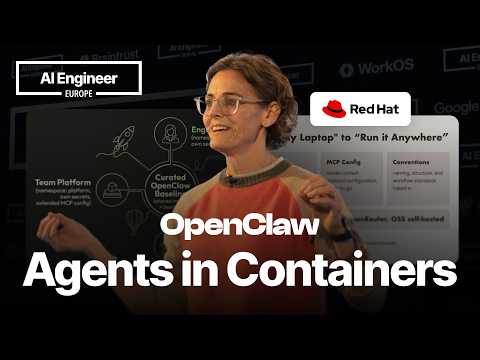
Lobster Trap: OpenClaw in Containers from Local to K8s and…
Talk by Sally Ann O'Malley (Red Hat) on packaging AI agent setups with OpenClaw in containers. Covers running a sub-agent locally via Podman, using a flag to move the same container image to Kubernetes, two-layer secret management (Podman secrets for API keys on the host, OpenClaw secret refs in-container), volumes for backup and persistence, scaling agent workloads on Kubernetes/OpenShift, and a case study of an Nvidia team running per-engineer OpenClaw instances in Kubernetes for model evaluations. Includes a local demo covering provider configuration, SSH sandbox features, and transitioning workloads to Kubernetes.
# Channel Identity Observations: Conference Talk Video
## Video Identity
- **Title:** *Lobster Trap: OpenClaw in Containers from Local to K8s and Back — Sally Ann O'Malley, Red Hat*
- **Speaker:** Sally Ann O'Malley, self-identified Red Hat employee of ~10 years: > "I'm Sally. I work at Red Hat. I've been there for about 10 years"
- **Format:** Live conference presentation with slide deck and live terminal/demo portion (speaker references time limits, "I've got four more minutes," and a mid-talk switch to a local installer demo).
## Explicit Self-Description
- **Current role:** Emerging tech organization, with autonomy over projects:
> "about 5 years ago, I moved to the emerging tech org... now I'm not totally tied to a product. I get to just work on what I want."
- **Background claimed:** Containers, Linux security, and Kubernetes in OpenShift for her first ~7 years at Red Hat; more recently AI work ("about 3 years ago it was like all AI all the time").
- **Observable claim about her own practice:** > "I run everything in containers. It's kind of foreign to me to just run something natively."
## Intended Audience
- **Practitioners of containers, Kubernetes/OpenShift, and AI agents** — evidenced by assumed familiarity with Podman, Docker, PVCs, MCP servers, and by direct audience interactions ("Anyone know Jyotish astrology?" / "Anyone going to run OpenClaw in a container? No? Try it.").
- **Developers of the OpenClaw project** are a secondary audience; she describes contributing: "a month of me helping out with OpenClaw... constantly pulling from main."
## Claimed Scope
- **Core topic:** Running OpenClaw (an AI agent framework, MIT-licensed, found on GitHub) in containers from local Podman/Docker through Kubernetes and OpenShift.
- **Sub-topics demonstrated or claimed:**
- Secrets management (Podman secrets, OpenClaw secret refs, Kubernetes secrets)
- Volumes/PVCs for state, backup, and recovery
- SSH sandbox features within OpenClaw
- A personal installer tool: "I built it just for me with everything that I need to run containers... it's in GitHub"
- A vision of workplace-standardized OpenClaw deployment ("curated baseline... fan it out across your whole team")
## Demonstrated Presentation Patterns (Observable, Not Claimed)
- **Personal, conversational, humor-forward style** — recurring asides about her "forever claw" (named Shubra), astrology sub-agent Joy, and Bruins-briefing agent Bruno.
- **Live-demo-centric structure** — the second half of the talk is an unscripted installer walkthrough, including handling of demo friction ("Hold on. I got to go over to Larry.").
- **Security-forward framing of AI workloads** — positioning containerization as the answer to internal skepticism:
> "We can take any application and run it securely. Like that's what Red Hat is... This is our golden opportunity to show everyone."
- **Namedropping ecosystem peers:** anecdote from PyTorchCon about Nvidia engineers running OpenClaw model evals; a Docker-employed friend "Eric" behind "Infer RS."
- **Opinionated tooling stance:** "all of these options [are] very opinionated... If you like it, use it. If you want to change it, then submit a PR."
## Channel-Level Claims vs. Demonstrations
- **Creator claims:** Red Hat affiliation, 10-year tenure, emerging-tech role, personal tooling preferences (Podman over Docker), Nvidia anecdote.
- **Demonstrated:** Working familiarity with container runtimes, a functioning local installer, and live deployment of OpenClaw instances (Joe, Larry, Carl) across local, kind/Kubernetes, and OpenShift contexts.
- **No curated metadata was supplied**, so no additional identity context beyond title and transcript is available.
# Delivery Observations: Sally Ann O'Malley — "Lobster Trap: OpenClaw in Containers from Local to K8s and Back"
## Tone and Register
- **Casual, conversational, self-aware.** The talk is delivered like an informal story rather than a structured presentation: "Hey, um I'm Sally. I work at Red Hat."
- **Enthusiastic and humorous.** Frequent exclamatory evaluation: "awesome," "really cool," "super cool," "it works and it's awesome."
- "Uh MIT, awesome."
- "The SSH sandbox in Open Claw is super cool."
- **Self-deprecating humor about her own talking:** "It took 2 seconds and I was babbling the whole way through" and "I don't have time to show you because I talk too much."
## Verbal Fillers and Disfluencies
- **Heavy use of "um," "uh," "like," and "so"** throughout, giving an unrehearsed, stream-of-consciousness feel: "Um but uh here we are today and what a what a crazy awesome world we're in."
- **Self-corrections and restarts are frequent:** "I know not I knew there was a data science team"; "what have I What have I been doing the past 10 years?"
## Recurring Vocabulary and Phrases
- **"Awesome"** as a recurring positive marker:
- "the first 7 years, awesome, totally cool"
- "that was awesome, too"
- "what a crazy awesome world we're in"
- **"Cool" / "really cool"** repeatedly signals approval: "OpenClaw. This is so cool," "Gemma's great," "He's awesome."
- **"You know"** as a recurring connective: "I, you know, started doing AI," "It's it's, you know, that's that's what it is."
- **"Guys"** when addressing colleagues in anecdotes: "Guys, check out OpenClaw" and "Guys, if you're not using AI for everything."
## Teaching Habits and Structural Patterns
- **Spoken self-reminders visible in delivery** — she notes on-stage reminders to herself: "I think this is a reminder to me" and "And this is my reminder to show you how I install my containers at the end."
- **Reassuring the audience on AI/job fears** — explicit pedagogical aside: "We're not all losing our jobs, people. Like that's not happening."
- **Audience interaction:** asks questions of the room — "Anyone know Jyotish astrology?" and "Anyone going to run Open Claw container? No? Try it."
- **Naming demos/agents anthropomorphically:** "Joy," "Bruno," "Joe," "Larry," "Carl," "Shubra" — a consistent device that carries through the talk: "she's she's she's coming through this whole talk."
- **Honest hedging about untested claims:** "Have I tested with this with Docker? No." and "it works and it's awesome, but I'm not going to test it."
## Communication Patterns
- **Personal anecdote as framing device:** opens with her career history and a "staycation" discovery story, and later a PyTorchCon anecdote ("my friend from Nvidia said I could share this").
- **Opinionated but inviting stance on her tooling:** "all of these options very opinionated cuz I I'm telling you this is exactly what I need. So if it's if you like it, use it. If you want to change it, then submit a PR."
- **Time-awareness signalled aloud:** "And I've got four more minutes," "How much time? Oh, I got to hurry."
- **Demo-religion nod:** "you never know the demo gods what they're up to. So I'm just in case it doesn't work."
## Uncertainty Notes
- Patterns like filler frequency, "awesome/cool" recurrence, and audience questions are well-supported by many instances.
- Some features (e.g., exact pause structure, pace changes during the demo) can only be inferred from transcript markers like mid-sentence capitals and trailing fragments, so those observations carry lower certainty.
- No curated metadata was provided, so delivery context is limited to the transcript alone.
# Position Record: "Lobster Trap: OpenClaw in Containers from Local to K8s and Back" — Sally Ann O'Malley (Red Hat)
## Speaker Background (self-described)
- Sally Ann O'Malley, ~10 years at Red Hat; first 7 years on containers, Linux security, and Kubernetes/OpenShift.
- ~5 years ago moved to the emerging tech org; ~3 years ago shifted to AI work ("a lot of Python and markdown").
## Core Thesis
- **Run OpenClaw (AI agents) in containers**, locally with Podman, then lift the same setup to Kubernetes/OpenShift.
- Rejected coworkers' claim that OpenClaw is "a security nightmare": she argued containerizing insecure apps securely is exactly Red Hat's competency — "if we can't take an application and run it securely, like come on. This is our golden opportunity."
## Arguments for Containerized Agents
- **Reproducibility, isolation, portability** across laptop, x86, Mac, Kubernetes.
- **Secrets management**: Podman secrets separate API keys from env vars; OpenClaw's secret-ref feature creates a "double" pointer ("not perfect, but it gives me some peace of mind"); Kubernetes secrets work analogously.
- **Volumes/PVCs** give a clean backup-and-recovery story for runtime state; she backs up her agent nightly via a systemd-like Mac service.
- **Natural sandboxing** — host access must be explicit.
- **Agent directory mounting**: tools, skills, MCP servers can live in a directory mounted at startup.
- Prefers Podman over Docker; her installer is "designed to work with Docker, too," though **untested with Docker** — a friend (Eric) agreed to verify it.
## Vision for Workplace Agents
- New hires receive a **curated baseline OpenClaw** with company-approved MCP servers, authentication, team-specific skills, then personalize it — versus today's ad-hoc "sit next to somebody" onboarding.
- Sees a future where everyone's agents "run everywhere and communicate with each other," requiring security at scale via Kubernetes.
## Claims About Others
- A friend at **Nvidia** (shared with permission): ~10 engineers run OpenClaw in Kubernetes for model evals; reportedly "doing the job of six engineers."
- Her framing: "We're not all losing our jobs" — AI frees teams for creative work.
## Personal Claims
- Hasn't written code "in a few months"; announced to her org that AI is "1,000 times better than me at writing code." Noted top Red Hat engineers "definitely raised eyebrows" — a disagreement she preserves, not resolves.
- OpenClaw's pace is extreme: gaps of days pulling from main meant "like 10,000 commits."
## Demonstrations (live)
- Spun up instances "Joe" and "Larry" via her opinionated installer (npm run dev; Podman-based; Docker theoretically supported).
- Providers: OpenRouter (Gemma) primary, Anthropic fallback, optional local endpoint; optional OpenTelemetry + Jaeger (works but not tested live); SSH sandbox feature.
- Showed switching models and accessing agents in a **kind cluster** ("Carl") and OpenShift.
## Qualifications & Tensions
- Docker compatibility is **unverified**.
- Mac limitation: cannot easily spawn a container from a container (containers on Mac run inside a VM); "You can do that if you're on Linux."
- Secret handling is "not perfect."
- Demo was rushed; she noted "I didn't have enough time to go through everything."
# Video Attribution Record
## Video
- **Title:** Lobster Trap: OpenClaw in Containers from Local to K8s and Back — Sally Ann O'Malley, Red Hat
- **ID:** `01a15ca9-4350-7404-9153-b056e5860e75`
## Speakers & Roles
- **Sally Ann O'Malley (Red Hat)** — sole human speaker; **creator/presenter** role. Self-identifies as a ~10-year Red Hat employee, formerly in containers/Linux security/OpenShift, now in the emerging tech org.
- No other human speakers; no narrator or guests.
## Referenced Third Parties & Claims
- **Unnamed Nvidia friend (met at PyTorch Con):** said his team (~10 engineers) runs OpenClaw agents in Kubernetes for model evals; claimed it was "doing the job of six engineers." Speaker states he gave permission to share.
- **Slack colleagues at Red Hat:** warned OpenClaw is "a security nightmare; do not put it on the work laptop" (quoted reaction, not endorsement).
- **Red Hat org meeting / top engineers:** raised eyebrows at her AI-for-code claim (anecdote).
- **Eric (friend who works at Docker):** agreed to test her installer with Docker; creator of a project called **Infer RS** (runs Gemma fast, uses "Turbo Quant").
## Referenced Tools / Sources
- **OpenClaw** — MIT license (speaker states she checked license on GitHub)
- **Podman** (Podman secrets), **Docker**, **Kubernetes**, **OpenShift**, **kind cluster**
- **Models/providers:** Gemma via OpenRouter, Anthropic (fallback), local endpoints, GPT 5.x
- **OpenTelemetry collector with Jaeger**, **OpenClaw SSH sandbox**, **secret refs**
- **Speaker's own installer tool** — self-built, on GitHub ("I'm not pushing it on anyone... it's in GitHub"); link not stated in transcript.
## Promotional Segments
- No commercial or sponsored promotion detected. The speaker **promotes her own personal open-source installer tool** and OpenClaw itself, but this is self-described personal work, not a flagged promotional segment.
## Availability & Limits
- **Comments:** no metadata supplied; comment availability unknown.
- **Timestamps:** none present in transcript.
- **Demos:** live demos (Joe/Larry instances, Kubernetes "Carl", OpenShift instance); a demo instance "Larry" with MCP server and sub-agent was mentioned but not fully shown ("didn't have enough time").
- **Uncertainty:** Docker compatibility of her installer **untested by speaker**; verified by third party (Eric) only claimed, not confirmed.
\>\> Hey, um I'm Sally. I work at Red Hat. I've been there for about 10 years and uh the first 7 years, awesome, totally cool. I was working on containers and uh
Linux security stuff and Kubernetes. Um in OpenShift. That's what I did for the first 7 years. And then uh about 3 years ago, well about 5 years ago, I moved to the emerging tech org and that was awesome, too, because now I'm not totally tied to a product. I get to just work on what I want. I get to just try out new things. Awesome. And then about 3 years ago it was like all AI all the time, everything AI. I know not I knew there was a data science team at Red Hat. I had no idea what they did. Machine learning something something. Um so, I, you know, started doing AI and uh yeah, it was a lot of Python and markdown. Every single thing was like, "Okay, another chatbot, more Python, more markdown." Um but uh here we are today and what a what a crazy awesome world we're in. Um so, the first time the first time I came across OpenClaw, I was home for a week on a like a staycation, took a few days off and uh a malt book happened and I was like, "What the What is this? I'm totally trying this."
And so, I went and found it on GitHub. The first thing I do is I look at the license. Uh MIT, awesome. Uh OpenClaw, I'm like, "I'm so going to install this
on OpenShift right now." And so, for the next few days I just kind of built the image, um ran it locally in a container, put it on OpenShift, just played around with it. Went back to work and like, "Guys, check out OpenClaw. This is so cool." And a couple people on Slack are like, "It's a security nightmare. Do not use OpenClaw. Don't put it on the work laptop." I'm like, "Guys, what have I What have I been doing the past 10 years? Is I'm We're We can take any application and run it securely. Like that's what rel is. Like if we can't take an application and run it securely, like come on. This is our golden opportunity to show everyone." And so, Red Hat's coming around to that. Um but yeah, so uh this talk is about me running in containers. And so, I wanted to get a list of uh So,
I wanted to get a list of why running in containers is the way to go. I run everything in containers. I It's kind of foreign to me to take to just run something natively. It's messy. It just
puts stuff on my computer that I have to clean up later. I don't like it. Um so, that's one one one thing. Uh and I um ask my forever claw.
I guess I have to introduce my forever claw cuz she she's she's she's coming through this whole talk, so I'm going to aside. My forever claw is Shubra and um
she I have two sub agents. I have Joy. Uh anyone know Jyotish astrology? Jeez, every time I ask, no one knows what it is. It's very scientific astrology. Um so, she's an astrology expert and she gives me my weekly readings, my birth chart, all of that. So, Joy and then my second agent is Bruno and he gives me daily briefings on the Bruins. Um so, we're heading into the playoffs and it's a close race, so I want to make sure the Bruins get in. Um so, that's my forever claw and uh and I asked her, you know, why should we run you in container? And uh she said all of that if you were reading, but it's reproducible, you can isolate your secrets, it's portable across infra, I can run on my laptop, I can run it on my X86, I can run it on my Mac, I can run it in Kubernetes. Um backed by volumes, which gives a really nice story for backup and recovery. Uh cuz I love my forever claw and I I back her up every night with uh with uh um like a system D service, whatever it's called on Mac. And um and and you just get that natural uh you just get that natural sandbox when you run something in a container. It's it's, you know, that's that's what it is and you have to be very explicit about what you um give access to, you know, from the host. And so, this Yes, I she loves running in a container. So, that's that's all you need to know. Um it gives her a clean, predictable environment, doesn't have to worry about the OS quirks, stale dependencies. This is literally the definition of why you should run everything in containers. And uh just quickly, we're not going to read this, but this is Joy, my horoscope. Um it's for today for giving a talk is excellent. It's like a very auspicious day to talk. Uh so, yeah. That's why this talk is going awesome so far. And uh my daily briefing, uh Geeky, is finally waking up. He had a bit of a lull. He's finally you know, ramping up for the playoffs, so it looks like the Bruins are going to be looking good. They're in and uh yeah. So, yeah, so um containers, it allows me to Uh another another thing that containers do is you can set up a whole agent
directory with maybe you run some tools, some skills, some MCP servers. Uh you can keep those in a directory and mount that whole thing into your container
uh and so, when at startup everything's just up and running. So, I do that as well. At the end of this talk, I'll show you how I install and I think this is a reminder to me Oh, no, let's talk about secrets. So, I run everything with Podman, not Docker. Um but in theory you can do anything with
Podman and Docker. Except, Podman has this really cool feature called Podman secrets. And you can save your API keys.
I'll show that I'll I'll show it off the sides later. You can save your API keys to a Podman secret. And then you mount that secret into the container. And so, it just gives the separation. Your your secrets, your API keys are then just a ref back to the secret. And with OpenClaw, what's really cool is there's like a double that because in OpenClaw there's a secret ref feature and I also use that. So, my API keys are pointer to a secret ref to the outside secret. And uh that's not perfect, but it gives me some peace of mind that I don't I'm not going to be showing my API keys in the logs and everything. And then very similarly, Kubernetes has Kubernetes secrets and same thing, instead of just a straight env var, you have a secret a secret ref to an env var. And this is my reminder to show you how I install my containers at the end. I have a really cool tool. I built it just for me with everything that I need to run containers. I'm not pushing it on anyone, but it's in GitHub and at the end I can let you know where that is. You can try it if you want. So, when I So, thank I think we're heading to a world where these agents, these AI workloads, whatever, are going to be running everywhere. I
hope we all can see that. And so, imagine my vision is for uh everybody's OpenClaws to be uh running everywhere and communicating
with each other. And uh when and especially in for like business use cases, real real things, not astrology and and Bruins. Uh that opens up the need that the same need to run any application uh in that way is security and and how to do it at scale. And that's what Kubernetes gives you. And you can What I always do is develop something locally and then lift it to Kubernetes. And so, the same story holds for AI workloads or OpenClaw. And I was at PyTorch Con yesterday and
um my friend from Nvidia said I could share this. They are running their model evals with OpenClaw. They have about 10
engineers. They each have their OpenClaws running in Kubernetes and uh periodically just checking in with the model evals. And it works so well for them. He said it was like, you know, doing the job of six engineers uh in with with himself. Now, let's think let's just talk about that for a second. We're not all losing our jobs, people. Like that's not happening. What's What that is enabling for his team is they get to do fun stuff, interesting stuff. They get to do creative things. And this is what AI is giving me and my team is we can focus on those like outside the box crazy things and you don't have to do the tedious code anymore. Like I haven't written code in in a few months. And this this did just happen like probably less than 6 months ago. I was using AI I was like, "You know what? This is way better than me at writing code." And there's I like Yeah. And I I announced that to my team. We had an org meeting and I'm like, "Guys, if you're not using AI for everything, like you're missing out. This is 1,000 times better than me at writing code." And some of the top engineers at Red Hat like definitely raised eyebrows and I could tell from their comments after that they were like, "No way." I'm like, "Yeah." Uh and so So yes, it's it's it's enabling us to just dream bigger and uh This is my reminder to show you the Kubernetes side of my installer later.
And um yeah, so backup and recovery is a nice clean story when you run in containers to the state is the same
volumes. Another nice thing about Docker and Podman is there are volumes. And so all of my runtime state lives in a nice contained Podman volume. And of course Kubernetes has PVCs. That's kind of what I just talked about. And so this this would be my vision of workplace setup for Open Claw where you maybe have your nice curated baseline
Open Claw that as a new hire you you just you get your your base. And what does that have in it? It has your list of company approved MCP servers,
your authentication that is approved through your company. It has all of your these skills that are very specific to your team, maybe access to your Google Drive. Like all these things uh that you use every day at work. You can take that and just fan it out across your whole team. And then And then you can personalize it as as the individual. And that's what this what this setup allows. The alternative would be you're a new hire and you sit next to somebody or get somebody's repo and kind of put it all together yourself. Um And so yeah, team standards portable environments reproducible onboarding. That's my vision for like Open Claw in the workplace in the future. Uh I actually just recently created my forever claw. It it was like a month of me helping out with with Open Claw and feeling like I don't even run a real Open Claw myself. I just constantly throughout the day I'm spinning it up, spinning it down, testing it, building it. Every hour there's like 100 new commits. So I'm constantly pulling from main. I was at PyTorchCon yesterday and hadn't pulled from main for a couple of days. Uh and and there were times when I did it was like 10,000 commits. No joke, it was crazy. I'm like, "I don't know what you guys are doing. Slow down." Uh not really, we don't want to slow down. So yes, uh that's that's the story. And I've got four more minutes. I am psyched cuz I can now switch over here.
So in order to run this local installer here which I think I have here. Yeah. It's just a NPM run dev. Now
The one thing I don't like about this is when I'm on my Mac I can't run this in a container. Uh I I think I can. I just haven't taken the time to figure out how to spawn a container from a container. You can do that if you're on Linux cuz Linux is awesome. But on your Mac, that's not possible because if you don't know, whenever you're running a container on your Mac, you're running in a virtual machine. Same with Docker. Containers only run on Linux. So when you're running a container on your Mac, you are always running in a virtual machine. Docker sets up one and so does Mac. So it gets a little tricky when you want to take a container and spawn another container from it. But anyways, here we go. So if I wanted to run a local instance and I have a couple running now. Just you know, you never know the demo gods what they're up to. So I'm just in case it doesn't work. I'm going to I'm going to um spin up Joe. All I all I do to set up my pod is I just give it a name. And then all of these options very opinionated cuz I I'm telling you this is exactly what I need. So if it's if you like it, use it. If you want to change it, then submit a PR. Cool. Now uh the port is usually 89. That's the default. But since this is my second one that I'm running on my machine, I had to I'm just bumping it to 99. These Podman secret mappings I want to show you here. So you can see I have these set up already. They're just on my system. They're like envars, but they're not envars cuz they're contained. Um these are my API keys. And what happens with this installer is it takes If you're on Docker, this should work with Docker. It's got Podman written all over it, but I've designed it to work with Docker, too. So um if you're on Docker, it takes the envars. So you want to export those as envars and um makes them Open Claw secret refs. Very cool feature of Open Claw.
Definitely enable that. For every current credential, create a secret ref. It creates that separation of uh running your secret within Open Claw or kind of
just a pointer to it. It's it's it's it's the way to go. And then uh your providers. So I'm going to start with Open Router cuz I have been playing with Gemma. And she's Gemma's great. And then as a fallback I'll use Anthropic. Sure, why not? But you Oh, here's here's some other choices, though. You can you can have your local endpoint if you're running your own. You could just add that, too. And then because I do observability at work uh I was like, "I'm going to give the option to set up an Open Telemetry collector with Jaeger." And it works and it's awesome, but I'm not going to test it. So let's not tax my system. Another feature How much time? Oh, I got to hurry. Another feature is SSH sandbox here we'll deploy. The SSH sandbox in Open Claw is super
cool. You give it SSH keys and known hosts to to wherever you want and it it runs all of its commands in that workspace. It's
really cool. So look, I just spun up a Podman container. And if I go over to the instances I have now have Joe. And there's logs for Joe, the gateway logs. Um the command I want to show you the command. Don't want to forget that. So here is the Podman command. If you were running Docker, it would be a
Docker command. Have I tested with this with Docker? No. Uh I have a friend who works at Docker. He's awesome. He told me he would try this out and make it make sure it works
with Docker, too. Um he also created this very cool project called Infer RS which takes uh Gemma and runs it really really really fast and uses Turbo Quant. Uh so anyways, that's um Eric. So that that's my Podman command and uh Here he is. Joe. And if I just do like models I'll do status. So people say it's hard to spin up Open Claw. It took 2 seconds and I was babbling through the whole way. It could have taken 1 second. Uh so I can say hey um And the cool thing is I don't have time to show you because I talk too much, but the agents are all set up. I've got Joe. Oh, that not that one. Hold on. I got to go over to Larry. Larry I started with a um with an MCP server and a sub-agent. Um, all through that form. So, uh, let me go back to Joe. I wanted to show you how easy it is just to switch models in case you didn't know. I'm not sure if the GPT 5, hopefully it knows it's just GPT 5.4. No, I I didn't No. No. No. We got to go over to Larry. Cuz I didn't set up I didn't set up the extra model with with Joe. There we go. Anyways, um, I didn't have enough time to go through everything I wanted to go through, but the, uh, Cool. The other thing is Kubernetes. And you can do the same thing with Kubernetes just as easy. It just, uh, it it's connected right now to my kind cluster.
And if I go over, I can access my Kubernetes claw very easily as well. Um,
There's Carl. He's running in Kubernetes. And I can access one in OpenShift. There's, uh, it switches over to OpenShift if you're connected to OpenShift. So, yeah. Uh, run Anyone going to run Open Claw container? No? Try it. Yes. Awesome. Okay, cool. Uh, thank you very much. Uh, is someone on after me? You're waiting? Okay, bye. \>\> \[laughter\]