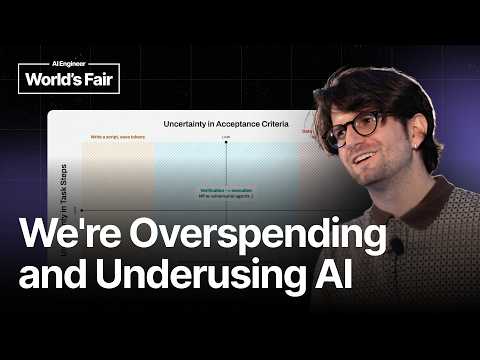
Mousepower: agents that can’t be measured, can’t be…
Talk by Maximillian Piras (founding designer at Yutori, which builds computer use agents) arguing that AI agents face a measurement problem analogous to James Watt's invention of horsepower. Key points: early adopters are a biased sample and most users can't judge whether token spend was worth it; the common pattern is "overspending and underusing"; tokens are an output, so spend should be traced to outcomes like bugs closed or support requests resolved; as coding got faster, verification became the human bottleneck. He proposes an "entropy matrix" framework—uncertainty in task steps versus uncertainty in acceptance criteria—for selecting suitable agent tasks, noting the sweet spot resembles problems cheaper to check than to solve, so agents can assist with verification. Includes timestamps covering these themes, culminating in the "mousepower" concept and the entropy matrix at 16:37.
# Channel Presentation Observations: "Mousepower" Talk
## Video Identity
- **Speaker:** Maximillian Piras, self-introduced as **"Maximilian Piros"** — "my name's Maximilian Piros and today I'll be talking about mouse power."
- **Affiliation (explicit self-description):** "for the past year and a half, I've had the pleasure of working as a **founding designer** at a company called... we focus on **computer use models**."
- **Venue claim:** "it's always a great honor to speak at the **world's fair**" — a conference-style talk setting.
## Intended Audience
- **AI-native builders and early adopters**, directly acknowledged: "everybody in this room is very biased, and we're early adopters."
- Audience is assumed to already run agents: "I'm sure some of you are saying... I've got a fleet of agents working for me right now."
- Audience familiar with terminology used without explanation: MCP, APIs, token spend, "vibe code," "token maxing," reinforcement learning, cross entropy, NP-style problems.
## Claimed Scope
- Topic stated explicitly: "a talk about **measuring agents through mental models**."
- Central thesis: "agents have a measurement problem" — agents' token costs aren't cleanly tied to outcomes/ROI.
- Proposed framing concept: "**mouse power**... the equivalent of horsepower for the agentic age," explicitly framed as "never going to be a metric of course, but it's more so an idea."
- Scope boundaries the speaker sets: "I'm not going to go into how to solve code review... I don't have any good frameworks... what I can do is give a principle."
## Observable Presentation Patterns
- **Conceptual, idea-stage content:** The core contribution (a 2-axis uncertainty matrix: task-step uncertainty vs. acceptance-criteria uncertainty) is offered as "a thought starter mostly... still in the works, so I'm happy to hear any thoughts."
- **Analogy-driven argumentation:** Extended historical analogy to James Watt and horsepower; information-theory framing via Claude Shannon's entropy.
- **Named external references:** Ramp's blog post ("overspending and underusing" — "a term I borrowed from Ramp"), a Coinbase CEO chart on X, the Upton Sinclair "mandatory quote," a Noah Hein post on code review, Anthropic's admitted code-review gap.
- **Personal anecdotes as evidence:** Running parallel design agents during the talk itself; a coworker's "Pepe Silvia" photo; his wife who "still copy and past[es] into ChatGPT."
- **Customer-research grounding:** "a lot of what I do as a founding designer there is talk to customers" — customers "feel like they're just scratching the surface."
- **Transparency about limits:** Jokes about a failed mouse-movement "measurement device" built with Claude as "a fool's errand," and jokes/botched phrasing ("totally butchered that") left in the talk.
## Distinguishing Claims vs. Demonstration
- **Creator claims about himself/company:** founding designer role, 1.5-year tenure, computer-use-model focus, customer-confusion observations (all stated, not independently verifiable here).
- **What the material demonstrates:** a speaker comfortable with speculative frameworks, honest about uncertainty, addressing a technical insider audience, and presenting nascent ideas rather than finished products.
# Delivery Observations: "Mousepower" — Maximillian Piras
## Tone & Register
- **Conversational, informal delivery** throughout — heavy use of filler words and hedges:
> "Um well, thanks all for your time... I'll do my best to uh give you guys some valuable insights"
> "So, you know, I've got a lot of slides to get through."
- **Self-deprecating humor** appears repeatedly as a rapport device:
> "it's a lot of fun, of course, until you get the bill."
> "I'm not I'm not like a big brewery guy, so I don't know exactly how how it's made"
> "Trust me I've I've tried I had Claude vibe code me this measurement device"
- **Audience-aware framing** — he repeatedly positions himself alongside the audience as an early adopter:
> "I'm sure it's probably familiar to a lot of you"
> "we probably are selling tokens, whether it's indirectly or directly"
## Vocabulary & Recurring Terms
- **Agent/tech jargon used casually and repeatedly:** "kick off an agent" (used 3+ times), "tokens" / "token spend" / "token maxing," "vibe code," "AI pilled," "FOMO," "out of distribution."
- **Repeated key conceptual pairing:** *tokens → outcomes → ROI*:
> "the tokens need to then be traced very cleanly to an outcome... How many uh bugs got squashed with the with our token spend?"
- **Signature metaphor vocabulary:** "horsepower," "mouse power," "horse gin" — a single extended analogy sustained across roughly a third of the talk.
## Teaching Habits & Structure
- **"Example-first" pattern:** he repeatedly grounds abstract points in a concrete scenario before stating the principle:
- Opens with a live example of backgrounding agents before introducing the thesis.
- Uses the James Watt/steam engine history before returning to agents.
- **Signposting transitions explicitly:**
> "And this leads me to the thesis of the talk, which is that I think agents have a measurement problem."
> "So, this is what I'm going to get into today."
- **Anticipated-objection technique** — voicing a skeptical audience member:
> "I'm sure some of you are saying, 'Hold on a sec. Like, what is this guy talking about? I've got a fleet of agents working for me right now...'"
- **Named external sources cited as evidence:** the "mandatory Upton Sinclair quote," Ramp's blog post, a Coinbase CEO chart, Noah Hein, Claude Shannon. (Note: the Sinclair quote text itself does not appear in the transcript, so its wording can't be verified here.)
## Communication Patterns
- **Filler and repair heavy:** frequent false starts and mid-sentence restarts, especially under time pressure:
> "how many uh bugs squashed did the tokens that we bought um sorry, totally butchered that."
> "we we also also also have to help them get to clear ROI calculations"
- **Verbalized uncertainty about staging** (an isolated moment, not a pattern):
> "So if we look at the at the left side, your right side. Yes. No, you're left as well. Then No, last speaker was also a confused about."
- **Explicit time management near the end:**
> "I think I'm I'm out of time, but I'm not getting kicked off yet. So I'll just finish this up quickly."
- **Hedged conclusions** — he repeatedly frames his framework as provisional:
> "this is perhaps this is a thought starter mostly kind of have kind of still in the works"
> "I don't have any good frameworks... but what I can do is give a principle"
## Stable vs. Isolated Features
| Feature | Evidence strength |
|---|---|
| Informal, hedged, humor-laced tone | **Stable** — consistent across the full talk |
| Concrete-example-first teaching | **Stable** — used at open, middle (Watt), and close (entropy matrix) |
| Sustained analogy building (horsepower → mousepower) | **Stable** — the talk's organizing device |
| Public self-correction / apologizing for mistakes ("totally butchered that") | **Recurring but occasional** — 2–3 instances |
| Directional confusion on stage ("your right side... No, you're left") | **Isolated moment** — insufficient repetition to call a pattern |
# Observation Document: "Mousepower: agents that can't be measured, can't be managed"
**Speaker:** Maximillian Piras, founding designer at Yutori (transcript renders company name inconsistently as "території"; talk title and metadata attribute him to Yutori)
## Personal Workflow with Agents
- Piras describes running agents **in parallel in the background** while focusing attention elsewhere — e.g., while giving the talk, agents explored slide design directions using his design system and guidance.
- His general pattern: maximize parallel agent execution because "there's just way more research to do" and design explorations to do.
- **Tension introduced:** "It's a lot of fun, of course, until you get the bill. And then you start to wonder, was it all worth it? Did you vibe code too hard? Were you token maxing too much?"
## Context: Yutori and Computer-Use Agents
- Yutori builds **computer use models** — models that learn to use a computer like a human.
- Stated use case: when data can't come from an API or MCP, send an agent to use the computer as a human would.
- **Qualification preserved:** "Obviously less efficient than APIs and MCPs, but as a last resort, just have an agent go use the computer."
## Customer Confusion and the Thesis
- From customer conversations: people are excited but "feel like they're just scratching the surface."
- Recurring customer questions: what are the best use cases, and how to think about **trade-offs between token cost and value**.
- **Thesis:** "I think agents have a measurement problem."
## Bias of Early Adopters
- Anticipates skeptics with agent fleets who claim measuring is fine; he agrees with them but invokes the "mandatory Upton Sinclair quote" (referenced, not quoted) to argue the room is biased early adopters.
- "In some way or another, we probably are selling tokens" — so our own usage isn't representative.
- Anecdote: some people still copy-paste into ChatGPT; "I may be married to one of these people."
## Historical Analogy: James Watt and Horsepower
- Watt wanted steam engines to replace the **horse gin** (horse walking a rotary arm powering mills, e.g., breweries).
- Watt recognized the barrier was **cognitive dissonance**: people "think in horses."
- His solution: study horse gins, derive **horsepower** as a baseline metric to show the steam engine's efficiency multiplier.
- **Qualifications:** the metric "was not very scientific at the time. It was not necessarily even accurate." Its value was *communicating* an increase in value enough to get people over the threshold of trying it.
- Watt also had to overcome emotion — "horses just have great vibes."
- Lesson: without tangible ROI for customers, it's very hard to communicate value.
## Current Industry Failures
- Engineers outside the AI enthusiast bubble blow through annual token budgets in a quarter; token leaderboards exist; incentives misaligned.
- Borrowed term from a Ramp blog post: a **"doom loop"** of overspending and underusing — token maxing into austerity, dropping out, then FOMO reactivating usage.
- Positive example: a Coinbase CEO chart on X showing AI spend diverging from token usage after changing model defaults, reserving frontier models for hard tasks. "A good start."
- **Critique:** these measures are "too focused on tokens" — tokens are just an output and must be traced cleanly to **outcomes** (bugs squashed, support requests closed) and then to objectives.
## Code Review as Bottleneck
- "We're all kind of dying by a thousand pull requests."
- Claims Anthropic "has some people on the team have claimed have solved coding" but "have also admitted that they've not solved code review." (Speaker's characterization.)
- Bottleneck shifted to **human verification**, so coding-agent efficiency gains aren't realized.
- Cites Noah Hein: the *assumptions underneath code review* must be revisited; code review has cultural convergence on shared assumptions enabling measurement at scale.
- Piras declines to solve code review — instead asks why it *feels* solvable: shared measurement rubrics.
- Goal: go from "execution at the speed of computer to measurement at the speed of computer," fitted to customers' mental models.
## Mousepower
- Proposes "mousepower" as the agentic-age equivalent of horsepower — a baseline of how humans use computers today, showing agent performance relative to it.
- **Explicitly disclaimed as a metric:** a literal attempt (having Claude "vibe code" a cursor-movement measurement device) was "a fool's errand because information space is just way too high dimensional."
- Restated: "Mouse power is never going to be a metric... it's more so an idea" — if you sell someone an agent, you must also help them build the **rubric to verify the agent's work** and justify token spend.
## Entropy Matrix Framework
Grounded in Claude Shannon's entropy — "uncertainty of a probability distribution" — applied both to agent performance and to tasks. Two axes:
- **X-axis: uncertainty in task steps**
- Low uncertainty → "why would you waste tokens? Just write a script."
- High uncertainty → risk of out-of-distribution pre-training data and sparse RL rewards; poor agent task.
- **Y-axis: uncertainty in acceptance criteria**
- High uncertainty → "verification is indistinguishable from execution"; a person must redo the work to check it — waste of tokens.
- **Middle sweet spot:** tasks with enough uncertainty to be interesting (not scripts, not out-of-distribution) but relatively easy to validate — "the shape of an NP-style problem, which means they're easier to verify than to execute."
- Corollary: build not just the agent but possibly **the agent that verifies the work of the agent**.
## Closing Stance
- Framework is explicitly tentative: "this is a thought starter mostly, still in the works" — he offers no concrete frameworks, only this principle.
- Closing hope: when building the next agent, "also figure out how to also build its mousepower."
# Speaker Attribution Record
## Video
- **Title:** *Mousepower: agents that can't be measured, can't be managed. — Maximillian Piras, Yutori*
- **Video ID:** `01a15ca7-6b0e-79df-965d-84e2b7527a92`
## Speakers
| Speaker | Role | Evidence |
|---|---|---|
| Maximillian Piras (spoken as "Maximilian Piros" — transcript spelling varies) | **Sole speaker / presenter**; self-identified **founding designer at Yutori** (transcript renders the company name as "території," likely a transcription artifact of "Yutori") | "my name's Maximilian Piros"; "I've had the pleasure of working as a founding designer at a company called..." |
No other speakers appear. One brief non-verbal audience moment is noted (`[snorts]`), unattributed.
## Roles Referenced (Not Speaking)
- **Co-worker:** took a photo of the presenter "measuring agents"; attributed the "Pepe Silvia" comparison.
- **Anthropic:** claimed via "some people on the team" to have "solved coding" but admitted not solving code review (third-party claim).
- **Presenter's spouse:** described as still copy-pasting into ChatGPT and declining agent setup (third-party anecdote).
## Referenced Sources & Third-Party Claims
- **James Watt / horse gin / horsepower** — historical analogy, no citation.
- **Upton Sinclair** — "mandatory Upton Sinclair quote" referenced (quote text not present in transcript).
- **Ramp blog post** — source of the "overspending and underusing" term; described as "a great blog post" (no URL/title given).
- **Coinbase CEO chart on X** — described as showing AI spend diverging from token usage after model-default changes (uncorroborated within transcript).
- **Noah Hein** — quoted/paraphrased on revisiting assumptions underlying code review; no source link.
- **Claude Shannon** — information theory / entropy cited as conceptual basis.
## Promotional Segments
- **None flagged.** The presenter describes Yutori's computer-use agent (including a demo of the agent browsing Yutori's own benchmark) as part of his role context, but no explicit promotional call-to-action appears.
## Availability Limits
- **Comment availability:** Not specified in supplied material.
- **Curated metadata:** None supplied beyond title; speaker role ("Yutori") comes from the title, company affiliation from the transcript.
- **Uncertainty:** Transcript contains transcription artifacts ("території" for company name; "Maximilian Piros" vs. "Maximillian Piras").
\>\> Um well, thanks all for your time. Really appreciate you dropping by and it's always a a great honor to speak at the world's fair. So, I'll do my best to uh give you guys some valuable insights and
um yeah, hopefully make it worth your time. So, my name's Maximilian Piros and today I'll be talking about mouse power. And this is a talk about measuring agents through mental models. But before I get into talking about measuring agents, I'm going to talk through a bit about how I use them every day. And it might seem familiar to you, but just to level set, we'll go through it. So, uh I tend to background them like I'm sure a lot of you people are as well. Um so, while my active attention is focusing on one thing, like perhaps giving this talk to you, I still want to make some progress on peripheral tasks. So, I'll keep my attention focused on giving this talk, while my agents can help me explore some designs in the background cuz I think that uh my slides need a bit of work. So, you know, I've got my design system already set up. I've got some guidance uh given to my agents. So, I'll kick off an agent to just try to explore some different directions on the type type two treatment and the layout. And um you know, just try to get as many explorations as possible. But of course, uh one agent's never enough. So, I like to kick off a bunch in parallel. You know, I've got a lot of slides to get through. So, I need all of my agents on and exploring it in different directions and uh hopefully I can get some interesting things to make my slides a bit better. And uh hopefully they can finish the job pretty soon cuz we're obviously kind of up against uh the timeline the the uh deadline here. So, um this is generally how I work. I'm sure it's probably familiar to a lot of you where we're just trying to kick off agents for as much as possible in parallel cuz it always feels like there's just way more research to do. We want it to be as thorough as possible. There's way more design explorations to do. So, whenever our main focus is on one thing, why not kick a bunch of agents off in parallel and just try to maximize your time. And it's a lot of fun, of course, until you get the bill. And then you start to wonder, was it all worth it? Right? Did did you vibe code too hard? Were you token maxing too much? Like, could you have been more efficient in
how you approached your sequencing your agents? And so, this is what I'm going to get into today. It's It's how do we evaluate the token cost? And specifically, how do we help our customers value it?
So, for the past year and a half, I've had the pleasure of working as a founding designer at a company called території and we focus on computer use models. These are models that learn to use a computer like a human would and the use case for them is when you can't get information from an API or an MCP, why not just send an agent out to use the computer like a human would and then we can extract all types of data and manipulate it in ways that let us access all the stuff that wasn't accessible previously. So, obviously less efficient than APIs and MCPs, but as a last resort, just have an agent go use the computer and try to get the information. Here's the U території agent using the U території website. Um checking out its own benchmark. So, kind of it's admire itself in a way. So, yeah, it gets it gets a bit weird. Like, and a lot of what I do as a founding designer there is talk to customers, try to understand how can we make agents as intuitive as possible, how do we figure out the mental models they're using to value the use cases they want to send out agents for. And a lot of them do seem pretty confused so far. A lot of people are excited about agents, but the phrase
that comes up quite often is that they feel like they're just scratching the surface. Um it seems like it's not quite intuitive how we can best use them yet. And so, in a lot of my uh customer discussions,
it's it always comes down to a question of like, what is the best way to use use uh to use agents? What are the best use cases for them? And how do I think about the trade-offs with regards to token costs relative to value? So, I think we're still kind of building this muscle today. And this leads me to the thesis of the talk, which is that I think agents have a measurement problem. And uh as an example, here's me at work trying to measure some agents, and one of my co-workers took this photo and told me I looked like I was uh trying to solve the mystery of Pepe Silvia. So, uh as you can see, it's it's it's not a it's not an easy task to to measure agents. But, I'm sure some of you are saying, "Hold on a sec. Like, what is this guy talking about? I've got a fleet of agents working for me right now. We're building our next million-dollar app as we speak, and I'm having a a totally fine time uh measuring my agents." Uh to which I will agree with you, uh but then I will point you to the mandatory Upton Sinclair quote to remind us all that everybody in this room is very biased, and we're early adopters, and we're very excited to explore this new technology, but it doesn't mean that we represent the people that ultimately we're going to be trying to help adopt this technology. And so, you know, I think it's important to remind ourselves that in some way or another, we probably are selling tokens,
whether it's indirectly or directly. And so, when we think about our own token usage, uh is it really representative of all the people out there who have never touched an agent yet? Uh some people are still copy and pasting into ChatGPT.
I may be married to one of these people, and despite how much I tried to get her to try out agents, she's not let me uh set her up with it yet. And so, um as a reminder, uh when we think about helping people adopt agents, you know, all the people across the world that we think could get as much uh excitement and value as as we do when we run off parallel agents, let's uh just remember this quote. \>\> \[snorts\] \>\> And um so, it really boils down to the age-old problem of a new technology. And of course, there's tons of history we can go to to study how people solved
this in the past. We have this really exciting new thing, but we haven't quite uh figured out the right ways to communicate it. And so for this talk, I'll go back to the 1700s and we can take some notes
from when James Watt was trying to sell steam engines. And at the time he decided that uh a great use case for his steam engines was trying to replace a horse gin. And these are the was the power source of a mill at the time. So when you're for uh let's say a brewery and you you need some power source to to grind your barley or whatever. I don't know. I'm not I'm not like a big brewery guy, so I don't know exactly what how it's made, but you need a power source and the power source at the time that was common was you hooked a horse up to a rotary arm and the horse walked in a circle and that's how you generated your power. Uh and seems crazy today maybe, but um at the time was commonplace and Watt thought, you know, it would be much better than a horse is like a very efficient machine. Although he um rightfully acknowledged that one of the big barriers to adopting it would be this cognitive dissonance of trying to tell people who kind of think in horses, how do you adapt to this to this uh cold machine that's kind of intimidating and scary and perhaps uh somebody's going to say it's going to solve all your problems, but you you can't quite see the vision yet. So uh perhaps that sounds familiar to any of us working in agents today.
And Watt's solution was that he needed to understand um the mental model of these people and specifically to create a metric that would help him uh give some baseline of the relative improvement in efficiency.
And so he literally studied uh horse gins and tried to get some kind of armchair measurements of of how is uh like where the mechanics and the average um performance of it and eventually came to a metric called horsepower, which may sound familiar. And uh he used this measure to, you know, this was to quantify the the general power that the horses were were um creating at the time and then he could use that as a basis to show the multiplier of efficiency that a steam engine could provide. And this metric was not very scientific at the time. It was not necessarily even accurate, you could say. But the main thing it did was it communicated an increase in value and so this led people who love horses let them kind of calibrate their the the efficiency gains that they could get by by attempting to adopt a steam engine. So not even necessarily um what you would get when you use it, but what would get you over the limit of trying it out in the first place. And you know, it's it's it's a pretty big feat because like although um he had efficiency on his side with regards to this metric you know, let's be honest regardless of how efficient this was horses just have great vibes. So like it's kind of hard to beat the vibes of horses and so he knew he had to kind of overcome the emotion and actually speak to to something that gave them an ability to calculate the ROI. And oh, sorry. Skipped something. And so yeah, the the lesson being if we're not able to give something that is a tangible ROI for our customers, then it's very hard for us to communicate value. And I think we only need look to our own industry to see all the examples where other people in the technology sector are failing to calculate good ROIs as well. And so we might in this room think this is some sort of solved problem. But if you look to the other engineers in the world who are perhaps not as AI pilled they're theoretically very smart and should be able to figure out how to calculate this pretty well, but then you
get these scenarios where people are blowing through their entire token budget for a year and they're blowing through it in in a quarter or they're like dealing with token leaderboards and such and so obviously
the incentives haven't quite aligned and we haven't perhaps got the right measure of value in terms of the technology sector itself. And so how then do we end up scaling past past that and talk to people who have no idea what we're talking about, but still try to provide them um a measure of the like increase efficiency with agents. And so right now I think we're kind of in this doom loop where we're we're overspending and we're underusing. Uh this is a term I borrowed from Ramp um and they have a great blog post on this. And so it's kind of this vicious cycle where we're just token maxing and ourselves into austerity kind of dropping out of the loop until we get more FOMO to to get activated enough to try it again. And so I think we have to break this loop and I think the way we do that is by getting better measures of that will communicate value. Some people are obviously on the right track. There was this chart floating around on X recently that the Coinbase Coinbase CEO posted where they hadn't really started changing the defaults of what models they will start with and trying to only save the frontier models for the hardest tasks and as a result saw some good saw AI spend start to diverge from token
usage. And uh this is a good start. Uh Ramp also, as I mentioned, has a great blog post about this. Uh but I think the problem is still that it's too focused on tokens. And tokens are of course uh useful as a
measurement of an internal system, but at at the end of the day they're just an output. And so the tokens need to then be traced very cleanly to an outcome. So how many uh bug how many bugs did the tokens uh how sorry how many um bugs squashed did the tokens that we bought um sorry, totally butchered that. Um how many uh bugs got squashed with the to with our token spend? How many uh support requests got closed, etc. So clean outcomes and then cleanly tying those to to progress on our objectives. And so without uh a very tight measure of ROI, this becomes very hard to do. And I think I'll take this further and um say that it need not even be the the broader um, technology industry where it's encountering this problem, but also many of us in this room perhaps are. And uh, although we're all probably enjoying uh, coding with uh, with various agents and feeling like it it's it does feel like there's something there in terms of the increase in ability and efficiency. Um, the problem of course is that we're all kind of dying by a thousand pull requests. And so, uh, even Anthropic who
has uh, some people on the team have claimed have solved coding, uh, they have also admitted that they've not solved code review. And so, as a result, um, the the bottleneck is now shifted to
the human review where the efficiency gains from coding agents aren't quite are aren't seen yet because we spend most of the time reviewing the code and we've not figured out how to scale that in tandem with uh, the generation of the code itself. And so, the bottleneck ends up shifting to the verification side and thus we don't have a way to uh, measure value at scale and uh, to judge quality at at the same speed. And so, again going back to the ROI calculations, we generate all this code, but how do we know uh, we don't know that enough of it is good to justify the spend. And of course, maybe uh, code review was always flawed, uh, but it's just that agents are now exposing it for uh, the are exposing the actual problem. Um, but I like this quote by Noah Hein who from a a post about how to solve code review where he's mentioning specifically that the assumptions underneath code review are what's now being uh, what needs to be revisited. So, you have to uh, check our priors to try to figure out a new basis for um, how we can code review in the age of agents. And I'm not going to go into how to solve code review. I think that's definitely better uh, a talk that's better given by somebody else and um, is totally different subject, but uh, what I think is important for this talk is why does code review feel like it is solvable? And I think that Noah is hitting on something important here which is that as a as a culture uh, code review has a a good uh, convergence on shared assumptions and that lets you um that lets you measure things at scale when we can all kind of converge on the measurement and it becomes somewhat of clear rubric and so the task at hand now is we have to adopt we have to adapt those assumptions for the agentic age. And so we can we need to go if we're able to do that then we can go from execution at the speed of computer to measurement at the speed of computer and of course the measurements need to fit the mental
models of the customers using it. And I think the lesson here being that if you're going to think of how to build an agent for something you also have to think about
how do you help the customers build build or at least create a method for verifying that the output is good and so it's not enough to build it we also have to help them we also we also also have to help them get to clear ROI calculations to justify their spend. And so this brings me to the idea of mouse power which could be the equivalent of horsepower for the agentic age just as James Watt was able to show a measure of efficiency relative to the horses in in the gins in the horse gins that were the source of power at the time we perhaps can also figure out how do we create a baseline of efficiency for the way we use computers today and can then demonstrate how much better or perhaps more performant on certain vectors an agent could be at that task. Um and of course it's not as easy perhaps as easy a task as he had back then where he could just study the horse gin cuz it's not as if we can create some method to measure cursor movements and like figure out the delta of how much more efficient an agent could move them and thus we can say yeah agents are this much more performant than humans at these tasks. Trust me I've I've tried I had Claude vibe code me this measurement device and I thought maybe if I can figure out the movement like the potential movement across the screen and measure how fast it went, I could get some clean measure of mouse power. Uh but of course this is only joking. Um this is of course um like a fool's errand because information space is just way too high dimensional and so I think mouse power is is never going to be a metric of course, but it's more so an idea. Which the idea being if you're going to sell somebody an agent, you also have to help them with the with the rubric of how do we actually verify that this agent is doing good work and thus we can uh have a good measure of saying that these tokens are worth it. Um so how to do that of course is is really up to you and I won't be able to tell you how do you I don't have any good frameworks for how do you figure out the right measurements to to help provide anybody you're building an agent for. Uh but what I can do is give a principle uh give an idea that I've been kicking around which is based um in information theory. So going back to Claude Shannon's ideas about measuring entropy and information. Uh entropy being uh the uncertainty of a probability distribution and of course very much the basis of how we train agents today. Things like cross entropy and such uh being a big factor in determining how capable an agent is. Um I think that entropy's an interesting idea to think through with regards to not just the performance of an agent, but also the task that we're setting
them out to to perform on. And so uh I put together this matrix which uh it maps on the x-axis axis the uncertainty in the steps it takes to
perform a task. And so when we're thinking of building an agent, I think it's not enough to just think what would be a valuable task for the agent to do, but also thinking about how um how much uncertainty are in the steps to perform that task itself. So an example would be uh booking a flight has uh much less uncertainty than let's say painting a masterpiece, right? Because you know there's certain information that has to be that has to happen in the flight purchase. There has to be a departing destination, arriving destination. There's going to be a seat chosen. It might be by the person. It might just be random. But these things have to happen for that task to be completed. And on the other hand, there is the task of like painting a masterpiece, right? And who knows what the steps are to that? Maybe you can get an agent to do it, but it would be very hard to figure out how we can actually create a a relatively predictable pathway to that. But then on the other axis is the the uncertainty in the acceptance criteria itself. So not just can the agent perform the task, but can we help somebody actually or is is there actually a a clean rubric for how it's graded? And so thinking about ideas on on these two axes and where they intersect, perhaps gives us a better guide for how to build agents and we can run through a few examples. So if we look at the at the left side, your right side. Yes. No, you're left as well. Then No, last speaker was also a confused about. So uh Yeah, on the left side when uncertainty in the task steps are low, then it's a very it's a very predictable outcome or it's a very predictable pathway to achieve that goal. And so then, you know, why would you waste tokens? Just write a script. On the other side, when the the steps to do perform the task are very high in in uncertainty, then you you have very unpredictable information. And so it's probably at risk of being out of distribution in pre-training and probably has very sparse rewards for reinforcement learning. And so perhaps it's not a a good task for an agent because it's just much harder to figure out how to actually model that data. And so obviously in the middle is is um is so I'm I think I'm out of time, but I'm not getting kicked off yet. So I'll just finish this up quickly. Um so yeah, in the middle is is probably the sweet spot, but then on the other axis, what's the uncertainty in verifying that this is actually valuable? So when you have high uncertainty in the acceptance criteria, you pretty much are in a spot where verification is indistinguishable from execution. So, why would you build an agent for something that to verify was useful, a person pretty much has to do the work again. So, like waste of tokens obviously. And then it leaves that that middle area where you have this interesting intersection of tasks that are um they're not too uncertain in that they or they they have a degree of uncertainty where they're not great they're not just a a script or they're not out of distribution for training, but they have enough uncertainty to be interesting, but at the at the same time they also have a property of being relatively easy to validate the to check the value of them. And so they become in this place where they kind of become the shape of an NP-style problem, which means they're easier to verify than to execute. And the reason I say that is because if you can figure out a pretty repeatable pattern for verifying their their work, you can actually just throw agents to that problem as well. And so of course you don't just build the agent, you perhaps build the agent that verifies the work of the agent. Um and so yeah, this is perhaps this is a thought starter mostly kind of have kind of still in the works, so I'm happy to hear any thoughts on it, but if with this guidance I hope when you're building your next agent you can also figure out how to also build its mouse power. And thanks very much.