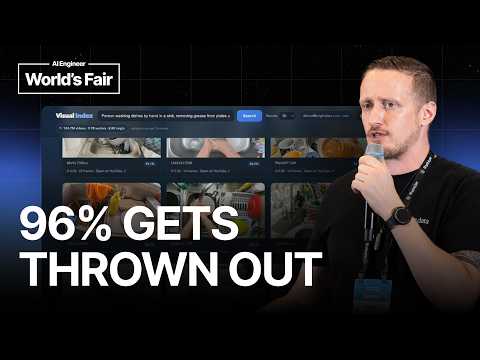
Physical AI's Next Bottleneck Is Finding the Right Video —…
Rafael Levi of Bright Data argues that data, not models, is the bottleneck for physical AI: LLMs train on trillions of words, but robotics has only about a million videos of robots acting. Staged recordings introduce bias, since people behave unnaturally when told what to do. He notes NVIDIA discards ~96% of downloaded video when training Cosmos, while Meta needed only ~62 hours of real robot data alongside ~1 million hours of public video. Bright Data's approach is 'search first, collect second': indexing over a billion videos by the actions depicted and returning trimmed clips with timestamps, match scores, and frame counts via API. The talk includes demos of action-based searches (dishwashing, clothes folding) and discusses uses in self-driving and brand discovery.
# Video Identity Observations
## Source Overview
- **Title:** *Physical AI's Next Bottleneck Is Finding the Right Video — Rafael Levi, Bright Data*
- **Format:** Conference talk / product presentation, delivered live to an in-room audience ("For those that came to actually see me, thank you... I'm going to try to entertain you guys, teach you something new").
- **No curated metadata supplied** — all identity evidence comes from the title and transcript.
## Intended Audience
The presentation addresses multiple overlapping audiences:
- **AI/robotics practitioners and engineers** — the core technical audience:
> "So right now I'm not sure if any of you training any robots... We provide to you the snippets of the video to train your robotics."
- **Conference attendees generally**, including casual passersby, signaled by the self-aware opening:
> "For those that came to actually see me, thank you. For those that are just hanging out here, also thank you."
- **Brand marketing / product teams**, offered as a secondary use case:
> "Let's say you have a brand and you want to find videos where your brand is being found."
- **General audience appeals** with light, relatable examples (Waymo rides, Russian dash-cam crash videos, gamers looking up level walkthroughs).
## Claimed Scope
- **Company self-description:** Rafael identifies himself as an employee of **Bright Data** ("I work at Bright Data. I've been with Bright... for over eight years") and describes the company broadly as: "In Bright Data we are collecting data and we're trying to innovate."
- **Specific product claim:** A new video action-indexing platform:
> "This is a new product that we're doing at Bright Data — indexing videos so that you guys can find specific actions."
Claimed scale: "we only got about 100 million index there, but now we're up to **1.1 billion videos**."
- **Thesis claim:** AI models are no longer the bottleneck in robotics — **training video data is**:
> "The AI is no longer the hard part. The data is."
- **Claimed differentiation:** "Search first, collect second" — search by *actions* rather than keywords, returning pre-trimmed, ready-to-use clips via API.
## Distinguishing Claims vs. Demonstrated Evidence
- **Creator claims (product/marketing):** 1.1 billion indexed videos, action-based search, API access, "ready to use clips," timestamp/score/frame-count results.
- **Demonstrated in-talk:** A live platform demo (playback of a query: "person washing dishes by hand in sink... close-up hand interactions") and cited third-party examples (Meta's model trained on ~1M hours of video plus 62 hours of robotics data; Nvidia Cosmos discarding ~96% of downloaded video; Stable Video Diffusion discarding 74%).
- **No broader channel-level conclusion** can be drawn from a single video, but the presentation style is consistent with **vendor thought-leadership content**: industry history recap (2022–2024 robotics milestones) framing a problem that the speaker's own product solves.
## Presenter Positioning
- Named individual with long tenure: "my name is Rafael. I work at Bright Data... over eight years."
- Direct networking invitation, reinforcing a business-development context:
> "If you want to connect with me... feel free to add me on LinkedIn... I'm at a Bright Data booth if you want to talk more about it."
# Delivery Observation: Rafael Levi — "Physical AI's Next Bottleneck Is Finding the Right Video"
## Overall Delivery Profile
A conversational, audience-facing conference talk that explains a technical data problem through everyday analogies and rhetorical questions. The delivery relies heavily on **spoken-listener habits**: fillers, restated ideas, and direct audience address, rather than dense technical exposition.
---
## Tone
- **Casual and welcoming**, opening with humor:
> "For those that came to actually see me, thank you. For those that are just hanging out here, also thank you."
- **Enthusiastic about the technology**, using exclamatory asides:
> "How cool is that? First time I got in the car, I thought I was going to die, but it was actually very nice."
- **Conversational framing devices** appear repeatedly, e.g., "right?" as a tag throughout the talk, and informal asides like "That's crazy. Why do you need a million people doing it?"
---
## Vocabulary and Recurring Phrases
- **Persistent tag question "right?"** — used dozens of times as a verbal checkpoint: "everybody knows AI without data is just a box, right?", "It's a very small limited data sets of robots doing things, right?", "That's just a lot of wasted money. Okay."
- **Repetition of the core thesis** with slight variation: "the AI is no longer the hard part. The data is", "So what is the alternative? The alternative is the web."
- **Waste vocabulary** recurs as a motivating theme: "That's wasted compute. That's wasted bandwidth. That's wasted storage. That's just a lot of wasted money", later echoed as "less waste of data collection. there's less waste of storage and bandwidth."
- **Running example phrases reused across the talk**: "person opening a door", "person washing dishes", "folding a t-shirt / folding clothes", "billions of hours", "billions and billions."
- Frequent **fillers and hedges**: "uh," "um," "I mean," "you know," "of course" (used many times: "of course everything is available via API," "of course, you can pre-record it").
- Superlative scale language: "trillions of words," "billions of images," "millions of hours," "hugest databases out there."
---
## Teaching Habits
- **Rhetorical question → answer pattern** structures most explanations:
> "How do you think it learned how to drive? By actually teaching itself."
> "So, what is the alternative? The alternative is the web."
- **One concrete example reused as an anchor** — the "person opening a door" example is introduced, then explicitly reused:
> "Since we're talking about a person opening a door, let's keep using that uh example."
- **Historical timeline setup** (2022 → 2023 → 2024) before introducing the problem.
- **Quantified contrasts** as the main teaching tool: trillions of text words vs. "only about a million videos"; Nvidia discarding "about 96% of the video"; "62 hours of real robotics data."
- **Live demo narration**, describing the screen as it plays:
> "So here we see person washing dishes by hand in sink removing grease from the plate..."
- **Practical takeaway emphasis**: "Everything is available via API. We don't expect people to actually do anything manually."
- Explicit **signposting** of structure: "So, a little more on how it works," "So, I'm going to wrap it up."
---
## Communication Patterns
- **Direct audience address** throughout: "How many of you like to watch accidents?", "maybe you are a gamer and you want to know how do you beat this level," "I'm not sure if any of you training any robots."
- **Self-interruption and restarts**, indicating unscripted delivery: "Uh we had uh an AI actually control multiple robots," "how do you think it learned how to drive? By actually teaching itself. By by learning on dashboard cameras."
- **Callback closing** mirroring the opening's warm tone: "if you want to connect with me... feel free to to add me on LinkedIn... thanks for coming."
- Occasional **humor hooks** to keep attention: "I'm going to try to entertain you guys, teach you something new"; "Crazy driving in Russia, right?"
---
## Confidence Notes
- The **"right?" tag**, **rhetorical question pattern**, and **recurring door-washing-folding examples** are strongly repeated across the transcript and are reliable patterns.
- Claims about pacing, gestures, or slide design cannot be verified from the transcript alone.
- Whether the self-interruptions reflect habit or stage nerves cannot be determined from a single talk; this is a single-source observation and would need more videos to confirm as stable.
# Video Position Record: Physical AI's Next Bottleneck Is Finding the Right Video — Rafael Levi, Bright Data
## Speaker Identification
- **Rafael Levi** — employee at Bright Data (states he has been there "over eight years"), presenting on video discovery for agentic world model training. No other speakers appear in the transcript.
---
## Central Thesis
Levi argues that **data, not AI models, is the current bottleneck for physical AI / robotics training**. The web — especially billions of hours of public video — is an underused alternative to expensive, unnatural, and non-scalable data collection, and Bright Data's new product solves the "noise" problem via action-based video search.
---
## Positions & Claims
### 1. AI is solved; data is the hard part
- "AI without data is just a box."
- Text LLMs have *trillions* of words; image generation has *billions* of labeled images — but robotics has only "about a million videos." This scarcity is the core problem.
### 2. Historical trajectory of robotics AI
- 2022: Google taught a robot via images and real-world actions.
- 2023: AI controlled multiple robots.
- 2024: Open source changed the game — all labs gained access and began putting AI into robots.
- Current examples: humanoid robots (many still remote-controlled, he concedes) and Waymo driverless cars in San Francisco, which he claims learned to drive from dashboard camera footage.
### 3. Instructed/paid data is biased (his stated assumption)
- Companies pay people to record actions (e.g., opening a door), but "when somebody is told to do something, they do not do it naturally."
- His own qualification: "**In my assumption, no**" — the data is biased and doesn't deliver the same results. This is presented as his view, not a settled fact.
- People also behave differently when they know they are on camera ("camera shy").
### 4. Existing data sources are insufficient
| Source | His stated objection |
|---|---|
| Simulations | Cheap, but video-game physics "are almost there but not good enough" for robot training |
| Teleoperation | Not scalable — limited recording hours per person per day |
| Pre-built datasets | Small (~1 million videos) |
### 5. The web is the alternative
- Estimates ~5 billion videos on YouTube; "millions of hours" of first-person door-opening footage exist.
- The web daily shows **gravity, motions, cause and effect, accidents, object handling** — "billions of hours, great training material for robots."
### 6. Evidence that web video works
- Cites a Meta model trained on ~1 million hours of real-world video, then needing only **62 hours of real robotics data** to control a real robot — "no simulations needed."
- Addresses the obvious objection — web videos don't show robot joint data — by citing frame-by-frame methods where AI measures movement between consecutive frames to derive angles and distances. He qualifies: "You do need to have some processing on top of that."
### 7. Current pipelines waste most downloaded video
- **NVIDIA (Cosmos):** discards ~96% of downloaded video (only 4% useful) — "wasted compute, wasted bandwidth, wasted storage, wasted money."
- **Stable Video Diffusion:** discards ~74%.
### 8. Bright Data's proposed solution: "search first, collect second"
- Indexes videos (claims **1.1 billion** indexed at time of talk, up from ~100 million in the demo video shown) and allows **search by actions, not keywords** (e.g., "person washing dishes," "person folding a t-shirt").
- Returns trimmed, ready-to-use clips with **timestamp, match score, and frame count**, plus the original video URL; accessible via API.
- Claimed benefits: less waste of collection/storage/bandwidth; removing noise that causes "hallucinations" in training.
- He acknowledges some returned clips may be tangential (e.g., kitchen-cleaning rather than dishwashing) and that extraction still requires downstream processing.
- Additional use case offered beyond robotics: **brand detection** in video (e.g., finding makeup-brand appearances that keyword search of titles would miss).
### 9. Applicability beyond robots
- Self-driving (dash cam footage, accident videos).
- World models and physics learning (sitting, walking, gravity).
- Gaming (searching for level-completion footage).
- He criticizes companies paying "millions of people" to record actions as unnecessary when "everything is available online."
---
## Qualifications & Tensions Preserved
- His claim that instructed data is useless is explicitly framed as an **assumption** ("In my assumption, no"), not demonstrated.
- He concedes many humanoid robots shown publicly are "remote controlled."
- He concedes web video alone "doesn't necessarily get you 100% there" — processing is still required.
- Demo results shown were sped up, and the demo used an older index (~100M vs. claimed 1.1B videos).
- The Waymo learning-from-dashcams mechanism is asserted, not sourced.
---
## Closing Position
Levi invites attendees to connect on LinkedIn or visit the Bright Data booth, framing the product as new and broadly applicable: "Anything. The world is yours."
# Speaker & Provenance Record
## Video Identification
- **Title:** *Physical AI's Next Bottleneck Is Finding the Right Video — Rafael Levi, Bright Data*
- **Video ID:** 01a15ca7-309e-78ab-ba08-0e5f97a904f7
## Speakers & Roles
| Speaker | Role | Basis |
|---|---|---|
| **Rafael Levi** | **Creator / presenter** — solo conference-style speaker; self-identifies as a Bright Data employee of over eight years | Explicit self-introduction in transcript |
- No guests, narrators, or additional speakers appear. The entire transcript is a single continuous talk.
## Speaker Affiliation & Context
- Speaker states: <blockquote>"my name is Rafael. I work at Bright Data. I've been with Brighta for over eight years."</blockquote>
- The talk describes and demonstrates a **Bright Data product** (video indexing/search for action-based video retrieval) — the speaker's employer.
## Promotional Segments (flagged)
- **Product promotion:** Extended promotion of Bright Data's "search first, collect second" video indexing platform, including a live/screencast product demo (dishwashing and clothes-folding search examples, API returns).
- **Closing call-to-action:** Speaker invites attendees to connect on **LinkedIn** and visit the **Bright Data booth** — promotional availability.
## Referenced Sources & Third-Party Claims
All claims below are asserted by the speaker; transcript provides no citations.
- **History timeline:** 2022 — Google taught a robot via images/real-world actions; 2023 — AI controlled multiple robots; 2024 — open source release changed the field.
- **Waymo:** autonomous vehicles operating driverless in San Francisco; speaker claims they learned from dashboard camera footage.
- **Data volume claims:** trillions of words for LLMs; billions of labeled images; ~1 million videos for robotics training; ~5 billion YouTube videos (speaker's estimate: "I don't know, five billion").
- **Meta:** an AI model trained on ~1 million hours of real-world video, then controlled a real robot with only **62 hours** of real robotics data.
- **Nvidia Cosmos:** discards ~**96%** of downloaded video as unusable.
- **Stable Video Diffusion:** discards ~**74%** of downloaded videos.
- **Product metrics claimed by speaker:** demo shown used ~100 million indexed videos; current index stated as **1.1 billion videos**.
## Cited Methods Described (speaker's explanation, not attributed externally)
- Frame-by-frame motion measurement enabling AI to learn angles/distances from ordinary video without sensor data.
## Availability & Access Notes
- Speaker states product access is **via API**; returns timestamps, match scores, frame counts, snippets, and links to original videos.
- Speaker invites follow-up via **LinkedIn** and in-person at the **Bright Data booth**.
- No comments section, downloads, or transcript availability beyond this transcript is indicated.
## Uncertainty Flags
- Speaker's surname "Levi" appears only in the video title metadata, not in the spoken transcript (speaker says only "Rafael").
- No dates, links, or formal citations are given for the Meta, Nvidia, or Stable Video Diffusion claims; provenance is speaker assertion only.
Hi everybody. Welcome. For those that came to actually see me, thank you. For those that are just hanging out here, also thank you. I'm going to try to entertain you guys, teach you something new. Um again my name is Rafael. I work at Bright Data. I've been with Brighta for over eight years. And in Bright Data we are collecting data and uh we're trying to innovate. So today I want to talk about video discovery for agentic world models training. And uh we're going to explain what that is in a little bit. So what does it take to take to build a system that can see understand and act
right? I mean, we figured out what an AI is. We're constantly improving it. Like, you know, that's kind of handled. But now, the hard part is what data do you
provide to it? Because everybody knows AI without data is just a box, right? So, let me take you a little bit back in
history, right? In 2022, Google taught a robot by images, real world actions, right? Then going
forward, there was a leap uh in 2023. Uh we had uh an AI actually control multiple robots. In 2024, the open source came out. Now, this where the game changed. Once we had an open source, all the labs had access to AI and they started already putting AI into robots, right? And so now these models are already driving humanoid robots. I'm you seeing some of course most here are remote controlled, but I mean in San Francisco you got weo driving without any drivers. How cool is that? First time I got in the car, I thought I was going to die, but it was actually very nice. Right now, how do you think it learned how to drive? By actually teaching itself. By by learning on dashboard cameras, right? Every car has a dashboard. So, if you provide that to an AI, it can figure out how to actually operate a machine. So, as I said, the AI is no longer the hard part. The data is. And this is what I want to talk about. Right? So for chat LLMs, there's trillions of words and texts, right? So we have so much text
data to train the LLMs. For image generation, we got billions of images, labeled images. So that's also a huge database. But for robotics, there's only about a
million videos. It's a very small limited data sets of robots doing things, right? And so the idea here is that of course you a lot of companies out there what they do is they pay people to record actions, right? So for example, hey
record me how you open a door or record to me how you're sitting on the chair. But then the problem becomes is that when somebody is told to do something,
they do not do it naturally. So I call it instructed, right? If you're told to record how you open the door and you're doing it for somebody, it's not going to be the same as if you just walk into the house. The movement is totally different. So is that data good for robotic training? In my assumption, no. It's biased data and it doesn't deliver the same results. So obviously the robot is not going to be as effective as if it's intuitive. Right? So I just threw in some examples on the slide, right? So uh the built by hand data is not the same as the data that is kind of on the site, right? So and also the fact is that people behave very differently when they on the camera. Some of you know some people are camera shy. So you know as soon as you put a camera on them you they change but in the natural world it's a totally different thing. So this is what we are trying to solve in bright data right um again so why is the usual data sources are not enough right simulations
uh virtual it's it's cheap but it's um you know everybody's playing video games the physics in video games are almost there but they're not good enough where to train a robot on it right a hand
control the person controlling a robot it's doable but how many hours a day can you record the robot, how many people you need to actually get huge scale data, right? I mean, you can record maybe eight hours a day every day. How many hours are you going to get in a year? It's not really scalable. And of course, there's already pre-built data sets, but as I said before, they're small. There's only about a million videos at this point. So, what is the alternative? The alternative is the web. Let's just think about YouTube. How many videos are there on YouTube? I don't
know, five billion videos. How many actions are in those videos that a robot can replicate? I mean, let's think about it. How many
do you think videos are there of a person opening the door firsterson view? Millions of hours. You'll be surprised. So, every day the web video shows gravity motions, right? So um cause and effect obviously accidents big the biggest cause and effect right how handle how people handle objects and billions of hours great training material for robots but what is the problem the problem is that there's a lot of noise right oh and for example right so one of the AI models that meta trained they gave it
about a million hours of real world videos and then all it took is 62 hours of real robotics data to actually control to control a real robot. So if you think
about it, the data was collected publicly, right? So it trained the the the robot on just random things and then in 62 robotic hours, it was already moving. So there no simulations needed, autonomous robotics delivered fast. But the videos don't show how the robots
move, right? So you might think, well, listen, how useful is it a person pouring water into a cup for a robot. So there is methods actually out there how
an AI can distinguish and actually learn from the actions that are in a video. If you take two frames frame by frame and the AI measures the movement this difference, right? So you have an image A and image two and there's a small movement that is changing between the two images and AI can actually measure that change. So if you keep doing that through the whole video and AI can actually figure out angles, distance and everything that it needs to train and robot right. So we don't necessarily need the sensor's data but of course the video itself that you download from video from YouTube or the video that uh you extract the data from doesn't necessarily get you 100% there. You do need to have some processing on top of that but it's available. It's out there and all you need to do is process it.
So a few more examples right? So for example, Nvidia when they train in the Cosmos robot, they're throwing out about 96% of the video. So what does that
mean? They download a million hours of video and the only part is 4% is actually useful. Everything else gets thrown out. That's wasted compute. That's wasted bandwidth. That's wasted storage. That's just a lot of wasted money. Okay. Stable video diffusion is throwing out 74% of the videos that they're downloading. So in bright data we are trying to solve
that problem and we're trying to take it a step forward. So what we propose is search first collect second. What we do is we are actually indexing videos and
we are allowing you to search for specific actions. Since we're talking about a person opening a door, let's keep using that uh example. What you can do on our platform is actually input detailed information, right? A query, person washing dishes, person folding a t-shirt and so on. And we will provide the snippets from the videos of these actions. So what does that mean? That means that there's less waste of data collection. there's less waste of storage and bandwidth, right? So, a little more on how it works. Obviously, you define what you're looking for. We search through billions and billions of pre-indexed videos, not by keywords, but by actions, and we provide you with ready to use clips. And obviously, they're already trimmed, prepared for your training. So all you got to do is process them a little bit for maybe motion distance sensors and so on and it's ready to be ingested into a robot. I have a small example of a video of how it actually works on our platform. So let me just hit play here if I can find it.
So here we see person washing dishes by hand in sink removing grease from the plate using sponge and soap including rinse and placing dishes into drying rack. close-up hand interactions.
So, right now what is happening is it's searching through billions of videos. Now, on this video, it's a bit old. We only got about 100 million index there, but now we're up to 1.1 billion videos. And it will literally like this is a little sped up, so I didn't want to waste your guys time, but it will provide to you clips from videos of people washing dishes. And you can see right here all the videos in That would be fine. Now, some of these videos might not have to do anything with washing dishes. They might have cleaning kitchen. They might have to do something else. And here's another example. For example, human folding different types of clothes, right? So, a little more description. The more description you give, the more you actually get back. So, again, a little speed up. Let's see. I want you to understand it could be anything. A person putting on makeup. Let's say you have a brand and you want to find videos where your brand is being found. All that can be also provided. So you see people folding clothes. So now you can train a robot on how to fold clothes. Of course everything is available via API. We don't expect people to actually do anything manually, right? So you can
trigger it by API. you get a returned snippet of the video, the URL. We give you the link to the original video if you want to watch it. But the main thing
here is that we can give you the snippets of the video to train your robotics. Now, I'm not sure if any of you training any robots, so I'm going to give you another example of how useful it could be. Let's say you have a brand and you want to know where your brand is being demoed on videos. The video titles doesn't matter because it doesn't actually consume. It's not about your product. It's just a person doing some podcast recording something. But you see a woman putting on makeup and she you see on the table that this is your brand of a makeup. So now all of a sudden you can find all videos for your brand where it's being used whatever it is right by searching name of the video you won't find it by by video indexing you can actually find specific things that you are interested in apple falling from the tree and so
on. So what comes back? We provide to you this time stamp. We provide to you the score matching, how close it is to your query, and of course the frame count. How many frames are about what
you're looking for? So what does this change? This changes a lot. Okay, less waste. You don't need to download million of hours of videos. you can actually get exactly the the specific actions that you are interested in. Again, it's very crucial for robotic training because noise creates problems, hallucinations, right? This removes the noise.
What is it useful for? Not only robots, but obviously self-driving for example, Wimo, right? trained on dash cam video cameras and there's millions, hundreds
of millions of hours on YouTube of dash cams. How many of you like to watch accidents? Dash cam c accidents. I'm sure everybody watched them. Crazy driving in Russia, right? So, this is what we're talking about, right? The videos that are out there, okay? A person running a red light, person stopping on red light, making a left turn, making a right turn, and so on. All of that can be a very useful data for training and any other world models. Physics, right? Robots needs to understand physics. What is the gravity? How to sit? How to walk? How to move? Again, of course, you can pre-record it. Um, a lot of times right now I speak to some of the people and they have millions of people recording videos for them. Hey, can you guys record me how you open doors? That's crazy. Why do you need a million people doing it when everything is available online? Online is one of the hugest databases out there. It's just people don't really like it's it's not that easy to use it, right? I mean, right now the only search available to us is by the keyword of the name of the video. And of course, one source, the whole public video web in one place. I mean, we got YouTube, we got Vimeo, we got so many different uh video providers out there, billions and billions of hours of training data just there waiting for you to grab it, collect it and process it. So basically this is a new product that we're doing a bright data right indexing videos so that you guys can find specific actions anything you can think about you know again it could be useful for brands uh as well it's not only for training data anything you can think of could be useful maybe you are a gamer and you want to know how do you beat this level but there's no exactly video like that so you can search okay people beating the level on the video game, right? Anything. The world is yours. So, I'm going to wrap it up. I don't know if you have any questions, but uh if you want to connect with me, talk about it more, feel free to to add me on
LinkedIn. And um yeah, I'm going to thank you guys for your attention. And uh I'm at a bright data booth if you want to talk more about it. And thanks for coming.