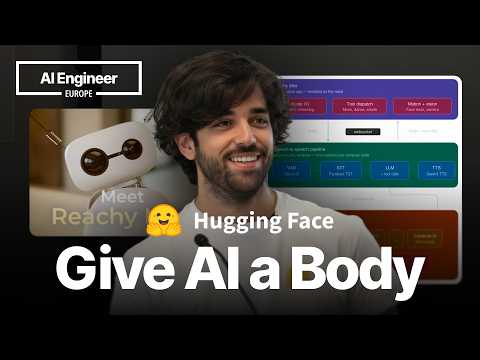
Reachy Mini: the $300 open source robot you can actually…
Talk by Andres Marafioti of Hugging Face about Reachy Mini, a $300 open source robot shipped unassembled to 7,500 people. Covers the robot's voice stack: Parakeet transcription running every 150 milliseconds with partial results fed back mid-sentence, Qwen 3.5 27B as the LLM, and a Qwen3-TTS optimization effort. The TTS initially ran at 0.8x real time (1.2 seconds per second of audio) due to no streaming, 500 autoregressive steps per audio packet with a CPU-GPU round trip each, and a dynamic KV cache blocking compilation; switching to a static KV cache with CUDA graph captures achieved 5.8x real time and under 200 ms time to first audio. At that speed, infrastructure round trips matched model latency, so the load balancer separates LLM endpoints from conversation nodes based on how much different users talk.
# Channel Identity Observations: Reachy Mini Talk (Andres Marafioti, Hugging Face)
## Explicit Self-Description Evidence
- **Speaker role and affiliation**: The speaker introduces himself: *"my name is Andy Marafioti"* and *"I lead multimodal research at Hugging Face, which I don't have time to explain very much, but I hope you know Hugging Face."*
- **Project framing**: *"We had We made it targeting really hackers, researchers, students, dreamers. If you have a computer, you should be able to play with it and make things. That's a little bit our target. Um a little bit of our vision."*
- **Stated open-source commitment**: *"everything that we are doing with the robot is open source. All of these models are open source. The agents are open source."*
- **Personal project ownership claim**: The speech-to-speech pipeline is *"a project that I've been maintaining with Hugging Face for the last 2 years"*; he also says of the TTS work, *"I spent maybe 2 weeks with Coqui TTS trying to get the model trained by them to actually be fast enough."*
- **Track record claim**: *"this is maybe our fourth open source robot and we tried to make them all stack with each other"* (mentioning SO100, SO101 arms and the "Kiwi" wheeled base).
## Observable Presentation Patterns
### Intended Audience
- A **technical, developer/hacker audience** is addressed explicitly: *"because you guys are a very technical audience, I wanted to show you a little bit how we're actually serving this."* He adds architectural detail (load balancers, inference endpoints, KV cache, CUDA graphs) consistent with that audience.
- **Accessibility for non-experts** is also claimed: *"it's not like you need a lot of knowledge to do these things. You can really start today even if you're not a coder"* — demonstrated via a "vibe coding" anecdote: *"I one shot it with Coqui TTS. I told it like, 'Hey, here's the repo for the robot...' And it just did it."*
### Claimed Scope
- **Affordable open robotics hardware**: Two models at *"450 and 300 USD"*; the cheaper one is *"selling... in bulk for high schools or universities to play with."*
- **Voice-first human-robot interaction**: *"one of the main ways to talking with robots is going to be through voice... we need to give people the tools to develop voice experiences."*
- **Communal, non-corporate development ethos**: *"we want how we interact with those robots to be communal, to be developed by everyone... And we don't want it to be guarded behind 50K robots."*
- **Repairability and hackability**: *"we ship these robots unassembled... you can basically repair anything that's going to break in the robot ever."* User modifications shown: 3D-printed parts, a Halloween pumpkin customization, and petting behavior someone discovered.
### Demonstrated Depth and Community
- **Scale claim**: *"we have now shipped 7,500 of these robots"* and the conversation app is *"our most used app by far."*
- **Hands-on engineering**: Detailed technical walkthrough of fixing Coqui TTS latency (streaming, static KV cache, CUDA graph captures, real-time factor *"from... 0.8... to being 5.8"*), plus a public demo: *"You can go and test it yourself"* on a Hugging Face Space.
- **Criticism of industry robots**: *"All of these robots... are still too expensive to prototype. I don't see any high school anywhere in the world ordering 10 of these 50K humanoid robots."*
- **Interactive format**: The talk ends with audience Q&A and an invitation: *"if anyone wants to talk to me about this, go ahead. We have 1 minute 57 seconds for questions."* A live robot is left available: *"I have the robot here. I leave it. You can talk to it."*
## Format Observations
- **Conference talk format** (live audience, timed Q&A, demo video rather than live demo: *"I'm not as brave as Sam from Mistral who did the live demo. I'm going to show you a video."*).
- The title (from metadata: *"Reachy Mini: the $300 open source robot you can actually hack"*) matches the talk's central claims about price ($300 model) and hackability.
- Note: the speaker verbally says **"Richie Mini"** while the title uses **"Reachy Mini"** — an observed naming discrepancy between transcript and title, not resolvable from this material.
# Delivery Observations: "Reachy Mini" — Andres Marafioti, Hugging Face
## Overall Tone & Register
- **Conversational, casual conference style**: heavy use of filler words — "Um," "Uh," "Yeah" — throughout, e.g., > "Um I'm going to talk today about this little robot called Richie Mini."
- **Self-deprecating humor** appears repeatedly: > "I'm not as brave as Sam from Mistral who did the live demo. I'm going to show you a video." and > "It's very hackable. It's very cute. That's maybe a personal opinion, but I think it's cute."
- The humor carries through the recorded demo, where he jokes back at the robot: > "Okay, okay, I'll change the pants before the talk."
## Verbal Fillers & Repair Patterns
- **Frequent "um/uh" and restarts**: > "Uh it was incredi- incredible and a little bit disturbing." > "to experiment to experiment, to hack with."
- **Self-correction while speaking numbers** is an isolated but notable moment: > "which means for 1 second, you take 20 seconds, I guess. Uh no, for 1 second, you take 200 milliseconds. Yes. Thank you." — the audience apparently corrected him ("Thank you" suggests an audience member helped).
- Intensifier reduplication: "really, really expensive," "really, really good humanoids" — appears multiple times.
## Teaching & Structure Habits
- **Signposting with "very quickly"** used to flag fast coverage: > "So, first, very quickly, the state of robotics." and > "Uh now, very quickly, we sell two of these robots."
- **Problem → solution framing**: he lists current robotics problems ("too expensive to prototype... very complex to adapt... You cannot really connect with them") before introducing the product as the response: > "And that's how we came up with Richie Mini. It's a little bit our response to that."
- **Audience-aware tailoring**, stated explicitly: > "because you guys are a very technical audience, I wanted to show you a little bit how we're actually serving this."
- **Layered/systems explanations**: technical sections enumerate components sequentially — the speech-to-speech pipeline walkthrough (VAD → speech-to-text → LLM → TTS) and the three-level architecture description.
## Recurring Phrases & Motifs
- **First-person plural "we"** dominates for team/product claims: "we came up with," "we made it affordable," "we are trying to give you."
- **Repetition of "really" as intensifier** — one of the most frequent words in the talk.
- **Open-source/hacker framing is a recurring theme**: > "hackers, researchers, students, dreamers," > "a bit more of a hacker fashion," > "you can basically vibe code things with the robot."
- Repeated inclusivity appeals: > "If you have a computer, you should be able to play with it and make things."
## Technical Depth Delivery
- **Anecdotes to open topics**: > "A couple of weekends ago, I was at the robotics club in Zurich, Switzerland, and we had a little boxing match between humanoid robots."
- **Concrete numbers with self-qualification**: prices (450/300 USD), fleet size (7,500 robots), latency figures (150 ms transcription, 0.8 → 5.8 real-time factor). Some hedged: > "I think they're like six figures mid."
- **Hands-on credibility markers**: > "I spent maybe 2 weeks with Coqui TTS trying to get the model trained by them to actually be fast enough."
## Closing & Q&A Behavior
- **Invitations to engage**, repeated: > "if anyone wants to talk to me about this, go ahead" and closing with > "I'm going to be around, so if you want to talk to me, please do."
- Q&A answers are direct, admit gaps honestly: > "So, you sort of need to hack around it... I still haven't seen it done, but we know it fits cuz we designed it that way."
- Opens with troubleshooting the AV: > "Can I Are you hearing me well? No. Okay." — an isolated moment, not a pattern.
- Explicit time-tracking: > "We have 1 minute 57 seconds for questions" and > "I'm out of time."
## Uncertainty Notes
- The transcript appears auto-generated ("Richie Mini" for "Reachy Mini," "Rhodium," "Coqui" possibly for "Qwen/Kokoro" in places), so exact wording of some technical names is unreliable.
- Whether audience laughter accompanied the jokes is not observable from the transcript alone; the tone of humor is inferred from word choice, not audible response.
# Observation Record: "Reachy Mini: the $300 open source robot you can actually hack"
**Speaker:** Andres (Andy) Marafioti, leads multimodal research at Hugging Face.
## Motivation for Reachy Mini
- **Critique of current robotics:** Modern humanoids are advancing fast ("neck-breaking speed" — citing a humanoid boxing match in Zurich as "incredible and a little bit disturbing"), but:
- Too expensive: humanoids in the **mid five-figure range (50K up)**; Waymo "six figures mid" (qualification: "I think").
- Prices don't appear to be coming down.
- Humanoid form is a creative constraint — "this is not biology, this is really hardware"; a spider form could be faster and more stable, but humanoids are chosen for recognizability, which he calls "a mistake."
- Not friendly-looking, too complex to adapt, targeting companies, hard to connect with.
- **Critique of the field:** Voice AI is mature (commercial: Rhodium in Paris, GPT real-time, Siri; open source: Box Rally, Cocoro at 80M params, Hugging Face speech-to-speech pipeline), but "no one is really working on how we're going to talk with these robots."
- **Vision:** Keep the future of robot interaction from being "dominated by one company or one group of people" — make it "hacker fashion" like early computers. Target audience: hackers, researchers, students, dreamers.
## Product claims
- **Deliberately non-humanoid:** an expressive robot you can talk to that doesn't look human — intended to push creativity toward "a new thing" rather than a human replacement.
- **Repairability:** ships unassembled; assembly gives owners the knowledge and tools to repair anything that breaks.
- **Two models:** $450 (Raspberry Pi + battery) and $300; cheaper one sold in bulk to high schools and universities.
- **Adoption:** ~7,500 robots shipped; the conversation app is "our most used app by far."
- **Community hacks:** 3D-printed parts (Halloween pumpkin antenna swap), petting the robot (it reacts and can be made to purr).
- **Ecosystem:** fourth open-source robot; SO100/SO101 arms stack together; "Kiwi" wheeled base designed to fit Reachy Mini — qualification: "I still haven't seen it done, but we know it fits cuz we designed it that way."
## Voice architecture (three levels)
1. **Speech-to-speech pipeline** (Hugging Face, maintained by speaker ~2 years): VAD → speech-to-text (**Parakeet**, partial transcriptions every 150 ms) → LLM with tool calling (movements, camera) → TTS (**Coqui TTS**).
2. **Conversation app on robot:** echo cancellation, tool dispatch, emotions, camera, face tracking.
3. **Serving:** Hugging Face inference endpoints, load balancer scaling compute nodes by connected robots; LLM inference (**"Coqui 3.5 27B"** — as spoken, "cuz we managed to make it fast enough") scaled separately because per-node usage of LLM vs. conversation varies.
## Faster Coqui 3 TTS optimization
- Claim: the released model matched advertised quality but **not** the paper's claimed latencies.
- Problems found and fixes:
- Model generated whole output before returning (no streaming) → implemented streaming ("harder in practice than in theory").
- Autoregressive model doing 500 steps per audio packet with CPU–GPU coordination → compiled model; replaced **dynamic KV cache with static KV cache** (more RAM, faster), enabling **CUDA graph captures**.
- Results (as stated): real-time factor from 0.8 (1 s audio takes 1.2 s) to 5.8 (1 s audio takes ~200 ms); time-to-first-audio from several seconds to a few milliseconds. Demo shows voice cloning in real time, 4x real time, first-token latency under 200 ms. Open source ("Faster Coqui 3 TTS"), released ~2 months ago, used daily.
- **Latency caveat he highlights:** time-to-first-audio as perceived by the client includes infrastructure overhead, which "add up a lot" — as much as the model itself in his case.
## Vibe coding claim
The movement app running during the talk was one-shot with an LLM: gave it the repo and the goal, "and it just did it" — argument that you don't need coding knowledge to build for the robot.
## Q&A positions
- **On-device apps (Prince?):** yes, anything not needing a GPU runs directly on the robot (Raspberry Pi or your own laptop); not constrained by language (Java, Python, HTML).
- **Plugin system:** "you sort of need to hack around it," but the robot lineup is designed to stack (arms, Kiwi base).
- **Other TTS limitations:** implementation "quite complete, but just generally slow," "felt like a research implementation." He speculates their fast API may be "a strategy of trying to get people towards the API" (explicitly framed as his inference). Ongoing corner-case issues surface via repo reports he has to fix.
## Preserved qualifications / tensions
- Cuteness: "That's maybe a personal opinion, but I think it's cute."
- "We made it easy to use. Well, we're making it easier to use."
- Waymo in London: "I heard. I haven't seen them."
- Kiwi compatibility: designed to fit but never witnessed done.
- RTF figure stumbled over before self-correcting (200 ms per second).
- Hugging Face is itself "a little bit GPU poor," hence hosted inference alongside open-source models.
# Speaker Attribution Record — Video `01a15ca9-19e3-7d59-96cf-55c2bf378980`
## Video
**Title:** Reachy Mini: the $300 open source robot you can actually hack — Andres Marafioti, Hugging Face
## Speakers & Roles
### Primary Speaker — **Andres Marafioti** ("Andy")
- **Role:** Presenter / creator-side representative of Hugging Face; leads **multimodal research at Hugging Face** (self-identified).
- Opens with: > "my name is Andy Marafioti. I lead multimodal research at Hugging Face."
- Delivers the talk, two recorded demos, and answers audience Q&A.
### Audience Questioners (unnamed)
- **Prince** (named by speaker in Q&A) — asks about apps running directly on the robot.
- Unnamed audience member — asks about a plugin system / servo extensibility.
- Unnamed audience member — asks about TTS implementation limitations.
### Robot Voice (recorded demo audio)
- Pre-recorded voice agent interaction ("Hey Richie, how are you doing? Functioning within acceptable parameters…") — not a live human speaker; a demo artifact in the talk.
## Referenced Third-Party Sources / Claims (speaker-attributed, unverified)
- **Waymo** — claimed now in London; speaker notes he hasn't seen them.
- **Robotics club in Zurich, Switzerland** — humanoid robot boxing match anecdote.
- **Rhodium (Paris)** — voice agent developer.
- **GPT Realtime, Siri** — commercial voice AI cited.
- **Mistral / "Sam from Mistral"** — prior talk referenced, including a live demo.
- **Box Rally** — cited as an open source model (transcript spelling uncertain).
- **Cocoro** — cited 80M-parameter open model.
- **Coqui 3 TTS / Coqui** — third-party model; speaker claims the paper's latency claims weren't achieved by the released model, and that the API is fast while the open model "isn't up there."
- **Parakeet** — speech-to-text used in their pipeline; **Coqui TTS** for text-to-speech; **Coqui 3.5 27B** as LLM (transcript wording uncertain).
## Product / Promotional Segments ⚠️
- **Reachy Mini ("Richie Mini") product pitch** — pricing ($450 and $300 USD versions), bulk sales to schools/universities, 7,500 units shipped, "most used app," open source framing. Extended promotional content throughout, presented by a Hugging Face employee.
## Provenance & Availability Notes
- All robot software, models, and agents claimed **open source** by speaker.
- Faster Coqui TTS demo described as publicly testable on a Hugging Face Space.
- No curated metadata supplied; comment availability **unknown**.
- Speaker explicitly states demo was **pre-recorded, not live**.
Um Can I Are you hearing me well? No. Okay. Yeah, you Yeah, now now with the speakers. Good. Hey, how are you everyone? Uh my name is Andy Marafioti.
Um I'm going to talk today about this little robot called Richie Mini. Um I'm going to try to explain to you why we developed it, why we think it's important, and what we are trying to do with it. Um and yeah, about me, I lead multimodal research at Hugging Face, which I don't have time to explain very much, but I hope you know Hugging Face. Good. So, first, very quickly, the state of robotics. Um we are actually making strides in robotics. I think for the day-to-day life, it's not very clear, but robots are just coming and they're coming at neck-breaking speed. We have really, really good humanoids nowadays. Um a couple of weekends ago, I was at the robotics club in Zurich, Switzerland, and we had a little boxing match between humanoid robots. Uh it was incredi- incredible and a little bit disturbing. Um there are also several companies today trying to sell you robots to put in your homes to do things like water your plants and scroll Tik Tok aimlessly. Um and of course, we have self-driving cars. I think Waymo is now in London, I heard. I haven't seen them, but pretty cool. Um now, something here that I always see with these strides that we're making with robotics is A, these things are really, really expensive. They're all at least in mid five-figure range, so 50K up. Um and they don't seem to really be coming down. They seem to be targeting that price range for now. Um That's to say the humanoids. The Waymo, I think they're like six figures mid. Uh and they also they kind of look like something that you know. So, it's not very much about being creative. It's very much about trying to imitate reality. And this is not biology. This is really hardware, and we're really constraining the robots to do this. Uh if you take a humanoid robot, it could look like a spider uh and just move around way faster, be more agile, be more stable, but we're actually making it be a humanoid such we look at it and we think like, "Oh, yeah, robot, human, it's the same sort of. Like, I understand what it can do."
Uh that to me is a mistake. They also don't look very friendly in general. Uh so, I see a few problems with the current state of robotics. All of these
robots, which they are making strides and they're becoming really, really good, they're still too expensive to prototype. I don't see any high school anywhere in the world ordering 10 of these 50K humanoid robots to let their students play with. Um they're very complex to adapt. They're really like targeting companies. And they You cannot really connect with them. Now, as you saw today already, you we can actually build pretty good voice agents. The state of voice AI is quite advanced. There are really good commercial solutions. There's um Rhodium in Paris developing voice agents. There's GPT real time, which I'm sure most of you have played with. Uh you can chat with it and it will reply, and it sounds fairly natural. There's Siri, which has its problems, but it's in all iPhones. Hey, kudos. Uh and in the open source, we also have a lot of really good models. Uh you heard the talk from Mistral maybe if you were here before. Box Rally is a really good open source model. We also have tiny models like Cocoro at just 80 million parameters, a tongue good. We have good models to understand speech, and we have good pipelines like speech-to-speech from Hugging Face to put all together and make your voice agents yourself. So, what I see here is that voice AI is
quite mature. We have the tools. We have the tools commercially. We have the tools in the open source, but still, no one is really working on how we're going to talk with these robots.
And we are thinking, "Okay, given that robots are coming, how can we manage to put this in the hands of everyone such that it's the experience of the future is not dominated by one company or one group of people, but really it's made like computers were made in a bit more of a hacker fashion." And that's how we came up with Richie Mini. It's a little bit our response to that. We had We made it targeting really hackers, researchers, students, dreamers. If you have a computer, you should be able to play with it and make things. That's a little bit our target. Um a little bit of our vision. The idea is that it's an expressive robot that you can talk to it, but it doesn't look like a human. And that for us is very important because it already puts your mind in a different place creative-wise that you are going to start developing new ways of interacting with this, and it's not going to be just, "Okay, this is a human replacement." It's not. It's a new thing. Uh and we want people to be able to explore that. Uh we made it affordable. We made it easy to use. Well, we're making it easier to use. We made it repairable. Actually, we ship these robots unassembled. So, the first thing you do when you get the robot is you need to assemble it yourself. And once you're done with it, which we get super positive feedback from, you can basically repair anything that's going to break in the robot ever. You have all of the knowledge. You have all of the tools. Um it really just is ordering the the parts and changing it. It's very hackable. It's very cute. That's maybe a personal opinion, but I think it's cute. And we are trying to give you a set of software tools uh for you to develop with. Uh now, very quickly, we sell two of these robots. Uh they are both uh 450 and 300 USD. And the difference between both of them is the 450, which is this one that I
have here, has a Raspberry Pi inside, and it has a battery. And that's it. Basically, if you don't need a battery, you don't need a Raspberry Pi, you can order the cheaper one. Uh we are selling
those cheaper ones in bulk for high schools or universities to play with, to experiment to experiment, to hack with. Um I here I wanted to show you a few um cool developments that we are seeing. For example, in the middle, what I mean with hackable, people can 3D print new parts for the robot. And in this case, they didn't need to really change anything. They're just taking the antennas out, putting a different type of antenna. They are putting something on top of the body. They are putting some lights, and they have suddenly a little Halloween pumpkin for to play with. Um on the right, something that we hadn't thought about, someone figured, "Oh, you can just pet the robot, and it can be fun, and it reacts." Does it purr? Um you can make it purr. Uh so, that's that's a little bit like for us, it's more about people exploring and people developing their own intuition for how this should be, and I'm making it their own. But I was talking to you about voice AI. We think one of the main ways to talking with robots is going to be through voice. I don't see anyone going to a humanoid robot and taking out the keyboard and typing something that that's not going to be what happens. Uh so, we need to give people the tools to develop voice uh experiences. Uh and we are doing that. We have a piece of software to you for you to to converse with the robot. I want to show
you a little demo. I'm not as brave as Sam from Mistral who did the live demo. I'm going to show you a video. Um please for the audio people, if you can maybe put it up a little bit.
I did this this morning with my phone. Functioning within acceptable Maybe a little bit higher. Yeah. Hey Richie, how are you doing? Functioning within acceptable parameters. I have demons disturbing us. You friends. You're supposed to be my friend. I'm good. Um could you take a photo and tell me what you Is it now a little bit higher? I I don't hear it. \>\> how are you doing? Functioning within acceptable parameters. Well, I'm still waiting for someone to tell me a good lobster joke to really get my circuits buzzing. How about you? I'm good. Um could you take a photo and tell me what you see in front of you? I'll have a picture and see what's in front of me. Though, I suspect it's just a very boring wall, which is basically the lobster equivalent of a rock. I see a guy taking a mirror selfie in what looks like a hotel room, wearing a white T-shirt with a yellow emoji on it and orange pants. Honestly, the only thing more crusted than those pants is a lobster that's been sitting on the beach too long. Okay, okay, I'll change my
pants before the talk. And but could you first show me an emotion? Let's do happiness. I'll show you happiness. Though, I hope you're not expecting me to burst into a
lobster-themed dance of joy. Okay, so that quickly for for the conversation. If you guys want to do live demos, I have the robot here. I leave it. You can talk to it. Um and what we're trying to do is we're trying to give people the tools to actually do the conversation. So, everything that we are doing with the robot is open source. All of these models are open source. The agents are open source. Uh but we understand also that people are a little bit GPU poor maybe and they cannot run all of those models locally. We are also a little bit GPU poor and we have now shipped 7,500 of these robots, which means we have a pretty sizable fleet of people talking to the robot. It is our most used app by far. People just like putting it there and talking to it. Uh and because you guys are a very technical audience, I wanted to show you a little bit how we're actually serving this. Uh there are three levels to the system. In the middle, there's the speech-to-speech pipeline. That's a project that I've been maintaining with Hugging Face for the last 2 years. Uh the Mistral Some from Mistral told you a little bit how it works. You have a voice activity detection system that knows if you're talking on or not. That sends it to a speech-to-text system. In our case, we are using Parakeet because it's super fast. So, we transcribe every 150 milliseconds and we send back the partial transcriptions for the robot to react if it hears something interesting. And when the transcription is is done, we send it to an LLM. The LLM replies,
can also do tool calling for movements or use the camera. And then we send it to the text-to-speech system, which we're using Coqui TTS. Now, on the higher level, we have the
actual conversation app running in the robot. That is taking the input and the output from input from microphone and output through the speakers. It's doing the echo cancellation to not hear itself when it's talking and to try to hear you. It's doing the tool dispatching to move, do emotions, and it's using the camera. It can do face tracking to follow you around. Um that sort of thing. And then the speech-to-speech pipeline, if you don't want to tweak it and use your own, we have it deployed in Hugging Face inference endpoints. We have a load balancer that determines how many compute nodes we have at at each time depending on how many robots are connected. And we have separated the LLM inference endpoints. We're actually using now Coqui 3.5 27B cuz we managed to make it fast enough. Um but we scale that differently because each of the conversation nodes can have an amount of concurrent users without the latency spiking up too much. And it changes a lot if in one node you have eight users that are talking a lot and using a lot the LLM. And in another node you have eight users that are not talking at all. Uh so, it really helps to save on resources if you have the LLM separated. Um and to show you a little bit of how far we're going into trying to make this work and also benefiting from the fact that you are a technical audience, I'm going to talk a little bit about Coqui 3 TTS. So, this is a model from Coqui that came out two or three months ago. For us, it was really uh a really great moment because TTS models hadn't been as good in the open source and as fast as Coqui 3 TTS when it came out. And we were really expecting for something like that. We knew it was coming, but we didn't know when it was going to come. Uh the issue is that the model that they released actually ended up being of the quality that they showed you, but not really of the speed that they showed you. Uh the paper claimed very low latencies, but the model didn't really achieve them. So, I spent maybe 2 weeks with Coqui TTS trying to get the model trained by them to actually be fast enough for voice agents. Um and I wanted to show you a little bit a little bit how I did that and what the main issues were. Uh first issue that I found is that the
model would generate the whole output before giving it to you. So, it wasn't streaming. Uh which meant if you wanted 10 seconds of audio, it needed to generate the 10 seconds. That can be
solved with streaming. Uh it's harder in practice than in theory as things usually are, but when it works, it works and it's really cool. The next thing that I noticed was the model being an autoregressive model was doing 500 steps for each packet of audio that it was generating. And for each of those 500 steps, it needs to coordinate the CPU with the GPU. So, it needs to send data back and forth between the CPU and the GPU. That is pretty bad. The way to solve that is to compile your model so that all of those interactions happen directly in the GPU. That couldn't happen by default because it was using a dynamic KV cache. So, the KV cache was evolving depending with the size of the inputs that it was processing. We changed that for a static KV cache. We used more RAM from the get-go, but that makes it faster. And then we could use CUDA graph captures to capture the whole model and to be able to accelerate generation significantly. Uh we went on a real-time factor from being below real time, so at 0.8, which means you generate 1 second, you take 1.2 seconds, uh to being 5.8, which means for 1 second, you take 20 seconds, I guess. Uh no, for 1 second, you take 200 milliseconds. Yes. Thank you. Um we also reduced obviously the time to first audio significantly from several seconds depending on what you're generating to a few milliseconds. Uh and I wanted to show you now a quick demo, not live, recorded of this model on a space on Hugging Face. You can go and test it yourself. I cloned a few voices and I make the model say things.
This happens all in real time. It does the cloning of the voices that I chose. And it generates the text that I'm copy-pasting. Against the odds, the wild lobster has
found a new vessel for its voice and with it the possibility to realize its full potential. Give it a moment of sound. Just a fragment and it will give you back a voice that feels almost human. The original system works, but only offline and at sub-real-time speeds. Faster Coqui TTS brings first token latency under 200 milliseconds and runs at 4x real time. Once you cross that threshold, entirely new applications open up. Uh great. That that is also open source. Now, you can go look for faster Coqui 3 TTS and use it or you can use it with our voice agent from uh Richy Mini. You can also test this demo online. Uh I released it like maybe 2 months ago and I think I it has been like used every day consistently. Um and something that I wanted to highlight quickly here, there's a difference between the time to first audio of the model and what the client perceives. Cuz on top of the basic thing that people are telling you of the model, there's all of the infrastructure times that actually add up a lot. In this case, infrastructure times are just as much as just the model because the model is quite fast, right? But still, when you're thinking of voice agents, you need to consider all these things and how they add up. Uh and going back, what we want you to do is get this robot and make it your own and create your own interactions. We don't want you to just stop at using our voice agents. We're trying to give people the tools cuz we want we know that robots are coming. We know that they're going to be everywhere and we want how we interact with those robots to be communal, to be developed by everyone that wants to develop it. And we don't want it to be guarded behind 50K robots. We want people to actually be working on this. So, we try to put as many resources as we can towards that. Uh and the last thing, you can basically vibe code things with the robot. The application that I had today now of the robot just running here doing some movements, I one shot it with Coqui TTS.
I told it like, "Hey, here's the repo for the robot. Here's what I want it to do. Make it." And it just did it. So, it's not like you need a lot of knowledge to do these things. You can really start
today even if you're not a coder and you can make cool things. Uh yeah. So, thank you. Yeah. Um I'm going to be around. I really like the concept of this being a conversation starter. So, if anyone wants to talk to me about this, go ahead. We have 1 minute 57 seconds for questions if anyone has them. Uh Prince. Are you guys considering apps outside of the ones that you need to host? Like apps that run directly on on on the robot? Yeah, yeah. So, a lot of the apps run directly on the robot, anything that doesn't use a GPU. Of course, this one has a Raspberry Pi, so you need to work with that sort of hardware. But you can also use your own laptop as the hardware. Um and we are not constrained by that. Actually, we also are not constrained by languages. You can make your apps in Java or in Python or in I don't know, HTML, I think. The sky's the limit. Yes. Is there like a system of plugins for extensibility? Like if you want to add like a servo making it like move around the room, something like that. Do you have something that's somewhat supported or do you need to hack around it? So, you sort of need to hack around it, but this is maybe our fourth open source robot and we tried to make them all stack with each other. So, the SO100 and the SO101 are arms that you can
plug together. And we have something called the Kiwi, which is like a base with three wheels that Richy Mini just comes into so it can sort of move around. Uh I still haven't seen it done, but we
know it fits cuz we designed it that way. Yeah. And I'm really interested in your fine TTS work. Yeah. What else What other limitations did you find with the original implementation? Like I know the streaming stuff, like the speed. Any other things that you see when TTS is lacking? So the implementation was quite complete, but just generally slow. It felt a little bit like it's a research implementation. If you use their API, their API is actually quite fast. So I think that was a little bit their strategy of trying to get people towards the API because the open source model isn't up there. Um and for me, I I've been having a lot of issues come to the repo from people that are like, "Oh, this thing doesn't work." And then I need to implement it just because the model can do so many different things that I didn't think of all the corner cases. But now the original implementation is quite complete. I'm out of time. So I'll thank you a lot. As I said, I'm going to be around, so if you want to talk to me, please do. And I'm going to mute this, but please mute the laptop so I can take out the Facebook.