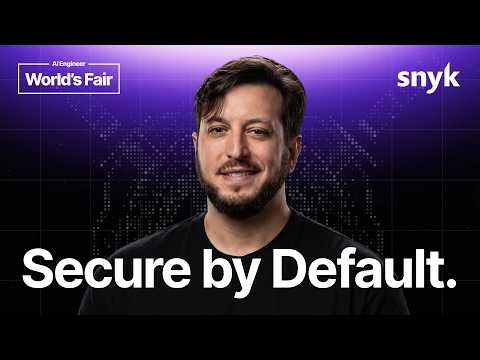
Security Track Intro — Randall Degges, Snyk
Opening talk for the World's Fair Security Track, presented by Randall Degges of Snyk. The talk frames why securing AI-assisted software development remains an unsolved problem, covering three challenges: AI-generated code being as insecure as human-written code, autonomous agents misbehaving in production, and restricted access to frontier models driven by geopolitics. (Scope based on the supplied title and description.)
# Video Identity Observation: "Security Track Intro — Randall Degges, Snyk"
## Speaker & Affiliation
- **Speaker self-identification**: "I'm Randall" — explicitly identified in the title as **Randall Degges, Snyk**.
- **Role in video**: Brief keynote-style introduction (self-described as "only up here for a couple minutes... very brief") announcing a conference security track.
- **Emcee role**: "I'm Randall, and I'll be emceeing the event all day."
## Explicit Self-Description Claims
- **Professional background claim**: "I've been a developer and security professional pretty much my entire life."
- **Stated focus**: "the state of AI security and the things that I've been thinking about quite a lot lately."
## Intended Audience
- **In-person conference attendees**: Direct address — "all of us in the room today," "How's it going everyone?"
- **Developer/security practitioners**: Assumes shared experience — "something that all of us probably learned the hard way a few years ago" regarding AI-generated code vulnerabilities.
- **Engineers building with AI**: Framed around "being able to build better quality software more quickly" and deploying "autonomous agents into production."
## Claimed Scope / Subject Matter
The video frames three core obstacles the speaker claims the field must solve:
1. **AI-generated code security flaws** — "when you're building software using AI... there's always the risk that the code the AI generates might have a security issue."
2. **Safe deployment of autonomous agents** — "how do you do that in a way that allows you to go to sleep easily and not worry that the agents you deployed are going to go off the rails."
3. **Geopolitical access constraints** — references audience frustration with "access to Fable got pulled" and inability to use "the brand new Open AI GPT-5.6 model right now."
**Central thesis (creator claim)**: "the biggest problem that I feel we have to still solve in our space is being able to use AI fearlessly and have it be secure by default."
## Event & Organizational Context (Observed)
- **Event**: A conference referred to as the "World's Fair," where this announces "the first security track... for the entire day."
- **Location detail**: "downstairs on the second floor, in room 2005."
- **Featured presenters named**: "presenters from Nvidia, Anthropic, Keycard, where Ali works, [and] Snyk, of course."
- **Third-party intro**: The speaker thanks "Ali" for the introduction, indicating a multi-speaker program.
## Observable Presentation Patterns
- **Interactive, audience-engaged style**: Uses show-of-hands prompts ("Show of hands. Yeah, a whole lot of people, right?").
- **Casual, enthusiastic tone**: "There's nothing more fun than shipping the things that you're working on to actual users and sparking that sense of joy, right? It almost feels like a cheat code."
- **Promotional/announcement format**: The video's function is to direct attendees to a follow-on event — "if security is a concern to you like it is to me, please come downstairs, join us."
## Claims vs. Demonstrated Distinction
- **Creator claims**: Career background; the framing of AI security as the field's core unsolved problem.
- **Demonstrated**: Channel/video content here is a short conference announcement — not a technical deep-dive — presented in a live-event context with audience interaction.
# Delivery Observation: Security Track Intro — Randall Degges, Snyk
## Overall Tone & Register
- **Conversational and casual** throughout — the talk opens with a plain greeting and immediately sets informal expectations:
> "Hello. How's it going everyone? I'm Randall... I'm only up here for a couple minutes. This is going to be very brief."
- Uses **first-person framing** consistently ("I've been thinking about," "the thing that makes me excited," "I think that..."), positioning observations as personal perspective rather than authoritative pronouncement.
## Recurring Linguistic Habits
### Rhetorical "right?" Tag
The speaker repeatedly ends statements with a check-in tag, seeking audience agreement:
> "It almost feels like a cheat code."
> "Everybody knows that. It's nothing new, right?"
> "...harm your business or your users or something else, right?"
This appears at least three times across a very short talk, making it a stable pattern rather than an isolated moment.
### "I think" as a Softener
Frequent hedging with "I think" before claims:
> "I think that there's really a few obstacles..."
> "And I think the reason that that's not a big deal is..."
> "And then the final thing that I think is a barrier..."
> "And I think it's interesting because..."
This is one of the most repeated phrases in the talk.
### Verbal Fillers
Noticeable use of "uh," "um," and "like," consistent with an off-the-cuff or lightly scripted delivery:
> "uh there's always the risk that the code the AI generates..."
> "is just like a core part of like modern engineering work"
> "Uh we have presenters from Nvidia..."
## Audience Interaction Techniques
- **Show-of-hands prompts** are used twice to engage the audience with shared grievances:
> "how many people were kind of annoyed when access to Fable got pulled? Show of hands. Yeah, a whole lot of people, right? How many people are a little annoyed they can't use the brand new Open AI GPT-5.6 model right now?"
The speaker answers his own prompts ("Yeah, a whole lot of people"), a repeated move within the same passage.
- **Direct address to the room**: "all of us in the room today," "how many people," "please come downstairs, join us."
## Structural / Teaching Habits
- **Enumerated framing**: the talk is explicitly structured as a list of obstacles ("the first thing," "the second thing though is a little more interesting," "and then the final thing"), delivered in a brief, signposted way.
- **Repetition for emphasis on logistics**: the room location is stated multiple times:
> "downstairs on the second floor, in room 2005"
> "Again, room 2005, second floor."
- **Restatement of identity at close**:
> "Um I'm Randall, and I'll be emceeing the event all day."
- **Motivational/enthusiasm framing** around shipping software:
> "There's nothing more fun than shipping the things that you're working on to actual users and sparking that sense of joy."
## Lexical Choices
- Casual, gamified vocabulary: **"cheat code,"** **"level up,"** **"go off the rails."**
- Everyday-experience framing of technical risk: **"allows you to go to sleep easily."**
- Colloquial intensifiers and down-players: "a whole lot of people," "nothing new," "no questions at all," "a ton of amazing content."
## Pattern Confidence
- **High confidence (repeated evidence)**: "right?" tags, "I think" softeners, casual register, enumeration, restated logistics.
- **Lower confidence (limited sample)**: This is a very short talk (~3 minutes), so habits like the self-answering of audience questions and the closing identity restatement appear only once each; whether these are stable delivery features across other talks is uncertain.
# Position Record: Security Track Intro — Randall Degges (Snyk)
## Speaker Background (as stated)
- Randall introduces himself as a lifelong **developer and security professional**.
- Despite his security background, he expresses excitement about generative AI enabling **better quality software, faster**.
## Core Claim: The Central Problem in AI Security
> "The biggest problem that I feel we have to still solve in our space is being able to use AI fearlessly and have it be secure by default."
## Three Barriers to Building with AI at Scale
### 1. AI-Generated Code May Contain Security Issues — *Not a big deal*
- Stated as something everyone "learned the hard way a few years ago" and already knows.
- His reasoning: humans generate security issues in code; AI models also do — so **security in the development lifecycle is simply core modern engineering practice**, not a novel problem.
### 2. Deploying Autonomous Agents to Production — *More difficult problem*
- The stated challenge: deploying agents "in a way that allows you to go to sleep easily" — ensuring agents don't **go off the rails**, harm the business, users, or others.
- Presented as **harder to solve** than issue #1; no solution offered in this talk.
### 3. Geopolitical Access Restrictions — *"Almost geopolitics"*
- Cites audience frustration (show of hands) over access to "Fable" being pulled and inability to use the new "OpenAI GPT-5.6" model.
- He frames these access losses as **fundamentally related to security**.
## Announcement
- First **security track at the World's Fair**, running all day in **room 2005, second floor**, immediately after the keynote.
- Presenters from: **Nvidia, Anthropic, Keycard (where Ali works), Snyk**.
- Stated goal: help attendees "level up" their work and build **without worry**.
- Randall will emcee the event.
## Qualifications & Notes
- Randall labels his talk as "very brief" and positions the geopolitical point as his personal framing ("almost geopolitics at this point"; "I feel we have to still solve").
- The talk is a promotional/introductory session; the three barriers are asserted from his experience, not evidenced in detail here.
# Video Attribution Record — Security Track Intro
## Video Metadata
- **Title:** Security Track Intro — Randall Degges, Snyk
- **Video ID:** `01a15ca8-6dd8-7092-a7e0-c612d37819ae`
- **Curated metadata:** None supplied beyond title.
## Speakers & Roles
### Randall Degges — **Primary speaker (keynote/intro speaker)**
- Self-introduces as **Randall**; title metadata attributes him to **Snyk**.
- Self-described background: **developer and security professional "pretty much my entire life."**
- States he will **emcee the security track event all day**.
- Speaking role: presenter introducing the state of AI security and announcing the security track.
### Ali — **Referenced third party (not speaking)**
- Mentioned twice: gave the intro ("Thanks for the nice intro Ali") and works at **Keycard**.
- No dialogue from Ali in the transcript.
## Referenced Sources & Third-Party Claims
- **No external sources, citations, or studies are referenced** in the talk; claims are presented as the speaker's personal opinions and observations.
### Named entities mentioned (contextual, not sources)
- **Nvidia, Anthropic, Keycard, Snyk** ("Sneak" in transcript) — presenters at the announced security track.
- **OpenAI GPT-5.6** — cited by speaker as an example of restricted model access.
- **Fable** — cited as an example of access being "pulled"; no source given for either claim.
## Promotional Segments — Flagged
- **Announcement segment (latter portion of talk):** Randall promotes a **security track event** running all day after the keynote — **second floor, room 2005, at the "World's Fair."** He invites attendees and names participating companies (Nvidia, Anthropic, Keycard, Snyk). This is an explicit promotional/event-announcement segment.
## Provenance & Availability
- **Comment availability:** Not specified in transcript or metadata.
- **Uncertainty:** "Fable" and "GPT-5.6" model claims are unverifiable from this transcript alone; no supporting references provided.
- No quality assessment made; only roles and provenance recorded.
\>\> Hello. How's it going everyone? I'm Randall. Thanks for the nice intro Ali. And I'm only up here for a couple minutes. This is going to be very brief. But what I wanted to talk about in the
time that I have is kind of the state of AI security and the things that I've been thinking about quite a lot lately and maybe things that you've all been thinking about too. So I've been a developer and security professional pretty much my entire life. And even though I've been in the security space, the thing that makes me excited in these recent years with the rise of generative AI is being able to build better quality software more quickly. There's nothing more fun than shipping the things that you're working on to actual users and sparking that sense of joy, right? It almost feels like a cheat code. And I think that there's really a few obstacles to allowing all of us in the room today to do these things at scale in today's world. So the first thing is something that all of us probably learned the hard way a few years ago, which is when you're building software using AI, uh there's always the risk that the code the AI generates might have a security issue. Everybody knows that. It's nothing new, right? And I think the reason that that's not a big deal is because first of all, everyone kind of intuitively knows that when humans write code, we generate security issues. When AI models write code, turns out they also generate security issues. And so having security as part of your development life cycle is just like a core part of like modern engineering work, no questions at all. I think the second thing though is a little more interesting. It's when you're trying to deploy actual autonomous agents into production, how do you do that in a way that allows you to go to sleep easily and not worry that the agents you deployed are going
to go off the rails, do something that they're not supposed to do, harm your business or your users or something else, right? And that's a much more difficult problem to solve.
And then the final thing that I think is a barrier to us, you know, really innovating and moving quickly is almost geopolitics at this point. Like, I don't know about all of you, but how many people were kind of annoyed when access to Fable got pulled? Show of hands. Yeah, a whole lot of people, right? How many people are a little annoyed they can't use the brand new Open AI GPT-5.6 model right now? Yes, a lot of people. And I think it's interesting because this is all related to security, right? Like, fundamentally, the biggest problem that I feel we have to still solve in our space is being able to use AI fearlessly and have it be secure by default. And so, that's why I'm really excited to announce that right after this keynote, downstairs on the second floor, in room 2005, we're going to be running the first security track at the World's Fair for the entire day with some of the best companies and presenters in the world talking all about these problems and how we can fix them going forward. So, if security is a concern to you like it is to me, please come downstairs, join us. Again, room 2005, second floor. Uh we have presenters from Nvidia, Anthropic, Keycard, where Ali works, uh Sneak, of course. We have a ton of amazing content and it's hopefully going to allow you to level up the stuff that you're building and do it without any worry at all. So, that's really the goal. So, with that being said, thank you so much for the time, and hopefully I'll see you down there. Um I'm Randall, and I'll be emceeing the event all day. All right. Take care, everyone.