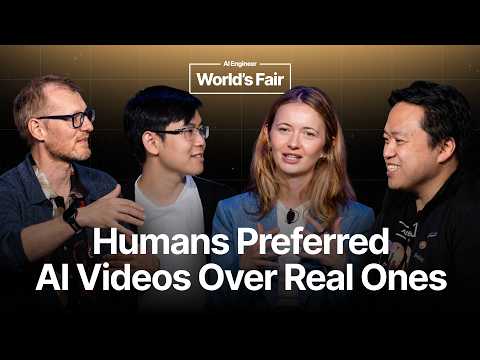
SOTA Generative Media Panel — Dumitru Erhan, Shane Gu &…
Panel discussion with Google DeepMind researchers Dumitru Erhan, Shane Gu, and Nicole Brichtova on the state of generative media. Topics include regenerating real video scenes from captions and the pitfalls of human preference evaluation (the "Instagram filter" effect and reward hacking, e.g., unnoticed wedding ring artifacts), whether language is an adequate intermediate representation for audio, taste, smell and skin tone, joint audio-video generation and the studio-quality tell of AI video, world models, video agents, zero-shot learning in video models, prompt engineering, and how video models are actually evaluated (manual side-by-side comparison, forward deployed engineers as an eval channel, and what training data they seek).
# Channel Presentation Observations — "SOTA Generative Media Panel — Dumitru Erhan, Shane Gu & Nicole Brichtova, Google DeepMind"
## Explicit Self-Description Evidence
- **Host frames the format as interstitial panel sessions**: *"we take tend to basically take these longer sessions between uh all the sort of mainstage keynotes to reflect on things that um you know are particularly important but like don't have like a significant like sort of launch moments."*
- **Host self-identifies as a podcaster**: *"as a podcaster I think a lot about sound"* and *"one of the most enlightening conversations I have on my podcast is with uh just people researchers at the frontier of these things."*
- **Host describes event context**: references "the world fair," an "eval track," "character AI and YouTube talking about how they evaluate videos," a *"data quality track,"* and *"we have an FD track here for the first time"* — indicating the channel covers a multi-track AI conference.
- **Host references past Cognition affiliation**: *"I push for this at Cognition as well"* (not elaborated further).
## Observable Presentation Patterns
### Intended Audience
- **AI/ML engineers, researchers, and founders**: Host asks technically detailed questions (intermediate representations, world models, RL, captioning as bottleneck) and says content aims at *"educating the market and educating researchers and engineers and founders on like this is where we're going."*
- **Frontier-lab outsiders**: Host positions his audience/viewers as aspirants — *"for those of us who are not working at a Frontier Lab, this is the best this closest we'll ever get."*
- **Data suppliers and developers**: Host solicits on behalf of people with data (*"A lot of people I talked to wanted to get in front of you actually… they have a lot of video data… they have labelers. What do you want?"*) and thanks guests for APIs (*"So thank you for the API"*).
### Claimed / Demonstrated Scope
- **Deep technical interviews with frontier-lab researchers** — guests are named Google DeepMind staff working on Veo/Omni, Nano Banana, and Gemini RL.
- **Practical AI-tooling focus** — host repeatedly ties discussion to real workflows: automating video editing on his own channel, translation of an Amazon gadget manual for his parents, working with editors.
- **Product-launch recaps** — the session opens with *"what was launched this week? What should people go try out?"* covering Nano Banana 2 Light and Gemini Omni Flash APIs.
### Demonstrated Presentation Style
- **Informal, banter-forward moderation**: opens with jokes about an office influencer and investment pitches (*"I remember you were trying to get me invested in like one of the companies"*).
- **Host inserts personal anecdotes** to steer discussion (Romanian translation of instructions, manga-artist sensitivity, wine taster vocabulary relayed by a guest).
- **Opinionated moderation**: host offers his own theses (e.g., *"language… still is like a lossy compression"*, prompt engineering persistence) and pushes back on guests.
- **Community-figure references**: multiple shout-outs to "Furer"/pop-on-opacity-style anonymous demo creator, Logan, Jitendra Malik, Fei-Fei Li ("FE had a kind of nice blog post"), Ethan of xAI's Grok video team — suggesting a channel embedded in the AI research community gossip/graph.
## Claim vs. Demonstration Distinction
- **Creator claims**: the "longer reflective sessions" framing and the educator role for researchers/founders are stated by the host directly.
- **Demonstrated**: technical depth, insider access to DeepMind staff, conference-based production, and developer/marketing audience orientation are all shown through the interaction, not asserted as channel-wide descriptions.
- **No explicit channel name, subscriber claims, or posting cadence** appear in the material.
# Delivery Observation — SOTA Generative Media Panel
## Format Overview
- **Multi-speaker panel** with a moderator (interviewer) steering questions to three panelists, who alternate frequently with short, overlapping turns.
- Style is **conversational and informal** — heavy filler words, laughter, interruptions, and self-corrections throughout.
## Tone
- **Casual, collegial, joke-laden.** The moderator opens with banter: "I think you're you're probably number one uh Google Google's number one office influencer." Panelists reply in kind ("Forget about that. [laughter]").
- **Enthusiastic and hype-adjacent** when describing launches: "that that's really exciting," "it's just really fun," "really really good quality for a really awesome price hopefully."
- Occasionally **self-deprecating/uncertain**, especially on sensitive topics: "I I don't know I haven't thought about this."
## Vocabulary & Register
- Dense **technical jargon** mixed with casual phrasing: "spurious coordination," "world model," "test time scaling," "post-training," "reward hacking."
- Product names used as shorthand repeatedly: *Nano Banana*, *Omni*, *Gemini*, *Veo* (as "V3").
- Metaphors to explain technical ideas:
- > "the model is like a bit of an overeager student that just like learned... let me like shove into the same image."
- > "language as like the sort of like the narrow pipe through which everything goes through... is a lossy compression."
## Recurring Verbal Habits
- **Filler-heavy hedging**: constant "like," "kind of," "you know," "sort of."
- > "you can you know kind of like go from this to that"
- **Repeated word/phrase doubling**: "we do do a lot of human evals. We do a lot of human evals," "It's very hard. It's very hard."
- **Hedged qualifiers before claims**: "I think," "I feel like," "maybe," "I don't know" appear constantly.
- > "I I feel like it's insufficiently answered"
- **"Yeah" as a turn-taking/acknowledgment token**, often starting a response.
## Teaching / Explaining Patterns
- **Concrete examples to anchor abstractions**: the Amazon-gadget Romanian translation, the wine taster, the manga artist's eye-gaze sensitivity, interior design and IKEA brand color examples.
- **Analogies to prior model evolution** (Shane, on video models): comparing them to early LLMs — "kind of creative sort of demo right... GBD2 and then those kind of days" — predicting a parallel trajectory.
- **Question-then-reframe structure**: panelists often restate a question in their own terms before answering ("what kind of excite me most is...").
## Moderator Patterns
- **Personal anecdotes as pivots**: "my my parents are visiting and there was there was a very fun sort of use case."
- **Explicit signposting of topic shifts**: "okay, one thing I want to get on there before I go into like sort of the omniverse," "I'll end this part of the conversation but..."
- **Direct provocative prompts**: "is it just as simple as you know reversing image to text," "is just English all you need."
## Stable vs. Isolated
- **Stable (repeated across speakers)**: filler density, "yeah" turn-taking, hedged claims, concrete-example-based explanation.
- **Isolated**: the moderator's "$ref476" aside, the wedding-ring artifact anecdote, and the "Deep Fates" Replicate tangent — single-occurrence moments, not recurring habits.
## Uncertainty Notes
- Speaker attribution is not labeled in the transcript; some patterns (e.g., "really exciting" repetition) are attributable to one likely panelist but attribution is **not fully verifiable** from the text alone.
- Filler/laughter counts suggest strong informality, but exact frequency cannot be quantified precisely from a lightly punctilated transcript.
# Observation Document: SOTA Generative Media Panel — Dumitru Erhan, Shane Gu & Nicole Brichtová, Google DeepMind
## Speakers
- **Moderator / Interviewer** (unnamed in transcript; hosts podcast, references Cognition and an "AI E" event)
- **Dumitru Erhan** — works on video models (Omni team), Google DeepMind
- **Shane Gu** — works on Omni Thinking, Gemini RL, Google DeepMind
- **Nicole Brichtová** — product-side, gen media models (Nano Banana, Omni), Google DeepMind
---
## Launches (This Week)
**Nicole Brichtová:**
- Two launch moments: **Nano Banana 2 Light** ("fastest, cheapest image model in the nano banana family"), which she claims is *better than the original Nano Banana* and "gets really close to the frontier quality" of bigger models; **~3 second latency** "unlocks ideation and iteration" and some outputs can be "ready production output."
- **Gemini Omni Flash APIs** launched, pre-announced at IO; first API availability for developers; priced the same as "V3.1 fast" (as expressed) for "really good quality for a really awesome price hopefully."
## Use Cases
**Nicole Brichtová:**
- Hero capabilities: (1) any-input → video (storyboard images + audio reference → video), enabling short film/shorts production; (2) **video editing via natural language** (add/remove, e.g. sloth example).
- Consumer cases: cleaning up noisy vacation video; marketing/ad campaign creation; education materials — "customized to you and personalized to your knowledge level."
- Noted team excitement about Feurer's demos (sloth, ramen, podcast edits) — "that is my favorite use case."
**Dumitru Erhan:**
- Personal use: photographed English-only gadget instructions, asked model to "translate this into Romanian and keep everything else the same" — result "looks identical and it's perfectly translated. I mean, more or less."
- Suggests Omni's **text rendering** enables translation, internationalization, redubbing use cases.
## Single Model vs. Video Agents
**Moderator:** Cited an Ethan (xAI Grok video team) podcast claim that the trend is "video agents" rather than one-pass single models.
**Shane Gu:**
- Most excited when "symbolic foundational models and video foundational model really work together."
- Historical claim: generative image/video took off when language models got good enough for detailed captioning (Stable Diffusion / DALL·E 2 era).
- **Hypothesis on spurious correlation:** language conditioning provides causal information; language is a "universal" representation.
- Referenced his evaluation paper *video models as zero-shot learners and reasoners* (8 months ago) and a follow-up "vision banana" paper by the Nano Banana team: video models are strong foundation models for space-time information, with good physical intuitions useful for robotics.
- Stance: unified model vs. agent orchestration is "incremental"; "I imagine everything's going to go into like a single model eventually," but "right now there's a lot you can do" combining Gemini understanding agentically with Omni — "our team is exploring a lot."
## Consolidation Into One Model?
**Dumitru Erhan:**
- "In five years from now, will they all be the same model? Probably. But six months from now we'll probably still have multiple different models" — pragmatic engineering/product trade-offs (Nano Banana 2 Light vs. a 4K 30-second-video model "probably not trainable in the same way").
**Nicole Brichtová:**
- Named it **Gemini Omni** to "hint at the future where Gemini just becomes fully multimodal in and out"; expects Omni to eventually generate/edit images.
- Open research question: **how much transfer exists between modalities** — image↔video transfer is plausible; joint audio-visual generation is justified; but transfer between coding and video generation is believed by "most people" not to exist (Erhan may believe there is some — tension left unresolved).
## Intermediate Representation / Is English All You Need?
**Moderator:** Captioning feels "very inefficient"; wonders whether code (ffmpeg, manim) is a better intermediate representation for video.
**Shane Gu:**
- Team "definitely exploring the coding representations."
- On whether chain-of-thought must be natural language: adaptive compute helps, but the key reason natural-language reasoning works is it "directly use[s] the intelligence of the pre-training"; removing that constraint loses that benefit. (References his own early work: "large model zero-shot reasoner and self-improvement," four years ago.)
- Acknowledges "RL maximalists" who see reasoning channels as "just additional compute" — moderator jokes about David Silver; disagreement left as stated.
**Nicole Brichtová:**
- Simpler view: "text is how we communicate" — natural default for human-facing products.
**Dumitru Erhan (pushback to moderator):**
- Language alone is **not** sufficient — that's why video is complementary. Omni is "a missing foundational model that's absolutely required if you want to make the AGI that matches humans, not just a jacked one."
## World Models
**Shane Gu:**
- Points to definitions by Jitendra Malik (UC Berkeley) and Schmidhuber (~1990); for him, "the world model is basically just the model in model-based RL," which "has sufficed to describe."
## Vision → Generation Career Trends
**Dumitru Erhan:**
- Started in vision (detection/recognition); generation is "just harder" — inverse mapping is more ambiguous ("from cat to image of a cat").
- Nicole: understanding and generation **bootstrap each other** — better understanding improves generation, and vice versa.
**Shane Gu (career narrative):**
- Generative models → RL/robotics → dexterity moonshot six years ago → four years ago concluded "symbolic AGI is going to accelerate much faster than physical AGI" → moved to language models → now collaborating with Dumitru/Omni team.
- Analogy: video models today resemble early LLMs (creative demos → instruction tuning → reasoning/RL). Predicts video models will improve instruction-following and reduce hallucinations enough to become "a very reliable world model" intermixing video space-time simulation with text simulation.
**Dumitru Erhan:**
- Understanding and generation are **not yet unified** in frontier video models — "two sides of the same coin... they should be in the same model in some ways. But we don't necessarily always do that."
## Audio
**Dumitru Erhan:**
- Technical differences between audio and video are "relatively minor."
- V3 (he believes) was the first model doing **truly joint audiovisual generation**; rationale: one latent causal generative process — "the lips have to move in sync with the audio." Prior approaches ("generate pixels then hack lips on top") were "very bad." After V3, people expected audio by default.
- On limits: doesn't know if they've hit evolutionary/human-perceptual limits — current audio weaknesses seem "solvable problems" with more/better data.
**Shane Gu (verbalization hypothesis):**
- Audio is "less verbalized" — hard to describe music, tone, pitch. Similar for taste, smell, touch, and skin color: he speculates these are tied to "primitive survival" functions, so our sensory sensitivity outstrips vocabulary. Anecdote: a wine taster borrows dating language to describe taste.
**Nicole Brichtová:**
- Same limiting factor applies to visual style/aesthetics — a reason for investing in world models.
**Moderator (audio expertise):**
- Audio domains: music, voice, SFX; "room sound" (echo/size/distance) is a world-model tell — "I'm further away from you so I should sound a little bit softer"; AI video's "studio quality" is an AI tell.
**Shane Gu (technical):**
- Poor captions → generation conditioned on language is highly multimodal/stochastic; draws on old VAE research: "capture most of the stochasticity in the latent representation," make X given Z deterministic.
## Realism, Preferences, Reward Hacking
**Nicole Brichtová:** AI content still detectable via facial expressions and skin texture; "we're so much better than we were a year ago"; images arguably already indistinguishable.
**Dumitru Erhan (key claim):**
- Internal experiment: describe real videos, regenerate with Omni, human eval — **humans largely prefer the AI-generated versions** ("margin"). But: "I'm not saying this is a good result" — outputs are sharper, more HDR, better skin tone, "it's not more realistic... on deeper inspection they would not actually be more useful."
- **Conclusion:** "human preferences are like a not particularly reliable barometer of what you should be optimizing for."
**Shane Gu:**
- Sensitivity is cultural/individual: a manga artist he spoke to is "disgusted" by generative AI due to slightly-off **eye gaze**; Japan is extremely sensitive on craft (architecture, food).
- Wedding-ring artifact = "very common reward hacking."
**Shane Gu (prompt engineering):**
- Four years ago debated whether prompt engineering would disappear; he argued it shouldn't — prompting is "the only way you can control the output." Advice: "never be satisfied with the AI's generated content, always fine-tune your sensitivity."
## Default Aesthetics
**Nicole Brichtová:**
- Nano Banana Pro triggered an "explosion of infographics"; default aesthetic was "too cluttered" — model is "a bit of an overeager student."
- (Moderator/Shane side note: Japanese-language prompts produce ~5x denser infographics due to style conventions.)
- Omni team explicitly tuned style choices (saturation, palette) with Nicole heavily involved ("PTSD" joke).
- Tension acknowledged: "it ends up being the modeling teams... are we the best people to do that or should we work with... an art director? We kind of go back and forth on this."
- Mitigations: **trusted testers** (weekly calls — "very well organized," credited to Logan's team), internal feedback (e.g., Feurer caught the wedding-ring artifact and "ruined my grass" regressions).
## Evaluation
**Dumitru Erhan:**
- "It's very hard." Partly auto-ratable (text rendering via OCR — "if a letter is off... you just can't use that asset"), but heavy reliance on **human evals at scale (thousands)**; close calls decided by side-by-side rooms ("10 of us... do you prefer this or do you prefer that").
- Video editing is near-"AGI complete" for evaluation; "we don't have an add-a-sloth eval" (moderator: "now we should").
- **Live experiments** provide large-scale signal; early access programs catch workflow breakage that sliced human evals miss.
**Shane Gu:**
- Human eval work "should be gradually amortized"; AI-generated video detection (semantic inconsistencies, not just aesthetics) is "an extremely important intelligence task." Self-assessment: "when I evaluate the AI videos I feel I'm so smart — AI is still behind."
## Data Requests
**Dumitru Erhan:**
- Guarded: "hard to talk about this without... revealing about our project." Wants **high-quality data** — "not random YouTube video... more professional" content; mentions embodied/robotics data interests via GDM robotics collaborations.
**Nicole Brichtová:**
- Most valuable: **real-world task trajectories** (e.g., full marketing campaign workflows: product image → video ad → platform-fitted assets). "That information lives in the places where people are doing these tasks... if anyone's figured that out, reach out to us."
- Wants both commodity work ("a lot of work is commodity and should be modelable" — moderator) and high quality.
**Shane Gu (dark knowledge):**
- "99% of information is inside people; you can only extract it through active dialogue and befriending them" — the internet holds only outputs, not trajectories/inspiration.
**Nicole Brichtová:** LLM-written novels "fall into default patterns... I can't connect to it" — human expertise still distinct.
**Shane Gu:** Google Cloud / DeepMind investing more in FTEs (forward-deployed engineers) for product engineers and creative gen-media recruiting; defines **post-training as "anything between pre-training and the final user experience"**; wants FTEs to derive insights feeding "very upstream" modeling improvements, not just sales/solutions.
**Dumitru Erhan:** Values direct conversations with users — examples: interior designers needing pattern replication across custom rug sizes; earring try-on sizing; **brand language** precision ("IKEA cares about the shade of blue").
## Moderator's Closing Stance
- Disappointed "when Sora shut down"; wants "more general exploration of generative models and not just coding" — panelists: "we love coding" (tension expressed humorously, unresolved).
# Speaker & Provenance Record — SOTA Generative Media Panel
## Video Metadata
- **Title:** SOTA Generative Media Panel — Dumitru Erhan, Shane Gu & Nicole Brichtova, Google DeepMind
- **Video ID:** `01a15ca7-96f1-7e01-9094-59dcef3eb6c3`
- **Format:** Panel discussion at an event ("world fair" / AIE context) with a live and streaming audience
- **No curated metadata supplied** beyond title/transcript; speaker attribution below is inferred from title plus transcript introductions
## Identified Speakers & Roles
### Moderator / Host (unnamed in transcript)
- Identified as a **podcaster** and event host; references "my podcast," "my editor," and prior work "at Cognition"
- Welcomes audience, introduces guests, asks most questions
- Self-describes as an investor adjacent figure ("I try not to be an investor")
### Dumitru Erhan ("Doomi"/"Demetrio") — Google DeepMind
- Introduced as working on **video models**, incl. **Omni** and Nano Banana
- Claims Google product launches: **Nano Banana 2 Light** and **Gemini Omni Flash APIs** ("we launched some APIs")
- Discusses V3 joint audiovisual generation history, evaluation methods, model consolidation strategy
### Shane Gu — Google DeepMind
- Works on **Omni Thinking, Gemini RL, coding representations, agents**
- Career background stated: generative models, RL/robotics, dexterity "moonshot" (~6 years ago), LLMs (~4 years ago)
- References own prior papers ("larger model zero shot reasoner," self-improvement, ~4 years ago) and an evaluation paper "video models zero shot learners and reasoners" (~8 months ago)
### Nicole Brichtova — Google DeepMind
- Product-side role; discusses use cases, trusted testers, watermarking, launch communications
- Panelists credit her with involvement in aesthetic tuning for Omni
## Referenced Third Parties (claims by speakers, not verified)
| Person/Entity | Mentioned by | Claim |
|---|---|---|
| **Logan** | Moderator & Nicole | Did the Omni launch podcast; runs trusted-tester program; "couldn't be here today" |
| **Furer / "Popers" (pseudonymous)** | Multiple | Google employee who created the sloth/ramen Omni demos; "number one guy to follow"; ex-Replicate; anonymous; badge name differs from pseudonym |
| **Ethan, xAI Grok video team** | Moderator | Claimed next trend is "video agents" not single models (from moderator's podcast) |
| **Jandra Matic** ("Jitendra Malik" referenced as UC Berkeley CV professor, per Shane) | Shane | Has a definition of "world models" worth consulting |
| **Schmidhuber** | Shane | Defined world models ~1990 |
| **David Silver** | Moderator/Shane | Jokingly named in discussion of "RL maximalists" who "just left to start their thing" |
| **Ethan-like manga artist (Japan)** | Shane | Disgusted by generative AI; cited eye-gaze artifacts |
| **Wine taster (professional)** | Shane | Uses dating-descriptive language for taste due to lacking vocabulary |
| **Character AI, YouTube** | Moderator | Speaking in the event's "eval track" |
| **Google Cloud / Google DeepMind** | Shane | Investing more in FTEs for product engineers and creatives |
| **Sora (OpenAI)** | Moderator | Moderator's claim that "Sora shut down" — flagged as a moderator assertion, not corroborated |
| **Replicate, Deep Fates, IKEA (example), Y31 (pricing comparison), arXiv/Nano Banana papers, Stable Diffusion, DALL·E 2, GPT-2, 3Blue1Brown/Manim, ffmpeg, matplotlib, Midjourney-style "sref" references** | Various | Referenced as context/comparisons |
## Product/Launch Claims (by panelists, promotional in nature)
> "Yesterday we had two launch moments... we launched NanoBanana 2 Light... and... the Gemini Omni Flash APIs."
- **Nano Banana 2 Light** — described as "fastest, cheapest image model" in the family; ~3-second latency; "better than the original"
- **Gemini Omni Flash APIs** — first-time developer availability; priced "same as Y31 fast"
- **YouTube Shorts support** for generative creation claimed
⚠️ **Promotional segment flag:** The opening recap of the week's launches (~first quarter of transcript), including quality/pricing claims, functions as **first-party product promotion by the panelists** and should be treated as vendor claims, not independent evaluation.
## Provenance & Availability Notes
- **Comments:** No information on comment availability supplied
- **Sources:** No external citations shown; references are conversational attributions only
- **Uncertainty:** Moderator's identity is not stated in the transcript; attribution of specific dialogue turns among the three panelists is partially ambiguous where speaker labels are absent
- Speaker claims about internal Google processes (evals, trusted testers, aesthetics tuning) are **first-party, unverifiable statements**
and welcome back for those on the stream and those those in person. um we take tend to basically take these longer sessions between uh all the sort of mainstage keynotes to reflect on things
that um you know are particularly important but like don't have like a significant like sort of launch moments. Today we're very lucky to have people working on Omni and VO Nano Banana like the you know the world's best generative models here with us. Uh, Demetrio, I I I first saw you when you were posting about your office. \[laughter\] Um, I think you're you're probably number one uh Google Google's number one office influencer at least in in San Francisco. I think you like you like to bike as well. You like to take photos of \>\> bike here. \>\> Yeah. Um, but you know, but also you work on video models. \>\> That's right. \>\> Um, Shane, I I met you I think at like a dinner. \>\> Yeah. Um and uh and uh and I I remember you were trying to get me invested in like one of the companies. I forget forget which one. \>\> Forget about that. \[laughter\] \>\> But now but now you're um now you're working on Omni Thinking. Um and and just you know a bunch of other \>\> Gemini RL. \>\> Yeah. Yeah. Uh and Nicole also uh the rest of the gen media models uh nano banana and uh all and everything you just launched actually even this week. Uh, \>\> yeah. We launched some APIs. \>\> Yeah. Yeah. Yeah. \>\> And I haven't tried to convince you to invest in anything, but maybe I should. \>\> I mean, so I try not to be an investor. People just convince me anyway. I'm like just, okay, well, I'm not that rich, but know like you can't not try to invest in some of these things. And, you know, for those of us who are not working at a Frontier Lab, this is the best this closest we'll ever get. Um, so yeah, actually, let's kind of recap since you're closest to it and we just did it, like what was launched this week? What should people go try out? \>\> Yeah. Um so yesterday we had two launch
moments. Uh one of them we launched NanoBanana 2 light uh which is our fastest, cheapest um image model in the nano banana model family. Um and it's
better than the original NanoBanana. Um so really for most people um that model replaces what you you know used and love the original Nano Banana for across like generation and editing and it gets really close to the frontier quality of of the kind of mainland bigger models. So that that's really exciting. I think if you look at some of the demos or like things that people have been trying like getting kind of that like 3 second latency just unlocks a whole bunch of things that you can do with like ideation and iteration and it's just really fun and the model's getting to a point where like the quality is really good um where um it you know you can use it for iteration but you can also use some of those outputs as just kind of like ready um production output. So that's really exciting. Um and then second launch we finally um launched the Gemini Omni Flash APIs um that we pre-announced at IO. So thank you for waiting. Um and that you know is the first time that we're making the APIs available for developers and it's basically really exciting kind of video generation and editing and we're pricing it the same as Y31 fast. So we're getting you kind of like really really good quality for a really awesome price hopefully. Um \>\> yeah, I mean that that's incredible. I'm actually really So when you guys launched Omni for the first time, you also did a podcast uh with Logan who couldn't be here today uh and you added like a sloth uh and and Ramen and all these all these things. I actually really want to do that to our videos. I just didn't have an API for it because obviously I have to automate the whole thing. So thank you for the API. \>\> Uh that is my favorite use case. Everybody should do that. Um I got a cat which is probably like the most boring of the animals. Um if you don't know what we're talking about, you should look it up. It's very funny. Feurer. um Furer who's um you know on on the team did that. \>\> Furer is the number one guy you should follow for you should follow ideas on okay what can this thing do? \>\> Yes. \>\> Right. \>\> Yes. He he's he's amazing at that. \>\> I've tried to get him for the last two years to come to AIE. He hasn't made it yet. He's actually come in person. He just didn't want to speak because he's anonymous. \>\> I know. \>\> I I want to say his real name but I can't say his real name. \>\> No \[laughter\] no we won't we won't do that to him. But you should really follow him. He's amazing. \>\> He did all that work. I actually met him uh in the office uh when we did the podcast I think and I didn't realize it was him. So his badge doesn't say Popers. \>\> Yeah, \>\> I know. \>\> So he used to be part of uh Replicate and Replicate had this joke where like everyone was Deep Fates. Deep Fates is this like kind of mysterious character and replicate. Replicate is very cool company and both was part of it. Um, so,
okay, one thing I want to get on there before I go into like sort of the the the the sort of omniper is we added cats, we added sloths, very cool, very
cute, very fun. \>\> Uh, what are the, you know, inspire people as to like what are the more sort of workhorse use cases that maybe are not just demos, you know? \>\> Yeah. So, so obviously the hero capability of the model or maybe there's two like one is the ability to kind of take in anything as input and then get video on the other side. Obviously in the future and and we've kind of talked about this as a pre-announce like we want to get the other output modalities out as well but basically what that means is you know you can take a set of images that you have as maybe a storyboard. You can take like an audio track as a reference of you know like a voice that you want a character to speak and then you can get a video on the other side. So like that just unlocks a whole bunch of things that you can do in like you know short film production or you know shorts we've launched on YouTube as well um to help creators kind of like create um content more easily. Um and then the other one is obviously video editing. Like that's another thing that we're really excited about that we're just making easier because now you can use natural language to take a video, you know, add something, remove something. Sloth is obviously like fun example. Um, but there there's obviously kind of there's consumer use cases that we kind of had in mind where, you know, you could take your beach vacation video that was too noisy and you want to clean up that noise. Maybe in the past you wouldn't have because you didn't have the tools or you didn't know what the tools were that you needed to go to. So, that's one use case that you can, you know, go to. We've seen a lot of folks use it for kind of marketing ad campaign creation and I'm excited to see more of those use cases as we launch the APIs. um because obviously like we don't we don't see all of it in the first party products but I'm really excited for people to start to explore that um in the API. So those are just some of the kind of like high level um things that have come up. U people also use it to create like education materials. Yes. Um and like like that's really exciting. I think we're all we've all kind of talked about being excited about the future of education where like everything can be kind of customized to you and personalized to your knowledge level and the style that you prefer and and so this is kind of just like a step in that direction. \>\> Yeah. I I I sort of actually used just none of yesterday, but my my parents are visiting and there was there was a very fun sort of use case. They I bought some gadget off from Amazon that they wanted and the instructions to use it was were only in English and there was plenty of diagrams or whatever and I took a picture of it and said, you know, translate this into Romanian. Yes. \>\> And keep everything else the same, right? So it was amazing, right? Like it was just like, yeah, it looks identical and it has, you know, it's perfectly translated. I mean, more or less, right? But it's it's you know using Gemini under the hood obviously to kind of do the translation and so you can you can see this use case for video as well right like the the power of text rendering in in in Omni is is quite next level. So and you could you could you could think about plenty of use cases of like both text rendering translation internalization all sorts of things that would be actually genuinely useful to a lot of different people and sort of broader access to either you could like redub a video or whatever it is that you wanted to do. like there's plenty of different things that you could you could think about doing. \>\> Yeah. Um one of the most enlightening conversations I have on my podcast is
with uh just people researchers at the frontier of these things. Um I had one with um Ethan from the XAI video team, the Grock video team who was basically saying like you know the next trend is
actually not just like single model, it's more like video agents. Um, and I don't know if that terminology resonates uh obviously for for very relevant for RL. Uh, but it was it was basically kind of like giving up on like trying to do everything in in effectively one pass. Um, do you feel that same way or is it still an open research question which way the trends are going? \[snorts\] \>\> Yeah. So um what kind of excite me most is really when the symbolic kind of foundational models and this kind of like video foundational model can actually kind of really work together and u in a way the if you look at the beginning of the generative sort of like image generation video generation a lot of it kind of started when the language model got good enough to provide a very detailed captioning like from stable fusion days or kind of dowi 2 days. So um so basically like language is extremely u helpful representation uh one is that it's kind of universal but the other kind of more um technical thing like kind of my hypothesis is like um one very difficult thing about machine learning is um this sort of like spirious coordination. So you don't know you know if the if this kind of feature right that's kind of predictive is actually causal factor or not. There are two ways. One is we can have really diverse data training data like from every intervention of the causal graph. The other is you condition the causal information and conditioning the language is kind of like conditioning like a coal information of the of the kind of world. So um \>\> which is a prompt or a concept what \>\> yeah exactly so if you look at like you know how we going to describe this video how this kind of image is actually very close to you know how would describe this kind of causality you know behind this like how this is kind of generated. So one is like that can really allow for very rich generalization and then uh very kind of just like a good model. Um the other is so eight months ago uh we put the evaluation paper called video models zero shot learners and reasoners. \>\> Yes. So that was a kind of you know it's it's a confirmed paper and then later on actually the N banana team followed up with a vision banana paper that basically used n banana to do but essentially the idea is uh video model is extremely good sort of a foundation model for space and time kind of information. So um classic computer vision tasks a lot of could be kind of zero shorted and when you like say feed in some like a visual quiz uh it can you know there's definitely like a lot to improve it can kind of solve and it can
um like robotics kind of like seeing it has really good kind of physical intuitions like word model uh and I think the the key is really the kind of mix of the visual kind of reasoning and
then the text kind of reasoning kind of all tied together Um obviously you know like whether doing it you know as kind of unified model versus like just kind of agent coation I think that's more like uh it's going to be more kind of incremental you know how it's going to I imagine everything's going to go into like a single model eventually \>\> but right now there's like a lot you can do if you uh basically take like really good video understanding image understanding Gemini agentically with anomy and that's actually gonna yeah our team is like exploring a lot \>\> yeah okay that there's a there's a lot in there um I I think uh one question I I am increasingly starting to wonder is does it all trend towards one product for you guys right like now you have multiple models out the naming of omni does imply that eventually everything will go away and it just goes into omnis um is that the plan \>\> is it \[laughter\] I don't know I I think I think uh maybe I mean I think eventually I I think there's sort of different trade-offs engineering research product trade-offs in like it's like for the same reason like the the sorry how is it called nano banana light I don't know what the product name \>\> nanob banana tite \>\> nano banana too light yeah right it's it's it's it serves a particular niche right and it probably doesn't necessarily fit immediately in the same model literally checkpoint as uh something that can do 4K you know uh 30 secondond videos right like they're probably not like trainable in the same quite way, right? Like, so I I don't know. It depends on how how far into the future you look like. Sure, in five years from now, will they all be the same model? Probably. Uh but like, you know, six months from now, we'll we'll probably still have, you know, multiple different models doing different things because kind of from pragmatically the trade-offs are such that we we should have multiple different kinds of models. \>\> Yeah, I \>\> I think that's right. And and just on that note, I mean, we did call it Gemini Omni because we wanted to hint at the future where Gemini just becomes fully multimodal in and out, right? And so so it's definitely a move in that direction. I think we'll probably see a move in the direction where Omni also generates images and edits images and all those kinds of things. But Doo is right that I think on the way there, there's a bunch of really really useful applications of some of these more specialized models. And so we we will probably continue to work on those as
well because like that serves a certain need at this point in time that may not exist you know a year from now. There's also like a research question about like just how much transfer there is between different kinds of modalities, right? I
think you may believe that there's some transfer between coding and video generation and I think most people don't necessarily believe that but they you know you could try to think that there is some some there something there or it could be a waste right to put them together to try to learn these both tasks at the same time right so I think it's it's it's interesting sort of question to which extent like image and video obviously kind of there's some transfer like kind of not that different there's value in in learning to output video and audio at the same time because joint audio visual is you know that's how that's how it is. Um and then there's you know other kind of intersections of modalities that are not super obvious right like 3D representation coding I don't know maybe uh things like that right so like I think it's worth sort of exploring the different corners there and we are actively doing that um with a focus towards like what people actually want to do with these models \>\> yeah um what one thing I feel I feel like uh I'm surprised by but also I feel like it's insufficiently answered is what is the correct intermediate representation Um, so captioning, right? XI does captioning. Omni does
captioning. Um, and I I I understand how captioning works for images. Um, and I understand that you can extend it into to video and and sort of guide it across
time. It just feels very inefficient. It there's got to be I feel like there should be something better. Uh maybe it's code and maybe we generate you know and obviously I think a lot of um ffmpeg and mapplot um what's the three blue one brown one manm um a lot of like video is generated through code and maybe that's like the optimal representation uh any hypothesis as to like is is it better or is just English all you need \>\> well as so I'm in the Gemini and they know we do like a lot of RL agent and of course kind of coding so yeah We we're definitely exploring the coding representations. \>\> Yeah. \>\> As kind of better kind of way to represent. Yeah. \>\> But you know like do you what's your probability estimate on like \[laughter\] if we just output binaries like we just you know like just it's just ones and zeros. \>\> Um I I guess maybe a kind of similar discussion was like um basically is the language the right representation like right. So uh one kind of question for example uh professor you know like some ask is like you know why why does the channel of thought need to be in the natural language? \>\> Yes. \>\> Can it just be the kind of any kind of like continuous tokens just any amount of you know additional computations. \>\> Um so one is like obviously the test like adaptive compute is going to give like you know better results. So it's that but what really kind of made CH thought so you know like four years ago I wrote you know the larger model zero sort reasoner and then self-improvement. So I kind of know from the very early day but the reason like it works really well is um right now the recipe that works is the pre-training that scales a lot and then that basically like learns a lot of intelligence. there are a lot of you know scaling RL but those are still like extremely kind of comput incent intensive to extract the information and um you really want to rely the intelligence on that so basically by tying the sort of like a reasoning in the natural language you basically directly use the intelligence of the pre-training to it while if you remove that kind of constraints then you're not um and these days uh I feel the a lot of advancements in the texts but also doing this kind of multimodal space is very driven by this uh kind of text as a kind of great uh sort of representation. \>\> Yeah, it's a good backbone. \>\> Yeah, \>\> I I think to me it's even simpler than that. It's text is is how we communicate. So I think fundamentally if you're building kind of products that humans will be interfacing with um like like that we will be using text somehow if it's a text interface, right? Not not for everything. So I think it's it's natural to default to that. \>\> Yeah. Obviously there's like a conf discussion you know some arrow like arrow maximalists is like oh we don't care about you know kind of channel those kind of like stuff it's just just additional compute \>\> sure but I personally yeah \>\> ro maximalists I wonder I wonder who who qualifies in that description David silver \>\> ah okay yeah I mean they they've just left to to start their thing um interesting okay so uh I I mean I think I'm very interested in just like better representations because I think that's one of our themes that we're curating today uh at the world fair is world models. You mentioned the word world models but it's not something that's like super well defined. I think everyone's like sort of converging on some version of it that is like the ideal. \>\> Sure. Everything is a world model now. It's sort of a \>\> it's not it's not that useful, right? \>\> So I just gave a keynote at the IER world model workshop. Yeah. And then uh yeah essentially uh I definitely encourage to check out the definition by Jandra Matic. He's like the you know OG computer vision professor UC Berkeley. \>\> Uh he has pretty you know bit of word to
say about world model \>\> but also kind of Schmidt Herburver's kind of how he defined the world model from 2019 like 1990 sort of uh uh you know like Wayne was just basically just
that kind of model base. Uh for me the word model is basically just the model in the model based RL and I feel that has sufficient to describe but obviously you know there are like a lot of uh FE had a kind of nice blog post about what about yeah this kind of broken down \>\> um but yeah \>\> yeah I mean so you know I I'll end this part of the conversation but like I I do think that language to me relying on language as like the sort of like the narrow pipe through which everything goes through um still is like a lossy compression. No, no, no. But we're not seeing that, right? We're basically saying the video model and the language together. \>\> So, so I think the language alone is uh not sufficient. That's why we feel like the video is a very complement model. Right? Now the um you know kind of v omni many people feel as uh you know generating kind of pretty videos but I think our vision it's it's much more than that. It's a missing foundational model that's absolutely required if you want to make the AGI that match to humans not just a jacked one. \>\> Yeah. Um okay. So one one other thing you know you you mentioned on the vision side um and I'm kind of curious how sort of uh parallel you know in terms of your research careers um this development is like I think basically a lot of vision people have crossed over into more model people um a lot of vision people also
become generative video and image people and is it just as simple as you know reversing uh image to text and then now it's text to image like
\>\> \[laughter\] \>\> is is that if I mean that effectively was the diffusion process. Um I I just you know I I just see the career paths of the people that I talked to and and see and I I I see this overall trend of research directions and I just wanted you to guys to sort of reflect on on that. \>\> I mean I certainly went that way right I I started long time ago uh doing computer vision sort of object detection recognition things like that. Uh I think just that's just simpler problem right just generation is just harder like it's a it's a different kind of mapping right you map from the the inverse mapping is not as simple as just inverting the the kind of network you use right it's it's a it's it's more ambiguous right to go from cat to image of a cat and in some ways it's also a loop because your vision work creates the synthetic labels that then continues \>\> I mean sure \[laughter\] I don't know I don't know I try to validate my my sort of theories about how fields develop how how careers has progressed through this \>\> I mean for like the the the better the understanding side gets like we have seen that the generation side also gets better right so like like \>\> it's completely bootstrapping yeah it's \>\> and so like like like there's definitely they're there to that thesis and I think yeah I think a lot of people have kind of like I I definitely worked with a lot of um image understanding people who became image generation people you know and then some of them have moved on to video because it's kind of like the next thing where you have so many more dimensions to work with so yeah I'm curious about you spec as your
\>\> so I definitely like recommend start with understanding recognition because that's basically discriminator and then that's going to lead to better generation and that's what the bridge is basically reinforcement learning so my
um my kind of journey is I initially kind of worked on the algorithmic research in the gent model against some like you know amnest kind of generation and then I worked on like RL and robotics um and then like six years ago I was like leading like a moonshot on the dexterity it was pretty early but I see now everyone's kind of doing uh four years ago I basically kind of figured out that this like symbolic AGI is going to accelerate much faster than the kind of physical AGI kind of counterpart. So uh I decided to kind of like language models and then those things. Um and then recently kind of work with Doomi and then like omni team I quite enjoy kind of collaboration there. the what I quite enjoy uh what I recommend definitely to the researcher is to uh definitely kind of explore or at least like get exposure to what the top people in each of the community are like looking at how they kind of think about problems. So when I look at the video model to me it kind of reminds me like pretty early on sort of like language model where like very early language model was a kind of creative sort of demo right you kind of like try to write like a story like mobile and then like you know GBD2 and then those kind of days like LTM kind of days right and then you know uh instruction tuning you actually kind of make it usable as a chatbot but then at the chatbot stage it still had so much hallucinations and instruction for wasn't good enough so it couldn't use for reasoning and when I got good enough um in pre-training and post- trainining for reasoning then you know this kind of test time scaling the RL really took off to like many of the kind of best performing models and right now I think the video model is as we mentioned it's it is a complimentary foundational model and I can imagine it's going to follow a similar path it's going to be very uh it's going to improve a lot instruction following a lot of uh this it's going to improve a lot in reducing coordinations to extend that it become a very reliable world
model so we can kind of like intermixed video like space-time simulation was a text simulation to solve like arbitrary AGI problems. Also like I think the difference still is between sort of text
models and like image video models is that like we haven't quite unified understanding and generation in in multimedia I'd say yet like I mean I think I think without going to the details of course there's like it depends on on at which level you're thinking about this but generally like there's not that many as far as I know models sot kind of you know frontier models that are genuinely kind of good at both understanding and generation of of let's videos, right? Like it's a it's a it's an interesting challenge. I'm not saying that we should do this. Uh but but I think uh it kind of stands to reason that like you know understanding and generation are two sides of the same coin. So they they kind of should be in the same model in some ways. Uh but we don't necessarily always do that. So yeah. \>\> Uh you mentioned audio as well, right? Yeah. Uh is that as hard as video or qualitatively different? If if so, in what way? Uh, one of the interesting directions three years ago was people using um, I guess diffusion to do audio uh, as in like the the sort of refusion approach. I don't know if you you guys saw that. Um, and I just think it's like very interesting if a modality that we perceive which is audio is different than video actually two machines is
exactly the same like there's they see no difference. I mean I think on a technical level there are some differences but I think they're like relatively minor. I think from my perspective audio came into into
my life when we shipped V3 which was I believe the first model that did like a joint \>\> with the slicing of the \>\> Yeah. Yeah. the gold bars or whatever. Um it it was the first model that did this sort of joint audiovisisual generation. Yes. uh like in the in the I mean there are there were other models that did kind of you know kind of kind of agentic hacking under the hood but this one was truly sort of you know generating everything at once and we the reason we did that is because we felt and I think was the right choice we felt that like uh it only makes sense to generate them at the same time because there sort of kind of like from a machine learning perspective there's one latent kind of you know causal kind of you know generative process right like there's something that generates you speaking it's not the pixels and then the the audio or somehow somehow generated by some other process like the lips have to move in sync with with the with the audio, right? So, I think that that solved a lot of the issues that previous models had or the way that people did video generation before where it was like, okay, we generate the pixels and then we're going to hack something on top of it that like moves the lips with the audio that we generate. And that's was very bad. And so, I think I think that was that's to me that's the the I mean after V3 like you know people were like what do you mean like there's no audio in your model? like that makes no sense like once it's there like you you have to have it. So I think that was that was the right choice and doing it to one single generative model I think was was the right choice. \>\> One thing I kind of want to also can ask you guys an opinion as well once one
difference I find the audio and then against the image and video is like the audio information is less verbalized. I mean of course the TTS and stuff is trivial right but the when you get her
outside like how to describe music how do you describe this like this person's tone kind of pitch I feel the sort of the verbalization is insufficient and the interesting thing is that you kind of see that in two other things like taste taste sense and also uh say um touch \>\> like smell and then the another interesting thing is the skin color so skin color the the language is pretty limited to describe the skin color and the reason is that we're extremely uh sensitive to the small difference perturvations or not skin color because that basically shows us is this person going to kill me or is can I befriend this person kind of those kind of information and then I feel the smell tastes um skin color and like sound kind of stuff is very very tied into primitive a like survival kind of stuff and so our sort of sensory system is so sensitive that it's intractable to Um, so for example, I asked like one the wine sort of taster and then like professional and then he basically said he kind of use like a language from like a dating, you know, describing like a, you know, partner as a way to describe the taste because there's no sufficient vocab to describe. Um, so I'm kind of curious. Yeah. Do you guys feel that? \>\> I think well to some extent I think the same is true for visual information, right? when you think about like a certain style or a certain aesthetic, right? Like like there are some people who just have a much more kind of developed like whether it's palette or kind of visual taste and aesthetic, right? Like I I think language just tends to be a bit of a limiting factor when you are trying to describe any of these things that like we experience with sensory information. And to your point earlier, I think that is the kind of the reason why we are investing in world models and why we are pushing on kind of the like perception and like generation side of things because it it is such a large part of how we as humans navigate the world. It's a large part of how like embodied AI navigates the
world. Um, and and I do I do think language like does have a lot of it's it's gotten us very far and it can probably get us really far, but it it feels limiting in a lot of these kind of
areas. And yeah, I don't I don't really know how to describe, you know, like sense and taste. Um, but yeah, I'm curious to me. \>\> Um, I I yeah, I don't know that I have thought that deeply about this yet. So, uh, yeah, I mean yeah, I don't have a good answer about audio. I mean like I don't know the limit because I'm thinking about like well what is what is Omni bad at in terms of audio but they're all like solvable problems I find uh so like with more data or better data or whatever it is so I don't know like that we have pushed the frontier so much that like we are have hit some sort of limits that are rooted in evolutionary uh kind of you know limits imposed by humans. I don't know. He's feeling the limits of captioning which is the the thing I was \>\> Yeah, exactly. \[laughter\] There there's a lot of information in the world and it connects to basically why we do work modeling you mentioned. You just need srefs sref476 and then that's your that's what your journey does, right? I guess maybe I can't describe this vibe but \>\> well well I think that that's kind of the point of providing some of these references, right? Because because like even just describing how someone talks and like their tone and and like procity and all of these things like I think I think some of these terms even like I didn't used to know what they mean, right? Well, now \>\> yes. Dispuencuencies ex like like there there's kind of an entire vocabulary that even if you're not kind of steeped in a domain, which is true for actually like most human domains that like you don't even know what it means. Um and sometimes it's also a question of like if we haven't focused on those things, you know, with the large language models that they may also have gaps in those areas, right? And then we feel them on the other side with generation because we're like fundamentally relying on on the language models understanding of the
world to then be able to like represent it. Um, so I yeah, it all kind of goes back to your question about like the the language as an intermediary. Um, but yeah, I think to De's point like some of these might just be like focus areas and
things that we haven't necessarily pushed on as much as we can and like as we will we will discover what the actual ceiling is. \>\> Yeah, as a podcaster I think a lot about sound. \>\> Um, and and I I'll just offer a couple things for discussion in case in case it triggers anything with you guys. Um I have three domains of rough audio which is like a music voice SFX you know is that rough okay covers everything and then also even within voice let's just let's just focus on voice forget the other two um room sound like the the echoiness of like big room small room in person in a car over a phone all these like are labelable but we experience them very differently and I I often think like one of the tells of a AI video is that it is studio quality because it was recorded in a studio video because that's your training data and like and and to me that's one thing actually like the most interesting thing is just uh when I tell this is how I convince people who are kind of skeptical about the need for world models because you need it even for audio about well I'm further away from you so I should sound a little bit softer or more diffused and like the the video models need to pick that up because if they're going to do immersive video and audio you need that \>\> I I I love that example of basically like studio quality or not in a way like
we don't have enough language to really describe like like this kind of echoing or like some kind of noise kind of happening we just like don't have precise enough and uh if you um you know
basically the reason that I think it's quite important to have like relatively information rich like kind of captioning is that we kind of rely on the natural language as a representation but if you basically don't have enough uh representation that basically means the condition on the language the generation is very multimodal and if you anything can learn from the BAE kind of like you know very old you know GMBA kind of research the idea is we really want to capture most of the stoasticity in the later representation and then the the X given the Z should be kind of like deterministic so yeah \>\> yeah yeah um well I hope I hope there's more uh progress there and I'm sure you guys are doing \>\> I even actually like facial expressions right and maybe this gets to your point about like things that we're very sensitive to right I think you can tell a lot of AI content also just by from like people's facial expressions stressful. \>\> Yes. \>\> Yes. And we try not to contribute to it, but you know, um and or or like skin textures, right? Like like the things that kind of make things look real in real life. Like I you know, I can tell from the way you're nodding or from the way like your micro expressions are kind of changing of like how you're reacting to what I'm saying. Like we haven't quite crossed that chasm. I think like we're we're so much better than we were a year ago. \>\> Yeah. Um, but there's so much more headroom kind of in a lot of those things that like we as humans are super sensitive to. And like I think image arguably probably is there because there's there's a lot of kind of images that I will see that like really do look indistinguishable from reality and I can't tell if they're generated or not. \>\> Better than reality \>\> um or well that's a different \>\> No, I I think that one of the parad \[laughter\] better than what I would take on my vacation as a photo. Yes. One of the one of the fun experiments that we did a while ago in the team is is like can we generate videos that are better than than real videos, right? So you just take the same caption from like oh yeah some video and then \>\> recycle it. Yeah. Just just try to like describe a real video and then generate the equivalent version with omni and then do a human eval. How does how does it do? And then humans largely prefer AI
generated \>\> margin. \>\> But because it's because it's the RL process, \>\> that's the RL process working. \>\> It's however you want to rationalize it. It's not necessarily the old process. It's just like I think it's just I'm not
saying this is a good result. I'm just saying is we have optimized in a way that like kind of potentially sort of, you know, triggers something in the human brain that like, oh, it looks it looks all a lot of the videos just look better. Like I'm not Yeah. Yeah. Yeah. on on inspection on on deeper inspection they they would not actually be more useful or whatever but like if you just say side by side random YouTube video versus \>\> generated version of it will you will just have a it will just look better because it's more it's a sharper more HDR uh you know the skin tone is is is better it's not again it's not more realistic \>\> uh it doesn't solve your problem necessarily but it it looks better \>\> I I since also depend on the sensitivity of the people. Uh I was born raised in Japan and I think one thing I kind of know is like they're extremely extremely like sensitive about like you know that's why you know like architecture like food and stuff like they have. \>\> Um so I talked to like a mangar like like artist there and he's like he's kind of disgusted by like the generation AI and one kind of thing he mentioned is like the eye gaze \>\> eye gaze that slight difference \>\> makes me makes him kind of feel creepy about like unnatural \>\> like if you're looking a little bit off. \>\> Yeah. It's just uh Yeah. just like uh it looks too fake. Yeah. To the point. So So I think it does depend on the sensitivity and \>\> Yeah. Yeah. All I'm saying is like you know human preferences are like a not particularly like uh reliable barometer of like what you should be optimizing for like if you just ask people do you like this or not you not necessarily get what you wanted. \>\> Yeah. Let let me just kind of add one thing but like four years ago there was a like debate that if the prompt engineering is going to disappear and uh
my my like you know some very powerful people say you know it's going to disappear but I basically said like it shouldn't because the prompt engineering like sort of you know specifying that is
like the the only way you can sort of control the output sort of you know when you have like sort of control by the AI and what allows you to prompt engineer is really that sensitivity. So sure maybe like right now the AI can do a lot of autoprompting and that and it can generate something that's sufficient but uh if it's like that never be satisfied like never be satisfied with the AI's generated content always fine-tune your sensitivity and always kind of keep prompting the differences. I I think to the there's also a big difference between like the average human untrained eye which I I would put myself in that bucket you know like I have I have some aesthetic sensibilities and I've done this long enough that you know like I have I have a preference um but you know like your example of a manga artist like that's somebody who has honed a craft like over possibly many decades. Um, and anybody who does that, whether it's like design, architecture, right? Like you you you just have a very different level of like expertise and you see things that like the average human will not see. But Doom is right. Like when we look at if you were to just, you know, um, poll 10 people on the street, they would probably prefer the like overly smooth like very saturated kind of \>\> It's called the Instagram filter. \>\> It is. It is the Yeah. \[laughter\] Um, and you know, and and so there's also a little bit of a question of like what does your default aesthetic look like if you don't specify? But then to Shane's point, one of the things we always try to get these models better at is instruction follow so that like when you want to get them to a different outcome like you should be able to whether that's through language or whether that's through references because language is sometimes too limiting. Um, and so like these models continue to get better at it but they so much at work. Do do you feel pressure as a as a product director to set the default for the world like I mean \[laughter\] \>\> kind of \>\> maybe I should I don't know I haven't thought about this \>\> you know you know it's like someone has to have a default the default has to exist \>\> actually I will say like we have thought about this um and I I think one of the so for example actually like if you look at nanobanana generations we had like an explosion of nanobanana infographics when nanobanana pro came out \>\> I tried it yeah \>\> um yeah I think Nurb's papers were like all you
know so so many had like infographics generated. Can you run your uh watermarking on it and see how many \>\> uh we pro we probably could we have we haven't done that but I saw so like my Twitter was maybe this is just also like
the bias of my algorithm but they were everywhere um and it was actually very painful because um I think our default aesthetic was a little bit too it was too cluttered like I think that the the model is like a bit of an overeager student that just like learned you know it was like oh I know all these like I know all this information about this concept let me like shove into the same image. Japanese infographics 5x that \>\> or maybe it was you know um but it just and and \>\> wait so same prompt same content if it's in Japanese it's \>\> density density \>\> oh wow \>\> because that's the style in Japan \>\> yeah some like very you know bureaucrat and \[laughter\] there's a famous word for it yeah \>\> no but we do do go through this process with Omni we did it together right like where like we had like a bunch of like we like at the very end okay like this is we did some tuning and like okay what kind of style do we prefer right like you know \>\> is it more muted more saturated \>\> we had a lot of saturation \>\> yeah there was there were I think Nicole just has PTSD so has forgotten about it but she was very much involved in this of like okay which which kind of color palette do we basically prefer right and it's you know it's it's it's not something that like you have to make a a trade-off there like uh \>\> and and and it's because it ends up being us right like actually it is true like it it ends up being the modeling teams and you could ask the question legitimately of like are we the best people to do that or should we actually work with someone who like has a really creative point of view and is more of like you know an art director and like has like and we kind of go back and forth on this um \>\> we have the trusted testers I'm on \>\> we do we have trusted testers who give us a lot of feedback and we take that serious \>\> very well organized by the way to have these like weekly calls and stuff like it's it's amazing \>\> um Logan's team does a lot of that so kudo kuda kudos kudos to Logan um who couldn't be here today um and we have a lot of people actually internally at Google like Fulfur who give us like a ton of No, no, no. Truly like who give us a ton of feedback on like when we when we release new checkpoints and like sometimes it will be stuff that we like don't see right like we would be like oh yeah this optimization seems okay and then they would come back what have you done like you completely ruined my grass you know because now the detail is all blurry. \>\> I think he just noticed not not a super secret at this point but like that our model tends to put rings wedding rings on on on hand. That's yeah \>\> very strange. I had never noticed that but he's like he I just saw it and there's a faux fur channel basically. \>\> Uh he posted I was like why is there wedding ring in every hand? I'm like
that's strange. \>\> That sounds very common reward hacking. \>\> Yeah. Yeah. Yeah. So but you know something that we would not have we would not have noticed necessarily while while developing this right is an oral artifact or \>\> I I don't know you do have like a lot of
preference based and then you know you may can prefer that sperious correlation reward hacking it can happen like in many weird ways. Yeah \>\> it does. It is \>\> uh this was related to another topic that again I I try to use these mainstage things as introductions or ties in. Uh we have the eval track we have character AI and YouTube talking about how they evaluate videos. Um how do you evaluate videos \>\> apart from furer \[laughter\] \>\> not everyone has a fauxur but also you know I think there needs to be something more quantitative \>\> well I mean it's you improve Gemini to improve the evaluation for video. Um that's that's no no that's that's definitely one way uh it's actually very hard. \>\> It's very hard. It's very hard um to get like you know audators to evaluate
things in a video like including especially things like aesthetics right like that it's like there are some things that are a little bit more objective like especially when we talk like let's say we talk about images and
we look at like infographics text rendering that's actually fine right because like you can kind of OCR things out and then you can look at like okay this letter is like messed up and then the whole thing is actually useless because if like literally if a letter is off in render text you just can't use that asset. Right. So th those things are like a little bit more auto ratable. Um from what we found we do rely a lot on humans looking at things and so we do do a lot of human evals. We do a lot of human evals. \>\> Do a lot of human ev and every time Jane is like um and every time we have a new model we like want to do more things and we want to like gem in more capabilities and then we have like more emails that we have to run. Um, and then at some point you do get two models that are like kind of close to each other and then like we literally make decisions based on like looking at outputs side by side. Sometimes like in a room like I've been in rooms where there's like 10 of us and we're just like looking at video side by side and we're like do you prefer this or do you prefer that? like oh wow it's \>\> I mean but it is it is genuinely very complicated the more capabilities you add like you know even just the one capability but it's like almost AGI complete capabilities like video editing right like think about video editing as a and like editing with audio and \>\> my editor will be very happy to hear this \>\> edit the hardest problem in g media \>\> I mean I don't know if it's the hardest but it's definitely there right like uh in terms of like complexity of of evaluation like free form video editing
is you can do anything like \>\> yes uh and like I I spent a lot of money on that and it's very hard to tell me \>\> like adding those we don't have like add a sloth eval right like uh that we
\>\> well now we should \>\> now we should yeah yeah yeah but like things like that like it's it's it's not that easy to track \>\> I think I'm just surprised at the sample size that you have right like to to test the entire surface of your models you still rely on a magnitude of hundreds \>\> no no no so we do like yeah well we do we do a ton of human evals on like on like you know thousands of things. Um I I think there's also like an element of you know we can talk about things like live experiments right like which which is also where you get signal on like like some of these more minute differences at like much larger scale then there's auto raers which is definitely kind of a more it's a very well defined space I think for LLMs much more nent for media models and then like sometimes you still do rely on human judgment and we do rely on things like feedback from people who just like have a very owned like aesthetic and and people who just like use these models in their workflows dayto-day, right? Because we could also like you could have a model that does really well on some slice of human evals, but then it like really breaks a workflow for somebody. And so this is why we do like early access programs and we try to get feedback and then we like try to incorporate it before we release something more broadly. I feel like Shane had a hot take based on his \>\> expression always when we were talking about this \>\> every kind of human sort of you know work should be gradually kind of amortized and then the interesting thing is the video understanding especially like against like AI gener like detecting air stuff is extremely interesting uh visual task \>\> and then like some of it kind of aesthetics or this kind of visual quality but for some of the kind of cases like semantically doesn't make sense for example you're taking like some like a famous scene from a movie and try to sort of um construct that and then if you kind of generate it uh it can generate something there but at some point some of the semantic information doesn't make sense like it's actually inconsistent. So can the AI actually detect that? So when I evaluate the AI videos like oh I feel I'm so smart you
know like like AI is still kind of behind but we should make like a lot of effort. I think the video understanding is extremely uh important intelligence task uh beyond just the pure aesthetics
or the preference. Um and yeah we we should always try to amatize the human \>\> human label. Yeah. \>\> Yeah. Um, what data do you need? A lot of people I talked to wanted to get in front of you actually. Uh, they I mean they want to be nice about it. They have a lot of video data. They have gaming data. They have real world video data. They have images. They have labelers. What do you want? \>\> Are you like offering? \>\> I'm just like this is your request for like Okay. Okay. We get I'm sure you get a lot of pitches, right? You get a lot of people want to talk to you. what's like I think actually it's the signal is this problem this sorting out signal from noise is the main problem so creating a nice API of like okay if you actually do a b and c we are interested in that \>\> um loaded question there so uh I don't know that there's like an easy like you know did you do I think we we do already have a lot of data I think it's it's \>\> hard to talk about this \>\> you know you want to talk about the public I don't want to get you in trouble Yeah, \>\> but like I think \>\> No, no. What I just want to say is like hard to talk about this in a sort of you know without trying to without I have to think about the what I am revealing about our project and what where we're
going. Um generally high quality data I think maybe maybe let's just put it this way right it's not not the secret \>\> embodied I'm sorry \>\> embodied data \>\> I mean \>\> yeah sure I mean we have sort of
announced I think publicly right that we we have some sort of robotics collaboration right like so I think it's like a like or or but you because we have a robotics team at GDM so you know they're always interested in things like that um I mean for Omni specifically I think we're just quite interested just high quality data right like you know it it's not some sort of not necessarily like oh random YouTube video but like you know some a some more professional shop things like that right the things that those are those are things that we're always on the lookout for like uh and yeah \>\> and I think for you know maybe this is easier to some extent to answer for like some of the agentic work as well like like like actual kind of like what are the tests that people are trying to do right these things are actually kind of difficult to manufacture if you're doing it yourself or if you're like doing it with a vendor, like what is the actual like if you're creating a marketing campaign, like what does that look like, right? Like do do you start from here's like a picture of my new product and then I want to turn that into a video ad and I want to turn that into a bunch of assets that like fit fit all these different ad formats that I need to push onto various platforms to promote and then like so you kind of go from this to that and like what is that kind of trajectory of tasks that you're that you're like you know experiencing along the way like that is really useful and that is actually kind of difficult to get right u because like we don't always have the right firstparty surface where people are actually doing some of these things or like you might work with someone who's a vendor but they don't also don't have that product surface right like like a lot of this kind of information lives in the places where people are doing these tasks and so that's kind of difficult to get like if anyone's figured that out you should reach out to us \>\> every channel of thought yeah every \[laughter\] thought \>\> every thought yeah and maybe the data the Chinese lab is using \>\> yes yeah uh you know as a media person myself, right? Like there's so many podcasters and people in
in marketing departments and all these like they would happy to be your data like you know just like put a BCI on my head \>\> and podcast \[laughter\] watch my things uh because like you know there's just
endless amount of work to do like there's so much work and this is all like this needs to somewhat be commodity like obviously you can be an art like an artisan like you can be Hollywood for like the really high quality stuff but actually a lot of work is commodity and like should be modelable and we want you to do \>\> \[laughter\] \>\> And but we we want the high quality to Demi's point right like we do want we want the high quality. \>\> We want commodity. Yeah. Yes. Yes. You want on both sides. \>\> Um I I just \>\> Thank you for the solicitation. \>\> Uh I you know we we we also I also added a data quality track. I I think that uh people want to understand like what uh at AI like how to raise the bar, right? like like the and a lot of it is just educating the market and educating researchers and engineers and founders on like this is where we're going a lot of this is stop doing that do this do this instead and I'm like people will listen yeah I don't know uh to that extent you know \>\> but I think to that to that point like there's a lot of again just like craft that goes into this right and there's a lot of process like you even to the marketing campaign example you don't create that in like five minutes right you like go you go through a process and you iterate and you like pick something over something else because you liked it for whatever reason like maybe the eye gaze was correct right like we just we don't know these things right because none of us are marketing directors and like the models don't know these things \>\> I even kind of say this for the natural like a language as well like I I always kind of say 99% of information is inside people you can only extract it through active dialogue and befriending them so most of the stuff on the internet is like sort of the outcome the output of that yes but you know what are what are all the trajectories you know how did this person have this inspiration to write this paper \>\> what is the starting point what is the inspiration what are the dialogue that sparked it those kind of stuff is kind of inside people so even you know those kind of like even the language space is kind of that I think the creative is kind of similar as well there's a lot of dark knowledge \>\> yeah it's like when you write a novel right like a novel speaks to you because like usually there's some sort of like a personal connection that you feel to like the story or the trajectory or the characters right like if you read most of the stuff that's written by LLM's
today like it's, you know, it's it's it starts it falls into these like default par patterns and like the language starts to feel really similar and all the descriptions sound really similar. You can kind of like quickly read it as
like, oh, this is not that interesting because like I can't connect to it, right? Um, and again, that's that's kind of like a human expertise. \>\> One nice thing recently is the Google Cloud and the Google Deep Mind are kind of starting to invest a lot more in the FTEEs for the product engineers. And I also kind of saw some uh recruiting for the creative you know gem media kind of space as well. So I think those are kind of really the effort because we we kind of feel that you know what we can kind of do with a lot of public data there's limits but really you know partnering with that we can provide kind of better models and products and yeah we kind of feedback \>\> uh we have an FD track here for the first time every lab is announcing it. It's it's crazy. Um, one thing I'm actually very keen on doing and I push I push for this at Cognition as well is to turn the FDES not just into sales and
solutions but also to EVAL's uh eval workers. \>\> FD is not the sales FD is way way bigger than that. How do you frame FDs then?
Because \[laughter\] I do think about it as sales like you're you know the more the more you customize the solution for \>\> so I define post training as anything between the pre-training and the final user experience anything anything is a post training \>\> and to me when I first sort of you know learned a lot about I mean FD kind of I guess originally you know came from like path here and then that so I guess the kind of history is different but yeah I think the key is really that um you know the key is like not only to kind of work uh with them and ensure that they kind of know how to but also to sort of code like derive kind of insights that can basically kind of help both parties. They can put the like a lot of harness how they use the model. We can improve like very upstream. So how to get the customer feedback to the modeling I feel is the kind of more the the role I I kind of want for the fds. Yeah. \>\> Yeah. Yeah. and and even for sorry just on that like if you want to talk to us or at least me um I I'm not going to offer up your time um but I it's really helpful for us to actually talk to people who are using our models and like understand where they're struggling uh because again that just like it's it's the real world task that you're actually trying to use them for right like I will talk to people who do kind of interior inter interior design with some of our image models um you know and they will say hey like I really want to take this pattern pattern, but then I want to scale it across like 10 different ruck sizes and sometimes I have like a very custom ruck size and then the model fails at like replicating the pattern the same way or you know I want to do a try on for these earrings and then the earrings have a certain size and then like my head has a certain size like it has to make sense if you're actually trying to try things on and like the models kind of fail at a bunch of these things that like actually happen in the real world, right? Um and so that that's like useful for us because for some of these things like we don't think about because we don't you know we don't use the models for those tasks \>\> or like um you know I think to your point about ad campaigns or whatever like people have like notions of brand languages or whatever like which is \>\> yes \>\> like a a bunch of images or PDFs saying things you know it's a pretty kind of you know ambiguous question as well what is the IKEA brand language you know is it is it blue and yellow I mean that's that's not a very like \>\> but like what shade of blue you know. \>\> Yeah. Yeah. Yeah. So there there's like, you know, and the brands are pretty spec, you know, pretty, you know, like they they do care about the shade of blue. It's not shouldn't just be a random blue and a random yellow. That's not going to be IKEA, right? I'm just thinking about an example. But like this is the kind of stuff that, you know, it's not necessarily part of our like, you know, developing frontier models kind of, you know, necessarily mandate, but it's something that we do want to we do want to fundamentally like build products that people will use to solve concrete tasks, not just not just research artifacts, right? So I think it's useful to understand what people do care about. Uh well, I'm sure a lot of people are very grateful for your work and there's a lot more to do that you've made so much progress over the last like even just couple years of like Nano Banana and Theo and Omni and uh I don't know what else you got cooking but we're very excited like you this is one of those things where like I was very disappointed you know when Sora shut down and and I think like there needs to be more general exploration of uh you know generative models and not just you know coding. \[laughter\] I think I think that is \>\> we obviously like this. \>\> We love coding. Love coding and and uh yes uh but thank you so much for your time. Uh it's been a real pleasure and I can't wait to see what this looks like next. \>\> Thank you for having us. Great question. \>\> Thank you everyone. \[applause\]