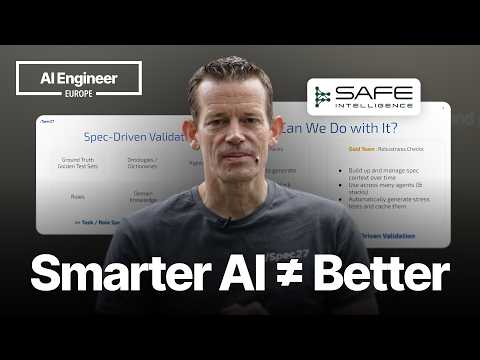
Spec-Driven Testing for Agents With A Brain the Size of A…
Talk by Steven Willmott (SafeIntelligence) on spec-driven validation and testing for AI agents. He argues that larger models are not straightforwardly safer, citing a jailbreak example where a malicious instruction wrapped in a poem succeeds against large models but not small ones, since larger models with broader capabilities present more attack surface and infrastructure access to abuse. His proposed framework treats an agent spec as more than a test dataset: it includes explicit rules (e.g., discount limits), domain ontologies scoped to the agent's actual domain, rights and roles, and robustness requirements such as tolerance for typos and rephrasings. Specs should be written independently of the implementation so they survive model swaps and can drive both security testing and iterative improvement.
# Channel Presentation Observations — Video `01a15ca9-1857-781b-ba41-5f23d0bbcdd1`
## Video Identity
- **Title:** "Spec-Driven Testing for Agents With A Brain the Size of A Planet — Steven Willmott, SafeIntelligence"
- **Format:** A conference-style talk delivered by a company CEO, with audience interaction cues ("come and chat to us at the booth," "you can win some of the LEGO prizes").
## Explicit Self-Description (Creator Claims)
- **Speaker role:** "I'm the CEO of Safe Intelligence."
- **Company age & focus:** "We're a company we've been around for 3 years. Um we really go very very deep into ML validation."
- **Technical approach claim:** "We use formal verification techniques… we started out on vision models, tabular data models… we look at whole regions of the input space."
- **Product claim:** "Yesterday we released a new product which is doing something analogous for language models… be very clever about how we generate edge cases and test cases."
- **Speaker background claim:** "My last company, we did API infrastructure… I helped write that spec [Open API] way back in the day."
- **Intent disclaimer:** "My point here is not to shill the product."
## Claimed Scope
- **ML/AI validation and security testing**, spanning:
- Formal verification of vision and tabular models
- LLM/agent testing via spec-driven approaches
- Security checks pulling from agent specs
- Future open-source-style tooling: "how do you express these things in a way that you could just have in a GitHub repo… and kind of just version the hell out of that stuff"
## Intended Audience
- **Engineers and teams building/deploying AI agents**, evidenced by:
- References to tooling ecosystems: "you may be building in LangSmith or something or Vertex agents"
- Engineering framing: "These look like integration tests if you're from an engineering perspective"
- Industry-aware references: Brain Trust, the A2A spec, agent cards, prompt management platforms
- **Conference attendees / prospective customers**, evidenced by booth promotion and prize giveaways.
## Observable Presentation Patterns (Demonstrated, Not Claimed)
- **Technical, conceptual teaching style:** Walks through a framework of spec components — ground truth data sets, rules, ontologies, domain knowledge, rights/roles, robustness requirements — each with concrete examples (e.g., "don't ever give a discount more than 10%", airline destination constraints, runway detection at sunset/fog).
- **Balanced marketing posture:** Promotes the booth and product but repeatedly frames advice as tool-agnostic: "if you're testing agents in any context using any infrastructure… being explicit about the various bits… is a useful thing to try to do."
- **Pop-culture framing for accessibility:** Uses the Hitchhiker's Guide "Marvin" robot as an extended metaphor ("Hopefully we can make Marvin a little bit happier cuz he has the specs").
- **Openness/standards orientation:** Emphasizes open approaches over vendor lock-in, tied to the speaker's stated Open API history.
## Summary for Channel-Level Synthesis
This video demonstrates a channel persona of a **technically deep AI-validation company** whose leadership presents at industry conferences, blending **conceptual education (spec-driven agent testing)** with **light-touch product promotion**, addressing an audience of agent-building engineers and ML practitioners.
# Delivery Observations — Spec-Driven Testing for Agents
## Overall Tone
- **Conversational, casual conference talk style**: heavy filler words ("um," "uh," false starts like "I I'm Steve," "is is").
- **Self-deprecating and informal humor**, e.g., the Hitchhiker's Guide aside: "you absolutely have to read read the trilogy um which is five five-part trilogy."
## Recurring Verbal Habits
- **Very frequent "um" and "uh"** throughout, often mid-clause: "So that's where the company started out. Um and uh actually yesterday we we released a new product."
- **Immediate self-correction/rephrasing**: "how do we actually specify what agents are supposed to do? And I guess my my key starting point is this this seems like an obvious question."
- **Repetitive handoffs like "so"** to open new points: "So what is this idea of spec driven validation?", "So, um hopefully we can make Marvin a little bit happier."
## Vocabulary & Framing
- **Engineering/testing register**: "formal verification," "F1 accuracy," "integration tests," "penetration tests," "unit tests," "penetration testing."
- **Repeated core vocabulary**: "spec," "robustness," "edge cases," "benchmarks," "eval," "surface area" — "robustness" and "spec" appear many times, anchoring the talk's theme.
- **Concrete analogy to classic ML testing**: "can I detect this runway... can I detect it at sunset, sunrise, under a fog?"
## Teaching Habits
- **Posing rhetorical questions to structure the argument**: "But how do you actually define what goods looks like?", "how do you actually test for sure that a rule is never violated?"
- **Concrete business examples** to ground abstract points: "don't ever give a discount more than 10%," "if it's able to wire millions of dollars to people."
- **Pop-culture reference as a mnemonic frame** (Marvin from Hitchhiker's Guide), introduced early and **bookended at the end**: "hopefully we can make Marvin a little bit happier."
- **Explicit disclaimer of commercial intent** ("my point here is not to shill the product") while still promoting the booth and rubber ducks.
## Audience Interaction
- **Repeated invitations to engage** at the booth: "come and come and talk chat to us," "come to our booth. We have a a game you can play."
- **Direct audience asides** about the "think harder" ducks.
## Uncertainty Note
- Pauses, applause, and slide content are not recoverable from the transcript; delivery pacing and audience reaction beyond "[applause]" cannot be assessed. Single-instance habits (e.g., "[clears throat]") are isolated moments, not patterns.
# Observation Document: Spec-Driven Testing for Agents
**Video:** *Spec-Driven Testing for Agents With A Brain the Size of A Planet — Steven Willmott, SafeIntelligence*
## Speaker
- **Steven Willmott**, CEO of SafeIntelligence, a ~3-year-old company focused on **ML validation** using formal verification techniques, originally applied to vision and tabular models, now extended to language models.
## Core Thesis
- The central question is **how to specify what an agent is supposed to do**, going beyond datasets and evals.
- Related to the preceding talk by Phil from Brain Trust, which Willmott says he likes; the "inherent problem" is specifying agent behavior.
## Claim: A Smarter Agent Is Not Necessarily a Better or Safer Agent
- Willmott challenges the assumption that a bigger model is better at a job.
- Supporting examples he gives:
- Some **jailbreaks work better on larger models** — e.g., a harmful instruction wrapped in a poem is ignored by a low-end model that doesn't understand the poem, but a larger model extracts and executes it.
- Agents with **broad remit create large attack and testing surface area**.
- **Cost and latency**: using large models for simple tasks like math wastes tokens and is slow.
- Desired balance: an agent **"good enough to perform but not capable of doing arbitrary harm"**, where harm has two components: (1) what instructions/prompts it accepts and how flexibly, and (2) what tools/tasks it can execute in your infrastructure (e.g., wiring millions of dollars vs. answering questions).
## Spec-Driven Testing: Components of a Spec
Willmott argues a dataset alone is insufficient — "not just a data set of inputs and outputs that are pretty good and then the rest is guesswork." Components he enumerates:
- **Ground truth datasets / evals** — examples of good behavior.
- **Rules** — e.g., "don't give a discount more than 10%," no refunds past 30 days. He cautions: "how do you actually test for sure that a rule is never violated? It's pretty hard."
- **Ontologies / dictionaries** — e.g., an airline chatbot's actual destination list; internal company terminology.
- **Domain knowledge** — e.g., "gross profit" and "gross sales" are very different in business but might be confused by an LLM; valid substitutions matter for testing.
- **Rights and roles** — agent behavior may differ by login state and permissions.
- **Robustness requirements** — behavior under stress: typos, rephrasing, frustration tolerance; analogized to vision work (runway detection at sunset, fog, camera shake).
## Application
- SafeIntelligence uses specs in two ways in their platform:
1. **Security checks** — if you know the agent's intended domain and tasks, you know where it's most vulnerable (it will engage with those domains and has infrastructure power there).
2. **Robustness testing** — varying inputs to measure the range over which it answers properly.
- He explicitly notes he is "not trying to shill the product"; the point is that being explicit about these spec elements is useful for testing agents with any infrastructure.
- He observes these tests resemble **integration tests** and that implicit elements should be made explicit.
## Industry Context
- **Prompt management platforms** exist that let you elaborate why a test exists — useful context for generating variants.
- **Agent cards** (from the A2A spec) describe what an agent does, but he notes even a long agent card "doesn't give you enough to actually evaluate the agent" — you still need to know the valid range of change.
## Recommendations
- Specify agent behavior; go beyond the eval dataset to capture **task and context**.
- **Stay independent of implementation** — keep integration, unit, and penetration tests portable across frameworks (LangSmith, Vertex, etc.).
- Use specs to **close the loop**: run the agent automatically, iterate to fill robustness gaps — "a backyard type of RL... you're kind of jury-rigging something around the outside."
## Future Direction
- Willmott notes he co-wrote the **OpenAPI spec** at his previous API infrastructure company ("if you used OpenAPI spec, I apologize. It's partly my fault") and is exploring expressing these specs in an open, versionable, GitHub-repo-friendly format usable with any tool.
## Asides
- References Marvin from *The Hitchhiker's Guide to the Galaxy* (the "five-part trilogy") as a theme: a vastly capable robot given trivial tasks. He hopes specs make "Marvin a little bit happier."
- Mentions SafeIntelligence released a new product "yesterday" for LLM edge-case/test-case generation, and invites listeners to their booth (ducks saying "think harder," a LEGO-prize game requiring "a bit of knowledge... or insanely lucky").
# Speaker Attribution & Provenance Record
## Video
**Title:** Spec-Driven Testing for Agents With A Brain the Size of A Planet — Steven Willmott, SafeIntelligence
**Video ID:** `01a15ca9-1857-781b-ba41-5f23d0bbcdd1`
## Speakers & Roles
| Speaker | Role | Evidence |
|---|---|---|
| Steven Willmott ("Steve") | **Primary speaker / company presenter (CEO of SafeIntelligence)** | "I'm Steve. Um I'm the CEO of Safe Intelligence." |
| Audience | Unidentified listeners; applause and brief responses only | "[applause]" |
| Phil (Brain Trust) | **Referenced third-party speaker** — delivered a preceding related talk; does not appear in this transcript | "very related to what Phil talked about just now from Brain Trust" |
- No narrator, host, or guest role present in the transcript.
## Referenced Sources & Third-Party Claims
- **Hitchhiker's Guide to the Galaxy** (book "trilogy in five parts") — cited for the Marvin robot metaphor; speaker paraphrases plot.
- **Brain Trust** — named organization; related prior talk by "Phil" referenced without quoted content.
- **A2A spec / agent cards** — cited as industry standard for describing agent skills; one skill example referenced.
- **Open API spec** — speaker claims personal provenance: "I helped write that spec way back in the day" at his prior API infrastructure company.
- **Named tools/platforms:** LangSmith, Vertex agents (mentioned as possible agent-building infrastructures).
- **Claim: some jailbreaks work better on larger models** — asserted by the speaker, illustrative example given; no external citation.
## Promotional Segments (Flagged)
- **Opening pitch:** company background (3 years old, formal verification for ML models) and a **product launch**: "yesterday we released a new product" for language model testing.
- **Booth promotion:** repeated invitations to visit the SafeIntelligence booth; rubber duck giveaway ("think harder" ducks).
- **Game/prize promotion:** booth game with LEGO prizes, playable "by four."
- Speaker explicitly hedges promotion: "my point here is not to shill the product."
## Availability & Limitations
- **Comments:** No metadata supplied; comment availability **unknown**.
- **Curated metadata:** None provided beyond title.
- Timestamps absent from transcript; no time-based segment boundaries recorded.
- Uncertainty: "Phil" is identified only by first name via speaker reference; no independent confirmation of full identity.
\>\> So nice to meet you. I'm I'm Steve. Um I'm the CEO of Safe Intelligence. We're a company we've been around for 3 years. Um we really go very very deep into ML um validation.
Um and actually we use formal verification techniques on especially we started out on vision models, tabular data models, bunch of other types of models. Um where we actually have the model available and we look at whole regions of the input space and see whether or not the test points that are there actually tip over and do the wrong thing um uh under perturbations. So that's where the company started out. We have a whole bunch of products in that space. Um and uh actually yesterday we we released a new product which is doing something analogous for for language models. Obviously we don't have the language model. So what we're trying to do instead is is be very clever about how we generate edge cases and test cases. So I I won't talk about too much. We have a booth so so come and come and talk chat to us um at the booth for that. If you've seen these ducks around, these are ours. If you didn't get one, I have a whole box of them here so feel free. They say think harder on the front so you can put that on your desk just to be reminded um about what you should be doing. And today I'm going to talk about something which is very similar to what um what very related to what Phil talked about just now from Brain Trust. Uh we like what Brain Trust does a lot um and I think one of the inherent problems is like how do you actually specify what an agent is supposed to do? Um so I think people are familiar with spec driven development. This is not going to be about developing code with specs. That's also very important. We do a lot of that in the company for the products that we build. This is but this is about how you specify what an agent or an AI system is supposed to do. And in ML you typically use a data set to do that. You basically have your data set and you run it all those examples and you look at F1 accuracy and things like
that. And that's sort of telling you what you want the what the what you want the agent or the system to do. Um but as as we'll see there's actually a lot more to it um when when you deploy things. So that's
what the focus of the talk is. Like how do we actually specify what agents are supposed to do? And I guess my my key starting point is this this seems like an obvious question like a smarter agent is a better agent, right? So if I have a smarter agent, I'm using a bigger model, uh it's going to be better at doing the job that it's supposed to do. Um in in general you'd expect that to be right. But that's I think probably most people have the experience that that's not always true in fact. Um so there's some problems. Um if you're familiar with uh the the book The Hitchhiker's Guide to the Galaxy, there's a robot called Marvin uh who has the brain the size of a planet and he's normally asked to do things like make the tea and he gets extremely bored and he's extremely depressed. So this depressed robot uh kind of is a theme in the book. Um if you haven't read the book by the way, you absolutely have to read read the trilogy um which is five five-part trilogy. That will tell you something about the the style of the humor. Um in any case, Marvin there are challenges with having like massive models. Some of the jailbreaks actually uh work better on large models because uh they're smarter. So if you encapsulate something in a poem and you give that to a relatively low-end model, the low-end model doesn't even understand the poem. Whereas a larger model will be like, "Oh, I can take this out and I can execute the bad instruction that's wrapped up in the poem." So it's not obvious that um bigger is safer and it's not obvious that bigger is better. Another thing is if you're building agents that have a very broad remit, they can do a lot of things. That creates a lot of surface area for someone to actually exploit. And it creates a lot of surface area to test if you want to be sure that the agent is
actually doing things that you want it to do. And obviously there's a cost issue, right? So if you're using large models to do something which is relatively simple like like just simple math, you're going to be paying for tokens and
it's going to be slow um rather than something that's very optimized. So in general, if you're building agents for deployment for especially automated use uh fully automated use, there's this trade-off between smart and safe in some sense and um smart and and capable in the other direction. And so what you're really seeking is like a model uh an agent that's built on a model that's good enough to perform but it's not capable of doing arbitrary harm. And that arbitrary harm is uh kind of two parts to it. One is, you know, what kind of instructions can it receive? How flexible is it about how those are formulated? What the what the prompts look like? Um that's one part of it. And the other part is like what tools and tasks can it carry out in your infrastructure? So if it's able to wire millions of dollars to people, that's obviously a lot more risky than if it can just answer questions and so on. Right? So this is the balance that most people that you're basically looking for. But how do you actually define what goods looks like? I think it's pretty obvious that it's not just a data set of inputs and outputs that that are pretty good and then the rest is like guesswork. Uh and it's also sometimes hard to define what harm looks like because maybe an agent doesn't do the right thing um but it's it's kind of just failing at the task and sometimes it's doing exactly the wrong thing was asking to do something bad. So what is this idea of spec driven validation? Um spec driven testing. Um you can call it that as well. Um it's basically what are the things we would want to do if we were just designing the role or the task benchmark by itself like independent of the agent. So we already talked about data sets. So the ground truth having a bunch of examples of what good looks like is one
thing. So that's kind of one component. Often we see uh customers that we work with also have rules. So if they've got a customer support agent, you want to say things like you know, don't ever
give a discount more than 10%. Uh we don't allow refunds if um if you know, it's more than 30 days past the purchase and there are sort of these rules, right? So your alarm bell should be going off a little bit already because like how do you actually test for sure that a rule is never violated? It's pretty hard. Um sometimes you also um have uh ontologies or dictionaries that are relevant. So an example would be if you're building an airline chat um bot that particular airline might only fly to certain uh might only fly to certain destinations. So that's the relevant universe of things you need to think about. Um you may have internal terminology in your company that apply to your policies that no one else in the rest of the world actually knows about. So that's also part of the spec, right? Because if you're going to actually um build an agent, you will be building that into the agent. But if you're going to test it, you actually need to tell the testing system what these things are and what is a a valid substitution. There's domain knowledge so you may have very specific, you know, scientific um finance agents, other things that are that need to know what terms are substitutable. So if you for example if you do substitutions on something like um uh you know, gross profit and gross sales for example, if you're sort of talking to an LLM generally, it might actually confuse those two terms. But in business they're very different things. Um so this specific domain knowledge is relevant to testing as well. And then we might have rights and roles. Like the agent may perform differently if you're logged in, if you're logged out, if you have certain rights and permissions and things like that. And then the last one which is um pretty important is robustness requirements. So one is I've got my test set. That should work, right? Um but it needs to work under stress. So in vision where we started out, it's things like can I detect this runway for the the plane to land on? Like can I detect it at sunset, sunrise, under a fog? Like and how much fog that can there be? How much can the camera shake before the thing doesn't work? And that's actually similar in in agents. You know, if you're building a customer-facing agent, could typos disrupt it? How many typos disrupt it? Like how frustrated will people get? Rephrasing, how how stable under change are are the results? And so really this is the point here is
we need to go beyond the test set to have like task and role specific benchmarks that are for the agent itself. Um and what do you then do with that? Oh, maybe I already talked about some of
these examples. But these are just examples of the kind of things if you had a product support agent. So we've worked with quite a few people doing this. So you can kind of think of it as there's an in in LLM land, people have started to call the eval kind of the test set. Which sort of makes sense, but I just think that the eval itself we have to think of going beyond the eval as well. There's this concept of an agent card which comes from the A to A spec. It's been in other things as around which like describes what the agent does. It's also relevant here. And then obviously there's all the context around this. And if you're a company deploying agents, you kind of want your your tests to look um like something that has these various elements that are relevant. That's a fair eval. And you want to build more and more these These look like integration tests if you're from an engineering perspective. Um often some of these things are implicit, but you want to make them explicit. So what do we what can you do with this? So what we do with this in our platform, we do two things. We do security checks. So we actually pull the the specs um that an agent is supposed to fulfill into security testing. Why do we do that? Generally, if you know what an agent is trying to do, you know the edges of where it's vulnerable because it's going to be willing to talk about those domains that it's supposed to act in, right? So that's actually where it's most likely to be vulnerable. Second, the tasks it performs, it will have more power to act in the infrastructure on those tasks. Like if it's a banking agent or something like that, it will have be able to work in that area. So we that's a place you can pull things like this spec information in. And then the robustness side is like to do its job properly. Especially the robustness side, can we vary the inputs and see how how much of a range it has in terms of answering the questions properly. Um so we build a product to do this, but my my point here is not to shill the product. Um I think it's just something
if you're testing agents in any context using any infrastructure, trying to like be explicit about the various bits of that are on this slide and bringing that together is is a useful thing to try to
do. Um from an industry perspective, I think there's lots of things going on, but just calling out two, I mean, there are there are a lot of prompt management platforms that allow you to be fairly elaborate \[clears throat\] about why this test exists and things like this is all useful when you actually want to generate um variants of the test because you want this context. As I said, from the A2A spec, you've got agent cards, they're quite long, but here's an example of a skill. Um you would also realize that even if you have this, that doesn't give you enough to actually evaluate the agent. You still want to know, well, what what range of change could be is is valid, you know, uh for maybe in this case, what kind of people could be could the meeting be booked for and and so on. Um I can talk a lot more about how it how hard it is to create variations within the sort of envelopes that a spec might create, um but I think just in general, my my point here is like as you think about evaluating agents, start thinking about not just the eval data set or benchmark, um uh also think about the task and the context for the task and how you how you capture that. So, um hopefully we can make Marvin a little bit happier cuz he has the specs and he kind of knows what he's supposed to do. Um um and then, yeah, specify the behavior of your agents. That's kind of the key thing to do here. Stay independent of the implementation cuz often you may, you know, may you may be building in LangSmith or something
uh or Vertex agents or or or so on, but then later on you may change to a different infrastructure. You actually want to keep those integration tests, all of the unit tests, and penetration tests and and run them independently.
And this is also a way to close the loop. So, part of our inspiration of thinking about what should go into a spec is like, what would you need uh to actually run the agent automatically, get the results, and then start to iterate and try to fill the robustness gaps that have appeared. So, it's like a backyard type of RL, it's not proper RL cuz you're not doing it on the model, but you're kind of like uh jury-rigging something around the outside. Um that's the key point. Um where do we go from here? So, we're obviously building product around this, but I've I've been in computer science for a long time. My last company, we did API infrastructure, so if you used Open API spec, I'm up I apologize. It's partly my fault. So, I helped write that spec way back in the day. Uh so, all about open. So, we're thinking about like, how do you express these things in a way that you could just have in a GitHub repo, pull them into whatever tool you want to do, and then pull all the different pieces, and kind of just version the hell out of that stuff. So, if anyone's interested in stuff in that, love to chat. Um that's my talk. Um come to our booth. We have a a game you can play. Uh if you play by four, uh you can win some of the LEGO prizes uh up there. Uh you need a bit of knowledge, to be fair, or you need to be insanely lucky. Um but yeah, that's my talk. Thanks a lot. \>\> \[applause\]