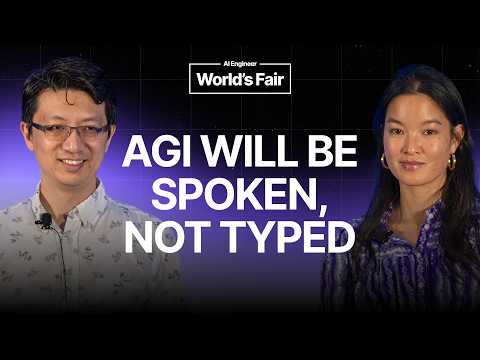
Speech-to-Speech Model Research at Google DeepMind —…
Conversation with Valeria Wu Fon (product lead for speech-to-speech in Gemini) and Tom Ouyang (engineer) at Google DeepMind about speech-to-speech model research. Topics include the shift from pre-2018 hand-built speech recognition pipelines to end-to-end and natively multimodal models, and the three-way design tension between being conversational (low latency), intelligent (task completion and instruction following), and bidirectionally multimodal (video, screen shares, documents). Demonstrations cover live translation in a multi-speaker meeting, a roadside assistance agent reading back a registration plate and postcode, and a "proactive audio" feature for handling background noise.
# Video Identity Observations
## Video Overview
- **Format:** Conference/presentation talk by two Google DeepMind speakers — Valeria Wu Fon (self-described as *product lead for the speech-to-speech model in Gemini*) and Tom Ouyang (self-described as an *engineer on speech-to-speech in Gemini*).
- **Topic:** Speech-to-speech model research at Google DeepMind, framed as *"voiceifying the agentic future with speech-to-speech research."*
## Intended Audience
- **Technical/research and developer audience** — evidenced by discussion of pre-training data formats ("multimodal interleaved examples"), token embedding spaces, evals, latency tradeoffs, and references to "developer experiences in our live API."
- **Potentially enterprise/industry attendees** — demos target enterprise voice agents (e.g., the insurance roadside assistance agent and *"deployed in cloud and the API for enterprise or voice agent use cases"*).
- **Recruitment-adjacent closing** — the talk ends with *"if you're excited or want to learn more, please come talk to us,"* suggesting an in-person event audience.
## Claimed Scope & Self-Description (Creator Claims)
- The channel/creators present themselves as **Google DeepMind / Gemini speech-to-speech team members** presenting their own research and products.
- **Scope claimed:** building *"robust universal voice agents"* via speech-to-speech models, spanning translation, search, agentic voice experiences, and avatars.
- **Stated team philosophy:** a "trifecta" of **conversation quality, intelligence, and multimodality**, with emphasis on multilingual support (*"the majority of our Gemini users are non-English speakers"*).
- **Stated vision:** *"we believe that AGI will not be typed, that it will be spoken"* — a forward-looking mission statement for the work.
## Demonstrated Presentation Patterns (Observable)
- **Product-integrated research presentation:** demos of shipping Google products (Google Meet live translation supporting *"70+ languages,"* Search Live, live API, Cloud Next avatar demo), not just theory.
- **History-to-present technical narrative:** speaker traces speech modeling from pre-2018 pipeline components to end-to-end ASR to natively multimodal Gemini models.
- **Live-demo style delivery** with pre-recorded demo videos (Meet translation, insurance voice agent, financial advisor avatar).
- **Explicit tradeoff framing:** candid discussion of tension between model intelligence (e.g., extended "thinking") and latency/naturalness.
## Audience Address & Tone
- Direct second-person address to an audience (*"Thanks for coming to our talk," "please come talk to us"*).
- Conversational, demo-heavy tone; assumes familiarity with ML terminology (ASR, TTS, LLMs, embeddings, evals).
## Notable Absences
- No explicit channel-level self-description (e.g., no channel name, subscribe request, or series framing) appears in the transcript; identity evidence comes from the title, speaker introductions, and institutional references to Google DeepMind/Gemini.
# Delivery Observations: Valeria Wu Fon & Tom Ouyang — Speech-to-Speech Model Research at Google DeepMind
## Overall Format
- **Two-speaker alternating structure**: the talk is split into segments handed off explicitly. Valeria opens, then says > "with that, I'll hand it off to Tom." Tom later returns: > "with that, I'm going to give it to Valeria to talk more about the North Star and some of the key demo products that we built."
- **Demo-heavy delivery**: both speakers repeatedly anchor claims in video demos they play live (Google Meets translation, search live, roadside assistance, avatar pilot).
## Tone
- **Conversational and informal** throughout, marked by casual fillers: "you know," "like," "kind of," "right?" Example (Tom): > "So, of course, like one way to create a voice agent is to just add an ASR like speech-to-text model in the pipeline and then a text-to-speech model on the other end, right?"
- **Enthusiastic but low-key**: repeated markers of excitement — > "another thing we're really excited about," > "demos that we're excited to keep pushing the frontier of."
## Recurring Verbal Habits
- **"So" as a paragraph opener** — extremely frequent: > "So, before we start diving into the history..."; > "So, of course, to do this task..."; > "So, to highlight in this video..."; > "So, let me show you a demo..."
- **Hedging qualifiers** "kind of," "sort of," "really": > "it kind of worked"; > "this sort of embodied agent experience"; > "a really kind of like ongoing fluid conversation."
- **"Of course"** used to frame shared assumptions (Tom, repeatedly): > "of course, that's where a lot of the history of speech come from"; > "of course, like there's limitless like YouTube videos with captions."
## Teaching Habits & Structure
- **Historical framing before technical content**: Tom sequences the history "up until around 2018... fast forward to now" before presenting current capabilities.
- **Concrete examples to explain abstractions**: pre-training is explained via a specific task — > "this is a task where you're asking the model to summarize a bedtime story."
- **Enumerated frameworks**: Valeria structures the talk around "three vectors" / a "trifecta" and a "Venn diagram" (conversation quality, intelligence, multimodality), later referencing it again: > "a demo that also brings our Venn diagram together."
- **Listed capability requirements**: > "it needs to do multilingual switching... preserve the speaker voice... be robust to noise, and of course, like do all this in real time, right?"
- **Highlighting "what's happening" after each demo**: > "So, to highlight in this video, many things are happening. First... And then finally..." — a consistent post-demo debrief pattern.
## Vocabulary & Framing Patterns
- **Agent/LLM terminology**: "voiceifying," "promptable," "universal voice agents," "North Star," "proactive audio," "ITNN/ITN," "tool calling."
- **Contrast framing (cascaded vs. end-to-end)**: > "it would be very hard to try to engineer this, but then with the LLM and Gemini models, this almost becomes a prompting task."
- **Trade-off framing**: > "once you move one of the knobs, it's very easy for the other knobs to kind of like mess up, right?"
## Self-Aware / Asides
- **Spontaneous audience-directed asides**: > "Should I use this as a microphone? Hello. Okay."
- **Self-deprecating humor about the demo**: > "I always joke that the user's audio in Spanish is worse than the audio model speaking back."
## Closing Pattern
- **Vision statement + call to action**: > "we believe that AGI will not be typed, that it will be spoken" followed by > "if you're excited or want to learn more, please come talk to us, and thank you so much for coming."
## Uncertainty Notes
- Some transcript markers (timestamps, ">>") suggest live transcription; a few unsmoothed segments (e.g., > "Sorry. In Spanish." self-correction, and "Whoops. How do I back to Okay.") indicate minor live stumbles, but these are isolated moments, not a stable pattern.
- Attribution of specific filler-word frequency per speaker is approximate; both use casual registers, though "of course" appears predominantly in Tom's segments and the "Venn diagram" framing in Valeria's — evidence is consistent but limited to one talk.
# Speech-to-Speech Model Research at Google DeepMind — Position Record
**Speakers:**
- **Valeria** — Product lead for the speech-to-speech model in Gemini, Google DeepMind
- **Tom** — Engineer on speech-to-speech in Gemini, Google DeepMind
## Motivation & Framing
### Valeria — Why voice matters
- **Core claim:** Voice is the most natural way for humans to interact with both the physical and virtual world.
- Evidence cited: existing Google products using voice — Search Live, Gemini Live (questions, homework, info seeking, EDU) — and the same models deployed via Cloud/API for enterprise and voice agent use cases.
- **Prediction:** Applications will "exponentially increase" over the next few years.
- **Position:** Speech-to-speech models are "the way to go" for robust universal voice agents.
## Tom — Historical Overview of Speech Modeling
### Evolution of ASR
- **Pre-2018:** Systems composed of many components — feature extraction, acoustic modeling, pronunciation modeling, language modeling, second-pass rescoring — mapping audio to text transcription.
- **~2018 onward:** Shift toward end-to-end systems where neural models learn the audio-to-text mapping without as much domain knowledge.
- **Limitation stated:** These end-to-end systems only do one thing (speech → transcription); they don't respond or translate. Tone, emotion, speaker speed, vocabulary biasing must be built separately — a barrier to scaling.
### LLM era & Gemini's native multimodality
- Early LLMs were mostly text; audio embeddings could be "hacked in" and "it kind of worked."
- **Claim:** Gemini models have long been natively multimodal; pre-training uses **multimodal interleaved examples**.
- Example given: a bedtime-story summarization task mixing text prompts, video, and audio inputs, expecting timestamped summaries; video captioning tasks leveraging YouTube videos with captions; audio generation from video/text.
- **Claim:** ASR, TTS, and agentic tasks are learned "under one unified token embedding space," forming the foundation for audio work.
### Live translation application
- **Claim:** Live translation "only works" when all capabilities sit in one model.
- Streaming real-time translation quality is "about as good as" offline systems — classically very hard with cascaded systems, but "a lot of it comes out of the pre-training" with LLMs.
- Required capabilities enumerated: multilingual switching, preserving source speaker voice, understanding multiple speakers, noise robustness, real-time operation.
- **Claim:** With Gemini, this "almost becomes a prompting task."
- The same model can be prompted to do streaming translation, act as an agent over image/audio input, or render an embodied virtual agent with a face and tools.
## Valeria — North Star & Demos
### Three-vector framework (the "trifecta")
1. **Conversational quality** — low latency, snappy, natural
2. **Intelligence** — task completion, instruction following, reasoning
3. **Multimodality** — audio in/out plus video, screen sharing, PDFs streamed in and output
**Caveat on internationalization:** The majority of Gemini users are non-English speakers; capabilities must work beyond EN-US across all customer languages.
### Stated tension / challenge
- **Trade-off example:** Raising "thinking" improves intelligence in evals but degrades latency, time-to-first-audio, and naturalness.
- Team goal: research initiatives that blend all three "without really sacrificing any of those by a lot."
### Demos presented
**1. Live translation (Google Meets, 70+ languages)**
- Multi-speaker, low latency; translation kicks off as the user speaks so it doesn't feel "turn by turn and robotic" and users aren't afraid to interrupt.
**2. Search Live**
- Real-time video/audio streaming in (no need to describe the sofa); multimodal out via a tool pulling up search cards; localization to Spain-Spanish with the intelligence to leave terms like "mid-century" untranslated because the term is commonly known.
**3. Voice agent (insurance roadside assistance)**
- Different demands under the hood: alphanumeric accuracy for postcodes/addresses.
- **Proactive audio feature:** the LLM knows when or when not to respond to external input — it won't cut itself short due to background noise or another speaker, since real conversations happen "on the go, on the train, while you're on a walk."
**4. Customized real-time avatars (pilot launched at Cloud Next)**
- **Claim:** "The true AGI conversational frontier will also require visual presence."
- Personalizable appearance from hyperrealistic human to cartoon; low-latency, multilingual lip-syncing.
- Demo (financial advisor "Jackson/Lisa" scenario) shown as combining the trifecta: multimodality in/out, tool calling, conversational fluidity with internationalization.
- Self-acknowledged limitation: Valeria jokes that the user's Spanish audio input was worse than the model's Spanish output.
## Parting Position (Valeria)
- **Claim:** "AGI will not be typed, that it will be spoken."
- Requires a single promptable, versatile model enabling seamless switching between conversation modes: translation, taking action, brainstorming, rambling.
## Preserved Qualifications & Tensions
- Tom's hedging on early audio-in-text-LLMs ("it kind of worked") kept as expressed.
- The intelligence-vs-latency trade-off is presented as an **unresolved challenge**, not solved.
- Demos are framed as "hinting at" the combined trifecta — progress, not completion ("starting slowly to come together").
- Multilingual parity is stated as a goal, with the challenge that "once you move one of the knobs, it's very easy for the other knobs to mess up."
# Speaker & Provenance Observation Record
## Video
**Title:** Speech-to-Speech Model Research at Google DeepMind — Valeria Wu Fon & Tom Ouyang, Google DeepMind
**Video ID:** `01a15ca7-6492-7042-8883-7cdd8e4a9cc1`
## Speakers & Roles
| Speaker | Role | Evidence |
|---|---|---|
| **Valeria Wu Fon** | Co-presenter; **Product lead** for the speech-to-speech model in Gemini, Google DeepMind | Self-identified: "My name is Valeria. I'm the product lead for the speech-to-speech model in Gemini" |
| **Tom Ouyang** | Co-presenter; **Engineer** on speech-to-speech in Gemini, Google DeepMind | Self-identified: "my name is Tom. I work on speech-to-speech as an engineer and Gemini" |
### Speakers Within Demo Footage (recorded video segments, not live presenters)
- **Demo 1 (Google Meets translation):** Three unnamed participants ("Cassie" in Shanghai, "Anna" in Sweden, one host speaker); simulated multi-language conversation.
- **Demo 2 (Roadside assistance voice agent):** "Richard Jenkins" (caller with blown tire) and "Ace" (AI voice agent for "Auto Transform Insurance Roadside Assistance").
- **Demo 3 (Real-time avatar / financial advisor):** "Jackson," "Lisa" (mentioned as joining), and an unnamed avatar agent conversing in English and Spanish.
## Role Distribution of Content
- **Tom:** Historical overview of ASR/speech modeling (~pre-2018 pipelines through end-to-end ~2018 to LLM-era multimodal pre-training), live translation capabilities.
- **Valeria:** Product framing ("North Star" — conversation quality, intelligence, multimodality), demo walkthroughs (Meets translation, Search Live, live API, avatars), closing remarks.
## Referenced Products / Sources (as claimed by speakers)
- **Google products cited:** Gemini (native multimodal models), Gemini Live, Search Live, Google Meets speech translation (70+ languages claimed), Live API (developer experiences), Cloud Next avatar pilot ("City" as transcribed — likely transcription artifact, uncertainty noted).
- **Technical concepts cited:** ASR, TTS, cascaded pipelines, acoustic/pronunciation/language modeling, multimodal interleaved pre-training, YouTube caption training data, proactive audio, tool calling, ITN/ITNN (inverse text normalization).
## Third-Party Claims
- Claim that streaming real-time translation quality is "about as good as offline systems."
- Claim that the majority of Gemini users are non-English speakers.
- Claim that raising "thinking" improves intelligence in evals but hurts latency/naturalness.
## Promotional Segments — Flagged
- **Entire talk is promotional** for Google DeepMind / Gemini speech-to-speech work: product demos for Google Meets translation, Search Live, Live API, and the Cloud Next avatar pilot.
- Explicit recruitment/promotion close: "if you're excited or want to learn more, please come talk to us."
## Provenance Limitations
- **No curated metadata supplied**; only the transcript was available.
- **Comment availability:** not indicated.
- Speaker names are drawn from the video title and self-introductions only; no independent verification.
- Demo speakers' names ("Ace," "Richard Jenkins," "Jackson," "Lisa") appear only within demo recordings; one product name is transcribed as "City," which may be a transcription error.
\>\> Hi everyone. Thanks for coming to our talk. We're going to talk a lot about how we are planning on voiceifying the agentic future with speech-to-speech research here at Google DeepMind. My name is Valeria. I'm the product lead
for the speech-to-speech model in Gemini and Tom. \>\> Yeah, my name is Tom. I work on speech-to-speech as an engineer and Gemini. So, yeah, great to be presenting our work. \>\> Cool. So, before we start diving into the history of Google research and audio and the latest research we've been doing, I just want to take a step back and really kind of like think about why this is important to us in the team. And the main reason is that voice is the most natural way for humans to interact with both the physical and the virtual world. And we're already seeing so many applications that are starting even within the own Google products. We see voice being used to ask questions and you know, do homework or info seeking or EDU in search live and Gemini live. All the way to these same models being deployed in cloud and the API for enterprise or voice agent use cases. Should I use this as a microphone? Hello. Okay. Um So, because of that, we only think that the number of applications is going to, you know, exponentially increase over the next few years and we believe that speech-to-speech models are the way to go when we want to build robust universal voice agents. And with that, I'll hand it off to Tom. \>\> All right. So, of course, like one way to create a voice agent is to just add an ASR like speech-to-text model in the pipeline and then a text-to-speech model on the other end, right? So, of course, that's where a lot of the history of speech come from. Of course, Google has been working on this for a long time. I'm going to give you a little bit of a historical overview of what speech modeling, especially speech-to-text
automatic speech recognition, typically looks like, right? So, up until around 2018, this usually involved a lot of different components. You have um you know of course feature extraction that's fairly general and then you have all these
different pieces like acoustic modeling, pronunciation modeling, language modeling, a second pass rescoring that allows you to go from the audio input to a text transcription. Right? And of course like around 2018, these moved more and more towards end-to-end systems. You don't have to have so much domain knowledge. You can actually have mostly the the neural model learn this pattern and mapping between acoustic inputs and text. But these aren't really the end-to-end models that we think about when we think about LLMs. They're only doing kind of one thing, which is speech to a transcription of that speech. They're not responding, they're not translating. If you wanted to have the model tell you about the tone or the emotion or the speed of the speaker. If you wanted to bias it towards words or much less like images, those are all things you have to build yourself as part of the system and there's really really a barrier to how easily you can scale these systems. So, fast forward to now, which is kind of of course the LLM era, right? Like you know, the first LLMs were mostly text, but even there I think you could kind of hack audio embeddings into these text models and it kind of worked, but now of course for a long time now, Gemini models have been very natively multimodal. So, what does that mean? It means that when we train these models in pre-training, which is where the bulk of the data comes from, these are multimodal interleaved examples, right? So, the bottom uh diagram here gives you kind of one example of what that might look like. So, this is a task where you're asking the model to summarize a bedtime story and there's a text prompt in the beginning, but then there's this sequence of video and audio inputs that the model gets and then of course like what you expect the model to do here is produce um both the summary and also annotate timestamps
for where interesting things happen and so forth. So, this example is teaching the model to translate its understanding of the audio and the video into text. You might have other examples in pre-training that ask you to caption a
video. So, you might have a video that has audio and the model is learning to bias towards both the video and the audio signal to caption this well. And of course like there's limitless like YouTube videos with captions that you can train these models on. Other models might actually try to generate audio from the video from the text, right? So, you can have ASR, TTS, or any combination of these plus all of these sort of agentic tasks all kind of learned under one unified token embedding space. So, this becomes a foundation for a lot of what we want to do in audio because we already have a model that understands audio, video, text, and how these things relate and transition from one to the next. So, very quickly, like one of the applications that this enables that we've launched recently is live translation, right? And this is a kind of application that kind of only works
when you have all of these capabilities working within the same model. You have basically state-of-the-art translation quality. Even though this model is translating basically as the user or speakers are speaking, you kind of ask, "Hey, I I speak English. There's maybe
friends who are talking in Spanish and Italian and Chinese." And it's translating all of them to your language as they talk. Um and then we're we're finding is the translation quality for this like streaming real-time translation is about as good as you would get with offline systems, right? Where you kind of know the full utterance um from the very beginning. So, that's something that has been classically very hard to do with these cascaded systems, but with LLMs, it actually just a lot of it comes out of the pre-training. So, of course, to do this task it needs to do multilingual switching because you could be translating across different languages. You don't know what those languages are beforehand. It needs to preserve the speaker voice of the source speaker and be able to understand multiple speakers, be robust to noise, and of course, like do all this in real time, right? So, again, it would be very hard to try to engineer this, but then with the LLM and Gemini models, this almost becomes a prompting task. And on that, like, I know, in this diagram we're saying, "Hey, at the top with these models, if you prompt it to do the speaking like this streaming translation task, and you give it the audio, it will produce the streaming translation output, right? The same model, if you ask it to act like an agent and respond to maybe image and audio input, maybe asking questions about that image, it will give you an answer. And finally, like very well we'll show examples of this, you can also have it create this embodied, you know, virtual agent that has a face, that has, you know, things and tools that it can show you, and it will produce this sort of embodied agent experience. So, with that, I'm going to
give it to Valeria to talk more about the North Star and some of the key demo products that we built. \>\> Yeah, so to create this type of kind of universal, versatile, uh kind of
model/product, there's like three vectors that we think about when we do research and product for these models. Um and they also come with some challenges, so I'll like walk you through some of them. So, at the core of a speech-to-speech model, the first thing that people usually think about is that it has very conversational, right? It's low latency, it's very conversational, very snappy, very natural. But, I think within our team, we really don't only want this model to sound nice. We also have two pillars at the top that we also really care about like pulling all together into one model, which is intelligence and it being multimodal. So, when we talk about intelligence, we talk about, you know, task completion, instruction following, reasoning, like capabilities that the model needs to have natively in order to complete tasks and to like do things uh that have high customer satisfaction, for example. And on the other side of the Venn diagram, we also have the idea that these models should be very multimodal, both in audio in and audio out, right? So, sometimes a user doesn't only want to input audio in and have that be the start of the conversation. We need video, your screen sharing, PDFs, whatever you would want the model to interpret and understand, we should be able to stream it in and also produce output out of it. So, that's kind of like the trifecta of which we think about speech-to-speech models. Um and I want to add a caveat about ITNN. I think actually the majority of our Gemini users are non-English speakers. Um so, we put a big focus on having and making sure that all these capabilities work within not only, you know, EN-US, but all the languages that our customers care about. Um of course, this also our North Star also becomes one of the biggest challenges in our research because once you move one of the knobs, it's very easy for the other knobs to kind of
like mess up, right? Like a very quick example, oh, how do we increase intelligence in the model? Well, you can turn thinking high or like the thinking is high as possible to have the model think a lot before calling a tool or
answering a question, which in eval's it does show that it does improve the model's intelligence. But when what does that do to latency, right? And time to first audio and the naturalness of the conversation? So, within the Gemini team, we're really trying to push forward research initiatives that can kind of blend in the three of them without really sacrificing any of those by a lot. Um, but in the meantime, we're going to show you some of the demos that we think are hinting at how our speech-to-speech model can combine all these three into really cool application. So, the first one is you kind of saw this as a preview, but our live model, as you know, uh, powers streaming translation that supports 70+ languages. So, this is a little bit around the core of conversation quality and IT&N efforts that we have in the team. I'll play a
quick video on how this works on Google Meets to help two people or maybe multiple people that are speaking different languages still have a live conversation. Oh.
One sec. Okay. \>\> Okay, let's turn on speech translation. \>\> So, here the user can simply select the language that they want the translation to happen in and then the rest will be done in real time in multiple speakers kind of having a conversation back and forth. So, I'll show you a snippet of this video of what happens. \>\> It's great to see you both. Cassie, how's the weather in Shanghai? \>\> It's nice to meet you. The weather here is really nice, sunny and bright. I spent all day Saturday in the park with my family. \>\> That sounds wonderful. Anna, you mentioned last week that you were celebrating your birthday. How was it? \>\> Oh, that was fantastic. I had dinner at my favorite restaurant with some friends. If you visit Sweden, you must try this restaurant. It was \>\> So, um a lot of things happening. Not only there's, you know, real-time translation. Whoops. How do I back to Okay. Um not only there's real-time translation that is happening, uh but we see that it's in a multi-speaker setting, you know, low latency, like right after the user starts speaking, the translation kicks off, so that it doesn't feel like it's really turn by turn and robotic and you're afraid to interrupt because, you know, once you start speaking, the model will start catching your translation directly. So, now I'll show some other applications where we see that we have one single speech-to-speech model for many conversational frontiers. So, two products that I want to highlight here are the same model that we power search live for everyday conversations in any language. It's the same model that we use to power developer experiences in our live API. As you'll see in the videos, both use cases are extremely different, but because we try and make this this model or this speech-to-speech model very promptable and universal, you can see how it adapts to the different use cases. So, let me just play the first video. So, to highlight in this video, many things are happening. First, the multimodal, you know, it's real-time uh video and audio streaming in, so that you don't have to actually describe what the sofa looks like. But then the multimodal out, you see that there was a tool called made to pull up the right search cards if the user wanted to know more information. And then finally, the ITN component, you know, we're localizing the speaker's Spanish to Spain Spanish. And also, when we do the kind of responding in Spanish, we're also smart enough to know that some words are better to be left in English, like the mid-century type of word. It didn't translate it directly to Spanish cuz it knew that the term was commonly known in English. Sorry, in Spanish. So, this is one example of how users are using search live for like info-seeking questions. Now, let me show a very different demo on how we do this for conversational voice agents. Oh. Sorry.
\>\> Hi, I've blown a tire and had to pull over to the side of the road. Can you help? \>\> Hello, you've reached Auto Transform Insurance Roadside Assistance. My name
is Ace. I understand this is stressful, but we'll take care of everything. To get started, could I please have your name and your policy number? \>\> Uh my name is Richard Jenkins. I I don't actually have my policy number to hand. \>\> No worries, Richard. I can look you up with your registration plate and postcode instead. Could you provide those for me, please? \>\> Whoa, that was a bit close. Um yeah, my registration plate is BD21 XYA and uh my postcode is SN48ZX. \>\> Policy details BD21 XYA. Thank you. For your safety, please stay clear of the road. I've found your details and I see you're in a blue Mini Cooper F-Series. Is that the vehicle you're in? \>\> Yeah, yeah, that that's the vehicle. \>\> Got it. \>\> Okay, so I'll pause it here, but as you can see, very different things are happening under the hood with the same model. You know, it's more about alphanumeric accuracy for complex kind of like postcode numbers or addresses. There's like this feature that we have called proactive audio, which is the idea that the LLM knows when or when not to respond to an external input. So, for example, if you're in a conversation and someone else is talking or there's background noise happening in the back, the model knows to not stop or cut itself short because there's external noise happening. Because we realized that the majority of these conversations are not happening in an office room with like no noise, you know, in a sealed environment. They're happening on the go, on the train, while you're on a walk. Um and that's the type of experiences that we want to facilitate with the speech-to-speech model. Um lastly, um another thing we're really excited about is not only voice out, but also multimodal out. We believe that, you know, the true AGI conversational frontier will also require visual presence. So, we were excited to launch our first kind of pilot demo with City um in Cloud Next, which supports customized real-time avatars. Um and you can kind of like personalize anything from a hyperrealistic human to a cartoon appearance and everything in the middle. And powered by the same speech-to-speech model we've been showing, it allows to have, you know, low-latency, multilingual lip-syncing, and a really kind of like uh ongoing fluid conversation that has visual presence. So, let me show you a demo that also brings our Venn diagram together and what we're excited about. \>\> All this is reminding me of my daughter's college fund. How are we
tracking on that? \>\> You're tracking well, Jackson. I've also identified a new opportunity that may get you there even sooner. Oh, and I can see Lisa just joined you.
Hi, Lisa. She must be so excited about her college acceptance. Congratulations. It's wonderful to see your savings goals coming to life. \>\> Excelente. Las cosas han estado tan inestables últimamente. \>\> Sí. Los servicios de tecnología y comunicaciones han mostrado un desempeño sólido en lo que va del año. \>\> That's good news. \>\> I always joke that the user's audio in Spanish is worse than the audio model speaking back, but um this is kind of just to show how like our Venn diagram of combining, you know, multimodality in and out, you know, tool calling to like pull up the relevant examples from the user, and also conversational fluidity with ITNN are starting slowly to come together in these types of demos that we're excited to keep pushing the frontier of. Um so with this parting thought, I guess last kind of thought that we have for you is that we believe that AGI will not be typed, that it will be spoken. Um and for it to be spoken, there's a lot of things that need to work together in a single promptable, versatile model that allows a user to switch between all the sorts of conversation modes that we're looking at, right? From translation to taking action to brainstorming to rambling, and we truly believe in the power of these speech-to-speech models to achieve that like seamless switching. Um so we're excited to push the frontier on that. So if you're excited or want to learn more, please come talk to us, and thank you so much for coming. \>\> \[music\]