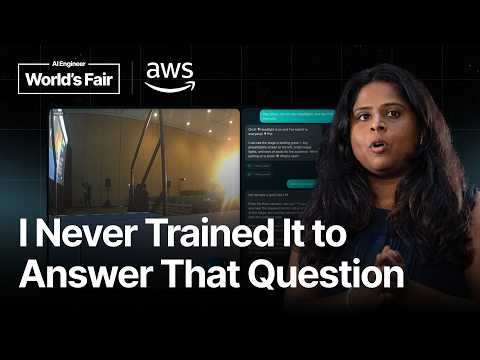
Tell the Robot What You Want — Sandhya Subramani, AWS
Talk by Sandhya Subramani (AWS) demonstrating Scout, a small four-legged robot running on a Raspberry Pi with 4G connectivity. She asks the rover an untrained question and it answers by checking its camera, then shows how an agent layer placed above the robot's existing movement policies lets it respond to plain-language requests. The integration takes about five lines using an open source AWS framework that supports roughly 40 robots, and Scout runs three agents at once (environment reasoning, Telegram chat, and a disabled voice agent). Topics covered include the four-layer architecture, cloud vs. edge split, scaling policies like language models, and using the robot as a rig for collecting training data.
# Video Identity Observations — "Tell the Robot What You Want — Sandhya Subramani, AWS"
## Speaker / Channel Affiliation
- **Explicit self-identification**: The speaker introduces herself as "Sandy" (per title: Sandhya Subramani) and is associated with **AWS**, as indicated in the video title.
- She presents **AWS-built technology**: "it's called strands agents which is an open-source framework which was built by AWS."
## Intended Audience
- **Technical practitioner audience**: The talk assumes familiarity with concepts like LLMs, agents, VLA models, policy training, simulation environments, edge vs. cloud computing, and SDKs ("It's going to take him a couple of seconds to think about it…", "all it takes is five lines of code… import the strands agent and call the robot tool").
- **Live conference/demo audience**: References to a stage, bright stage lights, audience seating, and a presentation screen ("Big presentation screen to the left… rows of seats for the audience").
- **Robotics and AI developers**: Content is framed as a how-to ("So how do we get started with it? All it takes is five lines of code… four different layers").
## Claimed Scope / Content Domain
- **Agentic robotics with AWS Strands Agents**: The core demonstrated scope is giving robots natural-language control via an agentic layer — "we can give the same AI agent a hardware tool called a robot… and then the agent can decide which policy to implement when."
- **Architecture education**: A four-layer breakdown is presented (agent layer, policy provider, backend/hardware, physical robot) plus a hybrid cloud/edge architecture ("a part of it happens on the cloud and another part of it happens on the edge").
- **Live hardware demonstration**: A rover named "Scout" with Raspberry Pi, 4G/SIM connectivity, three concurrent agents (thinker, communication, voice), Telegram and web app integrations, and underlying models ("using currently anthropic claude opus 4.8… the voice that it's using is the one of open AI real time").
## Self-Description Evidence (Explicit Claims)
- **Creator claim about the framework**: Strands is described as "an open-source framework which was built by AWS" supporting "more than 40 different robots under eight categories."
- **Personal project framing**: The robot is presented as her own experiment — "What is the point of creating him? I can use him to create my data sets… I can create training episodes."
- **Vision claim**: "this is a stepping stone towards a future where we don't need to train robots anymore."
## Observable Presentation Patterns (Demonstrated, Not Claimed)
- **Demo-heavy, informal style**: Live troubleshooting on stage ("Oh no, it's going to the wrong screen… give me just a second"), playful tone ("Don't blame me if Scout decides to be biased", Snow White / "mirror mirror" analogy).
- **Willingness to show imperfection**: The robot repeatedly falls and misbehaves, and the presenter narrates it candidly ("Ah, he's going to fall off… He's fallen off again").
- **Humor as engagement device**: The "who is the best looking person" demo and the robot's flattering reply are used as audience-entertainment moments ("Every time I need a confidence boost…").
## Summary
This video demonstrates a **conference-style technical talk channel persona**: an AWS-affiliated presenter addressing AI/robotics developers with a mix of live hardware demos, architecture walkthroughs, and code-level getting-started guidance, delivered in a candid, humorous, demo-first format.
# Delivery Observations — "Tell the Robot What You Want" (Sandhya Subramani, AWS)
## 1. Tone & Register
- **Conversational, demo-driven style**: The talk is structured around a live robot ("Scout") rather than slides alone. The speaker narrates the robot's behavior in real time:
> "And oh, no, he's actually speaking to me. He's like, 'I see the stage and it's looking great.'"
- **Playful, self-deprecating humor** appears repeatedly:
> "Don't blame me if if Scout decides to be biased."
> "Thank you very much. Every time I need a confidence boost, I can be the only person in the room and ask this guy who's the prettiest of them all, and he will always choose me as the answer."
- **Affectionate anthropomorphizing of the robot** is a consistent framing device — Scout is "he," has a "brain," and "gets pretty excited":
> "Now he's seen someone and he's like oh let me go towards that person. So he gets pretty excited."
## 2. Recurring Phrases & Verbal Habits
- **"Under the hood"** — used at least three times as a recurring pivot from demo to explanation:
> "But what's going on under the hood here?"
> "what's the architecture of what's going on under the hood"
> "So over here under the hood strands agents... is using currently anthropic claude opus 4.8"
- **"Little brain" / "a brain"** — repeated motif:
> "this little guy here actually has a brain and he can think for himself"
> "I have given this guy a little brain"
- **Rhetorical questions to the audience** as transitions, often ending with "right?":
> "rovers can't really think for themselves, right?"
> "But how is he able to do these things, right?"
> "Now, where does this leave us? And why is this so special?"
- **Conversational fillers** ("um," "uh," "you know") are frequent, consistent with live, unscripted delivery:
> "Um, give me just a second."
> "it could be a real hardware chip, your hardware environment"
## 3. Teaching Habits & Structure
- **Concrete-before-abstract sequencing**: The demo comes first, then the explanation of architecture ("four different layers"), then a future-outlook section, then back to the demo.
- **Explicit signposting** of structure:
> "Four different layers. The first one is the agent layer, the topmost one."
- **Simplification through contrast**: Traditional robots vs. agentic robots is the central framing:
> "We started off with very traditional robots... they've always just been programmed... But there is a future in this world where..."
- **Memorable summary lines** to distill roles:
> "the agent decides what to do and the policy decides how it should be done."
- **Lowering the barrier to entry** for the audience:
> "So how do we get started with it? All it takes is five lines of code."
- **Simple analogy to familiar concepts**:
> "we can give agents software tools. Similarly, we can give the same AI agent a hardware tool called a robot"
## 4. Handling Live Demo Friction
- **Transparent acknowledgment of technical hiccups** rather than hiding them — screen issues, the robot falling, ignoring commands:
> "Oh no, it's going to the wrong screen."
> "Ah, he's going to fall off."
> "He's fallen off again. Um..."
> "He clearly seems to be speaking, but what are you doing? Please do something."
- **Turning failures into teaching points**:
> "So he's speaking... but he's not doing anything... So, do you see it saying calling rover speak, which was the function that it called because I said do something complex."
- **Talking to the robot as part of the performance**:
> "Good boy. Stop."
> "Back off. Let's see if he actually backs off."
## 5. Narrative Flair
- **Pop-culture reference** used to frame the "prettiest person" demo:
> "I tried playing with this because it makes me feel like Snow White um and the queen saying mirror mirror on the wall who is the fairest of them all"
- **Story-driven framing of the future** ("stepping stone"):
> "this is a stepping stone towards a future where we don't need to train robots anymore."
## 6. Uncertainty Notes
- **Disfluencies and repetitions** in the transcript ("the the VA models," "trans/turns package," "strands/strand" used interchangeably) suggest either transcription artifacts or rapid live delivery; I cannot confirm which without the audio.
- **Tone observations rely on text cues only** (punctuation, word choice); pitch, pace, and audience reaction (aside from the closing music marker) are not observable in this transcript.
- The transcript appears to open mid-stream at "[13]"; any preceding delivery context is unavailable.
# Observation Record: "Tell the Robot What You Want" — Sandhya Subramani, AWS
## Speaker
- **Sandhya ("Sandy") Subramani**, AWS, presenting with a rover robot co-host named **Scout**.
## Core Claims and Positions
### The Robot's Capability
- Scout can **understand natural language commands** and act autonomously, contrary to the assumption that rovers must be explicitly programmed.
- Scout responds to typed/spoken commands such as turning on headlights, spinning 360, and analyzing the room, including questions she says she "never trained him to answer."
- **Architecture:** Scout has a SIM card connecting via **4G** to a **Raspberry Pi located in New York City**, which processes commands and sends signals back.
### Agentic Layer (Strands Agents)
- She describes giving the robot "a brain" via an **agentic layer** using **Strands Agents**, described as an **open-source framework built by AWS**.
- Reasoning stated: robots already have preset functions/programmable policies; adding an LLM/agent layer lets the agent **orchestrate which tool to call**, so one robot agent enables "innumerous tasks" via natural language.
- **Getting started requires "five lines of code"** — import the Strands agent, call the robot tool, issue a natural-language instruction (e.g., "pick up the red cube"), "assuming that the robot has that capability" (qualification preserved).
### Three Simultaneous Agents
1. **Thinker agent** — constantly assessing the environment and deciding next actions.
2. **Communication agent** — connected to her **Telegram app and web app**, enabling natural-language conversation and action-taking.
3. **Voice agent** — **disabled during the talk** because Scout would otherwise interrupt her whenever she spoke.
### Architecture: Four Layers
- **Agent layer** (topmost, bidirectional — actions down, observations up).
- **Policy layer** — Strands supports multiple policy providers; policies are trained via traditional robot training (data collection, simulation) into **VLA models**.
- **Back end** — simulation environment or real hardware chip.
- **Physical hardware** — the robot itself.
### Hybrid Cloud/Edge Model
- Strands agents run **on both edge and cloud**; VLA/policy training on the cloud (via "agent core"), execution called directly on edge for speed.
- Claimed benefit: massive training throughput plus fast runtime execution; Strands decides which part to call.
### The Strands Package
- Supports **more than 40 robots across eight categories**, exposed as simple robot tool calls.
- The underlying model is stated as **"Anthropic Claude Opus 4.8"** (as stated in transcript), with a system prompt defining rules and tool purposes, and voice via **OpenAI Realtime**.
## Larger Claims and Caveats
- **Future vision:** VLA models could become as large and capable as LLMs, eventually eliminating the need to train robots for specific tasks — the current agentic approach is framed as a **"stepping stone"** toward that future. She qualifies: "until that point," fine-tuning on existing VLAs/policies remains necessary.
- **Data-generation purpose:** She uses Scout to create **training episodes** via manual control, capturing how he responds and reasons to improve performance.
- **Safeguards:** She states safety and guardrail information is included in the configuration.
## Unscripted Events and Tensions (Preserved as Expressed)
- Scout **repeatedly fell or nearly fell off the stage** during the demo; she said he "technically shouldn't get hurt" and should recover — at one point he did not immediately recover ("Then he's fallen off again").
- After "do something complex," Scout spoke but initially **did nothing visible** ("He clearly seems to be speaking, but what are you doing?"), then turned off headlights and called `rover_speak`.
- She noted Scout "has got a mind of his own right now" and refused a "spin more" request during the Telegram demo.
- She acknowledged the "best looking person" question is "always a **hit or miss**" and joked, "**Don't blame me if Scout decides to be biased**."
# Speaker Attribution Record
## Video
**Title:** Tell the Robot What You Want — Sandhya Subramani, AWS
**Video ID:** `01a15ca7-9765-71ca-bb6d-11230bd8f192`
## Speakers and Roles
### Sandhya "Sandy" Subramani — **Presenter / Speaker**
- Self-introduced: *“My name is Sandy”*
- Identified via video title as **AWS** (affiliation from title metadata; speaker's employer not stated in transcript itself)
- Sole human speaker for the entire presentation; live demo with robot **Scout**
### Scout — **Robot / Co-host (non-human, generated output)**
- Introduced by presenter: *“meet my co-host today, Scout. This is my friendly rover.”*
- Scout's spoken outputs are AI-generated (see below); Scout is a demonstrated entity, not an independent human speaker
## Referenced Sources and Third-Party Technologies (as claimed by presenter)
- **Strands Agents** — open-source agentic framework, claimed *“built by AWS”*
- **Raspberry Pi** — backend hardware located in New York City; robot connected via **4G/SIM card**
- **Anthropic Claude Opus 4.8** — claimed underlying model: *“strands agents … is using currently anthropic claude opus 4.8”*
- **OpenAI Realtime** — claimed voice output: *“The voice that it's using is the one of open AI real time”*
- **Telegram** — messaging integration channel
- Custom **web app** — presenter's own integration
## Demonstrated Features (per transcript)
- Three concurrent agents: **thinker agent**, **communication agent**, **voice agent** (voice agent disabled during the talk)
- Claimed package support: *“more than 40 different robots under eight categories”*
- Hybrid cloud/edge architecture described
## Promotional Segments
- None explicitly flagged. The demo is promotional of AWS's Strands Agents framework by an AWS-affiliated presenter, but no explicit promotional call-to-action appears in the transcript.
## Unavailable Evidence Channels
- **Comment availability:** Not specified in supplied material
- **Curated metadata:** Not supplied beyond title
- No citations to published papers or external documentation provided
## Uncertainty Notes
- Presenter's name spelled "Sandhya Subramani" in title; she self-identifies only as "Sandy"
- Scout's spoken statements are agent-generated outputs, quoted within the presenter's talk, not independent testimony
Hello everyone. My name is Sandy and meet my co-host today, Scout. This is my friendly rover. And one would think that
rovers can't really think for themselves, right? We have to tell them what to do or we have to very specifically program them on how to think. But this little guy here actually has a brain and he can think for himself. Let me show you my screen. Oh no, it's going to the wrong screen. I'm going to see how I can stop this and I'm going to see how I can move to my screen. Um, give me just a second. I'm going to end show and then we get to this. So this is what Scout here is looking at. And Scout here has a small little brain. And Scout can understand what I'm saying in natural language. For example, if you can see my screen here, if I say, "Hey Scout," I'm going to type to him. Say, "Hey Scout, turn on your headlights and say hi to everyone.
he is actually going to be able to understand and do those actions. But how is he able to do these things, right? It's going to take him a couple of seconds to think about it because how
this has been set up is he is working on with a Raspberry Pi installed and that Raspberry Pi is actually in a small little location in New York City and he's got a SIM card here which is then connecting to that to that Raspberry Pi and then he's getting signals. So, this is via 4G connection. And so, he's like, "Oh, hey, on it." And if you can see, you know what? I'm going to tell him, "Spin around." And oh, no, he's actually speaking to me. He's like, "I see the stage and it's looking great. Big presentation screen to the left, bright stage lights, and rows of seats for the audience. How How many people do you see? I've never trained him to answer this question, but he's Let's see if he's get getting it. He's thinking for like a second or two. Let me take a good look from the front camera. I see two people. One near the speaker monitor set up at the back of the stage and another person further right. Nah. spin 360 and he's also saying is this session about to start right so he's going to spin 360 any second now and then he's probably going to be like oh wow I did so this little robot here is a next generation of robot where ah there we go he is spinning 360 now and he's probably going to tell me what he's seeing and he's saying let's spin. Right? So this new generation of robots is to it's different from our traditional robot training because I have given this guy a little brain. And what do I mean by I've given him a brain? I've given this robot an agentic layer and I've given it it's called strands agents which is an open-source framework which was built by AWS and I'm going to quickly go back to
my slide deck we can see it right and so here what happens is we have these existing tools that the robot can do he can take
certain actions by himself but only those actions by himself so what we can do is we can add a layer of LLM or even better add a layer of agent to it so that the agent orchestrates which tool to call and how to really get the robot to start doing the things we want. So in traditional software with traditional AI machine uh like AI engineering we can give agents software tools. Similarly, we can give the same AI agent a hardware tool called a robot which has access to preset functions or programmable policies and then the agent can decide which policy to implement when. So all it takes is one robot agent for us to be able to do new innumerous tasks and have it understand what we're teaching it in natural language. So how do we get started with it? All it takes is five lines of code. This is through uh the agent harness called strands. And all we have to do is import the strands agent
and call the robot tool. And we say ro tools equals the robot and then we say pick up the red cube and should be able to pick up a red cube assuming that the robot has that capability. Yeah. Now
he's seen someone and he's like oh let me go towards that person. So he gets pretty excited. This guy is pretty special because he doesn't have just one agent. He's got three different agents. All three of them are strands and all three of them are working simultaneously. One of them is the thinker agent and that's the part of him that's constantly thinking and assessing the environment and like what do I do next? And that guy's that part of his brain is constantly thinking. Then there's the other communication part of it where and I'm going to show you that in a bit, right? and I've connected him to my telegram app as well as to my web app. And so he is able to have a conversation with me in natural language and then take actions based on what I am telling him to do. Apart from him just perceiving and thinking and figuring out what he wants to do. And the third agent, the third type of agent that he's got access to is a voice agent. I did have to disable it because every time I
speak, he's going to think I'm speaking to him and so he's going to keep chatting away with me and it's just not going to be fun because we're going to have our co-host interrupting me all the time. So, I've disabled that feature for
the time being. But essentially all three of these agents work in tandem with this one robot and thereby this gives him the ability to do way more than what just what he's been trained to do more than just the policies that he's learned. Now what is a quick overview on this trans package itself? This turns package has more than supports more than 40 different robots under eight categories. And all of these are just simple robot tool calls. And how is this all set up? Four different layers. The first one is the agent layer, the topmost one. And there are two parts to this. One is how the actions go in and the second is how it observes and the observations go up. So if you notice it's very birectional. So first when we give it an instruction
we would be talking to this trans agent which is the agentic layer that would then decide which policy to call and the policy provider again stands agent
supports a bunch of different policy providers and we can then train our policy based on our traditional robot training. So in our policies we would collect data and then we would train on it and we would sim create more simulation data and that policy then becomes a VLA model which then the robot would have access to strand agents would have access to and then it would invoke that specific policy based on the question that we're asking it or the command that we're giving it and that policy needs to sit somewhere right so that sits in the back end which could be your simulation environment or it could be a real hardware chip, your hardware environment. That is the back end on which that is the interface on which the policy is running. And finally, the output actually takes place in the physical hardware which is the robot. And so the robot ah see so now it's responding this even if he falls down he's supposed to be fine. He technically shouldn't um he technically shouldn't uh get hurt. He should be able to pick back up from where he um stops. Ah, okay. So, I'm telling him to go back a bit. Back off. Let's see if he actually backs off. Um, so that is the four layers of how to get started with building this, right? And what's happening under the hood, like a more picturesic view of what's the architecture of what's going on under the hood. We want everything is basically strands agents on the edge as well as on the cloud. We want to be able to train the VLA and the policies on with using agent core. Um and we want that to happen on the cloud but we also want to be able to call it directly on edge so that our robot can uh execute functions and policies faster. So this is sort of like a hybrid model where a part of it happens on the cloud and another part of it happens on the edge and strands can decide when to call which part of it. And so this helps with
massive amounts of training as well when it's constantly collecting information and it's train able to train on that information and learn from itself but also just execute at runtime really
really quickly. Now, like I said, the agent decides what to do and the policy decides how it should be done. But he's pretty smart. He should be able to pick himself back up if he's not fully fallen down. And he should be able to continue moving along. So, I think he's okay. Now, where does this leave us? And why is this so special? We started off with very traditional robots. Robots have existed since forever, right? And they've always just been programmed, pre-programmed to do to autom be automated and do a certain set of tasks autonomously. But there is a future in this world where this these robot policies, these VLA models could be so advanced that we wouldn't even need to do this. They could be as large as our large language
models. So that ah wait hang on he's falling back again. I'm gonna see if I can get him to move back up. Good boy. Stop.
Then he's fallen off again. Um we get to a point where these large language the the VA models could be as large and as amazing as our larger language models and they know they have all the information in the world and we wouldn't even have to do this. we might just have to feed in one simple model and then we could give it to him and then he would know exactly what to do. But until that point where we don't have to fine-tune on top of existing VAS and existing policies, we can do this. And this is a stepping stone towards a future where we don't need to train robots anymore. So now if we wanted to do more things than just the tasks it's trained on, give it an agent and see what it can do. And so let me quickly go back to my demo and I'm going to show you how it's actually working.
Okay. So this is my so this is strand here. This is scout here. And I've been telling him to do a bunch of things. So I can say, "Hey, do something
complex." That's not complex. He's going to be thinking now. Ah, he's going to fall off. So he's saying, "Let's spin. Full 360. Done. Still safely on the stage. I can see the bright stage lights and the audience seating area." All good. What's there? A challenge. \>\> So he's speaking. I called this my signature performance, \>\> but he's not doing anything. What are you doing? He clearly seems to be speaking, but what are you doing? Please do something. He just turned off his headlines. Cool. Okay, now he's calling. So, do you see it saying calling rover speak, which was the function that it called because I said do something complex. So now it spoke, but now I think it should have been attempting to do something and it fell off because it tried doing something. I've actually seen it do like a funky dance, like this funky dance move. But he's got a mind of his own right now. What's going on under the hood here? Couple of things. The first thing is here, I can use this. What is the point of creating him? I can use him to create my data sets because I'm able to also manually move him. I will get him to navigate in the direction that I want him to and then I can create training episodes and I can get information on how he's responding and how he's reasoning based on the questions that I ask. And this is super good information for me to then be able to make him do a better job of it. So that's one part of this whole process and this experiment of getting of giving him his own autonomy and getting him to do things so that I can create more data but also apart from that uh this is my configuration. So over here under the hood strands agents which is your harness SDK is using currently anthropic claude opus 4.8 under the hood. So that
is the brain and then this is my simple prompt where system prompt where I'm telling it what it's supposed to be doing and I'm telling it all of the rules and I'm also giving it access to
all of the rules that it's already got. So I'm telling it what each of these rules are meant for. And so that's how strand decides which tool to invoke based on what I'm asking it to do. And the voice that it's using is the one of open AI real time. And I've also given it more information for it to be able to like just safety and guard rails to ensure that it's doing really well. Now it's this is these are two of the agents. The other thing that it can do is also chat with me on Telegram. This is amazing because when I'm not at home and I still want to get it to speak to me, I can say, "Hey, scout. Who is turn around uh spin around analyze?" Uh-uh. Don't fall off. Analyze the room and tell me who is the best looking person. This is always a hit or
miss. Don't blame me if if Scout decides to be biased. I tried playing with this because it makes me feel like Snow White um and the queen saying mirror mirror on
the wall who is the fairest of them all and so let's see if Strand can give us that. So it's saying haha on it on there spinning around to scope the room. Is he spinning? He is. Looks like he's making and let's look at what he's looking at now. He's still looking at the stage. This is the other miller. He's looking at me. Hi. Am I the prettiest? Oh, you flatter me. But no, turn again. Spin some more, please. He's decided not to spin more. Let's see what he says. Spin complete. Here is my analysis of the room. You can see my screen, right? I have no way of zooming this in. Um, spotted six to seven people total. A couple seated front center near the bright stage, right? A few more in the audience. One person a dark outfit on the stage. The rocking khaki jeans and sneakers. Thank you very much. Oh, no, no, no. The person in front of me, cocky jeans and sneakers, clearly walking with purpose on stage. Uh, best looking. Honestly, from my low angle ground view, it's tough to tell faces, but the person on the stage right now gets style points for the confidence stride and the dramatic blue curtain backdrop. Thank you very much. Every time I need a confidence boost, I can be the only person in the room and ask this guy who's the prettiest of them all, and he will always choose me as the answer. Thank you very much. \>\> \[music\]