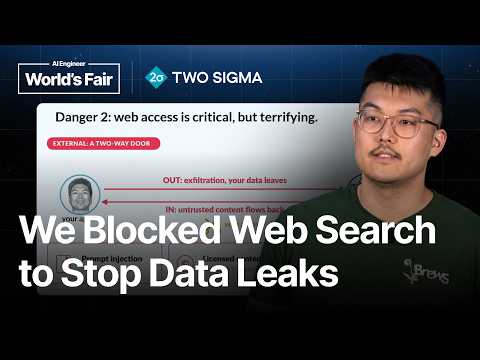
Tethered: Our Agents Are Us — Shu Fang, Two Sigma
A talk by Shu Fang (Two Sigma) on how the quant fund gives every employee a cloud AI agent that runs under the employee's own identity rather than a separate service account. He explains why a separate agent identity collapses in practice (permission drift, duplicate licensing, systems forbidding two identities on the same data) and how existing per-person Kubernetes namespaces made user-identity agents feasible. He covers the two main resulting dangers: distinguishing human actions from agent actions via a propagated provenance header (like a trace ID) that captures the full replayable chain, and the risks of open web access (exfiltration, prompt injection, licensing exposure), which they mitigate with Google's enterprise web grounding inside their network boundary while denying native search/fetch tools, accepting roughly 24 hours of index staleness. Timestamps also indicate segments on the fund's name, agent identity framing via the film Us, risk/return analysis, and Q&A on local models, spoofing, and audit.
# Channel Presentation Observations: Video `01a15ca7`
## Video Identity
- **Title:** *Tethered: Our Agents Are Us — Shu Fang, Two Sigma*
- **Format:** Conference-style talk with audience Q&A (ends with `[applause]` and audience questions), indicating a public event presentation rather than a produced tutorial.
## Explicit Self-Description by the Creator
- Speaker introduces themselves directly: *"I'm Shu Fang from Two Sigma"* and describes the employer as *"a little quant fund"* that is *"25 years old"* and *"a very regulated industry."*
- The speaker repeatedly frames views as personal, not corporate: *"the views are mine and not necessarily the companies"* and during Q&A, *"not the views of my company, but personally I think..."*
- Explicit hiring pitch: *"we are hiring and we encourage you to apply... check that QR code, check that link."*
## Claimed Scope of the Content
- The talk documents an enterprise AI-agent deployment: running **cloud agents under each user's own identity** rather than separate machine identities.
- Core technical claims:
- **Attribution via header propagation** — an agent-appended header (like a trace ID) distinguishing human vs. agent actions and enabling full provenance replay.
- **Safe web access via a cached enterprise search index** (described as Google's "web grounding for enterprise"), with native web tools like *"web search, web fetch"* denied to agents.
- Framing borrowed from finance: optimizing a *"return over risk"* / Sharpe-ratio-like tradeoff for agent permissions.
- Speaker explicitly positions the talk as enterprise guidance: *"this is one thing people should really consider, especially people working at companies, enterprises."*
## Intended Audience
- **Technical professionals at enterprises**, evidenced by:
- Assumed familiarity with concepts like trace IDs, Kubernetes namespaces, MCP, CLI tools, and agent harnesses (*"this is something we've all hopefully done in some way, right? Trace IDs"*).
- Attention to non-CLI users as stakeholders: *"many many people technical or not are not comfortable fully operating within a CLI."*
- Recruiting appeal to practitioners: *"if you have any experience in any of these domains."*
## Observable Presentation Patterns
- **Structure:** Opens with an extended metaphor (the horror film *Us*, "tethered"/"untethered" doubles), gives a legal disclaimer, then technical problem → solution → takeaways → hiring pitch.
- **Tone:** Casual, self-deprecating, and humorous despite serious security content (*"That's why I grew this mustache so you could tell the difference between us"*; the company name explanation about "two sigmas").
- **Evidence of production deployment:** The speaker claims shipped, company-wide infrastructure — *"a managed fleet of cloud... agents for every single user"* — and states *"everything I talked about actually happened last year,"* positioning the content as a retrospective case study.
## Claims vs. Demonstrated Content
- **Creator claims:** Safety improvements, preserved expected value, reduced exfiltration/prompt-injection risk. These are stated assertions from the speaker, not independently verified in the material.
- **Demonstrated:** Detailed architectural reasoning (identity model, header propagation, tool denial, index-based web access) and candid Q&A, including acknowledged limitations — e.g., index freshness lag (*"fresh within 24 hours... 6 hours"*).
# Delivery Observation: Shu Fang, "Tethered: Our Agents Are Us"
## Overall Tone
- **Conversational, lightly humorous** — a relaxed conference-talk register rather than formal presentation:
> "That's why I grew this mustache so you could tell the difference between us for now."
- **Casual disclaimers delivered with dry wit**:
> "You don't have to read it. It just has to be in this."
- Self-aware hedging humor about the company name:
> "ostensibly is not because we have two co-founders who are very online"
## Vocabulary & Framing Devices
- **Recurring financial metaphors** mapped onto agent security (consistent with the Two Sigma context):
- "risk and return," "differentiated alpha," "the sharp ratio" [sic — Sharpe], "optimizing that ratio of return over risk"
- **Recurring pop-culture framing**: the horror film *Us* is a sustained analogy thread — "tethered," "un tethered," "golden scissors" — bookending the talk:
> "make sure you ted your agents right letting them run around untetered you know is very dangerous we want to tar them"
(Note: transcript shows possible transcription artifacts "ted"/"tar" for "tether".)
- **Shorthand tech terms used fluently and without explanation**: Kubernetes, sidecar, VPC, MCP, trace IDs, namespaces, spans, CLI.
## Recurring Phrases & Verbal Habits
- **"Right?" as a frequent discourse marker** — appears many times, often after stating a claim:
> "And as a result, all the capabilities, all the access, all those previous constraints are no longer valid."
> "So of course there are big dangers with this right"
- **"You know" as filler**, dense throughout:
> "you know code containers usually operate on this principle"
- **"TLDDR"** used twice as a summarizing device:
> "the TLDDR is that I'm not trying to sell you on anything"
- **Rhetorical question → answer structure** to drive transitions:
> "So the question became Okay, how do we actually run these in terms of what identity they run as?"
> "So obviously it's like why don't we just run these as the user, right?"
## Teaching / Explanatory Habits
- **Problem → failure → pivot → solution** pattern, used repeatedly:
- Conventional "shoe agent" identity → "this quickly collapses" → list of reasons → run-as-user solution.
- **Numbered/listed structure** for constraints and risks ("One, differentiating access... And two, somehow getting safe web access in place").
- **Analogies to familiar engineering practice** as a teaching device:
> "This is something we've all hopefully done in some way, right? Trace IDs."
- **Explicit caveats after solutions** — consistently surfaces downsides:
> "There's one tiny downside, which is the data is obviously not going to be completely fresh."
## Q&A Delivery
- **Restates or clarifies audience questions** before answering:
> "His question was how do how do I view local LLMs for enterprise usage?"
- **Repeats the "not my company's views" disclaimer** when giving opinions:
> "not the views of my company, but personally I I think that is..."
- Answers are structured (identity → header → both together) rather than free-form.
## Audience-Aware Communication
- Addresses audience experience directly ("If any of you have seen us, you don't have to pay attention to this"; "I imagine a lot of you do too").
- Ends with a recruiting pitch framed with humor:
> "or even better, if you're like, that was horrible, we could do so much better. We are hiring"
## Uncertainty Notes
- Filler words ("uh," "you know," "right") are pervasive in this transcript; some may reflect transcription rather than delivery, so exact frequency should be treated cautiously.
- The talk appears lightly scripted in sections (disclaimer, takeaways) and more improvised in Q&A; the difference in fluency is observable but the degree of scripting is an inference.
# Observation Document: "Tethered: Our Agents Are Us" — Shu Fang, Two Sigma
## Context & Framing
- Speaker: **Shu Fang**, introduced as from Two Sigma (self-described "a little quant fund," ~25 years old, highly regulated industry).
- Disclaimers stated explicitly: views are the speaker's, not necessarily the company's; no endorsements implied.
- Title metaphor drawn from the horror film *Us*: "tethered" doubles running amok are "untethered" — the talk argues agents should be "tethered."
## Core Claim
- Two Sigma runs an ecosystem where **every employee has a cloud agent running as the user's own identity** (not a separate machine identity), and the speaker states they are "okay with this" given guardrails.
## Rejected Approach: Separate "Shu Agent" Identity
- Conventional wisdom of a machine identity attached to the user "quickly collapsed" due to:
- Difficulty keeping permissions in sync
- Software licensing doubling
- Systems (e.g., Google Workspace, email) not supporting multiple identities on the same data
- Systems that "block as a first step"
- Managing public/private boundaries
## Enabling Infrastructure
- Pre-existing **Kubernetes namespaces per user in every region**, originally for automated jobs, code containers, research notebooks — everything already runs as the user.
- Mechanics: a trigger hits a controller; a sidecar pulls identity from an identity service; containers mount and run as the user.
## Identified Dangers
1. **Internal attribution**: human vs. agent indistinguishable under one identity; need audit, blocking, and trace.
2. **Open web access risks** (called their "biggest fear"):
- Data exfiltration / IP loss
- Untrusted inbound content, prompt injection, malware
- Licensed/copyright content misuse
## Framing: Risk/Return
- Speaker frames the problem as optimizing a **return-over-risk ratio** (Sharpe ratio analogy): capture agent value while reducing risk.
## Solutions
### Attribution via Header Propagation
- Every agent appends to a header, analogous to **trace IDs** in deterministic code.
- Enforced via existing primitives: HTTP clients, MCPs, skills.
- Claimed benefit beyond identity: **full provenance** — ability to replay the entire chain of actions; a separate agent identity would only show the initial trigger, not the chain.
### Safe Web Access
- Uses **Google's "web grounding for enterprise"** — Google's index accessed within the company's VPC/network boundary; offers search and fetch.
- **Stated limitation (preserved)**: data not fully fresh — roughly 24 hours lag, ~6 hours for frequently updated sites; speaker judges this "probably more than sufficient" for most agent use cases.
- Native web tools (e.g., Claude Code's web search/fetch) are **denied**; access redirected through the grounding index via MCP/CLI/skills.
## Takeaways (as stated)
- "Make sure you tether your agents."
- Claim: they **didn't lose expected value** while hugely reducing risk — gained more observability from tagging than from pure identity verification.
- Broader advice: scary GenAI frontier capabilities can be de-risked using enterprise resources; "this is where you should be investing that time."
- Shipped: managed fleet of cloud agents for every user; anyone can deploy a remote agent running with their full identity.
## Q&A Positions (all attributed to Shu Fang, several flagged as personal views)
- **Local/self-managed LLMs**: personally (not company view) believes self-managed inference is "probably where we eventually want to go" due to cost, deprecations, frontier-model volatility, and improving open-weight models.
- **Header spoofing**: the header alone is not differentiating — someone could populate it — but the underlying identity chain is not mimickable; header is "XSLM-agent"-style plus separate identity verification at RPC entry points.
- **Prompt injection via Google index**: mitigation claimed because everything remains internal and Google applies curation/safety controls for regulated industries; **qualification preserved**: "certainly I think that curation could fail."
- **Session/behavioral data**: session data localized per user (colleagues can't view it); behavioral data used to configure agents based on actual usage rather than hierarchy.
- **Agent building/provisioning**: users build agents with existing frameworks; infrastructure is pre-provisioned per user; promoting an agent company-wide follows standard production-support/security review processes.
## Unresolved Tensions
- Freshness trade-off of the cached index acknowledged but judged acceptable — a stated judgment, not demonstrated.
- Prompt injection risk "much reduced" yet curation failure acknowledged as possible.
- Speaker's endorsement of self-managed local inference is explicitly personal, not company position — tension with the current cloud-agent setup left open.
# Speaker Attribution Record
## Video
- **Title:** Tethered: Our Agents Are Us — Shu Fang, Two Sigma
- **Video ID:** `01a15ca7-91ef-7d55-bfa7-7af3e7f165f1`
## Speakers
### Shu Fang — Creator / Primary Speaker
- Self-identified at talk opening: *"I'm Shu Fang from Two Sigma."*
- Delivers the entire presentation, takeaways, and closing remarks.
- Answers audience questions during Q&A, explicitly distinguishing personal opinions from company views at least once (*"not the views of my company, but personally…"*).
### Audience Members — Unidentified Questioners
- Multiple unnamed attendees ask questions during Q&A (local LLMs, header spoofing, Google index and prompt injection, session/behavioral data, agent creation process).
- Questions partially inaudible/fragmented in the transcript; some restated by the speaker.
## Roles Summary
| Speaker | Role | Confidence |
|---|---|---|
| Shu Fang | Creator / presenter (Two Sigma employee) | Explicit (self-identified) |
| Audience questioners | Unidentified guests | Explicit presence, identity unknown |
No narrator; no other identified roles.
## Provenance and References
### Third-Party Products/Companies Referenced
- **Two Sigma** — speaker's employer; described as a 25-year-old quantitative hedge fund.
- **Google** — "web grounding for enterprise" index product for regulated industries; speaker notes freshness constraints (24 hours general / 6 hours for frequently updated sites, "last I checked").
- **Brave** — referenced as the index behind Claude Code's native web search (speaker's characterization).
- **Claude Code (Cloud Code)** — referenced re: GA in June 2025 and web search/fetch tooling.
- **Kubernetes / MCP** — cited as existing technical primitives.
### Third-Party Media Reference
- The horror film **"Us"** — used as framing metaphor ("tethered"/"untethered" doubles, golden scissors).
## Promotional Segments — Flagged
- **Hiring pitch at closing:** Speaker states *"we are hiring and we encourage you to apply,"* directing to a QR code/link.
- **Legal disclaimer** read near the start: views are the speaker's, not the company's; no endorsement of mentioned companies intended.
## Claims Attribution Notes
- Company practices (agent identities in namespaces, header-based attribution `X-SLM-Agent`, tool blocking, managed agent fleet) are attributed to the speaker's account of Two Sigma's internal systems — no external documentation cited.
- Statements about Google's and Brave's products are the speaker's characterizations, some hedged (*"last I checked," "I think"*).
- Local LLM opinion in Q&A explicitly flagged by speaker as **personal view, not company view**.
## Availability Limits
- No curated metadata was supplied.
- Audience questions are garbled/incomplete in the transcript; identities of questioners unavailable.
- Comment availability: not stated.
Great. Thanks everyone for coming. Uh this talk is called Tethered. Our agents are us. I'm Shu Fang from Two Sigma and let's get started. So just a quick explanation. Two Sigma is a little quant fund. I will also take the opportunity to explain that the name ostensibly is not because we have two co-founders who are very online but because the two sigas are about the volatility sigma the small sigma and the large sigma sum. So by summing together these individual volatilities we can uh hedge the risk achieve differentiated alpha. Now because we are a hedge fund I have to give you all this important legal disclaimer. You don't have to read it. It just has to be in this. And the TLDDR is that I'm not trying to sell you on anything. The views are mine and not necessarily the companies. Any logos, any other companies I mentioned here are not me endorsing them or telling you to buy their stocks or anything. It is purely maybe coincidental. But that also is meant to segue into the fact that we are an old company. We're
25 years old and clearly we're a very regulated industry, but we've managed to run an ecosystem where everyone at the company has a cloud agent. And not only
that, but these agents run as their own identity. So, we're going to explain how we got here and why we're actually okay with this. So, we're first going to do a little horror movie review. If any of you have seen us, you don't have to pay attention to this. defend if you haven't the TLDDR of the movie is that everyone has these doubles and these doubles are called
tethered when the doubles decide to run loose and cause chaos and run around with these golden scissors they're called untetered and this is going to somehow relate into my talk
so back in June 2025 you know cloud code GA and all that stuff people started using agents through the local computer your local machine and it's very powerful but one it was CLI constrained and two it was localized right we wanted to achieve a world where people could use these agents from wherever they were whether it be mobile through slack through browsers but still have the ability to run them remote and this is important not just because of the capability but many many people technical or not are not comfortable fully operating within a CLI so the question became Okay, how do we actually run these in terms of what identity they run as?
The conventional wisdom is that you run these as some machine identity that is attached to your user in some way. You have a shoe and you have a shoe agent. But this quickly collapses and we found
this collapsed because of all the reasons that you can imagine, right? It's very hard to keep permissions in sync. Anytime you're dealing with software licensing, now you have to deal with two licenses. uh there's certain systems that do not support multiple identities interacting with the same underlying data. You know, stuff like Google Workspace, your emails, etc. And then how some systems are going to block as a first step. So you have to you're just going over the barrier of entry. And then you also have to figure out how you actually manage the public and private boundaries. So obviously it's like why don't we just run these as the user, right? How do how do we run these remotely as the exact same user identity? And as a result, all the capabilities, all the access, all those previous constraints are no longer valid. And we already had the info for this and I imagine a lot of you do too. If you don't, I would uh encourage investing in it, which is that you know you could have a Kubernetes cluster. You have all all of your clusters, your regions, etc. And you have name spaces for
individuals, right? And the reason we had this is because we often already needed this capability not for the agentic purposes, but for all the automated operations that we need to do
that did not suit confinement to someone's local machine. So we'd run automated jobs, you know, code containers usually operate on this principle, research notebooks, etc. And every single user already had these namespaces existing in every single region and everything in it runs as the user. A very simplistic way of how this works. Some trigger is going in to your controller and it's saying, "Hey, I need to spin up some compute resources. You have a separate identity service that a sidecar in the pod pulls down from to allow your actual containers to run and mount that identity and it runs as you. So of course there are big dangers with this right and you know the first danger you may imagine is an internal danger. How do you actually differentiate who or what took action right? You have you and your U agent are now the exact same
identity. That's why I grew this mustache so you could tell the difference between us for now. But uh you really want to know that differentiation because certain actions that can be taken. You want to audit,
you possibly want to block and you want to just have the trace, right? You want to have the attribution to determine, hey, was it someone operating as the human operating purely human actions or was it the agent identity doing these things? Another danger and perhaps a bigger one is we all know that for all of these
capabilities and LOMs in general, it's essential you have access to the external web. These are point in time mathematical functions that cannot actually update based on current data.
So it's like open internet access. That's why it's a core capability, web search, web fetch tools, right? The problem is once you have that capability, you leave yourself open to huge vulnerability vectors. One of which is exfiltration risk. This is one we are deeply concerned with in terms of possibly losing IP, you know, just exposing our sensitive information. but also certainly the possibility of untrusted content flowing back in and you know prompt injection just malware and vulnerabilities are all big risks there and then something we separately deal with is just the ability to make sure we don't u use licensed content without the right copyrights or actual licensing right you can map this to the golden scissors that they use and us so this is kind of our biggest fear to be honest So we are a finance firm and in finance there's a concept of obviously risk and return. So when we think about what is the positioning on the risk and return graph there's huge value in allowing
agents to run you but also there's very high risk. What we generally want to do is make sure we capture as much of the value as possible but reduce the risk.
We're optimizing that ratio of return over risk. Some of you may know the sharp ratio. We're looking at that from the perspective of how do we let agents run as users and optimize that return. And the ways we need to do this, right, are to solve those two critical problems. One, differentiating access attributed to the human versus the agent. And two, somehow getting safe web access in place. So the first thing we did is this attribution step, right? And how we did this is we use a header and we make sure that every single agent continues to append to that header. And this is something we've all hopefully done in some way, right? Trace IDs. You've you've all done this in
deterministic code. Making sure that your observability stack propagates through a trace ID through disparate systems. How we did it is very similar to how you would do it for trace ID
except we are dealing with a certain difference in the control vector which is the agent itself right and you can force you know using certain HP clients using MCPS using skills to make sure that that header initially gets populated and everywhere else along the way continues to be populated right you have a lot more deterministic control over agents and the harnesses and the frameworks than you may ink and you can enforce it with some of the already existing primitives. Now this gets very interesting because this is not only giving us the proper identification of who did something right it actually goes beyond that and no longer are we confined by just knowing the act identity but we also actually get the full provenence through the system right as we deal with multiple steps in the system we are able to replay the entire chain of actions that actually led to some end result. So the comparison here is if we had used that shoe agent identity we wouldn't have this and we would just know that at some point shoe agent triggered this initial flow into the span but we don't actually know hey those subsequent actions how do we properly trace back to that origination point with this header this trace ID we get that full propagation and the actor is still me right it's still my identity
And the second step that we needed to fix is this web access. Right? A lot of web access these days uses indexes for search. Right? I think cloud code's
native one is Brave web browser and it uses a Brave index. Well, we were like, hey, why don't we see what Google has, right? Google is at its core hopefully still a search company and they do this index generation already. And it turns out they actually do offer something specifically for regulated industries like ours that allows you to use their web index but within your existing VPC your you know network controls right and it's called web grounding for enterprise. It basically works like this where it's still within the exact same network boundary where you're probably running your cloud agents and stuff like that and offers two core capabilities search and fetch. Right? So the exact capabilities we want to mirror, we leverage that. We have all these guarantees. There's one tiny downside, which is the data is obviously not going to be completely fresh, right? And the constraints around this last I checked, it's fresh within 24 hours. And for more regularly updated websites, it's fresh within 6 hours. But for most use cases that you may have for agents, that's probably more than sufficient and completely removes this external egress vulnerability vector. Now the second question is how do we actually ensure the agents use web
grounding and again this is very simple with the existing primitives right you just need to make sure that they don't get confused and you certainly block the access itself but
just for user experience and stuff like that you need to make sure those tools themselves that are already existing and primitive and native to these agent harnesses and frameworks and such are actually blocked right again here's cloud code example. I think every other hotness has the same thing. Web search, web fetch. We just deny those tools. It's like, hey, you can't even use these. These are not even in your suite of tools available to you. Instead, we use the redirection going through, you know, MCP CLI and actual client code using the supported paths, uh, skills, whatever to make sure that whenever someone does need the capabilities of web access, it goes through that web grounding cache index. So takeaways from this talk basically make sure you ted your agents right letting them run around untetered you know is very dangerous we want to tar them and it's much safer to do so and in
fact if we go back to that initial slide of how we consider this relative to the risk and expected return because of some of the things we found while doing this we actually believe we didn't lose
expected value while huge hugely reducing the risk, right? So, the index certainly lags, but we get a ton more observability by just using that tagging primitive versus the actual uh just pure identity verification. And I think this is \[sighs and gasps\] one thing people should really consider, especially people working at companies, enterprises, which is that there are a ton of things happening in the Genai landscape that are probably scary to us that make your security teams really afraid that feel like, hey, they are too far on the frontier, right? You you're like, I wouldn't run this locally. I wouldn't run a open cloud agent on my local machine with full permissions, right? There's all these horror stories and you know various anecdotes about why this is bad. But in an enterprise again you can figure out how to leverage your enterprise resources to actually reduce those risk factors and get the real value out of the capabilities and this is where you should be investing that time. So what we ultimately shipped is this entire framework, right? We have the ability to run cloud agents as user identities uh because of all of those guard rails and vectors we put in place and using different kind of interface vectors to actually operate with them so that people who are not comfortable with CLIs can leverage them but certainly for other cases as well. And as part of that, we made sure to ship out just a managed fleet of cloud, you know, whatever agents for every single user in this remote fashion that they can already interact with so that we can continue to deploy and improve what is actually available to individual users. But also the core capability itself of being able for every anyone at the company to deploy an agent that runs in the cloud remotely with their full identity is there and is something we are comfortable with. So to finish up, uh, everything I talked about actually happened last year. So if you are interested at all in wanting to build and see what we're working on now, or even better, if you're like, that was horrible, we could do so much better. We are hiring and we encourage you to apply. If you have any experience in any of these domains, you can check that QR code, check that link. Yeah, that's it. Any questions?
\>\> What do you think about local connected to agents for enterprises? \>\> Uh, not the views of my company, but personally I I think that is
\>\> question. \>\> Yeah, sorry. His question was how do how do I view local LLMs for enterprise usage? And I think local in the sense that we manage ourselves is probably where we eventually want to go for a lot of our token use and inference because of cost because of deprecations because of you know every time Frontier Lab drops a new model you see some degradation. It's just there's too much volatility in that that we don't need to risk as the openweight models kind of become more advanced and sophisticated. request. \>\> Yeah. So as you can see the header is not purely differentiating in itself. Someone someone could certainly populate that, but the actor the identity itself will not be me, right? So some someone could I guess write in that they're using some agent, but the core previous identity itself is not mimickable, not like actually interceptable, right? So we still we have both we have both the originating identity and that you know all of your identity ecosystems and chains to ensure that but also the header. part of the header. \>\> Yeah, that that that is separate. The header is just XSLm agent and then you still have some way you you need some way to actually determine the identity of who's coming.
Yeah, I you know gen generally all of our RPC in some way has an initial entry point that is like populatable with that header and then once it actually goes downstream you
know you make sure that same with trace ids is part of the span internally within the So \>\> can you clarify how the use of Google index addresses the prompt injection issue? \>\> Yeah. So the core things about this index is not only is it a cached index, it is it has a lot of other controls and safety guarantees around it. It is specifically made for these curated financial like um highly regulated industries. So they themselves are doing some of their own curation on top of it. Now certainly I think that creation could fail. It's probably done using Gen AI but the prompt injection risk is much far reduced because everything still remains internal. \>\> Yep. \>\> Do you mean how they're being used? \>\> Yeah. I I think it's critical um in the sense that that behavioral data is something we can further configure based on right like that we we do try to ensure that not everyone at the firm can see what your agents are doing right like there's stuff certainly work-wise but also more sensitive information that might be privileged to you. So your session data is kind of localized. Now that behavioral data in the session data is very powerful because it can define additional configuration that can be applied to these agents for the purposes of making the user experience better. So we we try to leverage that to figure out what to configure further not just based on someone's like hierarchical persona but actually based on their usage to make sure that their experience continues to improve actually based on what they're doing.
Uh we're almost out of time. me and my co sorry I'll take the last question you're saying you have a process for letting individuals create their own
\>\> yep I mean how do you go about like anybody there is a process for like agents across the company \>\> yeah uh for building our own agents you know we we use some of the existing frameworks for agent building. Obviously all the genai harnesses are very good at using those frameworks to build agents. So you have a lot of agents proliferating based on that. In terms of provision, everything is already provision. All this is every single user at the firm has all the necessary infrastructure in place. So that's not really a worry. They can build an agent, deploy it as necessary into their namespace running as their identity. the the aspect of how do agents then become like a universal companywide or larger beyond a individual users uh agent you know goes through your standard kind of mechanisms right like hey is there going to be proper production support is there the right security it's like any application you might develop uh yeah so me and my colleagues will stick around here if anyone wants to talk further you know I guess if you're sticking around I can also take more questions but thanks for coming to this \>\> \[applause\]