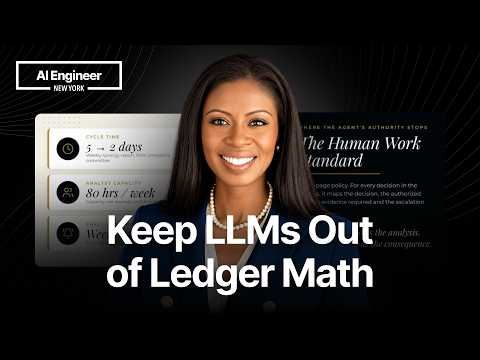
The Agent Works. Does Anyone Trust It? — Michele Grant,…
Michele Grant examines what it takes for an organization to trust a working AI agent in a core business process, using an illustrative acquisition integration scenario. She argues value must be measured against a baseline (reporting time, analyst capacity, operating cost, material issue detection), separates operational, risk-oversight, and independent assurance ownership, and introduces a Human Works Standard defining what the agent may do and where human judgment remains necessary. Supporting mechanisms include an auditable decision log, an agent inventory, an autonomy scorecard, and a four-stage path to greater authority: shadow operation, reviewed drafts, sampled exception handling, and exception-focused review with independent checks. Financial calculations stay in deterministic code while the model handles narrative and interpretation. The scenarios are illustrative, not disclosed results of a completed deployment.
# Video Identity Observations
## Creator Self-Description (Explicit Claims)
- **Named identity and role**: The speaker introduces herself directly: *"I am Michelle Grant, creator of Leading at Scale."*
- **Claimed expertise**: She states over two decades of relevant professional experience: *"I have spent over 20 years in enterprise transformation and more than a decade leading M&A integrations across media, tech, and consumer goods."*
- **Positioning as an authority/practitioner**: She frames her credibility around deal experience: *"On those deals, trust was not something we crossed our fingers and hoped for after launch. We engineered it before day one."*
- **Claimed purpose of the video/talk**: She positions herself as teaching an executive discipline: *"That work is not an engineering task. We find it is an executive operating mandate. And today, I'll show you how to meet it."*
## Intended Audience (Observable Presentation)
- **Enterprise executives and leadership**, not hobbyists or beginners:
- Framing: *"the question every enterprise is confronting right now is the agent works, does anyone trust it?"*
- Role references throughout: steering committees, CFOs, chief risk officers, integration leads, business unit heads.
- **Engineers in a governance context** are explicitly addressed as a secondary segment: *"where the engineers in this room come in"* — suggesting a mixed professional audience, likely at a conference or professional talk (title notes *"Leading at Scale"* as the platform/series name).
- **AI adoption decision-makers**: recurring vocabulary of value cases, risk appetite, audit plans, autonomy scorecards, and deployment gates assumes viewers control budgets and governance, not just code.
## Claimed Scope
- **Topic scope**: trust and governance of AI agents in enterprise operations — value definition, accountability, and evidence-based autonomy.
- **Method scope**: a prescriptive framework: *"leadership gets there by answering three straightforward questions. What value does it create? Who is on the hook for it? And what evidence gives it permission to run with greater autonomy?"*
- **Domain grounding**: scope is anchored in M&A integration: *"Picture a $15 billion acquisition targeting 400 million in net synergies"* with a 40-workstream IMO scenario.
## Demonstrated Presentation Patterns (Observed, Not Claimed)
- Long-form, structured instructional delivery with a running real-world scenario, staged framework (four-stage autonomy scorecard), and named artifacts (decision log, model inventory record, human work standard).
- Closing recap reinforces the framework as the video's takeaway: *"Answering those three questions is what earns it the trust to run at scale."*
# Delivery Observation — "The Agent Works. Does Anyone Trust It?" — Michele Grant
## Overall Delivery Profile
The delivery is **structured, instructional, and framework-driven**. The speaker teaches via numbered lists, named frameworks, and a single running example, maintaining a consistent consulting-style cadence throughout.
---
## Recurring Structural Patterns
### Numbered triads and tetrads
The delivery is organized almost entirely around enumerations, restated at intervals:
- **Three core questions**, introduced and repeated verbatim as a bookend:
> "What value does it create? Who is on the hook for it? And what evidence gives it permission to run with greater autonomy?"
Restated at the close: "What value does it create? Who is accountable for it? And what evidence permits it to operate with autonomy?"
- **Four leadership decisions**: "What is it permitted to do? Who owns it? What evidence it records and what triggers an escalation."
- **Three metrics**: cycle time, analyst capacity, detection time — each introduced with "First," "Your second metric," "Your third metric is the most important one."
- **Three lines model** (first/second/third line), **three artifacts**, and **four autonomy stages**.
### Signposting language
Frequent forward-pointing cues mark transitions: "First, let's look at cycle time." / "Next, the steering committee needs to know…" / "The second artifact is…" / "So, let's come back to the three questions."
### Framing devices
- Scenario grounding: "Let us ground this in a real-world scenario. Picture a $15 billion acquisition…"
- Direct address to audience segments: "The third question is where the engineers in this room come in."
- Instructional imperatives: "If the IMO cannot state the baseline today, do not deploy." / "Pay close attention to stage four."
---
## Vocabulary and Phrasing Habits
- **Business/governance register**: "risk appetite," "accountable executive," "operating mandate," "escalation path," "kill switch run book," "regression triggers."
- **Emphatic quantifiers**, even where generic: "Every single initiative," "every single line item," "every single metric," "single page view," "one-page policy," "one employee."
- **Condensed contrast statements** (rule-like aphorisms):
> "Go-live proves that a system exists, but it doesn't prove the people behind the work will actually use it."
> "A pilot tests whether the software functions, but daily operations is where we test whether it creates value."
> "The person who makes the decision owns the consequence."
---
## Teaching Habits
- **One sustained worked example**: the $15B acquisition / IMO scenario introduced once (~[158]) and carried through all three questions to the conclusion.
- **Concrete numbers throughout**: "400 million in net synergies," "40 workstreams," "five business days," "80 hours a week," "four-week pilot."
- **Conditional rules with consequences**: "If you can't measure where you started, you can never prove the agent moved the needle."
- **Anticipated objection handling**: "A falling override rate does not automatically mean the agent is getting smarter. It can also mean the depth of review has slipped."
- **Explicit authority framing**: "That work is not an engineering task. We find it is an executive operating mandate."
---
## Isolated Moments (low confidence as patterns)
- A brief **first-person credibility statement** early on: "I have spent over 20 years in enterprise transformation and more than a decade leading M&A integrations" — appears only once.
- A single **audible pause marker** in the transcript: "[clears throat]" at ~[710], just before the scorecard stages.
- Minor **transcription artifacts** suggesting occasional delivery hiccups (e.g., "this ticket it behaves unexpectedly" ~[485], "The one reason to delight delay deployment" ~[566]); the underlying spoken wording is uncertain.
---
## Stability Assessment
- **Stable (highly repeated)**: enumerated frameworks, signposting transitions, the aphorism-style contrast sentence, and sustained use of the single scenario.
- **Uncertain**: whether the "every single…" intensifier is a consistent verbal tic or concentrated in this talk; only one talk is observable, so no cross-video claims can be made.
# The Agent Works. Does Anyone Trust It? — Michele Grant, Leading at Scale
## Speaker & Framing
- **Michele Grant**, creator of *Leading at Scale*, cites **20+ years in enterprise transformation** and **over a decade leading M&A integrations** across media, tech, and consumer goods.
- **Central claim:** Go-live proves a system exists, not that people will use it or that it will deliver deal-model value. Trust in AI agents must be **engineered before day one**, as she says was done in her M&A integration deals through early change and risk management.
## Core Thesis
> "An agent earns trust when it delivers the value the business budgeted for while staying strictly within the company's approved risk appetite, policies, and regulatory guardrails."
- Leadership earns this trust by answering **three questions**:
1. **What value does it create?**
2. **Who is on the hook for it?**
3. **What evidence gives it permission to run with greater autonomy?**
- Distinguishes **pilot vs. production**: a pilot tests whether software functions; daily operations test whether it creates value within leadership's controls.
- Positions agent-specific governance as an **executive operating mandate, not an engineering task** — established AI risk frameworks give principles but not per-agent application.
## Illustrative Scenario: $15B Acquisition
- Deal closed; **400M net synergies** target; **IMO** drives a synergy roadmap across **40 workstreams** (vendor rationalization to ERP consolidation), each with an accountable business owner.
- Manual process: weekly reconciliation against the general ledger, variance analysis, executive deck for the steering committee (CFO, CRO, BU heads, integration lead).
- Engineering builds an agent to automate the first draft (ingest updates, reconcile ledger, run variance math, flag lagging initiatives). A **four-week pilot** matches analyst reports **line for line** — "the tech works."
## Question 1 — Value: Written Value Case with Pre-Deployment Baselines
Three metrics, agreed before the agent touches production data:
- **Cycle time** — e.g., reduce weekly report compilation from five business days to two.
- **Analyst capacity** — four analysts spending half their week on the deck = **80 hours/week returned**; counts as value only when reassigned to lagging workstreams and **net of compute, licensing, and human review costs**.
- **Detection time** (called "the most important one") — time from first data slip to steering-committee visibility; faster reports alone don't guarantee earlier detection.
> "If the IMO cannot state the baseline today, do not deploy. If you can't measure where you started, you can never prove the agent moved the needle."
## Question 2 — Accountability: Three Lines Model + Human Oversight
- **First line:** Management owns controls; the integration lead is the accountable executive, owning the agent's output as she owned the manual data.
- **Second line:** Risk and compliance oversee and challenge; review depth scales with exposure (internal draft scrubbed by an analyst vs. autonomous agent publishing to the board).
- **Third line:** Internal audit provides assurance, admitting the agent to the annual audit plan based on material risk.
**Daily human overseer:** a senior analyst with four required capabilities — understanding operational boundaries, interpreting output with context, **authority to override/reverse**, and a **clear kill switch**.
**Human work standard:** a one-page policy mapping every decision fork to the authorized human role, required evidence, and escalation path. Decision tiers: senior analyst (timing difference vs. real cash shortfall), workstream lead (remediation), integration lead (flagging at-risk initiatives). The agent prepares analysis only; **the decision-maker owns the consequence**.
> "The one reason to delay deployment is a decision with no assigned owner."
## Question 3 — Evidence for Autonomy: Three Artifacts
1. **Auditable decision log** — raw data ingested, tool calls, prompt, model versions, output, human sign-off. Two engineering rules: deterministic, finance-approved code for core math (not LLM-generated prose); model summaries treated as **explanation, not proof** — proof lives in telemetry. On ledger mismatch, the agent never touches the number; it flags and routes up.
2. **Model inventory record** — accountable executive, data lineage, source-system dependencies, validation results, escalation path, kill switch runbook, and **regression triggers** (base model or source-API changes requiring full revalidation).
3. **Autonomy scorecard** — four stages: **shadow mode → supervised draft → exception ensemble (lagging initiatives + random sample) → exceptions only**.
**Caution on stage four:** the biggest vulnerability becomes **what the agent failed to flag**. A falling override rate doesn't automatically mean the agent improved — it may mean review depth slipped; **independent sampling** distinguishes the two. The scorecard pairs control metrics with value metrics (cycle time, analyst hours, detection time), enabling decisions to promote, hold, or step back the agent.
## Closing Position
- The agent did **not** create the 400M in synergies — procurement, supply chain, and operating leaders did through integration work. The agent's contribution: **verified evidence weeks ahead of schedule**, giving leadership time to intervene while synergies remain capturable.
- Final framing: "Building an agent that works is just the first step. Answering those three questions is what earns it the trust to run at scale."
# Video Attribution Record
## Speaker Identification
- **Speaker:** Michele Grant (self-identified in transcript)
- **Role:** Creator of **Leading at Scale** — appears as the **creator/presenter** of this video.
- **Stated credentials:** Over 20 years in enterprise transformation; more than a decade leading M&A integrations across media, tech, and consumer goods.
- No guests, interviewees, or narrators other than the speaker are present in the transcript.
## Content Structure (as delivered by the speaker)
- Framing question: *"The agent works, does anyone trust it?"*
- Three-question framework presented as her own: what value does it create, who is on the hook, what evidence grants autonomy.
- **Worked scenario:** a hypothetical $15B acquisition targeting $400M net synergies, with a 40-workstream integration management office (IMO) and an agent automating weekly reconciliation reporting.
- Frameworks referenced: **three lines model** (management / risk & compliance / internal audit), **human work standard** policy, four-stage **autonomy scorecard** (shadow mode → supervised draft → exception ensemble → exceptions only).
## Referenced Sources & Third-Party Claims
- **Established AI risk frameworks** — referenced generally ("give you strong principles… do not give you how to apply these principles"), no specific framework or citation named.
- **Three lines model** — an external governance model applied to the agent scenario; no citation provided.
- All other concepts (value case metrics, human work standard, autonomy scorecard, model inventory record, auditable decision log) are presented as the speaker's own methodology; no external citations, studies, or named third parties appear in the transcript.
## Hypothetical vs. Real Claims
- The M&A integration scenario is explicitly a **constructed example** ("Picture a $15 billion acquisition…"); the speaker does not claim it describes a real deal.
- The speaker's own career experience is asserted first-person and cannot be independently verified from the transcript.
## Promotional Segments
- **Self-promotion (implicit):** The video promotes the speaker's brand, *Leading at Scale*, which she names in her introduction. No product, course, service, or external company is pitched, and no call-to-action is stated beyond "Thank you."
## Comment Availability
- The transcript contains **no information** about whether comments are enabled or disabled. **Unavailable/unrecorded.**
## Attribution Notes
- All first-person statements ("in my experience," "I look for") belong to Michele Grant; no quoted third parties or attributed external voices appear.
- Transcript contains minor apparent transcription artifacts (e.g., "roots it up," "kill switch to shut it down safely this ticket it behaves unexpectedly"); treated as transcript noise, not speaker intent.
Go-live proves that a system exists, but it doesn't prove the people behind the work will actually use it. Or that it will ever deliver a single
dollar from the deal model. I am Michelle Grant, creator of Leading at Scale, and the question every enterprise is confronting right now is the agent works, does anyone trust it? I have spent over 20 years in enterprise transformation and more than a decade leading M&A integrations across media, tech, and consumer goods. On those deals, trust was not something we crossed our fingers and hoped for after launch. We engineered it before day one through early change management and risk management. So, when the platform went live, the teams on the ground actually relied on it. AI agents demand the exact same muscle. An agent earns trust when it delivers the value the business budgeted for while staying strictly within the company's approved risk appetite, policies, and regulatory guardrails. In my experience, leadership gets there by answering three straightforward questions. What value does it create? Who is on the hook for it? And what evidence gives it permission to run with greater autonomy? The moment an agent steps out of a sandbox and into a core business workflow, the entire test changes. A pilot tests whether the software functions, but daily operations is where we test whether it creates value within the controls set by leadership. Established AI risk frameworks give you strong principles. What they do not give you is how to apply these principles to each agent. For every agent, leadership has to decide four things. What is it permitted to do? Who owns it? What evidence it records and what triggers an escalation. That work is not an engineering task. We find it is an executive operating mandate. And today, I'll show you how to meet it.
Let us ground this in a real-world scenario. Picture a $15 billion acquisition targeting 400 million in net synergies.
The deal has already closed and the integration efforts are now underway. The integration management office, which we'll also refer to as the IMO today, is driving the synergy roadmap across 40 workstreams. Covering everything from rationalizing vendor contracts to consolidating ERP systems. And every single initiative has a business owner accountable for its bottom-line savings. Every week, analysts in the IMO are going to reconcile the numbers against the general ledger. As they track down status from all 40 leads, they're also comparing actuals against the plan, then finally assembling the executive deck for the steering committee. Which is going to include the CFO, the chief risk officer, business unit heads, and the integration lead. The engineering team builds an agent automate that first draft. The agent then ingest the weekly updates, reconciles the ledger, runs variance math against the plan, and flags the initiatives that are falling behind. Everything looks good, and they decide to run a four-week pilot. The agent's drafts match the analyst reports line for line. So, we can say that the tech works. Now, the question is, what value does that steering committee need before they can trust it to run the business? First, the steering committee need a written value case agreed upon before the agent ever touches production data. In our example, that comes down to three specific metrics. First, let's look at
cycle time. If that weekly report is five business days to compile right now, you're going to want to set a far target such as two days.
Your second metric will be analyst capacity. If four analysts spend half of their week building this deck, that is 80 hours a week the agent gives back. That time counts as value only when the integration lead assigns it to the workstreams that are behind on their synergy targets and need help getting back on track. Then, you only count that value after netting out the compute, licensing, and human review cost of running the agent. Your third metric is the most important one, detection time. That is how long it takes from the first sign of a slip in the data to the moment the steering committee sees it. Cutting the report from five days to two days does not guarantee that the committee sees that slip any sooner. The agent class to catch it and the value case measures that directly. Every single metric requires a pre-deployment baseline. If the IMO cannot state the baseline today, do not deploy. If you can't measure where you started, you can never prove the agent moved the needle. Next, the steering committee needs to know who owns the risk the agent creates.
We are going to apply the three lines model to the agent. In the first line, management owns the controls. The integration lead is the accountable
executive. She owns the agent's output exactly the way she owned the manual data. In the second line, risk and compliance oversee the agent and challenge how to run it. How deep they go depends on the agent's exposure. An internal draft scrubbed by a senior analyst warrants a very different review standard than an autonomous agent publishing figures straight to the board. In the third line, internal audit provides assurance deciding based on material risk when and how the agent enters the annual audit plan. The agent also needs one employee assigned to oversee it every day. In our example, that is the senior analyst. He reviews the draft before it reaches the committee. Her role requires four specific capabilities. She has to first understand the operational boundaries. She has to interpret its output with context. She must have the authority to override or reverse it. And she needs clear kill switch to shut it down safely this ticket it behaves unexpectedly. Accountability also means defining where
the agent's authority stops. I document this in a one-page policy called the human work standard. For every fork in the process, it maps
the decision, the human role authorized to make it. The required evidence and the escalation path. These decisions exist at every tier. The senior analyst decides whether a variance is an accounting timing difference or a real cash shortfall. The work stream lead decides how to remediate that shortfall. And the integration lead is going to decide whether to formally flag an initiative as at risk to the steering committee. The agent prepares the analysis behind every one of those decisions and it stops there. The person who makes the decision owns the consequence. So keeping these decisions with your team does not slow the agent down. It can go into use while each role keeps its authority. The one reason to delight delay deployment is a decision with no assigned owner. This means if leadership has not agreed who declares an initiative off track, the agent's flights lead to no action. The third question is where the engineers in this room come in. The evidence for greater autonomy comes from how the agent is built.
I look for three artifacts. The first is an auditable decision log. For every workstream the agent evaluates, it records the raw data
ingested, the tool calls executed, the prompt, and the mono versions. Output generated along with the human sign-off. Two engineering choices make that log airtight. First, your core math and reconciliation rules must run in deterministic, finance-approved code, not generated as conversational prose from an LLM. Second, treat the model's written summary as a helpful explanation, not proof. Your real proof lives in the telemetry. What records were pulled? What deterministic tools ran? And who signed the review? If reported savings do not match the general ledger, agent does not touch the number. It flags the discrepancy and roots it up. The second artifact is the model inventory record. This captures the accountable executive, data lineage, dependencies across source systems, validation results, escalation path, and the kill switch run book. Most importantly, it documents your regression triggers, which are any updates to our current base model or source API that require full revalidation before running in production again. Your third artifact, this is going to be the autonomy scorecard. The steering committee uses it to grant autonomy in four stages. \[clears throat\]
Stage one is shadow mode. The analyst built the report as they do today. The agent runs right alongside them and the team compares the two.
Stage two is the supervised draft. The agent compiles the first draft and the senior analyst reviews every single line item. Stage three is the exception ensemble, where the analyst reviews lag initiatives plus a random sample of the claims. Then we have stage four, where it's exceptions only. The analyst reviews only high-risk anomalies supported by periodic independent sampling. Pay close attention to stage four, however, because once humans only look at exceptions, your biggest vulnerability
is what the agent failed to flag. So I advise tracking mis material issues through independent sampling, monitoring error severity and watching
your override rate carefully. A falling override rate does not automatically mean the agent is getting smarter. It can also mean the depth of review has slipped. So independent sampling tells you which one of these you are seeing. The scorecard puts those control metrics
side by side with your value metrics, cycle time, analyst hours deployed, and your detection time. And with that single page view, the
steering committee can make clean, efficient, data-backed decisions to either promote the agent, hold it where it is, step it back, or down to supervised review stage. So, let's come back to the three questions. Ask them of every agent you build, fund, or govern. What value does it create? Who is accountable for it? And what evidence permits it to operate with autonomy? In our M&A example today, the agent did not magically create the 400 million in synergies. Procurement, supply chain, and operating leaders captured that value through the gritty work of integration. But what the agent delivers is clear. Verified evidence weeks ahead of schedule, giving leadership the runway intervene while the deal's synergies can still be captured. Building an agent that works is just the first step. Answering those three questions is what earns it the trust to run at scale. Thank you.