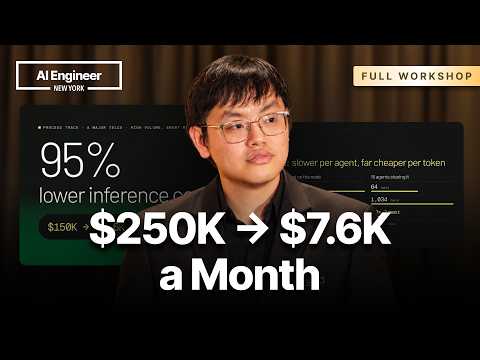
The AI Bill Is Too Damn High: Tokenomics 101 — Eugene…
Eugene Cheah (Featherless AI) presents a practical framework for reducing AI inference costs at scale, recorded at AI Engineer NYC 2026. He outlines four steps: measure usage (e.g., splitting API keys per team), right-size models for the task, buy GPU capacity wisely, and audit internal processes. Topics include agentic vs. process workloads, open models matching frontier models on specific tasks, classifiers, fine-tuning, the speed-vs-cost tradeoff, and avoiding low-quality 'slop grenade' outputs.
# Video Identity Observations
## Source Overview
- **Title:** "The AI Bill Is Too Damn High: Tokenomics 101 — Eugene Cheah, Featherless AI"
- **Format:** Conference workshop talk (AI Engineer event implied by "when the recording is released from AI engineering") with live Q&A.
## Self-Description Evidence (Creator Claims)
- The speaker identifies himself explicitly: *"I'm Eugene from Felis AI. I'm CEO and founder of of it."* (transcript rendering of Featherless AI/Felis AI; the title says "Featherless AI").
- Affiliation claims: *"I'm part of the team behind the Arabic AI open source project, the first AI model under the Linux Foundation"* — positioning as an open-source AI contributor.
- Personal handle disclosed: *"my Twitter handle is PicoCreator."*
- Company mission claim: *"our mission is to make AI accessible for everyone, every language, every dialect, every country."*
- Scale claims: *"the world's largest platform of open models, of over 40,000 open models"* and customers *"serving 2 trillion tokens a day."*
- Conflict-of-interest disclaimer stated openly: *"we sell inference. So, everything I cover here will cover... any provider. Nothing here is specific to Fiddler's."*
## Intended Audience (Observable)
- **Enterprise AI engineering leaders at scale**, explicitly gated: *"this workshop is going to cover a lot of optimization at scale, and it probably will not fit you if you're like spending less than 10K a month."*
- Addressed to organizations with department structures: references to finance departments, support departments, CICD pipelines, coding teams, call centers, and *"financial institutions here, since we are in New York."*
- Interactive room checks confirm practitioner audience: *"how many of you know your total token spend?"*
## Claimed Scope of the Talk
- Four-part framework announced: *"four moves... measuring, right-sizing, how do you buy your capacity, and how you check your process."*
- Vendor-neutral framing repeatedly emphasized: *"this is not... vendor specific"*; *"this is essentially what any inference company will work with you. It's not unique to us."*
- Positioning as a general industry observer rather than product pitch — e.g., citing third-party examples (AT&T, Shopify, Walmart, telcos, DevIn, Cerebras).
## Demonstration Patterns (Not Explicit Claims)
- Talks grounded in anonymized customer case studies (five-dev team spending 150K/month; telco cost reduction from 250K to 7.6K/month), suggesting a consulting/inference-provider vantage point on enterprise AI spending.
- Open-source posture demonstrated: mentions open-sourcing a *"tokenomics tracking tool"* and *"simple Jeff"* (SimpleJAF) open-source classifier project.
- Direct, opinionated delivery style: *"don't pay for ultra on a background agent. That's just dumb"*; *"nobody really switches their model to save the company money... people are lazy."*
- Self-critical transparency: *"this is a flawed measurement"*; *"this is not a flex because I'm quite sure now my model is beat by the recent Cloudflare fine tune."*
## Limitations
- Single video; channel-level identity synthesis (upload cadence, broader content mix, branding) cannot be inferred from this material alone.
- The transcript contains garbled proper nouns (e.g., "Felis AI," "Fiddler's," "GRM 5.3," "Arabic AI"); identity claims are reported as transcribed.
# Delivery Observation — Eugene Cheah, "Tokenomics 101"
## Overall Delivery Profile
Conversational workshop-style speaking with dense, data-backed storytelling. The delivery is energetic but verbally repetitive, using many filler markers and doubled phrases while walking through a four-part framework (measuring, right-sizing, buying capacity, checking process).
## Tone
- **Pragmatic and advisory**, frequently framing advice as rules of thumb rather than prescriptions:
> "A good rule of thumb is that give department models labels, but not the model names."
- **Blunt and humorous** in places:
> "Don't pay for ultra on a background agent. That's just dumb."
> "Happy New Year is the worst."
- **Self-positioning as an optimist** after critical sections:
> "Some slides may sound that very critical of AI, but I'm generally an optimist."
- **Audience-aware**: checks relevance live ("since we are in New York, a lot of OCRs… a lot of transaction risk… is under this category").
## Recurring Phrases and Verbal Habits
- Heavy use of **"respectively"** as a verbal tic — appears dozens of times, often grammatically unnecessary ("And this helps reduce the friction respectively, and helps improve your your token economics at user scale").
- **Doubled words/phrase repeats** are pervasive: "So So So," "uh uh," "we we," "respectively respectively," "the the cache," "and and and." This is a stable, signature feature of the delivery.
- Repeated audience-interaction formula: **"raise of hands"** polls ("How many of you know your total token spend? Can I have a raise of hands?").
- Recurrent framing: **"rule of thumb"** (used at least five times) and **"volume game"** for process-automation workloads.
- Frequent self-corrections mid-sentence ("I know it since we're are doing financial…").
## Teaching Habits
- **Concrete numbers as anchors**: nearly every claim is paired with a figure — "150k a month," "116 billion tokens a month," "2 trillion tokens a day," "512 AMD GPUs," "250k to 7.6k a month."
- **Disclaimers up front**: explicitly scopes the talk ("this workshop… will probably not fit you if you're spending less than 10K a month") and discloses vendor position ("We sell inference… nothing here is specific").
- **Interactive calibration**: uses live hand-raising to prove the point he's about to make (fewer hands at each level of token-spend granularity).
- **Named patterns and anti-patterns** as memorable handles: "slop grenade," "shiny new hammer," "tokens are not work done," "planner/implementation split."
- **Rule-of-thumb quantification** even when approximate: "For every two x of speed, it's three x the cost and it compounds."
- **Anecdote-per-section structure**: one customer story (five devs running eight agents; telco message filtering; AT&T fine-tuning; Shopify's proprietary language) grounds each concept.
- **Q&A handling**: answers are candid and hedge where uncertain ("I might not be the right expert to answer that question"; "This really is a good case of like try and then measure, and it works 70% of the time").
## Communication Patterns
- **Mantra-like reinforcement**: returns to "measure" repeatedly as the foundational step ("If you are not measuring, you can pretty much ignore everything else I say").
- **Binary scaffolding**: organizes the whole talk around dichotomies — agentic vs. process workloads, fast vs. smart models, dedicated vs. burst capacity.
- **Direct imperative asides** to break monotony: "Yeah, don't pay for ultra on a background agent," "Do not let slop grenades happen."
- **Anticipation of audience pushback**: pre-empts criticism ("this is an arbitrary metric," "this is more subjective. People disagree").
## Isolated Moments (Lower-Confidence Patterns)
- Self-deprecating humor appears occasionally rather than consistently (the prompt-tuned model anecdote: "this is not a flex because I'm quite sure now my model is beat").
- Analogies (steroids/supplements for teams, the Walmart stepping stool) appear only in the closing section, so analogy-heavy teaching is not clearly a stable habit across the talk.
## Uncertainty Notes
- Vocal qualities (pace, volume, emphasis) cannot be assessed from transcript text alone.
- The "respectively" tic and doubled words could partially reflect transcript artifacts, but their sheer density across the transcript suggests a genuine spoken habit.
# Video Observation: "The AI Bill Is Too Damn High: Tokenomics 101" — Eugene Cheah, Featherless AI
**Speaker identification:** The transcript identifies the speaker only as "Eugene," who states he is "CEO and founder" of the company he names variously as "Felis AI" / "Featherless AI" / "Fiddler's" (the transcript is inconsistent on the exact name). Curated metadata identifies the company as **Featherless AI**. He also says he is part of the team behind an Arabic AI open-source project (transcribed as "Arabic AI"), "the first AI model under the Linux Foundation," with Twitter handle **PicoCreator**. One unnamed audience questioner's voice is marked by a second `>>` speaker turn in the Q&A; several questioners are not distinguished in the transcript.
---
## Self-Introduction & Framing
- Eugene states his platform's mission is "to make AI accessible for everyone, every language, every dialect, every country," claiming the world's largest platform of open models with "over 40,000 open models," including specialized fine-tunes like the **Sunflower model**, described as Uganda's first language model.
- He cites a large customer serving **2 trillion tokens a day** at roughly **$0.03 per million tokens** (transcript shows both "0.3" and "0.03" — he later repeats "$0.03 per million token") on ~512 AMD MI215 GPUs, running a private model at "Opus 4.8 class performance." He qualifies this: such pricing is "not something you can get off the public cloud market."
- **Two stated disclaimers:**
1. He sells inference, so everything shared reflects his data points and touches any provider, though he discloses the commercial interest.
2. The optimization content assumes organizations spending **more than $10K/month**. He explicitly advises smaller spenders to focus on finding strong use cases instead, calling the threshold "arbitrary."
---
## The Four-Part Structure
He frames the workshop as four "moves" in order: **measuring, right-sizing, buying capacity, and checking your process.**
## 1. Measuring
- **Claim:** Most organizations don't know their token spend. Via show-of-hands, only about half the room knew total spend; fewer knew department-level, and fewer still team- or use-case-level figures.
- He reports "easily 30–40%" of customers reaching out began with a **single shared API key** used organization-wide.
- **Reasoning:** Without splitting keys by department, team, and use case, spend cannot be attributed. He treats measuring as the highest-ROI step: "If you are not measuring, you can pretty much ignore everything else I say and start with measuring first."
- He mentions Featherless is **open-sourcing a tokenomics tracking tool** ("just a very fancy way of splitting up your API key").
### Two Workload Tracks with Opposite Economics
- **Agentic track:** long-running, long-context (e.g., coding agents run overnight with multiple compactions). Extreme example: a 5-dev team averaging 8 continuously running agents spent **$150K/month** on Opus 4.8 (~116B tokens/month); switching to a GRM 5.3 single node brought it to **under $10K/month** with "no disruption or impact," per his account.
- **Process automation track:** short-context, task-isolated, volume-driven (call centers, email routing, transcription, OCR, approvals). A telco customer for child-safe message filtering hits a **peak of 10 million messages in a single minute** ("Happy New Year is the worst").
- Agentic economics observation: "only 1% of the request is to the output tokens" across agentic use cases they deploy — cost is driven by repeated cached/input tokens across turns.
## 2. Right-Sizing
- **Claim:** The open-model/closed-model gap is closing this year; previously "the best close source model is [far] better than the best open source," but now some open models are on par or surpassing. He cites Kimi K3 beating Opus in UI-design benchmarks (pre-Opus 5.5 update) and the **Step 1.5 model** achieving near-Opus extraction quality in financial use cases despite being ~10x smaller.
- He qualifies: "Is this the best coding model? No" — superiority is use-case-specific, and the rule-of-thumb list changes "every few months."
- **DeepSeek-V4 and Flash** are highlighted as extremely popular "regardless of the case," though he notes "benchmark score doesn't seem to justify why" — presented as an observation, not an explanation.
- **New model class:** one-shot classifiers (which he says are known as "JAF," with the open-source project "simple JAF") — he claims they are commonly **10x cheaper and faster**, but "cannot give a chat response."
- **Planning/implementation split pattern:** best model does planning and review; a cheaper faster model (e.g., Gemini 5.3 Flash or DeepSeek 4.1 Flash) does implementation, since implementation is token-heavy. He claims the cheap model can match quality "assuming those agents do the planning."
- **Incentive finding (stated as an empirical observation):** "Nobody really switches their model to save the company money." Speed is the effective incentive — if the cheaper model is also faster, people switch for speed, not cost. Teams given equal speeds and ample budget didn't switch; teams given too-small budgets burned the premium model and avoided it entirely.
- **Department model labels:** give departments labeled models (e.g., "finance agent"), not real model names, to retain swap control. He cites teams found still running **Llama 2** "in this year" because no one switched the option.
### Process Track Right-Sizing
- Process-track teams right-size by default because volume makes premium pricing unviable; the right question is not "is the smaller model good enough?" but "what are your evals and test cases?" — then search for the cheapest passing model.
- **Case claim:** a major telco's inference cost dropped from **$250K to $7.6K/month** via splitting off tasks, model fitting, and fine-tuning.
- **Fine-tuning examples:** AT&T fine-tuned from open-class models down to 27B and 7B models (Eugene says Featherless was "one of their launch partners"); Shopify fine-tuned for its proprietary web-store templating language.
- **Bootstrapping method:** deploy an expensive frontier model at small scale, generate datasets (noting some labs' ToS prohibit this and to "check with your lawyers"; Google Gemini openly offers a dedicated distillation API), then fine-tune down to ~7B scale. He advises routing **shadow traffic** to the best model to keep building datasets and "ride the wave" of open-model progress.
- **Speed claim:** today's ~27–32B MoE models run on a MacBook Pro and are "already much better than GPT-4," which he qualifies as "give and take... broadly."
## 3. Buying Capacity (GPUs)
- **Core claim:** "Things don't scale linearly." Rule of thumb he offers: **"For every two x of speed, it's three x the cost and it compounds."**
- Example: one GRM 5.3 node at ~112 tokens/second single-request; at 16 parallel requests, each request gets roughly half speed but total output is ~10x, yielding **~9–10x lower cost** just by changing the target speed profile.
- Customers typically choose **20–30 tokens/second** ("ChatGPT speed") up to ~60; rarely 120. He stresses: only pay for speed "when it's in front of someone," and "background jobs, please don't run it at 120 tokens per second."
- **Dedicated instances:** "the biggest cost savings you have right now in the market is deploying a dedicated instance if you know your base workload," with spikes allowed to spill over to public cloud. He qualifies that financial firms often can't mix, and that a short monthly spike with no base load is rare.
## 4. Check Your Processes
- He prefaces: "Some slides may sound very critical of AI, but I'm generally an optimist... things can be quoted out of context."
- **Claim:** Organizations report 10–100x token-spend growth without proportional results; he references reports of AI delivering "6% or 7%" productivity — "not the scale that a lot of us were promised." His diagnosis: "we tend to just spam it everywhere," and asks, "Can you please not do this as another co-pilot?"
- **Bottleneck argument:** organizational processes lag AI speed — CI/CD becomes a bottleneck, and lack of trust/review processes slows things down. He presents the trust problem symmetrically: a badly designed agent rightly shouldn't be trusted, but "what if hypothetically that agent was doing everything perfectly" and still isn't trusted because tests/validation weren't built?
- **Core maxim:** "**Tokens are not work done.**"
- **Anti-pattern (discarded agent work):** agents generate quarter-of-codebase changes; overloaded reviewers can't process them; issues without generated code go unreviewed; reviewers then ask an agent to extract relevant changes and "literally discard the first agent's job." He acknowledges legitimate reasons (control, quality) but calls it a process bottleneck. Suggested fixes: better testing, modular merges.
- **"Slop grenade"** (a term he attributes as "coined... trending"): generating lots of AI output and leaving it for someone else to verify — also illustrated with one-shot AI slide decks. His subjective guidelines (flagged as contestable: "people disagree"):
- **People should own what they generate** — "this slide, I own every text... It's not my AI agent who has an issue."
- **Measure outcomes, not usage.** He offers a rule-of-thumb formula — *tokens × price ÷ outcomes someone actually uses* — but immediately qualifies it as flawed: outcomes are hard to measure, and AI is better understood "as supplements or steroids that enhance the team" — better teams benefit more; AI "doesn't necessarily change everything."
- He remains optimistic: everyone is learning; the highest-impact use cases may be mundane, organization-specific wins (his analogy: Walmart's stepping stools in trucks reducing back injuries "by the millions").
- **Six kickoff questions** he offers: who/what team spent what; what must you test to use a cheaper model; what's your base load; what's the default model per team; which workloads have a person waiting (needing speed); how much of what you generate is useful.
---
## Q&A Positions
**Q1 (unattributed audience member): Is fine-tuning SFT or other methods?**
- Eugene: "In general, it tends to be SFT." RL is "very sexy" in coding (data generated in-loop), but "there's not really an RL environment for financial tasks," so SFT dominates for New York–type customers. He argues the fine-tuning method "might not be the right question — it's more like what's your evals." Supporting anecdote: his **prompt-tuned Qwen 27B** beat most fine-tuned 27Bs in Hugging Face's 10,000+ question benchmark two weeks after JAF's release — he explicitly disclaims it as "not a flex," noting Cloudflare's later proper fine-tune beat his model.
**Q2: Do you need golden traces, or can you train on imperfect frontier-model outputs?**
- Eugene (framing this as "personal opinion technique"): he splits datasets, keeping a smaller **golden-trace set fine-tuned at heavier weightage**, but cites papers showing even failed traces improve thinking processes. He rates the approach as working "70% of the time" — try and measure. Rule of thumb: near-same performance (eval down 1%, sometimes up 10%), and "does it 100x reduce my bill?" He concedes golden samples are critical beyond baseline and require human data review, which people avoid.
**Q3: How to deal with Claude Code lock-in?**
- Eugene: "Unfortunately, Claude Code is the example of fully locked in." First move is switching the **harness**; he notes some orgs build their own harness ("Why?"), and highlights **Pi** as a common lightweight switch with cheaper per-token cost. Transition pattern: keep Claude Code as planner, instruct it to delegate implementation to a Pi agent with a fast (~100 tok/s) model — the planner/implementation split as an entry point. On an MCP-based follow-up, he says MCP agents "unless done right don't have access to your file system," so simple CLI batch invocation is more typical.
**Q4: Caching case studies?**
- Eugene: takes specifics offline; larger customers get **dedicated caches** (privacy isolation), plus prompt formatting. "The short answer is yes, but there's a lot of ways to interpret this."
**Q5: Turn-based vs. task-based auto-routing?**
- Eugene: "generally more towards task-based" for expectation control at department level. Turn-based routing must be locked to **2–3 models maximum**, or cache hit rates "will start to wreck your optimization" — 30 models switching per turn destroys cache efficiency. Two models (e.g., GRM 5.3 and 5.3 Flash) is acceptable; "task and organization makes the most sense." The questioner agrees.
---
## Preserved Qualifications & Tensions
- **Commercial interest disclosed but present:** he sells inference and fine-tuning services while recommending optimization strategies.
- **Contradiction kept as stated:** the transcript gives the flagship customer's price as both "$0.3 per million tokens" early and "$0.03 per million token" twice later — an unresolved discrepancy in the source.
- He repeatedly flags rule-of-thumb claims as provisional ("updated every few months," "arbitrary metric," "flawed measurement," "more subjective, people disagree").
- The productivity critique is self-qualified: he explicitly labels himself "generally an optimist" while reporting AI productivity figures of 6–7%.
- Model names in the transcript (e.g., "Opus 4.8," "GRM 5.3," "Kimi K3," "JAF") are preserved as transcribed and not verified.
# Speaker & Provenance Record
## Video Identification
- **Title:** *The AI Bill Is Too Damn High: Tokenomics 101 — Eugene Cheah, Featherless AI*
- **Format:** Conference/workshop talk (AI Engineer event implied by transcript reference to "AI engineering" recording) with Q&A session.
## Identified Speakers & Roles
### Primary Speaker: Eugene Cheah
- **Role:** Workshop presenter; self-identified **CEO and founder of Featherless AI** (transcript phonetically renders "Felis AI" / "Fiddler's" — title metadata confirms Featherless AI).
- **Additional self-identified roles:**
- Part of the team behind an Arabic AI open-source project described as "the first AI model under the Linux Foundation."
- Twitter handle: **PicoCreator**.
- **Stated conflicts of interest / disclaimers (explicit in transcript):**
- > "We sell inference. So, everything I cover here will cover... any provider. Nothing here is specific to..." (provider name unclear in transcript).
- Case examples are drawn from Featherless AI customer data and experience.
### Secondary Speaker(s)
- **Audience questioners** — unnamed, multiple. Visible in Q&A:
- Q1: Fine-tuning methods (SFT vs. other approaches); follow-up on golden traces/data filtering.
- Q2: Code spend locked into "Claude Code" ecosystem.
- Q3: Follow-up on MCP-based offloading.
- Q4: Caching case studies request.
- Q5: Turn- vs. task-based auto-routing.
- Roles not stated (presumably attendees); no names given.
- **"Previous speaker"** — referenced only indirectly ("the previous speaker spoke at length at trust"); no identity provided.
## Cited Sources & Third-Party Claims
All claims attributed within the transcript to the speaker unless noted:
- **Named companies/projects referenced:**
- Featherless AI — 40,000+ open models; customers serving ~2 trillion tokens/day at ~$0.03/million tokens on 512 AMD MI215 GPUs (transcript varies: "0.3" and "0.03"); "Opus 4.8 class" performance.
- Sunflower model — "Uganda's first language model" (per speaker).
- **Telco customer example:** inference cost reduced from $250k to $7.6k/month; another telco filtering up to 10M messages/minute.
- **Five-dev team example:** $150k/month on "Opus 4.8 API," 116B tokens/month, switched to "GRM 5.3" instance under $10k/month.
- **AT&T** — fine-tuned 27B/7B call-center models; speaker claims Featherless was "one of their launch partners."
- **Shopify** — fine-tuned models for proprietary web-store configuration language.
- **Step 1.5 model**, **Kimi K3**, **DeepSeek-V4 and Flash**, **Qwen 27B** (prompt-tuned, compared against Hugging Face benchmarks over 10,000 questions), **Cloudflare fine-tune**, **Google Gemini** distillation API, **Devin**, **Adoption AI** ("adapted adoption AI" in transcript), **Cerebras**, **Walmart** stepping-stool anecdote (speaker hedges: "I believe it's Walmart"), **UAE AI mandate by law**.
- **Named tools/products:** JAF / "simple JAF" one-shot classifiers (open-source project by the speaker's team), "Pi" coding agent harness, MCP, agent harnesses ("M", "Mboni" per transcript phonetics), Hugging Face.
- **Industry claims:** reports that AI yields "only 6% or 7%" productivity; open-source models closing gap with closed models; laptops can run 27–32B MoE models "better than GPT-4" (speaker's characterization).
## Promotional Elements (flagged)
- **Self-promotion:** Featherless AI services (inference sales, 40,000 models, fine-tuning services, dedicated instances/caches); "simple JAF" open-source project; QR code for tokenomics tracking tool the company is open-sourcing (also collects sign-ups for slides/recording notification); closing invitation to "talk to me or my team."
- **Third-party mentions used in sales context:** AT&T and Shopify fine-tuning examples; Cerebras, Google Gemini distillation service presented as alternatives/options.
## Availability & Access Notes
- Slides and recording to be released by "AI engineering" via QR-code form — not yet available at time of talk.
- Off-record material acknowledged: process-automation volume examples offered "off the record"; caching case study deferred "offline."
- Speaker notes AT&T data-point specifics he declines to state ("I don't think I can say which size goes where").
## Uncertainty Flags
- Transcript contains phonetic/OCR-like corruptions of product and model names (e.g., "Felis AI," "GRM 5.3," "Opus 4.8," "Astra," "Jeff"/"JAF," "Mboni," "Quen 27B"); identities inferred from context, not confirmed.
- Audience questioners are anonymous; roles unverified.
- No curated metadata beyond title was supplied; speaker claims (benchmarks, customer figures) are recorded as asserted, not verified.
\>\> Uh thank you for everyone for coming here. Uh not too sure whether to be happy or sad that so many people are suffering from the token bill. It's a full workshop. Uh Yeah, that uh we're going to talk about
tokenomics. So, a little bit of a a background with the kickstarting it, right? I'm Eugene from Felis AI. I'm CEO and founder of of it. Uh and I'm part of the team behind the Arabic AI open source project, the first AI model under the Linux Foundation. And and we work on next generation AI architecture. Uh that's a little bit of my academic background. And my Twitter handle is PicoCreator. But, but more importantly, right? Uh uh a little bit of background for Felis AI is that our mission is to make AI accessible for everyone, every language, every dialect, every country. And we do this We do this by creating the world's largest platform of open models, of over 40,000 open models. And this includes specialized fine-tune like the Sunflower model, which is Uganda's first language model, specifically for their language, and a lot of other specialized models. So, we're not just not talking about the biggest open source model, but specialized language models or specialized use cases, uh some of it which I'll touch as well. And when we when we can go on scale in terms of variety of model, Felis AI also we serve customers at scale. So, some of our largest customers are literally serving 2 trillion tokens a day. And and they're And and they're serving it at around 0.3 per million tokens or 60K a day. And they're doing it on around 512 AMD GPUs, uh MI215. Uh and for this customer in particular, it's a private 400 Android BM OE model. Uh and they're serving it around Opus 4.8 class performance. So, it's lots of concurrent requests, lots of token
volume. That's what we mean by scale. And if you look at it, 0.03 per million token at over 4.8 class, it's not something that is not something that you can get off the public cloud market.
This is specially very specialized setups that is meant to run at the scale that we are talking about. So, that kind of uh leads in into two major disclaimers that I'm going to start off. One, we
sell inference. So, everything I cover here will cover the will will touch on any provider. Nothing here is specific to Fiddler's. But, to to for clarity, we
sell inference. So, so this is from our data points, from our experience, respectively, as well. Okay? The other thing is that this workshop is going to cover a lot of optimization at scale, and it probably will not fit you if you're like spending less than 10K a month in your organization. Uh my word of advice for those who are below this this uh metric mark, and this is an arbitrary metric, is that if you're spending less than this, you're probably better off focusing on like trying to get strong use cases within your organization, rather than trying to optimize the token spending bill. Because a strong use case can bring your organization way more than 10K a month. And and that's and that's what should be your main area of focus, and that's not my area of focus for this talk. So, what we are going to cover in this workshop uh is four moves in in in four major order: measuring, right-sizing,
uh how do you buy your capacity, and how you check your process. So, measuring. Yep. You'll be surprised at how essential this is. Uh
like, how many of you know your total token spend? Can I have a raise of hands? Wow, only half the room raised hand. Okay. How many of you can measure at the
department level? Those those who have their hands raised up, leave your up. And so, I see about another half went down. Yeah. And it gets lower and lower down to the team level, to the use case level. Uh we like easily 30 40% of our customers that reach out to us, the first thing they had was a single shared key that everyone in the organization used. And that was like Uh uh how do we even measure that? How do we start from there? So So this is not and a vendor specific like you need to start splitting up your keys, start splitting up by departments, start splitting up by major use cases so that you know where all your tokens are. Um and this is then from then on it can inform your workload. So yeah, API keys shouldn't be that hard to issue. Um once you know that, right, you can start right-sizing things uh respectively. Like like which team is uh and workloads spend on it? What was the person waiting for? Like some teams deserve the tokens per second. Some background agents running at midnight probably can don't deserve the tokens per second speed that you're paying for it. Uh yeah, don't pay for ultra on a background agent. That's just dumb. Um and and from that also you can also look at your usage to better advise like uh dedicated capacity that you may purchase, be it for open models or even close models. Uh yeah. And also you can also check which team spend the most token and whether they are productive. Uh I'll touch on that as well. One of the things that you should know in AI workloads, right, uh and you all
may already experience, right, is there are two major tracks with very opposite economics uh respectively. So there is the agentic workload and obviously there's things in between where it tends to be like long-running multitenant
agents. Coding agents are a particular example of this. Some Some Some may have some devs like run coding agents like literally overnight over a long period of time with uh with multiple compaction. And and these things maximize the context uh usage. Process automation is the other extreme. Uh think call centers, think email routing, things your meeting notes transcribing, and things like that. It's all It's much shorter in context in general, though there are a lot of examples that defy this statement. But, it's very process-driven, very task-isolated, and it's it's a volume game, essentially. So, well, what do I mean by more usage? And this is probably one of the first major explosion a lot of organizations face. In particular, when they jump onto the open cloud hype or one of the cloud clones. So, you like like from from from various developer teams that we we support, like for example, we sampled one of the team, and it was only five devs, and they were averaging around continuously eight running agents for one of the companies we work with. And And so, they were previously running Opus 4.8 of the API, and they were essentially spending 150k a month continuously running these agents. Some of it is the agents that they use to code, some of it is the agents that kick in at night. They They were slightly more advanced. They already knew that they they they they should kick things off at night when no one's are working. But, essentially, they were spending 116 billion tokens a month. And we literally helped them switch to GRM 5.3 instance. Previously, it was 5.2. They already upgraded 5.3, and that was like a single node. That was less than 10k a month. And they were And they didn't see any disruption or impact. So, knowing your team allows you to make these decisions respectively. And like like I highlighted, like knowing processes workload also allows you to split things off. So, like, for example, previously, they were running everything throughout the day, but they they started scheduling some of the background agents when the team was asleep, and it runs through night. So, this allows you to utilize their hardware respectively. The As I I touched on briefly, the other side of process automation is purely a volume game. Extremely predefined. I I can give you more specific example off the off the record, but you think of it as like millions per day or even tens of millions per day, decisions in call centers, lines of code scanned, emails and text messages filtered. Like, one of the telcos we work with, like, they easily hit peak 10 million messages in a single minute. And this shouldn't come as a surprise. Happy New Year is the worst. Yeah. So So So these And they And they help And the reason why they filter messages is because they provide a feature about like providing safe phone for kids. So they needed an AI to scan like basically is it profanity, sexual content, etc. etc. So So this This is really not a long context, but a volume game. Other things like Other things is like maker-checker processes, approval processes, document processing. These are all volume game for multiple organizations. So I suspect for the financial institutions here, since we are in New York, a lot of OCRs, a lot of documents, a lot of approval, a lot of transaction risk the is is under this category. Okay. So yeah. If you're not yet tracking your token token spend and token view split, right, we are open sourcing a tokenomics tracking tool, which is just a very fancy way of like splitting up your API key and tracking which API key spends how much, which is separate from this talk. Yeah. So if you If you want to again update it, feel free to to scan this QR code and respectively. It also if you want to slides for this talk and when the recording is released from AI engineering to be notified about this talk, you can also get fill up the form there. Okay. Okay. Okay. So yeah. That was about measuring. Um yeah. If you are not measuring, you can pretty much ignore everything else I say and start with measuring first because all your biggest ROI is just by measuring. But once you have things measured, right, the question is
how do you right-size it? And this is where things gets more complicated. Uh In In general, right, one of the things that we start to observe as as AI gets deployed at scale
within organization is that there tends to be a pattern of like because AI is the shiny new hammer, we try to apply it to everything. Especially within the innovation labs, we just try to apply to every damn thing. And we tend and and I have seen organizations literally apply fable to really the silliest of things. So so you there's a lot of models and a lot of models are really expensive and and and and and figuring out to do and where it fits is is is important is an important step of the process. I know open models I mean a lot of you probably heard about open models and that's our line of business. Yeah. And and so a lot when a lot of companies come to us for example to like find open models that fit their use cases and drop in replacements. This is we generally guide them along their use cases. So these are these are general rule of thumb that is probably going to be updated month because open models release every few months and same thing close source models. Things change rapidly. But but there but the thing is what we find right exciting actually within this year is things have started to change. Like in the previous year the best close source model is without better than the best open source. Almost. But as this year approach right we are starting to see the gap close. We are starting to see situations where where some of the open models are even on par or even surpassing. So like for example before the Opus 5.5 update came out Kimi K3 was beating Opus in UI design in some of the UI benchmarks. And and this is like very public benchmarks. Within customer benchmarks right we were already starting to see open source models beat very specialized benchmarks in specialized use cases. So like A particular one to highlight is like for example, step one five model. They it was able to achieve near Opus and extra quality despite being like a 10 x smaller model in financial benchmarks uh financial use cases. And this is it the best coding model? No, but in that use case, it's actually extremely strong and competent. So so so the landscape is slowly changing where where where you can have drop-in replacement for a lot of use cases that are sometimes even just 10 x cheaper respectively for the uh uh if if you know your workload and you can drop it in respectively. Special shoutout is also DeepSeek-V4 and Flash. For some reason, and this model is extremely popular across all workloads respectively because it's easy to prompt there uh for a lot of companies. So well I well the rest of the models I have listed there they are they are like default for good in their categories. DeepSeek-V4 and Flash seems to like be quite popular regardless the case. Yeah. Uh though benchmark score doesn't seem to justify why why is it so popular. Yeah. Yeah. Uh another thing to highlight, right, is that recently like and this is like for a few weeks ago, uh the a new class of uh AI models have been introduced called uh classifiers one-shot classifiers most popularly known as JAF. Open-source projects have already
started uh taking off like simple JAF. And these are models that are entirely focused on just making decisions and classification on on tasks. Uh the main advantage is that because on a technical
level only, they are commonly 10 x cheaper than existing models or even faster at the same time. Uh the downside is it cannot give a chat response. So so so these are things that are changing and happening that you all may want to start looking into on like on like segments of how you want to improve your your token economy. Yeah. But but back to the The the the token economy part, there is two major tracks and it is important to separate out and track this track them respectively. It on the agentic side we're talking about long running long context as I said earlier. And to and you have to understand this workload tends to be extremely cash heavy, extremely input preview heavy and cash heavy and there's only a small percentage of output. We see across like agentic use use cases in employment only 1% of the request is to the output tokens. And and and this is this is very logical because it takes multiple turns, rinse and repeat. But this also decides your token cost because like if you've seen token cost, right? Deployment cost, right? Output is may have the biggest number, but even your input value is much smaller or the cash is much smaller, it it gets repeated heavily in in this use case. Yeah. This is not coding agent workshop, but one of the most common patterns that we we see in a lot of organizations, right? Is that is that typically typically in terms of like trying to scale up their AI agent deployments we within within the coding teams, right? They tend to have the best agent do the
planning and a faster a faster cheaper agent do do the implementation and then maybe the best agent do the review again. There's a good reason why this split is very
common across all the agent frameworks is is that you get the best of both worlds because like the implementation phase is tends to be tends to be very token heavy process. A lot of processes repeated back and forth like key modifying the file, testing, checking for results, rinse and repeating. And and you and most and most of these agents are especially this especially like Gemini 5.3 flash is more than capable of doing a task at the same quality level as a much more stronger agent like I say Astra or Opus, uh respectively assuming those agents do the planning. We have worked with some of the organizations where literally the planning and review agent is the best frontier close muscle model, and then the workers that implement it is the GRM 5.3 flash as an example, or Deep Seek 4.1 flash. Yeah. One of the observations that we made from from this from from this kind of split pattern, right, is that unfortunately, as much as we wish that everyone does so, nobody really switches their model to save the company money. Um this people are lazy to switch the
models in general. You you want to give an incentive to switch. Or or alternatively, if your agent harness is good enough, so like for example, some harness like M, they automate the
process. Like like it uses a the weaker model as a baseline, and then it uses a big the smarter model to automate switching when it needs a smarter consultation. This This helps reduce the friction respectively, and helps improve your your token economics at user scale. Like a a major rule of thumb that we we now give our clients after going through a few times is that you want the smarter model, and since it's already so expensive as a baseline, but you but you want the the faster model to the cheaper model to be faster. And that naturally sets an incentive. People want to get their work done fast. If the model is smart enough to get it done and it's cheaper, they will just use it because it's faster, not because it's cheaper. Um we had teams where where where both models were the smarter one and the cheaper one was maintained at the same tokens per second speed, and it and as long as they had the token budget in excess, right, no one switched. And it and on the flip side, we have seen teams, which is the other extreme, where they set an extremely low budget, and so that if they use a smarter model, right, they just burn it in one day. Yeah, then everyone just switch to the to the Dharma into the faster model Dharma and faster model because that's their budget. It's like almost as if the smarter model didn't exist. So, like be aware about your team dynamics on how they switch. The The best trade-off is to speed because people are naturally incentivized for it. So, faster, cheaper, they will just switch it to it respectively. Yeah. Once again, reminder, measure, and you measure two separate token keys. Uh and but this also goes beyond just measuring. For example, like CICD is a very common use case right now of things running in the background. Uh we we have helped set up for teams like faster tokens per second that that is running for the the users, like the humans, but much slower tokens per second um speed, but much cheaper at scale for the CICD pipeline. Uh and and this is just the nature of like what's your priority respectively respectively across the task. Yeah. And you can control that at a key level. So, another major finding is that we had experience with deploying for for teams, right? Uh uh So, like for example, for some companies, uh how many of you had the fortunate or unfortunate experience of the CEO saying, "Everyone must implement AI now, and everyone must have a second brain now." Yeah. Multiple organizations have started this. Uh in some cases, like even in in the UAE, it became literally mandated by by by by the law of the country. So, so, like a lot of departments are not prepared to know what is the trade-off respectively. So, a good rule of thumb, right? Well, developers tend to know, okay, all these smart models, what's the trade-off uh between deep seek flash and GR553, for example? Most uh your your finance department have absolutely no idea. Your your support department has absolutely no idea. They they'll just pick whatever's the first model and probably just go with it. So
So, our general rule of thumb is that give department models labels, but not the model names. And this also gives you a lot more control as you switch it out. Uh what like like advised earlier, fast
versus smart, but in some cases also like finance agent or Excel spreadsheet agents. Um these are hyper-specialized agents that were fine-tuned to those tasks respectively. And and this also gives you a lot more control. It allows you to swap up the model. It allows you to split split the traffic and test in between with without without telling, "Hey, users, please try this." The downside is also users may sometimes complain when you do that and you screw that up. But having that control is a good thing. Uh another pattern that we see, even though you do this, is maybe some of a dash preview version. So, that's a variant of it, but it gives you control without without taxing the communication burden across the organization. And this is extremely important because like like some of the teams that we work with, right? We literally saw members running Llama 2 models when when we are talking when talking about like in this year because no one switched the option. Yeah, so you really really need to need to uh need to set this in place. Yeah. All right. Process track. Process track. A lot of things that I mentioned earlier don't really apply as much to process track because process track tends to be a lot integrated into the applications, into the workflows, uh respectively. And and that's just by the sheer volume of the traffic. Um yeah. And And of all of teams in the process track, right? Uh they tend to be a lot more focused on focused on the right sizing already by default because because if you're running like trillions of tokens you most departments will not approve it like $10 per token million token. It's
just not possible. And and so so so they start they start early with the evals, the benchmark, and then subsequently finding the model that right size fits it. Uh
yeah. So So the thing is like the common question is how do I know the smaller model is good enough? You don't need to That's the wrong question to say. You just need to make sure you set up your test cases, your evals, and your examples. And then subsequently just do the search process from there. Uh companies like us will be more than happy to help you because we have over 40,000 models. But then But then if you're It's also not that hard to just download 10 models from Hugging Face and just try. Uh So So from that you you just do the search, find the cheapest model that kind of like pass most of it, and then you just see how you iterate from there, fine-tune from there. Uh we also have a more specific process that I don't think is unique to us that we'll cover as well also. So for example, like in for one of the major telcos that we work with, right? We actually helped their team lower their inference cost 250k to 7.6k a month switching from existing close-source model just by going through this process of like, "Okay, you're running the best model first. Let's see what what models we can split off, and then subsequently what's the models that we can fit in in, and then what can we fine-tune?" And this was This was like to uh beat the customer support use cases and and so on and so forth. Yeah. And to re-highlight back Jeff uh and simple Jeff, which is a open-source project that we did uh that replicates it. You'll be surprised at how many m- percentage of your AI traffic is classification traffic. Uh At the end of the day, right? Like Yeah, sure. Answering the customer support is text. But even then, right? Even then, right? A lot of teams, right? Already have predefined text output that they put into the context for the model to output for most cases. And and you could use a classifier there. And there's a lot This is a new new new shift within AI world.
And that this is one of the big levers for this kind of processes in lowering your your token bill. Yeah. So,
one one one example of such a model when it comes to fine-tuning. So, a lot of models and processes, right? Uh do benefit at this scale where you start to fine-tune your own model. Uh on the flip side, for coding models, well, there are organizations that will fine-tune models for you, like Devin, for example. Uh a lot of developers generally just want the best model. So, it's kind of unless you are in this AI space, it's kind of hard to keep pace in fine-tuning the best coding model. But on the flip side, for your domain, it might be worth it to fine-tune a domain model for your use case, especially if the model is much smaller. So, for AT&T, for example, when they fine-tuned their models, they they they went from being open class to like 27B to even 7B models. And they have published this. So, so we were one of their launch partners. And you can actually try their open dialogue models respectively. And and This is basically what they use behind the scene. And and it's all about volume here. Like, I I think I think most of you understand the scale of AT&T and the call centers and things like that. Uh yeah. But it's a good example of how you fine-tune models to to specialize use cases. And once you reach that point, other organizations that are major example of like Shopify have started doing this. And and things and and it doesn't necessarily need to be a large-scale fine-tune. So, for example, in the Shopify use case, they did it because Shopify web store had a proprietary la- programming language for how to configure the the web store. And the existing models just weren't that great at it, so they went to fine-tune it. Uh but and AT&T also they had examples of that uh in particular on like how to arrange the the cell towers and things like that. Yeah. Uh very telco-specific task. I might not be the right expert to answer that question. Uh but they had those use cases. So so they fine-tuned respectively.
You too may have that those use cases. And how do you bootstrap such a model, right? Is that the good news is that uh you can easily bootstrap things these days because if let's say you're willing
uh if the best model that is too expensive to run at scale can do the task, you can already get started. So so so an easy way to do this, right? Uh that we see very commonly is like either you generate your own data or prepare your own data, which is hard. No one likes to do that for some reason. But that but another common path is that they start with an expensive model and then they deploy in a small scale and then they generate they they generate data set. I understand that some labs it's against their terms of service to do that, so you may want to check with your lawyers, but there are labs that openly embrace it. So, for example, Google Gemini uh their their frontier models, they literally have a dedicated API service for this. Uh so so so this allows you to build data sets respectively on your use case on a strong model, which you can then which which you can then reduce dramatically to let's say a 7B scale. Uh alternatively, open-source models are more than happy for you to to to run and distill on, so you can run the best uh open-source models respectively as well. Once you collect them, you can then fine-tune the data and then you can fine-tune and respectively like different sizes to see what fits best. So, once again, like in the 80/20 example, they have the 27B and 7B for different levels of the call center. Like your routine your routine calls may come in at a Wait. I don't think I can say which size goes where, but your routine calls can come in for the much smaller model, and then it escalates up due to some classifier triggers as an example. Then then so so so that's how you get the traffic to flow, get the traffic split, and then you get it at that efficient level. Uh one of the things that we also tend to work with teams on on when doing this is that even even when they go through the stages and they completely split over their traffic to the fine-tuned model, because the best of the best models still progress, uh they get they uh we typically advise them to cut over a cut a part of their
traffic as a shadow traffic to the best model to keep building the data set. And and and this allows you to ride the wave and progress of the best open models respectively.
Uh and the unit economics is actually very important here, because like one thing that I would like to remind people, right, is people severely underestimate the the the speed that AI is going, especially for models that you can run much cheaper at scale. Like you take this laptop as an example. I like to measure, right, what is the best model that I can buy in the most expensive MacBook Pro here. And today's best models, be it MoE models at 31B, 32B, 27B size, is already much better than GPT-4. So, essentially, this model that can run on a laptop is already better than the best model that you have last year. Give and take. People like to argue on the specifics, but let's just say broadly. And when you fine-tune it to your task, that means if you can run that model on a laptop respectively, you can run it on on on your GPU servers at scale much more efficiently. Yeah. So, Yeah. So, that brings in to the next topic, buying GPUs which which which is apparently increasingly a challenge. So,
yeah, that's where companies like us come in. One of the things that we we realized through a lot of customer conversations, people are rather surprised that things don't scale
linearly. Uh what I mean by that is like there is a huge trade-off between tokens per second on an individual request to to the cost to the cost of the request itself. So, for example, if you do not care about about the cost, you could run the best the model, let's say a fixed model, on the best hardware, on all eight GPUs, batch size one, and you could get, let's say, 100 tokens per second, 200 tokens per second. If you like if you really want and and and this is not our specialization, like you really want like thousands of tokens per second, that's where companies like Cerebras is more than happy to offer that as well. And it costs even more. So, there are definitely use cases where this makes sense. But, it's but a lot of people fall into the trap of thinking, "Hey, so if I have the speed, maybe it's half the cost." It's not even close. Like like a rule of thumb that I sometimes say like, "For
every two x of speed, it's three x the cost and it compounds." In this specific example for JM 5.3, it's like one JM node is like you can see the same server, 112 tokens per
second for running individual requests. But, if you run 16 requests in parallel, you get about half the speed for all the requests, but you literally 10x the output total output. You And and that that gives you like literally around 9 to 10x lower in cost. In just like changing your changing your target speed profile. And so, when a lot of customers ask us like, "How do we deploy things at scale?" Sometimes the first question is, "What's the model quality you want? And what's the tokens per second speed that you want?" And then we start recommending the amount GPUs, the amount deployment. And this this target tokens per second is an important trade-off. Essentially, um in more extreme cases, right? If you really, really can run things at 10 tokens per second, rarely anyone does, but there are some weird use cases that allows it. You can get even more incredible to- total throughput volumes, respectively. Typically, we see customers choosing between 20 30, which is kind of like uh your chat GPT speed without without too much thinking, all the way until like 60, which is like the fastest speed. And if they want 120 tokens like it tends to be this this range. Most stick between 20 30 to 60, depending on how how long the chain of task is. Yeah. So, yeah, uh I kind of mentioned you generally only want to pay for the tokens per second speed uh when when it's in front of someone. Uh whe- whether it's in front of your developers or whether it's in front of your customers. Those are the trade-offs that you want to make. And even within then, right? We have seen cases where even just a slight tweak down, right? Can easily save two times the cost, but has near minimal impact for the cus- uh customer, respectively. Yeah. And once again, background jobs, please don't run it at 120 tokens per second. It makes no sense when you do that. Yeah. So, uh once you have Previously, I said measure, right? You're able to see your your your traffic pattern. So, a lot of traffic patterns tend to be bursty in
some nature with some base load because someone's always running something at some time, uh especially background agents. And and this is where you can you can also plan your deployments, respectively. Uh
I know it since we're are doing financial a lot of financial may not have this as an option, but because they are only dedicated instance deployment, but if for some cases where people allow mixed where they have dedicated instances with some burst to the public cloud, this is where you have some flexibility respectively. So, like the biggest cost savings you have right now in the market is deploying a dedicated instance if you know your base workload. So, as long as you fully use it, you kind of have a savings there. But, it's a bit more complicated depending on your traffic pattern, and a lot of these things can be tested and validated uh respectively. And this is like essentially what any inference company will work with you. It's not unique to us. We'll be like, "Hey, this is Do you know your traffic workload? Can you share some data?" And then subsequently, we'll be like, "Okay, we propose this much. You can try switching to this." And then we we generate we can generally show you your savings respectively. And in some extreme cases where you have a lot of spikes, you may want to have limit your dedicated capacity to a certain amount and let the spikes spill over to the public cloud respectively. The different use cases uh have different right sizing, but this is something that by measuring your token workload once again at the beginning, you can start exploring these options, and the savings can be huge. Like once again, like for the customer that we served two 2 trillion token, and that was like uh 4.8 Opus class model, they are paying less than 0.0 $3 per million token. Like you can't get that price anywhere. Yeah. So, yeah. Simple disclaimer is the spikes really matter. Uh it's very rare that someone has a short spike at the extreme end where they like run a workload every month at that scale, and then nothing else matter. So, so usually some base workload exists. It's just how big of a base workload. Yeah. Yeah. So, yeah. Then the last one is check your processes. Uh this has nothing to do with inference
optimization from here onwards. Um Some slides may sound that very critical of AI, but I'm generally an optimist. Uh just this I just want to lay that out
because things can be quoted out of context. So, one of the uh Pandora's Box question or problematic question that we are starting to see is that a lot of organizations starting to ask, "Hey, I'm s- 10x 100x in my token spend, but I'm not seeing results at that same scale." Um respect- like like we are starting to see reports from from various organizations like uh AI where AI has limited productivity only has 6% productivity or 7%, which is not the scale that a lot of us were promised or we envision. And and unfortunately, this is the case because we are at the stage where everyone's just taking a giant hammer and hammering everything. Um it's not that AI is not useful, it's just that we tend to just spam it everywhere. And yeah, if uh there's a s- there are times where I just want to like, "Can you please not do this as another co-pilot?" Because it's just too much of it. You need to think of how you use it respectively. Uh um yeah. And and another major issue that we start to realize is that well well AI's are are being deployed at a larger scale and more frequently, and people get faster in creating stuff, the organization processes may not go as fast. The first bottleneck for for coding coding environments will be the CICDs, and you all may heard that CPU becomes a bottleneck respectively. Uh another another thing is like is just the processes in place uh respectively. How do you trust? How do you review? I think the previous speaker spoke at length at trust. Yeah, the lack of trust is what slows things down. And this could be rightfully so. Maybe the agent the the AI agent was badly designed and shouldn't be trusted. But it also flip and inverse. What if hypothetically the that agent was doing everything perfectly? But people weren't trusting it because it didn't have the test in place, it didn't have the validation, and it didn't build that trust. That slows things down. And these things make and these things have a much bigger impact. So, once again, be very wary about how the hammer is being used because you need to make your adjustments accordingly. So, and this goes back into saying like
tokens are not work done. You have uh um um and one major example that I will highlight, right, is is this happens more often than than I would like, is
that sometimes spamming more agents and more tokens sometimes means you get the same task done multiple times. So, one of the anti-patterns that we started seeing, right, uh we are well in overall the engineering organization improve productivity by clearing more issues quickly, automating clearing of issues, for example, like when someone like when a QA and and things like QA teams reporting an issue and the agent automatically fixing it without even an engineer, those are great. But one of the one of the common issues that we start facing is that people get ambitious really fast. And they instead of doing small changes, they start doing huge changes like changing like half the code bases or one quarter of the code bases. Sometimes when this is planned with proper testing, it's great. But a lot of times, right, the change is happening at such a large scale, right, the bottleneck becomes the on the reviewer to merge the code. And because because everything is done on such a large scale where a human cannot process it, one of the common anti-patterns that we start seeing is that okay, someone has implemented the the there's issues being done. And because there's so much code being generated, issues that do not have code generated do not get reviewed and do not get picked up by the reviewer. So, someone needs to generate the code using an agent. And then when the agent generate that giant pile of code, which should be a lot less if they were to like properly review prompting and stuff, the reviewer look at it and it's like, "Huh, this is too many code. Can I ask my agent to highlight what changes are relevant and then re-implement it?" And and and in the end they started
rebuilding it by hand with the with the agent. So, they literally discard the first agent's job. There's multiple good reasons why this happened. For example, like reviewers want to maintain control and quality of
the main code base, but this is a very common example of a bottleneck where you where where if you didn't think the process through, you're just throwing more and more things. And respectively, and the speed is not increasing. So, review your processes. A good way around this is naturally to to to instill better testing practices and so that you can automate that and filter out. Also, reminding teams to like, "Hey, split up your your your merge or or make it more modular to make it easier for the review process." Like things like that. These are human processes. It has nothing to do with the AI. And yeah, we tend to get too excited about AI sometimes. So, this is not just a code problem. Uh we are starting to see like because uh AI agents are being deployed to make decks, this deck was entirely design-wise was generated by AI. I went through multiple iterations. It's not a zero-shot. I I went through every page like at least 30 times to to change the text, but the design was done by agents. And and sometimes within the organization you're starting to notice people that just one shot from the entire slides, things like that. And and they start passing it around. They start doing meetings. And then it's on everyone else to filter what's the inconsistency, what's uh what's the misalignment? Why is this two data points completely different? This is also another example of like same as the previous example, people generating code or people generating slides or people generating report and the burden shifts onto a some human down the road to verify things. So, be very aware about this organization change. Uh why am I still an optimist is that I I don't think this is necessarily a bad thing in itself because the problem is everyone needs to learn. And this is
where we just start adapting our processes accordingly. Uh and the other major thing is that well, there are a lot of common examples on how to use AI. You'll know your subject domain for your
organization better. And there will be use cases where an AI could be used in place to automate a process, for example, that could save your organization uh millions of dollars or increase your productivity at a grand scale that that only you will know and not me as an AI expert will come in. I like to point to the most uh famous example that Walmart had where was it Walmart? I believe it's Walmart. Where they literally started putting a stool a stepping stool inside every single truck. And that was like the simplest change, but it lowered their bill by the millions because it lowered back injuries across for heavy goods respectively. It it's some something specific like that with the use of AI. And and it may not even necessarily be a the best AI model, but actually can have the biggest impact. Yeah. Yeah. So, uh doubling down on my previous point, uh one of the term that that was coined by uh that that's been trending is called the slot grenade. So, generating lots of things in AI and then leaving it to someone else.
Do not let slop grenades happen. Uh and this is a culture thing and a processing. Yep. So, the some guideline rules that I would
set and this is more subjective. People people disagree. Um to prevent a slop grenade from happening, enforce that people should own what they hand over or generate. So, for example, this slide, I own every text that is generated. If there's an issue, that's on me. It's not my AI agent who who who has an issue. I do not get to hand it off to an agent. I must own the responsibility. Same thing for code, same thing for anything that is generated. And you also have to measure outcomes, not usage. Uh And so this gets more complicated because I I don't want to explain too too long to this, but like there there is like this simple formula that's that I think people take as a rule of thumb, tokens times price divided by outcomes someone actually use. And and and this help guide a lot of things. Smaller, more efficient models, faster model, bigger model, yada yada. But, what I don't like about this is that another analogy that I'll use about AI is think of it more as like supplements or steroids that enhance the team. Think of it as uh like if let's say I use construction work as an example. It let's say I can use it to increase the muscle mass for the workers. For example, not that it's ethically to do so. I know that's not the case, but let's just say as an example in the train of thought. Some teams will have it and they improve productivity, some teams don't. But, even without that, it's quite clear some teams are much better than others. And and so the AI being a supplement here, right, doesn't necessarily change everything. So, you need to be aware that outcomes outcomes are hard to measure respectively, but it's something that you can start measuring and observing most importantly back to the first step. Measure. You know the tokens spent per department, per team, and you can start seeing which team is performing better and you start seeing how much tokens they use. You can start seeing what works. Yeah. Yeah, as I said, this is flawed measurement. So, yeah. Uh that's that's
the high-level overview respectively. And if if you want to to like kickstart your process internally within your organization, you can you can either talk to me or my team or like you have
six questions for you to start asking like who team spent what, what's the what what must you test to use a cheaper model, what's your base load, what's the default model for each team, and which workload has a person waiting that you need something faster, yeah. And how much of what we generate is useful. These are like guideline questions for you to start asking to refine your tokenomics. Yeah. So, Q&A. Yes. \>\> Yeah, so when you mentioned fine-tuning models, is that \>\> Test, test. \>\> Um \>\> Yeah, I'm trying. \>\> like SFT sort of fine-tuning or is there like other sort of uh fine-tuning methods that you have depending on what specific use case there is or what data there is? \>\> Uh okay, so in general, it tends to be SFT, but I don't think um Well, we do provide fine-tuning services and it tends to be SFT. I there is a lot of methods that are happening right now currently. I know RL is very sexy right now, especially in the coding environment, because it's easy to generate the data in the loop, but what we realize for a lot of organizations, especially like in New York, for example, financial institute, things like that, there's not really an RL environment for financial task, for example. And and so it tends to be more SFT base. And and there are also other organizations like adapted adoption AI where where they are starting to also automate the the the refinement of the data sets for you to train the model be SFT base or thinking thinking of machine base. Focusing on this might be the wrong question. It to me generally what people should focus on is the evals respectively. So here's a good example for Jeff that came when the Jeff model came out and then we did the open source project called simple Jeff which replicates the Jeff API for existing open source model. A lot of people quickly realized that the Quen 27B was really good at this task. And and there were multiple teams that went to fine tune the Quen 27B. I on on our side because we are trying to take the approach like our company like we want to accept any model and then we just build the API on top of it. We started taking the approach of like hey we see the benchmark we see the existing model why don't we prompt tune it instead. It's not even fine tune. And then and then two weeks later as hugging face went to do all the benchmarks at scale like over 10,000 questions things like that. Somehow my prompt tuned Quen 27B beat most of the 27B fine tune. So this this is not a flex because I'm quite sure now my model is beat by the recent Cloudflare fine fine tune model that was done on a more proper basis but it's more of like the tuning method might the tuning method might not be the right question it's more like what's your evals and what's the results that lead to it. \>\> And follow for that do you need do you need to collect golden traces for the set of data you need if you're doing SFT or whatever it is or can you do it let's just say like your your prior task the frontier models get like 80% accurate right? So maybe 20% of the time it makes some sort of mistake. If you fine-tune on that, won't the fine-tuned model also get like 20% of it wrong? Are you supposed to filter that out somehow and get only the golden traces for training, or can you just throw all the traces in
and train? \>\> So, this is more of a personal opinion technique because uh so, the generally, I try to split the data set because people are lazy filter.
Um so, I try to at least get a golden trace data set. And the golden trace data set maybe is much smaller uh respectively, and we just and we then we fine-tune that with a much heavier weightage uh as well. But, there have been multiple papers especially as especially with thinking tokens that even the non- uh the failed task, right? The as much smaller model, when you fine-tune, tends to benefit from the training because it improved the thinking process even if it got the wrong answer. Um this is something This is really a good case of like try and then measure, and it works 70% of the time. Sometimes, you just you need to increase the golden trace ratio, but it's a general rule of thumb. I think for a lot of customers when they're trying to to SFT down a smaller model, the general rule of thumb they're trying to keep is can I keep to the near same level of performance, and maybe the eval is down 1% or even in some cases it improved by 10% because the base model wasn't specialized for these tasks. And more importantly, does it 100x reduce my bill? So, that's usually the motivation respectively. Yeah, golden samples are critical if you want to do beyond the baseline. And sometimes that requires humans to actually look at the data, which as much as I love my customers to look at the data more, people don't like to do that. \>\> Hi. Um how would you deal with uh code spend that would mostly come from Claude's code and all the integrations there? Cuz then your model is fully locked into the Claude uh ecosystem, I
suppose. Do you have any advice on how to deal deal with those type of situations? \>\> Uh yeah, unfortunately Claude code is the example of fully locked in. \>\> \[laughter\] \>\> So, uh sometimes sometimes the first
movement is actually getting um them able to switch the harness. Um harness it seems to be a lot more flexible thing right now. Like we have seen organizations that are like fully locked in. Like I'm only going to use Devin only or Mboni. We have seen organizations that um that are more flexible. Like literally they are running their they are creating their own agent harness. And I'm my response is like, "Why? Why are you creating your own agent harness from scratch?" Uh but like a common one that we see people switching to is for example Pi. And this is also because there's a lot of excitement around it. People have shown that even with the same model, it gets a much cheaper cost per token because of the way it's simple and efficient. Um and from there on, the I think the beauty for the Pi coding agent harness is that it's easy to adapt because it's so si- so lightweight. We've seen a lot of teams that just start prompting their agents to make modifications. And once once they have that, then then they start getting the cycle of experimenting and changing. Uh a common way to get them to be very incentivized to change is to actually introduce a a a good enough model that is really fast, like 100 tokens per second. And then suddenly they start giving that a try. And some people start or like some of the first shift would be they still use their Claude code as their planner. And then they instruct the Claude code, "Use this Pi agent with this model to do the implementation." Hence the planner implementation split. It's more yeah, and that's where the transition started to happen. It's not easy to change people's agents, but yeah. \>\> Um Yeah, so an example of these could be perhaps to expose this this smaller agent as an MCP in inside cloud or having these tools where you can offload I I suppose is that something that you would you you would say could work? \>\> MCP is more tricky because MCP agents unless done right don't have access to your file system. So typically it's just something way simpler like pies installed and they run the batch command pie this. Yeah, that that's usually the case. \>\> Thanks. \>\> Yeah. \>\> Can you share if possible any case studies about caching solutions being very thoughtful about caching and the outcomes that have been generated for specific customers
even if it's anonymized? \>\> What's the specific challenge you're talking about? You do one caching you Okay, is your question more like you want anonymized you do Wait, you do not
want customer private information to save in the cache. \>\> No, so so like with customers that you've worked with have you got any case studies you can share about the outcomes that they've been able to generate because of being thoughtful about how they cache and different sort of caching methodologies? \>\> Uh I think this one we can take offline, but in general for our larger scale customers we deploy them with dedicated cache. So it kind of solves a lot of PI issues because it's the the cache is only for that customer. Um yeah, and obviously there's prompt formatting, but I may need to dig in more specifically like what you're trying to ask here. The short answer is yes, but there's a lot of way to interpret this. Yeah. \>\> Cool. Sorry about that. \>\> Uh thoughts on turn or task-based auto routing? \>\> Oh, um I'm a I'm generally more towards task-based. Um mostly because it's much easier to control expectation at a department organization level. So, this this is back to like, hey, a department may have a label model and I kind of auto router that model for them. Uh I know there's a lot of hype right now for turn-based auto routing. One of the issues with turn-based auto routing is that you need to lock down your your turn-based auto routing to let's say at most two to three models. If not, your cache will be extremely inefficient to be used. So, um so for example, we have seen turn-based for GRM 5.3 and GRM 5.3 flash. Make sense. But if you put in 30 models and it keeps changing your model every turn, your your low cache hit rate will start to wreck your your optimization. \>\> Yeah, that's what I've seen before. I saw I saw it like request level and it just didn't make sense and then \>\> Yeah. But two models tends to be okay. Uh task and organization makes the most sense. Yeah. \>\> Yeah. Yeah, I agree. \>\> All right. Okay. Thank you very much and uh if anyone wants to find me specifically for more questions, feel free to just come up front and ask me or find me by the side once the next speaker's here. Yeah. Thank you very much.