The Best Models Still Reason Like Toddlers — Andrew Dai,…
Andrew Dai (Elorian; previously Google Brain and DeepMind, with early work on pretraining/fine-tuning and co-leadership of GLaM, PaLM 2 pretraining, and Gemini data) argues that frontier multimodal models still fail at visual reasoning despite strong pattern matching. Examples include a model answering '32' for partially visible chessboard squares, miscounting Catan roads, and missing a robot arm lifting a lid due to inability to hold state across video. He proposes a one-second test distinguishing understanding from reasoning, critiques benchmarks that can be passed with tiny or unneeded images, and outlines Elorian's approach: novel visual reasoning data, a synthetic data flywheel (evals, agents, SFT, RL), architectural changes atop transformers, and native visual chain of thought. He closes with applications in robotics, construction safety, and mechanical design where models fail on blueprints and CAD.
# Channel Presentation Observations — "The Best Models Still Reason Like Toddlers" (Andrew Dai, Elorian)
## Format & Context
- This is a **conference talk recording**, not a typical channel video: the speaker opens with *"Hi, thanks for coming everyone"* and closes with *"happy to take any questions. I'll be standing around here."* The video captures a founder presenting his company to a live audience, later published as a video.
- Title framing ("The Best Models Still Reason Like Toddlers") uses a **provocative hook** while the transcript shows the core argument is about a gap between frontier models and human visual reasoning.
## Intended Audience
- **AI/ML practitioners and technical builders**: the speaker addresses system designers directly — *"as you are designing your own systems uh that's something to keep in mind keep these visual tasks very simple."*
- **Potential customers and industry adopters**: sustained discussion of deployment use cases (robotics, construction safety, architecture/CAD), suggesting interest in attracting buyers or partners.
- **Investor/startup-ecosystem audiences**: extensive credential-building and team presentation indicate a pitch-adjacent framing (see below).
- Assumes familiarity with terms like **ARC-AGI, MMMU, SAM 3, YOLO, SFT and RL**, reinforcing a technically literate audience.
## Claimed Scope & Self-Description
- The speaker explicitly self-identifies: *"I'm the co-founder and CEO of Elorium"* (spelled "Elorian" in the title).
- **Claimed credentials**, quoted directly:
- *"I spent the last 12 years at Google Brain and Deep Mind."*
- *"11 years ago I was the first author of the work that introduced pre-training and fine-tuning."*
- *"I co-led the palm to 2 pre-training architecture and I was co-lead for the gemini data area."*
- Co-founder *"led research for Apple's first public multimodal model MM1"*; Chief Reasoning Architect *"previously... lead of post training at XAI."*
- **Company scope claims**: ~20-person team, proprietary *"synthetic data flywheel"*, *"visual chain of thought reasoning"*, and a planned *"model API available uh by the end of this year."*
- **Public channels cited**: website *"lauren.ai"*, Twitter *"xx.comai"*, and LinkedIn.
## Demonstrated Presentation Patterns (observable, not claimed)
- **Contrarian benchmarking stance**: challenges popular evaluations — *"the images are only 32x 32 or 64x 64 pixels and I would challenge anyone uh to give me like a real world complex task that can be reduced to a 32x 32 pixel problem."*
- **Demo-driven argumentation**: chessboard counting, Catan, and robot-arm video examples used as reproducible evidence ("you can uh reproduce this outside").
- **Opportunity-gap framing**: *"there is actually a huge gap huge opportunity that is just being looked over right now."*
- The talk blends **technical critique, research positioning, and commercial pitch** into a single presentation — the channel's presentation style, as evidenced here, is founder-led thought leadership rather than pure education.
# Delivery Observations — Andrew Dai, Elorian
## Tone & Register
- **Conversational, talk-track style.** Frequent fillers and restarts appear throughout: *"Um, I'm the co-founder and CEO..."*, *"um uh this might be new to some of you"*, *"Um and then finally..."*. Delivery reads as spoken-improvised rather than scripted.
- **Audience-inclusive framing.** He repeatedly addresses the room directly: *"thanks for coming everyone"*, *"if you looked at an image or a video, how long would it take you to answer the question?"*, *"I doubt anyone in this room would be able to give an answer"*, *"So as you are designing your own systems..."*.
- **Casual asides for rapport:** *"I'm a big board game player. Have quite a collection."*, *"and yeah uh this will allow these models..."*.
## Recurring Vocabulary & Phrases
- **"Frontier models"** — used constantly as the comparison target: *"current frontier models"*, *"no frontier model will be able to tell you"*, *"these frontier models think extensively about this problem"*, *"frontier models uh fall apart today"*, *"they've tried frontier models, but they just don't work"*.
- **"Pattern matching"** — a central repeated concept: *"models rely a lot current models rely a lot on pattern matching"*, *"great at guessing uh great at pattern matching"*, *"or just doing some pattern recognition"*.
- **"Hallucination(s)"** — recurs across the talk: *"a chessboard hallucination"*, *"any ordinary person who doesn't hallucinate"*, *"you will have hallucinations a lot and a lot of hallucinations"*.
- **"Brittle"** — applied to existing systems twice: *"existing methods are overengineered and brittle"* and *"they're very these models as I said before are very brittle"* (the latter is itself a self-repair mid-sentence, a recurring habit: *"the where AI can make faster cars"*, *"uh you can also run u mechanical devices"*).
- **"Um and then / um so"** — near-universal transition markers between sections.
## Teaching Habits
- **Concrete example-first pedagogy.** Nearly every claim is anchored to a specific scenario: chessboard square counting, Settlers of Catan road counting, robot arm/lid/stove video, ARC-AGI resolution, construction helmet compliance, four-vs-three bedroom houses.
- **Interactional challenge framing.** He issues direct challenges to the audience: *"I will bet if any of you uh place the pieces in some kind of random position..."*, *"I would challenge anyone uh to give me like a real world complex task that can be reduced to a 32x 32 pixel problem."*
- **Simple heuristic definitions.** He reduces abstract distinctions to memorable rules of thumb: *"If you looked at an image or a video, how long would it take you to answer the question?"* and *"ask yourself the same question"* — followed by worked examples (one second vs. less than a second).
- **Anticipating audience questions:** *"a very common question I get is how do you define a visual reasoning problem versus a visual understanding problem?"*
- **Mock-dialogue of model errors.** He voices the models' faulty reasoning in quotes: *"oh this is a chess board. Chess boards all have 32 squares. Therefore this one must have 32 Y squares too."* and *"oh, the the guy has uh 10 blue rows off to the side of the board. Therefore, there must be five..."*
## Structural / Communication Patterns
- **Enumerated example sequences:** *"in this first example..."*, *"On the right example..."*, *"another example here is katan"*, *"and then finally um we have this example..."* — a consistent walk-through structure.
- **Repetition-for-emphasis constructions:** *"they look very cartoonish they look Hollywood style"*, *"great at guessing uh great at pattern matching"*, *"a huge gap huge opportunity"*.
- **Rhetorical questions as pivots:** *"What game is this?"*, *"how many of these workers are wearing helmets?"*.
- **Credentials block delivered in list form:** *"12 years at Google Brain and Deep Mind"*, *"first author of the work that introduced pre-training and fine-tuning"*, *"co-led the palm to 2 pre-training architecture"*, *"co-lead for the gemini data area"* — dense name-dropping of institutions (Google, Apple, XAI, DeepMind, Amazon).
- **Parallel closing triads:** *"faster cars, more efficient rockets, better batteries"* and *"our website... our Twitter page... or our LinkedIn page"*.
## Stable vs. Uncertain Observations
- **Stable-looking (repeated across the talk):** "frontier models" as foil, "pattern matching" as diagnosis, example-first teaching, audience challenges, filler-heavy casual delivery.
- **Uncertain / single-occurrence:** the "context amnesia" coinage and the Daniel Kahneman "system two" reference appear once each; whether they represent habitual framing cannot be confirmed from this single transcript.
# Visual Reasoning Gaps in Frontier Models — Speaker Positions and Reasoning
**Speaker:** The co-founder and CEO of Elorium (video title identifies him as **Andrew Dai**); all positions below are his as expressed in the talk.
---
## 1. Frontier models have a major visual reasoning gap
- **Claim:** There is a "big gap between how these models handle visual reasoning and how humans deal with it," and "we're actually quite far away from any definition of AGI for visual reasoning."
- **Supporting examples offered:**
### Chessboard hallucination
- Asked how many white squares are in an image of a *partial* chessboard, models answer **32**.
- His stated explanation: models see part of the chessboard, "hallucinate the complete board," and reason: *"this is a chessboard; chessboards all have 32 squares; therefore this one must have 32 too."*
- **Qualification he draws:** pattern matching makes models "so good at identifying plants and animals and flowers," but "the pattern matching is actively hurting them in this case."
### Chess piece localization
- He claims that with pieces in a random position, "no frontier model will be able to tell you where all those pieces are located." (He presents this as a bet/challenge, not a tested result.)
### Catan counting
- Asked how many blue roads the blue player has, models reason: "the guy has 10 blue roads off to the side; therefore there must be five blue roads on the board" — but "there's seven if you actually count."
- His framing: models "are great at pattern matching but they are not very spatially grounded."
### Robot arm video — "context amnesia"
- State-of-the-art models "miss the fact that the robot arm lifted the lid" and "missed the fact that the robot is turning on the stove."
- His explanation: "these models can't maintain consistency across long videos and they very easily lose track of what's happening."
---
## 2. His definition: understanding vs. reasoning
- **Claim:** The distinction can be made by asking *"how long would it take you to answer the question?"* after one second of looking.
- **Under one second** (system 1 / pattern recognition, referencing Daniel Kahneman's "system two" terminology): "What game is this?", "What flower is this?", "How many pieces are there?" — both humans and frontier models succeed.
- **More than one second** (visual reasoning / "system two kind of thinking"): counting squares, spatial queries — where "frontier models fall apart today."
- **Advice to builders:** "keep these visual tasks very simple otherwise you will have hallucinations."
---
## 3. Critique of existing visual benchmarks
| Benchmark | His critique |
|---|---|
| **ARC-AGI** | People claim 85–90% means "90% of the way to AGI," but he says they "haven't really looked at the benchmark data" — images are only **32×32 or 64×64 pixels**. He challenges anyone "to give me a real world complex task that can be reduced to a 32×32 pixel problem." |
| **MMMU** | A "step up" from MMLU (image-based science questions), but "images are a minor part" of most questions; many can be answered "without looking at the image or just doing pattern recognition." |
- **His position:** the industry needs "new visual reasoning benchmarks… that really target… geometric alignment, spatial intelligence, object permanence" — critical for visual AI deployment.
- **Observation he offers:** AI uptake has been concentrated in coding, math, and document handling, while primarily visual industries show little uptake — a "huge gap, huge opportunity."
---
## 4. The "missing paradigm" in visual AI: thinking
- **Generation models** (e.g., ByteDance's Seaweed model): high fidelity but "lack actual physical grounding and causal logic." Disaster/action videos look "Hollywood style" because they reproduce training data, meaning "they can be no better than those kinds of videos."
- **Understanding models** (Google Lens, SAM 3, YOLO, Mask R-CNN): "highly robust… used everywhere" but "fundamentally passive" — no reasoning capability, can't answer complex questions.
- **His claimed frontier:** "thinking visual thinking models" with "active spatial and temporal intelligence," extracting "actional logic for planning, agentic workflows and physical execution."
### Elorium's four-stage approach (his description)
1. Collecting/generating proprietary multimodal visual reasoning data ("you just can't get online").
2. A synthetic data flywheel using evals, agents, SFT, and RL.
3. Architecture improvements "on top of the transformer-based architecture."
4. **Visual chain of thought** — "one of the key things that humans have that no frontier model has today," since frontier models are "only textual chain of thought based." Example given: the model draws boxes around hotels, then narrows to red hotels — "a multi-step process happening in the visual space natively."
---
## 5. Cited use cases
- **Robotics:** robots are bottlenecked on "complex real-time physical actions" in dynamic environments; existing vision models are "trained from static images and very directed videos" and are "overengineered and brittle." He says Elorium plans a **model API by end of year** for action-relevant scene understanding.
- **Construction:** computer vision "can't adapt fast enough to changing safety rules," can't interpret OSHA policy language or spatial relationships ("how many workers are wearing helmets," "is construction happening according to plans"). Current enforcement requires separate, brittle models; his approach grounds video streams in (textual) safety regulations, requiring joint language + vision competence.
- **Architecture and design:** "if you design a house with four bedrooms instead of three, that homeowner is going to be very angry" — counting and spatial constraints matter. Anecdote: a mechanical engineering company said designing one small part of a robot testing platform takes **100–200 hours** of a **2,000–3,000 hour** project; frontier models "just don't work" across blueprints, 3D CAD, CAM files.
- He draws a parallel between mechanical design and coding (simulator validation ≈ unit tests) and asserts "mechanical design is still relatively untouched by AI," and that "people are not coding up the next iPhone or coding up the next SpaceX rocket. It's all fundamentally very visual."
---
## 6. Credentials claimed (as stated by the speaker)
- 12 years at Google Brain and DeepMind.
- First author, 11 years ago, of the work introducing **pre-training and fine-tuning**, which he says "combined with the transformer paper… led to the GPT series"; "all the GPT papers cite our paper."
- Co-led early state-of-the-art model **GLaM**, co-led **PaLM 2** pre-training architecture, co-lead for **Gemini** data.
- Co-founder led research for Apple's first public multimodal model **MM1**; chief reasoning architect **Dustin Tran**, "previously lead of post-training at xAI"; ~20-person team with hires from Apple, xAI, DeepMind, Amazon.
---
## Unresolved / notable tensions
- His claim that "no frontier model" can localize randomized chess pieces is presented as a **bet**, not a demonstrated result.
- He cites ARC-AGI scores (85–90%) as commonly claimed by others, while attributing the "90% of the way to AGI" framing to people he disagrees with — not his own claim.
- His contrast between "understanding" (models handle well) and "reasoning" (models fail) is his own definitional proposal, offered with acknowledgment that "a very common question" is how to draw that line.
# Video Attribution & Provenance Record
**Video ID:** `01a15ca7-555e-7e58-ae3a-a5c7cd8cf3ba`
**Title:** "The Best Models Still Reason Like Toddlers — Andrew Dai, Elorian"
---
## Speakers & Roles
| Speaker | Role | Basis in transcript |
|---|---|---|
| **Andrew Dai** (identity inferred from title; not named in transcript body) | Co-founder and CEO of Elorium; presenter | Self-identification: "I'm the co-founder and CEO of Elorium" |
| **Co-founder (unnamed in transcript)** | Co-founder; ex-Google Research; led research for Apple's MM1 | Mentioned in third person by speaker |
| **Dustin Tran** | Chief Reasoning Architect at the company; previously lead of post-training at xAI | Mentioned in third person |
| **Audience** | Conference attendees; Q&A invited | Greeting and closing ("happy to take any questions") |
> Note: The transcript speaker says "Elorium"/"Elorian" with inconsistent spellings; the title renders it "Elorian." Attribution of the CEO's personal name relies solely on the title metadata, not the transcript.
---
## Referenced Sources & Third-Party Claims (as stated by speaker)
### Models, systems & benchmarks
- **Claude, ChatGPT, Gemini** — frontier models cited as exhibiting visual reasoning failures
- **ARC-AGI** — speaker claims images are 32×32 or 64×64 pixels
- **MMMU** ("massive multi-discipline multimodal understanding") — described as a step up from MMLU; speaker claims images are minor in many questions
- **MMLU** — referenced as text-based predecessor
- **Google Lens, SAM 3, YOLO, Mask R-CNN** — cited as existing passive understanding tools
- **ByteDance "Seance" model** — cited as high-fidelity generation model (spelling per transcript)
### Academic/personal background claims (speaker's own account)
- 12 years at **Google Brain and DeepMind**
- First author, **11 years ago**, of work introducing pre-training and fine-tuning; claims GPT-series papers cite it
- Co-led early model **GLaM**; co-led **PaLM 2** pre-training architecture; co-lead for **Gemini data area**
### Third-party anecdote
- A mechanical engineering company (unnamed) reportedly spends **100–200 hours** per robot-testing-platform part; **2,000–3,000 hours** total human time; frontier models unsuccessful there
### Referenced ideas
- **Daniel Kahneman's** System 1 / System 2 thinking framework
---
## Promotional Content — **FLAGGED**
The talk is substantially promotional for the speaker's own company:
- Company team (~20 people) and hiring claims
- **Planned product launch:** a model API "by the end of this year" for robotics scene understanding
- Target use cases pitched: **robotics, construction safety (OSHA compliance), architecture/mechanical design (CAD/CAM)**
### Contact/promotional channels stated
- Website: `lauren.ai` (transcript rendering; likely intended as elorian.ai — spelling unverified)
- Twitter/X: `x.com/...ai` (handle incomplete in transcript)
- LinkedIn page
---
## Availability & Limits
- No comments section or external link availability stated
- Talk format: in-person conference; speaker available in person for questions afterward
- No verbatim citations, timestamps, or URLs for cited benchmarks provided in the source
- Proper nouns (company name, ByteDance model, Twitter handle) contain transcript spelling ambiguities; treat as unverified
Hi, thanks for coming everyone. Um, I'm the co-founder and CEO of Elorium and I'm here to talk about some of the issues with current models, current frontier models. This includes um Claude Chat GBD and Gemini um and how they handle visual problems and um uh this might be new to some of you who don't work in the visual space but actually there's quite a big gap between how these models handle visual reasoning and how humans deal with it. And you will see that we're actually quite far away from any definition of AGI for visual reasoning. So here are some examples of where uh
how easy it is to find where models break down. And um you can find these examples yourself. Just takes a few minutes. Uh in this first example uh we
have a chessboard hallucination and we give the models um this picture and ask how many white squares are in the image and any ordinary person uh who doesn't hallucinate would probably not say it's 32. So 32 of course the models say this because they see part of the chessboard and they hallucinate the complete board and as a result they give the wrong number and you see this quite a lot that models rely a lot current models rely a lot on pattern matching. That's what makes them so good at identifying plants and animals and flowers uh in the real world. But when it comes to like complex questions that part hurts them. So the pattern matching is actively hurting them in this case. Um so in their in what's going on in their reasoning is that oh this is a chess board. Chess boards all have 32 squares. Therefore this one must have 32 Y squares too. On the right example um I'm a big board game player. Have quite a collection. Um so you can see there's a a board game theme going on here. And actually you can uh reproduce this outside if you just go to you know outside the talks. It's a ball game area there. There are chess boards. Um I will bet if any of
you uh place the pieces in some kind of random position, no frontier model will be able to tell you where those pieces are located, where all those pieces are located. Um and then another example
here is katan. Um here another very simple question. How many rows does the blue player have? Um, these frontier models think extensively about this problem. Uh, one response I've seen is that, oh, the the guy has uh 10 blue rows off to the side of the board. Therefore, there must be five uh blue rows on the can board. Uh, but obviously that's not true. There's seven if you actually count. So these models um again are great at guessing uh great at pattern matching but they are not very spatially grounded and they just can't handle any kind of detailed questions. Um and then finally um we have this example where it actually um affects robots where here you have a robot arm uh manipulating this uh cup and um uh cooker basically and the state-of-the-art models today they miss the fact that the uh robot arm lifted the lid um and at the end they also missed the fact that the robot is turning on the stove like right now. So there's uh essentially context amnesia happening. Um and this is because these models can't maintain consistency um across long videos and they very easily lose track of what's happening. And a very common question I get is how do you define a visual reasoning problem versus a visual understanding problem? Um or
you could say like visual thinking um compared to visual understanding. I think a very simple way to do it is just um ask yourself the same question. If
you looked at an image or a video, how long would it take you to answer the question? So uh for example, in both of these cases, I doubt anyone in this room would be able to give an answer uh if they were only allowed one second to look at the image. So 1 second isn't enough to do these kind of like complex questions also called like system two um kind of thinking in Daniel Canon's book. But if I asked you what game is this uh or similarly what flower is this or if there are only three pieces on the chessboard if I asked you how many pieces are there those questions uh I'm sure all of you would be able to answer in less than a second and similarly all the frontier models would get that kind of question right. So that is the distinction um that we make between what is understanding uh what is like pattern recognition versus what is reasoning where you actually have to look in detail at the picture and um look at various things and this is exactly where frontier models uh fall apart today. So as you are designing your own systems uh that's something to keep in mind keep these visual tasks very simple otherwise you will have hallucinations a lot and a lot of hallucinations
um so uh this leads into evals of course um frontier models there are already a bunch of multimodal reasoning evals or
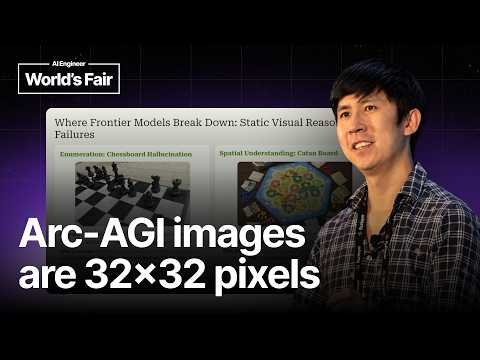
visual reasoning evals some that you might have heard of is arc agi this is uh quite often brought up to um people saying oh we the frontier models are 85% or 90% on RKGI therefore we are 90% of the way to a uh to AGI itself uh but I think these people they haven't really looked at any of the benchmark data because if you actually look at the data you will notice that the images are only 32x 32 or 64x 64 pixels and I would challenge anyone uh to give me like a real world complex task that can be reduced to a 32x 32 pixel problem. Um I think you'll very quickly realize almost no tasks almost no interesting tasks can be reduced to that kind of resolution. Another eval that people commonly uh bring up is MMU. Uh this is the massive multiddiscipline multimodal understanding. This is a step up from MMLU because it has um images rather than just pure text science questions. This is science questions based on images. But still images are a minor part of a lot of these questions. A lot of the questions you can just answer without looking at the image or just doing some pattern recognition just knowing roughly what the image is about. So what we really need is new visual reasoning benchmarks in the industry that really target the things that people care about like geometric align alignment, spatial intelligence, um object terminus and these are really critical for AI to be deployed in these visual use cases. And you might have noticed that still in a lot of industries that uh are primarily visual um which I will go into there isn't much uptake of AI right a lot of the AI uptake has been in the software engineering world and in the mathematician world um and in like documents um document handling etc. But this uh there is actually a huge gap huge opportunity that is just being looked over right now um based on the interest in coding. \[clears throat\] And so the missing paradigm in visual AI is thinking. So we
have generation models very high quality generation models like bite dances seance model. Um, so we have these very high fidelity models and they look
great, but they lack actual physical grounding um and causal logic. So you will you probably notice that if you ask these models to produce a a picture um a video of a some like uh something blowing up like um or a building falling down or these things they look very cartoonish they look Hollywood style kind of things and that's because they are just outputting what was in the training data and a lot of disaster videos um a lot of like action kind of videos on the internet are just going to be from Hollywood or game engines. So they're working to reproduce that and that's fundamentally a problem because it means they can be no better than those kind of uh videos. Um on understanding the what we are where we currently are is we have lot of tools that can map pixels to semantic labels like Google lens is obviously great to identify plants and flowers and I use that all the time. The SAM 3 for segmentation, YOLO for uh object recognition detection, mascaras CNN. These are of course highly robust and they're used everywhere in the industry, but they're fundamentally passive. So there's no reasoning capability to them. So they can't answer more complex questions. Um and really where the frontier is is uh with thinking visual thinking models. These models will have active spatial and temporal intelligence. They can extract actional
logic for planning uh agentic workflows and physical execution. And so our approach uh is uh four stage.
So we are collecting and generating our own uh multimodal data uh visual reasoning specific data. This this kind of data we found you just can't uh get online. Uh we have a synthetic data flywheel using evals agents SFT and RL to improve the model. We're making some uh we made some advances to the architecture um in terms of uh various different time um advance various different improvements on top of the transformer-based architecture and we're also enabling visual chain of thought reasoning and this is one of the key things that humans have that no frontier model has today since the frontier models are only textual uh chain of thought based um and this is one example of a visual chain of thought. So the question is like how many red hotels are built in this photo? Then the model realizes oh uh first we need to identify all the hotels. So it draws boxes around hotels um and other objects and then uh it reduces that to the red hotel. So it's this multi-step uh process happening in the visual space natively. So um about our company um I'm the
co-founder and CEO. I spent the last 12 years at Google Brain and Deep Mind. Um I developed a lot of the foundational techniques for the model for modern LLMs. 11 years ago I was the first
author of the work that introduced pre-training and fine-tuning. That's the work when combined with the transformer paper in 2017 led to the GBT series of models. So all the GBT uh papers site our paper. Um I co-led the earlye models uh the first model that was state-of-the-art called glam and then um more recently I co-led the palm to 2 pre-training architecture and I was co-lead for the gemini data area and my co-founder info and Google research he led research for Apple's first public multimodal model MM1 and he's has a a lot of experience in visual reasoning um across uh language as And this is our team. So we're roughly 20 people now. Um we've also have a chief reasoning architect Dustin Tran. Previously he was lead of post training at XAI. Um and we've hired a world-class team um across uh many other uh companies like Apple uh XAI um deep mind
Amazon and so on. Um and in terms of the uh use cases that I mentioned, robotics is one primary use case. So robots have uh really critical
bottlenecks performing complex real-time physical actions uh in these kind of like dynamic environments. Uh but existing vision models uh you probably realize are trained from static images and very directed videos. They are not like act they don't have active physical interaction. So existing methods are overengineered and brittle. Um and uh we are planning to release a model API available uh by the end of this year. Um and at that point the API can be used to deliver action relevant uh scene understanding into existing um planning and control systems for these um robots. Another important use case for uh visual reasoning um is construction. So construction sites they have these very complex zone specific safety rules. Um and uh computer vision can't adapt fast enough to changing safety rules. They also can't interpret things like OSHA policy language and match the that language to what's actually going on at the site or understand the spatial relationships that are important there. For example, like how many of these workers are wearing helmets or like is the construction um happening according
to the plans that uh were defined earlier. And um currently enforcing these rules require training separate models for different use cases uh because they're
very these models as I said before are very brittle. So you constantly have to do uh retraining. Um and our approach uh with the video um understanding capabilities that we are building into our models is um allows you to um ground these video streams in the safety regulations. And of course the safety regulations are in text, they're in language. So you have to be um the model has to manipulate both language and vision very well. And um yeah uh this will allow these models to interpret uh site policies using the current camera infrastructure that they have. Um and then finally architecture and design we think is also a very uh promising use case here. Uh this is exactly the use case where you need to be very detail oriented. So back to the board game example around counting spatial relationships. This shows up a lot in architecture and design. Uh like if you design a if you design a house with with four bedrooms instead of three, that homeowner is going to be very angry, right? Um so obviously counting is actually important. Um and also just understanding these spatial constraints, real world constraints is uh is a very manual process uh these days. We spoke to a mechanical engineering company just a few weeks ago and they said to design one small part of a robot testing platform takes 100 to 200 hours uh of the time to design the entire testing platform. Um, I believe it takes 2,000 to 3,000 hours of human uh time there. And they've uh a lot of these places they've tried frontier models, but they just don't work for
these use cases. They really struggle to understand uh visual context across these like architecture blueprints, 3D CAD, CAM files. Um, and so there are
lots of errors there. Um and similarly we believe that this can be useful useful for other kinds of design as well not just um architecture and engineering but maybe like designing um yeah for the web or fashion or other things and our approach is uh we're using multimodal reasoning to uh to extract um this uh geometric logic that's important. We're allowing programmatic validation or simulation validation. Just like in code, you can run code against unit tests. You can also run u mechanical devices through simulators that have been developed through seammens um and uh v various other companies to see if something will work in the real world. So there's a lot of parallels actually between uh this kind of like mechanical design and coding itself. But mechanical design is still relatively untouched by AI. Um and yeah, CAD CAM quality control is another potential use case and ultimately we believe that this is going to be a critical step to the future of mechanical design where the where AI can make faster cars, more efficient rockets, better batteries and all these things cannot be done just with code. Uh people are not coding up the next iPhone or coding up the next uh SpaceX rocket. It's all fundamentally very visual.
So, um you can find out more about us through our website um lauren.ai, our Twitter page xx.comai or our LinkedIn uh page. And yeah, happy to take any questions. I'll be standing around here for for a little bit. Thanks.