The Dirty Secret of Forward Deployed Engineering — Natalie…
Natalie Meurer (Sierra) argues that "forward deployed engineering" has never settled into one role: born at Palantir as literally being deployed on-site to keep platforms stable, the title stretched across DevOps, data integration, ontology work in Slate and Foundry, and solution architecture — so each company hiring for it means a slightly different role. Her thesis: the durable part of the job was never the code, but integrating customer data, understanding the customer, and being accountable for outcomes — which is why she sees today's "agent engineering" as forward deployed engineering renamed. Pricing models reflect this: seat-based pricing treats software as a tool, while usage- or outcome-based pricing assumes responsibility for results. Topics include FDE as a subdiscipline of AI engineering, Palantir's origins, why FDE is not one thing, and seats vs. usage vs. outcome pricing.
# Video Identity Observation Document
## Video Overview
- **Title:** *The Dirty Secret of Forward Deployed Engineering — Natalie Meurer, Sierra*
- **Format:** Conference talk (audience hand-raising, applause, "right after lunch" remark indicate a live event, apparently an AI engineering–themed conference given the speaker's aside "which we're of course here to talk about").
## Speaker Self-Identification (Explicit Claims)
- **Name & role:** "I'm Natalie Mier. I am the head of agent engineering at Sierra. I've been at the company about 2 years."
- **Career claims (stated, not independently verified):**
- Studied tech policy at Georgetown's School of Foreign Service.
- Worked at Palantir 2016–2021 on the privacy team, as infrastructure engineer, and as forward deployed engineer with law enforcement and defense.
- Stanford business degree; at Sierra "from 24 to 26."
- Wrote a July 2024 article on "the agent engineer."
## Intended Audience (Observable)
- **Practitioners and hiring managers in AI/deployment roles.** The speaker polls: "Who here is a forward deployed engineer? ... who here is hiring for deployed engineers?" — both raise hands.
- **Engineers familiar with AI tooling.** References to Retool, LLMs, coding agents, and "harness engineering" are used without basic explanation; only "data integration software" is defined.
- Explicit recruitment target: closing note, "we're hiring across forward deployed engineering roles at Sierra."
## Claimed Scope & Thesis
- **Central claim:** "The dirty secret of forward deployed engineering... is it doesn't exist. It is a term that it is meant to describe so many things that it sort of means nothing."
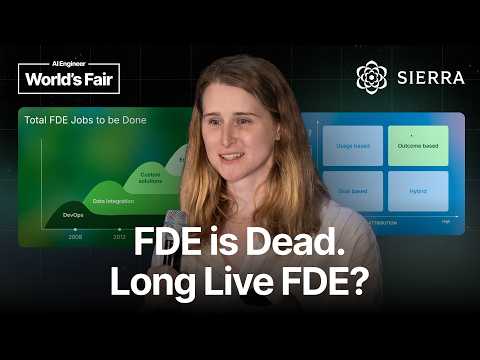
- **Supporting argument structure:** A historical timeline of Palantir FDE eras (2008 platform stability/DevOps, 2012 data integration, 2016 custom solutions/Slate, 2020 enablement/Foundry), followed by present-day convergence claims.
- **Closing reframing:** "Forward deployed engineering is dead. And long live forward deployed engineering" — arguing product, agent, AI, solutions, and customer engineering are all "trending" toward FDE-style customer accountability.
## Channel Presentation Evidence (Demonstrated, Not Claimed)
- **Style:** Opinionated talk format with a contrarian hook ("dirty secret"), direct audience interaction, and humor ("swindled my way or earned my way, depending upon your perspective").
- **Depth signal:** Cites specific artifacts — Palantir job postings from 2016, an Airbus/Skywise example, an "FDE vintage" framework for interviewing candidates.
- **Commercial framing present:** Sierra's **outcome-based pricing** model is described at length ("at Sierra, we've always been focused on this outcome-based pricing model"), plus an explicit hiring pitch — the talk demonstrates partial employer promotion despite the disclaimer "I told you it wouldn't be about Sierra."
## Claim vs. Demonstration Distinctions
- **Creator claims about self/employer:** tenure, Sierra's pricing philosophy, hiring activity — taken from speaker statements only.
- **Demonstrated patterns:** expertise in Palantir's history, hiring experience ("as I've done for the past, you know, 2 years"), and comfort addressing senior technical audiences are shown through content, not just asserted.
- **No evidence in this video of:** broader channel identity, upload cadence, or other content — observations here are limited to this single talk.
# Delivery Observations: Natalie Meurer — "The Dirty Secret of Forward Deployed Engineering"
## Overall Tone & Register
- **Conversational, low-formality conference talk style.** Frequent casual interjections and hedges: "Um," "you know," "sort of," "basically," "right?" appear throughout.
> "So, we're actually going to spend a little bit less time talking about Sierra and a lot more time talking about the history of forward deployed engineering and and the dirty secret, I like to call it, of the domain."
- **Self-aware, mildly ironic humor.** The speaker acknowledges context and pokes fun at herself:
> "I know right after lunch, this is like prime time like sleepiness."
>
> "I learned to code and then swindled my way or earned my way, depending upon your perspective, into a job at Palantir."
## Audience Interaction Habits
- **Repeated hand-raise polls** used as an engagement device — observed at least four times:
> "Who here is a forward deployed engineer? Okay, who here is hiring for a deployed engineers?"
>
> "quick show of hands, everyone here probably knows, but who here knows what data integration software is?"
>
> "Has anyone here heard of Slate?"
- She **plays off audience responses**, including following up on surprising answers:
> "Okay. One All right. I'm curious to hear your take after."
## Structural & Teaching Patterns
- **Explicit agenda-setting up front**, telling the audience what she will and won't cover:
> "I won't make you wait until the end, is it doesn't exist."
- **Chronological, era-by-era framework** (2008 → 2012 → 2016 → 2020 → present) with each era assigned a distinct function (DevOps, data integration, custom solutions, enablement).
- **Memorable coinage / framing devices.** She invents named concepts as teaching hooks:
> "What vintage of FDE are you? Are you the 2008 vintage of platform stability with hints of panic."
>
> "just like fine wine, I think there's a particular vintage of an FDE."
- **Analogy-driven explanation**, especially the movie-theater analogy:
> "I like to think of data integration software without integrated data as a movie theater that's playing nothing. It's like, why show up, you know?"
## Recurring Verbal Tics
- **"Sort of"** is by far the most frequent qualifier — appears in many segments ("sort of a famous Palantir term of art," "sort of means nothing at this point," "sort of lacks a coherent definition"). This is a stable, not isolated, pattern.
- **"Basically"** used as a frequent discourse softener ("basically the job felt like this," "basically what Palantir was selling").
- **"Right?"** used as a check-in with the audience.
## Concrete, Anecdote-Backed Teaching
- Grounds abstract history in **personal, specific experiences**:
> "my onboarding project at Palantir was actually deploy the software on an EC2 instance. And so, that was literally the job."
>
> "basically an email from the customer telling you that someone mistakenly unplugged the instance again. Hey, could you look into it? By the way, it's 2:00 a.m."
## Rhetorical Framing Habits
- **Contradiction-as-thesis rhetoric**, announcing a provocative claim early and resolving it at the end:
> "the dirty secret of forward deployed engineering... is it doesn't exist."
>
> Closing callback: "forward deployed engineering is dead. And long live forward deployed engineering."
- **Rhetorical questions to advance the argument:**
> "what happens to engineering broadly... when code becomes cheap to produce?"
## Uncertainty Notes
- The transcript is unedited verbatim, so disfluencies ("um," repeated words like "and and") may be overrepresented relative to perceived delivery; pacing, gestures, and visual aids (slides, the Alex Karp photo she mentions) are **not observable** from text alone.
- Her exact "hiring for the past, you know, 2 years, 2 and a half years or so" shows imprecise self-correcting numbers — a single instance, so not claimed as a pattern.
# Observation Record: "The Dirty Secret of Forward Deployed Engineering" — Natalie Meurer, Sierra
## Speaker Identification
- **Sole speaker:** Natalie Meurer, self-identified as **Head of Agent Engineering at Sierra** (at the company ~2 years, 2024–present). Previously: Palantir (2016–2021, privacy team, infrastructure engineer, and forward deployed engineer with law enforcement and defense); Georgetown School of Foreign Service (tech policy background); Stanford (business degree).
## Central Thesis
- **"The dirty secret of forward deployed engineering is it doesn't exist"** — the term describes so many things it "sort of means nothing," yet it remains "the hottest job in AI."
- Meurer's aim: convince the audience (a) this is true, and (b) "this doesn't matter" — because the underlying work is converging and expanding.
## Historical Timeline of Forward Deployed Engineering (per Meurer, at Palantir)
### ~2008–2012: Platform Stability / DevOps Era
- "Forward-deployed" **literally meant location** — sitting with customers, on the ground, partly due to on-prem deployments.
- Early job was essentially **DevOps**; her Palantir onboarding project was deploying software on an EC2 instance.
- Frequent customer emergencies, e.g., 2 a.m. emails about unplugged instances.
### 2012: Data Integration Era
- Palantir built **data integration software**; useful only with integrated data.
- Her analogy: data integration software without data is "a movie theater that's playing nothing."
- FDEs gained a **dual role**: DevOps plus data integration, modeling customer data via Palantir's **"ontology"** (a taxonomy for data, per Meurer). Mostly Java-variant code; Palantir client in Java Swing.
### 2016: Custom Solutions Era
- Building solutions to known problems, often via **Slate** (drag-and-drop builder, still part of Palantir's platform, compared to Retool).
- FDEs, as those who best understood the data, were best positioned to make it useful.
### Foundry Era: Data to Decision-Making
- Foundry focused on "going from data to decision-making."
- Key finding: **"A dashboard that doesn't write back to the data source isn't that useful"** — such dashboards decay over time.
### 2020: Platform / Enablement Era
- Pre-IPO Palantir needed solutions not "involving shipping people out to Finland or Canberra"; goal of **empowering customers** to do the work themselves.
- Example: Airbus **Skywise**, enabling thousands of Airbus engineers on Foundry.
- Alex Karp running **AIP bootcamps** where FDEs/deployment strategists taught customers.
- Post-departure platform "AIFTE" (as she names it) leveraging LLMs for similar work.
### Meurer's Observations on the Timeline
- These were **not discrete eras**; total FTE jobs to be done grew over time (peaked perhaps once, then grew).
- FDE is "the best training ground for generalists" — her explanation for Palantir alums' founding success.
- Introduces the **"FDE vintage"** interview heuristic: ask candidates whether they are the 2008 (platform stability "with hints of panic"), 2012, 2016, 2020, or present-day vintage.
## The Present State (2026, per Meurer)
- **FDE is "absolutely everywhere"**: Google/GCP hiring customer engineers; OpenAI's new corporate-AI unit with massive investment; Aaron Levie and others posting about the role's importance.
- Combining job postings yields an unrealistic composite: staff engineer (8 yrs) + direct sales (6 yrs) + solution architect (4 yrs) + teaching background.
- Framing tension, stated verbatim: it "either doesn't exist or maybe it actually exists too much. Hard to say."
## Claims About Convergence
- The **one continuity** across all eras: FDEs are **accountable to the customer** — for DevOps, enablement, custom solutions, or data integration.
- With **code becoming cheap to produce** (prompting background agents), FDEs can now build **end-to-end solutions**, not just prototype, making them more impactful in product development.
- At Sierra, **lines are blurring**: product engineering is becoming more client-facing; good engineers should think about product and customer together.
- FDE is "getting larger than we ever thought" — stacking more skills (product and infra engineers should also think DevOps).
## Pricing Model Argument
- Cites **Emergence Capital** and a blog post by Sierra's head of go-to-market ops, **Elliot Greenwald**.
- Two axes: **outcome attribution** and **agency/autonomy**.
- **Seat-based pricing**: weak outcome attribution.
- **Usage-based**: e.g., paying OpenAI/Anthropic — usage-based because outcomes are hard to attribute.
- **Outcome-based**: e.g., customer-experience AI — did you make a sale, solve an inquiry.
- Sierra's position: "most of pricing in this market will move to outcome-based."
- Claim: if FDEs contribute to product *and* pricing is outcome-based, **FDE is how you guarantee the outcome**.
## Self-Revisions and Qualifications (preserved)
- On her July 2024 article on **agent engineering**: she framed it as a subdiscipline of AI engineering with FDE-level customer accountability. Now states: "I don't know if I was wrong... but it wasn't the whole story" — she now views agent engineering as a **flavor of forward deployed engineering**.
- Current position: "in some ways everything is forward deployed engineering, or at least everything is trending that way" — product, agent, AI, solutions, and customer engineering all done on behalf of customers.
- Acknowledges FDE "lacks a coherent definition" even as a concept.
- Her stated dislike of Sierra's "deployment team" name when she joined (calling it nonsensical) — original position, later context.
## Closing
- Parting line: **"Forward deployed engineering is dead. And long live forward deployed engineering."**
- Notes Sierra is hiring across FDE roles.
## Unresolved Tensions
- The core definitional paradox stands unsmoothed: FDE simultaneously "doesn't exist," "means everything," and "exists too much."
- Her 2024 framing (agent engineering as its own domain) vs. 2026 framing (agent engineering as a subset of FDE) remains an explicit self-correction, not a settled resolution.
# Speaker Attribution Record — Video `01a15ca8-3673-7a6f-a643-8b167c184fa0`
## Speakers
### Natalie Meurer — **Primary / Sole Speaker**
- **Role:** Speaker; identified in transcript as **Head of Agent Engineering at Sierra**.
- Self-described background:
- Georgetown, School of Foreign Service (tech policy)
- **Palantir**, 2016–2021: privacy team, infrastructure engineer, forward deployed engineer (law enforcement and defense)
- Stanford (business degree)
- **Sierra**, 2024–present
- Delivers the full talk; audience is present (raised hands, applause) but contributes no spoken lines in the transcript.
### Audience
- **Role:** Attendees; non-speaking — only hand-raise responses and applause are noted.
## Referenced Sources & Third-Party Claims
### Companies / People Cited
- **Palantir** — history of forward deployed engineering (2008–2020 eras: platform stability, data integration, custom solutions/Slate, Foundry, enablement, AIP bootcamps)
- **Alex Karp** — referenced re: AIP bootcamp
- **Airbus / Skywise** — cited as example of customer enablement on Foundry
- **Google (GCP)** — claim: recently announced hiring customer engineers/FDEs
- **OpenAI** — claims: created a new unit with massive investment for corporate AI push; also example of usage-based pricing
- **Anthropic** — example of usage-based pricing
- **Aaron Levie** — claim: posting on X about importance of FDE work
- **Emergence Capital** — cited re: changing software sales
- **Elliot Greenwald** — identified as Sierra's head of go-to-market ops; cited for a blog post on sales changes
- **Sierra** — employer; outcome-based pricing model described
### Self-Referenced Work
- Author of a **July 2024 article on "agent engineering"** as a subdiscipline of AI engineering (6 months after joining Sierra).
## Promotional Segments
- **Flagged:** Closing segment —
> "By the way, we're hiring across forward deployed engineering roles at Sierra."
> "If you want to talk about FDE, I'm here."
- The speaker frames Sierra's outcome-based pricing model favorably throughout ("we think that you should pay a software platform for the value that software delivers").
## Provenance & Availability Notes
- **No curated metadata supplied** — no channel, publication date, or comment availability established.
- Historical claims (Palantir eras, Google/OpenAI hiring, pricing trends) are attributed to the speaker; some are her personal recollection or interpretation and are not independently sourced within the transcript.
- One uncertainty noted by speaker: possible missing photo of Alex Karp ("I think we might have lost the photo").
\>\> Thanks guys for coming. I know right after lunch, this is like prime time like sleepiness. I'm curious just to get a sense for the audience. Who here is a forward deployed engineer? Okay, who here is hiring for a deployed
engineers? Okay, helpful. Anyone else in between? You can raise your hand just like if if I didn't cover it. Okay. I see you. Double double hand raise. Um well, I'm Natalie Mier. I am the um head of agent engineering at Sierra. I've been at the company about 2 years. I'll tell you a little bit about that. But honestly, I'm here to talk about forward deployed engineering. So, we're actually going to spend a little bit less time talking about Sierra and a lot more time talking about the history of forward deployed engineering and and the dirty secret, I like to call it, of the domain. And you all can tell me how controversial it is. So, um just a little bit about me, which will give you a sense for sort of how I'm coming at this domain, at the whole domain of forward deployed engineering. I actually started off as a policy nerd. So, I was at Georgetown. Um I studied uh in the School of Foreign Service there. And so, I was obsessed with basically tech policy. I um learned to code and then swindled my way or earned my way, depending upon your perspective, into a job at Palantir, where I spent 2016 to 2021. And um there I worked on the privacy team and I was a an infrastructure engineer and also a forward deployed engineer with law enforcement and defense primarily. So, I I've seen forward deployed engineering up close and I'm going to talk a lot about the history of not just my time at Palantir, but actually the time that predated me to talk about basically the origins of the entire discipline. And then I actually wanted to get a business degree of all things, so I went to Stanford. And now I'm at Sierra from 24 to to 26. And one of the things that I think is is quite interesting and when I started at Sierra, actually a little known fact is that I joined the deployment team. and at the time I hated the name. I I thought this is not what we're doing
and B it sort of is a nonsensical name so to speak and so I actually wrote an an article in July of 2024, so about 6 months after I started, um about 2 years ago now, on this concept of the agent
engineer. And the idea was that agent engineering was actually a subdiscipline of AI engineering which we're of course here to talk about. And the vision was that agent engineering had the same level of customer accountability as forward deployed engineering but was actually a domain onto itself. And I think since then, you know, in the past 2 years we've actually seen a lot of folks talking about agent engineering as a discipline and now we're actually seeing harness engineering as sort of a new discipline sort of is almost a subset of agent engineering. And so if you're confused, that's sort of what this talk is about. And so the dirty secret of forward deployed engineering, I won't make you wait until the end, is it doesn't exist. It is a term that it is meant to describe so many things that it sort of means nothing at this point. But nonetheless, it's sort of the hottest job in AI. And so what I hope to convince you of over the next, let's say, 15 minutes is A that this is true and B that this doesn't matter. And so um I'm going to dive in and we're going to start with tracing the history of forward deployed engineering from Palantir. So we're going to start in 2008. We're going to basically come back to the present and then I'll share with you at least my perspective on what forward deployed engineering is today, why you should want to or not want to be a forward deployed engineer, and why we're actually all forward deployed engineers in the end. Um so first off, I I'd actually like to start in 2016 and then we'll go a little back in time. And I actually pulled basically Palantir job postings in 2016. This is when I started and what drew me into Palantir was effectively this concept of a forward deployed software engineer and this was an emphasis on the forward deployed part. I mean, they're leading. These days you lead with, you know, you
speak a certain language, you have these skill sets. They were leading with location. And there's a reason for that that we'll get to, but but forward-deployed literally meant sitting with customers, being on the ground. And
in part, as we'll talk about, this was because so much of Palantir's um ecosystem was on-prem deployments. And so, when we think of forward-deployed engineering though, we kind of think of this. And so, um this is sort of the prototypical forward-deployed engineer right out of college um parachuting out of a helicopter um and of course, you know, fixing some sort of runtime issue um in the air. But in practice, forward-deployed engineering actually started as something more akin to DevOps. And so, platform stability really constituted the bulk of the job early on. And so, when you think about um what forward-deployed engineering actually was, don't worry about understanding this code on the right, but it just gives you a sense for what what folks were actually doing. In fact, my onboarding project at Palantir was actually deploy the software on an EC2 instance. And so, that was literally the job. And it was a a large part of the
job, and so much so that um basically the job felt like this, which is basically an email from the customer telling you that someone mistakenly unplugged um the instance again. Hey,
could you look into it? By the way, it's 2:00 a.m. and you need to go in. Um and so, in practice, a lot of the early forward-deployed engineering was was really focused on DevOps. And come 2012, the the Palantir platform got a lot more stable. And Palantir built data integration software. So, quick show of hands, everyone here probably knows, but who here knows what data integration software is? Great. Anyone think data integration software is really useful without data? Okay. Oh, okay. One All right. I'm curious to hear your take after. Um So, um so I like to think of data integration software without integrated data as a movie theater that's playing nothing. It's like, why show up, you know? And so, this is basically what Palantir was selling without forward deployed engineers. A, the movie theater wasn't standing in 2008. By 2012, you actually don't have data in it, right? You don't have movies playing. And so, you sort of have this basic, um you know, comic explaining this this process, which is, "Hey, great. We have this data integration software, isn't it useful?" Right, but my data's in 20 places, and now you actually have a forward deployed engineer that needs to go in and integrate that data. And most of this was written in, you know, variants of Java back in the day. Um as was actually Palantir's client, fun fact, in Java Swing, if anyone here has had the privilege to to use that. Um So, so basically, forward deployed engineers now have this dual role, right? DevOps plus data integration. And so, they wanted to to deeply understand the customer's environment to to model that
data appropriately. And what Palantir uh did then and now still does call an ontology, which is sort of a famous Palantir um term of art. But you can think of it as a taxonomy for that data.
And then 2016 rolled around, and you have custom solutions. So, folks are building effectively solutions to known problems. Um and usually that took the form of a Slate dashboard. Has anyone here heard of Slate? This was sort of an internal Okay. All right. Um so, Slate was basically um a drag-and-drop builder. It actually still exists as part of Palantir's platform. It allowed you to map, similar to Retool actually, um map components on the page to data sources. So, now you have the data, and then the question became, "Okay, how do we make it useful?" And the the person or the individual or the group that was most well situated to make that data useful was the the individuals that most understood that data, which were the forward deployed engineers. And so, um the this basically era of of Slate actually gave way to an era of Foundry, which is Palantir's main platform today. And the era of Foundry was effectively all about um making data useful. So, Palantir had this phrase of uh going from data to decision-making, which was was sort of the core problem. One of the things they found, a spoiler alert for anyone building a dashboarding platform, is that a dashboard that doesn't write back to the data source isn't that useful. That these things would decay over time and actually not be as useful as they could be. Fast forward to 2020, you know, Palantir is on the verge of IPO. And they also need a solution that doesn't involve shipping people out to Finland or Canberra or choose the kind of location on the earlier slide of your preference. And um they actually wanted to empower customers to do more of this work themselves. And so, this is where Palantir really started to become a platform. And the job of forward deployed engineering still involved the first three, but it also involved enablement of those customers. So, if you look at the work that Palantir's done with Airbus, for example, in Skywise, that was focused on enabling thousands of Airbus engineers on the Foundry platform to do work of the forward deployed engineer. And these days, they actually have a platform uh since I left called AIFTE that's focused on leveraging uh large language models to do similar work. So, this is the timeline, and you'll see
that it's not one thing. And so, this is a a picture of uh Alex Karp, and I think we might have lost the photo um over over here, but of Alex Karp
basically running an AIP bootcamp. So, this is basically where the forward deployed engineers or the deployment strategists would go in and actually teach customers to use the software. So, what's interesting about this is these weren't discrete eras, right? The total FTE jobs to be done actually increased over time. Maybe they peaked at one point, but they actually grew over time. And so, now we have a world come 2020, 2024 where the role of FDE sort of doesn't mean anything quite yet or it means everything, right? It's actually the best training ground for generalists. And in fact, this is why I would say that Palantir has seen such success Palantir alums founding companies is because it's actually training you on all of these different facets of the role. And so I have an idea that I like to think of that you all can ask your next candidate if you're interviewing for for engineering role. Which is what vintage of FDE are you? Are you the 2008 vintage of platform stability with hints of panic. 2012, 2016 2020 or even you know today. What is what is the forward deployed engineer of today? And so that I like to call this the FDE vintage and you might debate the years and debate the details, but just like fine wine, I think there's a particular vintage of an FDE. So welcome to 2026. Here we are and FDE is absolutely everywhere. So I'm sure you all have heard Google recently announced with GCP an effort to hire customer engineers or FDEs. Open AI created a new unit with a massive
investment to aid the corporate AI push. You have folks like Aaron Levie basically posting on X as as well as many others about just how important this work is today. But if you think as
about what we just saw, the work isn't one thing, right? So forward deployed engineering is actually many things all at once. And in fact, today if you look at basically what it takes to be a forward deployed engineer, you were to combine all the job postings into one, you'd probably see something like this. You know, I don't know how many of you have been a staff eng for eight years with six years of direct sales experience and four years as a solution architect. Also, I don't know if you've taught in schools prior because that would help as well. And this is actually what it feels like hiring for these deployed roles as I've done for the past, you know, 2 years, 2 and 1/2 years or so. Um, but this is actually what's being asked of forward deployed engineers today. And so you think about the the dirty secret that it doesn't exist and actually it it either doesn't exist or maybe it actually exists too much. Hard to say. Um, and part of this, I think, and part of sort of um, I think the importance of the role is that across all of those different aspects of the role, the one continuity point is that you actually have every single forward deployed engineer accountable to the customer, whether that be for devops, for enablement, whether that be for custom solutioning, data integration. These are all forms of solutions or customer accountability. And when that happens though, I I ask the question, you know, what happens to engineering broadly, even outside of forward deployed engineering, when code becomes cheap to produce? When it becomes really quick to fire off a
prompt to a background agent and get something pretty great on the other end. And one way to think about this is forward deployed engineers being accountable to customers and trying to
translate that signal into the product, either to make it more stable or to drive more data integration. And so what this allows you to do as a forward deployed engineer today is actually be way more impactful in product development. So forward deployed engineers can now not just talk to customers, not just prototype, but actually build end-to-end solutions with coding agents. But I think something more interesting is happening that we're seeing at Sierra, which is actually the lines are blurring. So product engineering is also becoming more client-facing. And so if you're a good product engineer, if you're a good forward deployed engineer, you should be thinking about the product and the customer both together. And so one of the reasons that folks are talking about forward deployed engineering as so essential to where we are at this point in time is that it's actually converging. Forward-deployed engineering is in some ways actually getting larger than we ever thought it was before. So, it's actually stacking more skills on top. And if you're a product engineer, even an infra engineer, you should also be thinking about DevOps, right? How do you actually deploy the software? And then separately, a different shift is changing when code becomes cheap. And this is actually from um both Emergence Capital and then a a blog post from someone on on our team, our head of go-to-market ops, Elliot
Greenwald. And the way that we sell software is changing. And at Sierra, we've always been focused on this outcome-based pricing model. We think that you should pay a software
platform for the value that that software delivers. And this is not always possible. So, if you think about uh scenarios where basically you can only slightly attribute the outcome to the product, think of seat-based pricing. This is basically the way that software has been priced for uh an incredibly long time. And then you think about the agency and the autonomy to achieve the outcome. And agents basically move us up into the right here. So, usage-based, a good example of that might actually be what we pay to OpenAI or Anthropic or some of the foundation model providers. Because it's it's based on usage and it's hard to actually attribute the outcome. When you think about customer experience in AI, that's outcome-based. It's are you actually making a sale? Are you solving a customer's inquiry? And we think basically that most of pricing in this market will move to outcome-based. So, if you have both of these things, you have forward-deployed engineers that can now contribute to the product, you have more outcome-based pricing, how do you actually guarantee the outcome? And that really is forward-deployed engineering. And so, if I jump here uh back to sort of where I started, this is how I envision agent engineering in in 2024. And I I don't know if I was wrong or you guys can tell me if I was wrong, but it wasn't the whole story. Right? That agent engineering actually was a subset
heavily focused on outcomes. It is a flavor of forward deployed engineering. But these days, I'm actually of a different mind, which is that um really in some ways everything is forward
deployed engineering, or at least everything is trending that way. Product engineering, agent engineering, AI engineering, solutions engineering, and customer engineering. When you think about enablement, you think about devops, you think about solution building, data integration, building an agent, deploying it into production. These are things that are on behalf of customers at the end of the day. And we should be pricing outcomes associated with them. And forward deployed engineering as a concept, even if it is one, sort of lacks a coherent definition, is something that actually allows us to enable those outcomes. So, I'll leave you with um maybe one last note, which is that forward deployed engineering is dead. And long live forward deployed engineering. So, thank you so much. And by the way, we're hiring across forward deployed engineering roles uh at Sierra. So, I told you it wouldn't be about Sierra, but if you want to talk about FDE, I'm here. Thanks, guys. \>\> \[applause\]