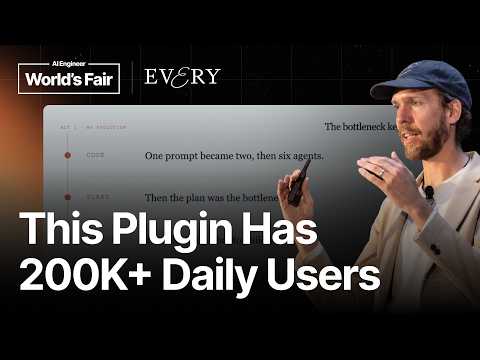
The Era of Compound Engineering — Kieran Klaassen,…
Talk by Kieran Klaassen (Every/Cora) on rebuilding the Cora email client alone without writing or reading most of the code. He describes how the bottleneck in AI-assisted development shifted from code quality, to plan quality, to deciding what to build, which motivated "compound engineering": spending half your time building features and the other half teaching the system what it got wrong, so stored solutions reduce future token costs. He covers the loop of autonomous work with the human at both ends (framing the problem, then raising the bar rather than doing QA), turning a backlog into argued ideas, and the goal that each shipped feature should make the next one easier to build.
# Video Identity Observations: "The Era of Compound Engineering — Kieran Klaassen, Every/Cora"
## Explicit Self-Description
- **Creator affiliation**: The speaker identifies himself as Kieran Klaassen working at **Every**, described as "an AI lab for the future of work."
> "Hello, I'm Kiran. I work at every is an AI lab for the future of work. And we ask ourselves the question, what's next? And we write about it, we teach about it, we build."
- **Product ownership**: He claims to have built **Cora**, "a complete AI email inbox it's agent native," where he says he "invented compound engineering."
- **Open-source contribution**: The talk promotes an open-source tool:
> "check out the plugin. It's open source. Please um, contribute. PR is welcome."
## Claimed Audience
- **Engineers as primary audience**, with explicit broadening to other roles:
> "compound engineering is really for engineers, PMs, designers, even people that do knowledge work."
- People building with AI who want durable practices, framed against trend-chasers:
> "what I'm trying to do is not that today… share something that you can bring to your workflow that will outlift trends."
- Both newcomers and experienced practitioners: he structures the talk in two halves — "why it's so important to compound how I got here… for people that maybe are not at the end of the trajectory" — and practical "stuff you can run yourself."
## Claimed Scope
- Teaching a repeatable **AI-assisted engineering methodology** ("compound engineering"): brainstorm → plan → work → review → polish → compound.
- Demonstrating a concrete toolchain: commands `ce id8`, `ce doc review`, `ce brainstorm`, `ce lfg`, `ce polish`, `ce compound`, usable "in whatever tool you use codeex cloud code cursor plus 10 others."
- Audience-scale claims for the plugin: "now hundreds of thousands of people use it daily" — a **creator claim**, not independently verifiable from this material.
## Observable Presentation Patterns (demonstrated, not just claimed)
- **Talk/conference format** with live product demos, direct address ("Hello everyone"), applause, and a closing Q&A invitation ("I will be hanging around if you have questions").
- **Practitioner-teacher stance**: shares a personal rule (50% feature / 50% teaching the system) and philosophy ("keep extracting until the complete middle runs itself").
- **Product evangelism woven in**: Cora beta recruitment ("if you want access just DM me talk to me") and open-source contribution requests appear alongside the methodology content.
- **Concrete workflow specificity**: real tool names, commands, and examples (Kora v1→v2 upgrade, Linear/GitHub/Slack/Intercom integration) — demonstrating the channel/lab builds and ships working products, not just theory.
## Claims vs. Demonstration Distinction
| Claim (creator-stated) | Demonstration (from material) |
|---|---|
| Every is "an AI lab for the future of work" that writes, teaches, builds | Talk format with shipped-product demos and a downloadable open-source plugin |
| "One engineer… built a full email client alone" | Detailed solo workflow described; team size not independently evidenced |
| "Hundreds of thousands" of plugin users | No usage evidence present in this video |
| "I invented compound engineering" | Methodology presented with original framing ("human-AI sandwich," "brain at the ends") |
## Notes for Later Synthesis
- The talk functions simultaneously as **education, product marketing (Cora), and open-source community building** — three observable presentation modes.
- Tone is informal, first-person, anti-hype positioning ("I never decided this should be something like hype"), which is itself an observable identity choice.
# Delivery Observations — Kieran Klaassen, "The Era of Compound Engineering"
## Tone
- **Conversational, informal, first-person throughout.** Casual markers appear constantly: "blah blah blah," "which is cool," "Um," "H."
- **Self-assured but not boastful** — claims are grounded in personal results: > "I have a product I built that thousands of people use and trust with their email inbox, which is amazing."
- **Anti-hype positioning** — explicitly distances himself from trends: > "Oh, you should use this the factory dark factory do that blah blah blah all the new hip cool things." ... "What I'm trying to do is not that today."
## Vocabulary & Recurring Phrases
- **"Compound / compounding"** is the signature term, repeated across contexts: "compound engineering," "compound product," "compound knowledge," > "a system that compounds," > "the next time the AI will come up with a brainstorm it will already include that thinking."
- **"Brain on" vs. middle** framing: > "where do I turn my brain on versus when do I leverage the model."
- **"Extract"** as a repeated imperative: > "extract never repeat if you see yourself repeating yourself make sure to extract it somehow."
- **"Raise the bar"** recurs as a closing-stage phrase: > "we need to raise the bar we need to do better."
- Colloquial intensity: > "so freaking good that it will surprise you."
## Teaching Habits & Structure
- **Announces structure upfront**: > "there are two halves in this talk. One is why it's so important to compound how I got here."
- **Narrative bottleneck sequence** — teaches via a staged story: > "first there was bad code hallucination... The plan was the bottleneck... the next bottleneck was deciding what to build."
- **Memorable metaphor**: > "the human AI sandwich where the human is the bread and the AI is the middle part."
- **Demo-driven** — walks through named commands ("CE ID8," "C do review," "c brainstorm," "LFG," "C polish") with concrete usage examples.
- **Prescriptive summary rules** near the end: > "Spend 50% of your time to make it better the next time," > "your standard should be the next feature should be easier because you ship this one."
- **Anticipates objections** and answers them: > "people say oh but tokens and in my research it's actually more token efficient."
## Communication Patterns
- **First-person credibility framing** — repeatedly grounds authority in his own practice: > "I'm an ex VPB of engineer and founder," > "I just built this while building Kora."
- **Direct audience calls-to-action**: > "if you want access just DM me talk to me," > "check out the plugin. It's open source. Please um, contribute. PR is welcome."
- **Acknowledge difficulty honestly**: > "I know it's hard like it's just hard to do for myself... it's kind of awkward."
- Filler-heavy, rapid delivery ("Um," "uh," "H" throughout) — consistent with an informal talk style.
## Uncertainty Notes
- The transcript is likely auto-generated (e.g., "VPB of engineer," "cloth MD/CLAUDE.md" ambiguities, "Trevan Chowo"), so exact command spellings and names are uncertain.
# Observation Document: “The Era of Compound Engineering” — Kieran Klaassen
## Speaker
- **Kieran Klaassen**, Every / Cora (speaker identification from title metadata and transcript self-introduction: “I’m Kiran. I work at Every… Cora is mine is where I invented compound engineering”).
## Central Thesis
- **Compound engineering**: extract your thinking and taste into a system that compounds, so each future AI run includes prior learnings.
- Claim: “**one engineer with a compounding system just beats teams… that use AI that don't**.”
- Explicitly distinguishes his approach from trend-chasing: “What I’m trying to do is not that today” (re: “factory dark factory… hip cool things”).
## Context and Background
- States he **hasn’t written a line of code this year** but ships a product (Cora, an AI email inbox) used by thousands.
- Built Cora alone since January (with design and database support); ex-VP of Engineering/founder who deliberately chose to test “how far can AI go before I actually need to grow the team,” starting with Sonnet 3.5.
- Every described as “an AI lab for the future of work” with single-engineer teams.
## The Evolving Bottleneck (Stated Progression)
1. **Code** — initially bad/hallucinated; fixed via agents, skills, review.
2. **Planning** — once code was good, larger plans became the limit.
3. **Deciding what to build** — user conversations, understanding problems (reason he gives for using your own product).
4. **Repetition** — solved by a **memory system** (started as a CLAUDE.md, later a dedicated system).
- Conclusion: “**Implementation is mostly solved**”; what remains unsolved is **judgment and taste**.
## The Loop
- Brainstorm → Plan → Work → Review → Polish → Compound → repeat.
- “**Human-AI sandwich**”: human (brain) at both ends — deciding what to work on, and applying taste/raising the bar at the end; AI in the middle.
- Emphasizes being able to “let go and let the machine rip overnight for many hours in parallel.”
## Core Rules / Prescriptions
- **50/50 split**: half of each interaction on shipping the feature, half on teaching the system what went wrong.
- **Never repeat yourself** — extract repeated knowledge.
- The middle should run without you and “should be boring.”
- If still needed in the loop, run it manually until you can let go.
- **Document the thinking, not the code** — reasoning is needed to generalize; traces useful for postmortems.
- **Token-efficiency claim**: storing solutions in the repo is *more* token-efficient long-term, because answers are already present, avoiding review/correction/deep research. (Noted as his research claim, offered as a counter to the “but tokens” objection.)
- Standard: “**the next feature should be easier because you shipped this one**” — flipping the normal dynamic of added complexity.
- “Don’t fix things… raise the bar. We’re not shipping shitty code.”
## Demonstrated Tooling (Compound Engineering Plugin)
- Open source plugin usable in Codex, Cursor, Claude Code, etc.; states “hundreds of thousands of people use it daily”; co-contributor **Trevan Chowo** credited with product sense.
- **`ce id8`**: aggregates issues (Linear, GitHub, Slack, Intercom), argues for/against work, outputs shareable HTML; can score ideas against OKRs/past learnings; can be turned into a designed PowerPoint.
- **`ce doc-review`**: sharp questions on PRDs/documents; answers can be compounded via `ce compound`.
- **`ce brainstorm`**: “brain-on” command; pulls in compound knowledge, personas; deliberately asks a minimal, “dialed-in” number of questions — he argues other libraries “over question” (stated opinion).
- **`ce lfg`**: the overnight loop — planning, work, review, testing, PR, dogfooding, before/after video in the PR.
- **`ce polish`**: brain-on review of PRs; explicitly “not QA… raising the bar.” Example given: two logo marks on a page — compounding the fix so design work won’t repeat it.
## Qualifications and Tensions Preserved
- He acknowledges orchestration/dark-factory approaches “kind of works, which is cool” even while distinguishing his approach.
- Notes the 50% discipline is “hard” and “awkward” — “it works, it’s great, let’s just move on” is the temptation he warns against.
- Admits “sometimes I don’t even know what was built” — polish used as a primer.
## Closing Bet
- “**Implementation is only getting cheaper and judgment is not**” — future systems must be structured so models can access human judgment and taste; brain at the ends, don’t offload the initial thinking to AI.
# Speaker Attribution Record
## Video
**Title:** The Era of Compound Engineering — Kieran Klaassen, Every/Cora
**Video ID:** `01a15ca7-cac7-7d30-ad43-e29c0ec1615e`
## Speakers
- **Kieran (Kiran) Klaassen** — **Primary/sole speaker**; self-identified as talk presenter, engineer at **Every** (described as an AI lab for the future of work), builder of **Cora** (AI email inbox), and creator of the **compound engineering plugin**.
- Role: **Creator / presenter** (conference-style talk with audience, ends in applause).
- **Audience** — Implied listeners ("Hello everyone"); greeted and addressed by the speaker. No speaking lines.
## Roles Identified in Transcript
| Role | Holder | Evidence |
|---|---|---|
| Speaker / engineer | Kieran Klaassen | "Hello, I'm Kiran. I work at Every" |
| Solo builder of Cora | Kieran | "I built a full email client alone" |
| Co-contributor | **Trevan Chowo** (as transcribed) | "I have a lovely co-contributor Trevan Chowo who has a very good product sense" — **non-speaking**, credited only |
| Employer / lab | Every | Named as speaker's organization |
| End users | "thousands of people" for Cora; "hundreds of thousands" for plugin | Third-party claims, no speaking role |
## Referenced Sources & Third-Party Claims
- **Products/tools named:** Cora (v1, v2 in beta), Every studio, compound engineering plugin (open source, "codeex cloud code cursor plus 10 others"), CLAUDE.md/"cloth MD", Linear, GitHub issues, Slack, Intercom, Cursor, Sonnet 3.5 (model cited as catalyst), Ruby/Rails backend, React frontend, MCP.
- **Commands demonstrated (speaker's own plugin):** `CE ID8`, `CE strategy`, `CE doc review`, `CE compound`, `CE brainstorm`, `CE LFG`, `CE polish`.
- **Third-party claims:** "hundreds of thousands of people use it daily" (plugin); "I've seen people dump this document inside [Claude] and say create a PowerPoint" — anecdotal, unverified.
## Promotional Segments — Flagged
- **Cora v2 beta access solicitation:** "soon beta access if you want access just DM me talk to me."
- **Plugin promotion:** "check out the plugin. It's open source. Please contribute. PRs welcome."
- Usage-statistics claims ("hundreds of thousands of people use it daily") function as promotion for the speaker's own tool.
## Availability & Provenance Notes
- **Comment availability:** Not indicated in source material.
- **Curated metadata:** None supplied beyond title; identity/role facts derived solely from transcript self-introduction.
- **Uncertainty:** Speaker's name spelled both "Kiran" and "Kieran" (title) in source; co-contributor name "Trevan Chowo" is as transcribed and unverified.
Hello. Hello everyone. Welcome. I want to start with saying I haven't
written a single line of code this year. Um, maybe I haven't even looked at most of it yet. I do ship. Uh, I have a product I built that thousands of people use and trust with their email inbox, which is amazing. I'm actually proud of the code I ship and I'm proud of the product I ship. I've been doing this for two years and trying to extract my thinking and my taste into a system that compounds. And I'm going to share you how I do that. Lots of stuff you hear is like, "Oh, you should use this the factory dark factory do that blah blah blah all the new hip cool things." Uh, what I'm trying to do is not that today. I'm going to just show you how I work and hopefully share something that you can bring to your workflow that will outlift trends and really set yourself up for success for newer models, bigger models. Uh there are two halves in this talk. One is why it's so important to compound how I got here. So this is for people that maybe are not at the end of the the trajectory. It's interesting to see how to get there. And then stuff you can run yourself, you can use uh day-to-day to ship, to build, uh to research, to do knowledge work even. Hello, I'm Kiran. I work at every is an AI lab for the future of work. And we ask ourselves the question, what's next? And we write about it, we teach about it, we build. And we have a studio se uh studio um where we have mostly single engineering teams that take a problem they really care about and use AI to build a product out and really leverage that and compounded knowledge is a big way we do that lots of loops shipping faster and faster and core as mine is where I invented compound engineering and it's a complete AI email inbox it's agent native. So that means whatever you can do the agent can do. H it runs on your desktop phone CLI insight codeex like uh MCPS and I'm rebuilding it as version two. Uh so soon
beta access if you want access just DM me talk to me. The cool part is it's one engineer and I have support. I have design support. I
have some like database hardcore engineering problem support like you need some support. Um but I built a full email client alone and I've only started building this in January this new rebuild. I use reals on the back end. I love Ruby React on the front end and I own products fully. So I talk to people when something goes down I'm the one responsible and it's set up like this on purpose. I'm an ex VPB of engineer and founder and I know how to hire grow teams all that stuff. But I wanted to do the opposite with sonnet 3.5. I just felt there was something new that was unlocked and I wanted to see how far can AI go before I actually need to grow the team. And I'm still alone with some support which is cool. So I built Kora and this is what I learned. Two years ago I started and the bottleneck by then was code. So it kept moving and my job changed over the years but first there was bad code hallucination just stuff that didn't work. I added agents I added skills just reviewing it. So okay code got good. The plan was the bottleneck because I could do things but larger things. So whenever I have a good plan set out, it would do bigger things than just code changes. Okay, plans got good. Um the next bottleneck was deciding what to build. Talking with users, really understanding problems you're solving. This is why
it's so good that you use your own product. You love what you're building for. And that got really good as well. The scope
got bigger. AI could help writing uh plans. And I kept repeating myself and that was annoying. So I figured out there needs to be some kind of memory system. So every time um I repeat myself, I can say, "Hey, can you make sure to store this knowledge in some way?" I started with storing this in cloth MD, but at some point that became too large. Um, so I built a system that remembers and that's really where compound engineering came from and you
see me go away from typing more towards judgment and taste and I think implementation is mostly solved even though you see many people that do
orchestration dark factories who it kind of works which is cool but the thing that doesn't work is our judgment and our taste. And for me it's really where do I turn my brain on versus when do I leverage the model and it's where you make judgments and it's where you add taste. So where you think where you iterate where you jam where you brainstorm I extract that into a system and if it's extracted into the system you can move on to bigger problems because the next time the AI will come up with a brainstorm it will already include that thinking so you can go on for the next one
and I see that one engineer with a compounding system just beats teams like full teams that use AI that don't.
This is my loop. It's it there's more to it than this, but this is the overview. Brainstorming, planning, working, reviewing, polishing, compounding, and repeating. And the real trick here is on both ends. It's kind of the human AI sandwich where the human is the bread and the AI is the middle part. And the brain is on on the ends. So the start brainstorming where you have to decide what to work on what the problem is and really understand what you're trying to do and at the end where your taste comes in where you decide this looks very good makes me very happy or we need to raise the bar we need to do better we need to make it more snappy we need to go optimistic or whatever that is like like delight and throughout here especially in the brain on parts it's important to extract the learnings to compound. So that's basically the loop. You cannot run the middle if it's not set up correctly. And it's very important to be able to let go and let the machine rip overnight for many hours in parallel. And the only way to be able to do that is making sure you spend time on uh on that system. So my rules 50% should go into creating uh the feature just making sure like did it build the feature? Did it deliver the value you set out to do? But 50% of the time should go to um teaching the system for anything that it did wrong. Can we
learn something? Can you teach the system something? And this is something that is kind of hard, but it's very important because it will make the next time better.
One bonus is because of this extraction um I store all of this knowledge inside my repository as solution documents and people say oh but tokens and in my research it's actually more token efficient because if you have the right answers and the right solutions already within the token you don't need to do review you don't need to correct you don't need to do deep research across the internet because the token's already there so it's actually more token efficient in the long term, which is cool. Less research, finding things faster. The real reason why this works is my brain is fixed and AI isn't or less
fixed. And my philosophy is keep extracting until the complete middle runs itself and is so freaking good that it will surprise you.
Um let me show you how this works. Uh so I have a plugin called the compound engineering plugin that you can install in whatever tool you use codeexcloud code cursor plus 10 others and I just built this while building Kora shared it at some point and now hundreds of thousands of people use it daily. So thank you all for using it if you did. I'm honored. Um, I never decided this should be something like hype. It's just me using my plug-in shipping code. Uh, you can install it wherever. Uh, you can also create your own version of this,
which could be just storing information in files. Uh, however you do it. But let me show you the plug-in. So, compound engineering became compound product as
well. Uh I have a lovely uh co-contributor Trevan Chowo who has a very good product sense and product background. So he brought a lot of product thinking and I think compound engineering is really for engineers, PMs, designers, even people that do knowledge work within every love to use compound engineering. It's such a uh like universal uh concept of compounding knowledge. It doesn't have to be used for engineers but that's where it came from me. So the first demo is um
it's it's here to activate your brain. So this is called CE ID8 and you can run it. And here I run it in it's maybe a little bit small but I say hey I have
Kora version version one. I want to upgrade people to version two. Um come up with oh no actually this is look at all my open open tickets. Tell me what to do next. It's a great command. It will just go through all your issues and you can link linear open like open source issues on GitHub, Slack, intercom. What it will do is it will generate uh structure from all this mess and we'll make arguments about what is good to work on versus not good to work on. And the cool part is it will reason about this and the output here is a clean HTML page that you can share with the team that you can be inspired by. So this is generation of ids and the cool part is you can point it to your OKRs you can um get ideiation aligned to your strategy and that's kind of how it compounds. So if you have past experiments or past learnings in your repository or a strategy document which you can create with CE strategy, it will score these ids against this knowledge already which is really cool. And I've seen people dump this uh document inside cloth design and say create a PowerPoint and you get a beautifully designed PowerPoint with like XY matrix of where the sweet spot is for what to do for your OKRs which is very low effort for you and very impressive to bring to your team. Uh next one is a very simple one. It's called C do review but is very useful. Um, if someone hands you a PRD or some
kind of document, run dock review on it and it comes back with very sharp questions. I always like the questions. I'm like, "Oh, that's a good question. I did not think about it." So, either you
relay this to your colleague or you ask them to answer. You can then compound that knowledge after answering with C compound so that the next time um this answer is already baked in and it wouldn't ask you it would already know the answer because it's already embedded in the system. You can share this with people. You can say oh you can actually run this yourself as well. This runs anywhere. So you can do it in co-work as well. It doesn't need to be in cloth code. Um it's a very simple thing that we spend a lot of effort in to make very good and it's part of our flow. This my most used one u it's when the ID is too big to describe. So this was the example of Kora version one to version two. I say c brainstorm. This is a brain on command. Uh I know I need to get into into the zone. I block off time. I'm not going to multitask or anything like that. Um, and I run this. So, it pulls in compound knowledge. It looks at the difference between Kora one and two and, uh, looks at the personas I've set up. So, it will see, hey, like certain people need certain things. And it will ask me questions. And it doesn't ask me a lot of questions. It's dialed in to ask you just the right amount of questions it needs to do the work. It's very easy to get 30 questions and feel, "Wow, I did so much." But in the end, the goal is not to answer questions. In the end, it's to get the absolute best work out of it. And I think other libraries might over question. H I think there's a balance uh to be found there. So out comes a plan, a brainstorm document stored and compounded. And then my favorite, which is SL LFG, which is basically the loop, the the automation loop. And if you like vibe coding/ LFG something is great as well. It will run for hours. It will do planning work review testing. Opens a PR. It will dog food. It will try fix fix things. It will then do a before and after video screenshot in the pull request. Makes it super easy for you to then see what happens
last if it comes back. So this is overnight. You can do parallel. There's polish. This is the brain on again C polish. You give it the pull request and what it will do is it will show you. So
I like to run it in cursor and on the left side I like to run this and it will tell me hey this was introduced with this LFG flow and on the right it will show the product. This is important. Sometimes I don't even know what was built because I also have video recordings that I dump into LFG that it will then process and analyze and see what went wrong. So sometimes I don't even know what it was solving for. So it's a good primer to know, okay, this is what we are here where we are. This is what it's solving. This is how I solved it. And you tell me what do you think? And this is not QA. This is raising the bar like it should work. If it doesn't work here, your LFG flow failed. Um, but you can see here like this works only in this example there is a mark of a logo mark twice which is not technically wrong but I don't want two marks on one page. So in this case I can say hey there are marks two marks here. Can we just make sure we only ever have one and run C compound. So it will extract that knowledge, make sure next time when I do design work, it's tagged correctly, it will find that file and uh know not to do that. So that's closing the loop. You merge it and you learn something. So why does compound engineering resonate with people? I think it's not a very new concept. It's just something how we do software engineering. is just now instead of working with teams we use with AI we use AI and we leverage that and AI is very good at specific things especially with large amounts of knowledge and doing the right thing especially with latest models so uh if you want to do this yourself if you don't want to use my plug-in uh make sure to extract never repeat if you see yourself repeating yourself make sure to extract it somehow make sure it doesn't happen again make sure that there is a middle that can run without you that does the planning, working, reviewing, and it should be boring. It should just work. Uh you should not be needed if you're still needed in the loop. Spend time on the middle. Do it manually. Feel where it's off and like iterate until you can actually let it go. And if if you are at a point where you just run something and runs for three hours and it's always good, you know you're there. \[sighs\] It's important to document the thinking, not the code. This is also
very anti- um developery. It's like yeah but documentation shouldn't mean the code and like the code is the artifact itself but I am of the opinion to
generalize you need reasoning behind why you did something and all these traces even though they're bad could lead to things like hey something happened right at postmortem what decision was made by whom or what agent that led to this can we then turn that into a learning so we change that behavior for the next time and I've seen it work very well uh especially with postmortems and again every interaction spend 50% of your time to make it better the next time. So, make sure to build the system that will remember uh instead of was this good, make the system better and make the system know. And I know it's hard like it's just hard to do for myself and we all know we need to do it, but it's kind of awkward and it's like h it's it works. It's great. Let's just move on. But it's very important and you can see the system really go if you do that a lot. So the bet is implementation is only getting cheaper and judgment is not and the future models and systems need to be set up so they have access to this judgment that we have our taste uh to have more leverage. So that is the bottleneck and remember brain at the ends really activate your brain make sure you really understand what you're doing in the start. Don't offload the thinking to the AI. Make sure you truly
feel understand what you're doing, the problem. H let the AI go and at the end raise the bar. Make sure you don't fix things. It should be very good at the
end, but make sure to raise the bar because we're not shipping shitty code. And your standard should be the next feature should be easier because you ship this one. If the next feature is harder because you added complexity, which is normally how engineering works, we're flipping that. The next feature should be easier to build because you ship this one. I'm Kiran. Uh, check out the plugin. It's open source. Please um, contribute. PR is welcome. I love PRs from everyone. Go build your orchestration system. Go build your personal uh, knowledge base that compounds. And thank you. I will be hanging around if you have questions and enjoy the rest of your day. \[applause\]