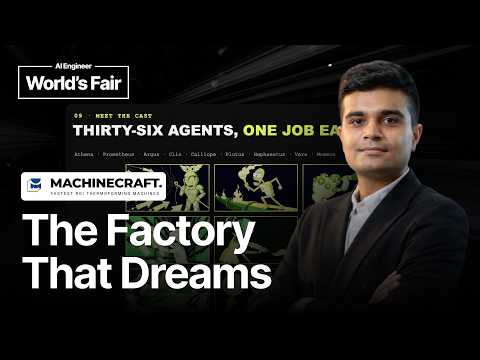
The Factory That Dreams: 39 AI Agents, No Framework -…
Talk by Rushabh Doshi (Machinecraft / Fork My Brain) on Ira, a multi-agent AI operating system built for a third-generation Indian thermoforming machinery manufacturer without relying on a single AI framework. Covers the architecture of 39 bounded specialist agents with Athena as orchestrator, a 17-stage request pipeline, Qdrant for document memory, Neo4j for relationship data, Mem0 for long-term semantic memory, Postgres for CRM and recruiting data, and Redis for coordination, operated through Cursor. Explains how Ira ingests company files, routes work through agents, applies guardrails for verifying claims, learns from memory and corrections, and runs a nightly consolidation cycle ("dreaming"), guided by a SOUL.md philosophical constitution drawing on Anekantavada, Syadvada, and Svadharma. Concludes with the Fork My Brain thesis: deploying a small AI team inside a company to map its business and leave behind a forkable digital brain grounded in the company's own documents and processes.
# Channel Identity Observations: Machinecraft / Rushabh Doshi
## 1. Explicit Self-Description
- **Creator role stated directly:** *"Hi, I'm Rushabh. I run Machinecraft, a 100 people factory in India."*
- **Positioning as non-technical builder:** *"No data science team, no ML budget, none of that."*
- **Explicit offer / call to action:** *"We pulled the whole architecture out and made it forkable. We call it Brain OS."* and *"forkmybrain.org — Go build something that remembers."*
- **Business model claim:** *"We are not selling ours to you. We are helping you build your own."*
## 2. Intended Audience
- **Non-technical business operators / SMB owners:** *"We are a 100 people factory with no data scientists. If we can grow a brain, you can too."*
- **Engineers curious about practical AI:** *"And here's the plot twist. The part that surprises every engineer I tell this to. We never trained a model."*
- **Cost-sensitive decision-makers:** frames spending as *"An agency quoted us 230 grand to build this. We built it for around 30."*
## 3. Claimed Scope
- **Company knowledge preservation:** *"for three generations, all of that lived in exactly three brains."*
- **Full go-to-market automation:** *"a 36 AI agent that runs our entire go-to-market"* (title says 39; transcript says 36 — a discrepancy in the source itself), covering *"Nine concrete jobs every single day."*
- **Human-in-the-loop guarantee:** *"the golden rule, the one we never break, Eira drafts, human sends."*
## 4. Observable Presentation Patterns (Demonstrated, Not Just Claimed)
- **Storytelling / narrative format:** opens with *"I want to tell you a story about a factory that taught itself how to remember."*
- **Recurring metaphor frameworks:** biological body metaphors (*"senses," "a gut," "an immune system"*), sleep (*"At night, it dreams"*), and named agents (Athena, Prometheus, Plutus, Hephaestus, Vera, Memnon).
- **Value-driven framing:** ties design to heritage — *"a soul file written from the principles of a Jain family business."*
- **Transparency posture:** shows internals — *"All of it, every capability exposed as 213 tools over one protocol"* and morning dream reports to review.
- **Cost-comparison rhetoric:** repeatedly anchors affordability (*"cheaper than a nice watch"*, *"a couple of thousand dollars a month"*).
## 5. Claims vs. Demonstrated — Note for Synthesis
- Everything above about the system's behavior is creator-reported in a talk format; the video demonstrates **presentation style and self-narrative**, not verifiable system performance.
- Numerical inconsistency in source: **title says "39 AI Agents"** while transcript says *"a 36 AI agent."*
# Delivery Observation: "The Factory That Dreams" — Rushabh Doshi
## Overall Tone & Register
- **Conversational, narrative storytelling** framed as a personal account: opens with *"I want to tell you a story about a factory that taught itself how to remember."*
- **Self-deprecating humor and frank admissions** recur: *"I'll be honest. Sounded insane first."*, *"I think that's still a little ridiculous."*
- **Direct address to the audience** with second person: *"and you already know this if you've ever tried it"*, *"why you can do the same thing."*
## Vocabulary & Metaphor Style
- **Extended biological/anthropomorphic metaphors** are the dominant linguistic feature:
- *"grew a brain that just held it"*
- *"a gut to digest the documents into facts... an immune system to fight off bad information"*
- *"a raw language model is basically a goldfish"*
- *"At night, it dreams"*
- **Named agents with Greek/mythological figures**: Athena, Prometheus, Plutus, Hephaestus, Vera, Memnon — delivered as a rhythmic list: *"Athena runs the room. Prometheus owns the sale. Plutus does pricing."*
- **Plain-language engineering descriptions**: *"we just looked at all the history, chopped it into bite-size chunks"*, *"Not a demo held together with duct tape."*
## Recurring Phrases & Patterns
- **"Here's the thing / here's the..." construction** appears repeatedly as a structural pivot:
- *"So, here's the thing about our company."*
- *"And here's the plot twist."*
- *"And here's the cool part."*
- *"And here's the part I care about the most."*
- **"Never sleeps / never gets tired"** repetition: *"a board room that never sleeps, never gets tired"*, *"one operator who never sleeps."*
- **Rhetorical question → answer pattern** for explaining design choices: *"Why biology?" → answer*; *"Why 36 agents instead of one genius mega prompt?" → answer*.
## Teaching Habits
- **Contrast framing** — setting up expectations then subverting them:
- *"We never trained a model. No GPUs humming in the basement, no fine-tuning."*
- *"The brain isn't a smarter model. It's actually a really, really well-organized memory."*
- *"It's emphatically not to be helpful, be harmless."* (contrasting with common AI safety phrasing)
- **Concrete numbers for credibility**: *"213 tools over one protocol"*, *"230 grand... We built it for around 30"*, *"a 100 people factory."*
- **Enumerated lists** for complex systems: five soul-file rules, five memory layers, nine jobs — each delivered in short parallel clauses.
- **"We just copied the homework"** — casual reduction of complex ideas into memorable one-liners.
## Communication Patterns
- **Crescendo structure**: builds from problem (knowledge in *"exactly three brains"*) → solution → commercial reveal (cost comparison) → call to action (*"forkmybrain.org"*).
- **Punchy short declaratives** as section closers: *"One agent, one job. It's a team, not a hero."*, *"Eira drafts, human sends."*
- **Imperative ending**: *"Go build something that remembers."*
## Uncertainty Notes
- The transcript contains minor inconsistencies in the agent system's name (**"Era," "Ira," "Eira"**) and agent count (**title says 39, transcript says 36**) — possibly transcription artifacts; cannot confirm from delivery alone.
- Delivery is transcribed speech only; pacing, gestures, and vocal emphasis are not observable here.
# Position Record: "The Factory That Dreams: 39 AI Agents, No Framework" — Rushabh Doshi, Machinecraft
## Speaker
- **Rushabh Doshi**, self-identified as running **Machinecraft**, a ~100-person thermoforming machine factory in India. No other speakers present.
## Core Thesis
- Instead of documenting company knowledge, the company built an **AI agent system ("Eira"/"Ira" — spelling varies in transcript)** that acts as a "twin of the company," running the entire go-to-market operation.
- Title says "39 AI agents"; transcript says **36 agents**. This contradiction is present in the source and unresolved.
## Problem Framing
- The company's real asset is **knowledge**, not machines — customer history, quotes, custom tweaks.
- For three generations, that knowledge lived in **three brains** (grandfather, father, Rushabh), which he calls "a genuinely terrifying way to run a company."
- Staff turnover meant "a chunk of our brain walked out" with each departure: "We weren't scared of the competitors, we were scared of forgetting."
## Technical Claims (as stated)
- **No model training**: no GPUs, no fine-tuning; off-the-shelf models read chunked private history (quotes, drawings, emails — "hundreds of gigabytes").
- Storage: **vectors** (meaning) plus a **relationship graph**. Claim: "The brain isn't a smarter model. It's actually a really, really well-organized memory."
- **Biology-motivated architecture**: senses, "gut" for document digestion, memory, dream cycle, "immune system" against bad information. Rationale: "evolution already spent a billion years solving how do you stay coherent over time? We just copied the homework."
- **Why 36 agents, not one mega-prompt**: "one prompt that's supposed to do everything ends up doing everything badly." Named specialists: **Athena** (runs the room), **Prometheus** (sales), **Plutus** (pricing), **Hephaestus** (machine specs), **Vera** (fact-checking), **Memnon** (locks in corrections).
- Agents "hold meetings," "actually argue," producing one answer.
- Stack claims: one Cursor tab as interface; vector DB, graph DB, CRM; three model providers; **213 tools over one protocol**; monitoring.
- **Layered memory**: working memory, pinned facts, episodic memory, "relationship warmth," and a **salience gate**; corrections override conflicting facts.
- **Nightly "dream cycle"**: replays the day, consolidates, hunts contradictions, forgets stale material, generates a morning "dream report." Claim: "The thing literally gets smarter overnight."
## Nine Daily Jobs Claimed
Outbound emails, account briefs, quotations, swipe-style outreach triage, reviving dead leads ("blast from the past"), inbound replies, and fit-filtering (list is presented as nine, though only seven items are enumerated in the transcript).
## Governance / "Conscience"
- **Golden rule: "Eira drafts, human sends."**
- A "soul file" from **Jain family-business principles** turned into engineering rules: cross-check before speaking; avoid absolutes; cite document and date; do only your own job; report ugly truths; nobody works alone.
## Financial Claims
- **$0 training bill**; "expensive part was never compute. It was teaching a company to remember itself."
- Agency quote: **$230,000**; built for **~$30,000**; running cost "a couple of thousand dollars a month."
- Claims to be "not a demo held together with duct tape" (his assertion, unverified).
## Closing Position
- Architecture extracted as forkable **"Brain OS"** — ships blank (agents, memory, dream cycle, soul file).
- Argument: "Only you can build your company's brain. We are not selling ours to you. We are helping you build your own."
- Call to action: **forkmybrain.org**.
## Qualifications & Tensions to Preserve
- Title/transcript agent count mismatch (**39 vs 36**); agent system name spelled both **Eira** and **Ira**.
- "Nine jobs" claimed but only seven enumerated in the spoken list.
- Speaker self-describes the idea as initially "insane" and "ridiculous" — tentative framing, later presented as working production system.
- All cost and capability claims are speaker-reported with no independent verification in the source.
# Observation: Speaker Roles & Provenance
## Video
**Title:** The Factory That Dreams: 39 AI Agents, No Framework - Rushabh Doshi, Machinecraft
**Video ID:** 01a15ca8-ab5e-75fb-8746-9f0c74f16bc4
## Speakers & Roles
- **Rushabh Doshi** — **Creator / primary (sole) speaker**. Self-identified: *"Hi, I'm Rushabh. I run Machinecraft, a 100 people factory in India."*
- No guest, narrator, or other speakers appear in the transcript.
## First-Party Claims (all attributable to the creator)
- Machinecraft is a ~100-person thermoforming machine factory in India, family-run for three generations.
- System called **Eira/Ira**: 36 agents (title says 39), built in-house, no model training/fine-tuning.
- Cost claims: agency quote of **$230,000**; built for **~$30,000**; **~$2,000/month** to run. No supporting documents cited.
- Architecture: 213 tools, three model providers, vector/graph/CRM databases, human-in-the-loop ("Eira drafts, human sends").
## Referenced Sources & Third-Party Claims
- **No external sources, citations, or third-party studies are referenced** in the transcript.
- All figures and claims are self-reported by the creator.
## Promotional Segments ⚠️
- **Closing call-to-action:** *"We pulled the whole architecture out and made it forkable. We call it Brain OS... We are not selling ours to you. We are helping you build your own. forkmybrain.org"* — explicit promotion of the creator's product/website.
## Availability & Limits
- **Curated metadata:** none supplied beyond title/transcript.
- **Comment availability:** not stated.
- **No timestamps** present in transcript.
## Uncertainty
- Title states **39** agents; transcript repeatedly says **36**. Agent system name appears as both "Era/Eira" and "Ira" in the transcript.
Okay, I want to tell you a story about a factory that taught itself how to remember. Hi, I'm Rushabh. I run Machinecraft, a 100 people factory in India.
No data science team, no ML budget, none of that. And somehow we ended up building a 36 AI agent that runs our entire go-to-market. I think that's still a little ridiculous. Let me show you how it happened and why you can do the same thing. So, here's the thing about our company. From the outside it looks like machines and metal. But the actual company, the part that matters, isn't the machines, it's the knowledge. Who the customer is, what we quoted them in 2019, why that one machine needed that weird custom tweak. And for three generations, all of that lived in exactly three brains. Initially my grandfather's, then my father's, and now mine. Which is a genuinely terrifying way to run a company. When you sit with it. A lot of people have joined us, people have left us, the revolving door never stopped. And every single time someone walked out, a chunk of our brain walked out with them. We weren't scared of the competitors, we were scared of forgetting. Or waking up one day and realizing the whole company only existed inside two increasingly tired heads. So, I had an idea. I'll be honest. Sounded insane first. But what if instead of writing the knowledge down in some document nobody ever reads, what if we grew a brain that just held it? Not a chatbot you poke at, a twin of the company. I didn't hire a sales team. I tried to build one. A quick detour because you need to know how messy this is. We make thermoforming machines. They heat up a plastic sheet and shape it. Same core machine, but it ends up making hydroponic farm trays, spa bathtubs, EV car panels, medical casings, and even packaging. Seven totally different worlds, seven
totally different buyers. So, this brain couldn't just memorize a brochure. It had to know which universe a given customer lives in.
Step one was almost boringly simple. Feed it everything, and I mean everything. Years of quotes, drawings, payment schedules, timelines, email threads, hundreds of gigabytes of our own private history. Not the public internet, our internet. And here's the plot twist. The part that surprises every engineer I tell this to. We never trained a model. No GPUs humming in the basement, no fine-tuning. We just looked at all the history, chopped it into bite-size chunks, and let off-the-shelf models read it and pull out the facts. We stored the meaning of each chunk as vectors and relationships. Who's connected to what as a graph. The brain isn't a smarter model. It's actually a really, really well-organized memory. Now, this is where it gets a little weird in a good way. We stopped thinking of Era as a software and started thinking of it as something we were raising. So, we gave it a body modeled on biology. Senses to figure out who it's talking to, a gut to digest the documents into facts, a memory, a dream cycle, an immune system to fight off bad information. Why biology? Well, because evolution already spent a billion years solving how do you stay coherent over time? We just copied the homework. Okay, so the big question. Why 36 agents instead of one genius mega prompt? Because, and you already know this if you've ever tried it, one prompt that's supposed to do everything ends up doing everything badly. So, Ira isn't one mind, it's a pantheon. A whole cast of specialists. Each one has exactly one job. Athena runs the room. Prometheus owns the sale. Plutus does pricing. Hephaestus knows every machine spec cold. Vera fact checks everything, and Memnon, my favorite, guards corrections. So, the second a human fixes something, it stays
fixed forever. One agent, one job. It's a team, not a hero. And here's the cool part. They hold meetings. Athena pulls in specialists.
They actually argue, and a single answer comes out the other side. It's like having a board room that never sleeps, never gets tired, and somehow has no ego. So, what does all this actually run? Honestly, the whole front business. Everything between a stranger exists somewhere, and now they're a customer. Nine concrete jobs every single day. Outbound emails that actually reference my real world. Account briefs built from cross-checked truths before a call. Quotations. A swipe left, swipe right mode for outreach. Reviving dead leads, which I call blast from the past. Inbound replies, and figuring out before we waste an hour whether a company is even a fit. Nine jobs, one operator who never sleeps. Where does all this live? One cursor tab. That's genuinely it. You type and Eira reaches out with a dozen hands. Searches the knowledge base, reads the inbox, drafts the email, builds the code, and then shows you before anything actually goes out. Under the hood, it's genuinely a real stack. Not a demo held together with duct tape. Databases for vectors, for relationship graph, for the CRM. Three different model providers, each picked for the job it's actually best for. Tools for Google, for swallowing documents, for every communication channel, plus monitoring. So, we can see what it's thinking. All of it, every capability exposed as 213 tools over one protocol.
And the golden rule, the one we never break, Eira drafts, human sends. Now, memory. And this is the part where most AI quietly lies to you, because a
raw language model is basically a goldfish. Brilliant for about 30 seconds, and then you close the tab and forgets you ever existed. So, we engineered memory on purpose, in layers. Working memory for the last few minutes. Pinned facts about someone who who is. Episodes, whole conversations as little stories. Relationships with warmth that grows from stranger to trusted. And a bouncer at the door. A salience gate that decides what's even worth remembering, so the brain doesn't fill up with junk. When two facts disagree, corrections win. Continuity without making things up. And then, I genuinely love this part. At night, it dreams. Every night, Eira runs a sleep cycle. It replays the day, locks in useful stuff, hunts for contradictions, gently forgets the stale junk, and turns the day's work into reusable skills. In the morning, there's a little dream report waiting for me to read. Here's what I consolidated. Here's what I Here's what I let go of. Here's what I figured out while you were asleep. The thing literally gets smarter overnight. And here's the part I care about the most. Every agent has a conscience. And it is emphatically not to be helpful, be harmless. It's a soul file
written from the principles of a Jain family business that's been doing this for the last three generations. Five old ideas turn into engineering rules. No single source has the whole truth.
So, cross-check before you speak. Never say things absolutely. Cite the document and the date. Do your own job, not someone else's. Report the truth even when the truth is ugly. And nobody works alone. Ancient philosophy running as guardrails in production. Now, let's talk money. Because this is the part that should make the whole industry a little uncomfortable. There was no training bill. Zero. The expensive part was never compute. It was teaching a company to remember itself. An agency quoted us 230 grand to build this. We built it for around 30. That's cheaper than a nice watch. And it runs on a couple of thousand dollars a month. So, here's the move. We pulled the whole architecture out and made it forkable. We call it Brain OS. It ships as an empty nervous system. The agents, the memory, the dream cycle, the soul file. All there, completely blank. You pour your own company's truth into it and from inside out. Because here's the thing nobody can outsource for you. Only you can build your company's brain. We are a 100 people factory with no data scientists. If we can grow a brain, you can too. We are not selling ours to you. We are helping you build your own. forkmybrain.org Go build something that remembers. Thank you.