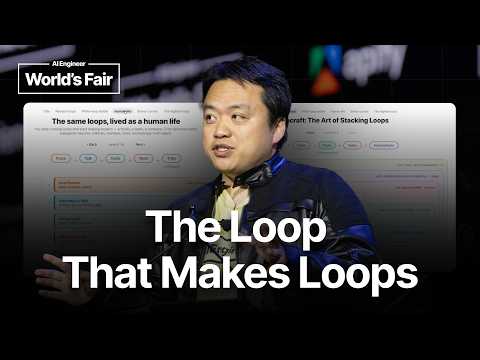
The Highest Loop — swyx
swyx's talk 'The Highest Loop', presented at AI Engineer World's Fair 2026, examining why the AI engineering community gathers. Based on the available metadata, the specific themes of the talk are not detailed beyond the framing of the conference gathering.
# Video Identity Observations — "The Highest Loop — swyx"
## Creator Self-Description (Explicit Claims)
### Role as Community Organizer
- The speaker identifies himself as the organizer of the **AI engineer / World's Fair conference series**, presenting attendance growth as his own track record:
> "This is the first World's first AI engineer in 2023… Then we had the first World's Fair 2024. About 2,000 people… we're basically at 6,000… it went to 7,000 today."
- He describes an international events operation:
> "we organize the Engineers Summit all around the world… summits in New York, summits in Paris, summits in Singapore… Melbourne… Miami."
- He explicitly invites the audience into co-organizing:
> "We want you to organize it in your home countries. We're we're having a partnership team uh to do this."
### Role as Author / Thought Leader
- He claims authorship of an essay and positions a concept as a core discipline:
> "I wrote this essay called Loop Crafts."
> "this is something that is basically a core skill of AI engineer uh is defining what loops you're working in."
- He references his own prior keynote:
> "The message of my last keynote at AI engineer was that… agents that you see are working in one domain are definitely generalizing this year."
## Intended Audience (Observable Presentation)
- The talk is delivered **live at a conference**, addressing an in-room audience of technical professionals while also acknowledging livestream viewers:
> "the rest of today on this live stream uh the those of you watching at home."
- The audience is explicitly framed as builders and leaders across roles:
> "I expect our engineers, our leaders, our researchers, our founders, um to all be understanding… these loops."
- Programmer literacy is assumed:
> "I think all of you in in the audience who are programmers will understand this."
## Claimed Scope
- **Technical scope:** AI engineering practice, framed as "loop stacking" — tokens → chat → tools → goals → automations → "software factories" — with the skill of moving "up a loop" for productivity and "down a loop" for reliability.
- **Domain-expansion scope:** The channel/event claims coverage beyond coding:
> "This is the year that we're adding vertical tracks. Like you know, AI in healthcare, AI in finance, AI in GTM. We have a forward deployed engineering track… All of this is meant to see how AI is just diffusing finally beyond coding."
- **Philosophical/civilizational scope:** The talk extends from engineering workflows to "the broader project of the human civilization and what we're building with collective intelligence," culminating in the titular claim:
> "the highest loop is where humans come together to figure out what the next loop is. All right, the loop that makes loops."
- **Content-volume stance:** He positions the event's breadth as deliberate and non-negotiable:
> "I'm not going to apologize for the content. Uh it's up to you to decide and route yourself."
## Demonstrated (vs. Claimed) Presentation Patterns
- The material itself demonstrates a **keynote-style, big-tent framing**: personal anecdotes (mic slip, ticket-sales curves, "Gini coefficient" joke), roadmap announcements, and motivational close — consistent with an event-opening or keynote address rather than a tutorial.
- Tone mixes technical content with community stewardship (organizer stress curves, early-ticket appeals), indicating the speaker operates in an **evangelist/community-leader capacity** as well as a technical one.
## Self-Check
All observations are tied to quoted transcript passages; no private motives inferred and no channel-wide conclusions drawn beyond this single video's evidence.
# Delivery Observation — "The Highest Loop" (swyx)
## Overall Delivery Style
Conversational, keynote-style address with a light, improvisational feel. The speaker frequently acknowledges live glitches ("Can you still hear me? Are we good? Sorry, I I um had a mic slip"; "if I can make this slide work. Oh my god."), giving the talk an informal, in-room texture rather than a polished recitation.
## Recurring Framing Devices
### Escalating-list openings
The most distinctive structural habit is the **"In the beginning… then…" ladder**, used twice nearly in parallel:
> "In the beginning, there was the token. Then there was the chat. Then we learned to use tools. Then we learned to set goals."
> "In the beginning, there's the heartbeat… then you learn to talk. Then we learn to use tools. Then we start to work. We eat, sleep, code, repeat, or prompt."
This parallel between AI capability levels and human development stages is the talk's central rhetorical move, explicitly labeled: "what I make the human analogy for is what is the human loop?"
### Loop vocabulary
- "Loop stacking" / "going up a loop" / "going down a loop"
- "The highest loop," "the loop that makes loops," "the summit of summits"
- Closing charge: "figure out your generative process for generating loops"
### Tech-metric humor applied to humans
> "If you measure the Gini coefficient, uh it's gone up and not down, that's the wrong direction."
Used as a playful jab about ticket-buying timing.
## Teaching Habits
- **Simplification on demand**: "If you want to simplify it, uh I have a better analogy that will be less complicated" — followed by "literally just a stack of wild loops."
- **Audience-addressed reasoning**: "I think all of you in in the audience who are programmers will understand this."
- **Deflecting pushback with a principle**: "I'm not going to apologize for the content. It's up to you to decide and route yourself."
- **Enumerated community callouts**: "our engineers, our leaders, our researchers, our founders."
## Verbal Tics / Disfluencies
- Frequent repetition-doubling under live conditions: "we we we aim for 6,000," "skipped skipped a few lines," "why we want to work at a conference, why we why I work on a conference."
- Filler "uh" is common throughout.
- Self-interruptions and restarts ("Um and I think this is something that…").
## Uncertainty Notes
- The speech appears to be an excerpt (starts at a mid-keynote timestamp); whether the escalation-list device appears across the speaker's other talks cannot be verified from this sample.
- Some transcript garbling ("be cursing in as a as a as a sort of human general intelligence") suggests possible transcription error, so that passage should not be treated as a deliberate word choice.
# The Highest Loop — swyx
## Speaker & Context
- **Speaker:** swyx (per curated title), delivering an opening keynote at the AI Engineer World's Fair.
- **Format:** Live conference keynote with audience interaction (laughter, mic issue, slide trouble).
---
## Claims & Positions
### 1. AI development progresses through stacked loops
- swyx presents a progression: *"In the beginning, there was the token. Then there was the chat. Then we learned to use tools. Then we learned to set goals... these days, we're all about automations... cron jobs and the loops."*
- References his essay **"Loop Craft"** and notes Joel gave a workshop on it the previous day.
- **Position:** Defining which loop you operate in is *"a core skill of AI engineer."*
- **Stated method:**
- **Go up a loop** when ready, to gain *"the next level of productivity and scaling your inference."*
- **Go down a loop** when finding issues, to gain *"reliability and fixing whatever bugs you find."*
- Simplifies the model as *"literally just a stack of wild loops"* for programmer audiences.
### 2. The human loop analogy
- Maps the loop progression onto human life:
1. **Heartbeat** (in the womb — "proof of life")
2. Learning to talk
3. Using tools
4. Working ("eat, sleep, code, repeat, or prompt")
5. Teams, small groups, families — praises **"tiny teams"** as increasingly important
6. Broader human projects: *"the broader project of the human civilization and what we're building with collective intelligence."*
- **Claim:** *"The things that you're doing with coding are definitely crossing over to human life."*
- **Claim:** Agents working in one domain *"are definitely generalizing this year"* — evidenced by new vertical tracks (healthcare, finance, GTM, forward-deployed engineering), showing *"AI is just diffusing finally beyond coding."*
### 3. Conference logistics (World's Fair growth)
- Growth figures given: 2023 first AI Engineer (sales curve "kind of linear"), 2024 first World's Fair (~2,000 people), 2025 aiming for 6,000 but *"crossed and it went to 7,000 today."*
- **Playful complaint:** attendees bought tickets later than asked — *"If you measure the Gini coefficient, it's gone up and not down, that's the wrong direction."*
### 4. The "highest loop" thesis
- **Core claim:** *"The highest loop is where humans come together to figure out what the next loop is. The loop that makes loops."*
- Positions the World's Fair as the **"summit of summits"** — above the regional Engineers Summits (New York, Paris, Singapore, Melbourne, Miami).
- Invites attendees to organize summits in their home countries via the partnership team.
- **Closing exhortation:** *"I hope that you figure out your generative process for generating loops and propagate it down to your teams, to your personal workflows, to your lives."*
---
## Qualifications & Presentation Frictions
- swyx repeatedly acknowledges **skipping steps** in both the AI and human progressions (*"I'm skipping a few steps"*, *"I think I maybe skipped a few lines"*).
- Live delivery interruptions noted: a slipped microphone, a slide that wouldn't load (*"Oh my god. I'm going to refresh"*), and a forgotten city in the summit list (*"and I'm forgetting one already"*).
- On criticism of too many conference tracks: *"I'm not going to apologize for the content"* — routing oneself through the levels is the attendee's responsibility.
---
## Observation Notes
- No contrary positions appear in the transcript; this is a single-speaker keynote presenting swyx's framing without challenge.
- The "loop" framework is presented as an analogy/heuristic, not an empirical claim; growth figures are conference metrics stated from the speaker's own knowledge.
# Speaker Attribution & Provenance Record
## Video
- **Title:** *The Highest Loop — swyx*
- **Video ID:** 01a15ca6-6d46-77c0-aa85-619d232873de
## Speakers & Roles
### swyx (speaker)
- Identified only via the video title; role inferred from context as the on-stage presenter/host of the conference (likely **AI engineer** event organizer — "the AI engineer" conference and World's Fair).
- Role category: **creator / conference host delivering a keynote-style address**.
- **No curated metadata was supplied** — attribution rests solely on the title; treat identity and exact role as inferred, not confirmed.
### Unattributed segments
- Audience reactions appear as `>> [laughter]` markers — no speech, no attribution needed.
- A possible second `>>` speaker mark appears mid-transcript with no distinguishable content; treat as laughter/transition, not a separate speaker.
## Referenced Works & Events
- Essay: **"Loop Crafts"** — written by the speaker; described as a core AI engineering skill framework.
- Prior workshop on loop stacking by "Joel in the audience" (third party, yesterday's workshop).
- Prior AI engineer keynote ("my last keynote at AI engineer") on agents generalizing beyond coding.
- **World's Fair** history: first AI engineer 2023, first World's Fair 2024 (~2,000 attendees), 2025 (~6,000 target, crossed to ~7,000).
- **AI Engineer Summits** in New York, Paris, Singapore, Melbourne, Miami.
- Conference vertical tracks mentioned: AI in healthcare, finance, GTM, forward deployed engineering.
## Promotional Segments ⚠️
- **Explicit promotion:** AI Engineer World's Fair attendance (early ticket purchase appeal), AI Engineer Summits worldwide, and partnership program inviting home-country organizers.
- Content is promotional/self-promotional for the speaker's own conference ecosystem.
## Third-Party Claims
- Gini coefficient of ticket sales "gone up and not down" — speaker's own claim, no source cited.
- Joel's workshop — mentioned, unverifiable from transcript.
## Availability & Comment Status
- Audience includes live-stream viewers at home ("those of you watching at home") — confirms livestream context.
- **No curated metadata supplied:** comments, links, and channel details unknown/unavailable in this record.
## Provenance Limitations
- No metadata beyond title and transcript; speaker bio, channel, publish date, and comment availability cannot be established.
\>\> In the beginning, there was the token. Then there was the chat. Then we learned to use tools.
Then we learned to set goals. I'm skipping a few steps. And these days, we're all about automations. We're all about cron jobs and the loops. And the rest of today on this live stream uh the those of you watching at home, uh we're going to be talking about software factories as well. So, there's a lot of loop stacking. Uh I wrote this essay called Loop Crafts. Uh I think Joel in the audience did a workshop on it yesterday. Can you still hear me? Are we good? Sorry, I I um had a mic slip. Um and I think this is something that is basically a core skill of AI engineer uh is defining what loops you're working in and figuring out whether that's the right level of extraction. And when you're ready, going up a loop in order to figure out the next level of productivity and scaling your inference. And when you're finding issues, going down a loop and going lower level in order to figure out reliability and fixing whatever bugs you you find. If you want to simplify it, uh I have a I have a better analogy that will be less complicated. Uh it's literally just a stack of wild loops, right? I think all of you in in the audience who are programmers will understand this. Uh and effectively this is what we're here to do today. We're um I expect our
engineers, our leaders, our researchers, our founders, um to all be understanding and be cursing in as a as a as a sort of human general intelligence, all these loops that you
guys are capable of of um going up and down. And that is why there's so much content. \>\> \[laughter\] \>\> Um I often tell people of you who who complain about uh the tracks, I'm not going to apologize for the content. Uh it's up to you to decide and route yourself uh as to which level you you're currently working at and which level you're currently blocked on. Um So, the thing that's occupying most of my time um recently and what I what I make the human analogy for is what is the human loop? Um And in the beginning, there's the heartbeat. You when you're when you're sort of in the womb, you you you sort of get that heartbeat, that's the proof of life. Um then you learn to talk. Then we learn to use tools. Then we start to work. We eat, sleep, code, repeat, or prompt. Um And then we start working in teams. We start working in small groups and families. We we've uh promoted the concept of tiny teams before and I think that is increasingly important with everybody. And I think the interesting thing to think about is like the broader human projects as a whole. Like where we all going? You know, extend out from your personal context, your family, your country, your company, whatever to the broader project of the human civilization and what we're building with collective intelligence. I think it's very interesting to consider that. So, I I think that's a little bit what I want to leave you with today. Like the things that you're doing with coding are definitely crossing over to human life. The message of my last keynote at AI engineer was that the you know, it's very much like agents that you see are working in one domain are definitely generalizing this year. This is the year that we're adding vertical tracks. Like you know,
AI in healthcare, AI in finance, AI in GTM. We have a forward deployed engineering track this uh today which I'm very excited about. All of this is meant to see how AI is just diffusing finally
beyond coding. Okay. Last World's Fair, I gave you all an update on the stress curves of the organizers. Just to give you an idea, this is the first World's first AI engineer in 2023. This is sort of the sales curves basically of like how people bought. Basically, it was kind of linear. Then we had the first World's Fair 2024. About 2,000 people. 2025 was I think I maybe skipped skipped a few lines. But we're we're basically at 6,000. And if you sort of calculate we we we we aim for 6,000. We actually crossed and go it went to 7,000 today. And basically, I asked you all to buy your tickets earlier. You did not. Um If you measure the Gini coefficient, uh it's gone up and not down, that's the wrong direction. Uh so if you all \>\> \[laughter\] \>\> if you all can just gather uh you know your yourselves and um you know join us early, I think that would be great. Anyway, um why we want to work at a conference, why we why I work on a conference, why you all come to a conference is basically the concept of the highest loop. Um I will submit to you that the highest loop of all is to uh if I can make this slide work. Oh my god. I I I'm going to refresh. Okay. Um uh that the highest loop is where humans come together to figure out what the next loop is. All right, the loop that makes loops. Um so we organize the Engineers Summit all around the world. Uh this year we have summits in New York, summits in Paris, summits in Singapore. Um and uh you know again, uh Melbourne and I'm forgetting one already, Miami. Um and uh we are organizing this with our partners. We want you to organize it in your home countries. We're we're having a partnership team uh to do this. And this is the highest loop of all, which is the World's Fair, which is the summit of summits. So you're I'm very excited to welcome all of you today. Um I hope that you figure out your generative process for generating loops and propagate it down to your teams, to your personal workflows, to your lives. Thank you very much and enjoy the show.