The Investor's Edge Lives in Their Head — Anekha Sokhal,…
Anekha Sokhal, founder and CEO of Moshi, discusses how an investor's edge comes from context in their own head rather than databases. She explains building AI that handles the quantitative data grind while leaving investment decisions to the human, covering what edge really means, AI's impact on finance, one-person pods, and giving every investor a quant-team-like capability.
# Channel Presentation Observations
## Source
Single video: **"The Investor's Edge Lives in Their Head — Anekha Sokhal, Moshi"** — a conference talk transcript. No curated metadata supplied.
## Speaker Self-Description (explicit claims)
- **Founder/CEO identity**: *"I'm Annika. I'm the founder and CEO of Moshi."*
- **Dual-domain background**: *"I was a derivative trader for nearly a decade and then I moved into data science and machine learning"* — including a scholarship and *"a paper at ICLR... working in machine learning systems with NASA."*
- **Product claim**: Moshi is *"your 24/7 quant analyst"* for *"institutional traders,"* running *"a team of six different agents"* in a *"deterministic manner,"* having *"read 2.4 billion data points."*
- **Stealth-to-public positioning**: *"We've been building very quietly with a few of the biggest players in the trading industry... this is the first time we're opening up to talk to the public."*
## Intended Audience (observable from the talk)
- **Finance professionals and fintech/AI builders**, evidenced by:
- Show-of-hands framing: *"How many people in this room are overwhelmed by the amount of data they have when making a decision?"*
- Technical and trading jargon used without explanation: *"second and third order derivatives," "MCP connectors," "FOMC," "one-person pods," "productionize."*
- Closing invitation: *"come talk to me. I love talking about everything to do with data and finance and financial engineering."*
## Claimed Scope
- **Thesis**: AI should feed, not replace, human judgment — *"instead of replacing it, why don't we just feed it?"* Machines handle *"the grind"*; humans keep *"the decision."*
- **Differentiation claim**: true edge is *"what you can't download... what sits in an investor's head."*
- **Quantified benefits asserted (not demonstrated)**: *"up to 35% more"* efficiency; *"institutional-grade analysis"* accessible without an in-house quant team.
## Demonstrated Patterns vs. Claims
| Demonstrated in material | Nature |
|---|---|
| Talk-style, single-speaker, thought-leadership format | Observable presentation |
| Product metrics (2.4B data points, 6 agents, 35%) | Creator claims, unverified |
| "Building a new way of thinking in finance" | Aspirational mission statement |
## Limitations
- Single video; channel-level synthesis would be unsupported beyond this talk's framing.
- Scale/performance figures are creator assertions with no cited source in the transcript.
# Delivery Observation — "The Investor's Edge Lives in Their Head — Anekha Sokhal, Moshi"
## Overall Register
The delivery is a **startup pitch-talk hybrid**: audience warm-up, big-number scene setting, problem framing, and product reveal. Tone stays conversational and rhetorical throughout, with heavy use of questions to carry the argument.
## Recurring Rhetorical Habits
### Question-driven scaffolding
Questions are the primary structural device, often stacked in short bursts:
- *"How many people in this room are overwhelmed by the amount of data they have when making a decision?"*
- *"So, what does that mean for financial investors?"*
- *"So, who am I?"*
- *"What is edge?"*
- *"So, if everyone has access to all of these things, then what is edge?"*
- *"Why are we spending everything trying to push it out of the loop? Why don't we flip that...?"*
A signature move is asking a question and immediately **answering it herself**: *"What is edge? So, edge is in practice just three things."*
### Repetition for emphasis
- Tripled repetition: *"It gets wider and wider and wider."*
- Anaphora: *"They're incredible at cleaning data. They're incredible at gathering data."*
- Repeated framing question: *"So, if everyone has access to all of these things, then what is edge?"* — the edge question recurs at least three times across the talk.
### Signature vocabulary
- **"Edge"** — the talk's central keyword, defined, re-questioned, and re-anchored (*"the edge is actually what you can't download"*).
- **"Context"** — used pervasively, both colloquially (*"to give you context"*) and technically (*"you are the context"*).
- **"Feed it" vs. "replace it"** — the core thesis pair: *"instead of replacing it, why don't we just feed it?"*
- **"Grind" vs. "judgment"** — a clean two-word dichotomy: *"some of it, well, is all the grind... and some of it is judgment."*
- Contrasts generally are her default argument shape: pull vs. push tools, brain vs. machine, weekend tool vs. infrastructure.
## Teaching Habits
- **Concrete anchoring via numbers and analogies**: *"runs on about 20 W, which is the power of a dim light bulb... 86 billion neurons."*
- **Vivid scenario-based illustrations** rather than abstractions: the frozen-time model *"telling you, 'Hey, go to bed at 2:00 a.m. It's late now.' when actually it's 3:00 p.m. on a Wednesday."*
- **Direct address and persona voices**: quoting traders (*"Hey, I don't want to speak to anyone all day. I just want to trade."*) and agents (*"Oops, I'm sorry. I shouldn't have done that. Please rotate it."*)
- **Time-compression hooks** for the product reveal: *"in the 4 seconds it took you to read that sentence, Moshi has learned 300 new things."*
## Structural Patterns
- **"So" as connective tissue** — opens a large share of sentences and nearly every section pivot (*"So, let's take a few steps back..."*, *"So, what do we do?"*, *"So, what does that actually buy you?"*).
- **Callback structure**: the FOMC anecdote introduced mid-talk is invoked again at the close (*"instead of debating when FOMC is"*); the brain-as-engine metaphor opens and closes the argument.
- **Credibility placement early**: derivative trading, Fulbright scholarship, ICLR paper with NASA — delivered briefly, then moved past.
## Uncertainty Notes
- The single transcript gives **one instance** of this delivery; recurrence claims are within-talk only and may not be stable across other talks.
- Minor self-corrections and stumbles appear (*"It what It's what sits in an investor's head"*, *"No No one person can build"*), but whether these are habitual or nerves-specific to this occasion cannot be determined.
- The product name shifts between "Moshi" and "Mosaic" once near the end; that inconsistency is observed but its cause is not.
# Observation Record: "The Investor's Edge Lives in Their Head — Anekha Sokhal, Moshi"
## Speaker Identification
- **Anekha ("Annika") Sokhal** — identified in the transcript as founder and CEO of Moshi. Prior background stated in the talk: nearly a decade as a derivatives trader, then data science and machine learning (Fullbright scholarship; an ICLR paper on ML systems with NASA). No other speakers appear in the transcript.
---
## Claim 1: Data volume has exploded, but attention has not
**Position:** More data does not produce more usable information for investors.
**Stated reasoning:**
- The world produced ~**175 zettabytes** of data in 2025 ("last year"), exponentially more than two decades ago, when investors had newspapers, books, and limited internet.
- Modern investors face PDFs, subscriptions, podcasts, and constant streams from X and LinkedIn.
- "More data does not equate to more information. It actually just gives everyone the same flood of information, but your attention is the flat line."
- For professionals "paid on financial synthesis," the gap between data and attention widens continuously.
---
## Claim 2: The human brain is the most efficient reasoning engine available
**Position:** AI should **feed** the human brain rather than attempt to replace it.
**Stated reasoning:**
- The brain runs on ~**20 watts** ("the power of a dim light bulb") with **86 billion neurons**.
- Systems trying to imitate "just a sliver" of that power "need a whole power plant."
- The brain is therefore "multiple times more powerful" in efficiency terms than the systems being built.
- The framing question posed: *"Do you try and replace it... or do you actually feed it?"* — she characterizes current AI as trying to replace it daily.
---
## Claim 3: Edge consists of three components — and it cannot be downloaded
**Position:** Real investor edge is tacit knowledge in a person's head, not accessible tooling.
**Stated reasoning:**
- Every investor wants **edge**, which in practice is three things:
1. Knowing what's happening **before anyone else**.
2. Knowing **blind spots** — "the second and third order derivatives of what's happening."
3. **Conviction** sufficient to size up on trades they believe in.
- The problem: if everyone has the same models, systems, MCP connectors, prompts, and skills files, none of those constitute edge.
- Edge is "what you can't download" — it comes from "decades of working and learning from some of the best traders... sitting next to them."
- **Concern raised:** when an investor moves firms or retires, that IP "leaves with them."
---
## Claim 4: What an investor actually does before deciding
**Position:** The decision is only the last step of a long process; AI should target everything before it.
**Stated workflow:**
- Keeping up with markets moving 24/7.
- Understanding relationships among "billions of different data connections."
- Comparing current events to historical significance — what happened, why, and what the market did.
- Running it through their models.
- Only then: **the decision** ("I just want to keep the last bit with you, which is the decision-making").
---
## Claim 5: AI-era tooling has a hidden production gap, and one-person pods threaten knowledge transfer
**Positions and reasoning:**
- AI tools suggest "one person, a few API calls" can replace a full stack of quants, data scientists, engineers, and traders — but productionizing a weekend dashboard requires security, databases, storage, reliability, and (the biggest issue) **credits/cost**, with pricing shifting to per-API-call.
- Two tool types in finance:
- **Pull tools** (you prompt the model): "you are the context," arguing with "a model that's frozen in time" — illustrated with the FOMC-date example.
- **Push tools** (data pushed to you): a data engineering problem of information flooding.
- **Cultural risk flagged:** junior traders traditionally learn by "one ear on the desk" next to senior traders, and "it's consistency that pays off." If everyone becomes one-person pods, "what happens to that future generation of context coming in?" — she calls this "the real cost that right now people are not pricing in."
---
## Claim 6: Finance cannot hand the decision-making loop to agents
**Position:** Accountability requires a human in the decision loop.
**Stated reasoning:**
- The other side of every trade is a client, a physical cargo, or a team of people.
- When something goes wrong, "you need a human to go and stand up and say, 'I made the decision for this reason.'"
- By contrast, an agent that leaks an API key just self-corrects ("Oops, I'm sorry... please rotate it"), while small errors "exponentially get bigger."
---
## Claim 7: Split the workflow — machines do the grind, humans do the judgment
**Position:** The core product thesis of Moshi.
**Stated reasoning:**
- Split the workflow into **grind** (reading, gathering, data cleaning, cross-checking, determining "what is the truth" and divergence of sources) and **judgment** (the decision).
- "Machines are incredible at the grind... the human is incredible at the decision making."
---
## Claims 8–9: Moshi's product description and trust mechanisms
**Product claims (as stated by the speaker):**
- Moshi is a "**24/7 quant analyst for institutional traders**": a team of **six deterministic agents** watching markets continuously, plus the investor's own data (PDFs, emails, subscriptions).
- Scale claims: has read **2.4 billion data points**; learns "300 new things" in 4 seconds.
- Claimed benefit: "**up to 35% more** efficiency," freeing headspace for conviction on trades.
- Positioning: "Moshi isn't you. It is you on steroids" — same instinct, fed by dispersed data.
**Trust and measurement claims:**
- New context is worthless if unverifiable: "in finance, even if it's a really confident answer, if it's wrong, then it's worth nothing."
- Moshi measures **hallucination**, measures **every claim**, checks **traceability**, and surfaces **assumptions** behind decisions — because investors want the reasoning, not just the opinion.
- Economics argument: running a personal quant/data-science team per human is "impossible" and economically irrational; Moshi provides "institutional-grade analysis" without that overhead.
- 24/7 big-data tooling "becomes infrastructure, not a weekend tool" because it must be reliable, trustworthy, and traceable — like a human who can stand up and justify a decision.
---
## Open Question Explicitly Left Unresolved
- The speaker states she does **not** have an answer to: *"If real edge lives in a human brain, how much can a machine actually capture?"*
- She adds that whoever answers it "is not building a product, they're building a new way of thinking in finance, and that's what we're trying to explore."
---
## Notable Tensions Preserved
- **Tension 1 — replacement vs. feeding:** The speaker says AI "is trying to" replace the brain daily, yet her own product deploys six agents doing synthesis work; her resolution is the grind/judgment split, stated as her belief rather than a settled fact.
- **Tension 2 — knowledge retention:** She flags that tacit edge leaves when investors retire, while her product is positioned as capturing some of it — but she explicitly concedes the machine-capture question is unanswered.
- **Tension 3 — determinism vs. scale:** Agents are described as "deterministic" while simultaneously learning "300 new things" every 4 seconds; the transcript does not reconcile these descriptions.
- All quantitative claims (175 zettabytes, 20W, 86 billion neurons, 2.4 billion data points, 35%, six agents) are recorded as the speaker's stated figures, not independently verified.
# Video Attribution Record
## Speaker & Roles
- **Speaker:** Anekha Sokhal (spelled "Annika" in transcript self-introduction; video title uses "Anekha Sokhal")
- **Role:** Founder and CEO of **Moshi** (she also says "Mosaic" at one point — transcript inconsistency for the same company/product)
- **Format:** Conference/pitch talk delivered to a live audience ("Hi everyone. Thank you so much for coming to my talk")
- No other speakers, moderators, or guests appear in the transcript.
## Speaker Background (self-stated)
- Nearly a decade as a **derivative trader**
- Moved into **data science and machine learning**; claims a "full bite" scholarship (likely Fulbright) and an **ICLR paper** on ML systems **with NASA**
## Referenced Sources & Third-Party Claims
- **175 zettabytes** of data generated in 2025 — speaker's figure, no citation given
- Human brain statistics (~**20 W** power, **86 billion neurons**) — speaker's claim, unsourced
- NASA / ICLR collaboration — self-attribution, unverifiable from transcript
- Traders' claims about efficiency gains — speaker anecdote
## Product Claims & Promotion ⚠️
> **This entire talk functions as a product presentation/soft launch for Moshi.**
- **Moshi** described as a "24/7 quant analyst for institutional traders" using a team of **six deterministic agents**
- Metrics stated without sourcing: **2.4 billion data points** read, **300 new things learned** per 4 seconds, **up to 35% more efficiency**
- **Explicit promotional reveal:** "we've been building very quietly with a few of the biggest players in the trading industry… this is the first time we're opening up to talk to the public"
- **Call to action:** invites audience to talk to her / use Moshi before trading
## Availability & Comments
- No mention of video availability limits, links, or comment availability in the transcript.
- Company named "a few of the biggest players" as customers/partners — **unverified**, no names given.
## Unresolved Uncertainties
- Spelling of speaker's name and company ("Annika"/"Anekha"; "Moshi"/"Mosaic") inconsistent between title and transcript.
- All quantitative claims (35% efficiency, data volumes) originate solely from the speaker; no external citation present.
\>\> Hi everyone. Thank you so much for coming to my talk. I'm Annika. I'm the founder and CEO of Moshi and I'm going to be talking about a financial investors context that lives in their head and how we can use that when we're
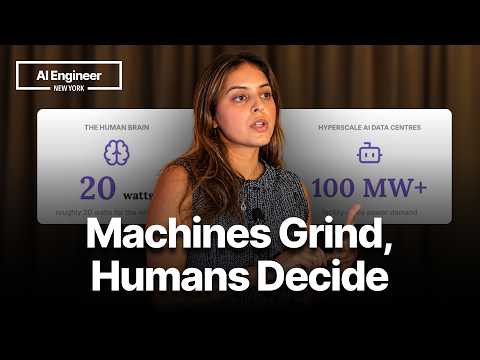
building with machines today. So I want to do a quick show of hands. How many people in this room are overwhelmed by the amount of data they have when making a decision? Okay. And how many feel like they've got less attention now today with all the amount of data? And so that's the exact paradox that financial investors have every day. So in 2025 last year, the world made about 175 zettabytes of data. That's exponential higher than what we had two decades ago. So before we were lucky if we had an internet connection, we had newspapers, books, but nowadays we have all of that plus the context that lives in PDFs, subscriptions, lots of different podcasts and also a stream of never-ending information coming on X and LinkedIn. So what does that mean for financial investors? Because more data does not equate to more information. It actually just gives everyone the same flood of information, but your attention is the flat line across everything. So for financial professionals who actually are paid on financial synthesis, what happens between the gap between attention and data, it just gets wider and wider and wider. So who am I? I've sat on both sides of the table. So I was uh I spent my career fascinated by data um and I've spent my career working in it. So I was a derivative trader for nearly a decade and then I moved into data science and machine learning. Uh so, I got a full bite scholarship to study machine learning, and I got a paper at ICLR uh working in machine learning systems with NASA. And now I've married those two. So, those two worlds being Moshi. Moshi is your 24/7 quant analyst, which works watching the markets 24/7 and understanding what is going on and what matters to a financial investor. Having sat on both sides, I can understand what the strengths are for both of them. And that's what I want to go into deep today. So, I want to talk about the machine that everyone is trying to beat. So, a human brain, to give you context, runs on about 20 W, which is the power of a dim light bulb. Uh so, it's 86 billion neurons in the brain, and we're it's making connections that we still can't understand. And that is on the power of a light bulb. And the systems that we are trying to imitate, which we're trying to imitate just a sliver of that power, they need a whole power plant to to run. So, just in terms of efficiency, the human brain is something like multiple millions multiple times more powerful than whatever systems that we're trying to uh whatever we're trying to build. And so, that actually what that actually means is it it's important for where you're trying to point that technology. So, at which point in the decision-making uh cycle do you point the technology, which is AI, which we're what we're building? Because if the most efficient reasoning engine sits between your two ears, then and it's running on a 20 W light bulb, where does machine learning actually sit in that? And so, do you try and replace it, which is what AI is trying to what I feel that AI is trying to do every day, or do you actually feed it? So, let's take a few steps back to understand how a trader's brain or a financial investor actually thinks. So, what do people actually want? Any investor you speak to is looking for the same thing, edge. What is edge?
So, edge is in practice just three things. I want to know what's going on before anyone else is. I want to know my blind spots. So, tell me the second and third order derivatives of what's happening. And
also, I want to have the conviction on what I'm doing so that I can size up on a trade that I believe in. All those three together give you edge. So, now here's the problem. If you're building in this space and everyone has access to the same models, and they have access to the same systems, then what is edge, right? Is it a skills file? Is it a whole bunch of MCP connectors? Is it just a better prompt? Is it a better model? Every Everyone has access to all of that. So, if everyone has access to all of these things, then what is edge? So, the edge is actually what you can't download. It what It's what sits in an investor's head. And how do they get that? It's decades of working and learning from some of the best traders in the industry and sitting next to them. And here's the concerning part. What happens when you have an investor and everything lives in their head when they move firms or they retire? That IP leaves with them. So, I think before we even start to think about how AI fits in into all of this, we have to actually understand what a financial investor is doing. They're keeping up with the markets, which are now moving 24/7. They're trying to understand what is going on and how they relate to each other. So, those billions of different data connections. They're trying to compare and understand the historical significance of the event happening right now. What happened in the past, why it happened, and what the market did when it happened. And trying to piece all of that together, and then run it on the models that they have. And then the last part is actually make a decision. So, there's a lot that takes place before actually making a financial decision. So, I just want to keep the last bit with you, which is the decision-making.
So, let's take think about what AI actually changed. So, before, if you worked in finance, you'd have a team of quants, data scientists, data engineers, traders, who are all
working together to build this decision-making engine. So, it's a whole stack of very expensive and very qualified people. However, with AI, these tools made you believe that you actually don't need any of these people. What you need is one person, a few API calls, and you've replaced that whole stack of people. But, here's the gap that no one actually talks about. Once you spent your weekend building a dashboard, the moment you actually want to productionize that and share it with one more person, you now have to think about security, a database, you have to think about storage, reliability, and the biggest thing in all is credits. How do you actually run the systems? And so, what we've seen is pricing has changed. People are no longer pricing by tools, but they're pricing for every API call. So, now if everyone is building the same tools, what actually makes it different? And so, there's two types of tools in finance. One is the tools that you pull data from, and one the tools you push data to. And so, if you're prompting a model, you are the context. You're explaining to it, you're arguing with a model that's frozen in time, which is telling you, "Hey, go to bed at 2:00 a.m. It's late now." when actually it's 3:00 p.m. on a Wednesday. And all of that, if you think about comparing it to reasoning with a human, it's absolutely no comparison. And then you've got the type of tool which pushes data to you. And that's the tool where it's flooding you with information, and that's a data engineering problem. So, when you have these two tools, and you've got different problems that you're solving for, one is context, and then the other one is the amount of data. You've got to think about what the traders actually using, and what what they think about in each of these different tools. And the one thing that it we're seeing is quietly breaking is that in finance, when you join a bank or you join a fund, you sit next to a trader or a team and you absorb everything that's going on. And you learn from them and you just listen to everything. You have one ear on the desk and one ear around everything else that's going on. And it's consistency that pays off. And if everyone is going to be running
their own teams as one-person pods, then what happens to that future generation of context that's coming in? And that's the real cost that right now people are not pricing in.
And so in finance, you can't just hand the decision-making loop to a team of agents. Why? Because the other side of the trade is a client. If it's in a commodity trade, it's a cargo, a physical cargo. If it's a company, it's a team of people. And so what happens in finance when something goes wrong is you need a human to go and stand up and say, "I made the decision for this reason." If an agent leaks your API key, all it says is, "Oops, I'm sorry. I shouldn't have done that. Please rotate it." And you can't have that in finance because um like an agent is just self-correcting and the one small error is just exponentially getting bigger. So, this is the question that I've been needing to, which is if the brain is the most powerful tool we have, why are we spending everything trying to push it out of the loop? Why don't we flip that and instead of replacing it, why don't we just feed it? And so if you think about what's in a trader's head, they've got everything leading up to the uh to the trade itself. But before that, there's a whole bunch of other work that takes place. They're reading, they're gathering information, they're cross-checking, uh they're watching the market. Because we have so much information now, the biggest question people have is what is the truth? What is what is actually the different sources saying? What is the divergence of information? How can I trust what is out there? And once I've done all of that, then I've actually got the decision. So, if we split it into two different parts, we understand that some of it, well, is all the grind, the reading, the gathering, the data cleaning, and some of it is judgment, which is the decision. And machines are incredible at the grind. They're incredible at cleaning data. They're incredible at gathering data. And then the human is incredible at the decision making. So, why not just split
those into two separate parts? And this is what brings us to Moshi, which is what we've built. It's a 24/7 quant analyst for institutional traders.
And what that means is we are running a team of six different agents, which are built in a deterministic manner, which are watching the market 24/7, more data than is humanly possible, plus the investors' data, which lives in PDFs, emails, different subscriptions, understanding all of that in a way that is making the the trader a better decision maker. So, Moshi has read 2.4 billion data points. And in the 4 seconds it took you to read that sentence, Moshi has learned 300 new things. And in those 300 new things that it's learned, that's new context for the model. The issue with that is new context is worthless if you don't actually know, is it trustworthy? Where does it come from? Do I even value this analyst's opinion? Because in finance, even if it's a really confident answer, if it's wrong, then it's worth nothing. And so, what do we do? We measure it. We measure the hallucination, we measure every claim, we see how it's traceable, and we also give the user the assumptions that we've had and how we've led to that decision. Because if an investor asks you about your opinion, they don't just want to know what you think, they want to know how you came to that reasoning. And so, what we do is we leave the decision-making with the human because we believe that that is what humans do best. There's no machine more powerful than the brain. But everything else that you need to run is what we give you. So, we believe that every single firm is running these desks of quants, of data engineers, of data scientists, and that's what we give
you. Because it's impossible to run that per human. It's impossible to run your own quant and data science team, and it also doesn't make sense. Economics-wise, it just is too much to run per person. And
so, that's what we do. We run an institutional-grade analyst how it works in bigger institutions to actually give you that conviction to make better trades. So, what does that actually buy you? It buys you more efficiency, up to 35% more, so that you can actually spend time to have the headspace to have more conviction on the trades that you want to do. So, if you speak to a lot of traders, they'll say to you, "Hey, I don't want to speak to anyone all day. I just want to trade." So, why are you giving these people just LLMs to talk to and to debate, "Hey, is FOMC today or is it tomorrow?" And then the LLM is saying it's tomorrow when it's today. That's just a complete waste of time. And so, that's the opposite of what investors want. They want something that can give them the power to reason more and use their brain. So, Mosaic isn't you. Mosaic isn't a model. It's It is you on steroids, which is the same instinct but fed by all the data that lives in different parts. So, that you can actually spend your time decision-making instead of debating when FOMC is. In In terms of the scale, we watch over 2.4 billion data points, and it's growing every millisecond. And so, that's decades of derivatives trading knowledge around the clock, which is what it No No one person can build. And then it's the pushing of the data. So, when you're pulling data from an LLM, you are giving it the context on an old model. When you are getting pushed new data, it's forcing your brain to think about new things and make connections in ways that you didn't initially think about. So, that means that you're then thinking about these blind spots which you've been told about, which you are then trying to understand, okay, well, I wouldn't have caught this, so what am I going to do with this new information? And then it's the deep dive, the ability to deep dive into one thing with a 360° view of information that you wouldn't have had before. And so we do that with the big data and all of the specific data. And so, how does it differ from a tool that you're building on the weekend when a tool that you need to build 24/7 on every market on big data, which is running in a way that you can understand the context, which is reliable and trustworthy, that becomes infrastructure. It's no longer a weekend tool because you need it to be something that other people can trust and you can trace back because that's what you have with a human, which is someone being able to stand up and say, "Hey, I made this decision because of XYZ." Not calling an agent who's never who's just going to apologize to you. So, the one question that I think we haven't answered yet, which is if real edge lives in a human brain, how much of a machine can it actually how much can a machine actually capture? And I don't think we have an answer to that yet, um and I think whoever answers it is not building a product, they're building a new way of thinking in finance, and that's what we're trying to explore. So, we've been building very quietly with uh a few of the biggest players in the trading industry in finance, and so this is the first time we're opening up to talk to the public uh because we believe that every single person should have access to institutional grade analysis without having to run their own data science or quant team. Um so, if that's interesting to you, come talk to me. I love talking about everything to do with data and finance and financial engineering. Um and yeah, before you trade, we want people to talk to Moshi. Thank you.