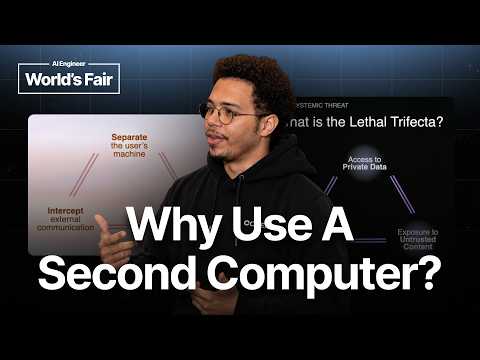
The Lethal Trifecta Is Already on Your Laptops — Michael…
A talk by Michael Patterson, staff solutions engineer at Coder, on the lethal trifecta (private data access, exposure to untrusted content, and external communication) as applied to coding agents such as Claude Code, Codex and OpenClaw running on developer laptops. Covers prompt injection, enterprise concerns about rolling out agents (CISO concerns, shadow AI, alert fatigue, skeptical engineers), and three architectural guardrails: cloud development environments, a model proxy that logs traffic and strips sensitive data, and an agent firewall that restricts commands and domains. Recorded at the AI Engineer World's Fair 2026. The description presents the talk's content; no comments or tags were supplied to independently verify it.
# Video Identity Observations — "The Lethal Trifecta Is Already on Your Laptops — Michael Patterson, Coder"
## Speaker & Context
- **Self-identified speaker**: Michael Patterson, presented as *"I'm a staff solutions engineer here at Coda"* (transcript renders "Coda"; title and later mentions of "Coder" indicate **Coder**, the company).
- **Venue**: Presented at an in-person industry event: *"here at the the AI Dev Conference the AI Engineers Conference."*
- **Audience interaction style**: Assumes a technical crowd; polls them — *"Has anyone heard of the lethal trifecta? All of us or half of us. So, about 50/50."*
## Intended Audience
Observable markers of who the talk addresses:
- **Enterprise engineering and security stakeholders**, not hobbyists:
- Discusses blockers to rolling out AI agents at companies: *"you pretty much need security approval from CISOs. You need buy-in from DevOps."*
- Speaks directly to infrastructure roles: *"platform admins, DevOps, infrastructure, security engineering, they're worried about observability."*
- **Engineers leading AI adoption initiatives**: *"the questions you can expect if you're trying to lead an initiative to get uh AI at your company."*
- Familiarity assumed with developer tooling and jargon: **Claude Code, OpenClaw ("Open Claw"), Codex, prompt injection, context poisoning, privilege escalation, CDEs, VPC/VPN, shadow IT**.
## Claimed Scope of the Talk
- Explains a named security concept: *"explain a little bit about what the lethal trifecta is"* — attributed to *"Simon Ellison"* (widely known as Simon Willison; transcript rendering).
- Claims organizational solutions: *"how Coder is addressing uh the principles of Agentic security, and how folks are coming to us so that they can address these problems and scale out AI at their company."*
- Proposes a three-part architectural remedy: **cloud development environments, a model proxy, and an agent firewall** — *"these are the three ways architecturally you can protect your organization."*
## Vendor Self-Description Evidence
Explicit creator/company claims made in the video (not independently verified):
- **Company origin story**: *"Coder was founded in 2017... founded by three teenagers who were making Minecraft mods."*
- **Product positioning**: *"delivers consistent, reliable, and secure remote development environments"*; *"We're open source. We're model agnostic. We're cloud agnostic."*
- **Enterprise customer claims**: *"in I believe six of the top 10 big banks, lots of hedge funds, lots of three-letter government agencies."*
- **Speaker's ongoing industry engagement**: *"I I personally talk to to CISOs probably once or twice a week."*
- **Commercial call to action**: *"if you're interested, please come over to our Curder [Coder] booth."*
## Notable Framing Choices
- Uses **anecdote and industry buzz-coining** to establish urgency: a Twitter story of an agent that *"deleted my production database,"* plus terms **"shadow AI"** and **"ninja AI"** (*"shadow AI at scale"*).
- Emphasizes that the security advice is conventional in nature: *"agentic security is it's really no different from sound security practices for anyone."*
- Acknowledges audience skepticism among senior engineers: developers *"not quite converted that AI can do code better than them"* and worried about *"AI slop."*
## Claims vs. Demonstrated Patterns
- **Creator claims**: the customer counts, founding story, and effectiveness of Coder's architecture are unverified self-descriptions.
- **Demonstrated patterns**: the video itself shows a conference talk format, a technical audience, a vendor education/marketing hybrid style, and content scoped to enterprise agentic-AI security adoption.
# Delivery Observation — Michael Patterson, "The Lethal Trifecta Is Already on Your Laptops"
## Overall Communication Style
The delivery is **conversational and audience-facing**, with frequent rhetorical questions, direct address, and real-time references to the room. The speaker structures the talk around repeated framing devices — scenarios, "right?" check-ins, and triadic lists — to walk the audience from problem to solution.
## Recurring Linguistic Patterns
### Constant audience check-in: "right?"
The most frequent verbal tic, used to seek agreement and keep momentum:
> "everyone's familiar with the privilege the the least privilege access principle, right?"
> "But the solution is really simple, right?"
> "So, this is kind of what it would look like, right?"
### Rhetorical question–answer pairs
Questions set up each section before the speaker answers them:
> "So, what's the deal with Open Claw, right?"
> "So, what is the lethal trifecta?"
> "What are the blockers to adoption? Why companies don't want to do this?"
### Colloquial / casual register
Notable informal vocabulary in a security talk:
> "Coolio."
> "They don't have to worry about mucking around the shell, mucking around their precious laptop."
> "If they are going to put Claude on YOLO mode and have it crank out a bunch of PRs..."
> "we're sniffing all of that traffic"
> "an agent going crazy"
### Stumbling and self-correction
The transcript shows frequent word repetitions and mid-sentence repairs ("the the", "it when it", "clawed code" for *Claude Code*), suggesting an unscripted, impromptu delivery style. There is also a visible moment of presentership housekeeping:
> "I'm going to start off by removing these Grenada notes from the presenter view. Sorry."
## Teaching Habits
### Story-driven openings
The talk begins with a narrative anecdote rather than definitions:
> "Jason uh had this Twitter post about how agentic coding changed his life... less than 24 hours later... he posts on Twitter again and says, 'Agentic AI just destroyed my product, deleted my production database.'"
### Named terminology as anchors
The speaker coins and defines terms for the audience and returns to them:
> "We call that shadow AI. Just like shadow IT... Shadow AI is just unauthorized usage of AI on your laptops."
> "We're starting to see a new term in the industry called ninja AI, which is shadow AI at scale"
### Triadic structures throughout
The talk repeatedly organizes content in threes, mirroring the "trifecta" theme: three threat layers, "three pillars of agentic security," three solutions (cloud development environments, model proxy, agent firewall), three stakeholder groups (CISOs, platform/DevOps, developers).
### Persona voice-acting for stakeholders
The speaker quotes hypothetical people in character:
> "Hey, we need AI. I need you to bless it because if anything goes wrong, it's not anyone's fault but the chief security team's problem"
> "Hey, this is why I need it. This is the workflow I want to do."
### Escalation framing for stakes
Risk is framed through vivid consequence lists:
> "The last thing you want is Open Claw to go download all of your sensitive files, put it up on the internet... and then delete all your personal files so that you don't have them, but the rest of the world does."
## Structural Patterns
- **Problem → terminology → architecture → adoption guidance → takeaways**: a clear progression from threat explanation to solutions to organizational advice.
- **Live audience calibration**: "We're a bit of a small crowd. Uh, can I get a raise of hands?" — used to gauge prior knowledge ("So, about 50/50. Fantastic.").
- **Self-aware improvisation**: "So, don't have time to run a demo right now, but if you're interested, please come over to our Curder booth."
- **Closing loop**: the talk ends by restating the speaker's name and role, mirroring the introduction: "My name is Michael Patterson, staff solutions engineer."
## Stable Patterns vs. Isolated Moments
**Stable (recurs throughout):** "right?" check-ins, rhetorical question setups, casual vocabulary, triadic lists, quoted personas.
**Appears once (uncertain as patterns):** the "Coolio" opening, the presenter-view housekeeping moment, the Minecraft origin story, and the phrase "AI superhighway" ("go as fast as they can on the the development AI superhighway") — each occurs only once, so no conclusion should be drawn about them as habitual features.
## Uncertainty Notes
- All quotations come solely from the provided transcript; timestamps in the transcript are segment markers, and no claim is made about exact slide content or visuals referenced ("here you can see normally...").
- The heavy repetition artifacts ("the the", "uh") may partly reflect transcript transcription quality rather than the speaker's actual speech, so fluency judgments are withheld.
# Observation Record: "The Lethal Trifecta Is Already on Your Laptops"
**Speaker:** Michael Patterson, staff solutions engineer at Coder (self-identified in transcript; delivered at the AI Dev Conference / AI Engineers Conference)
**Video claim note:** The curated title attributes the talk to "Michael Patterson, Coder" — consistent with the transcript. One transcript instance says "here at Coda" while other instances and the metadata say "Coder"; this inconsistency is preserved as spoken.
---
## Context Claims (2025 Agentic AI Landscape)
- **"2025 was undoubtedly the year of the AI agent."** Patterson claims every major vendor released agentic tools, naming Microsoft, Salesforce, AWS, and Claude Code (which he says "changed the game" when it came out "last March").
- **Anecdote (via a Twitter post Patterson recounts):** A developer ("Jason") posted that agentic coding "changed his life," then roughly 24–48 hours later posted that "Agentic AI just destroyed my product, deleted my production database." Patterson attributes these posts to Jason; they are secondhand in this transcript.
- **On OpenClaw (spelled "Open Claw" in transcript):** Patterson states it is a powerful personal-assistant tool but that widespread community advice is to run it on a separate machine (e.g., a Mac Mini) because of security vulnerabilities. He speculates about worst cases: exfiltrating sensitive files, downloading viruses, deleting personal files while the data goes public.
---
## Core Claim: The Lethal Trifecta
- **Attribution:** Patterson states the term was **coined by Simon Ellison** (as spoken; commonly rendered Simon Willison elsewhere, but the transcript says "Ellison").
- **The three threat layers** when an agent runs on a laptop:
1. Access to **private data** (personal files, credentials, company IP, databases)
2. Ability to **communicate to the internet** (exfiltrate data)
3. Ability to **download from the internet** (ingest malicious content)
- **Stated thresholds:** One of the three "isn't really a big problem." Two out of three is "completely unacceptable in any kind of secure enterprise environment." Having all three: "It's not if, it's when you're going to have some kind of security incident."
### Attack vectors Patterson identifies
- **Prompt injection:** malicious guidance embedded in information sources agents trust (error messages, support tickets, CI/CD logs).
- **Context poisoning:** planting bad data in documentation or datasets the agent retrieves.
- **Privilege escalation:** agents are often granted broad access; injections or poisoning can escalate privileges to destructive actions ("drop a table, upload, make requests").
---
## Proposed Solution: "Trifecta of Agent Security" (three pillars)
1. **Control data access** — run agents in a secure virtual environment, not on laptops; block private file access and destructive actions on personal machines.
2. **Restrict external communication** — architecturally isolate the VM; allowlist domains; VPN/VPC/firewall; governed, observable traffic with admin alerting and ability to kill the VM.
3. **Lock down content, contact, and access** — restricted permissions and tightly scoped credentials.
> **Key framing claim:** "Agentic security is really no different from sound security practices for anyone." Patterson argues people wrongly assume AI won't make human-style mistakes.
---
## Organizational Adoption Claims
### Pre-adoption blockers
- Security approval from **CISOs** and buy-in from **DevOps** are required; real-world use-case examples are needed.
### Shadow AI and "ninja AI"
- If unauthorized, employees will use **personal AI subscriptions** on laptops anyway — termed **shadow AI** (parallel to shadow IT).
- A new industry term, **"ninja AI,"** is described as "shadow AI at scale" — many agents doing unknown damage organization-wide.
### Stakeholder concerns (as Patterson reports from conversations)
- **CISOs** (he claims to speak with them "once or twice a week"): want guardrails; fear being blamed if agents go wrong without their sign-off.
- **Platform/DevOps/security engineering:** observability of every LLM call; alerting without **alert fatigue** (alerts becoming noise and masking critical events); repeatable, consistent rollout.
- **Developers:** an ongoing "holy war" — skepticism that AI codes better; worries about technical debt, code bloat, "AI slop," and personal accountability for agent actions (e.g., running Claude "in YOLO mode").
---
## Architectural Recommendations (Coder's offerings/patterns)
- **Cloud development environments (CDEs):** remote execution layer (URL/RDP/SSH) blessed by security/platform teams; pre-configured environments also prevent agents from pulling dependencies from potentially "contaminated" registries.
- **Model proxy:** all agent-to-LLM traffic passes through a gateway that can sanitize/strip injections and sensitive data (e.g., credit card numbers) and log everything.
- **Agent firewall:** process-level inspection that denies unblessed commands (examples given: `gh repo delete`, dropping a table).
---
## Stated Takeaways (Patterson's closing)
- Agents are powerful; be aware of the lethal trifecta.
- Ensure full visibility into agent actions.
- "It's okay to go slow" to think through architecture and infrastructure needs.
---
## Qualifications and Tensions Preserved
- Patterson acknowledges only "about 50/50" of the audience had heard of the lethal trifecta.
- He concedes agents deliver "tangible benefits" even when unauthorized — the shadow AI problem exists *because* the value is real.
- No demo was run ("don't have time to run a demo right now"); attendees were directed to the Coder booth.
- Transcript spelling/wording inconsistencies retained: "Coda" vs. "Coder," "Simon Ellison," "Open Claw," "Curder booth."
# Speaker & Provenance Record
## Video Identification
- **Title:** *The Lethal Trifecta Is Already on Your Laptops — Michael Patterson, Coder*
- **Video ID:** 01a15ca6-b060-75b8-98d3-06c342330645
## Speakers & Roles
| Speaker | Role (explicit in source) | Basis |
|---|---|---|
| **Michael Patterson** | Staff solutions engineer at Coder | Self-identified in transcript opening and closing ("My name's Michael Patterson, staff solutions engineer") |
- **Single-speaker recording.** No guests, interviewers, or narrators appear.
- **Format:** Conference talk at the "AI Dev Conference / AI Engineers Conference" (per speaker's own greeting). No Q&A or second voice in transcript.
## Referenced Third-Party Sources & Claims
Claims attributed by the speaker to others (recorded as attribution, not verified):
- **Simon Ellison** — credited by the speaker with coining the term **"lethal trifecta."**
- **"Jason"** — cited via unspecified Twitter/X posts: one claiming agentic coding "changed his life," a follow-up (~1–2 days later) claiming an agent "deleted my production database." Surname and exact posts not identified in transcript.
- **Named companies mentioned by speaker:** Microsoft, Salesforce, AWS, Anthropic (Claude Code / "Claude"), OpenAI (Codex; "Open Claw" appears to be the speaker's pronunciation/homophone of a tool name — treated as spoken artifact, not corrected).
- **Company claims (speaker's own promotional framing for Coder):** founded 2017; $80M valuation claim; open source, Terraform-configured, model/cloud agnostic; claims of presence in "six of the top 10 big banks," hedge funds, and "three-letter government agencies." These are speaker assertions, not independently sourced.
## Promotional Content — FLAGGED
> This talk contains **explicit vendor promotion** for **Coder** (the speaker's employer).
Promotional elements include:
- Company overview section ("A little about Coder…")
- Product-aligned solutions presented as answers to the security problem: **cloud development environments (CDEs)**, **model proxy**, **agent firewall**
- Closing **booth call-to-action** at the AI Dev Conference ("come over to our Coder booth")
## Provenance Facts
- **Sources cited:** None beyond the above verbal attributions; no papers, links, or datasets referenced.
- **Comment availability:** Not stated in transcript.
- **Demo:** Speaker states a demo was skipped for time and redirected to the booth.
- **Terminology introduced/used by speaker:** "lethal trifecta," "shadow AI," "ninja AI" (described as shadow AI at scale), "AI slop" (attributed to developer discourse generally, not a named source).
## Uncertainty Notes
- "Simon Ellison" is the name as heard in the transcript; spelling unverified (commonly rendered Simon Willison elsewhere, but this record reflects only what the transcript states).
- "Coda" vs. "Coder": the speaker's self-introduction appears as "Coda" in the transcript, while the title and later references say "Coder" — treated as a transcription inconsistency; the employer is recorded as **Coder** per the title and repeated usage.
- "Open Claw" is recorded as spoken; exact tool name unverified from transcript alone.
How's everybody doing? Coolio. Well, it's nice to be presenting to you all. I hope we're all having a good time here at the the AI Dev Conference the AI Engineers Conference. Um, my name's Michael Patterson. I'm a staff solutions engineer here at Coda. Today, I want to talk to you about the lethal trifecta. So, we're a bit of a small crowd. Uh, can I get a raise of hands? Has anyone heard of the lethal trifecta? All of us or half of us. So, about 50/50. Fantastic. So, what I'm going to
do is explain a little bit about what the lethal trifecta is and what we've learned here at Coda and addressing it. So, I'm going to start off by
removing these Grenada notes from the presenter view. Sorry. Want to start off just uh on a quick recap of agentic AI in 2025. 2025 was undoubtedly the year of the AI agent. Everybody had a new agentic tool,
Microsoft, Salesforce, AWS, uh, Claude Code basically changed the game when it when it came out last March. Everybody was using this stuff.
And I have a a quick story. So, Vibe coding was was a really big thing. Um, Jason uh had this Twitter post about how agentic coding changed his life. He's pushing out all of this code, making all of these new changes to his product. This was the future for him. And then, I think less than 24 hours later an agent or 2 days later, he posts on Twitter again and says, "Agentic AI just destroyed my product, deleted my
production database. And how can anyone ever use Agentic AI?" Um the thing is a
AI agents are very powerful, but they create problems. Um everyone here familiar with Open Claw? Right? So, what's the deal with Open Claw, right? It's a really, really cool tool. You can put your own AI on a computer, and it can essentially be your personal assistant, do all of this really, really awesome stuff for you. But you've probably seen everyone is saying, "If you're going to use Open Claw, you need to buy a Mac Mini and put it on a different computer than your personal computer, right?" Because it's got all these security vulnerabilities. The last thing you want is Open Claw to go download all of your sensitive files, put it up on the internet, download viruses on the internet, put that on your laptop, and then delete all your personal files so that you don't have them, but the rest of the world does. So, there are quite a few issues with agents that we are still wrapping our heads around and how to securely develop with with AI agents. So, today I'm going to spend a little bit of time talking about the lethal trifecta, if you haven't heard of it, and how Coder is addressing uh the principles of Agentic security, and how folks are coming to us so that they can address these problems and scale out AI at their company. So, a little bit about Coder. Coder was founded in 2017. Um it was founded by three teenagers who were making Minecraft mods, and they They tired of having to configure VMs constantly to run Minecraft so that they could develop mods on it. Somehow they stumbled on an $80 million company. Um we're very proud of them. What Coded does is it delivers consistent, reliable, and secure remote development environments. Those environments can be stood up pretty much anywhere you want.
They're configured with Terraform. We're open source. We're model agnostic. We're cloud agnostic. Uh you can host this on premise and we find that um
this is a really, really good solution if you need a self-hosted model for developer environments or agentic environments. We're trusted by some of the biggest companies here in the United States and across Europe. Uh here's some of the names on our board. We're in I believe six of the top 10 big banks, lots of hedge funds, lots of three-letter government agencies. Essentially, if a SaaS model doesn't work for you, if you've got on-prem infrastructure, if you cannot have code sitting on a developer's laptop or in some kind of uh uh perimeter that you cannot control, Coded is usually a good solution uh just like these companies need it. So, what is the lethal trifecta? The lethal trifecta was a term coined by Simon Ellison and it's a essentially three layers, three threat layers to the attack surface. One is if you have your agent on a laptop, that could be clawed code, open claw, codex,
right? Well, that laptop has access to private data. That can be personal information as files on your computer, credentials, company IP, databases.
So, now your laptop has access to it. Your agent now has access to this private data. Now that it has access to this private data, it can also ex- uh communicate to the internet. Right? So, it has access to private data and it can put that data on the internet. And not only can it put that data on the internet, it can also download things off the internet. So, this is a problem because you don't have oversight into what exactly that agent might do when you prompt it. So, one of these three isn't really a big problem. But, two out of three is completely unacceptable in any kind of secure enterprise environment. Having all three is basically not acceptable. It's not if, it's when you're going to have some kind of security incident by having an agent on that laptop. And so, here I've got a a couple of attack scenarios. I'm sure everyone here has heard of prompt injection, which is essentially um you have some kind of malicious guidance in the information source that
an agent would trust. So, it might be looking at error messages, it might be looking at support tickets, it might be looking at CICD logs. And it's very easy for a malicious actor to put something
in any of those messages and the agent just accepts that as a source of truth and can do something that you didn't expect it to do. Context poisoning is in that same realm where you're essentially putting bad information into documentation, into data, anywhere where you're going to your agent is going to grab information. And then, if there's any malicious data in there, the agent is going to go ahead and run with it and do whatever it wants. And then, there's privilege escalation, right? So, everyone's familiar with the privilege the the least privilege access principle, right? And generally, we're giving agents access to pretty much everything because it needs access to do the work, right? And so, any one of these prompt injections or context poisoning can unwittingly escalate the privilege of that agent so it can do things that it shouldn't do, drop a table, upload, make requests, or post things that it shouldn't be able to do. So, how do we address that? Um there are three pillars of the lethal trifecta.
There are three pillars of the of agentic security. We call it the trifecta of agent security. The first thing is you want to control data access. If you're going to use an agent,
you don't want it on your laptop, you want it in an environment that is secure, preferably a virtual environment, right? That's going to block private file access, is going to prevent destructive actions on your machine because it's on some other machine. Then, you restrict that external communication. So, if you're going to put that agent on some kind of box, a VM, it's going to now be uh isolated architecturally from your network. It's only going to be able to go to domains that you want it to go to. It's going to be on your VPN, your VPC, it's going to go through a firewall, and then anything that that agent is doing on that box, that traffic is going to be governed. You're going to be able to see every little thing that it does, and if it ever breaches that perimeter, you should have some way of alerting your admins, alerting yourself that your agent is going somewhere it shouldn't so that you can effectively kill that VM, kill that agent. And then, you want to lock down uh the content and the contact and the access. So, you want to lock down the permissions, you want to restrict what access it has to, you want tightly scoped credentials credentials. The thing about agentic security is it's really no different from sound security practices for anyone, right? And we think that because AI is so powerful, we can just give it whatever it needs and it's not going to make the same kind of mistakes, not going to it's not exploitable by other vulnerabilities that a human would be. So, we want to make sure to separate that machine, secure that environment, intercept any kind of uh communication that that agent might do to the uh to the wider internet. So, I'm going to kind of quickly go over what it looks
like uh deploying agents at scale at really, really large companies. What are the blockers to adoption? Why companies don't want to do this? Uh what are the
challenges if you do uh decide to roll out agentic AI at a company? And the questions you can expect if you're trying to lead an initiative to get uh AI at your company. So, some challenges to expect, right? Before adoption, um you pretty much need security approval from CISOs. You need buy-in from DevOps because they're the ones that have to roll this out to teams. You're going to need real-world examples of, "Hey, this is why I need it. This is the workflow I want to do." And the trick here is if you're not getting these approvals, if you're at a company right now and they are not letting you use agents, most people are going to use their personal cloud subscriptions, their personal uh ChatGPT subscriptions, put that on the laptop because they do get tangible benefits from using AI. They're just not being authorized by the company. They're going to get that stuff done anyway. We call that shadow AI. Just like shadow IT, when you're bringing your own VMs, you're bringing your own uh technology into your company to get the work done. Shadow AI is just unauthorized usage of AI on your laptops. Um it's a real problem because once you get AI on your laptop, you're using your personal subscription, the enterprise doesn't know what's happening, and usually uh agentic AI can do a lot of damage really fast. We're starting to see a new term in the industry called ninja AI, which is shadow AI at scale, where you're not just having one agent breaking stuff, you've got multitudes of agents doing lots of things at an organization that no one knows until it's too late that a whole lot of stuff has gotten broken. So, um if you were going to adopt AI at your company, you need to make sure that there are good outcomes, right? Usually, companies come to us, they start with the developers because they're getting the most use out of using AI, but you want to be adaptable. You need to be rethinking your architecture. You need to be rethinking how you're going to protect your organization from incidents like agents dropping databases, uh deleting personal information, uploading customer information, essentially uh extracting your company's IP onto the public internet. So, once you start wanting to bring AI, you're going to definitely need to be
talking to the security people. What are they What is the CISO uh concerned about? How do I stop agents from violating best practices? How do I put
boundaries around these agents, right? I I I personally talk to to CISOs probably once or twice a week, and they're saying, "Hey, we understand the value of AI. We want to bring AI. We want people to go as fast as they can on the the development AI superhighway, but I need guardrails for them, right? And I can't just have my platform team or this business team come to me and say, 'Hey, we need AI. I need you to bless it because if anything goes wrong, it's not anyone's fault but the chief security team's problem, right?" And they don't want the finger being pointed at them because someone used Agentic AI and they didn't know what they were doing or they didn't have the proper guardrails for Agentic usage at the company. Uh platform admins, DevOps, infrastructure, security engineering, they're worried about observability. What are these agents doing? How do I know it's doing? How do I get every call that they make to an LLM provider in some kind of observability tool? And how can I then set up some kind of alerting for that without also getting alert fatigue? So, another thing that's happening is maybe we do get some kind
of observability around AI, but now there's alerts going all over the place. Once you get alert fatigue, you stop really looking at what's actually happening. Everything AI is doing just
becomes noise and you're missing the really, really critical things that actually need to be addressed. And then another thing is if I am going to roll out AI, how do I actually set this up in a repeatable, consistent, reliable, secure way for everyone at the company? Lastly, developers are going to have concerns as well. There is still a holy
war happening where some of the most technical people are not quite converted that AI can do code better than them, right? They're worried about more technical debt, more code bloat, more
security vulnerabilities, and spending most of their time fixing AI slop versus just doing it themselves. And then if they are going to put Claude on YOLO mode and have it crank out a bunch of PRs, how do I make sure that that agent isn't doing stuff that would actually get me in trouble, right? Because at the end of the day, someone is going to be accountable when an agent actually does something that we didn't expect it to do. So, I'm going to talk a little bit about how you can address all of these guardrails that everyone is concerned
for. Uh the first thing is cloud development environments, and this is something that Coder does, right? You want a remote execution layer. You want a remote
environment. You don't want it on your laptop. You want to go to a URL. You want to RDP. You want to SSH into something that is not your laptop, but something that is in a secure environment that has been blessed by the security team, by the platform team, and let agents write code, execute code on cloud infrastructure that um is isolated, that has right-scoped permissions, and cannot communicate to anything unless you allow it to communicate to that um to that public internet. So, this is kind of what it would look like, right? Instead of putting things on your local machine, you go to an isolated cloud environment. Right now, it can only do You can only work on the code that's in there. It can only touch credentials that are in there. It can only touch data that you purposely put into that development environment. Right? Um CDEs accelerate AI productivity because the thing is if you grab a a project and you put it on your laptop, what do you have to do to get that project running? You got to download dependencies. You got to update your your path. If your computer's running Python version 3, but this project needs Python version 2, you're going to get conflicts. You have to create virtual environments. You have to do a lot of extra stuff that while it may not break your laptop, you really don't want to go through the trouble of doing that. It would be better if you had a consistent cloud environment that was already configured to run that application, right? And so, everything that Coder does uh that helps developers, they don't have to worry about mucking around the shell, mucking around their precious laptop. They can just go to this lightweight or heavy VM, and everything's already ready to go, and they can just start developing. Well, that same thing is true for agents, right? If you put an agent on a fresh box and say, "Download this GitHub repo and run the project." What is it going to do? It's going to read the contents. It's going to say, "Oh, I need to start downloading stuff." You never know where it's going to download things from, and if it grabs things from some kind of registry, that registry could be contaminated. You really want things to already be ready so that the agent could just start developing. Um the next thing is a model proxy. And this is really just something in between that uh agent or that model on your machine before it hits the LLM provider, it needs to go through a box where we're sniffing all of that traffic, and we're
able to log every little thing that it's doing, right? So, here you can see normally in in a in a normal scenario, the agent would be sitting somewhere, and it can just go straight to the
internet, straight to the model provider, and get what it needs. But the solution is really simple, right? Before the agent hits the model provider, it goes to your proxy server, it goes through your gateway, right? And it can sanitize, it can strip injections. If you have like if you accidentally put credit card data into a prompt, you don't want that going to the LLM provider. Uh model proxy can strip that, and it logs everything that's happening. Lastly, you want an agent firewall. So,
when that agent starts executing at the process level, you want to make sure that uh it can't run commands that you haven't already blessed, right? So, on
that remote environment that goes to the proxy, if it runs if that agent for whatever reasons runs gh repo delete or drop this table, you want some kind of agentic firewall that's looking at the process logs and saying, "Do not run this." That that command is denied. And so, these are the three ways architecturally you can protect your organization from an agent going crazy. So, don't have time to run a demo right now, but if you're interested, please come over to our Curder booth. We're opposite and to the We're opposite of this stage and over to the left. Um And just some key takeaways, right? Agents are powerful, but be aware of that lethal trifecta. Make sure that you've got some way of seeing everything that that agent is does. It's okay to go slow so that you can think about your architecture, know what your infrastructure actually needs. My name is Michael Patterson, staff
solutions engineer. Would love to talk to you guys about how you can securely develop with agents. Thank you for your time.