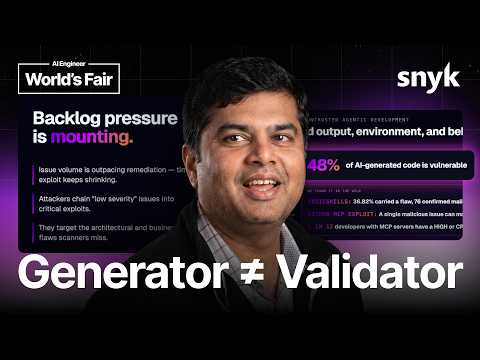
Through the AI Fog: The Architectural Decision Agentic…
Talk by Manoj Nair (Snyk) on AI security architecture: why the agent that generates code cannot also serve as its own validator. He cites Snyk customer data showing security backlog up 108% quarter over quarter across ~4,800 customers as agents write code faster than vulnerabilities are remediated, and highlights new attack surfaces: a large share of studied agent skills carrying malware or hostile instructions, insecurely wired MCP servers (including a GitHub MCP exploit), and an agent exfiltrating PII into an untrusted database it created. Red-team results show PII leakage varying wildly by model (100% vs 0%), arguing that one probabilistic system cannot police another and that a deterministic verification layer must run continuously inside the developer loop. Covers Snyk Studio prevention, remediation at scale (16,000 critical issues), live demos of package health and risky agent skill assessment, and the EVO community project.
# Channel Identity Observations: Manoj Nair / Snyk Talk
## Observable Presentation Context
This talk appears within a **conference security track** — the speaker notes it is "the very first ever security track at the World's Fair" and references an "AI Engineer" event context and an "AI Security Summit" partnership. The setting is a vendor-executive keynote/talk with a live product demo.
## Intended Audience
- **AI engineers and AI security engineers**: "Our goal here is to have that 10x superpower in the hands of AI security engineers so we can build trusted systems together."
- **Enterprise security decision-makers**: talk repeatedly frames problems around enterprise scale — "about 5,000 enterprise customers around the globe," "Half of Fortune 500 runs on Sneak."
- **Builders using agentic tooling**: audience is addressed as people who will "go back to your hotel rooms, and build some genuinely cool software."
## Claimed Scope (Creator Self-Descriptions)
- **Company scale claims** (stated by speaker, unverified):
- "helping secure about 5,000 enterprise customers around the globe"
- "Half of Fortune 500 runs on Sneak"
- **Leadership/credentials** (stated by introducer "Randall"): Chief Innovation Officer and CTO of Snyk; prior Chief Cloud Officer at "Convo IT"; founded HyperGrid; roles at HPE, Dell, RSA; "a dozen patents."
- **Product scope claims**: references GA'd "agentic dev security offering," an "Evo" system, a remediation agent, package health-check tooling, and skill/MCP risk assessment ("Go to sneak.io").
- **Community posture claim**: "We're building it with the community and we want this to be an open vision."
## Demonstrated Content Patterns (Observable, Not Claimed)
- **Data-driven framing**: repeatedly cites customer-derived metrics — "108% more backlog" quarter over quarter (4,800+ customers), "for every model that we find in a repo, you have three times more agentic components," red-team benchmark results (e.g., "100% of the time our attacks were able to extract PI" on one unnamed model).
- **Central thesis advocacy**: the "generator and validator" separation — "Can the generator and the validator be the same? And our point is... why not."
- **Live product demonstration**: an on-stage demo of package health checking and skill risk assessment, which partially failed due to Wi-Fi and fell back to a recording — demonstrating a demo-driven presentation style.
- **Call-to-action marketing**: repeated invitations to the booth, the website, and an evening "community jam" at the Snyk SF office.
- **Executive-anecdote evidence**: customer stories such as "a max seven company remediated 16,000 critical issues using this remediation agent" and agents "creat[ing] copies of PII data" in Fortune 100 environments.
## Claims vs. Demonstration Distinction
- **Explicit claims**: customer counts, Fortune 500 penetration, benchmark results, and product capabilities are all **asserted by the speaker**, not independently verifiable from this material.
- **Demonstrated**: the talk shows a vendor presenting proprietary research/data as authority, positioning Snyk within the AI-security education community (track curation, workshops — "training hundreds of AI security engineers"), and marketing products to a technical practitioner audience.
## Caveat on Attribution
This is a **single conference talk by a guest executive speaker**, not channel-owner content; identity conclusions about the hosting channel should not be drawn beyond the fact that this video documents a Snyk executive presentation at an AI engineering conference.
# Delivery Observations — Manoj Nair Keynote
## Tone & Register
- **Conversational, energetic**: opens with casual rapport-building — "What's up, everyone? Good to see you all here."
- **Rhetorical questions used as connective tissue**: "What does it do?", "How do you steer them, right?", "But what about the environment?"
- **Self-aware humor and hedging**: "I hate to have the scare tactic. It's just a fact."
## Recurring Phrases & Verbal Habits
- **"You know"** — extremely frequent filler, appearing in nearly every paragraph: "And our point is, you know, in some of the data you'll show…"
- **"Right?" as a tag question** for audience alignment: "that's the ultimate goal, right?", "That's not how you can run an enterprise system… right?"
- **"Real data" / "This is real data"** — repeated claim of empirical grounding: "some of what I'm going to show is real data from those customers", "And these are again facts. These are benchmark data facts."
- **"So"** as a dominant discourse marker starting many sentences.
## Teaching / Persuasion Patterns
- **Numbered problem structuring**: "Um, there are three problems that, you know, we hear when we talk to these customers."
- **Anticipate-and-defuse objections**: "So what does this mean? It doesn't mean that they're not good. It just means they need to be… used… for what they're really good at."
- **Analogical teaching** (closing): "you have fighter pilots with 5G fighters… you need to really observe, orient, decide and act."
- **Playful obfuscation for naming**: "the hot new model in Silicon Valley… rhymes with LLM."
- **Data-anchored claims with stats**: "108% more backlog", "only 50% of those ones are found", "100% of the time our attacks were able to extract PI."
## Structural Habits
- **Product tie-ins after each pain point**: prevention ("that's studio"), remediation ("a max seven company remediated 16,000 critical issues"), governance ("We just GA'd our agentic dev security offering yesterday").
- **Calls to action repeated**: "come by to our booth", "Find me in the hallway", "Come join us."
- **Framing device callbacks**: returns to the "cutting through the AI fog" theme and the "generator validator separation" thesis throughout.
## Uncertainty Notes
- Filler density ("you know", "like", false starts such as "I I want to") suggests partially improvised delivery; cannot confirm whether this reflects nerves or style without more samples.
- Randall's intro and Ezra's demo are separate speakers; observations above focus on Manoj, though Ezra shows a distinct habit of **turning failure into invitation** ("conference Wi-Fi is really really not playing in our favor… Come find us after").
# Position Record: "Through the AI Fog" — Manoj Nair, Snyk
## Speakers
- **Randall** (intro): Track curator/emcee
- **Manoj Nair**: Snyk Chief Innovation Officer and CTO
- **Ezra** (demo presenter): Snyk demonstrator
## Core Thesis: Generator/Validator Separation
- **Manoj's central claim**: A previously unquestioned security concept is now being asked: *can the generator and the validator be the same?* His answer: **no**, for the reasons shown in his data.
- Supporting benchmark claim (described as "fresh new research"): latest models asked to find the same vulnerability five times found it only **~50%** of runs; versus deterministic checks, LLMs found only **75%** of issues with a **40% F1 score**.
- Qualification preserved: this doesn't mean models aren't good — they should be used **for what they're good at**, combined with deterministic checks, not treated as solving everything probabilistically.
## Claimed Problems (three customer pain points)
### 1. Autonomous attacks
- Manoj claims automated attacks are real and observed: "All the frontier labs have been used in automated attacks," possible even **without frontier models**.
- Claim: chained low-severity vulnerabilities now yield exploits; traditional contextual risk triage ("fix criticals/highs") no longer suffices.
- Cited: Five Eyes statement last week that "AI will bypass cyber security systems in months, not years" — presented as fact, not scare tactic.
- Metric: 4,800+ customers showed **108% quarter-over-quarter backlog growth** in vulnerabilities.
### 2. Untrusted output, environment, agent behavior
- Claim: AI-generated code quality is **worse than human-generated code** ("a little worse").
- Claim: **more than a third of skills** (across open Claude/CodeAct skills) contain malware or vulnerabilities; "three lines of English" can bring down a system.
- Claim: **MCP** has "very little security built in" (improving); GitHub MCP server exploit cited — some customers shut down all MCP servers in response.
- Claim (own Fortune 100 environment data): agents created unsanctioned **copies of PII data** into untrusted databases.
- Red-teaming data: two frontier models resisted PII extraction; a "hot new model… rhymes with LLM" failed (100% PII extraction) but scored **0% on decision override**, where frontier models did worse — framed as dynamic, use-case-dependent risk.
### 3. Governance / visibility
- Claim: "You can't govern what you don't know exists." From 3,000+ customers: **for every model found in a repo, there are 3x more agentic components**.
- Position: AI governance "cannot live in a Confluence page or PDF" — must be real-time, in the loop.
## Snyk Solutions Presented
- **Studio**: puts security context in the agentic loop to prevent new issues.
- **Remediation agent**: Labelbox taken to zero backlog; a "max seven" company remediated **16,000 critical issues** last week; uses "breakability" data.
- **Agentic dev security offering** (GA'd "yesterday"): covers environment, output, skills, MCP servers, and behavior of agents like Cursor Cloud, Codex.
- **Evo**: open vision system inspired by the OODA loop (fighter-pilot training analogy); goal is giving AI security engineers "10x superpower." Manoj explicitly acknowledges unsolved problems: coordinating multiple agents, harnesses, shared memory.
## Demo (Ezra)
- **Package health check**: two QR-code packages both CVE-free; "qr code" actively maintained, "qr image" unmaintained (10 years old) — point being future patch likelihood, not current exploitability.
- **Skill risk assessment**: four findings on a "competitive analysis" skill; echoing authorization headers flagged; live Reddit/Twitter pulls flagged as context-dependent; most problematic was loading skill logic from a **remotely hosted YAML file** (third-party exploit vector).
- Ezra notes ongoing refinement of findings logic and signal-to-noise ratio in the Evo product.
- Live demo failed on conference Wi-Fi; fell back to recording.
## Tensions / Qualifications Preserved
- Randall's aspirational framing ("without humans in the loop" as the ultimate goal) vs. Manoj's emphasis on independent validation and human-enabling tools — not reconciled.
- Manoj: "We don't have all the answers"; multi-agent coordination explicitly unsolved.
- Benchmark validity caveat: the generator/validator benchmark is trustworthy only because "no model has been trained [on it]" — will require constant updating.
- Frontier vs. open model performance is test-dependent, not uniformly ranked.
# Speaker & Provenance Observation Record
**Video:** Through the AI Fog: The Architectural Decision Agentic Security Depends On — Manoj Nair, Snyk
**Video ID:** `01a15ca8-6cdc-7cd1-8e37-b711c5b6f75d`
## Speakers & Roles
- **Randall** — **Track host / emcee** (Snyk colleague of the speaker, per his framing "my good friend and colleague"). Opens the security track, introduces the speaker, delivers the bio, closes with a hand-back line after the demo. Introduced only by first name; no further identity given in transcript.
- **Manoj Nair** — **Featured speaker / presenter**. Identified as Snyk's Chief Innovation Officer and CTO; bio (given by host) credits him as former Chief Cloud Officer at Convo IT (transcript spelling "Convo IT"), founder of HyperGrid, product and security leadership at HPE, Dell, RSA, "a dozen patents," and curator of the track.
- **Ezra** — **Demo presenter**. Introduced by Manoj only by first name; performs two product demos (package health check, skill risk assessment). Affiliation with Snyk implied ("Come find us after... go to sneak.io") but not explicitly stated as a title.
- **Audience** — applause and laughter reactions only.
## Promotional Segments (Flagged)
- **Snyk product promotion** runs throughout Manoj's talk: Studio ("go check it out on our website"), remediation agent ("something you can go try out"), "agentic dev security offering... GA'd yesterday," Evo ("brought to the world late last year").
- **Customer reference:** Labelbox taken to "zero backlog"; "a max seven company remediated 16,000 critical issues" — vendor-supplied claims, no independent verification in transcript.
- **Ezra's demo** promotes Snyk tools (package health check, skill/MCP risk assessment, "Evo product") and directs audience to **snyk.io**, the booth, and hallway conversations.
- **Event promotion:** invitation to a rooftop "fan zone" / community jam at the Snyk SF office; mention of "50 plus events around AI engineer."
- **Host's framing** ("mind-blowingly useful," "a legend in the space") is promotional in tone but no product claims.
## Referenced Sources & Third-Party Claims
- **Five Eyes intelligence statement** (attributed "last week"): AI will bypass cyber security systems "in months, not years" — third-party claim cited by speaker without named document.
- **Benchmark/research claims** attributed to Snyk data: 4,800+ customers with 108% quarter-over-quarter backlog growth; 3,000+ customers showing 3x more agentic components than models per repo; skill research finding "a third or more" of skills contain malware/vulnerabilities; GitHub MCP server exploit highlighted "a year ago"; model red-teaming results (frontier models, unnamed "hot new model... rhymes with LLM") — speaker notes QR codes link to underlying studies (not visible in transcript).
- **Generator/validator benchmark** — "fresh new research from just yesterday": same vulnerability run five times found only ~50%; 75% issue detection vs. deterministic check; 40% F1 score.
- **Named third-party tools/platforms:** Claude, Codex, Cursor Cloud, MCP protocol, Reddit, Twitter (content sources in demo skill).
- **OODA loop analogy** referencing fighter-pilot training (5G fighters).
## Provenance & Availability Notes
- **Live demo failure:** conference Wi-Fi disrupted both live demos; Ezra switched to a **recorded demo** — live verification unavailable.
- **Key model names withheld:** frontier models and the "rhymes with LLM" model are unnamed in the transcript.
- **Company name ambiguity:** "Sneak" throughout the transcript is a transcription of **Snyk**; "Convo IT" spelling unverified.
- **Comment availability:** no metadata supplied; comment availability unknown.
- **Vulnerability counts, customer figures, and benchmark stats** are all vendor-reported from Snyk's own data/attacks; independent corroboration not present in the source.
\>\> What's up, everyone? Good to see you all here in the very first ever security track at the World's Fair. Um pretty exciting day, honestly, because uh like all of you, I genuinely love this stuff, and having looked through the agenda for the speakers we have today, um it's going to be absolutely mind-blowingly useful and fun information. So, hopefully if you stick around all day, by the end of the day, you'll be able to leave here, go back to your hotel rooms, and build some genuinely cool software, hopefully without humans in the loop, because that's the ultimate goal, right? Like, how do we build truly safe autonomous software at scale? And it's not something easy to do. So, with that being said, I'm very excited to welcome my my good friend and colleague, Manoj Nair. He is Sneak's Chief Innovation Officer and CTO. Um before Sneak, he was the Chief Cloud Officer at Convo IT. He founded and ran HyperGrid. He did product and security leadership at HPE, Dell, and RSA. And he's got something like a dozen patents to his name. So, he's kind of a legend in the space. Uh he also personally had a hand in curating this entire track. So, if you like the talks today, please go up and say thank you to him after, but if not, then just don't blame me, basically. Um but yeah, welcome to the stage, Manoj. \>\> Woo! \>\> \[applause\] \>\> Thank Thank you, Randall. I was not expecting a bio. Hi, everyone. Um really appreciate uh you all joining here um right after those great keynotes up front. Uh I'm Manoj Nair, and uh I have the uh pleasure of leading an amazing team that is helping secure
about, you know, 5,000 enterprise customers around the globe. Uh so, I get to look good about all of that, but some of what I'm going to show is real data from those customers. Half of Fortune 2
Fortune 500 runs on Sneak, and some of the data is, you know, from those learnings. But before that, I I also want to like talk about this, you know, the title of the talk was cutting through the AI fog, I think. But the way we do that is by having tracks like this. So last year we stood here, there were 3,000 people at the AI Engineer was there, and you know, it really felt like security was missing in the room. And thanks to Swig and amazing partnership with the AI Engineer organization, we created the AI Security Summit in partnership with them. And we're creating this track, so it is really good to see this and all the great speakers who are going to, you know, talk um here today with some fantastic knowledge. But that is in our mind, like that's how we cut to the fog, right? Security needs to be very much part of the room. We're very passionate about it not slowing things down, but really that's how you build trusted systems. So, one thing you're going to hear from from me quite a bit of, you know, in this like, you know, what if you take one thing, it's this notion of our learning from this real-life data
and working with the biggest frontier labs in the world and the biggest companies in the world is this concept that has really been, you know, not questioned in security before, but it is being asked now,
right? Can, you know, the generator and the validator be the same? And our point is, you know, in some of the data you'll show for all kinds of reasons why not, right? And and almost like if you know Sneak, don't think about the supply chain security company that shifted left. Like a lot of what you'll see is the last 18 months of what we have been doing with some of these very large enterprises in in adopting, you know, these complex uh systems that are we're all in joy and we love, and what What are we learning from that? Um, there are three problems that, you know, we hear when we talk to these customers. And I want to share those and I want to like kind of show some of the data behind that. Um, but, you know, fundamentally, it's it's really looking at this as um you think about this room and everyone that you support, you know, you're building fast at the frontier. The question nobody is answering is, can you trust what your agents just shipped and how they did it, right? And so if you'd like really take, you know, the gist of and I I have the joy of talking to all of these customers a lot, this is pretty much every like one, two, or three
or all of them. It's really the con- conversation that happens. So, autonomous attacks, like, you know, it's not mythos, it's not, you know, I know I said the M word, but sorry. Uh, you
know, it's it's not, you know, uh, GPT 55 Cybers. Like, we're seeing that you can have these attacks. All the frontier labs have been used in automated attacks. You can do that even without having frontier models. We have shown it, so have the attackers, unfortunately. With good context and good harness, now you have an attacker that never sleeps. What does it do? The fundamentals of things like application security that was already something we tried to disrupt for 10 years have completely, you know, gone away. Like, oh, you cannot have contextual risk management and say, I fixed my criticals and I fixed my highs and I'm pretty good because everything else is too hard. No, you can string low vulnerabilities and and, you know, create exploits. You can do it without a lot of a harness with the mythos class model, as we've seen. And and but with a little bit of, you know, effort, you can do it with everything else. So, so that's a big big, you know, sea change in how, you know, we are seeing our customers actually react real time. And then you go, wow, a thousand enterprises spend over a million dollars for, you know, a cloud code roll out. So, this is the answer, right? Well, mhm maybe. Let's let's let's pull that
string a little bit. The There are existing classes of problems that are getting worse. The quality of code is unfortunately worse than human-generated code. It's
not like humans we I'm an engineer like I don't think I wrote perfect code, none of us do. So, but it is actually a little worse. And so, well, if that was the only problem, that's okay. But what about the environment? All the things that we find as magical are based on skills and MCP servers and all these things that we want to share and use. And those are intentionally or unintentionally both, you know, being poisoned and, you know, malware's injected in there and we'll show some of the research on that. And then the behavior of the agent, right? And so, so we're having these these, you know, new patterns of problems compounding on top. And then who here doesn't want to become a an AI company or in any room in the world, right? Every company every board's like we're going to transform our business, our workflows, or you're starting brand new, you are fully agentic. And when you build with agents and models, that's an entirely new threat surface that was not part of the prior one. And so, these are really the fundamental problems, right? And And this is, you know, I want to share some of the real data. This is 4,800 plus customers in the last year. Their actual backlog
quarter over quarter is like 108% more backlog. So, remember that what I said about attackers? It's not just the existing vulnerabilities.
And unfortunately, there's millions of them if you're an enterprise of any size. It's the fact that we are growing them despite the best agents, despite things that we have done and the industry has done. This trend is real and it's it's not good. And, you know, you have novel exploits, but they're not novel. Like the light LLM exploit, you think about like it's really taking existing vulnerabilities in the new surface and and chaining them together. And so, they create a much bigger blast radius right now at the pace at which work's being done. And yes, speed is a big part of this, but it's not just speed. And you know, just this um last week we had the Five Eyes uh you know, uh these are the the the Western world's uh intelligence leaders talking about AI will bypass cyber security systems in months, not years. Now, I don't share you know, share this I hate to have the
scare tactic. It's just a fact. It's getting ready for you know, whatever is coming and we have already seen what's coming. It's just not widespread enough. And so, trying to
like you know, chase systems and like the specific model will be the cure for all this is not the way is our point. The data on the second pain point, the untrusted output
environment and behavior of agents. And these are again facts. These are benchmark data facts. All of them the QR codes at the top are are if you want to
like go check out the studies and the research behind it. This is you know, the amount of vulnerable code coming from the latest models. Plus the skills, there's toxic skills. We found the research the seminal research around how skills a third of them or more than third of them in all of the skills, not just you know, open claw, clawed, code acts, these skills actually have malware and they have vulnerabilities that are being Three lines of English are able to now bring a system down. So, you have to really understand the intent behind it. And the MCP servers, how do you connect to enterprise data? This is great protocol, very little security built in. It's getting better, but the foundations behind it is you know, this is the GitHub MCP server exploit that we highlighted to the year
a year ago. And what did some of our customers do? Immediately shut down all MCP servers then they figured out that all of their dev screens and then how do you actually go back safely enabling things that are
very powerful. And then on the behavior, everyone knows the pocket OS example, right? What I have is real data in our own environment in our Fortune 100 customers. These
agents go and create copies of PII data. Why? Somebody shared the PII data and and was trying to solve a real customer problem. The agent thought that maybe I should
create a squirrel away copy of this in a database just in case I needed it again. That database is untrusted. Great. You now have an unknown attack surface that is not part of any enterprise security, you know, um, coverage. This is happening. So, how do you not put gates on it? How do you steer them, right? And so, you start going into, you know, the last part problem is you can't govern what you don't know exists. This is when you start building with agents. Now, this is real data from 3,000 plus customers who have used our abilities to
really find the intelligence of what's in their code bases, what they're building. And for every model that we find in a repo, you have three times more agentic components in there. You have agents in
the tools and everything that they use. You have to figure out the full landscape because the risk is not just at one layer. And then once you find it, what do you how do you know how risky is it? What is your independent data verification? So, this is from this weekend from our risk BB that we have built our own attacks and red teaming capability. As new new models and new, uh, you know, components come out, we check them. The first two are your favorite frontier models. You can guess which ones those are. They did awesome on PI extraction like they didn't used to be so good on with our attacks.
No PI extraction with our attacks. The third one is is your is is the hot new model in Silicon Valley especially or this you know last few weeks rhymes with LLM
100% 100% of the time our attacks were able to extract PI. But when you check a different test decision override the frontier models did worse. The open model 0% of the time you were able to override the decision at least with our attacks. Knowing this allows you to know what to use when to use that and how do you control and these things are changing dynamically. So again going back to the original point right if none of that convinces
you like the generator validator separation this is fresh new research from just I think yesterday's when we went public with this. It's a benchmark that no no
model has been trained so we can trust it for now and we'll have to keep updating the benchmarks. But this is you know just a very simple thing. You're we're asking the latest models and we have access to everything as you can imagine. We're asking them to find you know the same vulnerability run it five times and only 50% of those ones are found across those five tests. That's not how you can run an enterprise system if you just use the LLM without any anything else. This is the latest models. Only 75% of the issues were found versus a good old boring deterministic check. And you know 40% was the F1 score. So this whole like what did you actually miss? And we're talking about the latest models that are not even publicly available to people right? So what does this mean? It doesn't mean that they're not good. It just means they need to be you really need to use them for what they're really good at together and carefully to find the surface that your deterministic check cannot use not just think about probabilistic systems will solve everything. And so, you know, to net it out, what we've been working on, we don't have all the answers. And I'll share where we're going to. And
but what we have answers for right now on the automated attacks that are working in some of these very large environments, just you know, how do I prevent new issues from coming into the
agentic loop? To put put security context right there, that's studio. You can go check it out on our website. And we're you know, everyone's worried about packages that they download. Like how we have we know what the health of the packages are. We know the vulnerability information. We know it's malware. So, we're able to prevent the the agent from, you know, picking a package like that or writing code that, you know, inherently is a sequel injection. But great, so prevention will prevent that hockey stick, which we all want to prevent. Well, what happens with, you know, um the fact that, you know, you
have this this mountain of vulnerability. We've been able to take organizations like Labelbox to zero once, zero backlog. Which is very hard in security due to because it breaks applications. So, you
need to know concepts like breakability. And that data is super important that we're able to get from our base to know this is a safe upgrade. And so, that, you know, just last week a max seven company remediated 16,000 critical issues using this remediation agent. Again, something you can go try out. So, you know, this is how, you know, I talked about, you know, kind of from the untrusted agentic development. We just GA'd our agentic dev security offering yesterday. It's looking at the environment, the output, the skills, the MCP servers, and the behavior of coding agents like Cursor Cloud, um Codex, and others. And when you're building ungoverned AI apps, that AI governance cannot live in a confluence page or PDF. So, how do you real-time look at everything that is happening in a very fast moving complex code repositories and understand risk and have policies enforced in the loops that the agents and the devs are. So, seeing is believing. I would love to bring Ezra up here to do a quick demo. Um and uh you know, Ezra's going to show you a couple things and you can come by to our booth and uh share a few more
later. \>\> Thanks, Manoj. Let's flip over to the CLI here. I'm going to do a few rapid-fire demos. Don't have time to do everything Manoj just talked about here, but we'd love for you to come and and talk to us. Stop
by Stop by the booth. Find us after this talk here. Uh the first thing that I'm going to do here is I'm going to ask Claude to generate a tool a CLI tool that can create a QR code image from uh from a prompt. \>\> Start Codex or Claude. Uh there we go. Please start Claude. Thank you. Live demos. Let's try that one more time. All right. Uh try number two here. We are uh going to try to get Claude to generate a CLI tool um to ultimately create that that QR code image. I'm asking it to use an open source dependency and if you notice this fourth uh fourth line that I have here um I'm being pretty verbose. I'm telling it to use the Snyk package health check tool. Um and so we're going to be able to see that here in the demo, but if you use this in practice, we really encourage you to leverage a uh a skill or a hook to make this just a deterministic automated part of your workflow. So, the first thing that it's going to do is going to see, you know, ultimately what what does the project look like and what are some dependencies some open source packages that I might be able to use. And let's see if we can expand this. I don't know if conference Wi-Fi is going to play nice with us. Now, we can switch to a recorded demo here, but was really hoping to to do this live. Is that a little better? That even more? All right. Great. Uh so, we can see now that it is calling this uh package health tool uh for two different open source dependencies. It's looking at a QR code package and a QR image package. Both viable packages that can help accomplish this task. Uh results are returning. Now, it looks like conference Wi-Fi is really really not playing in our favor here. Uh so, I'm going to quickly jump over to recorded demo. Apologies. Come find us after. We can go to hopefully a space where there's not as much of this happening. Uh if we can get this live here. There we are. So, same prompt. Maybe I can fast forward a bit so you don't need to hear me me banter on this a little bit. Uh but, ultimately uh we see here that the two images Excuse me, the two the two packages returned. Both are actually uh vulnerability free. There's no active CVEs that could be exploited in these versions. Uh but, the first one, QR code, is healthy, meaning it's actively being maintained. Um and there's a ton of a ton of active usage downloads of this. Whereas, QR image, no CVEs today, but it's not actively being maintained. It was really released 10 years ago for the first time. And so, if I were to deploy software with this right now, I may not get exploited today if I use either package, but if there was a new vulnerability identified in the future, um there's a much higher likelihood that if I'm using this QR code package here, that a patch would be released sooner, within a day or two, and I would be able to continue uh building on this right now. Uh the second demo that I wanted to show here was exploring that uh assessment of risk from skills uh or MCP servers that
a my agent might be using here. And so, somebody shared with me a skill uh called Do we have it here? Um a competitive analysis skill. Um and I
ran the skill assessment against Excuse me, the risk assessment against the skill here, and we saw there were four findings returned. And some of these are fairly problematic. We can see in the actual skill itself, it's asking me to echo the authorization header, which is a big no-no. That's That's not something that we want a skill ultimately to be doing. We also see that in some cases, it's going to be pulling from live content from Reddit, from Twitter. That may be totally fine, but you really want to go into that eyes wide open and making make sure that you know that it's pulling in this information, the way you're using the skill is going to be appropriate. For competitive analysis, that's probably probably reasonable. Um but what's especially problematic, if we see in this line here, is that it's actually looking to pull from a YAML file that's hosted on the internet, instructions on how to monitor these targets and some of the classification rules. So, it's really giving it the logic to actually execute the skill from a third-party website. And if that gets changed, even if my skill file doesn't change at all, that is a a chance for an exploit to occur. It's worth noting that we've been refining the logic associated with the findings that we return here, addressing the signal-to-noise ratio and kind of giving some policy configuration capabilities as part of our Evo product. And we're going to see the gap kind of get closed here with this open-source tool as well in the future. We encourage you to check these out. Go to sneak.io, come talk to us in the booth. Find Find me in the hallway. We can actually do this live instead of looking at a recording if you want. But I think given the time, we probably should wrap the demo. \>\> Cool. \>\> \[applause\] \>\> Live demos are always fun, but Murphy's striking always, but you had a plan B, so that's awesome. So, look, just to wrap it up, right? This is just the beginning. Yes, we have built some
very interesting agents for some specific sets of those problems. In the end, it's a you know, a system that we talked about that really like it's it's rooms like this that we're
building with in our customer base and and we would love to partner with the rest of the industry while we're doing this track. And we learned, you know, this as I mentioned Evo, what is Evo? Evo is the system that we we brought to the world late last year in terms of a concept and we've constantly built these different agents. We learned from other systems, you know, you have fighter pilots with 5G fighters and how are they trained? It is this notion of you need to really observe, orient, decide and act and that's how you go and in the constant learning from that kind of loop is how you become, you know, a super pilot. And so we want to enable this room and other rooms. We had a workshop yesterday training hundreds of AI security engineers. We want to enable AI security engineers to be able to have their own powerful system and tools and yes, there are problems that are not solved yet fully in terms of coordinating multiple agents with systems like this. Yes, we all know how, you know, the harnesses and and and shared memory and and we're working these problems. This is how we're building Evo. We're building it with the community and we want this to be an open vision. That's really empowering AI security engineers. You know, from from these rooms the AI engineers became 10x engineers. Our goal here is to have that 10x superpower in the hands of AI security engineers so we can build trusted systems together. So let's continue to do that and you know, come by, talk to us or if you guys are, you know, have have I think there was like 50 plus events around AI engineer but we're we're having this rooftop fan zone. We're going to do some some more things together with the community. So this is down the road in our office here in SF. Uh community jam. Come join us uh if you if you have time this evening. We'll continue the conversation. Thank you all. Let's continue building. \>\> \[applause\]